Skip to content
  • Home
  • Subscribe / donate
  • Events calendar
  • News
    • Local
    • National
    • Israel
    • World
    • עניין בחדשות
      A roundup of news in Canada and further afield, in Hebrew.
  • Opinion
    • From the JI
    • Op-Ed
  • Arts & Culture
    • Performing Arts
    • Music
    • Books
    • Visual Arts
    • TV & Film
  • Life
    • Celebrating the Holidays
    • Travel
    • The Daily Snooze
      Cartoons by Jacob Samuel
    • Mystery Photo
      Help the JI and JMABC fill in the gaps in our archives.
  • Community Links
    • Organizations, Etc.
    • Other News Sources & Blogs
    • Business Directory
  • FAQ
  • JI Chai Celebration
  • JI@88! video

Recent Posts

  • Sharing her testimony
  • Fall fight takes leap forward
  • The balancing of rights
  • Multiple Tony n’ Tina roles
  • Stories of trauma, resilience
  • Celebrate our culture
  • A responsibility to help
  • What wellness means at JCC
  • Together in mourning
  • Downhill after Trump?
  • Birth control even easier now
  • Eco-Sisters mentorship
  • Unexpected discoveries
  • Study’s results hopeful
  • Bad behaviour affects us all
  • Thankful for the police
  • UBC needs a wake-up call
  • Recalling a shining star
  • Sleep well …
  • BGU fosters startup culture
  • Photography and glass
  • Is it the end of an era?
  • Taking life a step at a time
  • Nakba exhibit biased
  • Film festival starts next week
  • Musical with heart and soul
  • Rabbi marks 13 years
  • Keeper of VTT’s history
  • Gala fêtes Infeld’s 20th
  • Building JWest together
  • Challah Mom comes to Vancouver
  • What to do about media bias
  • Education offers hope
  • Remembrance – a moral act
  • What makes us human
  • המלחמות של נתניהו וטראמפ

Archives

Follow @JewishIndie
image - The CJN - Visit Us Banner - 300x600 - 101625

Byline: Shula Klinger

Anne Frank exhibit at VHEC till July 31

Anne Frank exhibit at VHEC till July 31

The Frank family on the Merwedeplein, May 1941.  (photo from AFF BASEL, CH / AFS AMSTERDAM, NL)

Since her diary was first published in 1947, Anne Frank’s story has reached many millions of readers. Her precocious wisdom, her courage and her unswerving faith in the goodness of humanity are humbling. Many young readers encounter Anne’s work at school, as an introduction to their study of the Holocaust. Readers find a focus for their curiosity, grief and raw outrage in the fate of Anne and her family. But how do we ensure that this history truly is for “today”? And how do we help them make sense of a troubled world that has descended into horrifying chaos? These harsh lessons are currently being explored through Anne Frank – A History for Today, currently housed at the Vancouver Holocaust Education Centre.

According to Nina Krieger, VHEC’s executive director, this exhibit has seen “unprecedented numbers” of visitors – of all ages and ethnic backgrounds – at the centre’s Sunday openings. There are visitors during the week, of course, as well as school groups who tour the exhibit under the guidance of the centre’s docents. In addition to the training docents receive from VHEC education director Adara Goldberg, this exhibit has been guided by the exhibit’s Amsterdam staff, who traveled to Vancouver to offer their support.

On May 29, the JI accompanied Grade 6 and 7 students from King’s School in Langley as they toured the exhibit with docent Lise Kirchner. Described by their teacher Peter Langbroek as “cogent, clear and informative,” Kirchner moved swiftly between the display boards. Pausing frequently to ask questions, she encouraged the students at every step, reinforcing and building on their answers. What are these children wearing? asked Kirchner, referring to an image of Hitler Youth in uniform. Why did the children have to join this organization? One student replied astutely, “Because they are the next generation.”

The class group also included school parents, who were clearly invested in the day’s lessons. The presence of parents is extremely important, Langbroek explained, because students often need to talk through their reactions later on, not just in class or during the ride home. “It helps to have a facilitator at the dinner table,” he said. This was evident in the comments heard around the display cases, as mothers discussed their own questions. “Would you put your own family at risk?” one mom asked.

In line with the policy of Holocaust education centres worldwide, VHEC recommends their exhibits for children of 10 and up. According to Krieger, “Grade 5 is standard practice for Yad Vashem and the U.S. Holocaust Memorial Centre; our community bases its offerings on best pedagogical practice and current research.”

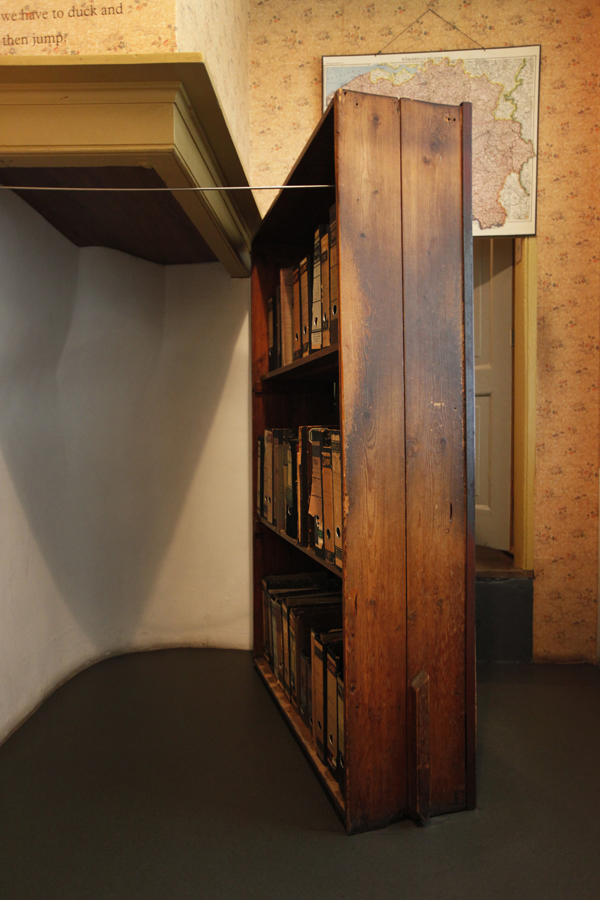
photo - The movable bookcase entrance to the secret annex
The movable bookcase entrance to the secret annex. (photo from Photos Anne Frank House, 2010. Copyright Anne Frank House, photographer Cris Toala Olivares)

When asked about his reasons for bringing his students to the exhibition, Langbroek explained that this is his 27th year in the classroom, and his reasons for doing so were spiritual – his is a Christian school – and personal, as well as professional.

“There are so many life lessons taught in this history,” he said. “By informing youth of this history and showing how bullying is a small-scale version of state-sponsored brutality, we can help train them in God’s righteousness.”

Raised by Dutch parents, Langbroek’s mother saw Jews being arrested and taken away in trucks; two of his uncles took Jews into their homes. An avid reader of Chaim Potok’s work, Langbroek has long been fascinated by “the pockmarked history of pogroms, exiles and forced conversions that took place in the Christian era.” He said he struggles with the atrocities committed in the name of a savior who set himself “the highest moral standard.” He added, “To me, it would only be natural for a Christian to risk his life to hide Jews.”

As well as the photographs and information on the boards, the exhibition room at the VHEC includes a 3-D model of the building and annex where the Franks were hidden. The students were clearly interested in the model and there was much crowding around, leaning in and craning of necks. Here, Kirchner honed in on the Franks’ living conditions, supported by a few trusted friends with shared food rations and occasional treats, like magazines. How do you occupy yourself when you are stuck inside for two years? she asked the students to consider. What about during the Allied bombing raids? Everyone else was hiding underground, in shelters, while Anne was in an attic at the top of a tall building. She couldn’t go down and risk being caught, noted Kirchner, but there were bombs landing all around them.

The exhibition also includes five glass cases housing original artifacts, saved by local Holocaust survivors. These items are particularly valuable, said Krieger. “A document is an eyewitness to the time.”

In a recent article for VHEC’s newsletter, Zachor, Kirchner talks about these donations from local survivors. She says that they help students to develop a personal relationship with Holocaust history. For example, in one case, students are able to see the yellow star worn by Inge Manes before she was hidden in a convent and confirmed as a Catholic. In another case, there is a medal showing that her rescuer was honored by Yad Vashem for bravery. The personal connections formed during these visits are an education that lasts a lifetime. Krieger refers to this as an “ongoing resonance.”

The King’s School students clearly appreciated the artifacts. They were given copies of an identity document belonging to Regina Bulvik. Asked to interpret the information it carried, they learned that she was the sole survivor of the Holocaust in her family, and had traveled to Canada alone, with no papers. At that time, she was still a teenager and was required to have a Jewish sponsor family here before being allowed to immigrate. The students pored over this document, scrutinizing it carefully as they responded to Kirchner’s questions.

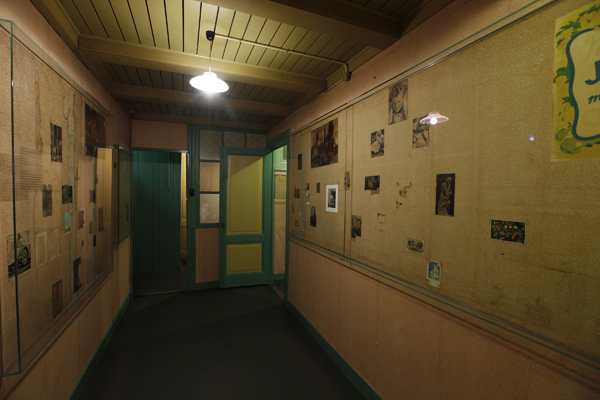
photo - nne’s room. After the Frank family took up residence in the secret annex, Anne pasted all sorts of magazine clippings and postcards on the walls of her room
Anne’s room. After the Frank family took up residence in the secret annex, Anne pasted all sorts of magazine clippings and postcards on the walls of her room. (photo from Photos Anne Frank House, 2010. Copyright Anne Frank House, photographer Cris Toala Olivares)

On returning to school, the students’ comments about the exhibit were telling. They spoke about justice, love and kindness. They showed gratitude for their freedoms and their desire to live well with God.

Vanessa contemplated the inner life of the Franks, who “probably felt guilty because their Jewish friends and family were sent to concentration camps while they were hiding and getting help.”

Added Hannah, “I would always wonder, Are my Jewish friends in a labor camp right now or even dead? And what would it be like if I was not a Jew and just a regular German?”

Caleb imagined being in the annex, being afraid to “step on a creaky floor board.” Megan said she’d miss “feeling the sunlight on my back.”

For these students, the exhibition is about prejudice and intolerance. It’s about standing up for – rather than judging or bullying – those we perceive to be different than ourselves. It’s about suffering through harsh lessons and still making dignified, compassionate choices.

Anne Frank – A History for Today is at the Vancouver Holocaust Education Centre, 50-950 West 41st Ave., until July 31, Mon-Thurs, 9 a.m.-5 p.m., and Fri, 9 a.m.-4 p.m.

Shula Klinger is a freelance writer living in North Vancouver.

Format ImagePosted on June 13, 2014June 13, 2014Author Shula KlingerCategories LocalTags Adara Goldberg, Anne Frank, Holocaust, King's School, Nina Krieger, Peter Langbroek, Vancouver Holocaust Education Centre
Researching family history is deeply rewarding

Researching family history is deeply rewarding

The author’s grandfather, Solomon/Zalman (later, Bernard), is at top right.

I have been researching my family history for some years now. Usually, over the winter break, when life slows down to a dull roar and I can spend time at the computer. I pore over JewishGen for hours, entering names of people and places into search engines. The same searches over and over, hoping that databases will have been updated; that something in my mind will click; that I will finally reach the right person; that the right person will still be alive – that someone will be able to tell me what happened to the women in that photo. The photo from Vienna. The photo of the family that could have been. That should have been. These four brothers and two sisters. The brothers who escaped. The women who did not, and perished. Where? How? The women whose stories have never been told. Or maybe they were told to someone in the United States, Argentina, Scotland or Mexico – but not to me.

In recent months, I have started to ask new questions. These new questions are concerned, as ever, with the people in the photo. But they are also about my own motivation. Why do I feel compelled to keep searching? Why do some people live by the adage that it’s all water under the bridge, while others steadfastly paddle upstream? Would it not be easier to drift with the currents of time, away from our family’s past and just meander, uncomplaining, toward the future?

People used to tell me that true self-knowledge only comes to us when we have children of our own and are challenged daily, hourly, to face ourselves. We find out if we have truly stuck to the resolutions of childhood. You know, the resolution that we’d do things differently, be more engaged, more sensitive, empathic, less busy, more patient – that we’d truly remember what it was like to be a child.

Sure enough, since my first searches brought me in touch with my many cousins, I have had children of my own. I watch our older child leaving behind his early childhood, becoming more and more aware of our small family unit. I hear his wistful questions during each year’s big festivals and explain that our family is scattered across the world. I set up Skype for him to speak to relatives on other continents. His curiosity, persistence and intellect are bound to lead to more searching questions, questions about who we are and where we came from. And since he is already attached to his Jewish roots in our household of mixed traditions, I know that I’ll need to get my story straight soon enough. I know this because it is already beginning. Perhaps this is why I search, I wonder? So I can look him in the eye and know that I don’t have to fudge it?

But then I realize that my motivation comes from a more complex place than one where i’s are dotted and t’s are crossed. It’s not just about information; it’s about education.

There is certainly no education quite like motherhood. Children are such dogged teachers. Their curriculum may seem haphazard at times, their lesson planning a little sketchy, but when I take a step back – a really big step back – I find that what they are teaching me has as much to do with my ancestors as the two little chaps asking me to help them finish a puzzle, reassemble a broken toy or read a particularly difficult word.

Researching one’s family history is a gesture as deeply spiritually maternal as the act of raising one’s own children. Yes, there is a visceral desire shared by all humans to know where we come from and who we are, but there is an added layer of compassion, of love, of nurturing that comes when the people we love are gone.

Researching one’s family history is a gesture as deeply spiritually maternal as the act of raising one’s own children. Yes, there is a visceral desire shared by all humans to know where we come from and who we are, but there is an added layer of compassion, of love, of nurturing that comes when the people we love are gone. And not only are they gone, they left us too soon and in a manner so horrific that time and again, the adjective I hear from survivors’ children and grandchildren is “secretive.” So often, people simply don’t want to talk. They don’t want to share their stories because that would mean choosing to relive the horror, to tell tales that are replayed in dreams over and over again. The ones that wake them up at night and destroy the possibility of sleep for hours to come.

Those of us who grew up in the safety of this part of the world, we who are too young to have been witnesses to these crimes against humanity, we are aware of our good fortune. We know how lucky we are to have grown up in peacetime and, yet, we can feel somehow diminished by our lack of suffering. At the same time, and as we become parents ourselves, we dream of extending our parental love back through time to embrace and soothe the wounds inflicted on our forebears. We recall those who died in infancy or childhood. Having expanded our capacity for love, our fluency in that subtle language, we want to communicate absolute safety to that vulnerable child, the terrified adult unable to keep her children safe. We are challenged by the desire to reach out to our tormented and murdered ancestors, adults and children alike, to lift them out far beyond the atrocities and into the warmth of our own homes, our present, a safe and comfortable existence that they never knew.

And yet, unable to do so, we do what we can. We learn their names and we express our empathy and our sorrow by inscribing them and their stories in Word documents late at night while our children sleep, so that tomorrow, when they wake up, their parents can let them know, as they do every single day, that they are loved, that their world is safe and that, as small as it is, the human heart embraces the whole wide world.

Shula Klinger is an author-illustrator in North Vancouver, B.C. Her young adult novel, The Kingdom of Strange, was published in 2008 by Marshall Cavendish.

Format ImagePosted on February 28, 2014April 11, 2014Author Shula KlingerCategories LifeTags JewishGen, The Kingdom of Strange

Posts pagination

Previous page Page 1 … Page 5 Page 6
Proudly powered by WordPress