
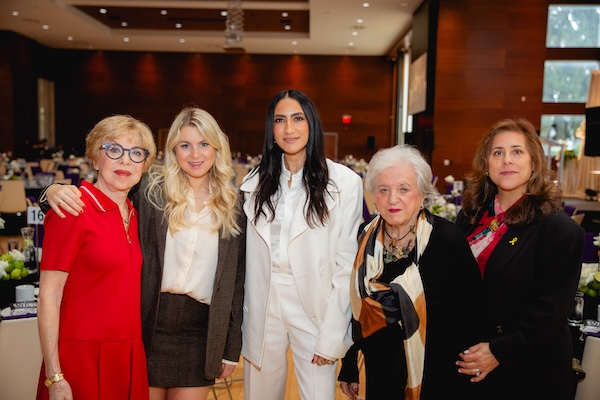
Choices keynote speaker Mandana Dayani, centre, with event co-chairs, left to right, Gail James, Briana James, Lola Pawer and Lisa Boroditsky. (photo by Rhonda Dent)
On Nov. 16, Choices once again celebrated the work of Jewish women philanthropists. This year’s theme, “L’dor Vador” (“Generation to Generation”), reflected the more than 400 people who attended the 21st annual event, which took place at Congregation Beth Israel.
“We saw so many younger, first-time attendees,” said Ricki Thal, associate campaign director at Jewish Federation of Greater Vancouver.
The event’s four co-chairs also represented the theme: Gail James and her granddaughter, Briana James; Lola Pawer and her daughter, Lisa Boroditsky.
Briana James introduced the keynote speaker, business leader and activist Mandana Dayani. In doing so, James said “our future shines bright,” with Dayani leading the way in philanthropy and activism, fighting antisemitism and advocating on behalf of women’s rights.
Dayani took the stage with her husband, Peter Traugott, presenting her material in conversation with him.
A Hollywood film producer with credits including HBO, Apple TV and Netflix, among others, Traugott also holds a master’s in business administration from Harvard University. He set a light-hearted tone, quipping, “This is my first at this – [being] Mandana’s ‘plus one’!” Speaking about their Jewish life in Los Angeles, where several members of the Dayani family live close by, he described a cross between Everybody Loves Raymond and My Big Fat Greek Wedding.
Traugott asked Dayani about her experiences as a new immigrant in New York. She spoke of the culture shock, the lights and traffic in New York. She also spoke, with gratitude, about HIAS (Hebrew Immigrant Aid Society), which supported her family’s flight from Iran, found her father a job as a shoe salesman and found them a place to live, where they became part of the community.
Dayani said her earliest memories of Iran are of “the morality police, the fear in everyone’s eyes.” She recalled having a gun pointed at her when she was just 4 years old. She is now 43.
Her family, who had wanted to leave Iran since the revolution in 1979, finally got a visa to Italy in 1987. They fled there, “leaving everything behind.” The experience has left her, she said, with an enduring sense of “how quickly this escalates, seeing my country taken over by lunatics.”
Despite having to live “with no safety net, starting over and over again, with no money,” Dayani said, “I’ve never missed a Shabbat in my life…. Shabbat is everything to us.”
Dayani’s grandfather was a rabbi and the family Orthodox. She understands the sacrifices that had to be made to maintain their traditions and feels “a responsibility” to do so as well, she said. As for integrating into American life, she described watching TV to learn how to dress, speak and behave as an American. She said, “I feel very Persian. Being a Persian Jew, that’s integral to who I am.” She also describes herself as “deeply patriotic – the US saved my life.”
Dayani takes her two daughters everywhere, she said. “If I meet my heroes, they meet my heroes. If I’m going to the UN General Assembly or the White House, they come with me.”
She and Traugott are trying to raise active, responsible citizens. “We have conversations about what’s happening in the world and they’re always rooted in kindness, through the lens of compassion,” she said.
Dayani advises caution when it comes to internalizing the messages we see online. “If we cave to the algorithms, we’ll believe that everyone hates Jews and it simply isn’t true,” she said, adding, “So many people stand with us and love us. The kids are good!”
In response to a question from Traugott about her process as a storyteller, Dayani spoke about “using storytelling to create impact,” to change society in significant ways.
Dayani acknowledged that anger spurs some of her work, such as her fight against the first Trump administration’s policy of attempting to deter migrants by separating children from their parents. She recalled her fears as a child, landing in New York, not wanting to let go of her mother’s hand. “I can’t think of a worse thing you could do to the most vulnerable population in the world,” she said. This sentiment led her to travel to Texas to see the policy in action, as the disconnect was just too powerful, she said. “The country that saved me is doing this?”
Her strategy in situations like this, she said, is to “call all the women I know who are smarter than me” to together “redirect the world’s attention to what we want them to look at. Real issues. It worked.”
She explained, “We received hundreds of millions of dollars of donated advertising…. I was so moved by how everyone showed up.”
The advertising aspect – the dissemination of information – was absolutely essential, she said, noting that “20% of the pro-Hamas information being spread on social media right after Oct. 7 was disseminated by bots, not real people…. It was planned. There was spin on the day it happened.”
When Mandani posted a video about this online within days of Hamas’s attack, the post got some 50 million views within a couple of hours. Death threats started coming in.
“I am a progressive leader and none of those people were speaking up,” she said, referring to other human rights and anti-hate activists.
Even though, as Traugott noted, Dayani doesn’t just work for a single demographic, but rather does outreach on behalf of various groups who have experienced different kinds of trauma and marginalization, she lost friends after Oct. 7 – or, as she put it, “so-called ‘thought leaders’ remaining silent because they couldn’t stand 10 negative comments” on their social media accounts. Dayani said the people she thought were her peers lacked the courage to stand up for justice when it came to Jews.
Among many other initiatives, Dayani founded, in 2024, the Calanet Foundation for young people, to harness “the power of Jewish stories in response to the branding work done by the Palestinian contingent.” After Oct. 7, she saw “so many black squares on people’s feeds,” as a mark of Jews’ grief. She also wanted people to focus on “the desert flower growing out of a crack,” the calanet (Hebrew for anemone), which symbolizes strength and resilience. She quoted the adage “They tried to bury us – they didn’t know we were seeds.”
One of Calanet’s projects is One Mitzvah a Day, which entails expressing thanks to those who stand up against antisemitism and/or in support of Israel – “one text a day, such as expressing gratitude to Trader Joe’s for selling Israeli feta,” said Dayani, noting that 5.5 million messages have been sent since the project’s January launch. Traugott pointed out that “most of the allies weren’t Jewish.”
Dayani asked the audience to consider “the power of this room, when everyone does the work.” She said, “Just do what you’re doing today – keep showing up.”
Shula Klinger is an author and journalist living in North Vancouver.