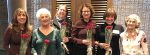
Left to right, National Council of Jewish Women of Canada Vancouver section’s 2018/19 board of directors Catherine Stoller (president), Linda Arato (secretary), Anne Lerner (social action chair), Rochelle Garfinkel (administration) and Debby Altow (past president) were installed by Shelagh Stoller, who gave a brief bio of each member and presented the traditional red rose. The 94th annual general meeting, which took place Oct. 14, confirmed members’ support of NCJWC’s advocacy at the United Nations, on Canada’s citizenship issues and against antisemitism here and abroad. Catherine Stoller reported on the programming for disadvantaged schools in Vancouver, which receives help from the B.C. Gaming Commission.
Tag: women
A personal perspective
April Ford (photo by Antonella Fratino)
In the fifth and final articles of a series on sexual harassment and violence, the Jewish Independent speaks with Montreal writer April Ford.
As the late Maya Angelou wrote in I Know Why the Caged Bird Sings, “There is no greater agony than bearing an untold story inside you.”
Montreal-born fiction writer and essayist April Ford, who has been working as associate publisher for Southern Fried Karma, a literary press in Atlanta, Ga., since December 2017, knows this all too well.
“I’m honoured to stand alongside any woman who’s been mistreated, whether or not there’s a hashtag appended to her experience,” said Ford, a bold, heart-on-her-sleeve survivor of abuse. “The #MeToo movement, like any grassroots quest for equality, is one of unleashed compassion, controversy and confrontation … and, right now, it’s a mess. Sometimes, it seems more interested in the public shaming du jour of a celebrity sexual predator than in collective healing, and that frustrates me.”
Ford said she is not a believer in public shaming. “Black Mirror brilliantly depicts this nastiness in White Bear, season 2, episode 2,” she said.
“I’m even skeptical about how much the #MeToo movement can help women who’ve been abused, but who don’t have Twitter accounts, blogs or access to other popular venues for the dissemination of dark secrets to the masses … in exchange for emoticons and the chance to go viral,” she added.
In terms of some of the stories that have come out of the movement and how they have affected her, Ford said, “The story I’ve followed most closely is that of Concordia University in Montreal, where I completed the undergraduate creative writing program in 2007. Throughout the course of my degree, I spent a lot of time on campus as an aspiring but uncertain writer, and I sought mentorship from a handful of professors. I was consistently treated very, very well – there were no strings, pressures or consequences attached to the help and encouragement I received. That said, thanks to rumours, I knew to stay away from certain individuals within that concentrated world.
“Also, I started the program when I was 23 and, I think, being a few years older than the typical undergraduate student buffered me against harassment. Or maybe the negative experiences in my life outside of the program had trained me how to get through a situation as cleanly as possible, without giving anything away that wasn’t part of the experience I had signed on for, or having it taken from me without my consent.”
Regarding some of the high-profile people who have been outed as abusers via the #MeToo movement, Ford said, “I certainly have an opinion about how to cope with the abusive actions of people, whether family members, friends, mentors, celebrities or demi-gods. First, you have to be clear on your definition of abuse … and consistent. If you’re going to accuse one person of abusing you, then you can’t switch to a sliding scale when some actor or comedian you love is proven guilty of the same offence. And, no, I don’t believe you can separate the teacher, leader or artist from the abuser. That’s like saying you can separate all the white fur from the cream fur in a cat the colour of sand. It’s ridiculous.”
Ford was adopted as a child and only discovered after marrying a Jewish man (they have since divorced) – that her birth family may have Jewish roots.
When she was 15 years old, her adoptive parents, who had been fighting for years, decided to call it quits. Her mother left their home. Not long after, Ford lost her virginity to Bruce, a 34-year-old man. Up until then, she said, she “had hardly kissed a boy.”
Bruce instructed her to start taking birth control, “which I did,” said Ford, “as soon as I found a clinic that would dispense the pill to me for free and without questions like, ‘Where are your parents?’
“While my parents were dealing with the failure of their marriage, I was dealing with the euphoria and confusion that come with being a 15-year-old girl with no adult in her life to anchor her to a safe place. My mother, in trying to move forward from the damage my father’s abuse had caused her, was unable to be a mother to me. My father, in trying to hold his world together with rage, essentially fast-tracked me into the hands of a man who … [abused] me. I did my best to keep quiet – to hide the fact that this man I had rebelliously told everyone that I loved more than life itself was raping me every weekend.
“A lot of people in my life at the time could sense there was more to the story,” she said. “But, instead of getting involved or simply buying me a hot chocolate and asking how I was doing, they stopped being my friends.”
At that time, the mothers of Ford’s former friends insulted her with terms like “slut” and “whore” and said she had no business being anywhere near their daughters, sons and husbands. Ford went from being a decent student at a private Catholic high school for girls, a horse-lover and aspiring Olympic rider, to being what she referred to as “someone to be ashamed of, an afterthought.”
Ford can still vividly recall the whispers that, to her ears, were like screams of “all-knowing” grownups predicting that she was – at that young age – already done for; that she would end up pregnant, hooked on drugs and collecting welfare.
“None of that happened,” said Ford. “Not even close. Over the years, I’ve occasionally reconnected with people from that period. And, after they express exaggerated delight to see how well I’ve done for myself, they’d defensively stammer things like, ‘You seemed so mature and into your own thing … we just figured that’s how it was…. You said you were happy. Anyway, look at you now. Everything happens for a reason, right?’ No, it doesn’t.
“I’m sure some survivors can relate to my next statement: Bruce didn’t abuse me all the time. Not every time we had sex was rape, and there were times when he tried to initiate and I refused, and my wish was granted.” But there were several instances, as well as other types of abuse, that are too graphic to describe here.
Ford finds the whole concept of “moving on” troubling.
“It’s not a tidy process and it takes time,” said Ford. “It takes a lifetime. For me, moving on involved a lot of self-injurious behaviour in my late teens through to my 20s, and a lot of self-hate that I eventually learned to disguise as wit.
“My ‘disguise’ actually helped me push forward, to appear exponentially more confident than I was, so that I could create opportunities for myself. I’ve found there’s an expectation of real-life survivors of abuse to tell our tales demurely, to dab our eyes and conclude with, ‘But that was then, and I am stronger for it.’”
One message Ford has for other survivors is to not assume that people, including family and friends, will protect the deeply personal stories and truths you tell them. She advised that survivors tell their stories to the authorities and to people in positions to protect them, physically and legally. Most importantly, Ford stressed that survivors take charge of their emotional safety.
“In the years immediately following my break up with Bruce, I felt constantly in need of confessing my unworthiness to anyone who didn’t know the story, from new acquaintances to college professors to bartenders,” said Ford. “Thankfully, there haven’t been many cases where someone I’d confided in judged me unfairly. Mostly, people are compassionate and kind. But then, just last year, a pair of colleagues at the university where I had taught for eight years ‘profiled’ me, let’s call it … because they disagreed with a choice I’d made in my private life. They accused me of victimhood, based on what I’d shared with them in our friendships. We are no longer friends.”
As a self-described atheist, when in need of support, Ford prefers systems she can interact with directly, such as “proper nutrition, regular exercise and sleep hours, close friends and cuddly animals, work and pastimes that light joyful fires in her belly, and the occasional double shot of rum with a splash of Coke on the side. These things I can trust to always be available to me, and I am free to adjust and readjust their proportions to fit my always in-flux needs.
“What has not worked for me, in terms of healing, is writing about my experiences for the sole purpose of healing. I am a fiction writer to the bone. Sure, I graft details from my life onto the stories I write. But, actually, I use fiction to explore other people’s nightmares, so that I can take a break from my own. I need one kind of noise in my head to cancel out the survivor noise, if that makes sense.”
While Ford hopes that sharing her story here will do some good in the world, she would rather not impose her story on anyone. Further, she feels strongly that no one who has been abused is obligated to become a spokesperson for others.
“Sometimes,” she said, “the abuse a person experiences is so extreme that she needs the rest of her life just to learn how to step outside of her house without fear.”
Rebeca Kuropatwa is a Winnipeg freelance writer.
Stories to bring smiles
Delightful. That’s the first word that comes to my mind for two new hardcover children’s books by members of the Jewish community that will soon find their way to my youngest nieces’ bookshelves: Pip & Pup by Eugene Yelchin (Godwin Books) and Counting on Katherine: How Katherine Johnson Saved Apollo 13 by writer Helaine Becker and illustrator Dow Phumiruk (Christy Ottaviano Books).
Yelchin’s wordless book begins with a chick hatching. On a farm somewhere, having just come out of her shell, Pip sees the world for the first time. She spies a puppy sleeping under cover of a tractor. Fearless, she goes right up to Pup’s nose to say hello. When Pup awakens and barks in greeting, Pip is thrown into a panic, not quite prepared for the full size of her relatively large new friend.
When the rain starts, Pip literally climbs back into her shell, but just to stay dry. She is no longer afraid. In fact, when she sees Pup’s distress at getting wet and at the sound of the thunder and the force of the rain, she offers what help she can. The two start to play even before the sun comes out again. A broken eggshell dampens spirits momentarily, but then it’s Pup’s time to fix things, which she does.
Pip & Pup is a simple story that is evocatively illustrated using warm colours, texture and layers, combining pastels, coloured pencils and digital painting. There is a depth to the art and the story. Children and their adult readers will have fun asking each other questions as they go along. Do you think Pip is brave to say hello to Pup? Do you like the rain? How is Pup feeling right now? How would you feel if something of yours broke?
Many questions will arise from reading Counting on Katherine, as well, though some of them will require a different kind of reflection, as the story touches upon racism, sexism and other such topics – in an age-appropriate way for readers 5 and up.
Becker interviewed Katherine Johnson, who turned 100 years old on Aug. 26, and Johnson’s family for this picture-book biography. Johnson was a mathematician at the National Aeronautics and Space Administration (NASA) and, among other things, her manual calculations were crucial in bringing the crew of Apollo 13 back to earth safely after it was damaged while in space.
In Counting on Katherine, we meet Johnson as a young girl: “Katherine loved to count. She counted the steps to the road. The steps up to church. The number of dishes and spoons she washed in the bright white sink. The only things she didn’t count were the stars in the sky. Only a fool, she thought, would try that!”
And Johnson was anything but a fool. She skipped three grades in elementary and was ready for high school at 10 years old. “But back then,” writes Becker, “America was legally segregated by race.” Johnson’s high school didn’t admit black students, so her father, by “working night and day, he earned enough money to move the family to a town with a black high school.”
Johnson’s next challenge was that, as a woman in that era, she was relegated to the teaching and nursing professions, so she became an elementary school teacher. However, in the late 1950s, the space race began, and NASA’s predecessor began hiring thousands of workers. “It even started hiring black women – as mathematicians.”
Johnson excelled at NASA and her work was integral to the United States’ space program, not just to the Apollo 13 mission, and Counting on Katherine has an epilogue that gives some additional information about Johnson. As well, Phumiruk’s imaginative digital artwork is also information-filled, clearly showing Katherine’s longing to learn, as she gazes from her bedroom window at the night sky; her joy with numbers, as she fills chalkboards with them; her anger at not being allowed to attend her town’s high school; her meticulousness, as she calculates a safe journey for Apollo 13. Counting on Katherine is a wonderful book.
The mitzvah of challah
On Rosh Hashanah, the challah is round and sweet, symbolizing our collective wish for a good, sweet year. (photo by Przemyslaw Wierzbowski)
It was two years ago that I fell in love with challah. I attended a challah baking workshop at a Jewish retreat and, at that point, the extent of my challah knowledge was that it’s sold in delis, comes in a plastic bag with a twist tie and makes great French toast. I was a challah virgin. This was around the same time that I was test-driving a more observant Jewish life, and figured it behooved me to learn more about our people’s famous braided egg bread. Little did I know how profoundly the workshop would affect me.
There we were, 40 or so Jewish women, up to our elbows in yeast dough, patiently following the instructor’s directions. She explained what each ingredient symbolizes, and how making challah each week is an auspicious time for Jewish women to pray for what they want and need. I was hooked. When it came time to make the blessing over the challah, that’s when I lost it, and became emotional. Something about a sisterhood of Jewish women gathered around tables doing something their mothers and grandmothers had been doing for generations struck a chord deep within me.
As I said the blessing, with my eyes closed and my hands atop the soft dough – “Baruch atah Adonai, Eloheinu, melech ha’olam asher kidshanu b’mitzvotav v’tzivanu, l’hafrish challah” – tears poured down my cheeks like they would never stop. The woman sitting next to me (almost a complete stranger) heard my sniffling and put her arm around me. I’m sure she was puzzled by my tearful response and, truth to tell, I was embarrassed, but I was overcome and just couldn’t help myself. Somehow, the mitzvah of making challah, and all that it symbolizes in our collective identity as Jewish women, hit me.
It mattered, in a deep-seated way, that I was part of something much bigger than myself – something inextricably tied to my Jewish roots, something to which I had paid scant attention over the years. I knew this activity would become a meaningful part of my life from that moment on. Challah is far more than just a food to sustain my family and me physically. It fills us spiritually as well. And that’s the most beautiful taste in the world.
Long story short, I now bake challah on a regular basis, for others and myself. It reminds me of who I am at my core. It draws me closer to my community of Jewish friends and acquaintances, and places me smack in the middle of what is real and true – my Yiddishkeit. Who knew that combining a few essential ingredients could produce such an inexplicable gift in my life?
It’s no secret that every Jewish custom is significant on a spiritual level. With Rosh Hashanah approaching, I set out to learn how to make one of the many unique symbols of the Jewish New Year – the round challah. The rest of the year, we make braided challot and dip them in salt, but, on Rosh Hashanah, the challah is round and sweet, symbolizing our collective wish for a good, sweet year. Its circular shape, which represents the cycle of life, has no beginning and no end, thereby symbolizing the continuity of the Jewish people. You could also say it’s a metaphor for the endless blessings that God sends us. Another interpretation is that the round challah resembles a crown, symbolizing the supreme power and authority of God.
As Rosh Hashanah nears, it’s a time for personal introspection and the beginning of our individual and collective teshuvah (return or repentance). We get ready to reflect, repent and ask for forgiveness. It’s a time to elevate ourselves and direct our thoughts and deeds toward a higher, more purposeful end. At precisely this time, when our thoughts turn to repentance and resolutions for improvement, the round challah reminds us that the opportunity for teshuvah is never-ending. This Rosh Hashanah, may we all be successful in elevating ourselves from our current reality into a higher, more spiritual state of being, on both an individual and collective level.
For those of you who want to learn more about the significance of baking challah, there’s a fascinating book called The Mitzvah of Challah by Esther Rivka Toledano (ArtScroll Mesorah Publications, 2018). The author dives deep into what is undeniably a mitzvah granted especially to women. She shares the history, the halachic (Jewish legal) guidelines, several recipes and lots more. The book goes far beyond the basics for those who really want to understand and embrace the mitzvah of challah.
May we all have a sweet, happy, healthy and prosperous New Year. L’shana tova u’metuka!
Shelley Civkin is a happily retired librarian and communications officer. For 17 years, she wrote a weekly book review column for the Richmond Review, and currently writes a bi-weekly column about retirement for the Richmond News.
Celebrating a colleague
Left to right, are Sally Berry, Debby Altow, Judy Stern, Linda Arato and Shirley Hyman. (photo by Sharon Stern)
Judy Stern was honoured at a luncheon July 31 for her long service to National Council of Jewish Women of Canada, Vancouver section.
Stern was the office manager for NCJWC for more than 12 years. During that time, she fielded phone calls about the organization’s programs, organized callers for its annual fundraiser Friends and Angels, sent out thousands of tribute cards, edited the newsletter, connected with various communal agencies, shepherded the Books for Kids materials, communicated with NCJWC members old and new, and supported the longstanding program Operation Dressup. She was a valuable and cherished colleague and we wish her well.
The lunch at Shaughnessy Restaurant was attended by several past presidents of Vancouver section and other volunteers, including Debby Altow, Linda Arato, Sally Berry, Annette Chernin, Shirley Hyman, Anne Melul, Linda Shulman, Shelagh Stoller and current president Catherine Stoller.
New views on heart disease
Dr. Ross Feldman is leading various teams as the principal investigator for women’s health at the Institute of Cardiovascular Sciences at the city’s St. Boniface Hospital. (photo from Dr. Ross Feldman)
Many of us are under the impression that heart disease mainly affects men. But researchers have been trying for the last few decades to change this skewed view. One such researcher, Dr. Ross Feldman, recently found his way to Winnipeg. Feldman is leading various teams as the principal investigator for women’s health at the Institute of Cardiovascular Sciences at the city’s St. Boniface Hospital.
According to Feldman, “Most of what we know in terms of risk and benefit and treatment of those factors that contribute to heart disease initially came from studies of younger people with more advanced risk factors – be it cholesterol, high blood pressure, [etc.] – and what the benefit was from the treatment of those problems, in terms of reducing risk of heart attacks or strokes. Women tended not to be included in those studies, because premenopausal heart disease risk is so much lower. So, in the earlier days, we developed guidelines that were mostly based on findings in younger men. It really wasn’t appreciated that women had accelerating risk after menopause.”
This new understanding about the connection between post-menopause and heightened risk of heart disease has only come to light in the past 10 to 15 years. The Heart and Stroke Foundation is only now, within the last year, opting to make the topic a priority.
“I think it’s taken even longer for it to register on the psyche of healthcare professionals … that women are at an increased risk post-menopause,” Feldman told the Independent. “They’re also much less likely to be diagnosed appropriately, less likely to get appropriate treatment, and they are more likely to have complications with trying to fix blood vessel problems. They’re less likely to be sent out following a cardiac event on all the right medications. And then, ultimately, a little more likely to die of heart disease.”
Feldman believes this lag time – for women to get the correct diagnostics and treatments – will not change anytime soon, unfortunately, as the training provided in medical schools is still based on past knowledge about women and heart disease. Medical students are still being taught that women are more likely to present with atypical chest pain, with no further explanation, said Feldman.
“If women are most likely to present that way, why are you calling it atypical chest pain?” he asked. “It gives you an idea of how male-centric our whole approach to heart disease has been. What we get out of it is, you often see a dichotomy, that sometimes you’ll see premenopausal women at risk of being over-treated.
“A woman, premenopause with hypertension, probably doesn’t need blood pressure-lowering therapy unless their blood pressure is greater than 160 over 100. Whereas, a post-menopausal woman with multiple smaller elevations in individual risk factors – a little bit higher blood pressure, a little bit higher cholesterol – will often get overlooked…. Yet, she is at a much greater risk than will be projected, based on consideration of any individual risk factor.
“There needs to be a sex-specific approach to management of the risk factors of heart disease and the presentation for heart disease,” he said. “The guidelines for that approach are still in flux.”
As medical practitioners are lagging behind the latest findings about women and heart disease, Feldman said that premenopausal women don’t need to be as concerned about risk factors that may be a little out of whack, such as LDL cholesterol or blood pressure. However, he said, post-menopausal women need to be advocates for more aggressive treatment for even seemingly marginal elevations in risk factors.
“The problem is that primary care professionals, a lot of them, will tend to underestimate the risks,” said Feldman. “There are reasonable calculators that will tell people, if you add up several small risks for a post-menopausal woman, that translates into an overall risk level that mandates more aggressive therapy. Generally, blood pressure and cholesterol are the most important factors to look at, but it’s the whole aggregate risk based on the calculation that tells you how aggressively you need to treat, regardless of the extent of the elevation.”
While researchers like Feldman are working on sex-specific therapies, women can help themselves by reducing their degree of risk via exercise, maintaining a healthy weight and a healthy diet, keeping hydrated and finding ways to keep stress and anxiety levels down.
“As women age, as with men, excessive salt intake increases blood pressure and often that excessive salt doesn’t primarily come from the salt shaker, but from processed foods,” said Feldman. “When shopping, shop the rim of grocery stores. Stay away from the aisles. Maybe shop in the frozen food sections, but probably not.
“To date, there is no real sex-specific preventative approach. That is, exercise, as far as I know, is as effective in blood pressure reduction and weight reduction for men as it is for women … maybe a little more effective in women, but likely marginal differences. I think it’s important for women to know that weight gain and a more sedentary lifestyle are bigger risks for them than for men. Men tolerate being couch potatoes a little better than women do.
“The slope of the line for weight gain in men is pretty linear,” he said. “In women, there’s an increase in slope of weight gain after menopause. Women’s systems are less tolerant of the kinds of changes that occur with age than men’s.
“We know there are ethnic differences in risk tolerance,” he added. “We know that Asians are less tolerant to weight gain than Caucasians. That is a genetic difference. We hadn’t appreciated that sex differences work the same way, although we should have, as, ultimately, a sex difference is a genetic difference.”
Rebeca Kuropatwa is a Winnipeg freelance writer.
הערים היקרות בעולם
הונג קונג (סין) היא העיר היקרה ביותר בעולם. (צילום: Estial)
מי אמר שקנדה יקרה: רק 5 ערים קנדיות ברשימת 209 הערים היקרות בעולם
חברת הייעוץ מרסר מפרסמת את הדוח השנתי ליוקר המחייה בעולם. המדד של מרסר המתפרסם זו השנה ה-24 ברציפות כולל 209 ערים, והוא מתבסס על בדיקת עלויות של למעלה מ-200 מוצרים שונים (כולל הוצאות לדיור, הוצאות על מזון, הוצאות על תחבורה, הוצאות על מוצרי צריכה לבית, הוצאות על ביגוד והוצאות על בידור).
קנדה שיש טוענים שהיא מדינה יקרה מיוצגת רק על ידי 5 ערים ברשימת 209 הערים היקרות בעולם. טורונטו במקום ה-109, ונקובר גם כן במקום ה-109, מונטריאול במקום ה-147, קלגרי במקום ה-154 ואוטווה במקום ה-160.
הונג קונג (סין) היא העיר היקרה ביותר בעולם. אחריה בעשירייה הראשונה: טוקיו (יפן), ציריך (שוויצריה), סינגפור (סינגפור), סאול (דרום קוריאה), לואנדה (אנגולה), שנחאי (סין), נג’מנה (צ’אד), בייג’ין (סין) וברן (שוויצריה).
העשירייה השנייה: ג’נבה (שוויצריה), שנז’ן (סין), ניו יורק (ארה”ב), קופנהגן (דנמרק), גונגג’ואו (סין), תל אביב (ישראל), מוסקבה (רוסיה), ליברוויל (גבון), ברזוויל (הרפובליקה של קונגו) ולונדון (בריטניה).
דיון בוועדת העלייה והקליטה של הכנסת להוקרת תרומת יהודי קנדה
ועדת העלייה, הקליטה והתפוצות של הכנסת קיימה דיון מיוחד להוקרת יהודי קנדה, ביום שלישי שעבר (ה-26 בחודש).
בקנדה חיים כיום למעלה מ-400 אלף יהודים ומדובר בקהילה השלישית או הרביעית בגודלה בעולם, מחוץ לישראל. מרבית היהודים בקנדה חיים בריכוזי הערים הגדולות: טורונטו ומנטריאול.
שגרירת קנדה בישראל, דבורה ליונס, שהשתתפה בדיון המיוחד של ועדת העלייה והקליטה, אמרה בין היתר כי היהודים החלו להגיע לקנדה כבר בשנת 1760. הפרלמנט הקנדי החליט כי חודש מאי יהיה חודש מורשת יהודי קנדה, מדי שנה. ליונס הדגישה כי קנדה תמשיך להילחם עד חורמה באנטישמיות ובתנועת החרם נגד ישראל והיהודים. ובמקביל קנדה תמשיך להנציח את זכר השואה תוך אמירת השבועה “לעולם לא עוד”. היהודים בקנדה ימשיכו להיות בטוחים ומוגנים כמו שאר האזרחים בקנדה.
ליונס עושה רבות לקירוב היחסים בין ישראלים לפלסטינים. במרץ אשתקד היא אירחה במעונה הרשמי כמאה נשים מתנועת “נשים עושות שלום”, המבקשת לקדם את הפיתרון הסכסוך בין שני העמים. האירוע לרגל יום האישה הבינלאומי, כלל את השתתפותן של 11 שגרירות שמהכנות בישראל (בהן מסלובניה, פינלנד ואירלנד). וכן שלוש סגניות שגרירים. ליונס אמרה באירוע: “התכנסו הערב, נשים מכל העולם, כדי לתת הכרה לתפקיד הקריטי שנשים ישראליות ופלסטיניות ממלאות בחברה כאן על כל רבדיה. אין מטרה נעלה יותר מאשר שלום במדינה. במיוחד היום כשאנו נושאות את מבטינו מסביב, אנו רואות מספר עולה וגובר של קונפליקטים, אשר גובים מחיר אנושי במיוחד מנשים וילדים. לכן מצאנו לנכון שהיום – יום האישה הבינלאומי, נישא על נס את התפקיד החשוב שממלאות חברות בארגון נשים, שעושות שלום ובקידום השלום. הטרמינולוגיה בה משתמשות הנשים הייתה ביטחון כולל על רבדיו השונים. ביטחון הוא לא רק צבא, אלה הוא גם ביטחון כללי, חברתי ואישי. אך מעבר להרחבת המושג, מדובר בשיתוף נשים בהליכים המובילים להסכמי שלום. כאשר נשים מעורבות במשא ומתן ההסכמים שנחתמים מכילים יותר ומחזיקים מעמד לטווח ארוך יותר. למרות זאת, כיום רק 9% מהנושאים ונותנים הינן נשים. ורק 4% מהחתומים על הסכמים הן נשים. משמעות הדבר היא בפועל כאשר מדובר בהחלטות קריטיות על ביטחון, ממשל, חוקים ותקציבים, כחצי מהאוכלוסיה נשארת מחוץ למעמד החשוב של קבלת החלטות. אנו תומכות במעורבות גוברת של נשים בחברה, דבר היביא לשיפור מצבה”.
Going beyond clothing
Donna Karan’s Urban Zen includes pieces to be worn year-round. But the project is grander than a fashion line – it is a broader approach to life that she hopes will speak to many people. (photo from fashionmodeldirectory.com)
With the sun finally out for days running, spring has truly sprung. We can now satisfy the urge to take out our colours from the back of our closets. That bright pink silk blouse in its garment bag is once more seeing the light. Whatever the current look may be, nothing compares to feeling at home in our classics; those pieces that are, at least to us, forever “in.”
In 1985, Donna Karan introduced to the world of fashion the “Essential Line.” In her first private collection, there were seven simple pieces that continue to be timeless. These include the oversize sweater, a bodysuit, jersey dresses, Lycra tights (no longer just for exercise class), a white shirt, loose trousers and a tailored jacket. Over the years, she would incorporate new pieces, in her go-to favourite colour, black.
Karan, born Donna Ivy Faske, in 1948 in New York, was raised by a fashion-model mother and suit-designer stepfather – she was practically destined to have a lifelong career in fashion. The many awards she has received are but one proof of her talent for it.
At the age of 14, Karan quit school and embarked into that world, working in a boutique. At 20, she was accepted into the renowned Parsons School of Design. After graduating, she became, at 26 years old, head designer of the Anne Klein fashion house.
In 1984, Karan divorced her first husband, Mark Karan, and married Stephen Weiss. With full force, she began her own label. The line was geared to “design modern clothes for modern people.” She wanted to create clothing that she herself would wear and in which she would feel comfortable.
After dressing the likes of her best friend, Barbra Streisand, many A-list Hollywood stars and high-powered women in politics, Karan launched a new brand in 1988, DKNY, a line of less-expensive clothing. Seventeen years later, her business expanded into a men’s fashion line, fragrances, bedding. She also wrote a memoir, The Journey of a Woman: 20 Years of Donna Karan, among other accomplishments.
Karan’s Urban Zen came to fruition in 2001. While watching her beloved husband lose his battle to lung cancer and experiencing the sale of her empire to the multinational LVMH (where she stayed on as head designer until 2015), Karan learned that everyone must “find their calm in the chaos around the world.”
Urban Zen includes pieces to be worn year-round. But the project is grander than a fashion line – it is a broader approach to life that she hopes speaks to many people.
Karan believes it is fundamental to blend Eastern healing together with Western science. While watching her husband undergo chemotherapy, Karan found mediation, yoga, acupuncture and other holistic remedies essential for healing, and for acquiring some sense of inner peace. She built a harmonious sanctuary in the hospital where her husband was being treated, Beth Israel Medical Centre in New York. The sanctuary is a place for patients, loved ones and staff to go to recover from broken spirits and find solace. Its philosophy and practices have helped ease suffering to such a degree that, now, many hospitals and hospices have adopted its methods. The concepts are taught to doctors and nurses through Karan’s foundation, UZIT, Urban Zen Integrative Therapy Program.
On a personal level, this fashionista-writer, who has always loved and appreciated the fun of fashion, also experienced an “aha” moment while researching this article. Being a cancer survivor and having overcome some unwanted surprises life has thrown my way, this spring, I am determined to embrace perfecting my downward dog as much as finding my new bag – devoting time to practising gratitude and investing in my most important asset, me. My tranquility and health are more important than any blouse.
Ariella Stein is a mother, wife and fashion maven. A Vancouverite, she has lived in both Turkey and Israel for the past 25 years.
Crocheting as work
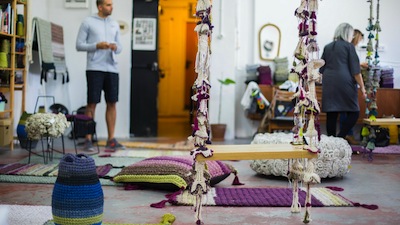
The label for an Iota rug and pouf hand-knit by Kefaya, a Bedouin woman. (photo from Iota)
Some of the best projects are born out of a desire for change – at least that was the case with Iota, an Israel-based textile company empowering unemployed women through the art of crochet.
Each one of the company’s rugs, pillows and home accessories is hand-crocheted by Bedouin women from their own homes, providing them with meaningful work and an independent source of income.
Bedouins are an Arab Israeli subgroup, located mainly in the south, with their own distinct culture and social norms. Historically, Bedouins lived a nomadic lifestyle, and many still herd livestock. Women traditionally tend to the house and children, resulting in high unemployment and poverty rates. A 2015 survey showed the employment rate among Bedouin women as 22%, compared to 32% for all Arab women.
Founded by Shula Mozes, an active social entrepreneur for more than 16 years, Iota aims to support the many women, all over the world, who are unable to work outside of the home due to cultural, religious and geographical reasons.
When she started the company in 2014, Mozes chose crochet, a self-taught hobby, as a means to create a business that could empower these women and fuel social change. With the help of creative director Tal Zur, she later discovered that not only is crochet a very versatile technique, but it has its own universal language that can be written and learned, like music notes.
“I realized that if I can learn to make things by crocheting small elements and putting them together, maybe we can teach women who don’t have work how to do the same,” Mozes said.

Iota now runs a small studio in Tel Aviv, where an all-female team of textile experts dreams up intricate designs. At least once a week, a member of the Iota team travels to Hura, a Bedouin village in southern Israel, to deliver raw materials to the women the company employs. Once complete, the finished products are transported back to Tel Aviv, each piece bearing a label signed by the woman who made it.
Currently, Iota employs three women in Hura, an intentionally small number, Mozes said, in order to maintain a strong commitment to each worker. “We have to respect their culture and empower the women slowly, so that they can work according to what they’re comfortable with,” she said.
Though centred on a 200-year-old technique, Iota’s designs are modern. The yarns used to create each piece are bespoke, developed in-house and produced in a local Tel Aviv factory. Mozes said that, by applying computerized designs, they’re able to create yarns that contain several different colours in the same thread, allowing the carpets to be made with one continuous string of yarn.
While Iota is currently only active in Israel, Mozes said she hopes to collaborate with other communities worldwide, which are experiencing high rates of female unemployment.
In January, Iota exhibited its collection for the third time at Maison & Objet, an international trade fair in Paris known for showcasing innovative design talents. The collection, ranging in price from 200 to 2,000 euros (from $315 to $3,150 Cdn), consists of colourful single-yarn rugs, oversized floor cushions, stools, one-of-a-kind swings and home accessories.
“I hope that, in the future, we will be able to take one of the women with us to an exhibition so she can experience the success of Iota firsthand,” Mozes said. “Without them, none of this would have happened.”
For more information, visit iotaproject.com.
Israel21c is a nonprofit educational foundation with a mission to focus media and public attention on the 21st-century Israel that exists beyond the conflict. For more, or to donate, visit israel21c.org.
A need for ethical guidelines
This time of year, we read Torah portions in the Book of Leviticus. It’s full of information about how to do sacrifices at the Temple in Jerusalem. It’s a good reminder – things have changed in the Jewish world, haven’t they? Perhaps we don’t need details for how to do a sin offering, an offering of well-being or for first fruits? Then again, maybe we do.
Huh? No, I don’t mean we need to learn to kill animals to sacrifice them. However, the rituals described in Leviticus have become guidelines for other things we do. For instance, it’s common to make a donation to a synagogue in honour of someone, or to express gratitude for a return to good health, a success at work or a family celebration. There are modern interpretations for some of these rituals, including the need to do something to repair things when feeling guilt or after committing a sin.
Parts of Leviticus offer us good metaphors … reminders that we can apply to other things in Jewish life.
I receive an email newsletter from the Jewish news organization JTA. One of the articles that popped up was about fundraising: “Women in Jewish fundraising say harassment is pervasive.” I followed the link. It turns out that fundraisers for Jewish organizations and in the nonprofit world are mostly women.
Donors? You guessed it, are predominantly men. Just like in other parts of the #MeToo professional world, many Jewish fundraisers have tolerated widespread harassment in order to do their jobs. If you don’t bring in the money, it’s hard to keep your fundraising job. These fundraisers have told hair-raising tales of stalking, requests for dates or sexual favours and dangling professional opportunities “if only” the woman professional would “cooperate.”
Most of us don’t want to imagine that one’s body has to be part of a professional encounter in the fundraising arena, unless perhaps your wife, daughter, mother or sister is a sex worker (and Jewish tradition has plenty of those. Read the Bible for more on that). Imagine if your daughter, recently graduated from university, went to lunch for her job at a Jewish nonprofit. A grey-haired man sat next to her, put his chequebook down, stuck his hand up her thigh under the table, and let her know that there would be more money to come if she just went out with him.
Disgusting? Yes. These days, there are laws that say both men and women deserve the same fair pay for their work and freedom from harassment on the job.
Oh, come on, some say – this doesn’t happen in the Jewish world. Well, it does. Jews can be alcoholics, drug addicts, adulterers, criminals and more. We are people. People aren’t perfect. We commit sin, and feel guilty. (Remember those Temple sacrifices?)
The sad part is that, in many ways, we groom children to be cooperative, to respect adults in their community, to listen and obey us even if they don’t know everyone’s name. This grooming, particularly for girls, starts young. This sometimes results in bad things happening. Young women tolerate a lot before they realize something bad happened and they should complain.
As someone who used to teach full-time (and a mom), I see things that make me scared in this regard. Imagine free-range preschoolers and elementary schoolers, left to roam in a Jewish community building without adequate parental supervision. Adults offer them candy or encourage them to find their parents, but no one leads them directly to the children’s activity or to their parents. Never mind the potential for accidents or getting into mischief … worse happens.
This situation is ripe for a predator to step in with candy and lure a child away. This is how horrible, life-altering, illegal things happen to children. When I mentioned this concern aloud, the response was: “Oh, kids roam around. It’s always been this way.” Really? Thank goodness that, in Jewish tradition, we evolve and change. Even the most traditional among us don’t do sacrifices anymore. We no longer sweep childhood sexual abuse under the rug. We no longer think it is OK for women to earn less, or that they must tolerate sexual harassment on the job. We no longer think it is OK for male donors to expect they can get away with this, if only they write a big cheque.
The key to changing a culture that allows sexual predation is in Leviticus, too. The instructions for sacrifice are well laid out and clear to follow. There’s a set of steps and a ritual to each one. In the JTA article written by Debra Nussbaum Cohen, she outlines some of the new efforts to make organizational and structural change to these interactions between funders and donors. This includes laying out ethical guidelines when it comes to sexual harassment and abuse, specifically addressing the power imbalance between fundraisers, who solicit donations to keep their jobs, and funders, who hold the purse strings.
Judaism has plenty to offer when it comes to respecting someone’s body, modesty and personal space. If we know the rules to appropriate behaviour, we recognize that we can do a lot to make modern environments safer and more ethical. We also must be aware that harassing fundraisers (who happen to be women), paying our Jewish professionals (who are often women) inadequately, or failing to provide our children Jewish “safe” spaces are not acceptable ways to behave as Jews.
If Jewish tradition alone doesn’t matter to some? Many of these behaviours are also illegal. We may mourn the loss of the Temple and pray for its return. However, I vote to exchange Leviticus’s ritual steps for bloody sacrifice with those ethical behavioural guidelines for donations that emerged from the rabbinic age. We can ritualize good behaviour around tzedakah (charity) instead.
Joanne Seiff writes regularly for CBC Manitoba and various Jewish publications. She is the author of three books, including From the Outside In: Jewish Post Columns 2015-2016, a collection of essays available for digital download or as a paperback from Amazon. See more about her at joanneseiff.blogspot.com.