Skip to content
  • Home
  • Subscribe / donate
  • Events calendar
  • Business Directory
  • FAQ
  • News
    • Local
    • National
    • Israel
    • World
    • עניין בחדשות
      A roundup of news in Canada and further afield, in Hebrew.
  • Opinion
    • From the JI
    • Op-Ed
  • Arts & Culture
    • Performing Arts
    • Music
    • Books
    • Visual Arts
    • TV & Film
  • Life
    • Celebrating the Holidays
    • Travel
    • The Daily Snooze
      Cartoons by Jacob Samuel
    • Mystery Photo
      Help the JI and JMABC fill in the gaps in our archives.
  • Community Links
    • Organizations, Etc.
    • Other News Sources & Blogs
  • JI Chai Celebration
  • JI@88! video

Recent Posts

  • SFU honours Gloria Gutman
  • Lifting people’s spirits
  • Wedding a ray of light
  • Indigeneity and Zionism
  • Rule of law broken: councilor
  • Football and its roles
  • The burden of defence
  • Fish Café returns after fire
  • All right in what goes wrong
  • Nuns & mermaids at TUTS
  • Camp offers holiday retreat
  • Students and mentors inspire
  • Once-in-a-lifetime trip
  • 100 dancers, one heart
  • Money for the sciences
  • What “Jewish food” means
  • Have a cookie, schnitzel too
  • Federation now across BC
  • Israel fighting for its existence
  • Deal strengthens Iran
  • Patriotic belonging diminishes
  • A campaign to engage
  • Upstanders’ first live event
  • Responding to Carney
  • Having your own home
  • Music a family tradition
  • Musical to warm heart
  • Community milestones … June 2026
  • Sharing her passion for Israel
  • Or Shalom reopens its doors
  • JFS from past to future
  • Need holistic approach
  • Sharing stories, advice
  • Journalist shares fears
  • Skills to live together
  • Road to independence

Archives

Follow @JewishIndie
image - CJN box ad Rockowers 2026

Tag: women

Milestones … Shapira, Or Shalom, Baumel Joseph, Respitz & Krug

Milestones … Shapira, Or Shalom, Baumel Joseph, Respitz & Krug

Adi Shapira brought home a silver medal for British Columbia in the 2019 Canada Winter Games. (photo by Peter Fuzessery Moonlight Canada)

From Feb. 15 to March 3, Red Deer and central Alberta hosted the 2019 Canada Winter Games. Among those taking home a medal was Adi Shapira.

Winning the silver in the archery recurve, individual female event, Shapira said in a Team BC article, “It is an amazing reward for all the training I have been doing and it is just an amazing accomplishment.”

photo - Adi Shapira prepares for a shot
Adi Shapira prepares for a shot. (photo from Team BC)

According to the Canada Winter Games website, Shapira, “who had taken up archery following a school retreat in grades 8 and 9, fought hard in the gold medal match, but Marie-Ève Gélinas, came back to win the gold for Quebec.”

Shapira, 16, is part of the SPARTS program at Magee Secondary School, which is open to students competing in high-performance athletics at the provincial, national or international level, as well as students in the arts who are performing at a high level of excellence. Last November, she won the qualifying tournaments against other female archers ages 15 to 20 to represent the province of British Columbia in the February national games.

* * *

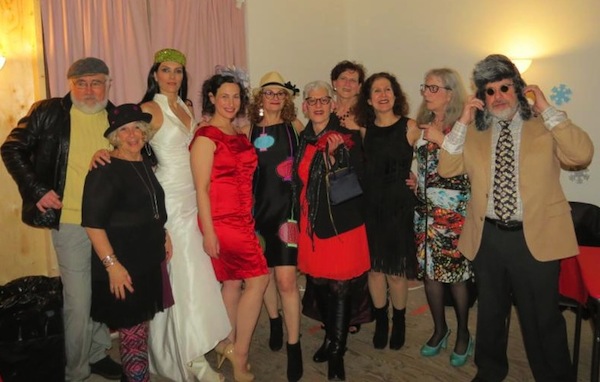
photo - The 2019 Stylin’ Or Shalom fashion models
The 2019 Stylin’ Or Shalom fashion models. (photo from Or Shalom)

Stylin’ Or Shalom on Feb. 20 was not just a beautiful evening: the event raised $1,600 for Battered Women’s Support Services so that they can continue their important work.

Models for the fashion-show fundraiser were Ross Andelman, Avi Dolgin, Val Dolgin, Carol Ann Fried, Michal Fox, Dalia Margalit-Faircloth, Helen Mintz, Ana Peralta, Avril Orloff and Leora Zalik. About 50 people attended and, between cash donations and purchases from the My Sister’s Closet eco-thrift store, this year’s show raised about $600 more than did the inaugural Stylin’ Or Shalom event held in 2017. In addition, many people brought clothing donations, which will be sold at the store, generating further funds for the organization.

* * *

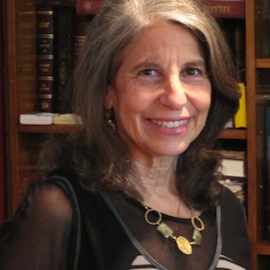
The Association for Canadian Jewish Studies has announced that Dr. Norma Baumel Joseph is the 2019 recipient of the Louis Rosenberg Canadian Jewish Studies Distinguished Service Award. Joseph brings together the highest standards of scholarship, creative and effective dissemination of research, and activism in a manner without rival in the field of Canadian Jewish studies, as well as being a respected voice in Jewish feminist studies more broadly.

photo - Dr. Norma Baumel Joseph
Dr. Norma Baumel Joseph

Joseph’s scholarship is remarkable for her mastery of both traditional rabbinic sources and anthropological methods. Her work on the responsa of Rabbi Moses Feinstein, including an award-winning article published in American Jewish History 83,2 (1995), is based on a close reading of some of the most technical and difficult halachic texts. Her mastery of these sources is also apparent in articles on women and prayer, the mechitzah, and the bat mitzvah. She has used her knowledge of halachah in her academic work on Jewish divorce in Canada, including an article in Studies in Religion (2011) and is a collaborator in a recently awarded grant project, Troubling Orthopraxies: A Study of Jewish Divorce in Canada.

As a trained anthropologist and as a feminist, she realizes that food is also a text and she has made important contributions to both the history of Iraqi Jews in Canada and to our understanding of the history of food in the Jewish community. Her Social Sciences and Humanities Research Council of Canada (SSHRC)-funded research has resulted in recent essays such as “From Baghdad to Montreal: Food, Gender and Identity.” Her ongoing reflections on Jewish women in Canada, first appearing as early as 1981 in the volume Canadian Jewish Mosaic, are foundational texts in the study of Jewish women in Canada.

Joseph has chosen to disseminate her research and wisdom in a variety of ways. Her undergraduate and graduate students at Concordia praise her innovative student-centred teaching. Recently, she instituted a for-credit internship at the Alex Dworkin Canadian Jewish archives, which has been beneficial to both the student and the archive. She is in demand as a lecturer in both professional and lay settings. Her work in film has reached a wide audience. In Half the Kingdom, a 1989 NFB documentary on Jewish women and Judaism, she explores with sensitivity the challenges – and rewards – of being both a feminist and an Orthodox Jew. She served as consultant to the film, and was a co-author of the accompanying guidebook.

Since 2002, Joseph has also committed herself to public education by taking on the task of writing a regular column on Jewish life for the Canadian Jewish News. Her views are based on a deep understanding of Judaism and contemporary Jewish life and are worthy of anthologizing.

Joseph is a founding member of the Canadian Coalition of Jewish Women for the Get and worked for the creation of a Canadian law to aid and protect agunot. As part of her Women for the Get work, she participated in the educational film Untying the Bonds: Jewish Divorce, produced by the Coalition of Jewish Women for the Get in 1997. She has also worked on the issue of agunot, as well as advocated for the creation of a prayer space for women at the Western Wall among international Jewish organizations.

Joseph helped in the founding of the Institute for Canadian Jewish Studies at Concordia, and convened the institute from 1994 to 1997, when a chair was hired. She was also a founder and co-director of Concordia University’s Azrieli Institute for Israel Studies. In 1998, she was appointed chair of the Canadian Jewish Congress National Archives Committee, and has remained in the position since then, under the new designation of chair of the advisory committee for the Alex Dworkin Canadian Jewish Archives (CJA). In this capacity, Joseph has been a forceful and effective advocate for protecting and promoting the preservation of Canadian Jewish archival material and for appreciating the professionalism of the staff. She has lent her time and experience to multiple meetings and interventions at various crucial junctures in the recent history of the CJA, during which she has balanced and countered arguments that would have led to the dissolution or extreme diminishing of the archives as we know it. Her work on behalf of the archives has drawn her into diverse committees and consultations. Notably, she contributed her expertise to the chairing of a sub-committee convened by Parks Canada when their Commemorative Places section was in search of Canadian Jewish women-related content. Her suggestions made during the 2005 meetings have resulted in several site designations over the course of the past 12 years.

Joseph has had a unique role in Canadian Jewish studies and Canadian Jewish life, and is richly deserving of the Louis Rosenberg Award.

* * *

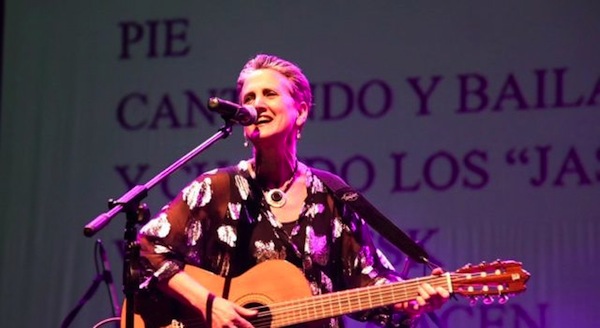
photo - Janie Respitz of Montreal won the prize for best interpretation of an existing Yiddish song at the final Der Idisher Idol contest in Mexico CityIn February, Janie Respitz of Montreal won the prize for best interpretation of an existing Yiddish song at the final Der Idisher Idol contest in Mexico City. She performed “Kotsk,” a song about a small town in Poland, which was the seat of the Kotsker rebbe, the founder of a Chassidic dynasty in the 18th century. The win included $500 US.

Respitz holds a master’s degree in Yiddish language and literature and, for the past 25 years, has performed concerts around the world. She has lectured and taught the subject, including at Queen’s University and McGill University, and is on the faculty of KlezKanada, the annual retreat in the Laurentians.

Respitz was among nine finalists, both local and foreign, who were invited to perform at Mexico City’s 600-seat Teatro del Parque Interlomas before a panel of judges and a live audience.

The competition is in its fourth edition, but Respitz only heard about it last year. She submitted a video of her performing “Kotsk” in September and received word in December that she was in the running.

A Yiddish song contest in Mexico City may seem odd, but the city has a large Jewish community, many with roots in eastern Europe, much like Montreal. The winner for best original song was Louisa Lyne of Malmo, Sweden, who’s also a well-established performer of Yiddish works.

– Excerpted from CJN; for the full article, visit cjnews.com

* * *

On March 14, at the New School in New York, the National Book Critics Circle (NBCC) announced the recipients of its book awards for publishing year 2018. The winners include Nora Krug, who was given the prize in autobiography for Belonging: A German Reckons With History and Home (Scribner). “Krug creates a stunningly effective, often moving portrait of Krug’s memories and her exploration of the people who came before her,” said NBCC president Kate Tuttle.

image - Belonging book coverKrug’s drawings and visual narratives have appeared in the New York Times, Guardian and Le Monde diplomatique. Her short-form graphic biography Kamikaze, about a surviving Japanese Second World War pilot, was included in the 2012 editions of Best American Comics and Best American Nonrequired Reading. She is the recipient of fellowships from the Maurice Sendak Foundation, Fulbright, the John Simon Guggenheim Memorial Foundation, the Pollock-Krasner Foundation, and of medals from the Society of Illustrators and the New York Art Directors Club. She is an associate professor at Parsons School of Design in New York and lives in Brooklyn with her family.

The National Book Critics Circle was founded in 1974 at New York’s legendary Algonquin Hotel by a group of the most influential critics of the day. It currently comprises 750 working critics and book-review editors throughout the United States. For more information about the awards and NBCC, visit bookcritics.org.

Format ImagePosted on March 29, 2019March 27, 2019Author Community members/organizationsCategories Local, WorldTags ACJS, Adi Shapira, archery, art, Association for Canadian Jewish Studies, books, Canada Winter Games, Janie Respitz, music, National Book Critics Circle, NBCC, Nora Krug, Norma Baumel Joseph, Or Shalom, sports, tikkun olam, women, Yiddish
Glory tour starts soon

Glory tour starts soon

The original cast of Glory. (photo by Barbara Zimonick)

I hope Glory inspires audience members to look up the Preston Rivulettes and learn how amazingly driven, committed, skilled and bad-ass these female hockey players were,” Advah Soudack told the Independent.

The Rivulettes were entered into the Canadian Hockey Hall of Fame in 1963. According to the website of the Rivulettes Junior Hockey Club, “The team played an estimated 350 games between 1930 and 1940, tying three and losing only two. In that 10-year span, the Rivulettes were 10 times the winners of the Bobbie Rosenfeld Trophy that was presented each year to the champions of Ontario. They were also six-time winners of the Eastern Canadian championship and the Elmer Doust Cup that went with it. They won the trophy each time they competed for it. The team’s crowning achievement was capturing the Lady Bessborough Trophy as Canadian champions no less than six times.”

“Their determination, their courage, their fight and their passion” were what inspired Tracey Power to write Glory, which starts its touring run March 29-30 at Kay Meek Arts Centre in West Vancouver.

Power was also interested in 1930s Canada, which “presented many personal challenges, a national depression, the growth of international hatred that would ultimately become the Second World War, and how those international relations greatly affected Canadian multicultural relations, antisemitism and sexism, to name just a few.

“Through hard times,” she said, “we often turn to sport or entertainment for escape, for community and for strength. For me, the women on this team and their coach represented not just a team of hockey players, but a country fighting to survive.”

Glory premièred last year, and the touring production brings with it some changes, including two new actors, Andrew Wheeler as the team’s coach, Herb Fach, and Soudack as the character Marm Schwartz.

photo - Tracey Power
Tracey Power (photo from Gateway)

“The choreography grows and strengthens with every run,” said Power of other changes. “I’m a huge believer in trying new ideas, and the more detailed we can be in our storytelling, the more exciting it will be for our audience. There may be some new text ideas that come out of rehearsal. I’m always open to a new play exploring new territory each time we go back into rehearsal.”

Kate Dion-Richard reprises her role as Helen Schwartz.

“Tracey reached out to me a couple of years ago to play the part of Helen in a workshop and reading for the show,” said Dion-Richard. “A few months after the workshop, I auditioned formally for the role. That included reading a couple of scenes, as well as taking part in a group dance call. The dance was a new style of ‘swing-skate’ that Tracey had created, which incorporated swing dance moves of the 1930s with hockey skills and plays.”

It is not an accident that Jewish community members have been cast as the real-life Jewish sisters.

“Marm struggles with being able to get the education she wants because of quotas universities had at the time; she fights back against antisemitism and must find ways to deal with her anger both on the ice and off. Helen is confident in her femininity and struggles to figure out how such an aggressive sport fits within the expected view of a woman of that time. It has always been important to me to have Jewish actors play these roles,” explained Power.

“During the development of the play,” she said, “the conversations we had were instrumental in bringing the characters’ truths to the stage. I am not Jewish, but it’s my duty as the playwright to understand the souls and bones of these women and what they went through. I’m extremely thankful to Kate Dion-Richard, Gili Roskies [who played Marm last year] and Advah Soudack for being so open and honest with me about their own Jewish history.

“Bobbie Rosenfeld was one of the most famous Canadian athletes of the 1920s/30s,” she added. “She was an Olympic gold medalist and, among many other sports, played hockey for the Toronto Pats. She inspired many women to follow their athletic dreams – including Hilda Ranscombe, who was the Hayley Wickenheiser of the Preston Rivulettes – and, much like Marm, she also fought against antisemitism in her sport and life.”

“The awareness of, frustration and personal experience with antisemitism are a big part of Marm’s storyline and journey in this show,” said Soudack. “I personally have not experienced the extent of antisemitism that Marm experiences in this story, however, my close family members have, and I can understand and imagine what it would be like. I feel that I bring my strong sense of Jewish identity to the role of Marm, with all its deep-rooted traditions and expectations. I also share and connect with the concern and, at times, discomfort Marm feels with being Jewish in a world where antisemitism lingers right around the corner.”

photo - Kate Dion-Richard
Kate Dion-Richard (photo from Gateway)

Dion-Richard, whose Jewish side of the family is from London, England, grew up hearing stories of living through the war from her grandparents. “Those stories stay with me and in many ways is why this role is so close to home,” she said. “Although Helen is Canadian, the antisemitism felt in Canada in the 1930s was strong and I am able to connect to that through my family’s experiences. Also, on a lighter note, I married a man who isn’t Jewish and so did my character, so that’s a nice similarity.”

And there are other connections for Dion-Richard, who was a hockey fan before taking on this show. “My large extended family of Richards are huge Montreal Canadiens fans due to our distant cousin Maurice Richard (‘The Rocket’),” she shared, “and I grew up on the West Coast, so the Canucks were frequently on the television at home. I have definitely become more of a fan since doing this show – especially of women’s hockey. The Canadian women’s team is incredible and I’d love to meet them and chat about their experiences as women in a traditionally male-dominated sport. I’d also love to know if they know about the Rivulettes!”

Soudack admitted to not having been much of a hockey fan before she started her research and work on Glory. “My husband is a big fan, so I always hear him talking about it, and get dragged onto his computer to watch videos of amazing plays and goals,” she said. However, since Glory, she has become more interested in the game. “I recently went to Thunderbird Stadium to watch the UBC Women’s Hockey playoffs,” she said. “Their commitment, drive and talent were inspiring. I was moved to tears as I sat there, thinking of Hilda, Nellie [Ranscombe], Marm and Helen, realizing and deeply understanding why they loved the game so much.”

photo - Advah Soudack
Advah Soudack (photo from Gateway)

About sports and the relevance of the Rivulettes’ experiences for today’s audiences, Soudack said, “It still feels the same, in regard to women not having the same opportunities and not really being seen as equals to men in athletic ability. I find it sad that young girls can fall in love with a sport and be exceptional at it, like Hilda Ranscombe; however, there is no future career they can look toward. Once the war was over, women’s opportunity to play sports vanished, whereas the men’s opportunities and careers took off.”

“Women not only had to fight for ice time – often having to play and practise in the very early hours or very late hours of the day; essentially when the men didn’t need the ice – but they also had to fight to be taken seriously,” said Dion-Richard. “Many of the reports of the women’s hockey games included remarks about the apparent lack of femininity within the game and some even questioned the sex of the players because of how aggressive the women were. Also, women were unable to be professional hockey players. The men were paid and the women weren’t. As a woman living in 2019, I still see the need to fight for equality with pay, representation and respect.”

Directed by James MacDonald, Glory has some minor profanity and is recommended for ages 9+. The Western Canada Theatre production – which includes Katie Ryerson as Hilda and Morgan Yamada as her sister, Nellie – heads to Gateway Theatre in Richmond April 4-13 after the March 29-30 Kay Meek shows, then to Capitol Theatre in Nelson April 16, Vernon’s art centre April 18 and Coquitlam’s Evergreen centre April 23-27. It also travels to Ontario, where it plays in several communities over the course of a few months.

“I’d love to add that this show has something for everyone,” said Dion-Richard. “The Canadian history is so important to know, as well as the fight for respect and equality that these women pushed for. They really paved the way for all of us and I hope we can show how grateful we are to them for that. This is a show that could be a link for people who don’t normally go to the theatre. It fuses sport and theatre with Canadian history, and the story is as relevant today as it was in the 1930s.”

Format ImagePosted on March 22, 2019March 20, 2019Author Cynthia RamsayCategories Performing ArtsTags Advah Soudack, cultural commentary, dance, history, Hockey, Kate Dion-Richard, Rivulettes, Tracey Power, women
Story about friendship

Story about friendship

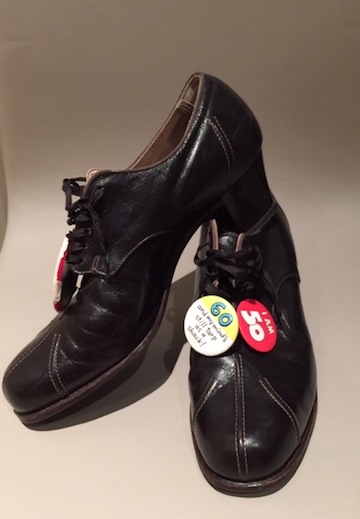
Penny Sprackman receives the special shoes on her 60th birthday, in 2006. (photos from Shirley Barnett)

Some things just happen and, before long, they become a tradition. In 1987, Harvey Shafron, while working at Freedman Shoes on South Granville, came across a rather clunky pair of women’s shoes on a top shelf and gave them to his sister, Rhoda (Shafron) Brickell.

Brickell, in turn, presented them to her friend Lola Pawer for her 50th birthday. Since then, the shoes have been passed from friend to friend among a group of Vancouver Jewish women on birthdays that end in a zero or five.

“It just happened,” said Shirley Barnett, a two-time recipient – on her 60th and 70th birthdays. “It became kind of fun to say, ‘Oh my God, it’s the shoes again.’”

The pair is not casually delivered; the recipient is formally presented the shoes at a celebration, usually at a restaurant, in front of the assembled pals.

“I really believe, as they were passed around, that it’s a story about friendship,” Barnett said. “When you reach a special age of some sort, everybody seems to say girlfriends are really important. It doesn’t matter if you’re divorced or widowed or you’re still married. At a certain age – and that could be 60, 70, 80 or 90 – a light seems to go on in women’s heads that says girlfriends are important. They are the ones you call in the middle of the night – maybe not, maybe you call your kids, I don’t know – but there seems to be an unwritten code that the older you get, you just need a few good girlfriends.”

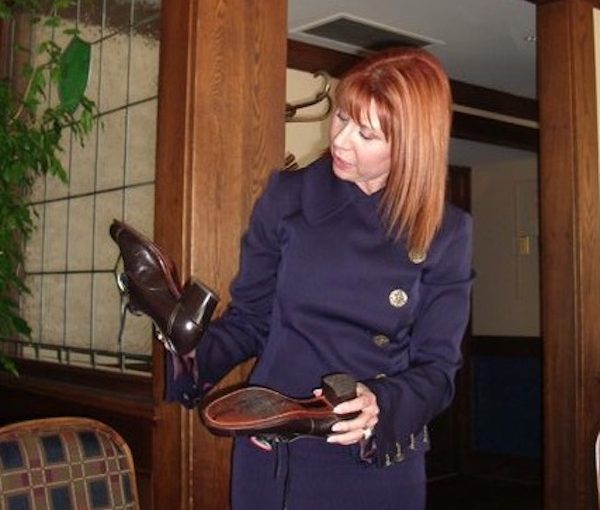
photo - The “traveling shoes”
The “traveling shoes.” (photo from Shirley Barnett)

The size 8C shoes have fit every recipient, Barnett said. A ceremonial walkabout by the birthday celebrant is a part of the ritual.

Leslie Diamond and Pawer have received the shoes five times. Sylvia Cristall and Darlene Spevakow have received them four times. Karla Marks is a three-time recipient and Carole Chark and Penny Sprackman have gotten them twice. Others who have been honoured with the pair are Maja Mindell, Shelley Lederman, Anita Silber, Sandy Magid, Esther Glotman and Cynthia Levy.

At the start, the names of the recipients were written on the soles of the shoes but, as Dorothy Parker said, time wounds all heels, and the inscriptions have become mostly illegible.

What has remained indelible are some of the remarks made by recipients over the years. Barnett, who is sort of the informal archivist of the group, has collected words of wisdom shared over the years.

“It is the friends we meet along life’s way who make the trip more fun,” said one birthday celebrant.

“Friends make good things better and bad things not so bad,” said another.

“Being older sets you free,” reflected one. “You care less about what other people think, you no longer need to question yourself. You have earned the right to be wrong and not think about what could have been or what will be.”

On one birthday, a friend declared: “Remember, growing old is a privilege and old friendships are rare. So, when your ‘old’ friends reach for your hand, grab it.”

Another gem Barnett has collected: “The better the friend, the less cleaning you have to do before they come over!”

Format ImagePosted on February 22, 2019February 21, 2019Author Pat JohnsonCategories LocalTags friendship, lifestyle, Shirley Barnett, shoes, women
Conference invigorates

Conference invigorates

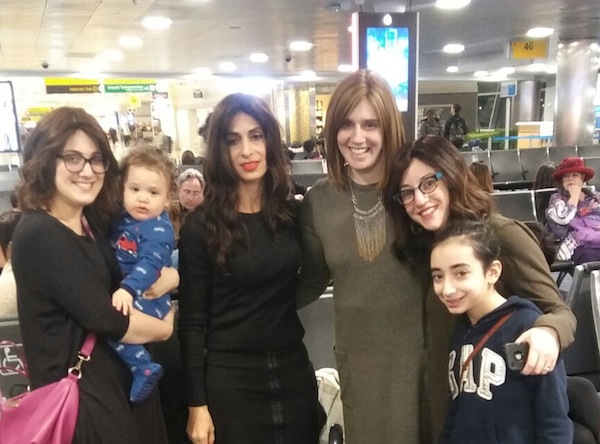
In New York for the 2018 International Conference of Chabad-Lubavitch Women Emissaries. (photo from Lubavitch BC)

Last month, nine shluchos (female emissaries) of Chabad-Lubavitch in British Columbia – Henia Wineberg, Rivki Yeshayahu, Chanie Kaplan, Shainy Wineberg, Fraidy Hecht, Chanie Baitelman, Blumie Shemtov, Chaya Rosenfeld and Malky Bitton – joined more than 3,000 women leaders from all 50 U.S. states and 100 countries at the International Conference of Chabad-Lubavitch Women Emissaries (Kinus Hashluchos) in Brooklyn, N.Y.

The annual event is aimed at reviving Jewish awareness and practice around the world. At this year’s gathering, thousands of women – hailing from as far away as Laos and Angola, Ghana and Uzbekistan – came together for five days of brainstorming about the future of world Jewry and their roles as representatives of the Chabad-Lubavitch movement.

The leaders, who embrace multiple roles and responsibilities, explored numerous issues and learned from professionals and colleagues with years of experience. The topics covered ran the gamut: understanding troubled relationships; adult education and inclusion; responding to tragedy; fundraising; the opioid epidemic; and mental health. There was also a conference within the conference for Hebrew school and preschool directors, as well as one for those who serve students on college campuses. The meeting included a parallel track for lay leaders.

“The Kinus is my yearly dose of inspiration,” said one of the shluchos. “It gives me strength and motivation for the whole year, to continue bringing light to everyone around me.”

Additional highlights of the five-day conference were a visit to the gravesite of the Rebbe, Rabbi Menachem M. Schneerson, of righteous memory, in the New York City borough of Queens; the “class picture,” where they posed for a group photo; as well as the gala banquet, where they were joined by admirers, supporters and influential women leaders for a sit-down dinner.

The conference is a tribute to the legacy of Rebbetzin Chaya Mushka Schneerson, the esteemed wife of the Rebbe, and is timed to the anniversary of her passing. Rebbetzin Schneerson’s deep care for and insight into their work remains a source of inspiration to the Chabad women emissaries.

The conference also serves another vital purpose: it represents an opportunity to connect with colleagues and recharge their personal energy. This gives the participants, especially those going back to isolated outposts, an exhilarating send-off, coupled with the sense that they are not alone.

Format ImagePosted on February 15, 2019February 13, 2019Author Lubavitch BCCategories LocalTags Chabad-Lubavitch, emissaries, Kinus Hashluchos, leadership, shluchos, women

Airing, rejecting bad ideas

Hundreds of thousands of women and allies marched in cities all over North America Saturday, bringing people from across the spectrum together to stand for equality and justice. It was the third annual network of women’s marches that sprang out of the shock and alarm after the election of U.S. President Donald Trump.

To ensure that the nearly spontaneous eruption of resistance to the direction of American (and world) politics was more than lightning in a bottle, a movement was solidified in the form of Women’s March Inc. This body, led by a small group of activists who quickly gained international fame and recognition, not only came to helm one of the most remarkable new grassroots movements in American history, they also became central figures in the cadre of leftist, socialist and progressive political activists that is loosely defined as “the resistance.”

Unfortunately – or, perhaps, fortunately, for reasons we’ll explain – the small group of Women’s March leaders has recently been beset by controversy. In a book-length analysis last month, Tablet magazine reconstructed accounts of the earliest hours of the march movement – including the marginalization of Jewish women who were there at the start and the assertion, apparently made in one of the earliest meetings, that “white Jews” were partly responsible for “white supremacy.”

Additionally, some of the leaders of Women’s March Inc. are associated with Louis Farrakhan, head of the Nation of Islam and an unrepentant Jew-hater and Hitler admirer who last month capped a career of antisemitic rhetoric by declaring Jews “satanic.” Tamika Mallory, one of the most visible faces of the march movement, has referred to Farrakhan as “the GOAT” – the greatest of all time.

These developments led march organizers in various cities to disassociate their marches from Women’s March Inc. While some figures tried to patch over or reconcile divergences within the movement, such efforts were undermined by top leaders, including Mallory, who appeared on national TV the Monday before Saturday’s marches. She defended her position on Israel and Palestine. She declared “the Palestinians are native to the land,” and that “there are people who have a number of sort of ideologies around why the Jewish people feel this should be their land. I’m not Jewish. So for me to speak to that is not fair.” She’s not Palestinian, either, her interviewer noted, yet she had no qualms defending Palestinians’ right to national self-determination.

At a time when another organization might aim for conciliation, Women’s March Inc. leaders seemed to double down on their troubles. In her keynote speech to the march in Washington Saturday, Linda Sarsour, another leading figure, expressed support for the BDS movement. While she had, earlier, finally rejected Farrakhan’s antisemitism and homophobia, her decision to use her limited time on stage to focus on BDS – an issue peripheral at best to the women’s movement – suggests she is not finished enflaming tensions with Jewish people.

Notably, attendance was down at rallies across the continent, including here in Vancouver. There could be a range of explanations – Trump-fatigue, weather – but certainly some Jewish and non-Jewish women were motivated to stay away because of the association of march leaders with bad ideas.

Within the loose affiliation of “resistance” figures, several of the individuals elected to the U.S. Congress in November’s midterm elections have made themselves known for statements about Israel and Palestine. One of the freshmen, Rep. Ilhan Omar, a Democrat from Minnesota, came under criticism for a 2012 social media post in which she wrote: “Israel has hypnotized the world, may Allah awaken the people and help them see the evil doings of Israel.” She has since said that she didn’t understand the implications in her choice of words.

Another new legislator, Rashida Tlaib, Democrat of Michigan, made her entry into Washington known by displaying a map of the world with a Post-it note with the word “Palestine” covering Israel.

These examples – and there are more – are disheartening. That these ideas have moved from the recesses of crackpot online discussion forums and into Congress, into one of the most significant grassroots organizations and, apparently, into a significant swath of the Democratic party, is certainly concerning. But there is a silver lining: it also allows us to openly confront the trend and, perhaps, to gain allies in opposing it.

When we talk about the need to shine light on dark crevices of bigotry, this is exactly what we mean. Social media has, for better or worse, allowed anyone with any views to broadcast them. In the chaotic network of the internet, there is no practical, central force for contesting bigotry and other bad ideas. When those ideas and expressions seep into institutions like Women’s March Inc., Congress or, even more noticeably, the U.K. Labour party, this presents an opportunity unavailable elsewhere. It is a chance to bring these issues out in the open and contest them in the light of day. Among other things, it forces people with power and influence to make a choice.

Among those who made choices in recent weeks – the choice to withdraw as sponsors of Women’s March Inc. – are prominent individuals and organizations, including the Democratic National Committee, the Southern Poverty Law Centre, the women’s political action group EMILY’s List, the LGBTQ advocacy group Human Rights Campaign, the pro-choice organization NARAL, the Centre for American Progress, and Amnesty International.

This is the kind of unified voice we need: a concerted rejection of antisemitism or Jew-baiting or Israel-bashing that has emerged as a force in important places.

Posted on January 25, 2019January 24, 2019Author The Editorial BoardCategories From the JITags anti-Zionism, antisemitism, Farrakhan, racism, women, Women's March

Taking principled stand

Rahaf Mohammed al-Qunun, an 18-year-old Saudi woman, was publicly welcomed to Canada Saturday. She had spent a week in a hotel in Thailand, asking for asylum in a Western country, saying that she did not want to return to her allegedly abusive family, whom she says have threatened to kill her.

Whether her family is indeed abusive has not been proven. But two factors make that issue somewhat moot. First, guardianship laws in Saudi Arabia require women to get permission from a father, husband, brother, son or other male relative in order to work, travel, marry, receive certain medical treatments and even to leave the house. This is codified inequality and abuse against about half the population of the country. In principle, that law alone should make all Saudi women eligible for refugee claims in democratic countries. Additionally, al-Qunun renounced Islam, which is an offence punishable by death in Saudi Arabia.

The teen’s arrival was a bit of a media festival, with Foreign Affairs Minister Chrystia Freeland embracing al-Qunun at Toronto’s airport.

The ostentatious greeting was extra-weighted because Canada is in an ongoing diplomatic spat with the Saudis. After Freeland tweeted a criticism of Saudi arrests of civil and women’s rights activists last year, the Saudis threw Canada’s ambassador out of the country and threatened to withdraw thousands of Saudi medical students from Canada, among other responses. The public greeting of a now-prominent Saudi dissident by a senior Canadian government official will be seen as a provocation, and perhaps it was intended as such.

Some commentators note that al-Qunun jumped the queue, not only flown to Canada to make a refugee claim, but accepted immediately as a refugee. The global visibility of her case resulted in a country – ours – leaping to accept her, even while one percent of refugees are resettled in a given year.

Also, some diplomats with Saudi experience are warning that the young woman should not be used as a political football – both because that could put her safety at risk and because it could unnecessarily enflame existing tensions.

David Chatterson, a former Canadian ambassador to Saudi Arabia, told the CBC that he worried about precedents.

“What happens the next time a teenage girl or adult woman from Saudi Arabia flees her family and declares herself to no longer be a Muslim, does that mean automatic sanctuary?” he asked.

Of course, diplomatic idealism is always tempered by economic and other realities. The CBC obtained, through an Access to Information request, evidence that the federal government heard concerns from Canadian businesses about their interests being jeopardized when Freeland’s tweets to the Saudis raised the ire of the kingdom’s rulers. On the flip side, Canada does not have as many economic ties to the Saudis as many European and other democratic countries, and this might give us a little more freedom to criticize. The U.S. president has already stated explicitly that he will not endanger American economic interests by contesting Saudi treatment of dissidents – including the murder and dismemberment of Washington Post writer Jamal Khashoggi.

Of 149 countries rated by the World Economic Forum in its annual report on gender equality, Saudi Arabia came 141st. Canada cannot free every one of the 16 million or so Saudi women, but we can ensure freedom for this one.

Yes, al-Qunun did effectively “jump the queue.” But, at the moment when the whole world was watching, that queue-jumping allowed Canada to take a principled stand for gender equality and for the freedom of – and from – religion.

Posted on January 18, 2019January 16, 2019Author The Editorial BoardCategories From the JITags al-Qunun, immigration, politics, refugees, Saudi Arabia, women
How RGB got her start in law

How RGB got her start in law

Marty Ginsburg (Armie Hammer) and Ruth Bader Ginsburg (Felicity Jones) arrive at court in On the Basis of Sex. (photo from Focus Features)

A news flash for members of the tribe who’ve been kvelling over a Jewish woman on the U.S. Supreme Court for fully a quarter of a century: Ruth Bader Ginsburg long ago matriculated beyond a symbol of ethnic achievement.

Last year’s hit documentary, RBG, noted that Justice Ginsburg is an enormously popular role model for women in their teens and 20s, and she has achieved pop culture celebrity to boot. The latest film – released recently in Canada and, as of press time, still playing in Metro Vancouver – is On the Basis of Sex, which applies the Hollywood treatment to Ginsburg’s beginnings as a smart but struggling lawyer and situates her smack in the mainstream. To coin a Lincolnesque testimonial, now she belongs to the masses.

Director Mimi Leder and screenwriter Daniel Stiepleman (who happens to be Ruth and Marty Ginsburg’s nephew) frame On the Basis of Sex as an underdog saga. And, like a lot of underdogs in Hollywood movies, our heroine has a superpower that she only discovers – and masters – on her journey.

The movie is effective, and ultimately inspiring, in a way that doesn’t remotely challenge viewers other than to ask them to follow clever legal strategies.

The film opens with Ginsburg’s first days at Harvard Law School, where her husband Marty is in his second year. Immediately and repeatedly, she (and the viewer) is reminded of her second-class status as a woman in a man’s world.

It takes awhile to reconcile the confident Justice Ginsburg of public record with the somewhat skittish character that British actress Felicity Jones creates. On the one hand, as a wife and a mother who – like every other aspiring woman professional of the time – never wears pants, Ginsburg is plainly a grownup. But she’s patronized by everyone from the law school’s WASPy dean (a villainous Sam Waterston) to her husband (a stalwart Armie Hammer), and she risks being seen as a rabble-rouser (it’s the late 1950s) simply by standing up for herself.

Although the film does not conceal or finesse the Ginsburgs’ Jewishness, it presents casual misogyny and the entrenched old boys’ network, not antisemitism, as the obstacles Ruth needs to navigate. Consequently, she has to devise ways – both direct and elliptical – to raise the consciousness of every ally, including her devoted husband, before she can even challenge potential adversaries. While Marty certainly recognizes his wife’s brilliance, he’s a product of his upbringing and the times.

On the Basis of Sex or, as it’s referred to at your favourite corned beef dispensary, “RBG: The Early Years,” devotes considerable screen time to the couple’s relationship and, for many viewers, that will serve as the emotional heart of the film. Others will derive more pleasure from Ginsburg finding her footing and her voice as a scholarly attorney.

As Stiepleman noted in an interview during a recent visit to San Francisco, “Coming out of law school, [Ginsburg] had three strikes against her: she was a woman, she was a mother and she was a Jew. Any one of those things alone, law firms had taken the risk. It was the three together that made her unhire-able in their eyes.”

Unable to find a job practising law, she takes a teaching position. Through a combination of determination, persistence and luck, she comes across a unique case that addresses the inequities of gender discrimination. The complainant, who looked after his mother but was denied the tax deduction for caregivers, is a man.

Earlier in the film, there’s a crucial chain of events when her husband is diagnosed with cancer. Ginsburg not only took care of him (and their small daughter), but got them both through law school. That experience as a caregiver gives her both the empathy and the understanding to identify with and persuade her would-be client, as well as to research and argue the case.

The lengthy courtroom scene that comprises the film’s last 20 minutes or so is genuinely effective and even emotional, despite the formulaic staging and the fact that we know Ginsburg will prevail. At the pivotal moment, we witness a character coming into her own, grasping her abilities and realizing her destiny. And with that, the underdog becomes a superhero.

On the Basis of Sex is rated PG-13 for some language and suggestive content.

Michael Fox is a writer and film critic living in San Francisco.

Format ImagePosted on January 11, 2019January 9, 2019Author Michael FoxCategories TV & FilmTags history, law, RBG, Ruth Bader Ginsburg, women
Shalvi reaches the sky

Shalvi reaches the sky

Alice Shalvi, an Israeli professor and educator, has played a leading role in progressive Jewish education for girls and advancing the status of women in Israel. Her autobiography, Never a Native (Halban Publishers, 2018), reads almost as a personal diary. Otherwise, how could this 92-year-old recall the most minute details of her life?

The youngest of two children, Shalvi was born in Essen, Germany, to Benzion and Perl Margulies, religious Zionists who owned a wholesale linen and housewares business. In 1933, soon after Hitler’s rise to power in Germany, their home was searched, prompting her father’s move to London, England. The rest of the family followed in May 1934.

In London, Shalvi’s father and brother imported watches and jewelry. When the Blitz began, they temporarily moved to Aylesbury, 50 kilometres north of London.

In 1944, Shalvi studied English literature at Cambridge University. In 1946, she was sent to the Zionist Congress in Basel as a representative of British Jewish students and, in 1949, after completing a degree in social work at the London School of Economics, she immigrated to Israel, settling in Jerusalem. She became a faculty member in the English department of the Hebrew University of Jerusalem and she earned her PhD there in 1962.

In May 1950, Shalvi met Moshe Shelkowitz (changed later to Shalvi), a recent immigrant from New York, whom she married in October of that year. They had six children between 1952 and 1967; Moshe Shalvi died in 2013.

The 25th issue of Nashim: A Journal of Jewish Women’s Studies and Gender Issues (fall 2003) was dedicated to Alice Shalvi, “who made the dream of a journal devoted to Jewish women’s and gender studies possible.” When the concept of Nashim was first presented to her, the special issue notes that Shalvi greeted it not only with enthusiasm but as an idea whose time had finally come – she and her friends, pioneers of second-wave Jewish feminism, had raised it long before. “Subsequently, as rector of the Schechter Institute (1997-2001), [Shalvi] added her voice to the approval process for the issue’s first publication. She has remained on Nashim’s editorial board ever since, contributing her wise and warm guidance on issues of editorial and academic policy and herself serving as consulting editor for our issue on Women, War and Peace.”

In an interview by Elana Maryules Sztokman for the Lookstein Centre at Bar-Ilan University some years ago – after Shalvi had been awarded the 2007 Israel Prize for life achievement – Shalvi commented: “I felt that, through the work we had done on behalf of women, an enormous change had occurred in the status of women, in the self-image of women, in the self-assurance of women and, most importantly – because that’s what the prize recognized – in the awareness of the importance and centrality of the subject of the status of women in society at large.”

Shalvi spoke about the Pelech School for Girls and the Israel Women’s Network. “The school has created a generation of young modern Orthodox women who are changing that entire social system within modern orthodoxy,” she said. “The other thing I’m proud of is the years at the network, which saw the largest number of legislative changes and reforms in women’s status because what I call the ‘alumnae’ of the network were so prominent in the Knesset.”

In her autobiography, Shalvi emphasizes “that it’s all about the home,” and acknowledges the impact her parents had on her. “What I saw at home,” she writes, “was an open attitude, observance but openness. My mother always used to set an extra place at the table on Shabbat in case my father brought home a stranger from synagogue, as was the custom in those days. And, in my family, I learned about tzedakah in the very best sense – always a readiness to help others, not only from my father, who did it on a both public and personal level, but also from my mother.

“The other thing I absorbed was Zionism. It was a strongly Zionist household, and my father was very active in the religious Zionist community. From very early on, I knew that I would come on aliyah one day. I didn’t know when, but it was definitely there in the future.”

When asked to convey one message to the next generation, Shalvi said, “Reach for the sky and don’t give up. Don’t ever give up. Even if you know you’ll never attain what you’re reaching for, persist. Keep at it. I like to quote Robert Browning’s ‘Andrea del Sarto’: ‘Aye, but a man’s reach must exceed his grasp / Or what’s a heaven for.’ Keep on striving because, even if you don’t attain that goal yourself, the chances are that, for the next generation, it will be easier.”

Sybil Kaplan is a journalist, lecturer, book reviewer and food writer in Jerusalem. She created and leads the weekly English-language Shuk Walks in Machane Yehuda, she has compiled and edited nine kosher cookbooks, and is the author of Witness to History: Ten Years as a Woman Journalist in Israel.

Format ImagePosted on January 11, 2019January 9, 2019Author Sybil KaplanCategories BooksTags Alice Shalvi, history, Israel, women
Empowering Negev women

Empowering Negev women

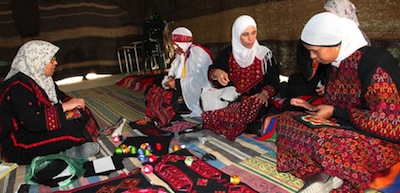
In Lakia, Israel, there are 160 women throughout the village who are responsible for designing and developing embroidery materials. (photo from Michelle Sitbon)

Our trip took us to the southern part of Israel, where we traveled to Beersheva. There is a small sign along the way, that you can miss quite easily, and it says Lakia. Lakia is one of the many Bedouin villages in this part of the country.

The Bedouins are a group of nomadic tribes who have lived in the Negev Desert for hundreds of years. Their heritage can be traced back to the traders along the ancient Spice Route, which happened to cross this region. Most traditional Bedouin hospitality experiences include camel riding, Bedouin food and staying inside a Bedouin tent overnight. However, in the village of Lakia, you are probably not going to find any of those things.

When you stop there, you are in for quite a different and unexpected experience. We arrived in Lakia in the middle of a hot summer day at the end of July and our main goal was to visit the Desert Embroidery. As we drove along the unpaved roads of the village, we quickly realized that Lakia might be small, but the Embroidery was extremely difficult to find. There was no sign telling us which direction to go, even though it is a tourist attraction.

When we finally found our destination, we got out of our vehicle and were warmly welcomed by Naama Al-Sana. She is the Bedouin woman who today runs the Desert Embroidery, and also founded the place together with other women from the community in 1996.

As we entered the visitor centre, we saw a display of beautiful art that was recently made by the local women. These women create the art in their homes in between their chores, and they use the money they earn from it to help support their families.

We were invited to sit inside a beautiful and colourful hand-woven tent, while Al-Sana offered us traditional Bedouin coffee that was scented with local spices. She was excited to hear that we had come all the way from Vancouver, as she has a sister who is currently in Canada, studying at the University of Toronto. Her sister often gives lectures about women in the Bedouin society, as a way to keep the history of this region alive.

The Desert Embroidery doesn’t offer the typical Bedouin tent experience, which includes being served a traditional meal. Instead, you will have the chance to contribute to the empowerment of Bedouin women in your own way. When you participate in one of the workshops or purchase any of their artwork, you will be actively improving the life, health and education of Bedouin women.

The Desert Embroidery was known as the Association for the Improvement of the Status of Women when it first began. The business has grown tremendously over the years and there are now 160 women throughout the village who are responsible for designing and developing embroidery materials. They also provide worker training and product marketing, and there is another group of women who work part-time to provide quality control checks on the products.

The system is very well organized. The women visit the Desert Embroidery twice a week to collect embroidery materials, drop off their finished items, learn about new patterns and designs, and participate in educational workshops and lectures. All of the women are allowed to choose how many hours they work, and they are paid by what they are able to produce within that time. A few of the women have chosen to preserve the traditional jewelry-making that was done by previous generations. They spent time learning how their mothers and grandmothers made jewelry and are now creating their own jewelry to include in the Desert Embroidery collection.

photo - With the help of the Desert Embroidery, Bedouin women in the Negev create the art in their homes, and use the money they earn to support their families
With the help of the Desert Embroidery, Bedouin women in the Negev create the art in their homes, and use the money they earn to support their families. (photo from Michelle Sitbon)

The Desert Embroidery is continuing to achieve its goal of providing employment and income for Bedouin women while empowering them and improving their self-confidence. More than 40 different artistic products can be found on display in the visitor centre, as well as other collaborations that help generate revenues for their work. An example of one of those collaborations is with Kibbutz Gan Masarik, which assists with strengthening the coexistence of Bedouin and Israelis.

The Desert Embroidery is also currently involved in improving the education and health of Bedouin children. And they want to expand to other Bedouin communities within the Negev, so that all Bedouin women can achieve economic independence. There are still so many challenges that women face in Bedouin society and this group is trying to help every woman overcome them.

The main reason I chose to visit Lakia was that I wanted to learn about this destination and the work that the Desert Embroidery is doing. My goal is to share what I have learned and to take other travelers to Lakia, so that they can see it firsthand. Of course, such activities aren’t only being done in the Negev region. In the northern part of the country, in the Galilee region, Israeli and Arab women also create traditional artwork to create a change in the lives of women.

I have made a visit to Lakia part of my itinerary in an upcoming small group tour to Israel, because I believe that travel can support and strengthen local communities. Since I am a travel agent who creates itineraries that are art-oriented, this is a perfect way to show everyone that they can appreciate art while making a difference in both children’s and women’s lives.

In the Mishnah Torah, Rambam organized the different levels of tzedakah, or charity, into a list from the least to the most honourable. Sometimes it is known as the “Ladder of Tzedakah.” The highest form of charity is to help sustain a person before they become impoverished, by offering a substantial gift in a dignified manner, by extending a suitable loan or by helping them find employment or establish themselves in business. These forms of giving allow the individual to not have to rely on others.

Projects such as those led by the Desert Embroidery can be found around the globe in places like Jordan, Mexico and Canada. When we travel, we know the many ways in which we benefit. However, I believe we should also try to find ways to benefit others as we travel, even in small ways. We should become more involved with local communities and support them in respectful ways that will, among other things, help them preserve their tradition and art.

Michelle Sitbon is an art travel adviser who organizes small group tours to Israel among other art-related destinations around world. For more information, visit yourartvoyage.com.

Format ImagePosted on November 30, 2018November 28, 2018Author Michelle SitbonCategories Israel, TravelTags art, Bedouin, embroidery, Empowerment, Negev, travel, women
To forgive and to save others

To forgive and to save others

Left to right are Megan Laskin, Sherri Wise, Karen James, Jane Stoller, Jeannie Smith, Alyssa Schottland-Bauman and Sharon Goldman. (photo from Jewish Federation)

For the past 14 years, the Jewish Federation of Greater Vancouver has organized a women’s philanthropy event called Choices. The evening is meant to inspire women to understand the power of their tzedakah and to feel part of the community. On Sunday, Nov. 4, in Congregation Beth Israel’s Gales Family Ballroom, the informal consensus in the room of more than 500 women was that Choices exceeded its objectives.

One of this year’s achievements, according to event co-chair Jane Stoller, was that there were 50 first-time attendees. Stoller explained that a table of Hillel BC students had been sponsored and there were new faces from Federation’s young adult program, Axis, in the crowd. In addition, she said a record number of Israeli women were among the new attendees.

As for the featured speakers this year, both not only spoke movingly, but they also tied in Federation as an important component of their respective stories.

Sherri Wise is a dentist who lives and works in Vancouver. She survived a triple bombing on Ben Yehuda Street in Jerusalem on Sept. 4, 1997.

Wise described the sequence of events that led her to be at a café on a beautiful sunny day and what transpired after three Palestinian terrorists each blew themselves up in the immediate vicinity. Wise was seriously injured, with more than 100 nails embedded in her limbs and second- and third-degree burns on many areas of her body. After recounting the details of this tragedy, Wise was able to focus on some of the positives that arose from the horror. “Someone from Jewish Federation in Vancouver contacted Federation in Jerusalem and a kind woman named Trudy came every day to visit me.… I never even learned her last name,” she said.

Wise said she has managed to get on with her life not only with the help of her parents and the Jewish community, but also by making a decision not to harbour anger or hatred toward those who injured her, killed seven and injured 200 others. “Those men were born innocent babies and they were taught to hate – what chance did they have?”

Wise has since helped craft, advocate for and see enacted the Justice for Victims of Terrorism Act. This bill includes deterrents to those who would support terrorist organizations financially and materially, and grants rights to Canadian victims of terrorism. Wise imparted a message of healing, gratitude and finding a way to make a positive difference.

Jeannie Smith, the daughter of Irene Gut Opdyke, was the second speaker. Opdyke, who passed away in 2003, saved the lives of 12 Jews in Poland during the Holocaust and was recognized by the Israeli Holocaust Commission as one of the Righteous Among the Nations. Smith recounted many details of her mother’s story to a captivated crowd.

At the age of 17, Gut was forced to work in, among other places, the home of a high-ranking German officer stationed in Poland near her hometown. Prior to “keeping house” for this officer, she had worked in a laundry facility at a German officer’s camp. When she learned that she would be relocated to a villa in the town and that the Jews of that town would be liquidated, she managed to smuggle the group of Jews she had worked with in the camp’s laundry into the basement of the villa.

Eventually, the officer discovered the hidden Jews but, for a variety of reasons – none of them altruistic – he did not turn them in. As the Soviets approached and the Germans fled Poland, the 12 Jews, one of whom was pregnant, fled to the forest and joined the partisans.

There are many more twists and turns to Gut Opdyke’s story, but she ended up in California, where she married an American man who was the only person in the United States who knew anything about her painful and heroic past. Gut Opdyke was moved to begin speaking about her experiences only after she received a random call from a Holocaust denier. For the rest of her life, she was a Holocaust educator who shared the story her daughter, Smith, shared with the women at Choices.

Smith expressed gratitude toward the Jewish Federation of Portland because they paid for her father to live out his life in the Jewish seniors home once he developed Alzheimer’s. Commenting about Federation, she said, “One person can make a difference, and an organization can make a mighty difference.” She concluded with what she said her mother used to end her speeches with as well: “Every day we have an opportunity to be kind, to stand up for what is right and to go against what is wrong. We can be the difference in someone’s life.”

Both Wise and Smith received standing ovations for their heartfelt stories of love and resilience.

Leanne Hazon was one of the first-time attendees at the event. Having lived in Toronto for the last 18 years, the Richmond native returned to Metro Vancouver earlier this year for work.

“I thought the whole event was amazing!” she said. “It had such a nice vibe and feeling of community, very warm and welcoming. And the speakers were exceptional…. Sherri Wise’s message of forgiveness was so powerful and Jeannie Smith’s story about her mom was very moving.”

For more information on Jewish Federation and its annual campaign, visit jewishvancouver.com. 

Michelle Dodek is a freelance writer living in Vancouver.

Format ImagePosted on November 16, 2018November 15, 2018Author Michelle DodekCategories LocalTags Choices, forgiveness, Holocaust, Jeannie Smith, Jewish Federation, philanthropy, Sherri Wise, terrorism, tikkun olam, women

Posts pagination

Previous page Page 1 … Page 9 Page 10 Page 11 … Page 15 Next page
Proudly powered by WordPress