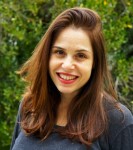
Maya Rae performs April 9. (photo by Robert Albanese)
Only 13 years old and already a veteran of the Vancouver International Jazz Festival. Only 13 and already dedicating her time and talents to helping others.
Maya Rae and her Rhythm Band perform an evening of jazz and soul at Temple Sholom on April 9.
“This show is a benefit concert for the settlement of two Syrian refugee families,” Rae told the Independent. “If my music can make a difference towards helping people and making the world a better place, I can’t think of anything else that I’d rather be doing. Tikkun olam is about the pursuit of social justice and I believe strongly that we need to help refugees of all parts of the world to find a safe place to settle.”
She added, “Right now, the Syrian refugee crisis is one that is very prominent, and of epic proportions. Millions of innocent people have been displaced with nowhere to go. I felt compelled to participate and to do something meaningful at a local level. Our rabbi at Temple Sholom, Dan Moskovitz, has urged the Temple Sholom congregation to take action, and this is my way of doing so.”
Scheduled to join her at Temple Sholom are Luis Giraldo (piano), Eli Bennett (saxophone), Ayla Tesler-Mabe (guitar), Ethan Honeywell (drums), Evan Gratham (double bass) and Benjamin Millman (piano and ukulele).
The Grade 8 student at York House started taking singing lessons when she was in Grade 3. “My first official performance was for the jazz festival in 2012. I remember singing the solo part of ‘Lean On Me’ by Bill Withers, with Cecile Larochelle’s Anysing Goes choir supporting me with the beautiful chorus line. It was an extremely memorable experience for me.”
Earlier this year, she was asked by the organizers of the jazz festival – Vancouver Coastal Jazz and Blues Society – to perform in the Women in Jazz series, which took place in March. “As part of that preparation,” said Rae, “I was introduced to some wonderful young musicians who I asked to support me for those two shows. As we were preparing for those performances, I was inspired to do a benefit concert in my synagogue with the same set and the same musicians…. I’ve since decided to add another set, and a few more musical friends and surprises to expand the show. I’m really happy with the results so far and can’t wait for April 9th.”
Rae said she chooses to cover “songs that deliver meaningful messages through their lyrics. I also like to pick songs that could have impact on the listeners, and also spark awareness about the significant issues we are facing in this generation.”
She has a YouTube channel on which there are a few videos, including for the song “I’m Still Waiting for Christmas,” which was released last year and is on sale on iTunes, as well.
“I have co-written a few songs with various artists/musicians that will be released in the near future,” she said, adding that she is hoping to have more time to write this year.
“My goal is to continue to enjoy playing and making music with others,” she said. “It would certainly be a dream come true to make a living through my music.”
This summer, she’ll be busking on Granville Island, and she invited everyone to “please stop by.”
More information about Rae’s upcoming events and recordings can be found at mayaraemusic.com. For now, though, her focus is on the April 9 concert, which starts at 8 p.m., at Temple Sholom. Tickets are $18 for adults, $14 for children/students, and the proceeds will aid two refugee families. RSVP to Temple Sholom at 604-266-7190 or register at templesholom.ca.
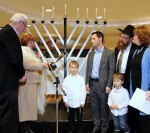
Surrey Mayor Linda Hepner, left, White Rock Mayor Wayne Baldwin and Simie Schtroks of the Centre for Judaism present the 2015 Young Lamplighters Award to Sarah and Amy Aginsky on Dec. 13. (photo from Lauren Kramer)
Sarah and Amy Aginsky, 12-year-old identical twins from Richmond, are this year’s recipients of the Centre for Judaism of the Lower Fraser Valley’s Young Lamplighters Award. With this annual award, the Centre for Judaism honors individuals between the ages of 5 and 18 who have performed outstanding community service.
In March 2015, Sarah and Amy, Grade 7 students at Homma Elementary in Richmond, hosted a Street Store for the homeless and impoverished. The Street Store concept was founded in Cape Town, South Africa, in January 2014 to help the homeless. Based on retail shopping, it involves collecting clothes and other items, organizing a pop-up, one-day store and giving shoppers the opportunity to select apparel and shoes without the exchange of money. The Street Store provides people located all over the world with an infrastructure, support and inspiration to host their own such stores.
The twins’ parents were born in Cape Town and their grandparents and relatives live there to this day. They saw how the Street Store had helped the homeless in cities including Sao Paulo (Brazil), Kentucky, Brussels, Tepic (Mexico), Grande Prairie (Alberta), Tucuman (Argentina), Oslo (Norway) and Vancouver, among others, and were inspired to host a Street Store of their own.
Between January and March, Sarah and Amy collected truckloads of donated clothing and footwear, distributing them to the needy on March 6 at the Lighthouse Mission in Bellingham, Wash.
“It was humbling to see how much people were prepared to give and how eagerly they wanted to help us help others,” said Amy. “Seeing the appreciative faces of our Street Store shoppers was heartwarming and beautiful. Many of them have very little and are living difficult lives. It felt great to know we were helping others and that, as a result of our mitzvah project, their lives might get a little bit easier.”
Rabbi Falik and Rebbetzin Simie Schtroks, directors of the Centre for Judaism, with Surrey Mayor Linda Hepner and White Mayor Wayne Baldwin, presented the Lamplighters Award to Sarah and Amy at a public menorah lighting at the Semiahmoo Shopping Centre in White Rock on Dec. 13.
“Chanukah celebrates the victory of light over darkness and goodness over evil,” said Simie Schtroks. “This is a most appropriate opportunity to motivate and inspire young people to make this world a brighter and better place. By filling the world with goodness and kindness, that light can dispel all sorts of darkness.”
***
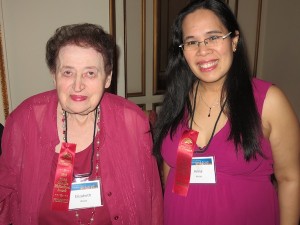
Elizabeth Wolak and her daughter-in-law Anna Wolak (photo from Arthur Wolak)
Elizabeth Wolak and her daughter-in-law Dr. Anna Wolak were both nominated for the 2015 British Columbia Multicultural Awards. As nominees, they were honored to attend the official awards gala evening, together with representatives from the provincial and federal governments, which took place at the Fairmont Hotel Vancouver in November.
The B.C. Multicultural Awards is an annual event hosted by the provincial government and the Multicultural Advisory Council to recognize and honor the multicultural accomplishments of individuals, organizations and businesses throughout the province. Elizabeth Wolak was nominated for her decades of multicultural work bringing the beauty of Jewish choral music to the attention of diverse ethnic communities through her numerous annual concerts. Dr. Anna Wolak was nominated for her health-care work, treating and educating patients and medical practitioners in British Columbia’s multicultural setting.
***
Leila Getz has been selected by Musical America Worldwide as a 2015 Influencer and is profiled in its MA 30 Professionals of the Year: The Influencers special report, released this month, which lists 30 honorees. The report’s editors, “recently asked the MA community to nominate 30 people who are making a difference in our business, either by virtue of their position, their creativity and/or their dedication – folks about whom you could say, ‘When they speak, we listen.’”
“Leila Getz looms large as one of the primary driving forces on the classical music scene in Vancouver, B.C.,” reads her profile in the report. “In 1980, at the age of 40, this South African native founded the Vancouver Recital Society, a presenting organization that has consistently aimed high and brought many of the world’s leading artists to a relatively isolated region.
“It seemed like a foolhardy project at first, especially since there was an economic recession in Canada in the early 1980s…. But the series gradually expanded from five events at the beginning to 20 in 2015….
“Most striking is Getz’s knack for finding major artists before they become widely known. She presented the Canadian debuts of mezzo-soprano Cecilia Bartoli, who reportedly stopped the first rehearsal cold after she sang her first note (the baton flew out of the amazed conductor’s hand), and pianist Lang Lang, who was all of 15 at the time. Other Canadian debuts on this series include those of violinists Joshua Bell and Maxim Vengerov, Anne Sofie von Otter and, one of Getz’s earliest discoveries, pianist András Schiff.”
The Jewish Community Centre of Greater Vancouver has announced that Sharon Dwek has joined the centre as director of development.
Sharon Dwek has joined the Jewish Community Centre of Greater Vancouver as director of development. (photo from JCCGV)
Dwek comes with more than a decade of experience in development, fundraising, community service and marketing, in Vancouver, Israel and the United States. She most recently worked as the director of development at King David High School.
Eldad Goldfarb, JCCGV executive director, said the appointment of Dwek to this new position was a positive step for the centre. “Sharon’s wealth of experience and knowledge has already made her a key addition to the JCC family,” he said. “We view her appointment as a sign of our commitment to being a leading communal organization in our Jewish community.”
Goldfarb suggested the hiring was as much about the centre’s future as it was about its current success. “Our growing programs and our evolving vision for the future led us to look for an addition to our team who will fit in with our values and exceptional service,” he said. “It is very fortunate that we were able to find someone of Sharon’s calibre to fulfil this role.”
For Dwek, coming to work at the centre was a natural fit. “Five years ago, my family and I relocated to Vancouver and we turned to the JCC and immediately felt at home and connected,” she said. “As a place of connecting, care-giving and learning, the JCC has truly become our second home and I am honored to help usher the JCC into the next stage of its future growth and development.”
For more information on JCCGV programming or staff, visit jccgv.com.
***
The 613th mitzvah of the Torah is the obligation for every Jew to write a Torah scroll. In the words of the verse: “And now, write for yourselves this song, and teach it to the Children of Israel. Place it into their mouths, in order that this song will be for Me as a witness for the Children of Israel.” (Deuteronomy 31:19)
Congregation Beth Israel has been blessed to receive a generous gift of a new sefer Torah with the opportunity for its members to complete it by scribing the last 100 letters. As space is limited, participation is by lottery. For more information on the project, visit bethisraelvan.ca/asitiswritten. The deadline for entry into the lottery is Jan. 18, 2016.
Under the guidance of sofer Rabbi Moshe Druin of Florida, families will participate in scribing and other activities for all ages Feb. 19-21. The following weekend, Feb. 26-27, the dedication of the congregation’s new sefer Torah will take place, as will a celebration of Debby Fenson’s 10th anniversary as BI’s ba’alat tefillah.
There are 304,805 letters in the Torah and, if any is missing, the whole Torah scroll must be wrapped up and put away until it is repaired. Every letter in a Torah is vitally important. Now imagine all the Jewish people as one Torah scroll. Each person, big or small, rich or poor, a pious scholar or just a simple Jew, is one letter; all of us as important as each other.
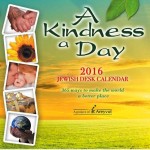
Areyvut, a New Jersey-based nonprofit organization whose mission is to infuse the lives of Jewish youth and teens with the values of chesed (kindness), tzedakah (charity) and tikkun olam (repairing the world), has released its 2016 A Kindness a Day Calendar.
This flip calendar offers 366 suggestions (it’s a leap year!) for people of all ages to better themselves, their communities and the world at large. For example, Jan. 1’s entry suggests, “make a New Year’s resolution that will positively impact someone else’s life.” Other entries remind readers to “call and wish Shabbat Shalom to an out-of-town relative” or to “assist someone who is unemployed with writing a resumé and finding a job.” Beneath each act of kindness is a traditional Jewish text that explains from where the act of kindness is inspired.
Areyvut debuted A Kindness a Day in 2005 and continued to create calendars through 2009, the last year that the flip-book was published. Despite a six-year hiatus, the A Kindness a Day calendar is back with suggestions, sources and inspiration that will hopefully help readers to play a more active role in their families and communities.
“Charity, kindness and social justice must be an integral part of everyone’s day,” said Daniel Rothner, Areyvut’s founder and director. “The 2016 calendar allows for these core Jewish values to become more aligned to the context of people’s daily lives. A Kindness a Day is a great educational tool for children and adults alike; as well as homes, schools and other organizations, both as a guide to help instil Jewish values into one’s life and as a springboard for discussion and study.”
The 2016 calendar also includes a thematic index that categorizes the acts of kindness by theme (for example, loving your neighbor, tzedakah, tending to the sick, volunteering, prayer, etc.) and a glossary of terms. Calendars can be purchased on Areyvut’s website areyvut.org/shop. For sample pages, and additional information, email social@areyvut.org.
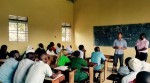
Aaron Friedland at Semei Kakungulu High School in Uganda. Friedland has written the book The Walking School Bus, both as a first reader but also as a means to generate funds for students to access education. To get it published, he has started an Indiegogo campaign. (photo from Aaron Friedland)
During high school and elementary, “it was too easy for me to miss school,” said Aaron Friedland, currently a master’s in economics student at the University of British Columbia. In other parts of the world, children walk great distances to attain an education.
“Five years ago, I wrote a children’s book called The Walking School Bus,” Friedland told the Independent. It was “written with the realization that students in North America really take access to education for granted.”
It was on a trip to Uganda and South Africa, he said, when he really began to understand “the distances students had to walk to obtain an education and it was startling.”
Data from the Uganda National Household Survey Report 2009/2010 indicate that 5.5% of children aged 6-12 do not attend school because it is too far away, and the average high school-aged student must walk a distance of 5.1 kilometres to the nearest government school, more than 10 kilometres every day.
“I wanted the book to serve a purpose and the purpose was twofold. I wanted it to raise awareness … that students have to walk,” Friedland said about The Walking School Bus. “But I also wanted it to be a means to generate funds for students to access education and so, in that case, I’d say the school bus itself is metaphoric and it represents access to education.
“I submitted my manuscript to a publishing house just under a year ago and it was well received, so we started moving forward. But, in order to really have a book come to fruition, it costs quite a bit of money.”
On Nov. 9, Friedland started an Indiegogo campaign to raise $15,000 to cover the costs of publication, “everything surrounding the book,” which includes editors who specialize in children’s books and the illustrations. The campaign runs for 60 days.
The Walking School Bus has the capacity to “act as a first reader and, while it does have a picture book component, I’d also like it to serve as a coffee table book and a symbol for interfaith collaboration,” said Friedland.
Friedland’s concern about and involvement in interfaith work began in 2010, when J.J. Keki, a member of the Ugandan Abayudaya Jewish community and founder of the Delicious Peace fair-trade coffee cooperative, was invited to King David High School. Many students, including Friedland, “formed a pretty special bond with him.”
A bond that continued for Friedland. “When I was in first year [university] – while all my friends were going to Mexico and hilarious holidays – I went to Uganda with my family,” he said. “It was an amazing experience for us. We benefited so much more than the ‘recipient’ community. I recognized quite quickly that our aid had been negligible, but what it did for me was it provided me with a clear trajectory, which guided me for my four years at McGill.… At McGill, I started working with the Abayudaya community in Uganda, specifically with Delicious Peace…. What most amazed me – and my rationale for getting involved – was that they employed an interfaith collaboration model in which they united these previously disparate communities, the Muslim, Christian and Jewish communities, and formed one solid frontier in which they collaborated. In collaborating, there were a variety of positive spillover effects … you see higher levels of economic prosperity in that region on Nabagoya Hill than you do in comparable areas, you see how there is much more religious tolerance.”
About his experience in Uganda, Friedland, who has worked with UN Watch, said, “I have only seen the us-against-them mentality, and this is one of the first times I have ever seen this collaboration.”
About his most recent trip to Uganda, Friedland said, “Essentially, I have been working with three schools there as well as King David over here, kind of empowering their educational sector in the interfaith forum. And the three interfaith schools I’ve been working with are the three I’m the most motivated to help provide school buses.”
While interviewing students in Uganda, he said, “One of the girls that really stood out to me was a girl named Miriam, a lovely Jewish girl from [Semei Kakungulu] high school, an 18-year-old. She was telling me that, when she walks to school, she walks six kilometres in either direction. And, in extreme rainfall events, which is pretty much all of the rainy season, she will cross a river to school and, when she goes back, the river is often flooded and she cannot cross back, so that night she’ll spend at a friend’s.”
Friedland added, “When I think about the struggle that our counterparts make to go to school and we do not – we don’t have that drive. That is something I’d like to impress on people in North America. I’m not saying you have to feel bad, just appreciate your access and your ease in getting an education and take it seriously.”
The website thewalkingschoolbus.com was created by Friedland to support the book and bus project, and sales of T-shirts and various other merchandise go towards his efforts to increase access to education. He said, “I think, as a Jew in Vancouver, in a more liberalized society, that this is the model that we should be going for … we should be supporting interfaith.”
Friedland has most recently worked with a team to connect King David’s Marketing 12 class with the entrepreneurship class at Semei Kakungulu. About his master’s degree, he said he will likely be writing his thesis on “the positive economic spillover effects from interfaith collaboration and employing interfaith collaboration, as an economic development growth model in other places, particularly Israel.”
Filmmaker Yael Luttwak spoke at Choices Nov. 1. (photo from jewishvancouver.com)
A film that brings Palestinian and Israeli women together in a weight-loss group. Who would have thought that was possible? American-Israeli Yael Luttwak did, and she made it happen. Luttwak, the keynote speaker at Choices, Jewish Federation of Greater Vancouver’s annual women in philanthropy event, held on Nov. 1 at Congregation Beth Israel, captivated the audience with her story.
“The idea came to me at a time when
I was attending Weight Watchers in Tel Aviv,” said Luttwak. “The peace process had broken down and Ariel Sharon had been hospitalized and I had this image of Sharon and [Yasser] Arafat jogging together on the beach and working it all out. It struck me, as I listened to women in my group who were uninhibited in sharing their struggles with health and weight and body image, that there was so much humanity in that room. What if we could capture this humanity and bring together women who otherwise would never have an opportunity to meet?”
She set out to find women who would be willing to participate in this social experiment. She approached Orthodox women, West Bank Muslims, American-born settlers and Bedouins. Fourteen women agreed to get involved. The Jerusalem Cinémathèque in East Jerusalem became the meeting place. Filming took six weeks.
The women metamorphosed during the process, as they started to come to the meetings in nicer clothes and make-up, and they began to share their thoughts (and recipes). “This was the first opportunity for Arab women to meet Jewish women that were not soldiers, and for Israeli women to meet Arabs that did not want to kill them. At the beginning, everyone was nervous, but very polite (unusual for the Middle East) but, within a few hours, they were all talking and sharing stories.”
The women found common ground on many issues that emphasized their similarities. Even when there was political turbulence, violence on the streets of Jerusalem and curfews, the Arab women would cross the checkpoints to attend the meetings. When Luttwak asked what it was about the group that kept them coming, they answered that it was their only opportunity for hope. And so, the 2007 documentary A Slim Peace came to be. It premièred at the Tribeca Film Festival in New York and screened in the United States on Sundance Channel.
While promoting the film, Luttwak was approached by English philanthropist Dame Hilary Blume, who offered to seed fund more women’s groups. She told Luttwak, “Don’t waste your talent on films. You have hit on something. You are building bridges. This is your destiny.” As a result, the nonprofit Slim Peace developed and, over the past eight years, it has opened 33 groups in six cities and two countries. Luttwak said, “It’s a train I cannot stop.” She has also been able to keep making films about contemporary issues. Her final messages – we all have to do our part for tikkun olam (repair of the world) and to never give up hope.
Prior to Luttwak’s talk, Ricki Thal addressed the audience: “My name is Esther Zuckerman Kaufman and I was born in Warsaw, Poland, on Oct. 11, 1920. I was one of the Jews on Schindler’s List.” Everyone’s attention caught, Thal then told the story of her grandmother and grandfather, Leon, both saved by Oskar Schindler. They never spoke about their wartime experiences and the family had no idea that they were Schindler Jews until they all went to see Steven Spielberg’s movie. That moment changed Thal’s life. It led her to explore her family’s history, to participate in March of the Living on two occasions, as a student and as a chaperone, and to become involved in the Jewish community. Kaufman died in 1999 but not before she appeared in New York on The Phil Donahue Show to tell her story to television audiences. Thal finished almost as she began: “My name is Ricki Thal and I was born in Vancouver in 1979 and I am proud to be the granddaughter of Esther and Leon Kaufman.”
CBC television personality Belle Puri emceed the night, co-chair Debbie Jeroff gave opening remarks and Stephen Gaerber brought greetings from Federation. Two video presentations, a raffle and a meal catered by Susy Siegel completed the night, and then 500 Jewish women went out into the rain inspired, full of good food and hope.
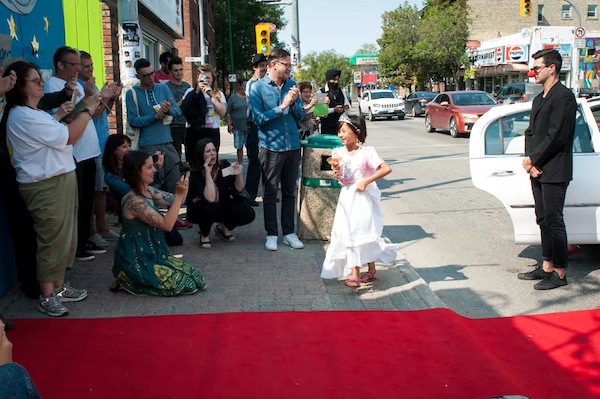
From filming and acting, to walking the red carpet, a group of 5-to-7-year-olds were filmmakers this summer. Their creation? The short Odd Life of Dr. Tooth. (photos from Art City)
It’s not every day that a group of 5-to-7-year-olds creates a movie. But that’s just what happened in Winnipeg this summer at Art City.
Art City was founded in 1998 by local artist Wanda Koop. She saw a need for engaging programming for kids and youth and, being an artist, she thought it would be great if there were a place where they could go to make art for free.
Since its opening, Art City has been providing after-school programs. In the summer, they run all day, from 9 a.m. to 8 p.m.
“Part of our model is that our staff and volunteers are mostly all artists,” said Josh Ruth, Art City managing director. “We also hire guest artists to come in and lead workshops, bringing their own art practice, perspectives and methods into the context of our community.”
One of the summer drop-in programs is Green Art, which is held at the park behind Art City. The idea of creating a movie came from the coordinator’s consultation with the kids about what they wanted to do this year. Art City invited as a guest filmmaker Noam Gonick.
“We all know him from his reputation as a filmmaker and he’s sort of a local art star,” said Ruth. “I asked if he would be interested in helping us out and he was really keen. He said the only reason he’d never done anything with Art City before was because he’d never been asked.”
Art City puts the kids’ ideas at the forefront of everything they do. In this case, participants wrote the script, developed the characters, made the costumes and sets – basically, they steered the whole creative process.
“The kids obviously developed their skills in terms of storytelling and understanding how to convey the message they are trying to get across to an audience,” said Ruth. “We feel it has some strong implications in terms of helping to grow literacy – not just reading and writing, but social literacy, and all those sorts of things, and working together in a team. Collaborating in that way always takes patience and problem-solving.
“In terms of working with Noam, he brings a huge amount of expertise, certainly in filmmaking, but in art-making in general. For example, I was in the office one day during the shoot and I overheard him talking to one of the participants who, for whatever reason, didn’t like what he was suggesting they do. And I heard him tell her, ‘You know, if you take direction well, people say you’re easy to work with, and then you’re more likely to get more work in the future. If you don’t take direction well, then people say you’re difficult to work with and that can be bad for your career. So, just keep that in your back pocket.’
“I thought that was a great way for him to shoot straight with the participants, even at such a young age, about the fact there are times when you get to do what you want and other times when you need to follow direction.”
Ruth felt the kids did an amazing job and that Gonick did a great job directing. As well, those involved in the post-production work were also invaluable, people like Ryan Simmons who edited the film along with Gonick, and Andy Rudolph who did the sound production.
Ruth and staff created a première screening of the film that included the stars getting dropped off in a limo, walking down a red carpet, and enjoying champagne glasses full of gummy bears.
“The kids got out of the limo one by one and walked the red carpet,” said Ruth. “Then, they came into Art City, where we had set up a big screen and the kids had made their own VIP lounge passes. I was the security guard.”
Gonick said he felt a little lost at times, due to how Art City runs and the fact that he had very little control over many aspects of the film.
“They were looking for someone to mentor them, but not to bring an original concept to the table, just to help the kids realize their idea,” said Gonick. “Mostly, the shooting process, editing and, really, the idea came out of a workshop that Art City staff and kids did on their own.
“I was mostly just given their script. They cast it themselves and did all the designing ahead of time…. It was like being a director for hire and having 7-year-old producers. Given some of the producers I’ve worked with, the 7-year-old mindset was just par for the course.”
For Gonick, the experience was all about ensuring that everybody felt empowered, had fun and was involved. “You know, you don’t want children to be traumatized,” he said. “So, you just kind of make sure everyone gets to participate and that the ideas are fluid enough that everybody gets a part.”
There was a core group of six 5-to-7-year-olds but, on the morning of the first day of shooting, a seventh child joined the group, so a new role and scenes had to be created on the spot.
Gonick was at ease working with the kids, as he has been working with young stars as of late. “They are like any other group of actors,” said Gonick. “Everybody has their own needs and abilities. You just have to be responsive in the moment and get out of them what you can. The difference between this and working in a professional environment with kids is that I was conscientious that I didn’t push them too much.”
The 10-minute film, Odd Life of Dr. Tooth, is a surreal, non-linear story that follows the main character, who is a dentist. It begins with the dentist working on someone’s mouth and commenting on their poor dental hygiene. Then, suddenly, the camera closes in on the mouth of the patient and transports the viewer to outer space. Gonick incorporated this concept of traveling to outer space and animal kingdoms via patients’ mouths as a way to connect the disparate ideas that the kids had. The movie can be viewed at vimeo.com/138120558. For more on Art City, visit artcityinc.com.
Yosef Nider, centre, receives the inaugural Lamplighter Award last year. (photo from Centre for Judaism)
Do you, or does someone you know, qualify for the Centre for Judaism Young Lamplighter Award? Has anyone you know between the ages of 5 and 18 made a unique effort to illuminate their world by performing extra special deeds of goodness and kindness?
Last Chanukah, on Dec. 21, Yosef Nider, 7, received the Centre for Judaism Young Lamplighter Award at the annual public menorah lighting in the Semiahmoo Shopping Centre. White Rock Mayor Wayne Baldwin, Surrey Mayor Linda Hepner and Rabbi Falik and Rebbetzin Simie Schtroks, co-directors of the Centre for Judaism of the Fraser Valley, presented Yosef with an engraved trophy, as well as a cash prize.
“Chanukah celebrates the victory of light over darkness and goodness over evil. This is a most appropriate opportunity to motivate and inspire young people … with a little light, they can dispel all sorts of darkness,” said Simie Schtroks.
“We were delighted to bestow this honor upon young Yosef because he turned the painful experience of dealing with his grandfather’s terminal cancer into an opportunity to do good for others. With his parents’ support, he organized an event – highlighted by his own violin performance – A Concert for a Cure, which raised $10,000 for cancer research,” she added.
Jeff Nider, Yosef’s father, described the experience. “We were blown away by the events of the evening, and it was such an honor for my wife and I to be the parents of a child who won the Lamplighter Award,” he said. “Yosef started out simply wanting to do something to help his grandfather, but what he eventually accomplished resulted in such a ripple effect. We truly are amazed and feel both humbled and proud of Yosef.”
When Yosef heard that he would be passing the light forward to the next recipient, he said, “I felt really happy to get this award. I hope that other kids will also do something good for the world after hearing about this award. The award is on my dresser in my room. I also got to buy a really cool Lego set.”
The deadline to submit a nominee for this year’s Lamplighter Award is Nov. 22, 2015. Include with the nomination at least one letter of recommendation written by a rabbi, teacher, principal, mentor, doctor or other verifiable source. Send all the material and direct any questions to Simie Schtroks, c4j@shaw.ca.
The award ceremony takes place on Dec. 13, 5:30 p.m., at the Semiahmoo Mall menorah lighting. Everyone is welcome.
Eli Winkelman was just looking for a way to fit in at college. But her quest for a niche resulted in an international philanthropic phenomenon.
Winkelman’s passion for making challah caught fire with fellow students and she ended up founding one of the most familiar – and foodie-friendly – philanthropic endeavors in the Jewish community today.
Challah for Hunger is now known to thousands of students on campuses throughout Canada, the United States, Australia and elsewhere. Volunteers gather to make the irresistible braided loaves, then sell them to fellow students and divide the profits between a local charity and a designated national cause.
Winkelman, who founded the international movement, will be one of four speakers at FEDtalks, marking the launch of the Jewish Federation of Greater Vancouver’s annual campaign Sept. 17. She will speak on Chesed (Loving-kindness).
Winkelman’s expertise in challah came, as it has for centuries of women, through her mother. But where some recent generations have let the challah thread drop – who has time to knead, braid, bake? – Winkelman’s choice to become vegan sort of changed history.
“I decided to become vegan in high school and [her mother] said, ‘OK, but you’re making your own challah,’” she recalled.
When she arrived at the Claremont Colleges outside Los Angeles in 2004, Winkelman started baking challah for Shabbat dinners at Hillel.
“People heard that I was baking and they showed up to learn from me randomly,” she said. “And every week they came back and they complained that all their friends were eating their challah. So, I saw that there was demand for bread and demand for the activity of making the bread and I thought that we should scale up and do it for a good cause.”
Within two or three months of starting school, Winkelman had launched Challah for Hunger, selling 15 loaves. Her group started out baking in the dorm kitchen, then moved into the kitchen of the campus interfaith centre. They eventually got permission to use the dining hall kitchen.
The national charity is MAZON: A Jewish Response to Hunger. Local chapters can determine the cause to which they want to allocate the other 50% of profits. Some chapters, like at Emory University in Atlanta, have been supporting the same cause for years (in Emory’s case, a refugee assistance agency). Other campuses operate differently. At Stanford, for example, the chapter partners with other clubs every week and they choose a different designated recipient each time.
“Different chapters approach it differently, which I really love because they are figuring out how they want to be givers,” she said.
Winkelman is no longer operating the organization’s day-to-day activities – she’s started a business in Austin, Tex. – but she is on the board of directors and closely follows the progress. There are now more than 70 chapters worldwide, each baking 30 to 300 loaves, usually weekly. Sometimes they defy tradition and add chocolate chips, cinnamon sugar, sun-dried tomato or other innovations. Canada’s sole chapter is in Montreal.
Baking and sharing bread is an ancient, symbolic and ritualized process. Challah for Hunger makes it social in a way that may be particularly suited to undergrads finding their place and new friends.
“Part of how I define Challah for Hunger is doing it together and doing it on a regular basis so that it becomes a community,” she said. “For me, that is core to the organization. That’s how people learn and grow, by interacting with each other. Especially when you’re baking bread, your hands are engaged in something so you’re busy and that means that you can have a conversation or not have a conversation or have whatever kind of conversation you want with the person next to you. It really doesn’t leave any awkward quiet time.”
For more information about and tickets to FEDtalks, visit jewishvancouver.com. Interviews with fellow speakers Irwin Cotler and Dafna Lifshitz appeared in previous issues of the Independent, and Rabbi David Wolpe will be featured next.
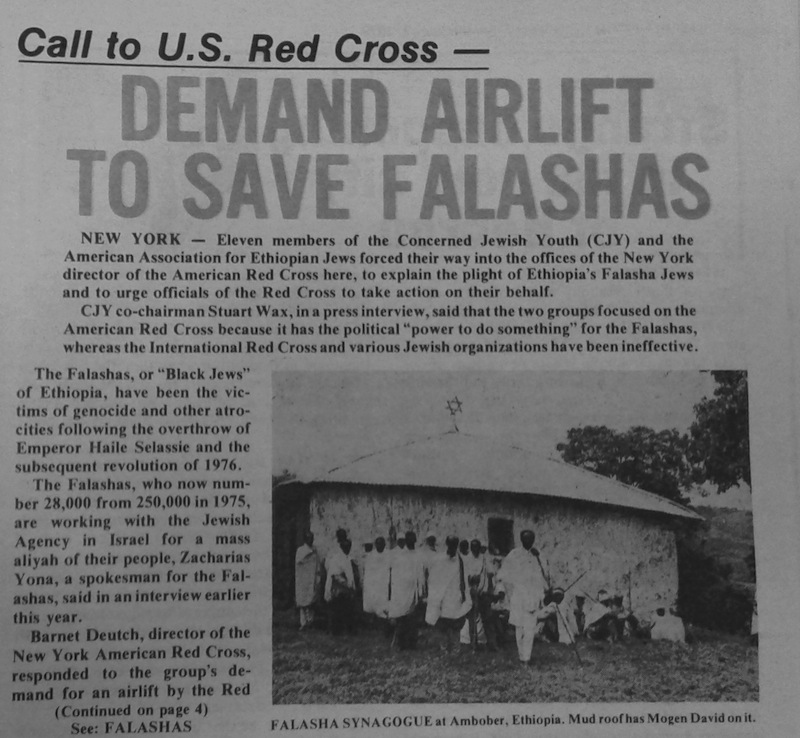
Growing up, the writer was involved in community campaigns to help free Soviet and other Jews suffering state-sponsored, organized persecution. These campaigns were international and Vancouver youth also participated in them. Here are but two of the many items in the JWB about these causes: top one is from 1982; below, from 1976.
I was recently reminded of a fashion-activist item many Jewish teens of my generation wore: the stainless-steel Soviet Jewry bracelet. Etched with the name and date of arrest of a single Jewish dissident in the Soviet Union, each bracelet transmitted to the wearer a deep and penetrating sense of social justice and tribal consciousness. I wore mine proudly, and recall being equally pleased to be selected from my seventh grade class to present handmade cards of encouragement to Avital Sharansky, the wife of jailed activist Anatoly Sharansky (later Israeli politician Natan Sharansky), when she visited Vancouver in the mid-1980s on her global campaign to secure his release.
With the last of the Jewish communities having been freed from state-sponsored, organized persecution (other campaigns as my generation was growing up included the freeing of Ethiopian and Syrian Jews), there is little in the way of that Soviet Jewry bracelet campaign to bind today’s Jewish teens together in such a single, uncontroversial way. The modern state of Israel represents an ongoing cause, of course, but that issue is much more fraught: should a Jewish teen wear a bracelet etched with the name of a fallen Jewish soldier, or the name of one of the 182 Palestinian children currently (as of February 2015) being held in Israel detention – according to data provided by Defence for Children International? When it comes to social justice and activist solidarity, the issue of Israel is clearly complex.
I decided to poke around to see what Jewish teens these days are concerned with when it comes to issues and activism. What I found was a dizzying array of causes. From the website of the Orthodox NCSY (National Conference of Synagogue Youth), I found reports of teens volunteering with Habitat for Humanity and with Oklahoma tornado victims. Both USY (Conservative Judaism’s United Synagogue Youth) and NFTY (the Reform movement’s North American Federation of Temple Youth) select an annual theme to guide their social action and tikkun olam efforts: for 2014, USY chose “a focus on acceptance and tolerance including but not specific to gender, special needs, LGBTQ and racial equality,” according to its website. NFTY chose a similar theme for 2014-15: sexuality and gender equality. Habonim-Dror, which has various active local chapters, or kenim (nests), included a Maryland referendum initiative, for example, to campaign for undocumented high school graduates to become eligible to pay in-state university tuition fees.
Other Jewish educators I polled from the Jewish educators’ network JEDLAB reported that their teens are involved in various issues, including suicide prevention, food banks, poverty, water issues, peace/conflict resolution, mental health awareness and advocacy, women’s rights and empowerment, LGBTQ activism, medical marijuana, vaccines, human trafficking, transgender acceptance, orphans in western Kenya and child soldiers.
A report from the Jewish Teen Funders network attempts to aggregate data from 71 Jewish teen foundations in the United States and Canada during 2013-14, showing where the total of nearly $1 million in philanthropic dollars went. Across 362 grants awarded, the top five issue-areas in descending order were: youth, education, special needs, chronic illness and poverty.
And none of this even begins to capture the array of charitable and social awareness efforts represented in today’s mitzvah projects popular among 12- and 13-year-olds marking their bat and bar mitzvahs, a trend that was absent in my generation, as I recall, anyway. As a complement to that, here in Ottawa, my own shul has been running a monthly b’nai bitzvah class by Cantor Jeremy Burko, which has been including discussion of Jewish-history-informed social justice topics, such as labor conditions in the fashion industry.
What’s the takeaway from this big picture? On one hand, there is no longer a single cause (if there ever was one) that unifies Jewish teens. And that means that tribalism is likely being replaced by a sense of universalism: the sense that social justice must necessarily cross ethnic and religious boundaries. On the other hand, today’s Jewish teens are no doubt indeed being united in the very belief that through Jewish social action, they can repair the world in a global, nuanced and holistic sense. So, while I admit to feeling some nostalgia for the simplicity of the worldview embodied in the Soviet Jewry bracelet I wore with pride and even some excitement, I think we should feel buoyed by the youthful energy and optimism in our midst that the world is ours – and theirs – for the repairing.
Mira Sucharov is an associate professor of political science at Carleton University. She blogs at Haaretz and the Jewish Daily Forward. This article was originally published in the Ottawa Jewish Bulletin.
We were fortunate to be guests at two warm and spirited seders this year. As designated song-leader, I tried to ensure that the singing was fulsome and sufficiently rowdy to rescue late-night flagging energy levels. One heartfelt moment was singing Ani Ma’amin. Based on Maimonides’ 13 Principles of Faith, the song declares, “I believe, with complete faith, in the coming of the Messiah.” It’s a song familiar to attendees of Jewish summer camp and Holocaust remembrance ceremonies. It’s beautiful and haunting and, with its concise lyrics, contagious for group sing-alongs.
There was an Israeli-Canadian couple at the seder and so, after singing about the Messiah’s hoped-for arrival, I grabbed the opportunity to insert another song from my favorite genre: Israeli ’70s and ’80s pop music. Shalom Hanoch’s 1985 hit, “Waiting for the Messiah,” launched onto the Israeli music scene an iconoclastic cry of frustration: “The Messiah isn’t coming – and neither is he phoning.” The few at the seder who knew it sang and air-banded for a bit before turning solemn as we wound down the seder with Hatikvah.
In Ani Ma’amin there is the belief that the world will one day improve, if only we are patient. Hanoch’s song, by contrast, is an attempt at hard-edged realism.
In 1985, Israel was gripped by hyperinflation. “The stock market crashed,” he sang. “People jumped from the roof; the Messiah also jumped, and they announced that he was killed….” Serious political ills were also ramping up, with the Lebanon War fresh in the memory of an increasingly restless nation. And, with the intifada breaking out two years later, more would follow.
Even in the absence of belief, messianiam is an ever-present notion in Jewish culture. In the 17th century, there was Shabbetai Tzvi, known as the false Messiah; later, there was the rejection of modern Zionism among the ultra-Orthodox who believed – and still do – that the experiment in Jewish sovereignty should wait for the Messiah’s arrival. Then there is the belief of some within the Chabad movement that the Rebbe, Rabbi Menachem Mendel Schneerson may himself have been the Messiah. For my part, given that I speak only Hebrew to my kids, I’m stuck with phrases that I normally wouldn’t use in English – and which don’t always reflect my worldview – phrases like “what are you waiting for – the Messiah to come?” when my then toddlers would rest in a snowbank between their JCC preschool and the parking lot.
But what really struck me that night at the seder as we sang Hanoch’s lyrics was a two-fold question. First, which stance better fulfils the Judaic imperative of tikkun olam: the traditional belief in messianic redemption, or the belief that it is all up to us? And second, how can we agree on what of the many problems in the world are deserving of fixing in the first place?
Clearly, the world is in disrepair. Just within the last few weeks, for example, two infants died in unregulated South Tel Aviv day cares serving African refugees; Islamic militants of the al-Shabab Somali group slaughtered 148 Christian students at a university in Garissa, Kenya; bloodshed continues in Syria and Yemen; antisemitic attacks are on the rise, especially in France; and, in Canada, according to Make Poverty History, one in 10 children here lives below the poverty line.
Certainly, none of us in our lifetime will solve all the world’s ills, and with humanity’s imperfections, including our own mental and emotional flaws, our lust for power and the natural drive for accumulation amid scarcity, it’s hard to believe that widespread suffering will ever be overcome. Some believe that messianic yearnings lead to passivity; others that it spurs us to action.
But perhaps the biggest conundrum is how to agree on which of the world’s ills we should actually care about. For some, the criterion is whether the problem is local; for others it is the perception of how the solution will implicate their own well-being; for others it hinges on whether they think the problem is actually the fault of the sufferer. Whether or not one believes in the possibility of messianic redemption, or whether one believes that it is up to us mortals to repair the world, we would do well to start with something that is hard to contest: the importance of compassion for suffering wherever it is found.
Mira Sucharov is an associate professor of political science at Carleton University. She blogs at Haaretz and the Jewish Daily Forward. This article was originally published in the Ottawa Jewish Bulletin.