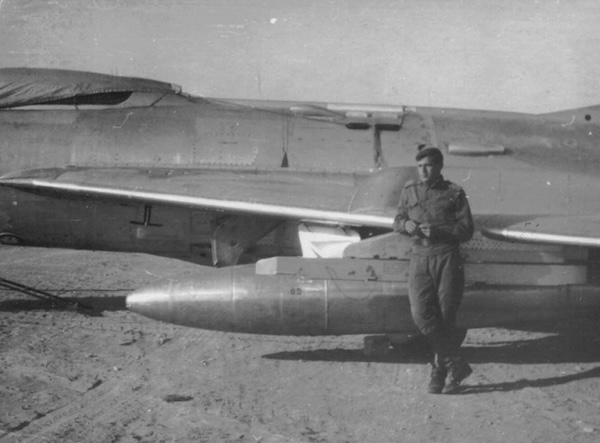
A photo of Reuven Rashkovsky from the book An Improbable Life: My Father’s Escape from Soviet Russia, by his daughter, Dr. Karine Rashkovsky. Here, Reuven is pictured with a MIG 19 Soviet fighter plane. At 18, he was drafted into the military, conscripted for three years.
Perusing the pages of the Independent’s predecessor, the Jewish Western Bulletin from the 1960s and ’70s, demonstrates the centrality of the movement for Soviet refuseniks in Jewish life of that time. Jewish communities in North America and elsewhere in the West were deeply devoted to the Jews behind the Iron Curtain who sought to emigrate to Israel and other places of freedom.
That movement, ultimately, was a largely Western phenomenon. In a new book, Vancouver’s Dr. Karine Rashkovsky shares her family’s story. An Improbable Life: My Father’s Escape from Soviet Russia, and others of its still-emerging genre, open the narrative to the stories from the other side of the Iron Curtain, those of the refuseniks who Western activists were trying to free.
The Soviet Union, Rashkovsky writes, was a country based on an ideology intended to eliminate ethnic and religious lines, but which counterintuitively insisted that every citizen’s internal passport indicate their nationality – and for Jews, regardless of their geographic origins, their nationality was “Jewish.” And that “nationality” meant slammed doors in the face of opportunity for those carrying that mark.
 The book is a personal testimony – written by the daughter in the first person from the perspective of her father, Reuven – but it is also part of a larger story of the struggle of refuseniks and the lives they eventually made for themselves.
After his escape from the Soviet Union, Reuven fought in the Yom Kippur War, attained a PhD in Israel and France, and both he and his wife narrowly avoided being on the hijacked Air France flight that was the centre of the famous raid on Entebbe, Uganda.
In the preface, Reuven calls his life, “a kaleidoscope of hardships and failures.” But there are plenty of successes also.
Reuven’s parents were born in Bessarabia, in what is now Moldova. It was a highly multicultural area and they spoke German, Romanian, Yiddish, Hungarian, Ukrainian and Russian. When the Romanian fascists took over their town, the family fled, but went east to Odesa, rather than to Palestine or America.
When Germany invaded the USSR, Reuven’s father was drafted into the Red Army. His facility with languages put him in the intelligence unit and he assisted in interrogating prisoners of war. He was severely injured during a Luftwaffe bombing raid and, because he was an officer, the family was evacuated to a military hospital in Uzbekistan. There, he learned to walk again and returned to service, participating in the capture of Berlin, in March 1945. Reuven was born in Uzbekistan, in November 1945.
After the war, the family relocated to Belgorod-Dnestrovsky (now in Ukraine but under shifting sovereignty for centuries and known by at least 13 different names and transliterations over time). His father was a police officer and his mother worked 25 years in a fish cannery, which was relatively good fortune for the family in terms of providing protein, thanks to fish she smuggled out of the factory in her bra.
Eventually, they would be a family of seven, with five surviving children. At age 6, Reuven was responsible for taking care of his younger siblings all day while the parents were at work.
In response to antisemitic bullying, Reuven became a scrapper, taking his malnourished body to the gymnastics coach at school and forcing the coach, through the power of determination, to take on the unpromising-looking young Jew. As his biceps grew, the bullying receded. But the discrimination became more insidious and systemic.
In the home of a more well-off classmate, Reuven discovered books. Together, they devoured foreign works in translation, “free from Communist Party propaganda and boring Soviet patriotism.” This set Reuven on a trajectory of skepticism and dissidence that could have ended badly (and, along the way, did have bad moments – but ultimately resulted in freedom and a very successful life in the West).
Reuven’s teachers ascertained that he wasn’t a fan of the Communist Party and so he did not get a favourable reference for university. After 10th grade, he got a job at a slaughterhouse, then became an apprentice electrician. He began night school, where his facility with numbers shone and where his politics were not known and he might get a recommendation for university.
At 18, he was drafted into the military, conscripted for three years.
Eventually, the American allies of the refuseniks forced the American government to put conditions on the sale of American wheat, upon which the Soviet economy depended. The 1974 Jackson-Vanik Amendment tied trade in this necessary commodity to visas for Soviet Jews. Until then, of the several million Jews in the USSR at the time, just a few hundred had been permitted to leave.
Reuven was part of a group of about 25 Jewish youths who decided to hold a hunger strike to demand emigration. They took a petition to city hall and police soon blocked the exit. They were taken before authorities and subjected to “a long lecture on how inappropriate it was to think about leaving our Soviet paradise for Israel, that aggressor capitalist country, a puppet of America.”
When an interrogator threatened the group with imprisonment, one of the dissidents explained to the KGB officers why that was not a good idea.
“She calmly explained to him that we’d communicated with Western journalists and passed them our names and plans for the hunger strike. We’d also alerted these journalists to expect a phone call before midnight to tell them what had happened today. If we didn’t call them, they would tell the Western media about us. Katya went on to tell the colonels what would happen if we were arrested: America wouldn’t sign the contract for selling wheat to the Soviet Union, which would harm the whole country. And Moscow would come down hard on Odesa’s KGB for causing such a disaster.”
The next morning, Reuven and his family went to the government offices first thing. The entire family was granted the right to emigrate except for Reuven’s brother Fima, because he was serving in the army. But the authorities finally agreed that everyone would be allowed to emigrate after Fima’s military service. Reuven’s parents refused to abandon their son and decided that Reuven and his sister Hanna should go on ahead to Israel and the rest would follow later, which they eventually did.
Traveling through Moscow, at New Year’s 1971-’72, Reuven was put up at the apartment of a friend’s mother. There, he met Fania, who was visiting from Kyrgyzstan. She didn’t know anything about Israel and it had never crossed her mind to emigrate. A few shots of vodka in, Reuven told her he would be waiting to marry her if she ever decided to come to Israel.
“It was crazy of me to say such words – to offer marriage to the most innocent girl I ever met and one I had only known for hours – on my last evening in the Soviet Union,” he says. “Of course, I was both very stressed and excited that I was leaving the country, and I had been drinking quite a lot of vodka to relax a bit.”
That was the beginning of a happy 50-something-year marriage that continues today.
Freed of the Soviet Union’s antisemitic shackles, Reuven’s career took off. Hebrew University was looking for a Russian-speaking mathematician to teach first-year students, then he developed a curriculum for high schoolers with advanced math skills. An opportunity landed in his lap to teach at an elite Israeli school in Paris. Friends who had migrated to New York extended an invitation, which led to a side journey to Toronto, where Reuven’s career took another turn and the family became Canadian.
While they were living in Paris, Reuven was unable to attend his brother’s wedding in Israel, in June 1976, but Fania went. On his way to the airport to pick her up on her return, Reuven heard that terrorists had hijacked an Air France plane to Uganda. Reuven was beside himself. It turned out, Fania had missed the plane and was rebooked on a later El Al flight – but jammed phone lines prevented her from notifying Reuven for several days.
Jews of a certain age remember the fight for Soviet Jewry. The Rashkovskys’ book, An Improbable Life, is a story of what they were fighting for.
Rashkovsky is part of the JCC Jewish Book Festival on Feb. 24, 6 p.m., at the Jewish Community Centre of Greater Vancouver, along with Sasha Vasilyuk, author of Your Presence Is Mandatory, a debut novel, based on real events, about a Ukrainian World War II veteran with a secret that could land him in the Gulag, and his family who are forced to live in the shadow of all he has not told them. Visit jccgv.com/jewish-book-festival.