Skip to content
  • Home
  • Subscribe / donate
  • Events calendar
  • Business Directory
  • FAQ
  • News
    • Local
    • National
    • Israel
    • World
    • עניין בחדשות
      A roundup of news in Canada and further afield, in Hebrew.
  • Opinion
    • From the JI
    • Op-Ed
  • Arts & Culture
    • Performing Arts
    • Music
    • Books
    • Visual Arts
    • TV & Film
  • Life
    • Celebrating the Holidays
    • Travel
    • The Daily Snooze
      Cartoons by Jacob Samuel
    • Mystery Photo
      Help the JI and JMABC fill in the gaps in our archives.
  • Community Links
    • Organizations, Etc.
    • Other News Sources & Blogs
  • JI Chai Celebration
  • JI@88! video

Recent Posts

  • Federation now across BC
  • Israel fighting for its existence
  • Deal strengthens Iran
  • Patriotic belonging diminishes
  • A campaign to engage
  • Upstanders’ first live event
  • Responding to Carney
  • Having your own home
  • Music a family tradition
  • Musical to warm heart
  • Community milestones … June 2026
  • Sharing her passion for Israel
  • Or Shalom reopens its doors
  • JFS from past to future
  • Need holistic approach
  • Sharing stories, advice
  • Journalist shares fears
  • Skills to live together
  • Road to independence
  • Cutting grass with scissors
  • Zionism as a solution
  • Deceit, desire & the divine
  • Reclaiming sacredness
  • Creative project ideas
  • Summer squares and cobbler
  • Thou shalt … summer commandments
  • Legal help for students
  • Revisiting myth of Lilith
  • Wrong person rebuked
  • Canada’s mixed messages
  • Questions for museum
  • Symposium on antizionism
  • Making soccer political
  • CJPAC lauds Pulver’s impact
  • City recognizes Vrba’s legacy  
  • Organ donation saves lives

Archives

Follow @JewishIndie
image - CJN box ad Rockowers 2026

Tag: tikkun olam

Seek Peace initiative

Seek Peace initiative

Steve McDonald, deputy director of communications and public affairs for the Centre for Israel and Jewish Affairs. (photo from of Steve McDonald)

Every day, a handful of the approximately 500 volunteers at Road to Recovery head to one of the crossing points in Israel, pick up Palestinians who have medical permits for appointments or treatments in Israeli hospitals, and escort them there and back. Entirely volunteer-driven, this is the kind of peaceful bridge-building that rarely makes the media headlines, but that the Centre for Israel and Jewish Affairs is hoping to highlight through its recently relaunched program, Seek Peace and Pursue It.

“This program is designed to encourage Canadian individuals and organizations who are concerned about the absence of peace in the Holy Land to rethink the issue by engaging in practical, positive initiatives that help build peace from the ground up,” said Steve McDonald, deputy director of communications and public affairs for CIJA. “Rather than getting distracted by destructive initiatives like the boycott, divestment and sanctions movement, Road to Recovery is exactly the sort of thing that will bolster Israeli initiatives to bring the two sides together and keep activists focused on positive engagement.”

The idea for Seek Peace was hatched by former CIJA executive Len Rudner in 2012, after the United Church of Canada declared it would boycott Israeli settlements. At that time, CIJA reached out to UCC leaders.

“We told them BDS does nothing to advance peace or improve life for average Palestinians, we don’t think it fulfils your own interest in helping Palestinians,” said McDonald.

The efforts were in vain and the UCC continued to advocate a boycott, something McDonald says was a betrayal of average UCC members in Canada, as well as an undermining of longstanding Jewish-Christian ties in this country.

One of McDonald’s tasks is to develop CIJA’s relationship with Christian churches and leaders in Canada, many of whom are interested in Israel and want to get engaged in peace-building activities. At the end of May, he will deliver a presentation at the Toronto School of Theology to Baptist, Anglican and Catholic representatives. His focus will be on one organization: Hand in Hand, a network of Jewish-Arab integrated bilingual schools focused on mutual recognition, inclusion and equality.

“There’s tremendous interest among some of our Christian partners for this sort of work,” explained McDonald. “When they see we’re pro-Israel but not anti-Palestinian, they are somewhat surprised that the organized Jewish community is so interested in peace. We want to show them there are constructive alternatives to BDS, positive ways we can be helping build peace.”

Seek Peace is not directly about fundraising, but rather about providing a catalogue of positive initiatives. The organizations featured include Heart to Heart, where Jewish and Palestinian Israeli youth live together in a camping environment for three weeks and tackle politics, culture and identity through dialogue. There is Project Rozana, which is about delivering medical access for Palestinian-Israeli children who need pediatric intensive care, and there is Tsofen, which promotes the integration of Israel’s Arab citizens into the high-tech industry. These are just a handful of the many constructive, peace-building programs that Seek Peace is trying to bring to the forefront, organizations doing impressive work that often goes unreported.

Within a few years from now, McDonald said he’d love to see churches and synagogues partner to host events that highlight one of these particular or similar causes.

“My goal would be for this to be taken on at a local and national level by our Christian friends,” he said, “but it’s not specifically for Christians – any community can get involved.”

In Vancouver, the CIJA team already has strong interfaith relationships and is well-positioned to pitch this project to its existing contacts, he added. “I think Vancouver is a place where there could be a lot of appetite for this kind of thing,” he said.

For more information on Seek Peace, visit cija.ca/resource/seek-peace-and-pursue-it.

Lauren Kramer, an award-winning writer and editor, lives in Richmond. To read her work online, visit laurenkramer.net.

Format ImagePosted on May 27, 2016May 25, 2016Author Lauren KramerCategories NationalTags CIJA, Israeli-Palestinian conflict, peace, tikkun olam
Learning about other faiths

Learning about other faiths

Grade 6 students from Vancouver Talmud Torah – Sophie Chelin, Ava Abramowich, Sayde Shuster, Ruth Nahmad and Rachel Seguin – do the blessing over the candles at an interfaith Shabbat dinner on May 6. (photo by Jennifer Shecter-Balin)

The joy of learning, the excitement of meeting new people, the comfort of community, the satisfaction of a job well done. All of these energies filled the room at Congregation Beth Israel on May 6. And, while that Shabbat dinner marked the culmination of Vancouver Talmud Torah’s Grade 6 Term 2 Tikkun Olam course, it seemed like a beginning as well.

With the knowledge and relationships gained and curiosity and compassion further engrained, these students now have an even more solid foundation from which to carry on their interfaith connections and broaden their experiences beyond the Belief project.

The initiative of Jennifer Shecter-Balin, director of admissions and communications at VTT, who guided the students with Grade 6 humanities and tikkun olam teacher Meghan Davey, the project was inspired by Oprah Winfrey’s seven-part Belief series.

Every week, students watched an episode of the series, explained Shecter-Balin in an email to the Independent. They then “completed related assignments and activities to both deepen their own connection to Judaism and broaden their understanding of other world religions and belief systems.”

“Each week, we journeyed across the globe to learn about different streams of Judaism, Christianity, Islam, Hinduism, Sikhism and other non-traditional beliefs systems,” she explained to those gathered on May 6. “In addition to gaining further grounding in their Judaism, our students expanded their perspectives and worldviews through learning about myriad different spiritual practices, rituals and beliefs.”

“Throughout the term,” added Davey, “we broadened our vocabulary and learned terms such as monotheism, agnosticism and atheism…. We debated the merits of arranged marriages; we compared the divinely inspired versus the scientific; and we discussed the concept of miracles and what constitutes one. But most satisfying was the fact that the students all agreed that being alive and having one’s health is indeed miraculous.”

Davey also noted that, “They have learned to identify similarities across the religions – the importance of water for purification in so many traditions, for example – as well as significant differences between the major world faiths.”

For the course’s final assignment, students had to interview someone of a faith other than Judaism and then write about that person’s beliefs and influences.

“For many students, this was their first time ever interviewing an adult and someone of a considerably different background to them,” said Shecter-Balin.

The result is a nicely designed spiral-bound book of essays on the 40 interviews conducted. A copy of the book was placed at every Shabbat table and Shecter-Balin invited guests – the students’ families and many of the interviewees – to read through it.

“Like us,” she said, “you’ll learn about a host of beliefs, practices and unique life experiences, and you’ll read our students’ enthusiastic reflections about this assignment. Most importantly, their hearts and minds have further opened without compromising the integrity of who they are or where they’re from. In fact, we believe it will only serve to strengthen their identity.”

For many of the guests, the dinner was their first time in a synagogue and their first time attending a Shabbat dinner. Sharing this experience and more about Judaism, said Shecter-Balin, is a way to continue to build bridges of understanding. “This, we believe, is tikkun olam, or the Jewish commandment to repair the world,” she said.

Davey thanked all the parent volunteers who helped prepare the meal with Shlomo and Hagar Yekutieli; VTT head of school Cathy Lowenstein and assistant head of school Jessica Neville “for their support with this initiative and trusting us to think a bit outside the box”; Ellen Wiesenthal, VTT’s director of curriculum and programming, who led everyone in a few Shabbat songs after the blessings; and Beth Israel’s Gaynor Levin, for her help in planning and organizing the dinner.

Lowenstein said a few thanks of her own, including to Beth Israel Rabbi Jonathan Infeld for being so welcoming. She also introduced Rabbi Marc Kasten and his family, who came to Vancouver for the weekend. Kasten – who is currently at Temple Beth Am Day School in Miami – will start in August as VTT’s new school rabbi and director of Jewish life and learning. He spoke about some of the Shabbat rituals before they were fulfilled, mainly by the students: the singing of L’Cha Dodi, the candlelighting, the blessing of the children by their parents, the Kiddush and Hamotzi.

The next step in the project, Shecter-Balin said, is “to send a copy of the book to Oprah along with notes from the students sharing their personal reflections of watching the video series.”

Format ImagePosted on May 20, 2016May 24, 2016Author Cynthia RamsayCategories LocalTags Davey, Oprah, Shecter-Balin, tikkun olam, Vancouver Talmud Torah, VTT

A healthy community

There are more than 26,000 Jews who live in Metro Vancouver. There is no possible way that a weekly newspaper can cover every event that happens, every milestone that is celebrated and every challenge that we face. But each week that we publish, we can provide a glimpse into the state of our community. And what we see is heartening.

Last week, for instance, our community hosted both Daniel Pipes and Achinoam Nini, two people firm and outspoken in their political beliefs. One could safely argue they represent near-opposite ends of the spectrum in this regard, and yet they both have a place and an audience in our community. This is healthy.

As well, while Nini’s Yom Ha’atzmaut concert sold out, there were some who chose not to attend because they disagreed with her politics. A handful of them protested peacefully outside of the concert; others chose to hold their own Israel Independence Day gathering. Our community can accommodate varied interests and opinions without coming apart at the seams. This is positive.

Currently on display at the Zack Gallery is a group exhibit inspired by Festival Ha’Rikud. The festival brought together dancers from Metro Vancouver, Miami and Kiryat Shmona to perform folk dances with elements from places such as Russia, Yemen, Georgia, Greece and Morocco. And the art exhibit, A Tapestry of Cultures, also celebrates “the diversity as well as commonality of the social groups and micro-societies that make up Israeli culture.” This is enriching.

With a strong understanding of their own culture and religion as their foundation, Vancouver Talmud Torah Grade 6 students have been exploring other faiths and spiritual practices. The students identified similarities and differences across the religions, and their essays show the breadth of what they’ve learned and the enthusiasm with which they have learned it. This is inspiring.

Tikkun olam even finds its way into the publication of a new novel for young adults, with the author donating 10% of the proceeds from sales to charity. And a high-tech entrepreneur is trying to save us from ourselves, and allow us to really – not just virtually – connect with each other via social media. These acts are motivating.

And these stories don’t even touch the surface. We are busy, engaging in the world around us, trying to make it a better place. When we do disagree, it is usually because we care so passionately about the same things. It’s worth stepping back now and then to acknowledge we are part of a community of which we should be deeply proud.

Posted on May 20, 2016May 18, 2016Author The Editorial BoardCategories From the JITags community, Festival Ha’Rikud, Noa, tikkun olam, tzedekah, Vancouver Talmud Torah, Yom Ha'atzmaut
JFSA lunch raises $266K

JFSA lunch raises $266K

Hootsuite’s Ryan Holmes speaks to an attendee at the Innovators Lunch on May 4. (photo by Sandra Steier)

More than 550 people at the Jewish Family Service Agency’s Innovators Lunch on May 4 raised more than $266,000 for the important services JFSA provides.

Starting the event at the Hyatt Regency, featuring Hoosuite founder and chief executive officer Ryan Holmes, was Beth Israel Rabbi Jonathan Infeld who, before the motzi, said a few words about volunteer Elayne Shapray, whose funeral had been that morning. Incoming JFSA board chair Karen James also spoke about Shapray’s contributions, noting that she had been “honored with the highest volunteer award from JFSA, the Paula Lenga Award, for her quiet strength and years of support.”

photo - Innovators Lunch committee members, left to right, Shannon Ezekiel, Hillary Cooper and committee chair Sherri Wise with keynote speaker Ryan Holmes, CEO and founder of Hootsuite
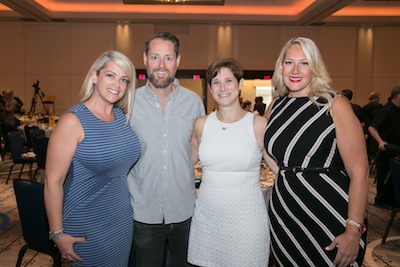
Innovators Lunch committee members, left to right, Shannon Ezekiel, Hillary Cooper and committee chair Sherri Wise with keynote speaker Ryan Holmes, CEO and founder of Hootsuite. (photo by Sandra Steier)

When event chair Dr. Sherri Wise took to the podium, she thanked everyone involved in making the lunch possible, including her co-chairs, Shannon Ezekiel and Hillary Cooper. Richard Fruchter, senior management consultant at JFSA, added his thanks and, after a video about JFSA’s impact, introduced Dr. Neil Pollock who, with his wife Michelle, matched all new and increased donations to the lunch up to $20,000.

Pollock spoke about his family’s involvement with JFSA. In particular, he spoke about Dorita Flasker, who came to Vancouver from South America as a senior, having had all her wealth expropriated by her home country’s government. In the years since JFSA connected them, she and the Pollocks have become family, and they all recently celebrated her 80th birthday together.

Shay Keil of Keil Investment Group of ScotiaMcLeod, one of the lunch’s co-presenting sponsors, introduced the keynote speaker. Holmes founded Hootsuite in 2008, said Keil, taking the company from a small startup “to a global leader in social media with over 13 million users, including 800 of the Fortune 1000 companies.”

“My parents were both teachers – they left teaching in the ’70s to get back to the land, to become farmers,” said Holmes. “They bought a hobby farm. I grew up with goats, chickens … kerosene lamps, a water well in the Okanagan Valley.”

He discovered computers – “magical things” – at the library. The librarian noticed his enthusiasm and suggested he enter a schoolwide programming contest. Two months later, he won the contest – the prize, an Apple IIc computer, which had to be connected to the family car’s battery, as their home had no electricity.

His first business was a paintball company he started in high school. He went to university to study business, but dropped out and opened a pizza place, which he ran for a couple of years. After selling the restaurant, he moved to Vancouver, bought a computer and started learning how to build HTML websites. He got a job at a dot-com that crashed about six months later, so founded his own agency, Invoke. He continued to learn his craft and eventually hired employees. They had customers to whom they would provide computing services and they built a number of products, such as product-management and e-commerce systems.

“Around 2008, we started to do marketing on social media for our customers,” he said. “What we realized very quickly was that there weren’t very many tools out there to manage social media…. We needed a tool to help manage multiple team members and multiple social networks all from one place, and that was the aha moment for Hootsuite.”

Soon thereafter, Hootsuite was launched. Investors were found about a year later – “Remember, this was at a point when people were asking, ‘Is Twitter just a fad?’ ‘Is Facebook just the next MySpace or the next Friendster, is it going to be obsolete in a year?’ People didn’t know if social media was relevant and was here to stay.”

Hootsuite – which has about 800 employees – is headquartered in Vancouver, but has offices around the world. “We send 28 million messages a week and these messages reach three billion users across the planet every week.” Among those users have been the Arab Spring and Occupy Wall Street movements, and the White House.

“We’re in an era of unimagined disruption,” he said, pointing to three trends driving it: social (sharing videos, for example, which can go viral), a more collaborative economy (businesses like Uber) and mobile.

“Sixty percent of people who complain on Twitter expect a response within one hour,” said Holmes. “So, if you’re a brand, if you’re a business, and you’re not there … it’s like you don’t have a website, like you don’t have a telephone…. The thing about social is there is an implied contract: you’re naked and transparent….” If customers do not get a response, “they’re going to talk about it over and over again and, so, you’re going to be brought into the open as a business.”

Holmes compared various communications technologies. “The telephone took 75 years to reach 50 million users, radio 38, television 13, LinkedIn six-and-a-half, Twitter four, Facebook three, Instagram 1.7. Adoption is happening quicker and quicker.”

He then talked a bit about Snapchat, and showed the audience how to use it.

About the next big thing, he hopes that, like “the PayPal mafia” – “a group of alum … [who are] driving a lot of the innovation that’s happening in Silicon Valley” – there will be a “maple syrup mafia.”

“I would love to see the alum of Hootsuite go on to create the next 10 Hootsuites within Vancouver and more within Canada,” he said.

Already, the B.C. technology sector employs more people than the mining, oil and gas, and forestry sectors combined. To create an even better ecosystem for innovation, he said, there are three key requirements: capital (money to build companies), environment (places for people to live and work) and talent (education and immigration, as there currently is a lack of supply).

“There is huge opportunity for people who want to head into this industry,” he said, predicting an increasing demand for these types of jobs.

During the question-and-answer period, Holmes responded to concerns about privacy – he believes the good aspects of technology outweigh the bad; housing – a problem for every business, he said, putting the onus on the government to increase supply, create more diverse product (not just 500-square-foot living spaces) and implement policies to control demand; and corporate responsibility, which he thinks will become more of an issue. To him, the lack of what once were basic skills – such as writing – is simply the evolution of language, the next steps being the keyboard and more voice-activated technology.

Format ImagePosted on May 13, 2016May 11, 2016Author Cynthia RamsayCategories LocalTags Hootsuite, Innovators Lunch, Jewish Family Service Agency, JFSA, Ryan Holmes, Snapchat, tikkun olam
Courage’s two records

Courage’s two records

Lorne Segal, chair, Courage to Come Back Awards. (photo by Cynthia Ramsay)

In its chai year, the Courage to Come Back Awards had a record night on May 5 at the Vancouver Convention Centre, with more than 1,500 guests and more than $1.43 million raised for Coast Mental Health.

In his address, Courage to Come Back chair Lorne Segal pondered the question of why the event is so popular. “Because,” he said, “at these awards, like nowhere else, we feel the extraordinary power of the ordinary spirit and the deep humanity so often lacking in our daily lives.”

He said, “We all shed a tear tonight and, whether it was a tear of joy, of hope, of love, it was not because we wanted to, but because we needed to. You see, we need to know that, even against the worst hand we could be dealt in life, we too can triumph. Because our six heroes tonight could do it, so can we.

photo - Cynthia Ramsay, publisher of the Jewish Independent, and Shay Keil of Keil Investment Group of ScotiaMcLeod
Cynthia Ramsay, publisher of the Jewish Independent, and Shay Keil of Keil Investment Group of ScotiaMcLeod. (photo from Cynthia Ramsay)

“Each of us came into this room for a different reason, but we will all leave with our nourished souls tied together by one common thread: the unshakeable belief that, by seeing the very best in others – courage, faith, hope, endurance – we will somehow find the strength to face our own fears and achieve our greatest dreams. And for that, we need to thank our six superstars who are symbols of the possibilities which lie within us all.”

This year’s six honorees were Christy Campbell (in the physical rehabilitation category), Jemal Damtawe (addiction), Meredith Graham (social adversity), Dr. Barbara Harris, (mental health), Coltyn Liu (youth) and Tom Teranishi (medical). Since 1999, Courage to Come Back has now honored 103 individuals who have had the “courage to overcome serious adversity, change their lives for the better and move forward to help others do the same.”

Co-hosting the gala evening were Randene Neill and Kevin Evans, while Howard Blank emceed the fundraising portion of the proceedings. In his comments, Blank noted that Coast Mental Health helps an average of 12 clients a day and that its programs address three main pillars: housing, employment and support services.

The largest donation of the evening came from B.C. taxpayers, as Minister of Health Terry Lake donated $100,000 from the province on behalf of Premier Christy Clark and Minister of Finance Mike de Jong. The largest private donation came from Joseph and Rosalie Segal, who contributed $50,000. Many other individuals and companies made donations, several citing the Segal family as their example of what it means to give back to community.

There was no shortage of role models for giving that night, with the six honorees leading the way. There were many meaningful takeaways, including Liu’s statement: “Mom’s lesson: don’t feed the negative monster inside; rather, fight with a belief in yourself and for a reality you want.” And Graham’s reminder that, “sometimes, you can give what you didn’t get.”

“What part will you play,” she asked the crowd, “to change lives today?”

Format ImagePosted on May 13, 2016May 11, 2016Author Cynthia RamsayCategories LocalTags Courage to Come Back, mental health, Segal, tikkun olam
Helping those at risk

Helping those at risk

Shai Lazer, chief executive officer of Youth Futures, an organization that aids Israel’s at-risk youth. (photo from Shai Lazer)

Earlier this year, Shai Lazer, chief executive officer of Youth Futures – a program supported by the Jewish Federation of Greater Vancouver’s annual campaign, among others – visited Vancouver.

A leader in the Israeli youth-outreach movement, Lazer describes himself modestly.

“I am 36 years old, married with three kids, living in Modiin,” he told the Independent. “My hobbies are reading, traveling around the country and sports. My military service was very meaningful, as was studying in university at the Mandel Institute.”

Lazer’s modesty is deceiving, as he presides over a national organization with outposts in 36 Israeli communities.

Youth Futures endeavors to help vulnerable children, their families and their communities cope with the painful and/or challenging aspects of their daily lives. Started in 2006, Youth Futures works with all demographics of Israeli society, including every manner of Jew, Arab, Bedouin and Druze. Working with more than 12,000 people throughout Israel, Youth Futures designates around 300 professional “mentors” to facilitate the majority of the organization’s outreach. Ultimately, Youth Futures’ mission is “to give every at-risk child in Israel’s geographic and social peripheries the confidence, opportunities and skills to realize their inherent potential.”

photo - Shai Lazer, right, with Jewish Federation of Greater Vancouver chief executive officer Ezra Shanken
Shai Lazer, right, with Jewish Federation of Greater Vancouver chief executive officer Ezra Shanken. (photo from JFGV)

But, as Lazer explained, the organization is continually expanding. On his mid-March visit to Vancouver, he spoke with his Canadian counterparts about the direction in which Youth Futures and similar organizations are heading.

“I was received incredibly well,” said Lazer. “I felt there was a real and honest dialogue about what’s currently happening in the field, future endeavors, and meaningful conversation in private and in groups. All in all, the main feeling was that of partnerships.”

Lazer is no stranger to partnerships. Under his direction, Youth Futures’ Kiryat Shmona branch currently benefits from Vancouver (22%), the Jewish Agency (35%), the Ministry of Education (38%) and the local municipality (5%) in partnerships and investment. The organization has grown dramatically since Lazer became director of the program in 2008, and even more since he became CEO. One of his achievements has been securing more government financial backing.

Lazer became a part of Youth Futures when he was in university.

“The program was just started while I was in the second year of my studies in Mandel Institute,” he said. “I was approached to join the staff. I remember thinking that it was an interesting educational concept, and was drawn to the newness – the opportunity to create something new and redefining our approach to helping at-risk children.”

Youth Futures uniquely uses the model of having a mentor reach out to the youth and families in their national outposts. Lazer believes that the idea of the mentor is the key to the success of the organization.

“I define a professional mentor by their ability to learn,” he said. “To be able to stop, have some personal reflection and increase their learning curve – that and passion. Youth Futures chooses this model because it’s the only thing that works.”

Youth Futures has the statistics to show its effectiveness. For example, 78% of the youth showed increased self-confidence and ability to cope and 74% showed improved social skills; its alumni have a negligible school drop-out rate and 84% of them have shown the higher motivation required to qualify for more elite army units or to perform civil service. Lazer maintains that such positive numbers are directly because of Youth Futures’ role in these children’s lives.

“I think it’s because someone believed in them,” he said. “When someone believes in you, your confidence grows and you want to become part of the community. It gives you a sense of responsibility over the world you live in.”

Lazer is adamant that his organization’s model could be used in other countries to help at-risk children and the families and societies that surround them. And Youth Futures is actively looking to expand into North America.

Building on his organization’s momentum, and the foundation of 10 years of solid community outreach, Lazer believes the next decade for Youth Futures will be busy and successful.

“Ten years from now, Youth Futures is still here, constantly expanding to more communities and to new populations – early childhood and high school,” he predicted. “We’re currently in the midst of planning the celebrations of 10 years of Youth Futures and launching the next decade. We’re working on a ‘journey book,’ which will include interviews and showcase all different localities, a film, a big national event to celebrate with our participants and their families, a professional seminar, a reception to be held at the General Assembly of the Jewish Federations of North America in November, and many more. We’re also launching two new initiatives, expanding into intervention with early childhood parents, as well as starting an organization to help our alumni. It’s an exciting time and we’re looking forward to many new things coming our way.”

Jonathan Dick is a freelance writer living in Toronto. His writing has appeared in the Canadian Jewish News, and various other publications in Canada and the United States.

Format ImagePosted on May 6, 2016May 5, 2016Author Jonathan DickCategories IsraelTags at-risk youth, Israel, Lazer, mentorship, tikkun olam, Youth Futures

Talking about Israel as a family

Sixty-eight years ago, when Israel was born and became the state of the Jewish people, a family was created. As with any other family that has a complex history, there is love and arguing, support and fallings out in the Israel mishpacha. To make things trickier, Israel is what we would call a blended family, whose members come from wildly varying geopolitical, socio-cultural, ethnic, religious and linguistic backgrounds.

This variety makes for a richness you would be hard-pressed to find elsewhere – the intensity and vigor of which those visiting or missing Israel so often speak. However, the blended Israeli family is fraught with tensions brought about by both the baggage each member has and the difficult neighborhood in which they live. Because Israel is the only Jewish state in the world – our only “family home” – each discussion about it feels of utmost consequence, even to Israel’s extended family of Diaspora Jews, who feel strongly about their connection to that familial home and the relatives living in it.

Not long ago, the announcement that singer Achinoam Nini (Noa) had been invited to perform at our community’s Yom Ha’atzmaut celebration on May 11 set in motion a heated debate about where we draw our red lines when it comes to criticizing Israel. The Jewish Federation of Greater Vancouver made a decision to welcome Noa despite the objections of individuals who disagree with the artist’s political views, and Ezra Shanken, JFGV’s chief executive officer, expressed his hope that our community would continue the Jewish tradition of welcoming diversity of opinion and embracing respectful debate. As we celebrate Israel’s 68th birthday, I think it would be worthwhile to take a look at how our blended family handles conflict and disagreements when they arise from within, and do a little cheshbon nefesh, soul searching, about how we each might be contributing both to the family’s well-being, as well as to internal friction and divisiveness.

With Israel, we so often focus on the external conflicts, sometimes at the expense of looking at what is happening in our own backyard, and this is something we cannot afford to do any longer. For our blended family to thrive and prosper, it is not enough anymore to stand united against enemies. The strength of a tight-knit family depends less on the extent to which its members agree on every issue, and more on how they communicate their disagreements and live with differing points of view under one roof. We all share a moral obligation to set an example for the children and youth in our community, and show them that the Israeli family of which they are a part is strong and confident enough to welcome and even encourage different opinions and points of view.

So, how do we have disagreements and important discussions without engaging in the kind of destructive behavior and accusations that tear at our familial fabric? Is it possible to have difficult conversations from a place of mutual respect, even when we don’t see eye to eye? I speak from experience when I say that, while not easy, it is, in fact, possible. I have friends from across the political, national and religious spectrums, and I cherish the ongoing, sometimes challenging, conversations I have with them about Israel. With those conversations in mind, I would like to offer a few points to consider and some basic strategies I have found helpful when discussing Israel.

We have something important in common. Whenever you engage in a discussion with a fellow member of the tribe who holds different opinions about Israel than you do, remember that you wouldn’t be having that difficult conversation if it weren’t for the fact that you both care enough about Israel to take the time and argue. If you are not sure this is the case, ask the person a simple question: Do you care about Israel? If they answer yes, then, as surprising as it may sound, you have some common ground – a starting point for a respectful exchange of ideas. It is not always comfortable to accept that someone who holds a political view we disagree with comes, as we do, from a place of caring about Israel. But that is a discomfort we should learn to lean into and work with if we want to help foster within our community the democratic value of free speech – the same value that sets Israel apart from other countries in the Middle East.

Respond rather than react. Yes, there is a difference between the two. When we react, we re-act specific lines, roles and dialogues, just as a well-rehearsed actor in a long-running play would do. Unsurprisingly, reaction-based discussions usually feel like rather irritating déjà vus. When we respond, we do so from a sense of responsibility (response-ability): we know that we are not merely actors with memorized lines, and that we have the freedom to improvise, to choose to keep an open mind in those conversations where our default mode is to be judgmental, get defensive or go on the offensive.

Next time someone says something about Israel that makes you want to yell at them, “You have no idea what you’re talking about!” or “How can you say something like that?!” ask instead “Can you tell me more about what you just said?” It won’t feel natural at first because improv moves us out of our comfort zone. Nevertheless, try it. Be curious. We all have a human need to be heard and we all know how unpleasant it feels when our words are ignored or dismissed. Really hearing someone out is a beautiful, positive way to practise what Rabbi Hillel believed to be the essence of the Torah: what is hateful to you, do not do unto your neighbor.

Respect the importance of our personal histories. So much of who we are, what and how we think and how we feel about any given issue is a result of our personal history. When and where we were born and raised, our family’s past, our religious background, the influential people and key experiences in our lives – all of these and more also contribute to how we relate to Israel. If we understand that each one of us has such a personal history that affects our worldviews and that these histories differ from person to person, we move a step closer to accepting that it is inevitable for a variety of opinions about Israel to exist within our community. Once we accept this truth, we can choose to find it in ourselves to treat with respect even those with whose opinions we disagree.

In Hebrew, the words kavod (respect), kibud (honoring/acknowledging) and koved (weight/difficulty) all stem from the same root. Truly respecting “the other” and acknowledging from where they come and their right to hold different opinions to ours can, indeed, feel difficult and burdensome at times. Yet, if we want to help create a strong community that honors the histories and diversity of all its members, we should view this effort to respect the other as a blessed weight that we choose to carry, like that of an unborn child.

If you are a regular reader of the Jewish Independent, it is safe to assume that you, too, care about Israel. As we celebrate Israel’s birthday this year, I invite you to envision the kind of legacy or family heirloom we want to leave for the next generations in our community. In my mind, I see a vibrant, warm, colorful, imperfect and unique patchwork quilt to which each of us can add a symbolic piece of ourselves as the dialogue about our beloved Israel continues to unfold. What is your vision? And what are you willing to do to make it a reality?

Pirkei Avot (Ethics of Our Fathers) teaches us that “it is not upon us to complete the work, but that neither are we free to desist from it.” Our work as fellow members of the extended and blended Israeli family is to do tikkun olam (repair of the world). And tikkun olam begins with us, at home and in our community. So, in our conversations about Israel, let us all commit to being a bit more curious and a little less judgmental. Let’s treat one another with kavod and remember that the strength of our family is directly proportionate to our ability to be kind to one another.

Yael Heffer is an educator who has been working with children and families in the Vancouver Jewish community for close to 10 years. She is currently completing her master’s in child and youth care, is involved in social emotional learning research and is training as a clinical counselor. She grew up in South America, Germany and Israel and is a strong advocate of nonviolent communication.

Posted on May 6, 2016May 5, 2016Author Yael HefferCategories Op-EdTags Diaspora, free speech, Israel, Noa, tikkun olam, Yom Ha'atzmaut
RJDS student mitzvah

RJDS student mitzvah

Students Tomer Berko Gabay (student council president), Liam Greenberg (secretary) and Nathan Tourvieille (treasurer) with Heartly, aka Karen Pasqua, senior events coordinator, Howard Blank, Reesa Pawer and Julie Kendell. Student Tal Pretli (vice-president) was absent when the photo was taken. (photo from Richmond Jewish Day School)

Until last year, Richmond Jewish Day School did not have a student council. That was when Reesa Pawer, education assistant at the school, decided it was time to make some changes and do something “for school spirit.”

Not only were students given an opportunity to vote in their council, but they cast their votes at the same time as their parents were participating in the federal election. Said an enthusiastic Pawer, “There were lineups to the ballot boxes! The votes were counted and the student council was elected, as they would be in a real election.”

Class representatives were then chosen by teachers and students. Since then, the council has gone from handing out hot chocolate at recess to coordinating an impressive fundraising program.

The students have targeted three charities to support, said Pawer. “They wanted a global charity, so they picked Variety Club. They wanted a local charity, so they chose the Richmond Animal Shelter, who received a cheque last term. And they wanted to support a Jewish charity, so they’re raising funds for the Jewish Food Bank.”

The project involved students from grades 1 through 7 and, said Pawer, the student council “did the legwork.”

To raise funds, students sold flowers, including gerbera daisies and roses, for local families’ Shabbat tables. They also sold cakes and contributed $2 on non-uniform days, which take place monthly on Rosh Chodesh, to raise funds for Variety.

On April 11, RJDS welcomed Howard Blank, president of Variety in British Columbia, to the school. After a short video presentation about the work of Variety, the students presented Blank with a donation. School council president Tomer Berko Gabay spoke at the assembly, saying that the student group felt “honored to give this $1,000 cheque to Variety – The Children’s Charity.”

The students had a chance to meet Heartly, Variety’s mascot, and were shown a video by Richard O’Shaughnessy, Variety’s events coordinator, about a young man who has benefited greatly from the generosity of Variety supporters. Born with only one hand, Drew now has a robotic hand, which allows him to complete even the most intricate tasks. His passion is making jewelry and, thanks to the robotic hand, he is now able to operate the tools required to do so. The RJDS kids watched the video in rapt attention, exclaiming “Cool!” when they heard about the “bionic” hand from Blank.

Blank praised the students for their community spirit and hard work. He described the “wonderful mitzvah” they had performed. “You’ve given a young boy or girl a new wheelchair or a special bicycle,” he said. “You guys really helped make sure that every kid gets a fair chance, and we think that’s right.”

RJDS principal Abba Brodt also applauded the students. “I am really proud of you,” he said. “You did something special – and so did your families.”

Asked how this fundraising program contributes to the students’ academic programs, Brodt described the integration of the school’s Jewish studies with the government-mandated B.C. curriculum.

“It was the perfect way to teach tikkun olam, to bring beauty to Shabbat tables and bring beauty to the wider world. It’s the perfect way to tie what’s out there in the world with what’s in here,” he said, putting his hand on his heart.

He added, “Reesa went above and beyond. This is a remarkable achievement for the student council. She gave the kids her full support.”

Blank took the time to answer questions from the group assembled, bringing the kids’ attention back to familiar experiences. He also reminded them to help kids in wheelchairs feel included when they meet them at playgrounds. “They don’t just want help, they’re just like you, they want friends,” he said.

RJDS students will present a cheque to the food bank in June, said Pawer. “This is the first year we’ve done such a big project,” she said. “We’re hoping to keep it going.”

Shula Klinger is an author, illustrator and journalist living in North Vancouver.

Format ImagePosted on April 22, 2016April 20, 2016Author Shula KlingerCategories LocalTags charity, Richmond Jewish Day School, RJDS, tikkun olam
Hillel BC to Rwanda, Israel

Hillel BC to Rwanda, Israel

The Hon. Jody Wilson-Raybould, minister of justice and attorney general of Canada, centre, addressed Project Tikkun participants at Hillel BC on March 13. (photo from Hillel BC)

As the academic year winds down on university campuses across the province and students gear up for exams and summer jobs, 15 student leaders from the University of British Columbia and Simon Fraser University are also preparing for a totally different experience: a 16-day experiential learning and service trip to Rwanda and Israel.

Project Tikkun was developed by Hillel BC to challenge students to “understand the essence of hate by breaking down stereotypical thinking.” It is a yearlong program of learning that allows participants to explore the root causes of racism and antisemitism, culminating in a service trip to Rwanda and Israel between May 3 and 18.

The overseas component will enable participants to bear witness to how the diverse citizenry of two relatively young nation-states have grappled with a legacy of genocide. It will provide a firsthand examination of conflict resolution and reconciliation through the humanitarian work and activism pursued in each country to build durable and bonded communities.

According to its website, Project Tikkun brings together “undergraduate students of different ethnic backgrounds, religious practices, sexual orientation and personal beliefs to establish a caring and committed community of change-makers.”

Rebecca Recant, program director at Hillel BC, noted that the intent of the project is also to “build a local community of allies that can support each other when a [hateful] incident comes up, no matter which community.”

Student interest in the program exceeded the limited number of spaces and, last fall, a diverse group of 15 participants was selected. The group includes students of Chinese, Taiwanese, Indian, Korean, Persian and Rwandan backgrounds and a mix of the Jewish, Sikh, Baha’i and Christian faiths. The religious affiliation of the Jewish students varies – some come from secular homes whereas others were raised Orthodox; some have visited Israel and, for others, this will be their first trip to Eretz Yisrael.

Over the course of the year, the participants have been getting to know each other and examining their biases through intensive group learning sessions in which they have explored the history of Canada, Rwanda and Israel. A number of guest speakers, ranging from academics to community activists, have facilitated discussions. Of note, Dr. Andrew Baron, an assistant professor of psychology at UBC whose research examines the cultural and cognitive origins of unconscious bias, structured tests for Project Tikkun participants based on the Harvard Implicit Bias Test that he helped create. Jordana Shani, managing director of Hillel BC, explained that the testing of participants’ level of bias takes place at three different intervals: at the outset of the program, prior to departure and one to two months after return to Canada. The testing provides a way “to measure what we’ve done and how effective the program has been,” she said.

Certainly, much time, effort and money has been channeled into the program, especially the service trip. The journey begins in the capital city of Rwanda, Kigali, where local guides will accompany the students on a tour that will highlight the many landmarks and memorials of the 1994 genocide. The students will then travel to the Agahozo-Shalom Youth Village (ASYV), where they will spend the bulk of their time. Established in 2008 as a residential community-home to protect and nurture Rwandan children who were orphaned during and after the genocide, ASYV now cares for approximately 500 of Rwanda’s most vulnerable high school-aged students. It is modeled after Yemin Orde, an Israeli youth village founded in 1953 to care for orphans of the Holocaust, and it provides a family-like environment for at-risk youth.

The Rwandan students “grow up in this youth village hearing about the youth aliyah village in Israel that [ASYV] was based on,” said Recant. “It’s an Israeli model that is part of the connection between the two countries. They even know Hebrew words, like tikkun olam.”

At the youth village, Project Tikkun participants will learn and live side by side with the ASYV students and volunteer in the classrooms, on the farm and in the kitchen. They will accompany the ASYV students during their foray into town to fulfil a weekly community service commitment.

Libia Niyodusenga, a second-year UBC economics and geography student who was raised at the Agahozo-Shalom Youth Village, is looking forward to returning to Rwanda as part of Project Tikkun. “I think the country itself has the best ways and methods of teaching people through so many organizations that are based in Rwanda and so many history-based sites that you can learn from,” he said.

From Rwanda, Project Tikkun participants will travel to Israel, arriving on Yom Ha’atzmaut, where they will celebrate Israel’s independence in Jerusalem. Later, they will commemorate the victims of the Holocaust at Yad Vashem, tour the Old City and observe Shabbat before moving on to explore other parts of the country, including the Yemin Orde Youth Village. All the while, participants will learn from and volunteer with Israelis who are committed to combating intolerance and inequality – political, religious, ethno-cultural and socio-economic – to effect positive change within Israeli society.

The Israel portion of the trip will demonstrate that complex issues – both regional and domestic – defy the simplistic characterizations often portrayed by the media and that “you can love the country and be critical of it at the same time,” said Shani. The participants, she added, “will meet with people who believe in the right of Israel to exist and who are engaged to make it a better place.”

Jasmeet Khosa, a fourth-year student of international relations at UBC whose Sikh parents immigrated to Canada from Punjab, India, said: “I know that this project focuses on Rwanda and Israel as case studies [for conflict resolution and activism], but what I’ve learned so far is that this extends far beyond – [the message] is universal.”

By all accounts, Hillel BC is pleased with the results of the project thus far. Participants are inspired to help create positive change both at home and abroad and have developed a profound sense of strength through their diversity. As Khosa observed, “… the great thing is that we come from such different backgrounds – academically, culturally, religiously – that everyone brings their own perspective and we get a really great mix in that everyone has something unique to contribute to discussion and friendships, in general.” Niyodusenga added that the connections between program participants are already “deep and intimate.”

In reflecting on the many experiential learning and service trips that she participated in during university and how integral they were to forming her identity, Recant said, “Trips like this are life-changing.”

Shani and Recant are grateful for a grant from the Diamond Foundation that made Project Tikkun possible. While participants will pay a fee, the cost of the program is heavily subsidized to ensure that finances do not pose any obstacles. However, because of the decrease in the value of the Canadian dollar, Hillel BC is continuing to seek financial support for the program. For more information about Project Tikkun, visit projecttikkun.hillelbc.com; to make a donation, call 604-224-4748.

Alexis Pavlich is a Vancouver-based freelance reporter.

Format ImagePosted on April 15, 2016April 13, 2016Author Alexis PavlichCategories LocalTags antisemitism, genocide, Hillel BC, interfaith, Israel, racism, Rwanda, tikkun olam
An update from Aleph

An update from Aleph

Among other activities, Aleph in the Tri-Cities Israeli culture club is getting ready for Passover. (photo from facebook.com)

Looking back at 2015, Aleph in the Tri-Cities Society reports that last year’s food bank donations amounted to approximately 2,000 kilograms (more than two tons) of food items for the SHARE Family and Community Services Society and other missions around the Lower Mainland.

For Purim this year, Aleph cooked and delivered mishloach manot directly to the homeless. Community members prepared 100 trays with pasta, rice, beans, tacos and organic orange juice and distributed the food at the corner of Main and Hastings streets.

“We care. We do. Community connections” is Aleph’s slogan. The nonprofit has been helping the larger community and its neighbors since 2010. It operates as an Israeli-Canadian culture club, welcoming more than 120 young families, including many newcomers and other local Jewish families mixed with Canadian friends, all celebrating life through Israeli culture.

Aleph programs include marking the Jewish holidays and educational programs, such as Hebrew lessons, computer classes, nature walks for families, as well as providing donations to the food bank, networking and supporting each other.

The society is self-supported, relying on volunteers and donations to sustain itself. The community is preparing for Passover and will be holding a seder on April 22, 6 p.m. Anyone interested in becoming involved in the seder and other activities can do so through Aleph’s Facebook page.


Format ImagePosted on April 8, 2016April 6, 2016Author Aleph in the Tri-Cities SocietyCategories LocalTags food bank, Passover, tikkun olam, Tri-Cities

Posts pagination

Previous page Page 1 … Page 27 Page 28 Page 29 Page 30 Next page
Proudly powered by WordPress