Skip to content
  • Home
  • Subscribe / donate
  • Events calendar
  • Business Directory
  • FAQ
  • News
    • Local
    • National
    • Israel
    • World
    • עניין בחדשות
      A roundup of news in Canada and further afield, in Hebrew.
  • Opinion
    • From the JI
    • Op-Ed
  • Arts & Culture
    • Performing Arts
    • Music
    • Books
    • Visual Arts
    • TV & Film
  • Life
    • Celebrating the Holidays
    • Travel
    • The Daily Snooze
      Cartoons by Jacob Samuel
    • Mystery Photo
      Help the JI and JMABC fill in the gaps in our archives.
  • Community Links
    • Organizations, Etc.
    • Other News Sources & Blogs
  • JI Chai Celebration
  • JI@88! video

Recent Posts

  • Federation now across BC
  • Israel fighting for its existence
  • Deal strengthens Iran
  • Patriotic belonging diminishes
  • A campaign to engage
  • Upstanders’ first live event
  • Responding to Carney
  • Having your own home
  • Music a family tradition
  • Musical to warm heart
  • Community milestones … June 2026
  • Sharing her passion for Israel
  • Or Shalom reopens its doors
  • JFS from past to future
  • Need holistic approach
  • Sharing stories, advice
  • Journalist shares fears
  • Skills to live together
  • Road to independence
  • Cutting grass with scissors
  • Zionism as a solution
  • Deceit, desire & the divine
  • Reclaiming sacredness
  • Creative project ideas
  • Summer squares and cobbler
  • Thou shalt … summer commandments
  • Legal help for students
  • Revisiting myth of Lilith
  • Wrong person rebuked
  • Canada’s mixed messages
  • Questions for museum
  • Symposium on antizionism
  • Making soccer political
  • CJPAC lauds Pulver’s impact
  • City recognizes Vrba’s legacy  
  • Organ donation saves lives

Archives

Follow @JewishIndie
image - CJN box ad Rockowers 2026

Tag: identity

Where Jewish pride grows

Where Jewish pride grows

Camp Solomon Schechter builds identity and combats antisemitism. (photo from Camp Solomon Schechter)

During Tisha b’Av, a day of mourning and reflection, the entire camp community of Camp Solomon Schechter in Tumwater, Wash. – 300 campers, ranging from 3rd to 10th graders – gathered in silence at the amphitheatre. A staff member stepped forward, the flicker of torches casting shadows. They asked a question: “Please stand if you have ever encountered antisemitism.” 

Slowly, hesitantly at first, campers began to rise – one by one, then in clusters. Younger campers glanced around, their faces etched with uncertainty, before joining their peers. Staff members, too, stood. Eventually, every camper and every staff member were on their feet. 

The sight was both powerful and heartwrenching. The realization that every single member of our community, even our youngest, had faced antisemitism was a sobering reminder of the challenges our children navigate. It underscored the importance of camp being a safe haven and Camp Solomon Schechter’s mission to empower campers with pride, resilience and an unshakable connection to their Jewish identity. 

“Living as a minority, especially in times when hate seems to be ever growing, camp becomes an oasis of belonging, safety and joy,” said Rabbi Eve Posen of Congregation Neveh Shalom in Portland, Ore. “The opportunity for children to be immersed in joyful Judaism at camp is a powerful antidote to the antisemitism present in our world today.” 

Antisemitism is not a relic of the past – it is a persistent reality that manifests in subtle and overt ways, from exclusionary rhetoric to acts of violence. As Jewish communities grapple with these challenges, there is a question that arises time and again: how do we equip the next generation to respond to and rise above these threats? One answer lies in Jewish summer camp. 

Camp Solomon Schechter believes camp is more than a summer getaway – it’s a transformative space where Jewish identity is not only celebrated but deeply ingrained. It’s where children and teens connect with their Judaism, form forever friendships and discover the joy of being part of community. These experiences serve as a critical counterweight to the forces of antisemitism by fostering pride, resilience and a sense of belonging.

Proud Jewish identities

Antisemitism seeks to diminish Jewish identity, often targeting individuals and communities by attacking their sense of self-worth and belonging. Schechter counters this by fostering environments where Jewish life is celebrated unapologetically. Imagine a Shabbat at camp: the entire community dressed in white, walking hand in hand to a service that looks out on Lake Stampfer. The melodies of prayers mingle with the natural beauty of the outdoors, creating a sacred space where campers feel deeply connected to their heritage and one another. These moments instil a sense of pride that stays with them long after camp ends.

Whether it’s singing Birkat Hamazon after meals or morning prayers, core tenets like Shabbat, kashrut and tefillah – and the intentionality (kavana) brought to these traditions – the camp cultivates shared values and rituals that form the foundation for lasting friendships and a rich Jewish life. Examples include Maccabiah (team-building through friendly competition), the Oded program (Jewish leadership development) and Havdalah, where the entire community gathers to mark the end of Shabbat with song and light.

The integration of Jewish practice into every activity reinforces the idea that being Jewish is not just about rituals – it’s about community, identity and how we live our daily lives. At Schechter, Jewishness is woven into everything, from discussions about values to hands-on activities like planting Camas bulbs as part of an environmental stewardship program. Playing basketball becomes a Jewish experience because it’s played alongside Jewish friends. Swimming in Lake Stampfer is Jewish because it’s filled with laughter and camaraderie among a community united by shared traditions. Climbing the ropes course is Jewish because it’s about trust, teamwork and overcoming challenges together. Even sitting down for lunch is Jewish because it’s a moment of connection, blessings are recited. 

Through stories, songs and discussions, campers gain a nuanced understanding of Israel beyond the headlines. Hebrew is spoken throughout the day. Programs like the Israeli Scout delegation and daily flag-raising ceremonies, where Hatikvah is sung, help campers develop a connection to Israel while instilling a sense of responsibility to something greater than themselves. 

Cultivating resilience

Camp teaches resilience in ways both subtle and profound. The challenges of a ropes course or the learning a new skill remind campers of their own strength and capability. These lessons are essential when confronting antisemitism, which often tests the emotional and psychological fortitude of young Jews. 

More importantly, camp creates a safe space to address difficult conversations. When global events – like the war in Israel – impact our community, camp becomes a haven where campers and staff can process their feelings and find support. 

Staff bring their own Jewish journeys to Schechter, and campers are surrounded by Jewish role models who inspire them through teaching, leadership and mentorship.

Community bonds 

Antisemitism isolates individuals and communities, attempting to weaken the collective strength of the Jewish people. At Schechter, the opposite happens: connections are built that transcend geography and last a lifetime. Campers come from across the Pacific Northwest, spanning a range of backgrounds and experiences. At camp, these differences dissolve as the kids unite around shared traditions, values and goals. Whether it’s competing in a friendly staff versus camper football game or singing camp parodies around the closing bonfire, the bonds formed at camp are rooted in joy, trust and mutual respect.

These connections don’t just benefit the individuals involved. Camp alumni go on to become leaders in synagogues, schools and other Jewish organizations, bringing the lessons of connection and collaboration they learned at camp into their adult lives. 

At Schechter, we see it every summer: campers and staff return home inspired and proud to be Jewish. Campers leave not only with stronger Jewish identities but with a sense of hope for the future. That hope is our greatest weapon against hate, and it’s what ensures the continuity and vibrancy of our people for generations to come. To support our work, visit campschechter.org/give. 

– Courtesy Camp Solomon Schechter
Format ImagePosted on January 17, 2025January 15, 2025Author Camp Solomon SchechterCategories LocalTags antisemitism, Camp Solomon Schechter, education, identity, Jewish summer camp

Stepping up to lead

Kolot Mayim Reform Temple’s Building Bridges Speaker Series returns on Nov. 3, 11 a.m., with Rabbi Liz P.G. Hirsch, chief executive officer of Women of Reform Judaism, speaking on Just for this Moment: Stepping Up to Lead.

photo - Rabbi Liz P.G. Hirsch
Rabbi Liz P.G. Hirsch (photo from cdn.fedweb.org)

Hirsch hosts the weekly podcast Just For This, where she invites women leaders to discuss their journeys, challenges and triumphs. She previously served as rabbi of Temple Anshe Amunim in Pittsfield, Mass. She was the founding co-chair of RAC-MA (Religious Action Centre of Reform Judaism, Massachusetts) and serves on the National Council of Jewish Women’s Rabbis for Repro Rabbinic Advisory Council. A writer on social justice, spiritual practice and trends in Jewish life, she has contributed chapters to publications including The Social Justice Torah Commentary (CCAR Press, 2021) and Prophetic Voices: Renewing and Reimagining Haftarah (CCAR Press, 2023).

The theme for this year’s Kolot Mayim Building Bridges series is Kvell at the Well: Celebrating the Joys of Being Jewish. Within the context of the dramatic increase in antisemitism since the events of Oct. 7, 2023, it is more important than ever to highlight proud and strong Jewish culture, history and heritage. The series, which runs on various Sundays until April, will explore Jewish identity, faith, traditions and community, and highlight resilience, survival and hopes for the future. The lectures are free but pre-registration is required via kolotmayimreformtemple.com/2024-25-lecture-series.

– Courtesy Kolot Mayim Reform Temple

Posted on October 25, 2024October 24, 2024Author Kolot Mayim Reform TempleCategories LocalTags Building Bridges, faith, identity, Kolot Mayim, leadership, Liz P.G. Hirsch, speakers, Women of Reform Judaism

Name inspires artist’s work

Growing up in Vancouver during the 1960s and ’70s, I was the dancer, my brother was the guitarist and my sister was the writer, soon to blossom into a visual artist as well.

Devorah Stone, my sister, is one of the contributors to this year’s Calling All Artists exhibit, which opens at Victoria’s Congregation Emanu-El on Aug. 26. Since the early 2000s, the mostly annual event has celebrated artists of many kinds – sculpture, ceramics, textile, poetry, mixed media, fabric, music – who offer their interpretation of a rabbinical or biblical text that they’ve studied with the synagogue’s spiritual leader, Rabbi Harry Brechner.

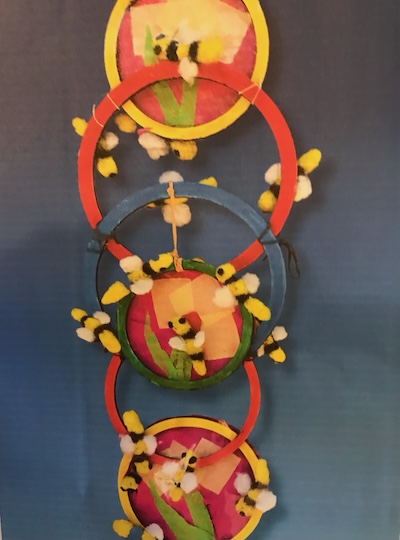
photo - Devorah Stone created a honeybee circle for this year’s Calling All Artists exhibit, which opens at Congregation Emanu-El Aug. 26
Devorah Stone created a honeybee circle for this year’s Calling All Artists exhibit, which opens at Congregation Emanu-El Aug. 26. (photo from Devorah Stone)

“This year’s theme is ‘animals’ and since my name means ‘Honeybee’ in Hebrew, I went with that,” Devorah told me. “The bees in my work are all hand-felted, a technique that involves pocking at wool and shaping the form. I decided to present the bees in circles because they are so crucial to the circle of life.”

The artists’ works are up for six months in the shul’s social hall. Devorah has been involved with the event for the last 10 years. Rabbi Brechner gives a lecture on the theme and how it pertains to Jewish traditions, sacred writings and thought once a month for five months before the celebration. This year, his teaching focused on the significant symbolic and ritual roles animals play in Jewish texts.

“I’ve learnt so much about both art and Judaism attending the rabbi’s lectures,” said Devorah. “Anyone can join … you don’t even need to be Jewish.” 

The Calling All Artists project is run by self-proclaimed “den mother” Barbara Pelman. She said there is a chapbook written every year with an explanation of each artist’s creative process and a copy of that is given out to guests.

“In last year’s Calling All Artists, I did the kohain gadol’s (high priest’s) breastplate with references to all the various colour and gem stones as described in the Torah,” said Devorah. “The only difference was the mannequin I used was a woman’s so I pretended that there might have been female priests at the time of the Temple!

“I’ve also done a collage of a person wearing a tallit and the burning bush, a three-dimensional piece of the Rosh Hashanah dinner, and another collage on a wooden cradle of the story of Abraham and Isaac.” 

Devorah has always been fascinated with art.

“As a child, there was nothing better than a box of crayons and endless paper,” she said. “I drew space ships, planets and alien worlds. I also drew castles and princesses. I loved it. My imagination had no limits.” 

In her 20s, Devorah spent four years at the University of Victoria, earning a bachelor of fine arts. All the while, she felt inspired by Emily Carr and Indigenous art.

“I loved the way Carr personified nature and her magnificent trees,” she shared. “I marveled at the complexities, elegance and craftsmanship of the First Peoples of the land.”

Our parents also brought us up with a strong Jewish identity.

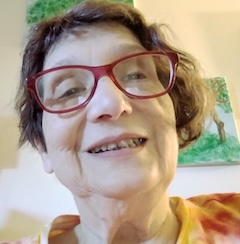
photo - Devorah Stone
Devorah Stone (photo courtesy)

“Being Jewish, I was taken by the imaginative work of Chagall, his goats and houses and how everything seemed to be floating or suspended,” said my sister. “Later on, I began to be influenced by the school of Bauhaus design, especially Kandinsky, his calculated and yet whimsical designs.” 

After Devorah moved to Victoria 20 years ago, she joined the Pandora Arts Collective Society. The group exhibits its works at the Little Fernwood Gallery twice a year and Devorah recently sold a painting there.

The collective is a community of people whose mandate is to facilitate and support mental health through the social and educational benefits of a free and welcoming creative arts space. The studio is open to everyone: professionals, students and beginners. The atmosphere is especially sensitive to people who are using art therapeutically. Devorah is on their board and has planned events for them in the past.

“We inspire and mentor each other,” she said. “I have learnt so much about art from that group. I’ve been introduced to many different kinds of art and artists, as well as being influenced by so many artists in our synagogue. The joke is that you can’t throw a rock without hitting an artist in Victoria!” 

When she was living in and around Vancouver, Devorah brought up three children, two of whom live in the Lower Mainland. She visits all of us frequently and spends a lot of time on the ferry.

“I love doing fast sketches of the scenery as it goes by,” she said. “I also do fast sketches at outdoor concerts and festivals, which Victoria has so many of.” 

Devorah uses pencil crayons, acrylic paint and watercolours, creates collages and sometimes three-dimensional art made out of whatever she can find.  

“I love experimenting and I feel that all my art is influenced by being Jewish,” she said. “It all has a profoundly Jewish way of seeing nature and of being.”

The best way to view Devorah’s art is through Instagram @devlovesart. 

Cassandra Freeman is a journalist and improviser who lives in East Vancouver.

Format ImagePosted on July 26, 2024July 25, 2024Author Cassandra FreemanCategories Visual ArtsTags art, Calling All Artists, collage, Devorah Stone, education, Emanu-El, Harry Brechner, identity, Judaism, multimedia, painting
Pride in his Jewish identity

Pride in his Jewish identity

Brian Gleckman in front of his work, “The Judgment of Solomon (Psak Din: Judgment).” Psak din is a ruling given by a beit din, a Jewish court. (photo by Olga Livshin)

Brian Gleckman’s first show at the Zack Gallery, Abstracted Identity, opened on June 18. 

The artist has loved art since childhood. “I grew up in Los Angeles,” he said in an interview with the Jewish Independent. “It is a vibrant city for visual arts. There are an endless number of art galleries and museums, and I was always there. And, of course, I always drew and painted.” 

After getting his degree in visual art and history from California State University, Gleckman traveled extensively around Europe, before settling in Vancouver more than 30 years ago. But traveling has remained his passion and, during his travels, he invariably focuses on art and art history, museums and galleries. 

“When I first visited Europe, I fell in love with Rococo and Baroque,” he said. Baroque and Rococo are both highly ornamental styles, which infused the art and architecture of post-Renaissance Europe.

Later, he drifted towards more contemporary styles, both as an art connoisseur and in his own work. “I suppose I can call my art abstract expressionism,” he said.   

“Colour for me is a vehicle that allows me to play with shapes and space,” Gleckman explained. “Spatial relationships and composition of the images are of the utmost importance to me. I’m also concerned with depth and texture. I aim to create visual tension in my paintings. I think art shouldn’t be too easy or too comfortable. I want my viewers to engage, to ask questions. ‘What did he mean by that?’ ‘How does it make me feel?’ My viewers might not arrive at the same inner realization I conceived, but their explorations are more important than my answers. When people interact with my art, they become part of the creation process.” 

With his current show, Gleckman seeks to “portray things that lie beyond the tangible – that is, beyond the figurative, beyond the readily recognized narrative. The paintings in this exhibit are expressions of the inspiration I derive from biblical stories, religious thought, as well as rudimentary ideas within kabbalah. Selected from the portfolios of my professional artwork, these paintings are reflections of how I personalize the intangibles of Judaism.… These paintings are abstractions of my Jewish identity, an identity that is the product not so much of formal religious practice but the summative effect of intellectual and emotional sensibilities of my Jewishness.”

Of course, the Jewish Community Centre of Greater Vancouver, which is home to the Sidney and Gertrude Zack Gallery, felt like the perfect venue for such a show, but there was an additional reason why Gleckman wanted to exhibit at the Zack. 

“After Oct. 7, I wanted to do something that had meaning,” he said. “I wanted to share my pride in my Jewish identity. At the same time, I wanted to be part of the effort to help Israel, to make my own contribution. But I am an artist. I create art. I thought maybe my art could inspire someone to do something for Israel, to help in some way.” 

He approached the gallery with the idea of a show and offered to donate any proceeds from the sales of his paintings.

“I’m going to donate whatever I get to two organizations: ASI-Canada (Association for the Soldiers of Israel), which supports active-duty IDF soldiers, and Magen David Adom, which is Israel’s emergency response service. To promote the sales, I’m also offering 30% discount off my website prices for all my paintings.”    

The exhibit comprises 27 paintings from several of Gleckman’s established series. “For this exhibition, I have included paintings that are accompanied by titles … for fuller comprehension,” he said.

“The titles invite viewers to search for and reflect on the nuances of their own understanding of the selected stories, themes and ideas,” the artist explained. “I’m not trying to dictate my own interpretations to viewers. Instead, with the titles, I try to nudge viewers in the right direction. The titles are sort of guidelines for understanding the images, their conceptual representation.”

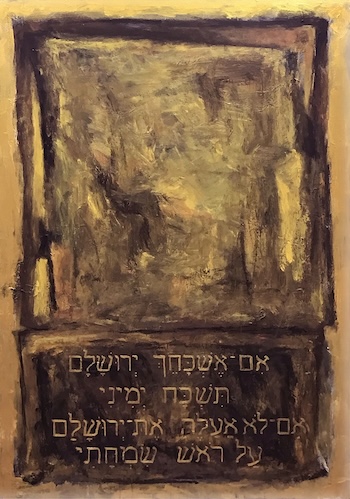
image - “Yerushalayim (Jerusalem)” by Brian Gleckman. The Hebrew words in the painting are from Psalm 137: “If I forget you, O Jerusalem, may my right hand forget ...  if I do not bring up Jerusalem at the beginning of my joy.”
“Yerushalayim (Jerusalem)” by Brian Gleckman. The Hebrew words in the painting are from Psalm 137: “If I forget you, O Jerusalem, may my right hand forget …  if I do not bring up Jerusalem at the beginning of my joy.”

Most of the titles are in Hebrew, spelled phonetically in the English alphabet. Some are in English, but they represent Jewish customs and stories. For example, the large painting “Tikkun Olam” is a field of life-affirming blue, while “Shiva” is bleak and dark, a painting of grief and despair, but both will generate different feelings for everyone.

A few other paintings are linked to grief and death, but many sport bright colors, like “Aytz Chaim” – blue and gold and triumphant – which proclaims the artist’s vision of the Tree of Life. The painting, tall and narrow, is framed by golden words. 

Another tall and narrow painting, “Tefillah” (a prayer), contains this one word in Hebrew, as well as 10 bright gold stars dancing on the blue background below, representing a minyan, the quorum of 10 men (in Orthodox Judaism) or people needed for Jewish communal prayers.

Another painting with words and colours woven together is “Yerushalayim.” Its golden-brown palette is reminiscent of the ancient city of Jerusalem, its modernity and its millennia of history, including conflict.   

Then there are calligraphed Hebrew letters, each magnified manifold on its own black and white canvas. “Their shapes are still recognizable,” said Gleckman, “but I wanted to explore the possibilities, the situation where something we know becomes something else, something to investigate and find a new meaning.” Each of these letter-paintings is like a road, curling capriciously according to the letter’s design, leading the viewers towards the unknown. 

Abstracted Identity runs until July 18. To learn more, visit the artist’s website, briangleckman.com.

Olga Livshin is a Vancouver freelance writer. She can be reached at [email protected].

Format ImagePosted on June 28, 2024June 27, 2024Author Olga LivshinCategories Visual ArtsTags Abstracted Identity, ASI-Canada, Brian Gleckman, fundraiser, identity, Israel, Judaism, Magen David Adom, painting, philanthropy, Zack Gallery
Community gathering place

Community gathering place

Many community events, lessons and celebrations take place in the Jewish Community Centre of Greater Vancouver’s Wosk Auditorium. (photo from JCC)

A sense of family and community, somewhere to be physically active and mentally stimulated, a haven in which to socialize and relax, to have a nosh, a lifeline during the pandemic and a place to be with like-minded people after Oct. 7. The Jewish Community Centre of Greater Vancouver – “the J” – “is a warm and welcoming place for Jews and the community in general,” offered JCC executive director Eldad Goldfarb.

The Jewish Independent spoke with Goldfarb and others recently, to see how the centre has fared since the Hamas terror attacks on Israel, the Israel-Hamas war and the rise in antisemitism around the world, including in Metro Vancouver.

“The level of security has seen a noticeable increase,” said Goldfarb. “The initial shock had an effect on our entire community, which felt insecure and somewhat afraid to venture out and into Jewish community facilities. This fear quickly changed into a desire to congregate, be with fellow Jews in safe spaces, and the JCC is a place where everyone feels safe and welcome.”

He praised the Vancouver Police Department and its role in allowing the community to gather safely.

“The VPD is amazingly supportive of the Jewish community and the JCC,” he said. “They are doing above and beyond within their limited resources to provide both physical as well as emotional safety at this very difficult time for our community. The JCC staff team is very vigilant and pays close attention to anything out of the ordinary.”

Goldfarb has been the J’s executive director for 11 years, and was assistant executive director for the six years prior to that. He said the centre has “expanded its programs and services, providing substantially more scholarships and subsidies to families and individuals.” And he and the JCC board “have been involved in the conceptualization, visioning and creation of JWest, an exciting innovative community project for generations to come.”

“The JCC has been working diligently on expanding our capacity, we have made investments in recruiting top-notch staff, replacing and transforming our technology systems in order to improve customer experience, ease the registration process and create efficiencies in the organization,” said Goldfarb.

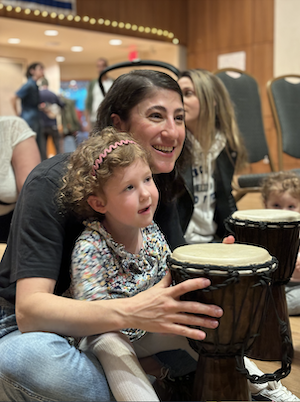
“We’re always trying out new programs,” Hila Olyan, senior director of programs, told the JI. “I’m especially excited about programming for new families, which ramps up this coming fall: pre- and post-natal yoga, baby sign and sing, stroller fitness, storytime in the library. We’re also trying out some new children’s programming over the summer. Music, Music for Littles and Music, Music for Babies will be offered on Sundays. I can say from personal experience that my toddler loves the program. He’s been taking it since April.”

photo - The J's many programs include ones to introduce toddlers and their families to the joys of music
The J’s many programs include ones to introduce toddlers and their families to the joys of music. (photo from JCC)

While the programming hasn’t changed much in response to Oct. 7, Olyan said “the interest in being part of programs has increased. I think, for many people, myself and my family included, the opportunity to participate in Jewish and non-Jewish programming, but in a safe space surrounded by like-minded people, is more important than we previously realized.

“We’ve also tried to be thoughtful as we plan and host our community events like the recent Festival of Israeli Culture. We are thinking about how we can honour the challenging times we are living in, but also celebrate the beautiful culture we all know and love.”

She pointed to significant participation in events such as seniors luncheons, the J’s annual Purim Party and other activities.

“The people of our community want to be around other community members and I think it’s a great thing,” said Olyan. “The atmosphere has shifted a few times. We’ve moved from shock and devastation to strength and resilience. I think it’s a real testament to the spirit of our community.”

“The JCC has and will always be a safe place for me and my family and the entire community,” said Michael Averbach, who has been going to the J since he was a kid himself. “Oct. 7 didn’t change my frequency of visits or how I feel about being at the JCC, nor should it for any current member, but my message to those considering joining – there’s no greater feeling of family than being at the J. It’s the only place where we can truly interact with all sectors of our community, from the non-observant, to the Reform, to the Orthodox and everyone in between. Furthermore, the JCC was built on the foundation where everyone is welcome, regardless of religion or race.”

In addition to being a J member, Averbach has chaired the centre’s main fundraising event, the RBC JCC Sports Dinner, for many years. Attesting to his family’s generations of involvement with the JCC, the welcome desk everyone passes on their way into the centre is called the Betty and Louis Averbach Membership Desk, named after Averbach’s grandparents. And the next generation is also involved. 

“We’ve had our kids in day camp and swimming lessons over the years and, personally, I enjoy boxing sessions with Alexei to keep me sharp and on my toes and to complement my regular fitness routine,” said Averbach. “I also try and get to the J in the later evenings up three to four times a week to enjoy the sauna and steam in the men’s spa.”

photo - Working out at the J
Working out at the J. (photo from JCC)

When asked what keeps him coming back to the centre all these years, Averbach said, “The warm feeling and sense of community walking through the doors.”

This is an aspect that also appeals to J member Cathy Paperny and her family, who joined the JCC in 2006 when their children began the 2-year-old program. 

“I appreciate being surrounded by a Jewish community,” she said. “I have a good relationship with Eldad and we often have good talks about various topics, including the war in the Middle East. During these challenging times, it’s especially important to be surrounded by like-minded people. I feel I have that at the JCC.”

The social aspect is one of Olyan’s favourite parts of her job.

“I like the combination of interacting with members, program participants and administration. I like thinking about how we can make our programming stronger and then having the opportunity to put plans into action and see the results. Every single day I meet and talk with interesting people who are all here at the J for their own unique reason – a workout, childcare drop-off, gymnastics, music lessons, a holiday or festival.”

For Paperny, that reason was the program for 2-year-olds. She said the J was the only place that offered it. “I liked that my children were attending with other Jewish children, some of whom became lifelong friends. It was close to VTT [Vancouver Talmud Torah] for afterschool programs and convenient for me when I was working at the Holocaust Centre,” she said.

Paperny worked at the Vancouver Holocaust Education Centre, which is on the lower level of the centre, until 2019, for about four years as the symposia coordinator and as a docent for more than 10 years.

In addition to the 2-year-old program, Paperny said, “Yaelle went to ballet classes when she was young and did Israeli dancing through Talmud Torah and then performed at the Festival Ha’Rikud events at the JCC until Grade 7. Both of my children attended Camp Shalom for a couple of years.  One of my children did the leadership-in-training program at Camp Shalom. They also attended other sports camps, like soccer.

“I did personal training there for years and attended some of the fitness classes, including circuit training,” she continued. “Now, I swim, do private pilates with Camila, attend yoga twice a week and attend many fitness classes.”

She also attends Jewish Book Festival events and, often, Israeli dancing on Wednesday nights.

These types of activities are exactly what the JCC mission entails.

“For our Jewish community, we continue to be committed to our mission to provide programs to enhance positive identification with Jewish life and Israel,” said Goldfarb. “This can be seen in our children’s camps, early childhood education programs (daycare and out-of-school care) and with our Israeli dance classes – to name a few.”

Nava Creative Kosher Cuisine is also on site. A popular spot to have a coffee or lunch, it is hard not to run into fellow community members when you’re there: members of the J, people visiting the latest exhibit at the Zack Gallery or going up to the Waldman Library, staff from the various Jewish organizations housed in the centre, participants in different programs, parents picking up their kids, students from King David High School, which is located across the street from the centre, and others.

“The JCC, while not without its challenges, is a place of growth and potential,” said Averbach. “I am aware of the high staff turnover and the need for building upgrades and, together, we are actively working on raising the necessary funds to address these issues. If there’s one key area for improvement, it is staff training for those with special needs and neurodiversity. By properly implementing this training, we can ensure that all our children feel comfortable and welcome.”

And it seems that the J is committed to continually improving. For example, staff review its programming often.

“Every participant in a registered program receives an email link to a quick survey,” said Olyan. “We also look at our mission statement and consider how we can continue and better meet our mission and the needs of our community. Are we offering social, educational, recreational and cultural programs for every demographic? Finally, we consider what are the emerging trends and interests within and outside the Jewish community and is the JCC the right place for [such programs]. We really try to listen to our members and find out if there are particular programs they would like to see.”

As for her feedback, Paperny said, “During COVID, the J was a lifeline for me when virtual programs were available, and then when it opened up to in-person programs. My physical health is so integral to my emotional, mental and spiritual health. The J has always been there for me.” 

Format ImagePosted on June 14, 2024June 13, 2024Author Cynthia RamsayCategories LocalTags Cathy Paperny, Eldad Goldfarb, Hila Olyan, identity, JCCGV, Jewish Community Centre of Greater Vancouver, Judaism, Michael Averbach, Oct. 7
What is life’s purpose?

What is life’s purpose?

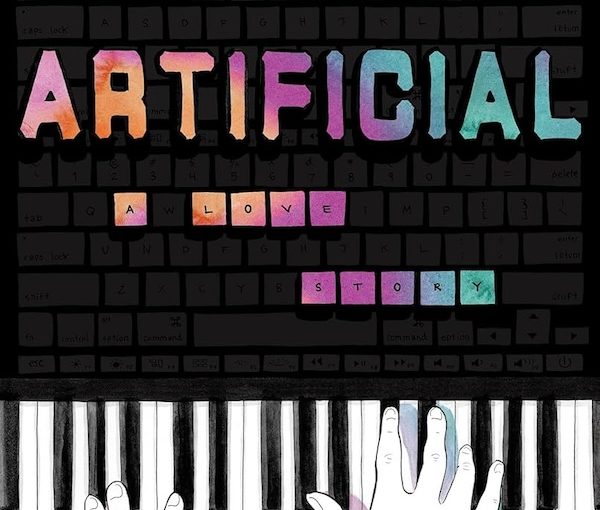
In her graphic memoir, Artificial: A Love Story, Amy Kurzweil tackles many existential questions, framed around her father’s quest to resurrect his father using artificial intelligence. Kurzweil participates in the Cherie Smith JCC Jewish Book Festival Feb. 12.

The purpose of life, of art, what it means to be human, to love and be loved, the value of relationships, our mortality. In a very personal story, cartoonist and writer Amy Kurzweil explores not just universal questions but the biggest of questions in her new book, Artificial: A Love Story.

Kurzweil participates in the Cherie Smith JCC Jewish Book Festival Feb. 12 in two separate sessions: one about the choice of the comic form to tell a story, the other titled Art & Artificial Intelligence.

In Artificial, readers are invited into another part of Kurzweil’s world. Her debut graphic memoir, Flying Couch, was also family-focused, centring around her maternal grandmother’s story. As she writes on her website, “At 13 years old, Bubbe (as I call her) escaped the Warsaw Ghetto alone, by disguising herself as a gentile. My mother taught me: our memories and our families shape who we become. What does it mean to be part of a family, and how does each generation bear the imprint of the past, its traumas and its gifts? Flying Couch is my answer to these questions, the documentation of my quest for identity and understanding.”

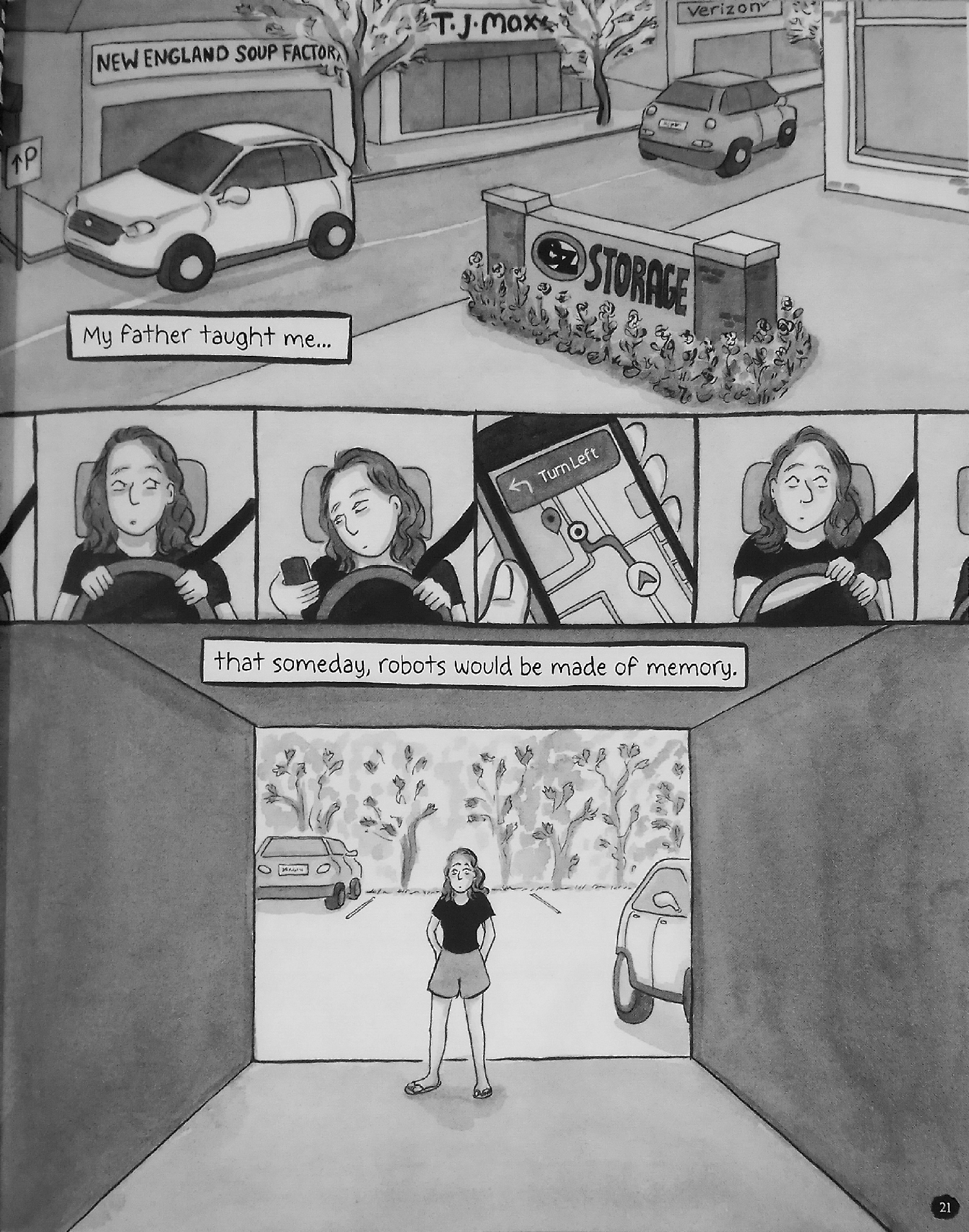
image - Artificial: A Love Story, by Amy Kurzweil, page 21
Artificial: A Love Story, by Amy Kurzweil, page 21.

Kurzweil continues to grapple with these questions in Artificial, this time from the paternal side. Her father, Ray, an inventor and futurist, is building an AI tool that will allow him, basically, to resurrect his father, who died of a heart attack in 1970, at the age of 57. Ray has saved letters, articles, music and other material relating to his father, Frederic, a pianist and conductor, who fled Austria in 1938, a month before Kristallnacht, to the United States, saved by a chance encounter. Amy is helping her father sort through boxes upon boxes of material and computerize the information. She even chats with “her grandfather,” as the AI program is being developed.

“My father taught me … that, someday, robots would be made of memory,” writes Kurzweil. Of course, the creation of a Fredbot has functional, ethical, emotional and other challenges, and Kurzweil – in words and images – presents them with sensitivity, intelligence and creativity. Each page of Artificial is attention-grabbing and the level of detail on some pages is remarkable. Kurzweil meticulously re-creates correspondence, typed and handwritten, newspaper articles and other documents, emails and texts, but she also captures, for example, the doubt on her father’s face during a conversation and the concern she has for her partner when he’s undergoing some medical tests. Readers learn about the people asking the questions, not just the questions themselves.

As for the answers? There are multiple ones. Of her father’s project, his quest to conquer mortality using technology, Kurzweil writes that her father’s definition of infinity is, “Computers become so small and dense that they become intelligence itself. Humans who do not grow up or grow old and seal our stories. Our stories wake up and keep writing themselves. This future sounds like liberation from the sadness of a story’s end. But it also sounds terrifying.”

That Kurzweil isn’t completely convinced of the merits of her father’s project, even though she loves him dearly and is helping him try and accomplish it, makes Artificial a satisfyingly complex and relatable story. It is a love story on many levels, and one well worth reading. 

The Cherie Smith JCC Jewish Book Festival runs Feb. 10-15. For the program guide and to purchase event tickets, visit jccgv.com/jewish-book-festival.

Format ImagePosted on January 12, 2024January 11, 2024Author Cynthia RamsayCategories BooksTags AI, Amy Kurzweil, artificial intelligence, creativity, Frederic Kurzweil, graphic memoir, identity, Jewish Book Festival, Ray Kurzweil

Pride in being “just a Jew”

There is an age-old question that frequently nags at us along our journey of life: “Who am I?” I’ve struggled with it, and perhaps you have as well. When you ask yourself “Who am I?” you probably start by listing superficial things about yourself. In my case, I’m from Argentina, I play music, and people say I have a great sense of humour. Even though I always knew who I was on the surface, a deeper layer eluded me. There is still more to learn about myself.

When I was young, well, younger than now, I constantly pressed my father with the similar question that was scrambling in my head: “Who are we?” I was trying to find a simple way to get my answer, to avoid spending my own time navigating the question so I could do something (seemingly) more productive, like playing video games. I figured that, by asking my dad, I may very well be who he is, given I’m his son, an extension of him, in many ways. But, every time, my father would reply in the same cryptic way and always with a smile on his face: “Son, we are Jews.”

I was never quite able to comprehend why he couldn’t just give me a plain answer, rather than that infuriating, puzzling and annoying explanation. I was not going to give up and, with my insistent character, I continued asking. I posed the question from different angles, wanting him to elaborate, but he would just say, “Uriel, it’s simple. We are Jews. You and I are solely Jews.”

When my dad couldn’t satisfy my curiosity, I turned to my school’s rabbi, Rabbi Stephen Berger. When I asked Rabbi Berger, his answer was just as confusing and mysterious. He kindly stated that he could not provide me with the answers I sought; I had to embark on this road of self-discovery myself, with the help of my loved ones. Then, about halfway through the year, he introduced me to StandWithUs Canada, an organization that would help me better understand who I was by putting me in touch with other Jewish teenagers from around the world.

I now realize why I couldn’t access a fast-food solution to a philosophical question. I finally found the answer I’d been seeking.

Last August, as I joined 190 of my peers from high schools throughout the United States and Canada at the StandWithUs conference in Los Angeles, I found myself on a path leading to enlightenment that has reshaped my understanding of Jewish identity. The sessions were informative and interesting, but it was when we reached the segment focusing on what Jews were before the dark chapters of persecution during the Holocaust – they were highly contributing members of society, and more – that everything started to click.

A single statement truly hit home: Jews have been forcibly expelled from about 109 countries throughout history. It was a stark reminder that, regardless of our accomplishments and contributions, we would always be seen as “Just a Jew.” It became clear that the essence of being Jewish transcended any specific occupation or societal role. We are a resilient and diverse community with a history of triumphs and tragedies. 

This knowledge instilled a sense of pride in my identity, not as a limitation but as a source of strength and unity. Thanks to StandWithUs Canada, I learned that, at the end of the day, embracing who we are, with all our complexities and contributions, is a powerful testament to the enduring spirit of the Jewish people. I felt a sense of pride but a pride that could be taken away from me at any moment. This is when I decided to become a more invested member of the community by being on the board of NCSY, the Orthodox Union’s youth group.

Talking to politicians and people who can truly make a difference became an essential component of my advocacy. I understood how dialogue and education could change people’s perspectives. 

My aim in sharing the history of the Jewish expulsions and the resilient spirit of our community is to raise awareness and foster understanding. My tool against bigotry and ignorance is teaching. I am committed, every day, to teaching people about the rich history of the Jewish people.

Uriel Presman Chikiar is in Grade 12 at King David High School and is a board member of NCSY.

Posted on January 12, 2024January 11, 2024Author Uriel Presman ChikiarCategories Op-EdTags education, history, identity, Judaism, StandWithUs
Most magical place on earth

Most magical place on earth

Mairav Robens-Paradise, right, has found her community, and so much more, at Camp Miriam. Her closest, deepest relationships are the friendships she has made through camp. (photo from Camp Miriam)

Last summer was my 11th year at Camp Miriam. Even before my first year, in 2012, I dreamed about sneaking onto the school bus parked in the Jewish Community Centre of Greater Vancouver parking lot as we dropped off my older brothers to go to what I understood to be the most magical place on earth. Over a decade later, I can confidently say that description is an understatement.

I grew up attending public school, where my siblings and I made up the majority of the Jewish population. I don’t recall my immense excitement to go to camp being consciously related to my Judaism, but unbeknownst to 8-year-old me, it would forever alter my connection to my sense of self and my community. Camp Miriam fostered the environment that allowed me to grow into my Jewish identity. At camp, you are surrounded with people who all relate to their Judaism in different ways, both culturally and religiously, and are given the tools and safety to form that unique, personal relationship.

I am currently in my second year of university at McGill, in Montreal, living with two friends from camp. It has been incredibly important to me to have a Jewish community nearby, especially over the past several months, and my roommates are just a fraction of the connections Camp Miriam has given me.

The strength of the friendships I have made over my years of involvement with the camp overpowers any other facet of my life. The values we learn, the skills we practise and the tools we gain at camp equip us to manage complex interpersonal relationships, resolve conflicts and gain independence. Whether it’s learning how to tie knots for camping, defusing relational tensions or discussing social justice, chanichimot (campers) and madrichimot (counselors) alike do so in a secure and empowering environment. Now, as a student who lives away from home, Camp Miriam and its extensive community keep me tethered and grounded to my Judaism and my personal values.

Camp Miriam’s unique structure as a youth-led camp provides empowerment to its entire community. Over the last two years working as a madricha (counselor), I have been trusted with a multitude of responsibilities. Last summer, I had a tafkid (role) that consisted of organizing the programming that occurs during Shabbat. Some of our traditions every Friday include everyone dressing in their nicest clothes and competing for the cleanest cabin award. These small but significant means of welcoming in Shabbat in fun ways foster an exploratory environment for kids to form their connections to Judaism at their own pace.

As a kid, my favourite part of Shabbat was rikud (dance), when all of camp gathers for Israeli dancing. Now, as a madricha, my favourite part is Havdalah, which is a ceremony held every Saturday night to signify the end of Shabbat. Last summer, we introduced live music to our Havdalah tradition, which we listen to while everyone is gathered in a circle watching the ceremonial candle burn. These shared moments all contribute to creating an incredibly strong community of Jewish youth.

As I’m writing this article, I’m sitting in the living room of a member of my national kvutzah (age group/cohort), surrounded by the company of 18 other Jewish members of Habonim Dror North America, the larger movement that Camp Miriam is a part of. This experience really encapsulates what Camp Miriam has given me as a Jew. The closest, deepest relationships I have are the friendships I have made through camp. It’s just not about making friends, learning and forming your identity, but also about finding your community. As I look around, I come to realize – I owe a lot to Camp Miriam. 

Mairav Robens-Paradise is a second-year student at McGill University in Montreal. Last summer was her 11th year at Camp Miriam.

Format ImagePosted on January 12, 2024January 11, 2024Author Mairav Robens-ParadiseCategories LocalTags Camp Miriam, friendships, identity, Judaism, youth
Building teen togetherness

Building teen togetherness

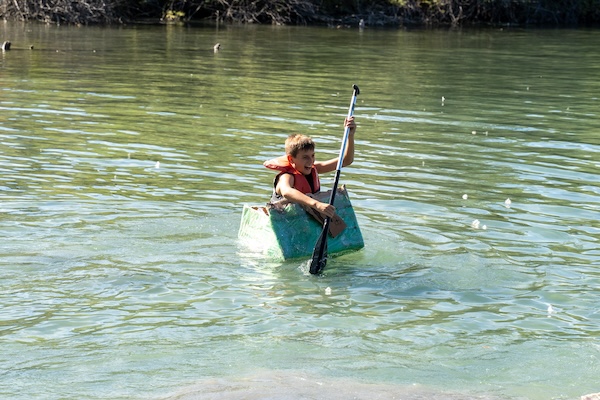
Yachad activities in summer 2023 included one where campers were given a large box, tape, bubble wrap and scissors and told to make a functioning boat. (photo from Camp Hatikvah)

In the summer of 2023, Camp Hatikvah introduced a new activity just for their 13- and 14-year-old campers called Yachad. Named after the Hebrew word for together, Yachad was introduced with the aim of fostering connections and breaking down the barriers that sometimes divide today’s teenagers. 

“Motivating teenagers to step out of their comfort zones can be a challenge. With this in mind, our goal was to design something new that breaks the ice, melts away self-consciousness, and brings campers together,” said Liza Rozen-Delman, executive director.

Knowing their audience well, Camp Hatikvah decided that friendly competition would be the key to success. 

At the beginning of the summer, campers were organized into “house” teams and told that this would be their team for the whole summer while they competed for end-of-session prizes like a trip to the ice cream store. 

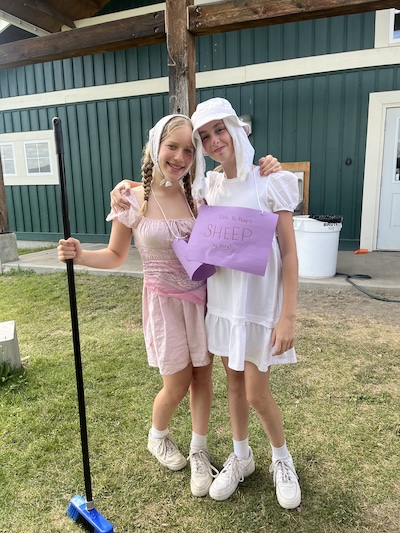
photo - In one of the Yachad activities, campers had to dress up like the characters of a movie they picked out of a hat
In one of the Yachad activities, campers had to dress up like the characters of a movie they picked out of a hat. (photo from Camp Hatikvah)

Every second day or so, these teams would engage in wacky daytime competitions that required more enthusiasm than skill. From dress-up competitions to hilariously messy slime wars, Yachad quickly became a favourite activity among campers.

“We never knew what was coming next,” said one 14-year-old camper, “so each time Yachad came around we were filled with anticipation and excitement.” 

The heart of Yachad lies in its unique approach to team building. Without knowing it, campers are learning myriad skills like communication and adaptability (shh … don’t tell them). 

“The program is centred on the belief that shared experiences have the power to forge lasting bonds. In the midst of extraordinary escapades, campers not only form new individual friendships but also contribute to building a tight-knit community – a community that embodies the very essence of Camp Hatikvah’s mission,” said Rozen-Delman. 

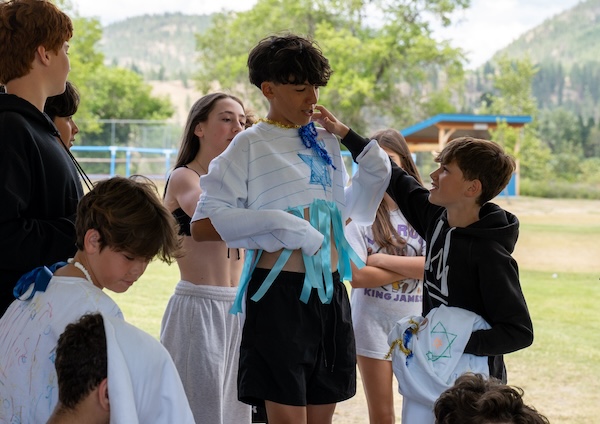
photo - Another Yachad activity challenged campers to make an ugly Hanukkah sweater
Another Yachad activity challenged campers to make an ugly Hanukkah sweater. (photo from Camp Hatikvah)

Last year’s activities included “noodle fencing,” where campers jousted with floppy pool noodles; a “wedding dress challenge,” where campers designed a dress using a spool of tulle; an “ugly Hanukkah sweater challenge,” where campers were given a sweatshirt and all sorts of tacky Hanukkah décor to attach onto it; and a “Disney challenge,” where the team needed to dress up like the characters of a movie they picked out of a hat.

“The highlight for me was the boat regatta,” shared a camper. “We were each given a large box, tape, bubble wrap and scissors and told to make a functioning boat. One of our teammates then had to go onto the lake in it to see if it floated. Ours didn’t last long and it was hilarious.”

“Yachad celebrates the joy of togetherness, unleashing the power of pure, unfiltered fun,” said Rozen-Delman. “In a world that is so heavy, it’s really just what these kids need.”

Looking ahead, Camp Hatikvah is already planning a repertoire of creative and crazy Yachad activities for the summer of 2024 – the sillier the better, as Camp Hatikvah knows the power of fun in bringing kids together and building community. 

– Courtesy Camp Hatikvah

Format ImagePosted on January 12, 2024January 11, 2024Author Camp HatikvahCategories LocalTags Camp Hatikvah, identity, teenagers, Yachad, youth
Three essential life lessons

Three essential life lessons

Time at summer camp is an incredible gift to give kids and teens. (photo from Camp Kalsman)

In a world where children and teens are met with a barrage of external pressures telling them who they should idolize, what they should wear and how they should spend their time, summer camps provide a respite. As much as I try to help my three kids build resilience and a strong moral compass, I know that, as soon as they walk out the door, it can be an uphill battle every day of the school year. 

As parents, we need more places outside of our home where our kids and teens can feel at home while they can practise the critical thinking, self-awareness and problem-solving skills we all know are so essential. This is why I love summer camp for my kids – and I’m not just saying that because I’m the director of a summer camp! Ask anyone who grew up at an overnight summer camp and most will tell you that camp was where they felt most comfortable in their own skin, where they were celebrated for exactly who they were, and where they learned many of the lessons that have stuck with them throughout their adult life. 

Here are the top three life lessons that kids and teens can take away from summer camp.

1. Find your people

Each summer, kids arrive at camp with a ton of baggage and it’s not just in the form of trunks and duffels and sleeping bags. The beauty of summer camp is that campers can shed that layer (or layers) of themselves that build up over the course of the year and spend time exploring who they are, what brings them joy, who brings out the best in them … without the pressures of school peers who “know them.”

photo - The beauty of summer camp is that campers can shed that layer (or layers) of themselves that build up over the course of the year and spend time exploring who they are, what brings them joy
The beauty of summer camp is that campers can shed that layer (or layers) of themselves that build up over the course of the year and spend time exploring who they are, what brings them joy. (photo from Camp Kalsman)

Spending time in an immersive environment like overnight camp enables kids and teens to be vulnerable with their peers in a safe and supported way; eventually worrying less about how they “should be” and feeling more comfortable and confident in who they are. It’s in this state of self-confidence – nurtured by kind, compassionate counselors – that campers are able to find “their people” who “just get them,” reinforcing what we at URJ Camp Kalsman (and every other overnight summer camp!) have known for years: camp friends are the best friends.

2. Be still, present, open

Camp creates an environment that is ripe for self-awareness, self-discovery and meaningful connections away from the pressures of school, sports and, yes, well-meaning adults at home. Without a message to respond to or an assignment to complete, kids and teens are presented with … time. Not the time filled with camp activities (although there is plenty of that, too) but those significant, intentional moments where nothing is planned … the 15 minutes of serenity in the canoe in the middle of the lake or the walk, together with a friend from the cabin, to the dining hall under a canopy of trees, or the silence after hours of belly-laughter, staring up at the stars surrounded by cabinmates. The stillness of those moments, which are so hard to come by when we are shuffling kids to and from school and activities, are priceless and are built into the fabric of summer camp.

photo - Camp creates an environment that is ripe for self-awareness, self-discovery and meaningful connections
Camp creates an environment that is ripe for self-awareness, self-discovery and meaningful connections. (photo from Camp Kalsman)

3. Don’t run from mistakes

As parents, we want our kids to be gritty – to be able to take responsibility for a mistake and bounce back, whether from making a poor choice, disappointing a friend, failing a test, or not being cast in the school play. At camp, mistakes and failure happen every day, and kids must live with it – there is no escape, they can’t hide in their rooms alone or take the long way to class to avoid a friend. Camp is a 24/7 living and learning experience, where campers are supported and guided through conflict and failure, whether it is not making it to the top of the tower or tension with a bunkmate. Mistakes happen, we fall short of expectations, and camp provides the structure to help kids recognize where they missed the mark and the opportunity to try again tomorrow – or in 15 minutes!

Time at summer camp is an incredible gift to give kids and teens – one that they will benefit from long into adulthood. 

Rabbi Ilana Mills is camp director, URJ Camp Kalsman. If you are interested in learning more about URJ Camp Kalsman, visit campkalsman.org or contact Mills at [email protected].

Format ImagePosted on January 12, 2024January 11, 2024Author Rabbi Ilana MillsCategories LocalTags Camp Kalsman, identity, Judaism, life lessons, youth

Posts pagination

Previous page Page 1 Page 2 Page 3 … Page 7 Next page
Proudly powered by WordPress