Hate crimes down a bit

The number of antisemitic hate crimes in Canada declined a fraction last year, according to the B’nai Brith Canada League for Human Rights Annual Audit of Antisemitic Incidents 2022. The decline, though, is from 2021, which saw the highest number of incidents since the audit began 40 years ago so, despite the marginally good news, 2022 remains the second-worst year on record. In all, 2022 saw 2,769 incidents, down 1.1% from the 2,799 incidents reported in 2021.

“When viewed from a historical perspective … the numbers are less reassuring,” Marvin Rotrand, national director of the League for Human Rights, writes in the report. “In 2012, the Jewish community sounded the alarm when that audit noted 1,345 antisemitic incidents, the highest ever since we first began auditing in 1982. Ten years later, the number is an alarming 105.9% higher than that reported in 2012, and the second-highest total since we started tracking 41 years ago.”

Aron Csaplaros, British Columbia regional manager for B’nai Brith Canada, noted the most significant finding is that the majority of hate incidents are online.

“The audit says that 74% of hate is now online and that violent incidents are down,” he told the Jewish Independent. Violent incidents across Canada dropped to 25 last year from 75 the year previous. “But incidents have been moving online in the past decade or so and it’s kind of equally, if not more, dangerous when hate is online because it’s much easier to spread, more people read it,” he said. “It’s about context. It’s obviously different than a violent incident but it is equally as dangerous.”

Csaplaros does not have a clear explanation on why violent incidents saw such a drop. It may have to do with the fact that 2022 saw slightly less incendiary conflict in Israel and Palestine, overseas problems that invariably have repercussions worldwide.

“Obviously, we’re happy that violent incidents have gone down,” he said. “Hopefully, the reason for that is that certain provinces have adopted, for example, the IHRA [International Holocaust Remembrance Alliance] definition of antisemitism, and that might have filtered down into education for police forces and how they respond and deal with these situations. But we don’t really have a theory on why the violent incidents have gone down.”

In British Columbia, the number of violent crimes declined from two in 2021 to a single incident in 2022: a threat against Victoria’s Jewish Community Centre during the annual Jewish film festival in the capital city. Other B.C. instances include 51 cases of vandalism, 53 cases of harassment and 137 cases of online hate.

Csaplaros acknowledged that it is difficult to place a number on online antisemitic incidents.

“There are, unfortunately, probably thousands, millions of anti-Israel and antisemitic comments online and, obviously, just because of the sheer number of them, we don’t catch all of them,” he said.

The criteria B’nai Brith uses to measure hate online includes the question, “Is it antisemitic in that it targets Jews as a people and attribute negative things to them? For example, that they caused COVID, or do they use antisemitic stereotypes like Jews control the banks and so on and so forth,” explained Csaplaros. “With a lot of these comments, they are clearly antisemitic.”

B’nai Brith, he said, uses the “three Ds” measure created by Natan Sharansky: delegitimization, demonization, and applying double standards to the state of Israel.

While 74% of incidents were online, 15% involved vandalism, 10% in-person harassment and 1% were violent incidents.

In British Columbia overall, incidents declined more than 40%, to 242, compared with 409 the previous year. (For the purposes of the report, British Columbia and Yukon are reported together.) Examples of B.C. incidents included in the B’nai Brith report are the Simon Fraser University student society’s passing of a resolution referring to Israeli “war crimes and apartheid” and a Tweet accusing Jews of Satan worship and seeking world domination.

“At the end of the day, hate is hate,” said Csaplaros. “It’s important to have a record of how many antisemitic incidents occurred, regardless of whether it was a Laith Marouf-type thing or a violent incident or a swastika drawn on the sidewalk. Hate and antisemitism is hate … and it’s important to record all of that.”

Laith Marouf is a Montreal activist whose Community Media Advocacy Centre received more than $133,000 in federal government consulting fees before his antisemitic social media postings became widely known, including one in which he called Jewish people “loud mouthed bags of human feces.”

Csaplaros called on the province of British Columbia to join half of Canada’s other provinces in adopting the IHRA definition of antisemitism and to follow Ontario’s lead by introducing Holocaust education into the elementary school curriculum. The core curriculum in British Columbia does not mandate any Holocaust education, Csaplaros said. Students can learn about the Holocaust in elective courses and may learn about it in core courses, depending on the teacher’s choices.

The full annual audit is online at bnaibrith.ca.

Hate crimes on the rise

On Aug. 2, Statistics Canada released police-reported hate crime data for 2021revealing, once again, that hate crimes targeting the Black and Jewish populations remain the most common reported by police.

“We are deeply concerned that incidents of hate crime rose yet again in Canada in 2021,” said Shimon Koffler Fogel, president and chief executive officer of the Centre for Israel and Jewish Affairs (CIJA).

There were 642 reported hate crimes against Black Canadians in 2021, a slight decrease from the 676 reported in 2020, but an 86% increase from the 345 incidents reported in 2019.

Overall, hate crimes targeting religious groups increased 67% from 2020, breaking a three-year downturn. Incidents targeting the Jewish community grew by 47% from 2020 to 2021. Statistically, this reflects 1.3 in 1,000 members of Canada’s Jewish community reporting having been the target of a hate crime in 2021.

Jewish Canadians remain the most targeted religious minority for hate crime and second overall. There are approximately 380,000 Jews in Canada, representing only one percent of the population, yet members of the Jewish community were victims of 14.5% of all reported hate crime in 2021.

“Statistically, Canadian Jews were more than 10 times more likely than any other Canadian religious minority to report being the target of a hate crime. This is alarming,” said Fogel.

“This report should be a call to action for all Canadians to stand against antisemitism and all forms of hate…. We are grateful that police services across the country take these incidents seriously, but more needs to be done to protect vulnerable communities,” he said. “This includes greater support for security and safety at community institutions such as houses of worship; equity, diversity and inclusion education that includes training on antisemitism; and a national strategy to target online hate and radicalization.

“Although Canada remains one of the best countries in the world in which to be Jewish, or any other minority for that matter, these numbers should concern all Canadians. One hate crime is one too many.”

For more on the Statistics Canada report, visit www150.statcan.gc.ca and click on the link for the publication Juristat.

– Courtesy Centre for Israel and Jewish Affairs

משותפות אסטרטגית חדשה

אחד הפרויקטים המשותפים ינוהל על ידי פרופ’ ארי מטמון, מהמכון למדעי כדור הארץ באוניברסיטה העברית ופרופ’ מיכאל חזן מהמחלקה אנתרופולוגיה באוניברסיטת טורונטו. המחקר יתבצע בחלקו בדרום אפריקה במטרה להבין כיצד שינויי אקלים השפיעו על התפתחותם של בני האדם הראשונים במדבר הקלהארי.

(en.earth.huji.ac.il/people/ari-matmon)

כיצד תנאים סביבתיים ושינוי אקלים השפיעו על ההתפתחות האנושית המוקדמת, והאם ניתן לרתום הנדסת חלבונים כדי לחסל את נגיף הקורונה? שאלות אלה ועוד רבות אחרות נבדקו לאחרונה על ידי חוקרים וחוקרות מאוניברסיטת טורונטו והאוניברסיטה העברית בירושלים. זאת, כחלק משותפות אסטרטגית חדשה שנועדה לאפשר לחברי סגל וסטודנטים משני המוסדות לשלב מאמצים ומשאבים לצורך ביצוע מחקרים בינלאומיים פורצי דרך וייחודיים בתחומם, ולהגדיל את החשיפה של אותם מחקרים וטכנולוגיות שיפותחו לשווקים חדשים.

אוניברסיטת טורונטו נחשבת לאחת האוניברסיטאות הטובות ביותר בעולם. כיום היא ממוקמת במקום העשרים וחמישה באחד המדדים הבודקים את האוניברסיטאות המובילות בעולם, במקום העשרים וארבעה בעולם במדד אחר של האוניברסיטאות המובילות בעולם, ובמקום השמונה עשר במדד שלישי של האוניברסיטאות המובילות בעולם. בקנדה כמובן האוניברסיטה נחשבת למוסד האקדמי הטוב ביותר ביותר. במסגרת שיתוף הפעולה החדש בין שני המוסדות: מדי שנה אוניברסיטת טורונטו והאוניברסיטה העברית בירושלים יבחרו פרויקטים מחקריים שיקבלו כל אחד מימון של כמאה וחמישים אלף דולר לשנה. זאת לתקופה של עד ארבע שנים. שיתוף הפעולה החל לאחרונה וכבר נרשמו פרויקטים רבים ופוריים בין הצדדים, שצפויים לקבל חיזוק בעקבות החתימה על ההסכם החדש.

פרופ’ אורון שגריר, סגן נשיא לבינלאומיות באוניברסיטה העברית, אמר כי השותפות מאחדת בין שתי האוניברסיטאות המובילות בישראל ובקנדה, וכי הקריאה להצעות מחקר הביאה עד כה למספר פניות מרתקות. בתקופה מאתגרת זו עבור האוניברסיטאות, שותפויות בינלאומיות מעין אלה ומהוות מסגרת חשובה לקידום ותמיכה בפרויקטים מחקריים שונים, הוא הוסיף.

אחד הפרויקטים המשותפים ינוהל על ידי פרופ’ ארי מטמון, מהמכון למדעי כדור הארץ באוניברסיטה העברית ופרופ’ מיכאל חזן מהמחלקה אנתרופולוגיה באוניברסיטת טורונטו. המחקר יתבצע בחלקו בדרום אפריקה במטרה להבין כיצד שינויי אקלים השפיעו על התפתחותם של בני האדם הראשונים במדבר הקלהארי. פרויקט משותף נוסף ינוהל על ידי פרופ’ סאצ’דב סידהו מאוניברסיטת טורונטו ופרופ’ יוליה שיפמן מהמכון למדעי החיים (ע”ש אלכסנדר סילברמן) בפקולטה למדעי החיים באוניברסיטה העברית. השניים יחקרו ביחד כיצד ניתן לרתום את תחום הנדסת החלבונים לפיתוח טיפולים למחלות כולל נגד נגיף הקורונה. בפרוייקט החדש שלהם: השניים יפתחו מערכי חלבונים לכל הגנים הקיימים בנגיף הקורונה. בסופו של דבר הם אמורים לסלול את הדרך לפיתוח טיפולים אפשריים כנגד המגפה הקשה הזאת.

פשעי שינאה בבית כנסת במונטריאול: פורעים השחיתו ספרי תורה

אלמונים גרמו נזק כבד לבית הכנסת קול יהודה השוכן בשכונת קוט סנט לוק שבמונטריאול. הגבאים של בית הכנסת שהיה סגור לאחרונה בגלל מגיפת הקורונה שפגעה קשה במונטריאול, מצאו שספרי וחפצי קודש הושלכו על הריצפה וכתובות נאצה נראו במקום. בין הנזקים שאחראים להם האלמונים ושמוגדרים פשעי שינאה: תשמישי קדושה (כולל תפילין), גווילי ספר תורה וחפצי קודש שונים הושלכו על הריצפה בצורה המבזה את בית הכנסת. זאת ועוד כתובות נאצה אנטישמיות בגנות הקהילה היהודית נראו בכל מקום.

בית הכנסת כאמור סגור בגלל המגיפה ולא נערכו בון תפילות לאחרונה. לכן לא ברור מתי התרחשו פשעי השינאה במקום, שעוררו את כעסם של חברי הקהילה היהודית במונטריאול שסוערים עקב המקרה החמור.

שכונת קוט סנט לוק בפרבריה של מונטריאול נחשבת לאזור בו גרים יהודים מזה שנים רבות. לאחרונה הצטרפה לשכונה קבוצה גדולה של חסידי בעלזא, שאף פתחה במקום בית מדרש ללימוד תורה ותפילה. לקהילת היהודים בשכונת קוט סנט לוק יש מספר רב של מוסדות קהילתיים עמוסים.

Choosing love not hate

On Sunday, vigils were held in many cities to commemorate the 11 worshippers killed at Tree of Life Synagogue in Pittsburgh on Oct. 27, 2018. The shooting was the deadliest attack on Jews in American history.

As we have mourned and taken greater measures toward protecting ourselves, we have, mainly, not let fear paralyze us or isolate us from our neighbours and the larger world. We have continued to live Jewishly, whatever that means to each one of us; whether it’s helping those less fortunate, lobbying for sound government policies, going to synagogue or simply being kind to the people we encounter in our day.

In Vancouver, community members and others could join two collective moments of remembrance on Sunday: the Jewish Federations of North America’s Pause with Pittsburgh, which included the livestreaming of a public memorial service, and a service at Congregation Beth Israel, organized by the Rabbinical Association of Vancouver with the Centre for Israel and Jewish Affairs, the Jewish Community Centre of Greater Vancouver, Hillel BC and the Jewish Federation of Greater Vancouver.

Over the weekend, Jews were also encouraged – as they were in the wake of the tragedy last year – to #ShowUpForShabbat, an initiative of the American Jewish Committee, calling for us “to honour the victims and raise our collective voice for a world free of antisemitism, hate and bigotry.”

Beth Israel’s Rabbi Jonathan Infeld, who grew up in Pittsburgh, told News 1130, “There are still many people who are frightened and worried about what took place a year ago…. There are people who are concerned about coming to synagogue and people who are concerned about antisemitism. Especially on holidays, one of the messages I deliver is that, unfortunately, antisemitism is on the rise in the world. But we have to remain strong, to have the courage to come to synagogue, and to not allow attacks like this to prevent us from being who we are and to deprive us of the benefits that come from being in a sacred space.”

Infeld also noted, “One of the aftermaths of the attack is that people in Pittsburgh didn’t feel this was an attack just on a synagogue, they felt it was an attack on Pittsburgh…. We have to understand an attack on any sacred space is an attack on an entire community, so we need to stand together as one community with the message that love is stronger than hate.”

While the situation is not as bad as elsewhere in the world, the number of hate crimes and the incidences of antisemitism in Canada, including in British Columbia, have increased worrisomely. Love has a long row to hoe. Not only to give us the courage to speak up in the face of prejudice, but also to confront and temper our own. Not only to make us self-assured enough to make space for those with whom we agree and for whom we care, but also for those with whom we disagree and whom we dislike. Not only to inspire us to dream of a better world, but to give us the imagination and resourcefulness to bring those aspirations into being.

Love can only be stronger than hate if we choose to make it so.


Will jail curb hater?

The sentencing of a notorious hate promoter in Toronto last week is, in some ways, evidence that our country’s laws and norms against targeting identifiable groups are working.

James Sears, editor of Your Ward News, a propaganda sheet distributed periodically to 300,000 households in Toronto and area, was sentenced to two consecutive six-month terms in jail. His paper is filled with bigotry and hatred, especially targeting Jews, women and LGBTQ+ people. He is obsessed with the Rothschild family, denies the Holocaust, dabbles in bizarre racial theories and celebrates rape. One issue invited volunteers to join an Adolf Hitler Fan Club. He and a co-conspirator, publisher LeRoy St. Germaine, were found guilty in January of promoting hatred against women and Jews. St. Germaine is yet to be sentenced.

The Centre for Israel and Jewish Affairs, among others, praised the judge’s sentence. In fact, the judge openly expressed his wish that he had the legal power to hand down a harsher sentence.

Unlike the United States, where constitutional freedoms make it legal to express almost anything but overt death threats or yelling fire in a crowded hall, Canada’s laws place limits on acceptable discourse. This is, it has seemed, a consensus position that we as a society have accepted as justifiable limits on our freedoms for the greater good. In practice, convictions on the basis of hate speech are exceedingly rare. More common are hearings and decisions via our network of human rights commissions, which provide a quasi-judicial recourse for victims. Neither of these systems is perfect. But cases like Sears’ indicate that, when necessary, they can have the appropriate outcomes.

We hesitate to call this good news, however. Justice may be served but, in the long run, what is gained? A happy ending would have been a society in which ideas like Sears’ are nonexistent. A more realistic world might be one in which some form of restorative justice is the sentence, some construction in which Sears and St. Germaine learn from their victims about the harm they have inflicted and perhaps come to see the humanity of the people they vilify. Instead, Sears will spend a year (or four months, depending on parole) stewing over what he doubtlessly interprets as some heinous injustice perpetrated against him by the imagined forces of evil. Justice is served, probably, but is the larger cause of social cohesion and mutual understanding?

Hate crimes in Canada spike

(image from Statistics Canada)

Crimes against identifiable groups in Canada have spiked sharply, according to the latest data from Statistics Canada on police-reported hate crimes. Jews and Jewish institutions were the foremost targeted group, but hate crimes against Muslims comprised the largest increase.

Across Canada, there were 2,073 police-reported hate crimes in 2017, an increase of 664 incidents over the previous year. Almost half of all hate crimes were reported in Ontario. In British Columbia, 255 hate crimes were reported to police, including 68 that targeted Jews, 36 incidents against black people, 19 against Muslims and 18 crimes based on sexual orientation. Reported hate crimes against the Muslim, black, Arab or West Asian and LGBTQ+ communities all increased nationwide.

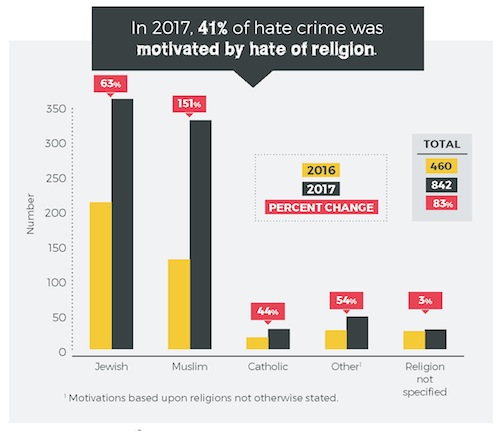
Across the country, hate crimes against the Jewish community rose by 63% between 2016 and 2017 – from 221 incidents to 360 – and the Jewish community remained the most frequently targeted group in both absolute and per capita terms, the report stated. Hate crimes against the Muslim community increased 151% between those years, from 139 police-reported incidents in 2016 to 349 in 2017.

In one of few comparatively bright spots in the report, violent incidents decreased as a proportion of all hate crimes, accounting for 38% of reported hate crimes in 2017, down from 44% in 2016. But this proportional decline is tempered by the raw numbers. The actual number of violent hate crimes increased 25% but decreased as a proportion of hate crimes overall only because the number of non-violent crimes increased that much more – non-violent offences like mischief and public incitement of hatred increased 64%.

Of the 360 police-reported crimes against Jews or Jewish institutions across Canada in 2017, 209 of those were in Ontario and 49 in Quebec – making British Columbia not only the second province in raw numbers of anti-Jewish attacks, but almost tying Ontario on a per capita basis and surpassing all other provinces by far.

Hate crimes in Canada have been creeping upward relatively slowly since 2014, according to Statistics Canada, but 2017 saw a leap of 47% over the previous year. Most of the crimes involved hate-related property crimes, such as graffiti and vandalism.

Despite the large increase in 2017, however, hate crimes still represent a very small proportion of overall crime – about 0.1% of the more than 1.9 million non-traffic crimes reported by police services in 2017. That said, a 2014 Statistics Canada study, General Social Survey on Canadians’ Safety (Victimization), in which Canadians self-reported incidents of perceived hate crimes, indicated that two-thirds of such incidents were not reported to police, suggesting that the numbers in the hate crimes reports might underestimate actual incidents substantially.

image - Hate crimes versus religious groups, 2016 and 2017
(image from Statistics Canada)

“Police-reported hate crimes refer to criminal incidents that, upon investigation by police, are found to have been motivated by hatred toward an identifiable group,” explains StatsCan. “An incident may be against a person or property and may target race, colour, national or ethnic origin, religion, sexual orientation, gender identity or expression, language, sex, age, mental or physical disability, among other factors. In addition, there are four specific offences listed as hate propaganda offences or hate crimes in the Criminal Code of Canada: advocating genocide, public incitement of hatred, wilful promotion of hatred, and mischief motivated by hate in relation to property used by an identifiable group.”

Hate crimes against Muslims, particularly in Quebec, contributed significantly to the overall spike in 2017 reported incidents. Hate crimes in that province increased 50% over the previous year, with incidents targeting Muslims almost tripling to 117 reports in 2017 from 41 the previous year. Perhaps most disconcertingly, the biggest spike in anti-Muslim incidents in Quebec occurred in the month following the mass shooting at the Islamic Cultural Centre of Quebec, where six Muslim men were murdered in a shooting rampage on Jan. 29, 2017.

In response to the statistics, which were released Nov. 29, the Centre for Israel and Jewish Affairs called on the federal government to take a three-pronged approach to hate-motivated crime and related matters.

“In the wake of this report, we are reiterating our call on the Government of Canada to take three key steps to combat hate,” Shimon Koffler Fogel, chief executive officer of CIJA, said in a statement. “First, we are grateful that the prime minister announced he will enhance the Security Infrastructure Program. We urge the government to expand it to cover training costs, especially given that emergency training saved lives during the Pittsburgh synagogue attack. Second, we need a national strategy to combat online hate. Experience shows that vicious rhetoric online can fuel and foreshadow violence offline. Third, the federal government should strengthen the capacity of law enforcement to combat hate crime. This should include enhancing legal tools to deal with hate speech and supporting the creation of local hate crime units where they are lacking.”

Each one, and all one

The news is not good. Hate crimes are up almost everywhere in the world one cares to look. A Statistics Canada report on police-reported hate crimes in Canada erases whatever smug superiority Canadians may have been feeling when watching rampant racism south of the border, at least some of which seems a result of the licence granted by a president who flirts with the most incendiary elements in U.S. society. The number of hate crimes reported to Canadian police in 2017 far outstripped the number in 2016 (see story, page 1) – and the actual number of hate-motivated incidents may be up to three times larger than the number reported to police.

Similarly terrible phenomena are taking place across Europe, where xenophobic and racist rhetoric is manifesting into violence against Jews, Muslims, Roma, asylum-seekers from Africa and Asia and, really, anyone who does not fit an escalating nationalist and populist consensus.

The lines are not all clear, either. The perpetrators and the victims can, at times, overlap. In online posts, email threads and private conversations, we witness members of our own community attributing motives to entire groups of people, and spreading hatred based on religious or racial identities. Likewise, messages of anti-Jewish hatred are common in online locations addressing the Israeli-Arab conflict, often including antisemitic comments from members of victimized minority groups.

The range of hate-motivated incidents addressed in the Statistics Canada report varies – most are non-violent and involve graffiti or crimes against property. But, when they are violent, they strike with a precision that aims at the emotional, as well as physical, vulnerabilities of the victims. In three of the most horrific hate crimes of recent years, assailants struck in the very places where people should expect safety – in the spiritual sanctuary of Emanuel African Methodist Episcopal Church, in Charleston, S.C., where nine African-Americans were murdered by a white supremacist on June 17, 2015; at the Islamic Cultural Centre of Quebec City, a mosque, where six people were murdered by an Islamophobic killer on Jan. 29, 2017; and at the Tree of Life synagogue in Pittsburgh, where 11 were murdered during Shabbat services this past Oct. 27.

The idea that people should be safe in a place of religious observance seems to be precisely the reasoning behind such attacks. But there is another form of violent crime that seems oddly excluded from this discussion.

Thursday (Dec. 6) marked the 29th anniversary of the mass murder at the École Polytechnique, in Montreal, where 14 women were killed by a man with deep-rooted hatred against women. A commemoration took place at the Vancouver Art Gallery, in recognition of the annual National Day of Remembrance and Action on Violence Against Women, with empty shoes representing the 545 women who have been murdered in British Columbia between 1997 and 2015 (the last year for which reliable statistics are available).

These victims include some of Canada’s murdered indigenous women, women working in vulnerable situations and women who were murdered because they were women and members of another marginalized group. Others were murdered by their domestic partners. In probably all of these cases, issues of differential power (of various forms) and attitudes about the value of women’s lives, factored into their fates. They are victims of gender-based violence.

It seems strange that, in a discussion about hate-motivated crimes, we exclude an entire gender, whose experience with violence is as prevalent, or more so, than that of other identifiable groups.

This is not an attempt to detract from one or another group’s experience with violence to emphasize something else; it is more an attempt to emphasize that every life should be respected and that membership in an identifiable group often diminishes that respect in the eyes of perpetrators.

But neither should the universal idea – every life is sacred and every individual deserves respect – detract from the more particular issue at hand. Every life is sacred and every individual is deserving of respect, but membership in particular groups can disproportionately impact on one’s experience with violence and discrimination. So, while we should be always conscious of the universal, we should likewise militate against the particular bigotries and prejudices that lead to disproportionate victimization of identifiable groups. In Canada and around the world right now, humankind could benefit from more emphasis on both the universal and the particular.

אנטישמיות בקנדה

המכתבים נשלחו למוסדות היהודים בערים הבאות: טורונטו (ארבעה בתי כנסת), מונטריאול (שני בתי כנסת), אוטווה, המילטון, קינגסטון, קלגרי ואדמונטון (שני בתי כנסת).

מחלקת פשעי שנאה של משטרת קנדה פתחה בחקירה לבדוק את זהות שולחי מכתבי השנאה לבית כנסת ברחבי המדינה. עד כה ידוע כבר על לפחות עשרה בתי כנסת שקיבלו מכתבי שנאה אנונימיים בימים האחרונים. המכתבים נשלחו למוסדות היהודים בערים הבאות: טורונטו (ארבעה בתי כנסת), מונטריאול (שני בתי כנסת), אוטווה, המילטון, קינגסטון, קלגרי ואדמונטון (שני בתי כנסת).

המכתבים כוללים ציור של צלב קרס על מגן דוד צהוב עם דם נוטף, בצרוף הסלוגן “היהודים חייבים במיתה” גן כן עם דף נוטף. בשלב זה לא ברור האם קמפיין השנאה היה קשור לחג החנוכה שחל באותם ימים, או להכרזתו החד צדדית של נשיא ארה”ב דולנד טראמפ, כי ירושלים היא בירת ישראל, או שמדובר בפעילות אנטשימית “רגילה”.

ראש ממשלת קנדה, ג’סטין טרודו, אמר בתגובה לפרשה החמורה: “למעשי שנאה ואנטישמיות אלה אין מקום במדינתנו ואנו לא נסבול זאת”.

בבני ברית קנדה מציינים כי בשנת 2016 נרשמה עלייה משמעותית בהיקף של עשרים ושישה אחוז בפשעי שנאה נגד יהודים במדינה (1728 מקרים בסך הכל), לעומת השנה החולפת (2015). בבני ברית מוסיפים עוד כי 2016 הוותה שנת שיא בפעולות האנטישמיות, מתוך 35 השנים האחרונות, בהן הארגון מנהל רשום בנושא.

כלבים כלבים בואו הביתה: נהגי משאיות מחזירים הביתה כלבים שהלכו לאיבוד ברחבי קנדה

מי אמר שלנהגי משאיות לא איכפת משום דבר חוץ מעבודתם. מתברר שבשנים האחרונות נהגי משאיות שנוסעים ברחבי המדינה הגדולה הזו מחזירים לביתם הרבה כלבים שהלכו לאיבוד. האיחוד מחדש עם בעלי הכלבים מרגש ביותר. הנהגים עושים זאת ללא שום עלויות וכולם שמחים.

מרגרט פוסטר-הייד (ממחוז אונטריו) שהייתה בעברה בעצמה נהגת משאית כבדה, החליטה שיש מקום לנצל את ההזדמנות שנהגי משאיות נוסעים בכל רחבי קנדה, לשם החזרת כלבים אבודים הביתה. היא הקימה לפני כארבע שנים רשת באינטרנט בשם “גיבורי הכביש מעופפים נודדים”, שמקשרת בין בעלי כלבים שאבדו וקיבלו מידע שהם נמצאו במרחק גדול מביתם, לבין נהגים שעובדים בכל רחבי קנדה. בעלי הכלבים ממלאים את פרטי הכלבים שאבדו, היכן הם אבדו, היכן נמצאו והיכן הם גרים. המידע נמסר לנהגים בשטח שמקבלים מידע מפורט היכן לאסוף את הכלבים שנמצאו. הם מעלים אותם לתא הנהג במשאיות שלהם ומסיעים אותם לאחר כבוד לנקודת המפגש עם בעליהם.

כאמור הנהגים כמו גם פוסטר-הייד לא גובים שום כסף על השרות המבורך שהם מספקים. בעלי הכלבים שלא נדרשים לשלם על החזרת כלביהם הביתה, בדרך כלל מכבדים את הנהגים במתנות וכרטיסי שי לשימוש בבתי קפה ומסעדות.

לדברי פוסטר-הייד עד כה הרשת של נהגי המשאיות עזרו בהחזרת לא פחות מארבע מאות כלבים לבעליהם המודאגים. רק בימים האחרונים נהג בשם סקוט סטיבנס, החזיר ממחוז בריטיש קולומביה למחוז אלברטה כלב בשם פרנקי. הכלב הלך לאיבוד לפני כחמישה חודשים (במהלך קיץ האחרון), נמצא בריא ושלם מרחק של לא פחות מ-1,200 ק”מ מביתו. מדובר בכלב טיפולי מיוחד שברח מהבייביסיטר שלו לאחר שזה שיחרר אותו מהרצועה, בזמן שבעליו אשלי פאור (אם יחידה לילדה קטנה בת שלוש) שהתה בבית החולים. פרנקי יודע להריח את רמת הסוכר בדמה של פאור וכן הוא עוזר לה להירגע מהחרדות הרבות שלה. סטיבנס שמח מאוד להחזיר את פרנקי במשאית שלו לבית בעליו. פרנקי במפגש עם פאור ובתה קפץ משמחה ולקיק את שתיהן ממושכות. אכן הוא שמח לחזור הביתה.

A “slap on the wrist”

At a sentencing on March 13, Arthur Topham, the man convicted of deliberately promoting hatred against Jewish people on his now-defunct website radicalpress.com, was given a ban on public online activity and a six-month curfew.

B.C. Supreme Court Judge Bruce Butler said Topham, 70, did “not call for violence; his views were political satire,” and said it was not Topham’s “intent to indirectly incite violence.”

On the racist, antisemitic website he founded and on which he posted vitriol until removing the site just prior to the sentencing, Topham wrote that Jews should be forcibly sterilized. He described Canada as being “controlled by the Zionist lobby” and Jewish places of worship as “synagogues of Satan.” He could have faced a sentence of up to two years in prison.

Unrepentant, Topham told the Quesnel courthouse he felt it was his “duty to alert the … public to the imminent threat …. [of] the Jewish lobby.”

In Feb. 27 posts on anti-racistcanada.blogspot.ca, Topham informed his followers that his Facebook presence and website would be removed from the web within two weeks and said he would be unable to publish “anything on ANY website that has my name attached to it. To do so would mean immediate jail for breaking whatever probationary restrictions that will be imposed on me.” He said his “immediate concerns are personal family issues and health challenges” and added he was “not planning on doing any interviews in the immediate future.” On March 8, he exhorted his followers to download any and all items from radicalpress.com for free.

B’nai Brith Canada, which had alerted the RCMP to Topham’s activities back in 2007, said it was “strongly disappointed” with the sentencing. In a statement, chief executive officer Michael Mostyn described the sentence as “a mere slap on the wrist which will do little to protect Canadian Jews or preserve the multicultural mosaic of our society.”

Mostyn continued, “Mr. Topham is a committed and unrepentant Jew-hater, who persisted in publishing lurid antisemitic content on his website throughout this legal process. Canada’s laissez-fair approach to hate crimes continues to fail minority groups and puts them at increased risk of attacks against their lives or property.”

Mostyn said the timing of the lax sentence was especially disturbing, “as Canada’s Jewish community reels from a series of bomb threats against our community centres, inspired by the same hateful ideology that drives Mr. Topham.”

Harry Abrams, who was the representative for the B’nai Brith Canada’s League for Human Rights in 2007, when he was first to raise the alarm about Topham’s antisemitic writing, described the sentencing as “a rope around [Topham’s] balls.”

“Somewhere in all this, the judge took pity on an old man with a sick wife and bought this thing that Topham and his friends were trying hard to sell: that all this was a parody, a satire,” Abrams said. “Sure, I’m disappointed with the sentence, but we have to look at the sum total of this thing. Topham has been exposed as a sick, crazy old man, his stuff is down from the internet and he’s restricted from posting online. This is what we’ve got to work with, and he’s not just given free rein to go back to beating on us Jews.”

Ryan Bellerose, advocacy coordinator for B’nai Brith Canada’s League of Human Rights for Western Canada, described the sentence as “a little ridiculous.”

“He was convicted of hate speech and he’s got a curfew? This almost sends a message that you can pick on Jews and it’s totally OK, you won’t have an existential payment for it,” he said. “We finally managed to get someone charged and convicted on a hate crime in Canada and the message they send with the sentencing is that it’s not taken very seriously.

“Everyone is talking about antisemitism right now, and the bomb threats to Jewish communities in Canada, which, of course, needs to be dealt with. But no one is even talking about this [Topham’s sentencing]. That’s an especially bad message to send in today’s climate,” said Bellerose.

Lauren Kramer, an award-winning writer and editor, lives in Richmond. To read her work online, visit laurenkramer.net. This article was originally published by CJN.


Topham appeal denied

The appeal of Arthur Topham, convicted of promoting hatred against Jewish people in November 2015, was rejected last month by the B.C. Supreme Court. On his website, radicalpress.com, Topham wrote that Jews should be forcibly sterilized. He described Canada as being “controlled by the Zionist lobby” and said Jewish synagogues are “synagogues of Satan.”

Harry Abrams, who was the representative for B’nai Brith Canada’s League for Human Rights in 2007, when he was first to raise the alarm about Topham’s antisemitic writing, said he’d like to see Topham receive the maximum sentence of two years.

“He was convicted in 2015 by a jury of his peers and he’s dragged it out, kept everything up on his website since then and added to it over all this time,” said Abrams, who now serves as chair of community relations for the Jewish Federation of Victoria and Vancouver Island. “It’s all been hateful, deliberate and with the intention of causing maximum pain and fear to Jews. He’s a sick guy and there has to be some kind of backstop on this.”

The Feb. 20 ruling is an important one, said Adam Fishman, who worked closely with Amanda Hohmann, national director of B’nai Brith’s League for Human Rights on this case.

“The argument by Topham’s lawyer, Barclay W. Johnson, that the law that criminalizes hate speech in Canada is unconstitutional, had no merit in my opinion,” Fishman said. “Basically, they were arguing that the presence of the internet and the fact that information is more widely available because of it, changes whether that material is constitutional or not. The judge firmly rejected that argument. He wrote in his decision that it actually makes the offence even more serious, by virtue of the fact that it’s much easier to disseminate hate today.

“This also means that when faced with incidents of hate, especially online, police and prosecutors should press charges because there’s no evidence those charges won’t succeed – so there’s no excuse for not enforcing them.”

Abrams speculated that Topham might try to appeal this conviction again in the B.C. Court of Appeal. Johnson said he had not received any instructions from his client on this matter.

Johnson had shared office space with Topham’s former lawyer, Doug Christie, who died in March 2013. “On his deathbed, I told [Christie] I’d look after the rest of his files, and this was one of them,” Johnson explained. “My interest was piqued by going over the issues related to freedom of expression. Ninety-nine percent of the material Arthur Topham posted from other sources is available on the internet, so the question is, what do you do about all this wickedness? I don’t think you use the Criminal Code. We argued that the protections afforded in Canada are of little assistance if you weigh them against what’s available worldwide.”

Johnson said Topham does not have a criminal record and was hopeful he would not serve time in jail. But Abrams begged to differ. “I really think he should spend a couple of years in jail. He’s sadistic and racist, and he’s worked really hard for it.”

Johnson added Topham’s sentencing is scheduled for this Friday, March 10.

Lauren Kramer, an award-winning writer and editor, lives in Richmond. To read her work online, visit laurenkramer.net. This article was originally published by CJN.