Skip to content
  • Home
  • Subscribe / donate
  • Events calendar
  • News
    • Local
    • National
    • Israel
    • World
    • עניין בחדשות
      A roundup of news in Canada and further afield, in Hebrew.
  • Opinion
    • From the JI
    • Op-Ed
  • Arts & Culture
    • Performing Arts
    • Music
    • Books
    • Visual Arts
    • TV & Film
  • Life
    • Celebrating the Holidays
    • Travel
    • The Daily Snooze
      Cartoons by Jacob Samuel
    • Mystery Photo
      Help the JI and JMABC fill in the gaps in our archives.
  • Community Links
    • Organizations, Etc.
    • Other News Sources & Blogs
    • Business Directory
  • FAQ
  • JI Chai Celebration
  • JI@88! video

Recent Posts

  • Sharing her testimony
  • Fall fight takes leap forward
  • The balancing of rights
  • Multiple Tony n’ Tina roles
  • Stories of trauma, resilience
  • Celebrate our culture
  • A responsibility to help
  • What wellness means at JCC
  • Together in mourning
  • Downhill after Trump?
  • Birth control even easier now
  • Eco-Sisters mentorship
  • Unexpected discoveries
  • Study’s results hopeful
  • Bad behaviour affects us all
  • Thankful for the police
  • UBC needs a wake-up call
  • Recalling a shining star
  • Sleep well …
  • BGU fosters startup culture
  • Photography and glass
  • Is it the end of an era?
  • Taking life a step at a time
  • Nakba exhibit biased
  • Film festival starts next week
  • Musical with heart and soul
  • Rabbi marks 13 years
  • Keeper of VTT’s history
  • Gala fêtes Infeld’s 20th
  • Building JWest together
  • Challah Mom comes to Vancouver
  • What to do about media bias
  • Education offers hope
  • Remembrance – a moral act
  • What makes us human
  • המלחמות של נתניהו וטראמפ

Archives

Follow @JewishIndie
image - The CJN - Visit Us Banner - 300x600 - 101625

Tag: VHEC

VHEC reopens with exhibits

VHEC reopens with exhibits

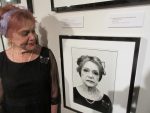
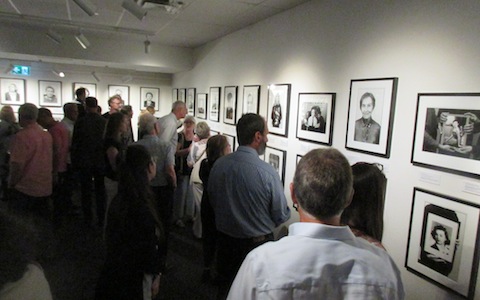
Jannushka Jakoubovitch, a Holocaust survivor, looks at her portrait, taken by Pulitzer Prize-winning photographer Marissa Roth, part of the Faces of Survival exhibit at the VHEC. (photo by Pat Johnson)

Two new original exhibits opened at the Vancouver Holocaust Education Centre recently, concurrent with the opening of the centre’s redeveloped space.

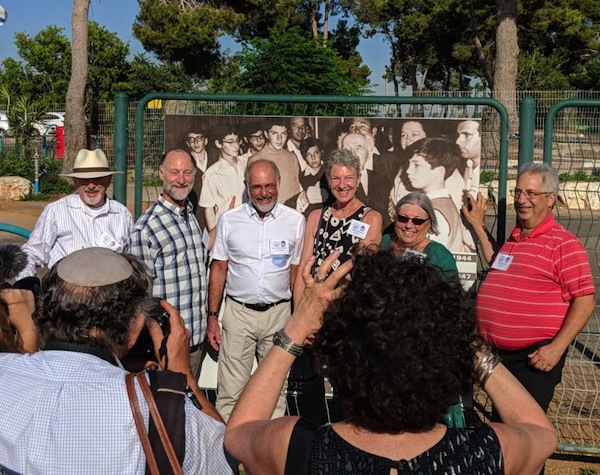
Following the annual general meeting of the Vancouver Holocaust Centre Society for Education and Remembrance on June 20, attendees moved from the Jewish Community Centre of Greater Vancouver’s Rothstein Theatre to the Holocaust centre for the official opening of the exhibits and a first look at the revamped space. (An article on the centre’s renewal project will appear in a future issue.)

photo - Following the AGM, attendees moved from the Rothstein Theatre to the Holocaust centre for the official opening of the exhibits and a first look at the revamped space
Following the AGM, attendees moved from the Rothstein Theatre to the Holocaust centre for the official opening of the exhibits and a first look at the revamped space. (photo by Pat Johnson)

Both exhibits emphasize local relevance of broader Holocaust history.

In Focus: The Holocaust through the VHEC Collection includes items that the Holocaust centre has assembled over decades. Thematic aspects of Shoah history are illustrated through documents, photographs and artifacts. Interactivity is incorporated through replica items in adjacent drawers, which visitors can handle and explore. Electronic kiosks encourage deeper and broader exploration of topics, including cross-referenced databases that connect, for example, all holdings related to an individual, a place, an event or other search query.

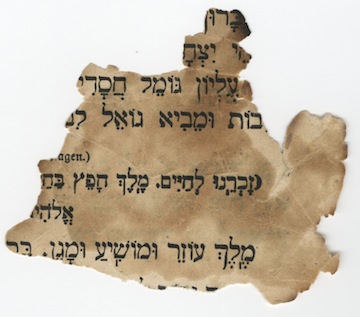
Among the items on display are a yellow Star of David worn in the Theresienstadt camp in Czechoslovakia, a fragment of a prayer book burned during Kristallnacht in 1938 and found on the street in Berlin after the violence temporarily subsided, and a photo album of life in the Netherlands under Nazi occupation, created from negatives that were developed in 1981 and donated to the VHEC.

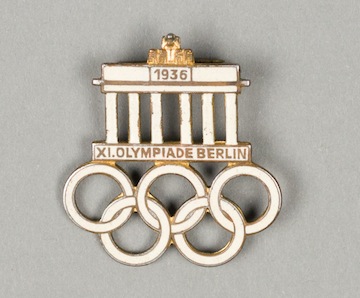
photo - A souvenir pin from the 1936 Berlin Olympics, part of the Vancouver Holocaust Education Centre’s permanent collection and the exhibit In Focus: The Holocaust Through the VHEC Collection
A souvenir pin from the 1936 Berlin Olympics, part of the Vancouver Holocaust Education Centre’s permanent collection and the exhibit In Focus: The Holocaust Through the VHEC Collection. (photo from VHEC)

Also on display is a Torah scroll from Prague, which, along with 100,000 other Czechoslovakian Jewish religious objects, was gathered by the Central Jewish Museum in Prague at the behest of Nazi officials.

A souvenir pin from the 1936 Olympic Games in Berlin, featuring a replica of the Brandenburg Gate, and a porcelain figurine of an idealized Aryan woman produced around the same time speak to that portentous international sporting event.

Artifacts from life in hiding include a wooden toy dog that belonged to local child survivor Robert Krell. Among the most unusual items on display is a chess set modeled from chewed bread and sawdust, then painted and varnished.

“These finely articulated pieces are believed to be the work of a Polish Jewish man interned in the Warsaw Ghetto,” according to the exhibit descriptor. “He likely offered the set to a soldier stationed as a guard in the ghetto, in exchange for food.”

Photographs illustrate life in the ghettos, life in hiding and the “Holocaust by bullets,” the process of mass murder in Eastern Europe perpetrated by Einstatzgruppen (Nazi death squads) and collaborators.

Also on display is a recipe book compiled by Rebecca Teitelbaum, the aunt of Vancouver-area Holocaust survivor Alex Buckman. While working in a Siemens ammunition factory in the women’s concentration camp Ravensbrück, the exhibit explains, “At great risk of being discovered and killed, she stole pencils and paper to record her recipes and those of other inmates.”

A child’s shoe recovered from the Kanada barracks at Auschwitz II-Birkenau is on exhibit. “This shoe, belonging to a child of age 3 or 4, was retrieved after the Second World War. Young children deported to Auschwitz were among the first to be selected for the gas chambers. An estimated one million Jewish children were murdered by the Nazis and their collaborators during the Holocaust – 220,000 children died in Auschwitz alone.”

photo - A fragment of a Torah scroll found on the street in Berlin following Kristallnacht, in 1938, part of the VHEC's permanent collection and the exhibit In Focus: The Holocaust Through the VHEC Collection
A fragment of a Torah scroll found on the street in Berlin following Kristallnacht, in 1938, part of the VHEC’s permanent collection and the exhibit In Focus: The Holocaust Through the VHEC Collection. (photo from VHEC)

Also on display is a letter, dated April 20, 1945, from U.S. soldier Tom Perry to his wife Claire after arriving in the liberated Buchenwald concentration camp.

“I want to write you tonight about one of the most moving experiences I’ve ever had, as well of as one of the most horrible things I have ever seen.… With the idea not of pleasing you, for what I saw there was really too horrible to be seen by any decent human being. But with the thought that as my wife you would want to share with me my most horrible as well as my pleasant experiences. And because I think the rest of the family and our friends should know from personal observations what bestial things the Nazis have done, and what a dreadful menace they have been to people all over the world.” The letter proceeds in graphic detail.

The second exhibit is even more intimately connected with the local community. Faces of Survival: Photographs by Marissa Roth consists of portraits of British Columbians who survived the Shoah. Roth, a Pulitzer Prize-winning photographer who created a similar exhibit at the Museum of Tolerance / Simon Wiesenthal Centre in Los Angeles, took portraits of survivor volunteers, including both past and present VHEC outreach speakers and board members. In cases where the survivors themselves have passed away, the portraits feature family members holding a photo of the survivor.

The subjects were asked two questions: “Why do you think it is important to remember the Holocaust?” and “What message do you want to convey to students?” From their answers, captions were created to accompany the portraits in the exhibition, which was made possible by the Diamond Foundation.

Accompanying Agi Bergida’s portrait are the words: “My great hope is in the young people, the new generation. Racism is ignorance, to which the answer is education.”

Marion Cassirer, who died in Vancouver in 2014, is pictured in a photograph held by her daughter, Naomi Cassirer. “The Holocaust happened a long time ago, but for our family and for many others, it never ended,” said her daughter. “Marion spent the rest of her life speaking to groups about her family’s experiences, hoping that people would learn and understand that no society is immune.”

Serge Haber said, “It is important to remember the Holocaust because it can happen again, and it can happen here.”

A photograph of the late Paul Heller, held by his daughter Irene Bettinger, is accompanied by her words: “Dangerous human behaviour continues to this day, including antisemitism. Every one of us must participate in efforts to combat such behaviour if our freedoms and democracies are to survive.”

Accompanying Evelyn Kahn’s portrait are her words: “In a world where the media reports events absent of historical truth, the most essential tool becomes survivor testimony.”

The photograph of Peter Parker, who survived Birkenau and Dachau as well as a death march and died in Vancouver in 2015, includes words from his 1987 testimony: “Every human being has good and bad in them, we are capable of the highest noble things and the lowest deeds.”

Claude Romney, who survived in hiding, said: “We, as the last witnesses, have a duty to warn the world of the dangers of targeting any ethnic or religious group; for discrimination and persecution can lead to extermination, as it did under the Nazis.”

The late Bronia Sonnenschein was a survivor of the Lodz Ghetto, Birkenau and Stuthoff concentration camps and a death march from Dresden to Theresienstadt. Dan Sonnenschein, her son, said, “In her many years of Holocaust education, my mother honoured not only the memory of the murder victims and the other victims who survived, but understood the virulent intensity of antisemitism as ‘the longest hatred’ and the need to combat its current forms.”

Louise Stein Sorensen, a survivor of the Amsterdam Ghetto who survived in hiding, said: “The Holocaust teaches us to arm ourselves against the abuse of human rights.”

Both exhibits continue until next year, and information on opening hours and other details can be found at vhec.org.

After the routine business of the annual general meeting, Dr. Ilona Shulman Spaar, VHEC education director, presented the 2018 Meyer and Gita Kron and Ruth Kron Sigal Award to educators Sharon Doyle of South Delta Secondary and Julie Mason of David Oppenheimer Elementary in Vancouver. The award recognizes excellence in Holocaust education and genocide awareness in B.C. elementary and high schools.

Ed Lewin, past president of the organization, conferred life fellowships on Ethel Kofsky and Dr. Martha Salcudean.

Introductions and explanations of the new exhibitions, as well as of the renovated centre, were presented by Nina Krieger, VHEC executive director, architect Brian Wakelin, principal of Public: Architecture + Communication, and Shulman Spaar. Hodie Kahn offered reflections from a second-generation perspective.

Format ImagePosted on July 6, 2018July 5, 2018Author Pat JohnsonCategories LocalTags Holocaust, photography, VHEC

The value of memoirs

This academic year marks the second session of Writing Lives, a two-semester project at Langara College, coordinated by instructor Dr. Rachel Mines. Writing Lives is a partnership between Langara, the Vancouver Holocaust Education Centre, and the Azrieli Foundation. Last fall, students learned about the Holocaust by studying literary and historical texts. In January, students began interviewing local Holocaust survivors and are now in the process of writing the survivors’ memoirs, based on the interviews. Students are keeping journals of their personal reflections on their experiences as Writing Lives participants. They used their most recent journal entry to reflect on the topic of The Importance of Memoirs. Here are two excerpts.

Memories are our experiences: our interactions with people we love or hate, our communication with the ever-changing world. Our memories remind us of our moral values, our knowledge, our appreciation of our own lives, and perhaps our own inadequacy in being the person that we wanted to be. Our memories are a true reflection of who we are, and that is exactly why they are our most valuable asset.

Writing down our memories is a great way to retain them and, hence, it is meaningful to write a memoir on behalf of David, a man who has experienced one of the most controversial and complex events in history – the Holocaust – so that his memories will be retained in concrete form and can be passed on to many generations. I believe David’s descendants, and anyone who cares about other human beings, will be inspired by what David fought for in the past and will be grateful for what they have. Sometimes, we take food and safety, peace and dignity, the privilege to love and to be loved, for granted, and we forget about the unfortunate ones.

Most importantly, memoirs of Holocaust survivors are a stern reminder of the fact that we humans can turn into perpetrators for not so obvious reasons. It would be wrong for us to think that, since we are civilized, rational, educated people, we cannot become perpetrators. We have come to realize that it is not the case that only psychotic or inherently evil people can harm others in callous and appalling ways. The Holocaust has demonstrated that hatred, racism, conflicts between religions and a sense of insecurity can easily be used to justify our wrongdoings. With the real-life experiences of survivors recorded in memoirs, hopefully people will never forget this painful lesson in human history.

– Bonnie Pun

Storytelling is a phenomenon that all manners of societies and cultures have practised since the hominid species first learned to communicate. We use stories to convey social values and wisdom. In Western society, thanks to pioneers such as Sigmund Freud and Carl Rogers, storytelling forms the bedrock of modern counseling practice. The intimacy of sharing a story with a compassionate and safe person can literally transform a life. Stories transmit meaning, both individually and socially. It’s as simple and complex as that.

Memoirs are a place where individuals can encounter and transform their experience into one that has larger meaning. On a societal level, projects like Writing Lives present the human experience and personal costs of the atrocities that have occurred. The personal narrative transforms historical facts into real and impactful events that can be felt, if not fully understood.

The Holocaust is so often constructed and taught as an historical anomaly, a mysterious evil; however, the fact of the matter is that it is a story of social relationships. Sadly, “stories” such as this have occurred far too frequently over the last 70 years. Globally, we have seen genocidal processes of hate in countries such as former Yugoslavia, Rwanda, Cambodia, Russia, Sudan … the list goes on. As our neighbour to the south, the United States, struggles with an ideological divide that has become so significant it is now one of the countries monitored by the NGO Genocide Watch, memoirs from the Holocaust become particularly important here in the Western world. I think it is sometimes easy to look at racially motivated brutality in the second and third worlds and feel a certain sense of safety. These memoirs confront us with a different reality, one which is too important to ignore.

– Ann Thomas

Posted on May 4, 2018May 2, 2018Author Writing Lives studentsCategories LocalTags Azrieli Foundation, education, Holocaust, Langara College, memoir, survivors, VHEC
B.C. marks Yom Hashoah

B.C. marks Yom Hashoah

(photo from Vancouver Holocaust Education Centre)

Many child survivors of the Holocaust did not identify as survivors – and were not deemed so by other survivors, including their parents – until decades after the end of the Second World War. The emergence and evolution of the unique experiences of child survivors was the subject of the Yom Hashoah keynote address in Vancouver by Dr. Robert Krell, professor emeritus of psychiatry at the University of British Columbia.

Local survivors of the Shoah and their families, as well as the premier, cabinet ministers and other elected officials, joined hundreds more in Vancouver and Victoria to commemorate Yom Hashoah, Holocaust Remembrance Day, earlier this month. An event presented by the Vancouver Holocaust Education Centre took place at the Jewish Community Centre of Greater Vancouver on April 11 and another took place at the B.C. legislature in Victoria the following day.

In his presentation, Krell spoke about how he was liberated at the age of 5, having been a hidden child in the Netherlands. From the only family he knew, he was returned to the parents of his birth.

“My father and mother’s parents – my grandparents – and their brothers and sisters – my uncles and aunts – had all been murdered,” he said. “I learned about being Jewish at home, hearing stories from survivors who returned. They spoke of Auschwitz and other mysterious places in Yiddish, ably translated by my second cousin, 8-year-old Millie, who had returned from Switzerland with her parents. We heard things no child should hear and, therefore, listened all the more attentively.

“That was my introduction to Judaism, an unforgettable litany of horrors visited upon Jews that imprinted on my mind,” said Krell. “So far as I knew … being a Jew meant death, for everyone was dead, save one first cousin and Millie.”

Finding one’s way through the present with such a burden was an added challenge. “The task of being normal when you know you are not is all-encompassing,” he said. “What I did not realize then was how deeply affected we children were by the events of the Shoah and how intimately the traumatic consequences were entwined with our daily existence.”

While at UBC, in his small private practice, Krell began to see the children of Holocaust survivors. “And, from them, I learned of the impact of the Shoah on survivor families.”

During this period, he was spearheading Holocaust education initiatives in the province, including the Holocaust Symposium for high school students, which will have its 42nd iteration on May 2, and video recording survivor testimonies. “But there was one overriding issue that became the driving force of my preoccupations,” Krell said. “I discovered child Holocaust survivors. That may sound strange…. They did not need to be discovered. But they had disappeared from view. For almost 40 years, child survivors did not identify themselves as survivors. Immediately after the war, children were discouraged from talking about their experiences. In any case, said adults, you were too young to have memories, lucky you. Therefore, you did not suffer like we did.

“Other well-meaning adults urged children to forget in order to get on with their lives. That is not how it works,” said the psychiatrist. “Traumatic memories experienced in early childhood are not forgotten. They remain and they return.”

Throughout the 1980s, child Holocaust survivors began to speak with each other and to the public. In 1991, 1,600 people, primarily child survivors and their families, gathered in New York. “The workshops provided a safe environment in which participants gained self-awareness and much-needed relief,” said Krell.

Yom Hashoah corresponds to the 27th day of Nissan in the Hebrew calendar, the anniversary of the Warsaw Ghetto Uprising. This year marks the 75th anniversary of the uprising, which began on April 19, 1943. “The ghetto fighters were able to hold out for nearly a month,” said Vivian Claman, a member of the second generation at the Vancouver event. “On May 16, 1943, the revolt ended and a total of 13,000 Jews died. It was the largest single revolt of Jews during the Second World War.”

Jody Wilson-Raybould, federal minister of justice, also addressed the audience. “I want to say that we hear you, we honour your lived experiences and your stories, and we renew our commitment, and we reaffirm our vigilance to speak out against antisemitism, to speak out against xenophobia, to speak out against any form of racism or intolerance as unacceptable in this country and throughout the world,” she said.

Councilor Raymond Louie, acting mayor of Vancouver, read the proclamation from city hall. Kaddish was led by Chaim Kornfeld, a survivor. Eric Wilson played cello, and singers included Advah Soudack, Kathryn Palmer and Mia Givon. Wendy Bross Stuart played piano and, with Ron Stuart, were artistic producers. The ceremony ended, as is tradition, with “Zog Nit Keynmol,” the Partisan Song.

* * *

B.C. Premier John Horgan quoted Elie Wiesel: “To forget the dead would be akin to killing them a second time.”

“That’s why it’s so important,” said Horgan in the legislature’s Hall of Honour, “that, on Yom Hashoah, we acknowledge, as a society … that this may never happen again provided – provided – we don’t let time and the sands of history go through our fingers and we remember the words of the survivors that I was fortunate enough to hear today and we remember the millions and millions of lives that were lost because of hate, intolerance and because people didn’t stand up fast enough.”

Selena Robinson, minister of municipal affairs and housing, who is Jewish, emceed the commemoration. MLAs of all parties were present. British Columbia is the only province with a Yom Hashoah commemoration in the legislature.

“We are here today to think deeply on one of the darkest moments in human history so we can remember and, in our remembering, stop it from happening again,” she said.

Opposition MLA Sam Sullivan said, “It is only through knowledge and recognition of humanity’s worst capabilities, including the profound banality of evil, that we can strive for ensuring justice and good in the world and ensure that such heinous acts will not happen again.”

Judy Darcy, minister of mental health and addictions, shared the story of how her father hid his Jewishness with the intention of protecting his family after he survived the Second World War in Europe. Darcy shared the story with the Independent last year. (See the Feb. 24, 2017, issue.)

Temple Sholom’s Rabbi Carey Brown chanted El Maleh Rachamim and an adaptation of the Kaddish, also by Wiesel, which includes the names of camps and other places Jews were interned. Members of the audience spoke out names of places that they or family members came from or experienced.

MLA Nicholas Simons played Kol Nidre on the viola while Holocaust survivors Daniel Wollner, Alex Buckman, Rita Akselrod, Suzi Deston and Edith Matous lit candles. Another candle was lit by Nathan Kelerstein, a member of the second generation. A seventh candle was lit by representatives of other groups targeted by the Nazis, including people with disabilities, who were represented by Meyer Estrin and his mother Tzvia Estrin; Peter Csicsai of the Romani Canadian Alliance; and Jonathan Lerner, in memory of gender- and sexuality-divergent peoples. A group of young people, led by Hannah Faber, sang.

Micha Menczer, a Victoria lawyer who deals with First Nations and aboriginal rights, spoke as a child of a survivor of the Shoah. His mother, he said, spoke frequently of the non-Jews who risked their lives to save or help Jews.

“I learned also that, while Jews were a central target, others were attacked, deported and killed because of their race, political or religious belief, disability or sexual orientation,” he said. “Very importantly, my mother taught me that this does not diminish the memory of the Shoah or those who perished to give full recognition to the pain of other people and to the heroism of non-Jews who helped at great risk to themselves. It takes nothing away from our collective memory as Jews to honour those people and remember others who suffered.”

Format ImagePosted on April 27, 2018April 25, 2018Author Pat JohnsonCategories LocalTags British Columbia, child survivor, Holocaust, Robert Krell, Shoah, VHEC

Class leads to understanding

This academic year marks the second session of Writing Lives, a two-semester project at Langara College, coordinated by instructor Dr. Rachel Mines. Writing Lives is a partnership between Langara, the Vancouver Holocaust Education Centre and the Azrieli Foundation. Last fall, students learned about the Holocaust by studying literary and historical texts. In January, students began interviewing local Holocaust survivors and are now in the process of writing the survivors’ memoirs, based on the interviews. Students are keeping journals of their personal reflections on their experiences as Writing Lives participants. They used their most recent journal entry to reflect on the topic of Multicultural Perspectives. Here are a few excerpts.

It’s been more than half a year since I decided to join the Writing Lives program. The historical context should have been enough motivation for me to join when I first heard of the program about a year ago, but I hesitated. I’d never done a writing project as large or as important as this. I felt that my skills and experience were inadequate in preserving the stories of Holocaust survivors. I still feel that way.

As a child and then later, as a student of history, I regarded my sources as just that: sources. The stories I listened to were filtered, edited for a younger audience. The books and films I read and watched were similarly altered. As I delved into the history and historiography of it all, I had an inkling in the back of my mind that people actually lived through these events, experienced them. But the moment our survivor partner started telling his story, it really struck me that yes, this is real, these are real people.

This project isn’t just a curiosity, an interest – it has become more of a duty. It has been mentioned many times since the program started that it is crucial for these stories to be told, written down and passed on, for time is running out. I never felt the gravity of that responsibility until we heard the history from someone who saw it with his own eyes.

– J.V. Malabrigo

***

Courses like Writing Lives are a reminder of the damage complacency can cause. Without knowledge, without tolerance, we are doomed to walk in circles until our hatred ends our capacity to recognize each other as human beings. We will fail to recognize that we all bleed, cry, laugh and need each other to survive.

I have learned the beauty of a human story. I have learned what it truly means to be triumphant and what it means to be a survivor. I am learning what it means to achieve true greatness and compassion, despite the lack of it that is shown to so many. I have explored the reality of how complacency may be our true enemy. I have learned that ignorance and acceptance of extremism means turning off our humanity and letting hatred rule minds and hearts alike.

We see history as ancient stories…. Through this class, I understand how to immortalize living, breathing history and to show a history of peace and love coming out of trauma and violence.

– Heather Parks

***

The Writing Lives program has had a significant impact on me. I hope to become an elementary school teacher, specifically teaching a primary grade (kindergarten to Grade 3). Holocaust education may be out of my hands in terms of the curriculum, but there is a major, never-ending lesson that I take away from this experience. I hope to teach my students the importance of embracing and celebrating our differences.

When someone looks different from us, celebrates different holidays, eats different food – whatever the case may be – these are opportunities to learn and to love. If there are things we notice about each other that we don’t understand, there are ways to respectfully ask questions. We will always have differences of views and opinions, but the most important thing to remember is that no single person’s opinion is “proper” or more important than anyone else’s. Our differences make us unique. Our differences are what make the world such an amazing place. If we remember the importance of respect and understanding, we can ensure that we will never see another Holocaust.

– Chelsea Riva

***

My father is Chinese South African. Born in 1965 in Johannesburg, South Africa, he grew up in the final stages of apartheid. This racist system denied people of colour, namely black people, basic human rights and dignity. Laws were based on the race or colour of a person and, while laws were well-defined for most ethnic groups, Chinese people in South Africa were such a small minority that most of their daily lives fell into a legal grey area. In this system, Chinese people were above black people, below white people. Chinese people in some cases would be allowed into white institutions but could be refused service at the discretion of the owner. While Chinese people were given certain privileges, at the end of the day, my family was denied the full rights of humanity. They had to carry identification cards, they were victims of racism and their lives were constructed in fear of punishment from a racist system whose punishment was seemingly random.

My mother is Japanese. Born in 1965 in Hiroshima, Japan, she grew up in a conservative society that often refuses to talk about its violent history of invasion, colonialism and war. This is not to say that my mother herself denies this history, but, in general, Japanese people become uncomfortable when discussing the role of Japan as an invading force in Asia. Numerous Japanese war crimes remain unacknowledged to this day, and even those that have been acknowledged have never reached the same global recognition as the crimes of the Holocaust.

It is unfair to compare separate instances of invasion, imprisonment or murder. The discrimination my father experienced was distinctive and had similarities to the Holocaust, but by no means was it the same. The invading history of my mother’s homeland was horrific, but to compare the actions of the Japanese army and government to those of the Nazis dilutes the complicated issues of Japanese society while disrespecting the unique experience of those terrorized by the Japanese. However, it was with knowledge of these two sides of my family, both Chinese and Japanese, that I took this class.

Taking this class did not change my perspective of the Holocaust. Instead, the Holocaust became more real, more detailed. I came to this class with the utmost respect for what we were studying and with an intense desire to do something that “mattered,” which is a common goal for many people my age. What I didn’t expect was to form such a personal connection with our survivor. I didn’t expect for it to become so real that I would break down crying.

My experience in this class has been enriching in ways that I didn’t expect. I don’t think that I can say this class changed me, but it deepened the ideas of legacy that I held because of my background, and it helped personalize the Holocaust. My family’s history helped me form a deep respect for my elders. Because of them, I learned that there is power in the retelling of stories told with fear, shame and beauty. I have family that comes from the side of both the oppressed and the oppressors, and this informed my perspective and my need to take this class.

– Yukiko Takahashi-Laisut

Posted on April 20, 2018April 18, 2018Author Writing Lives studentsCategories LocalTags Azrieli Foundation, education, Holocaust, Langara College, VHEC, Writing Lives

Reflections on first meeting

This academic year marks the second session of Writing Lives, a two-semester project at Langara College, coordinated by instructor Dr. Rachel Mines. Writing Lives is a partnership between Langara, the Vancouver Holocaust Education Centre and the Azrieli Foundation. Last fall, students learned about the Holocaust by studying literary and historical texts. In January, students began interviewing local Holocaust survivors and will write their memoirs on the basis of the interviews. Students are keeping journals of their personal reflections on their experiences as Writing Lives participants. Students used their most recent journal entry to reflect on their first meetings with the survivor with whom they are partnered. Here are a few excerpts.

Prior to meeting our survivor partner, one of our group members spoke to him on the phone, and she described him as a person “who doesn’t let anything past him.” It seems he’d tested her on her ability to say the word “Holocaust” without shuddering an apology.

It is clear that our partner refuses to spend his time telling his story to anyone who cannot handle it. On one hand, his attitude is a comfort; I believe we will be able to show him that not only are we unafraid to hear his story, but also that we care deeply about helping him tell it authentically. On the other hand, this adds to the building anxiety about our interviews and our worries about writing the memoir. Producing a memoir that our survivor is 100% proud of is my biggest goal and also my biggest fear. I feel that telling the story of another person’s life is a tremendously huge responsibility, and I do not take it lightly.

– Chelsea Riva

We actually met D. before our first meeting: he came to our class to give a talk last semester. Our first interview was arranged at his home, and D. was as warm and friendly as before. So was his wife, and they took good care of us. They helped us with our coats and insisted that we did not have to take our shoes off. D. said we must have walked a long way, and it was the shoes that kept us walking comfortably; therefore, we should not take them off. I immediately recalled what Primo Levi wrote in his book Survival in Auschwitz. Yes, shoes are of the utmost importance, and D. has experienced that. However, we quickly realized that the house was immaculately clean, and so was the light beige carpet that we were stepping on with our shoes! Anyway, while I was worrying about the carpet, the meeting began.

– Bonnie Pun

When I first met D.S., I was apprehensive. The culmination of the past four-and-a-half months was finally at hand, and I was set to be the lead interviewer for our group – not a task that fell lightly on my shoulders.

Moira and he came into the room and she introduced him (she had met him previously). D.S. smiled so widely that his eyes crinkled, and he shook each of our hands in turn. When we were done, D.S. said a few words about himself and then quickly launched into a very compressed, detailed story about his life.

We had been expecting a more casual, getting-to-know-you first interview, and none of us had been expecting to take in such a massive amount of information – although, in hindsight, I’m glad we did. At the end of the interview, after D.S. had given us advice about meeting deadlines and making sure we had enough time to edit and rework parts of his story, we breathed a sigh of relief – it had gone well.

The opportunity to have a question-and-answer session with a person who has survived such great personal trauma is incredible. D.S. is a wonderful storyteller, and the interviews so far have been a continuously rewarding experience.

– Susan Scott

Some of the stories that D.S. shared with us at that first meeting were hard to absorb. I think I didn’t really want to understand what he was saying, as a way of protecting myself, so I wouldn’t show I was affected while I was in the room with him. It was only after I listened to the recorded interview that I could even start to imagine the events that he had endured. It sunk into me that this was a real thing that had happened to a real man, one who sat in front of me, ready to share his pain and perseverance with us. For that, I am grateful and honoured.

What D.S., the other survivors, the Vancouver Holocaust Education Centre, the Azrieli Foundation and Langara College are doing through the Writing Lives program is so immensely important – something I have come to understand on a new level after that meeting. I think the point is to affect others in the way that this one meeting affected me. It’s to try and understand people’s suffering as best we can, though we will never feel their pain, and to use that understanding to become better people, and not be complicit in others’ suffering in the future.

– Moira Henry

Posted on March 2, 2018July 2, 2020Author Writing Lives studentsCategories LocalTags Azrieli Foundation, Holocaust, Langara College, memoir, survivors, VHEC
Survivor shares story

Survivor shares story

Holocaust survivor David Ehrlich speaks on Jan. 25. (photo by Pat Johnson)

David Ehrlich grew up in a small city in Hungary, sleeping in the kitchen of the family’s three-room house – “not three bedrooms, God forbid, three rooms” – and it was through the kitchen curtains early one morning that he saw three bayonets before he heard a knock at the door.

“I opened the door, they came into the kitchen and they said to me in German – there were two Hungarian gendarmes and one German soldier or officer or whoever he was – ‘I want you to bring in the family into the kitchen.’”

Young David gathered his parents, sister, three brothers and grandmother and they assembled in the kitchen, where they were told to be on the street in 30 minutes to prepare for deportation to a work camp.

Ehrlich shared his story Jan. 25 at a commemoration marking International Holocaust Remembrance Day (which was Jan. 27). The afternoon event, which took place at the University of British Columbia, was presented by the Vancouver Holocaust Education Centre, Hillel BC, the department of Central, Eastern and Northern European studies at UBC (CENES) and the Centre for Israel and Jewish Affairs, with support from the Akselrod family in memory of Ben Akselrod.

After two weeks in a makeshift ghetto on a local farm, the 7,000 Jews were forced onto trains, said Ehrlich. Seventy people were pushed into each car.

“These were not cattle cars,” he clarified. “I wish they had been cattle cars because [cattle cars] are ventilated.” There was one little hole at the top of the car, covered with barbed wire, and a child would occasionally be lifted up to look out to see if the signs outside were in Hungarian, German or Polish.

“But, soon enough, the train stopped,” he said. “They opened up the door … and there were some signs and some smells and some visions that I’ll never forget as long as I live. The place had electric lights … barbed wire all over in all directions.

“Little people – I thought they were little, but they were prisoners – came up to the train and said leave everything there, stand in line, five abreast. And we did that and walked over to this man with a stick in his hand and he was doing the selection. Who is going to live, who is going to die.… They played God. About 10 minutes or so later, we were separated from our family.”

While he was receiving his uniform, Ehrlich got his first lesson in what this place – Auschwitz – was all about.

“Did you say goodbye to your family?” the man asked Ehrlich.

“I said, why should I? I’m going to see them probably this afternoon. He said, while you were taking a shower, your family was gassed and, while we talk here, their bodies are probably being burned in the crematorium.”

Ehrlich’s brothers were almost immediately sent on to Melk, a sub-camp of Mauthausen, in Austria.

Because Hungarian Jews were among the last to be deported to the camps, the Soviet army was already advancing from the east by the time Ehrlich arrived at Auschwitz and the prisoners were sent on a death march westward. He, too, ended up in Melk and found someone from his hometown who knew the fate of his brothers. They had been sent to the hospital a few days earlier. Ehrlich knew that the hospital was a farce and that being sent there meant certain death.

“That was probably my lowest point in the whole deal because I always felt that I’d meet up with my brothers someplace,” he said. “I did, only a week too late.”

As the Russians kept on moving westward, the Nazis marched Ehrlich and the others further, this time to Ebensee, Austria.

“One day – it was a nice sunny day – we went outside and the loudspeaker came on and the president of the camp said, I’ve got good news for you. I have received orders from the Reich that we are to take you into the mine and blow it up with you in it. But I’m not going to do that – that’s the good news. For the first time since I’m in the services of the Third Reich, I’m going to disobey this order.”

He told the prisoners that they were free. The next day, they heard tanks on the cobblestone streets.

“And a guy that was probably 20 years old – like a kid, he looked like me – got out of the manhole and said to us in Yiddish, ‘Ich bin ein Amerikaner Jude,’ ‘I am an American Jew.’”

After liquids, then vitamins, eventually solids, Ehrlich regained some of his health. After two months, he still weighed less than 100 pounds, but he was ready to go home.

“But going home for Holocaust survivors, whether it was to France or to Germany or to Poland, it was the same thing,” said Ehrlich. “Canadian soldiers, American soldiers came back from the war, they came back to their community, to their parents and to their country. We went back and there was nobody there. My sister [who had been liberated in Lithuania] was there but we lost everybody else.”

Ehrlich wasn’t going to stay behind the Iron Curtain. He and a friend wanted to see Paris, planning eventually to head for pre-state Israel.

“But, while we were waiting in Paris, there were rumours that Canada was looking for orphans to go to Canada,” he said. “I went to work as soon as I came to Canada. I was going on 19. I went to work and I’ve been paying taxes ever since.”

The story has a good ending, Ehrlich told his audience.

“I married a wonderful girl – she’s right here, the little grey-haired girl – 65 years ago and we’re still together and we brought up three wonderful sons.”

Rabbi Philip Bregman told the survivors: “We are tremendously aware of how precious you people are who lit these candles and came in today as personal witness.”

The commemoration also featured Prof. Uma Kumar, of CENES, who said the Holocaust is a contemporary issue because antisemitism is a contemporary issue. “For this reason,” she said, “it is everyone’s duty to reflect on what happened.”

Format ImagePosted on February 2, 2018February 1, 2018Author Pat JohnsonCategories LocalTags Akselrod, CENES, David Ehrlich, Hillel BC, Holocaust, survivor, UBC, VHEC

Survivor’s talk inspires

“There are as many Holocaust stories as there are Holocaust survivors,” said David Ehrlich, a survivor outreach speaker of the Vancouver Holocaust Education Centre, to open his afternoon talk at Langara College. On Oct. 31, a class of 20 students and several faculty members and guests heard Ehrlich – a Hungarian survivor of Auschwitz who immigrated to Canada via Paris in the late 1940s – tell his personal story.

This class is part of a program called Writing Lives: The Holocaust Survivor Memoir Project. In the first term, its students produce research papers on prewar European Jewish communities like the one that Ehrlich called home; in the second term, they will interview survivor-partners and together write memoirs of the survivors’ experiences.

Ehrlich is an evocative speaker. He spoke lovingly of his family home in Transylvania (now part of Romania). “We had a three-room home, and we were middle-class. But we had no running water and no electricity, not for another 20 years,” he said. “Kids don’t know any better. I thought that we had it well: chicken on Friday night, bread on the table, it was wonderful!”

But he also told of his experience with antisemitic violence, the hard choices made by families who tried to avoid a Nazi roundup, and life in Auschwitz. He silenced the room when he spoke of stepping off a train boxcar at Auschwitz: “I’ll never forget the view when the sliding doors opened, or the noise that the doors made,” he said.

The students – who in this term’s research papers attempt to imaginatively reconstruct Jewish life before the Second World War’s devastation – responded with questions about Ehrlich’s journey to Canada. He spoke of the family that he made in Canada: a wife and three sons. He made his story accessible to the audience of all ages.

The students admired Ehrlich and a bond was formed during his talk, which was about an hour long. When he finished speaking, there was a respectful silence, and no student seemed willing to be the first to break it. Teachers from Langara began the question-and-answer session and, once the ice was broken, the students filled the remaining time with questions. Ehrlich in turn shared relevant wisdom for Writing Lives’ participants.

“You are educated and smart,” he told them. “There comes a time where you’ve got to learn to put up with people who are different because you have to get along. Start practising by getting along with your fellow students.”

Indeed, Writing Lives features groups in which students collaborate on research and, ultimately, on memoirs with the course’s survivor-partners. These collaborations require empathy. Ehrlich conducted himself as an exemplar of empathy, stating, “I can’t hold the grandchildren of Nazi-era Germans accountable for the Holocaust,” and the students’ response to his talk suggests that they, too, understand empathy’s importance. The course thus offers an excellent venue for students’ development of collaborative skills and of compassion. It provides a space in which students can grow closer together.

The afternoon also contained humour and reference to contemporary subjects. Ehrlich joked that he was now willing to use various German-made appliances and recalled that the heavy rainfall during a roundup of Hungarian Jews paled in comparison to Vancouver’s weather. Ehrlich also demonstrated strong knowledge of news and politics by interspersing references to American and Canadian current events into his remarks. He shared his general optimism about the post-Holocaust situation, stating, “After three or four generations, the Germans are coming clean; they are behaving like good nations do. It’s the only country in the world where you cannot say that the Holocaust didn’t exist.” He added, “We in Canada are very lucky – multicultural – and there’s no way that one minority group could be persecuted as in the Holocaust.”

His audience appreciated his graceful, optimistic tone. One enthusiastic student baked dozens of cupcakes to celebrate Ehrlich’s recent birthday.

Ehrlich’s talk will guide Writing Lives’ students through the remainder of the program. They will respond to it in one of their weekly written submissions, and the experience of interacting with a Holocaust survivor foreshadows the interviews that they will conduct in early 2018. They could not have asked for a better guide.

William Chernoff is a student in the Writing Lives program. Coordinated by instructor Dr. Rachel Mines, the two-semester program is a partnership between Langara, the Vancouver Holocaust Education Centre and the Azrieli Foundation.

Posted on December 1, 2017November 29, 2017Author William ChernoffCategories Op-EdTags Azrieli Foundation, David Ehrlich, Holocaust, Langara College, VHEC, Writing Lives

The Holocaust in literature

This academic year marks the second session of Writing Lives, a two-semester project at Langara College, coordinated by instructor Dr. Rachel Mines. Writing Lives is a partnership between Langara, the Vancouver Holocaust Education Centre and the Azrieli Foundation. This fall, students are learning about the Holocaust by studying literary and historical texts. In January, students will begin interviewing local Holocaust survivors and will write their memoirs on the basis of the interviews. Students are keeping journals of their personal reflections on their experiences as Writing Lives participants. Many students used their most recent journal entry to reflect on the value of literature in transmitting Holocaust memory. Here are a few excerpts.

The role of literature in preserving history is controversial but important. Understandably, there are people who are reluctant or even vehemently opposed to recording the Holocaust through the lens of art, concerned that the act of rewriting events in a fictional context may undermine the significance of the tragedy. Others may worry that historical inaccuracies are inevitable in these artistic works, thus doing a disservice to the victims and betraying their memories.

I would argue otherwise: that literature and historical facts can and should build upon one another, used to educate and not obscure. For me, reading our history textbook this semester has not always been easy, but reading the short story A Ghetto Dog by Isaiah Spiegel took the experience to a different level. Such is the power of narrative. As Menachem Kaiser wrote in his article “The Holocaust’s uneasy relationship with literature” (The Atlantic, Dec. 28, 2010), “literature affects us in ways that even the most brutal history cannot.” Literature makes the event close, immediate and personal. It’s hard for me to imagine being a Jew in Second World War Europe, but personal accounts and narratives come close to letting us immerse ourselves in the tragedy.

– Athina Leung

In his article “The Holocaust’s uneasy relationship with literature,” Kaiser argues that Holocaust literature is an important part of history. It can provide the emotional connection that reading facts cannot. It is a window to understand what people felt without having to experience the ordeal that the characters or author went through. Literature has the power to move the human heart. Facts are important, but they do not give the reader the ability to connect with history in ways that a more emotional and personal experience can provide.

– Tina Macaspac

I found the assigned reading, “The Holocaust’s uneasy relationship with literature,” to be incredibly relevant and thought-provoking. This article discusses the various difficulties associated with Holocaust literature, including the opinion by some historians that the only valid way to recount the Holocaust is through historical facts and memoirs. I agree that acquiring factual knowledge about the Holocaust is integral, and that reading historical documents is essential. However, I find myself disagreeing with the perspective that Holocaust literature is distasteful or discrediting to the Holocaust. Rather, literature provides an alternative, more emotional perspective that one cannot acquire from reading a fact-based history textbook. This week, for example, we read the short story A Ghetto Dog, which narrates the tale of the Jewish widow Anna and her dog Nicky. While I was aware of the facts (in this case, Jews being rounded up by Nazi troops) from a historical perspective, the story emphasized the feelings of helplessness and exhaustion that Holocaust victims and survivors felt. It touched a part of me in a way that facts and statistics could not.

– Emma Proctor

In A Ghetto Dog, the widow Anna and her dog Nicky are persecuted under the Nazi regime and forced to move into a ghetto. It is very clear from the beginning that Nicky is extremely important to Anna, and that he is her last remaining tie, not only to her deceased husband, but to her home.

The Nazis took livestock and any useful animals away from the Jewish people in order to make a profit. The livestock had value, which is why they were kept alive. People’s dogs, however, were not valuable to the Nazis, and that is one reason the dogs were killed.

Another reason was psychological. To the Nazis, it was important to wound people emotionally in order to conquer them. In the story, there were Jewish children dragging their dogs on ropes and leashes, bringing their pets, beloved family members, to be put to death. Dogs were part of a support system and, as with Anna, were reminders of home. To kill these dogs was to kill hope of return. The deaths of dogs were a stern reminder that just as easily as they could kill animals, Nazis could kill humans.

– Yukiko Takahashi-Lai

Posted on November 17, 2017November 15, 2017Author Writing Lives studentsCategories Op-EdTags Azrieli Foundation, Holocaust, Isaiah Spiegel, Langara College, literature, Menachem Kaiser, VHEC, Writing Lives

VHEC renewal now underway

Through education and remembrance, the Vancouver Holocaust Education Centre engages British Columbian students, educators and the broader public with the history of the Holocaust – the Shoah – and its ongoing relevance. Building on the VHEC’s achievements as Western Canada’s foremost Holocaust teaching museum, the centre’s renewal project, currently underway, will reconfigure the centre’s space to better serve the community and advance the organization’s vital mission.

The preservation of the VHEC’s collection of artifacts, and their use in support of Holocaust education in the post-eyewitness era, has emerged as a new area of emphasis for the future. To provide access to its archival collections and to better meet the needs of students and educators, the centre is proceeding with needed infrastructure upgrades, with support from the Government of Canada (Canada 150 Cultural Infrastructure Program), the Province of British Columbia (British Columbia/Canada 150: Celebrating B.C. Communities and their Contributions to Canada) and the Jewish Community Foundation.

The project will feature temperature and humidity-controlled archival storage and display facilities to enhance the visitor experience. The centre also looks forward to incorporating electronic access portals, which will allow visitors to interact with key themes in Holocaust history and with artifacts, documents and testimonies from the collections at the touch of a screen. Additionally, the VHEC is developing a designated audio-visual programming space that will allow Holocaust survivor outreach speakers – perhaps the centre’s most powerful, and certainly most in-demand, educators – to interact with students and participants in remote locations throughout British Columbia and beyond.

The VHEC renewal project will enable the centre to reach more students, to fulfil its obligation to archival donors and to engage in the time-sensitive work around ensuring that Holocaust-era artifacts from the community can be collected and integrated into exhibits and educational programs.

With plans for an eventual redevelopment of the Jewish Community Centre of Greater Vancouver in progress, the VHEC is ensuring that key aspects of the renewal are modular and transferable, in the event that the centre relocates in the coming years. The renewal will build in flexibility and sustainability.

The VHEC looks forward to welcoming students, teachers and community members to its renewed facility in early 2018, and to using its improved facility as a platform for carrying out its programming and interacting with the community. Guests attending the Nov. 22 special event in support of the VHEC, called “Looking Back … Moving Forward: Expanding the Reach of Holocaust Education,” will learn more about the centre’s upcoming plans, and preview the inaugural exhibition that will open in its renewed space.

Featuring a commissioned series of portraits of VHEC Holocaust survivor volunteers, the exhibition will honour and put a human face on those who survived the Shoah and have contributed to the VHEC community. Pulitzer Prize-winning photojournalist Marissa Roth created a similar exhibition of portraits of Holocaust survivors associated with the Museum of Tolerance in Los Angeles, currently on permanent exhibition at the museum. Inspired by this remarkable project, the VHEC is launching a documentation and exhibition project by Roth at an important time of transition for the centre and for Holocaust education.

The exhibition of black-and-white, matted and framed archival silver gelatin prints will be accompanied by biographical and historical information, and reflections on survival and the importance of education and remembrance. Representing and honouring the survivor volunteers who are no longer with us is an important aspect of the project, which will feature posthumous portraits – photographs of photographs of survivors, in some cases held by descendants.

Embodying the VHEC’s commitment to engaging with the past with eyes fixed firmly on the future, the renewal project and the Roth portrait exhibition will honour survivors, invite the participation of next generations and extend the reach of the VHEC’s work to new audiences, asking ever-more-challenging questions of how we extrapolate insights from history to navigate present-day affronts to social justice and human rights.

Nina Krieger is executive director of the Vancouver Holocaust Education Centre. This article originally appeared in the centre’s magazine, Zachor.

Posted on November 3, 2017November 1, 2017Author Nina KriegerCategories LocalTags Marissa Roth, photography, Vancouver Holocaust Education Centre, VHEC
Goldman memoir is a must-read

Goldman memoir is a must-read

Breakfast at Andrésy circa 1945. René Goldman is holding his bowl out for more food. The children peering through the windows are from another dining room, who had likely finished their meal but had not yet been given permission to leave. (photo from memoirs.azrielifoundation.org)

René Goldman’s account of his childhood – A Childhood Adrift (Azrieli Foundation) – is set in Belgium and France during the Second World War, when Hitler’s plan was to annihilate all European Jews. Each European Jewish child was automatically sentenced to death. Only between six and 11% of European children survived the Holocaust. Ironically, this memoir describes both a heartbreaking and an uplifting story of one Jewish boy’s struggle to stay alive and sane despite all odds against him.

A Childhood Adrift is both personal and, at the same time, an important historical document. The story, written with a spatter of tongue-in-cheek humour, is a fascinating labyrinth of multiple narratives; stories within stories. It is not only about René the child, but also René the man, who revisits the past and examines the wounds left by war.

Goldman weaves his experiences throughout the periods of war and postwar, when he is a young man who travels back to the places that sheltered him and other children lost in the horror of war. The entire narrative is skilfully infused not only with historical and political facts but with the geography of various places so poignantly described one can feel and see them.

Goldman writes about the time when children lost parents, siblings and homes. These children had to depend on the kindness of strangers or were left alone to fend for themselves.

Goldman was 6 years old when the Nazis invaded his native Luxembourg, where he was born, and Belgium, where his family had taken refuge. In 1942, the family fled Belgium for France. From the last station before the French border, they walked on foot to the Demarcation Line between the German Occupied Zone and the Free Zone. No sooner did they cross the line than they were arrested by the French police, who were rounding up Jews escaping from the Occupied Zone, and the family was interned in Lons-le-Saunier. On Aug. 26, Goldman and his mother were taken to the city’s train station for deportation. His aunt appeared from nowhere and tried to take him away, but to no avail. Eventually, she found someone in authority to send two officers to rescue the young boy and save him from boarding the train. His mother was already in one of the cars waving goodbye as the train was pulling out of the station. This was the last time Goldman saw his mother. He was 8 years old.

His father disappeared that morning and it was only in 1944 that Goldman was reunited with him for a brief time, until his father was arrested and taken away. Only after the war did Goldman find out that his father died at the end of the death march from Auschwitz, in January 1945.

In 1942, Goldman was placed in the care of the OSE (Oeuvre de Secours aux Enfants) and brought to Château du Masgelier. After two weeks, he was taken to the village of Vendoeuvres, where a young couple offered to take care of him. Soon afterward, the Free Zone was invaded by the Germans.

What followed for Goldman were moves to several homes due to the changing circumstances, which necessitated a constant search for safe places for children.

Left an orphan in 1945, Goldman was placed in the care of the CCE (Commission Centrale de l’Enfance), an organization inspired by communist ideology, which was instrumental in shaping his political beliefs. His faith in this system remained unshaken until he lived in Poland for three years, when he became disillusioned, even shocked, by it.

He writes, “I can now in all candidness recognize that I caught myself wondering whether communism was not the greatest lie of the century, if not of all time.”

Goldman’s narrative strength, among his many others, leans towards the lyrical.

One of the immediate postwar places to which Goldman was moved in France was the town of Andrésy and its Manoir de Denouval, which inspired poetic instincts in him. Here, he found the beauty of gardens and serenity, a “sanctuary” that shielded him for a time from his loneliness and the postwar chaotic reality. Interestingly, Marc Chagall, who donated funds for the children’s care, would occasionally visit the manor.

“I was enthralled with the Enchanted Manor,” writes Goldman. “It nourished in me a fascination with mystery as I explored it for hidden nooks and ventured up the narrow winding steps that led to the turret, sometimes even in the dark of night.” And, indeed, these were dark times in the young boy’s life for it was then that he realized he was an orphan.

Friendships played a huge part during the war and in the postwar period. In the boys and girls Goldman befriended along the way, and some of the kind teachers, he found a certain relief from the loneliness he felt, and from the lack of affection and support. One person who played an important role in his life was Sophie Micnic, who became his caregiver and friend. This woman, a founding leader of the MOI, the Jewish communist resistance movement in Paris and Lyon during the war, later became the director of CCE. It was she who took Goldman under her wing, and recommended that he live in the “Enchanted Manor.”

A Childhood Adrift – a must-read – is a powerful testimony of a child’s response to the calamities of war and their everlasting imprint on his life. It is also a statement of courage and survival in the face of adversity. Eventually, Goldman developed a tremendous hunger for knowledge, education and a desire for communication in as many as 10 languages.

In the last section of the book, the author reveals himself as a poet and a grown man still deeply immersed in his past.

Lillian Boraks-Nemetz is a Vancouver Holocaust Education Centre outreach speaker, an award-winning author, an instructor at the University of British Columbia’s Writing Centre and the editor of the No Longer Alone section of VHEC’s Zachor, in which a longer version of this book review was originally published. René Goldman will be the keynote speaker at the community’s Kristallnacht commemoration on Nov. 5, 7 p.m., at Congregation Beth Israel. Copies of his memoir will be distributed to those in attendance. Holocaust survivors are invited to light a memorial candle. The ceremony is presented by VHEC, Beth Israel and the Azrieli Foundation. For Pat Johnson’s review of Goldman’s book, which was initially called A Childhood on the Move, visit jewishindependent.ca/fragmented-childhood.

Format ImagePosted on October 27, 2017October 25, 2017Author Lillian Boraks-NemetzCategories BooksTags Azrieli Foundation, Beth Israel, Holocaust, Kristallnacht, René Goldman, survivors, VHEC

Posts pagination

Previous page Page 1 … Page 6 Page 7 Page 8 … Page 10 Next page
Proudly powered by WordPress