Skip to content
  • Home
  • Subscribe / donate
  • Events calendar
  • News
    • Local
    • National
    • Israel
    • World
    • עניין בחדשות
      A roundup of news in Canada and further afield, in Hebrew.
  • Opinion
    • From the JI
    • Op-Ed
  • Arts & Culture
    • Performing Arts
    • Music
    • Books
    • Visual Arts
    • TV & Film
  • Life
    • Celebrating the Holidays
    • Travel
    • The Daily Snooze
      Cartoons by Jacob Samuel
    • Mystery Photo
      Help the JI and JMABC fill in the gaps in our archives.
  • Community Links
    • Organizations, Etc.
    • Other News Sources & Blogs
    • Business Directory
  • FAQ
  • JI Chai Celebration
  • JI@88! video

Recent Posts

  • Sharing her testimony
  • Fall fight takes leap forward
  • The balancing of rights
  • Multiple Tony n’ Tina roles
  • Stories of trauma, resilience
  • Celebrate our culture
  • A responsibility to help
  • What wellness means at JCC
  • Together in mourning
  • Downhill after Trump?
  • Birth control even easier now
  • Eco-Sisters mentorship
  • Unexpected discoveries
  • Study’s results hopeful
  • Bad behaviour affects us all
  • Thankful for the police
  • UBC needs a wake-up call
  • Recalling a shining star
  • Sleep well …
  • BGU fosters startup culture
  • Photography and glass
  • Is it the end of an era?
  • Taking life a step at a time
  • Nakba exhibit biased
  • Film festival starts next week
  • Musical with heart and soul
  • Rabbi marks 13 years
  • Keeper of VTT’s history
  • Gala fêtes Infeld’s 20th
  • Building JWest together
  • Challah Mom comes to Vancouver
  • What to do about media bias
  • Education offers hope
  • Remembrance – a moral act
  • What makes us human
  • המלחמות של נתניהו וטראמפ

Archives

Follow @JewishIndie
image - The CJN - Visit Us Banner - 300x600 - 101625

Tag: VHEC

Marking memorial’s 30th year

On Sunday, Sept. 24, 11 a.m., at Schara Tzedeck Cemetery in New Westminster, the annual High Holidays Cemetery Service, presented by the Vancouver Holocaust Education Centre, Congregation Schara Tzedeck and the Jewish War Veterans, will mark the 30th anniversary of the Holocaust Memorial. On April 26, 1987, 1,300 numbers of the community, including Holocaust survivors and their families, attended the unveiling of the memorial, on which more than 900 names of family members who perished during the Holocaust were inscribed. Survivor Lillian Boraks-Nemetz wrote the following poem after that unveiling 30 years ago.

The Six Million
Written in dedication of the Holocaust Monument in Schara Tzedeck Cemetery

In this cemetery
far away from where They died
you stand dwarfed by this giant monument
your feet sinking lower and lower into the earth
your soul graining deeper and deeper
into the black granite.

You stand an alien to this earth
a born again human
sixty odd years away from the factories of death
of mercy – pleading voices scattered to deaf winds.

You stand in this cemetery
on the anniversary of the Holocaust
staring with hollow eyes
at simulated graves of strangers finally named
who once went to sleep in a common ditch
souls torn from peace like bones from flesh –

a child’s name upon your lips
a child’s fist pressing upon your breath
to break the granite silence
to speak to shout to scream the truth
to silence forever the mad dogs who
deny the happening of Shoah.

You remember as you stand here
waiting your turn to honour the Dead
how you stood with Them then
in line for death only you didn’t die
running away on all fours
through the contaminated sewers like a rat.

You say Kaddish and for a single moment
become one with the living and the dead.
Then you, the survivor, slip away into an alien world
where your soul must learn to sustain alone,
The Six Million.

Posted on September 22, 2017September 21, 2017Author Lillian Boraks-NemetzCategories LocalTags Holocaust, Jewish war veterans, memorial, Schara Tzedeck, Vancouver Holocaust Education Centre, VHEC
Community birthdays, awards

Community birthdays, awards

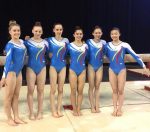
Team BC Junior Olympic level 10 (16+) were bronze medalists in the 2017 Canadian Championships in Artistic Gymnastics that took place in Montreal May 25-28. Congratulations to the whole Gymnastics BC team, which included 18-year-old Rachel Rubin-Sarganis (third from the left). (photo from Gymnastics BC)

***

photo - Sylvia Hill
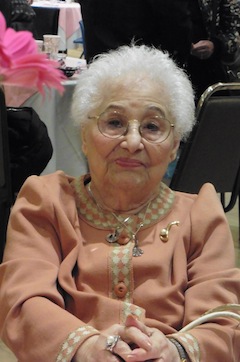
Sylvia Hill (photo from Jewish Seniors Alliance)

In the Pirkei Avot (Ethics of Our Fathers), we learn the saying, “Teach us to number our days so that the experiences of life should provide us with wisdom that only years can bring.” How fortunate we are that we have this exceptional woman, Sylvia Hill, admired by all who know her.

Sylvia has been part of the Jewish Seniors Alliance of Greater Vancouver since its inception and is an honourary life member. On June 6, Sylvia turned 103 years old. We honour her as she continues to inspire us with her staunch resolve to advocate for better lives for seniors – be it in the home where she was once president of the residents or within the community at large.

In the newsletter put out by the Snider Campus, Sylvia was called “the Face of Louis Brier” and was honoured during morning services on June 10, with a special kiddush following. On the day, we of JSA proudly wished you, dear Sylvia, a yom huledet sameach, a happy birthday, and we wish you continued good health for many years to come … beez (until) 120, and thriving, as has been the theme of JSA’s Empowerment Series this season. Continue being a beacon of light for us to follow!

With love and deep respect.

* * *

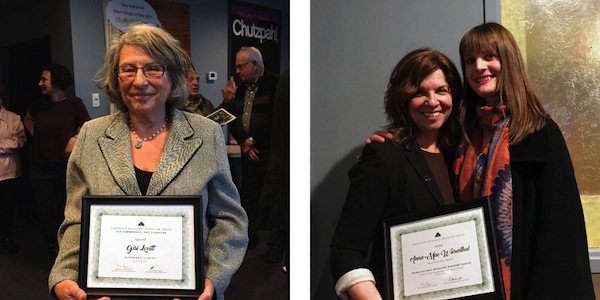
At the annual general meeting of the Vancouver Holocaust Centre Society for Education and Remembrance on June 14, Gisi Levitt received a Life Fellow Award for her 12 years of service as VHEC’s director of survivor services.

The Meyer and Gita Kron and Ruth Kron Sigal Award for Excellence in Holocaust Education was awarded to Anna-Mae Wiesenthal, who teaches Jewish history and English at King David High School. She recently worked together with VHEC on the Student Docent Training Initiative, a successful pilot project in which volunteer students from KDHS were trained to become docents. Two of the student docents, Milena Markovich and Jacqueline Belzberg, did an outstanding job of sharing with the audience their experiences of guiding their fellow students through the VHEC exhibition In Defiance: Jewish Resistance During the Holocaust.

photos - Gisi Levitt, and Anna-Mae Wiesenthal, left, and VHEC education director Ilona Shulman Spaar
Gisi Levitt, and Anna-Mae Wiesenthal, left, and VHEC education director Ilona Shulman Spaar. (photos from VHEC)

* * *

On June 20, Women in Film & Television Vancouver celebrated leaders for their outstanding work and contribution to advancing opportunities for women with their annual Spotlight Awards. This year’s recipients included Mark Leiren-Young, who received the Iris Award.

The Iris Award is given to a person who has demonstrated a commitment to the promotion of female creators and their screen-based works, either through curating or programming or through print and online media sources. Named after the Greek mythological figure Iris, associated with communication, messages and new endeavours.

Leiren-Young was also one of the finalists for the 2017 BC Book Prizes’ Hubert Evans Non-Fiction Prize for The Killer Whale Who Changed the World (Greystone Books).

Killer whales had always been seen as bloodthirsty sea monsters. That all changed when a young killer whale was captured off the west coast of North America and displayed to the public in 1964. Moby Doll – as the whale became known – was an instant celebrity, drawing 20,000 visitors on the one and only day he was exhibited. He died within a few months, but his famous gentleness sparked a worldwide crusade that transformed how people understood and appreciated orcas. Because of Moby Doll, we stopped fearing “killers” and grew to love and respect “orcas.”

Leiren-Young is a journalist, filmmaker and author. His Walrus article about Moby Doll was a finalist for the National Magazine Award and he won the Jack Webster Award for his CBC Ideas radio documentary Moby Doll: The Whale that Changed the World.

* * *

It was a banner year for the Leo Awards, which received a record 1,295 entries, from 301 unique programs in 14 different categories. Among the finalists was David Kaye – for best lead performance by a male in a motion picture for his work in Cadence and as part of the cast of Grocery Store Action Movie, which was nominated in the category of best music, comedy or variety program or series.

Format ImagePosted on June 30, 2017June 29, 2017Author Community members/organizationsCategories LocalTags Anna-Mae Wiesenthal, David Kaye, Gisi Levitt, gymnastics, Holocaust Centre, Jewish Seniors Alliance, KDHS, Leo Awards, Mark Leiren-Young, Rachel Rubin-Sarganis, Sylvia Hill, VHEC, women
Students pen survivors’ memoirs

Students pen survivors’ memoirs

Dr. Peter Suedfeld, professor emeritus of psychology at the University of British Columbia, spoke on behalf of the survivors who participated. (photo by Jennifer Oehler)

Emotions were high at a graduation event where survivors of the Holocaust and Langara College students who wrote their memoirs shared their reflections on the experience.

Writing Lives was a two-semester course and a partnership between Langara College, the Vancouver Holocaust Education Centre (VHEC) and the Azrieli Foundation. In the first semester, students learned about the history of European Jewish culture and the Holocaust. In the second term, groups of three students were teamed with a Holocaust survivor. Students interviewed the survivor, transcribed their recollections and wrote their memoirs, which were presented at the closing event April 20.

“These memoirs will be given to the survivors as gifts for themselves and their families, but they will also be archived and they may possibly be published, and they will also serve as legacies for the survivors, their families and perhaps the research community in general,” said Dr. Rachel Mines, an English instructor at Langara and coordinator of the Writing Lives project. “I’m also the daughter of survivors, so I know how important it is that the stories get told and kept as a legacy for the families and the children and the grandchildren and great-grandchildren and also for the community at large, which I think is something that this particular program has succeeded in very well.”

Dr. Peter Suedfeld, professor emeritus of psychology at the University of British Columbia, spoke on behalf of the survivors who participated.

“I have been interviewed a number of times by different people, of different levels of experience. So, when I was asked if I was willing to be interviewed by some students from Langara, I thought, ‘Oh well,’” Suedfeld said to laughter. “It’s not going to be very interesting. They are probably amateurs who don’t really know what they’re doing.”

He was pleasantly surprised, he said.

“My expectations were not fulfilled at all,” he said. “They had fresh points of view, they had interesting ideas about the Holocaust, they had interesting questions – not the kind of routine things that I’ve gone through before with more professional interviewers who tend to ask the same questions the same ways. Some of the questions made me think about my own experiences in ways that I never had before…. The interviews were always interesting and lively, occasionally funny, sometimes a bit frustrating and rarely, but once in awhile, irritating. But, all in all, a very positive experience and I expect that most of my cohort probably had similar experiences, and I certainly hope that the students did as well.”

Frieda Krickan, speaking on behalf of the students in the program, saw Writing Lives as an opportunity to honour the survivors, deepen her knowledge of Holocaust history and serve her Jewish community.

“This class has been so much more than that in so many ways,” she said. “It’s been a life-changing experience and I feel incredibly lucky to be a part of it. This class has taught me the importance of personal perspectives and historical documentation. Memoirs put a more human face on history and they memorialize what our survivors have been through and create empathy that historical facts and figures just cannot…. These survivors represent living history. These memoirs are a way of honouring survivors and making sure that history will never forget them…. You cannot get that sort of visceral emotion and intense human connection from a book or documentary. This is a living, breathing human being in front of you opening up about their most intimate and painful memories. It is an experience I will never forget.”

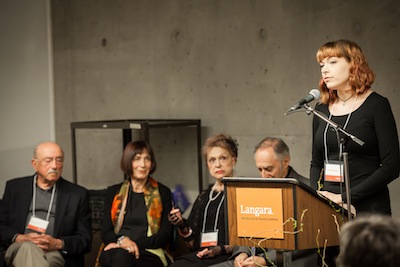
photo - Frieda Krickan, speaking on behalf of the students in the program, saw Writing Lives as an opportunity to honour the survivors, deepen her knowledge of Holocaust history and serve her Jewish community
Frieda Krickan, speaking on behalf of the students in the program, saw Writing Lives as an opportunity to honour the survivors, deepen her knowledge of Holocaust history and serve her Jewish community. (photo by Jennifer Oehler)

She added: “I came out of this class with something I did not expect: hope. Amidst all their personal accounts of suffering and loss, our survivors still managed to impart upon us the importance of hope. I don’t know if I’ve ever had such a life-affirming experience as talking to these survivors.”

Gene Homel, an instructor in liberal studies at the B.C. Institute of Technology who taught part of the Writing Lives course, said evidence-based and factual history are important at a time when the veracity of events past and present are being called into question.

The collection and preservation of eyewitness accounts is what makes the Writing Lives project so valuable, said Ilona Shulman Spaar, education director at the VHEC.

“Some students told me that they would never forget the personal encounters that they had with their interviewees and that they will always carry them close to their hearts. Some even mentioned that this program was life-changing for them,” she said. “Some of the survivors shared with me that they greatly appreciated being part of this program. For them, too, it was a unique experience, as most of them never gave interviews to this extent or in such depth.”

Robbie Waisman, one of the survivor participants, said the greatest fear that Holocaust survivors have is what’s going to happen after they are gone.

“What you are doing gives us hope that it’s going to be remembered, to make this a better world,” he said. “So thank you.”

Serge Vanry, another survivor participant, said it was an experience that he hadn’t expected.

“I started out wanting to do this, but feeling uneasy about somehow getting involved in the past, a past that has been put away quite a bit,” he told the audience. “I was talking about events that I had forgotten, things that were difficult, things that were hard to live with and things that can haunt you. As I was looking back at the past, I started to discover a lot of things that I had forgotten – events, situations that really had disappeared for me.”

Turning to the students, he said: “You did extremely well and I am really thankful and I’ve really appreciated what you’ve done for me, for the things that I don’t want to forget, the things that need to be told again for me and for my family.”

Other survivors who participated in Writing Lives were Alex Buckman, Amalia Boe-Fishman, Jannushka Jakobouvitch and Mark Elster. Excerpts from student-participants’ journals have run in previous issues of the Independent (search “Writing Lives” at jewishindependent.ca).

Mines thanked the Azrieli Foundation, for expertise and materials that made Writing Lives possible, and the VHEC, “which has been crucial, essential, absolutely indispensable in supporting Writing Lives … through liaising with survivors, making their library available for research and as an interview room and, generally, just being generous in terms of their time, their advice, expertise and not to mention moral support.”

Mines added that she hoped this pilot project of Writing Lives would become an ongoing program and, in the days following the closing ceremony, she received the news that Writing Lives will indeed run again, starting in the fall semester.

Pat Johnson is a communications and development consultant to the Vancouver Holocaust Education Centre.

Format ImagePosted on May 5, 2017May 3, 2017Author Pat JohnsonCategories LocalTags Azrieli Foundation, Holocaust, Langara College, memoir, survivors, VHEC
Marking Yom Hashoah

Marking Yom Hashoah

Claude Romney will give the keynote address on April 23. (photo from Vancouver Holocaust Education Centre)

Jacques Lewin, a Jewish physician in Paris, was arrested at the end of 1941 and was sent to Auschwitz on the very first convoy from Western Europe to that notorious death camp. His profession almost certainly saved his life, as he performed a role that the Nazis deemed useful: that of a prisoner-doctor.

Lewin’s daughter, Claude Romney, has studied the Holocaust experiences of prisoner-doctors like her father and has a forthcoming book on the subject. She will share her family’s story, and illustrate aspects of the experience of prisoner-doctors, as the keynote speaker at this year’s Yom Hashoah Holocaust Commemorative Evening, which takes place April 23, 7 p.m., at the Jewish Community Centre of Greater Vancouver.

Lewin’s arrest took place two weeks after Romney’s third birthday. She and her mother, Saya, survived the war in Bagnères-de-Bigorre, a small town near the Spanish border that was occupied by the Germans less than three months after they arrived.

Romney’s presentation will begin with some context about the state of French Jewry in the early part of the war, something she said is not as well known as it could be. She will share a bit about her and her mother’s experiences during the war, then turn attention to her father’s story.

That story is something that Romney has pieced together mostly after her father’s death in 1968. “I remember when he died, thinking that so much had remained untold,” Romney said. “He never talked about it.”

Years after her father passed away, Romney’s mother gave her a file containing documents from her father’s past, including a few articles he had written immediately after he returned to France after the war. These had been published in a newsletter distributed by the French resistance and never reached a wide audience.

Romney has obtained the transcript of the testimony her father gave at the 1947 trial of the Auschwitz commandant Rudolf Höss, but it is not comprehensive.

“The transcript of his testimony looks as though he was so frustrated that he wasn’t given more time to talk about it,” said Romney. “I don’t know if it was 10 minutes or what, but it looks as if he was really frustrated because at one point he enumerates a number of atrocities that he saw and he said, ‘it could take me days and days to tell you about them.’ I think that’s why he never wrote any more. I don’t know whether he was approached to testify anywhere else, but he never did.”

However, other prisoner-doctors did write and testify. Romney’s forthcoming book, Saving Lives in Auschwitz: The Written Testimonies of Prisoner-Doctors, is based on the experiences of 60 individuals who survived and told what they witnessed.

When Lewin first arrived at Auschwitz, he and the others in his transport were put to work constructing a new section of the camp – to be known as Birkenau.

Lewin was one of only a few from this group that survived the war, Romney said, because he was a medical doctor. The Nazis decided around the end of 1942 that they could use prisoner-doctors to treat ill and wounded inmates who were doing forced labour. Prisoner-doctors tried their best to help other inmates, but routinely confronted horrific ethical dilemmas. They were faced, Romney said, with what the Holocaust scholar Lawrence Langer called “choiceless choices.”

“If they had refused to obey orders outright, they would have sent them to the gas chambers too,” she said.

After the war, Romney studied at the Sorbonne and became a professor of French linguistics and literature, first in Toronto, then Sudbury and finally Calgary, before retiring to Vancouver. She and her husband, also an academic, thought Canada seemed an ideal place since he was English and she was French.

The annual Yom Hashoah evening is presented by the Vancouver Holocaust Education Centre (VHEC). It is supported by the Gail Feldman Heller Endowment and the Sarah Rozenberg-Warm Memorial Endowment Funds of the VHEC, and funded through the Jewish Federation of Greater Vancouver annual campaign.

In addition to Romney’s keynote address, the evening will feature cellist Eric Wilson, Yiddish singer Myrna Rabinowitz, Cantor Yaacov Orzech and the Kol Simcha Singers. Artistic producers are Wendy Bross Stuart and Ron Stuart of WRS Productions. Holocaust survivors are invited to participate in candlelighting.

Pat Johnson is a communications and development consultant to the Vancouver Holocaust Education Centre.

Format ImagePosted on April 7, 2017April 4, 2017Author Pat JohnsonCategories LocalTags Claude Romney, Holocaust, VHEC, Yom Hashoah

Fielder gives to VHEC

Vancouver-born writer and comedian Nathan Fielder has donated more than $150,000 US to the Vancouver Holocaust Education Centre (VHEC). The funds represent the profits of the Summit Ice outdoor apparel line, founded by Fielder to raise awareness of the Holocaust and to support the education and remembrance mandate of the VHEC.

“We are honoured to be the recipient agency for Nathan Fielder’s Summit Ice initiative,” said Nina Krieger, executive director of the VHEC. “It is especially meaningful that Nathan appreciates the work our centre does to advance anti-racism education in his hometown.”

This significant contribution will help the VHEC deliver more programs to more people at a time when the centre’s work is as relevant as ever. This gift will strengthen the VHEC’s outreach programs, educational resources and exhibitions that engage students, teachers and the general public in British Columbia and beyond.

“We receive countless letters from students affirming that participating in a VHEC program, particularly when this features a Holocaust survivor speaker, is among the most meaningful and memorable experience of their school years,” said Phil Levinson, president of the VHEC board. “Nathan Fielder’s generosity will help advance the Vancouver Holocaust Education Centre’s vision of a world free of antisemitism, discrimination and genocide, with social justice and human rights for all.”

The VHEC relies on the support of members of the community to fund education and remembrance programs.

Posted on April 7, 2017April 4, 2017Author Vancouver Holocaust Education CentreCategories LocalTags Holocaust, Nathan Fielder, Summit Ice, tzedakah, VHEC

The importance of memoirs

This is the third of a three-part series on Writing Lives, a two-semester project at Langara College, coordinated by instructor Dr. Rachel Mines, in which second-year students are teamed up with local Holocaust survivors to interview them and write memoirs of their experiences before, during and after the Holocaust. The course is a partnership between Langara, the Vancouver Holocaust Education Centre and the Azrieli Foundation. As part of their course work, students are keeping journals of their personal reflections on their experiences as Writing Lives participants. This week’s journal is entitled “The Importance of Memoir.” Here are some excerpts.

Our survivor has repeatedly stated that he and his peers greatly fear that, once they are gone, no one will remember what they went through. Survivors worry that, once they are no longer here as living testaments, their suffering and the people they lost will be forgotten. Our class, and other projects like it, is working to ensure that does not happen.

We must preserve the experiences of Holocaust survivors in written form so that, once they are no longer physically here, their story will be. We are not only archiving personal anecdotes, we are putting a human face on history. Facts are important for historical validity, but personal perspectives are essential in creating empathy. This program is chronicling history in such a way as to touch people and make them care about what happened to the Jewish people (and others) during the Holocaust. Empathy is one of the greatest tools in breaking down intolerance. Once we see the humanity in others, it becomes harder to hold onto prejudice and hatred.

Now, more than ever, it is vital to create this historic empathy. Prejudice and persecution are becoming ever more prevalent in our society, and it is up to us as a nation to halt such hatred. It is essential to remind the world what can happen when hatred is met with social apathy. These memoirs are a documentation of the horrors that unchecked hatred can lead to. I believe in the power of memoirs, the power of living history. I am honoured to be a part of such an important project at such a crucial time.

– Frieda Krickan

***

The first time I interviewed a Holocaust survivor, I was nervous, and rightfully so. My interview partner and I had been preparing for months before our first meeting but, nonetheless, when our interviewee arrived, I was so star-struck that I briefly lost my aptitude with the English language altogether. All I could manage to say was multiple renditions of the same sentence, thanking him again and again for his time and for agreeing to meet us.

Our interviewee, R., was gracious and didn’t miss a beat. He chimed in every time by thanking us in return just for listening and told us on multiple occasions, “I am so grateful for what you are doing. This is very important to make sure that the Holocaust never happens again.” His response surprised me but, the more I listened, the more I realized that this project meant more to him than just sharing his story; it was his personal call to tikkun olam, to repair the world the best that he can.

I learned that every Holocaust survivor’s greatest fear is not what you would expect. It is not death camps or gas chambers – instead, R. told us that their greatest fear is that no one will remember their stories when they are no longer alive to tell them. They are afraid that, with today’s ugly resurgence of antisemitism, everything they endured will be meaningless in the face of a society that cannot wait to forget. In a world that wants us to keep silent, it is every survivor’s hope that we raise our voices – that we proclaim the truth until our breath runs out. Our sacred duty is to empower the ones who can no longer empower themselves, and the key to making sure history never repeats itself is to tell their stories.

– Zoe Mandell

***

During this course, my group members and I spent a concentrated amount of time with a child survivor of the Holocaust. Time and time again, he narrowly escaped falling into the hands of the Nazi regime…. His story is inspiring, heroic, terrifying at times, and very emotional. He tells his story with such grace, in such detail, that we could clearly visualize in our minds what he had experienced.

I have heard many stories of those who survived, and the stories they tell of those they lost. I have learned what it was like for a child survivor from Paris, a teenage survivor from Amsterdam and an adult survivor from Warsaw. I have heard the stories of their mothers, fathers, brothers and sisters: how they watched their father get shot, or saw their mother walk toward her certain death, or said goodbye to a brother they knew they’d never see again. Telling their stories, writing their stories, is not only a therapeutic technique, but a preventative one. It is important for those who survived to tell as many stories as they can, not to let the memory of their loved ones perish like they did during that awful time in history. It is important to tell the story of their loved ones to keep their memory alive in as many beating hearts as possible. And it is important to tell the stories of the Holocaust, for both survivors and those who perished, to stand up and say, “We survived. We won’t forget. Never forget. And never let it happen again.”

– Marni Weinstein

***

During and after each interview my group conducted with R., he thanked us multiple times. He thanked us for taking the time to listen to his story, for writing his memoir, and even for sharing parts of our lives with him. Every time he thanked us I was taken aback: why was he thanking us for listening to him, when we were the lucky ones? We were being given the opportunity not only to listen to a Holocaust survivor speak but to write a memoir that would continue his legacy throughout time. At first, I struggled with his gratitude; I was almost uncomfortable with how genuinely thankful he was that we were spending time with him and listening to his story. Yet no matter what I said, he was grateful.

It took me quite awhile to grasp exactly why R. felt the need to continually express his gratitude. In fact, R. did not grow up in a world that accepted the events of the Holocaust as facts and wanted to learn more about it. He grew up in a world where no one wished to speak about the Holocaust and its events were contested. He did not conceal his experiences only because they were too painful to revisit, but also because no one wanted to listen.

Not only did those affected by the Holocaust lose their families, their homes, their childhoods and years of their lives, but in many cases they lost their voices. For years, the world refused to listen and, because of that, we lost many valuable stories. Memoirs are important not only because they give survivors the opportunity to share their stories, but because, on a very small level, they begin to give a voice back to the voiceless. Although we can’t bring those survivors back and prove to them there are people who care and will listen, we can make sure the survivors who are still alive do not go unheard.

– Lucy Bogle

Posted on April 7, 2017April 4, 2017Author Frieda Krickan & Zoe Mandell & Marni Weinstein & Lucy BogleCategories LocalTags Azrieli Foundation, Holocaust, Langara College, memoir, VHEC

Writing Lives journals


Writing Lives is a two-semester project at Langara College, coordinated by instructor Dr. Rachel Mines, in which second-year students are connected with local Holocaust survivors to interview them and write memoirs of their lives before, during and after the Holocaust. The project is a partnership between Langara, the Vancouver Holocaust Education Centre and the Azrieli Foundation. In the first semester, students learned about the Holocaust through reading literary and historical texts, and wrote a research paper on prewar European Jewish communities using the resources of the VHEC and Waldman libraries. This semester, students studied practical strategies for interviewing survivors and have conducted and transcribed their interviews. They are now in the process of writing the memoirs, which, when complete, will be presented to interviewees at a closing ceremony to be held at Langara later this spring. As part of their course work, students are keeping journals of their personal reflections on their experiences as Writing Lives participants. A recent journal entry was on the theme of multicultural relationships, and here are excerpts from three student journals.

One of my older relatives knew how to count in Japanese. She was not Japanese. My family is predominantly of Filipino descent. She only learned how to count in Japanese because she was forced to learn as a child, during the Japanese occupation of the Philippines. I learned this pretty late in her life.

I wanted to ask my relative questions, and I assumed I would get the chance at some point, but I was never sure if it was appropriate to bring it up. Two or three years after I learned that she could count in Japanese, she passed away. I never got to ask my questions.

When I decided to take part in the Writing Lives project, I was thinking of my relative. I have learned that having unanswered questions about someone you care for can lead to painful regret. Because of my own family’s unknown history during the Second World War, I wanted to help another family learn theirs.

– Jonathan Pineda

“Some”

Some feel sad when they see pain,
Some feel fascinated when they see pain.
Some feel broken
Once they see a broken heart.
Some feel fire
And mock that broken heart.

Some reach out a hand
Only to say “got you man.”
Some reach out a hand
Only to say “let me help you man.”
Some are inwards
Some are outwards.

Some love to inflict pain.
Some love to inflict love.
Some grab a gun.
Some grab a seed.
Some ignite a fire.
Some extinguish the fire.
There are always two sides to a story,
Whether good or bad it has a history.

Where do these people come from?
I used to ask.
They come from us,
They used to answer back.
Now I stand with a shattered heart.
Now I stand with a broken back.

Seeing is something.
Hearing is intriguing,
Both are fascinating,
The hearts are something.

– Mojtaba Arvin

I have listened to survivors tell their stories a few times before. Two survivors visited my school when I was in high school, and we had a couple of survivors come to our Writing Lives class last semester. Those were really the only encounters I had with the stories of Holocaust survivors. My family is not Jewish, and were not persecuted during the Holocaust.

My paternal grandfather and his father emigrated from southern Russia in 1925 to

escape the persecution and violence they were facing because they were Mennonites, but we have no personal family experience of the Holocaust or anything that the Jewish people endured. Because I could not bring my own perspective to this course, I am lucky that I had an amazing partner who was able to bring insight into many things because of her Jewish background. Overall, this project has been really incredible. My two partners are so supportive, and I have had the most amazing experience interviewing alongside them and writing the draft memoir with them. This is a project that I will remember my entire life.

– Caylie Warkentin

Posted on March 24, 2017March 23, 2017Author Jonathan Pineda & Mojtaba Arvin & Caylie WarkentinCategories LocalTags Azrieli Foundation, Holocaust, Langara, survivors, VHEC, Writing Lives
Return of looted art

Return of looted art

“Young Man as Bacchus” by Jan Franse Verzijl was among about 400 works owned by Max Stern that were forcibly sold by the Nazis in the 1930s. (photo from Max and Iris Stern Foundation)

When the painting “Young Man as Bacchus” by Dutch master Jan Franse Verzijl (1599-1647) went on display in New York City two years ago, the FBI moved in and seized the work. In the possession of an art gallery in Turin, Italy, the painting was among about 400 works owned by Max Stern that were forcibly sold by the Nazis in the 1930s.

In 1935, Stern was a successful gallery owner in Düsseldorf, Germany, but because he was Jewish, his collections were confiscated and sold by the Nazis. Stern would later move to Montreal, where he became a leading figure in the Canadian art world. After Stern died, in 1987, the beneficiaries of his estate learned of Stern’s Düsseldorf gallery and an extraordinary project began to seek restitution for the confiscated artworks.

Dr. Clarence Epstein, director of the Max Stern Art Restitution Project and senior director of urban and cultural affairs for Concordia University, will speak in Vancouver March 23 about the successes and challenges of the project.

The beneficiaries of Stern’s will are Concordia University, McGill University and the Hebrew University of Jerusalem. As a result, the art restitution project may be the only program of its type with three academic institutions working collegially to a common goal, said Epstein. His visit here is presented by the Canadian Friends of the Hebrew University, the Vancouver Holocaust Education Centre and Congregation Schara Tzedeck and is sponsored by Heffel Gallery and the estate of Frank and Rosie Nelson.

The Dominion Gallery, Stern’s Montreal business, remained in operation for more than a decade after his death. During this time, the beneficiary universities became aware of Stern’s prewar history.

“There was an entirely additional gallery business in Düsseldorf that his family had run before the war but had been closed by force as a result of Nazi persecution,” Epstein told the Independent in a telephone interview. “It wasn’t public knowledge. I think some people were aware of Dr. Stern’s past, but it coincided with the time when the issue of restitution was just starting to gain a little bit of traction in the art world and so it merited questioning. We just didn’t know how far to take it.”

The Max Stern Art Restitution Project has become a significant entity, with staff in Montreal, Ottawa, Washington and New York, as well as researchers in Europe. In addition to the obligation Epstein has to maximize the financial outcome for the beneficiaries of Stern’s will, there are other factors driving the project.

“There were fiduciary obligations, which is part of estate management,” he said. “There were moral implications, because this was something that was right for the universities to do on behalf of their great benefactor Max Stern. And then there were educational opportunities that this could open up in the fields of art history, of social justice, of art and law, the mechanics of the art market – and this enticed all kinds of academics to get involved in the project.”

The return of “Young Man as Bacchus” is among 16 successes the project has seen so far. While the restitution of that piece involved law enforcement, it also exemplified the good faith response of the gallery into whose possession the painting had fallen.

Every country has different rules and statutes of limitations around the return of art that has been stolen or forcibly sold, and the Stern project navigates the law as well as less litigious means of restitution. Through the recommendation of the German Friends of Hebrew University, the German government recently announced tax receipts for the owners of returned artworks. In the cases of galleries or museums, the reputation of the institution could suffer if they are known to be in possession of a work of dubious provenance, so this encourages cooperation. Individual collectors may not have the same impetus for preserving a reputation, but once a piece of art is identified as coming from Stern’s Düsseldorf collection, it bears a figurative black mark that makes it valueless on the open art market. Even so, Epstein said, the project does not seek to punish anyone for unwittingly possessing such a work.

“We don’t intend to be the bearers of bad news about the state of the work that is in their possession,” he said, “so if there’s any way that we could alleviate that kind of misfortune with some kind of tax relief, we would do so. But it hasn’t been tested yet.”

One example of an innovative solution found is the case of a work that was discovered in a Düsseldorf gallery. While the ownership was transferred to the Max and Iris Stern Trust, the universities agreed to lend it back to the gallery for long-term display.

“In their case, everybody kind of got their cake and ate it, too,” said Epstein. “It is owned by the Stern Foundation but it is lent to the Düsseldorf Museum.”

While Canada does not have the sort of art sector that New York or the capitals of Europe have, Epstein credited the federal government, specifically Minister of Canadian Heritage Mélanie Joly, for expressing the Canadian government’s commitment to restitution.

What happens to the artworks when they are returned varies. In the Düsseldorf case, the gallery in possession maintained custody. In some instances, the pieces have been sold to fund additional work of the project. (Once returned, the black mark is eliminated and the piece can be exchanged in the legitimate art market.) Others are loaned to museums and public institutions.

Next year, an exhibition of works from Stern’s collections will open in Düsseldorf, later traveling to Haifa, Israel, then Montreal.

Popular culture has taken on the topic of art restitution, Epstein said, and this is a good thing. For example, Monuments Men is about Allied soldiers charged with rescuing cultural artifacts before the Nazis destroyed or hid them, and Woman in Gold focuses on an American woman’s legal fight with the government of Austria to return a painting by Gustav Klimt that was stolen from her family by the Nazis. There have also been documentaries on different aspects of pillaging during the war. Epstein credited Helen Mirren, the star of Woman in Gold, for personally taking up the cause of restitution and making it more public.

“Any way we can make more public the challenges of the recovery of these kinds of objects, and the more we keep it in the spotlight, the more I think we’re going to be able to generate sympathy and attention from the groups that are in possession of those works,” he said.

While the Stern project has seen the return of 16 works and has located several more that are the subject of negotiation, it is impossible to know precisely how many cultural artifacts were stolen and remain unidentified.

“There is a number circulating on the internet in the hundreds of thousands in terms of objects that remain unrecovered,” said Epstein. “I don’t think it’s ever going to be possible to nail down that number … because we are talking about an historic loss that is multiplied over millions of people’s losses, that is also somewhat effaced as a result of time and lack of memory and archives. But that’s really the tip of the iceberg in terms of losses because in terms of material losses, everything that was in the possession of a Jewish family that was oppressed could still be in circulation now – musical instruments, jewelry, the list goes on. But those items were a lot harder to trace in terms of ownership and attribution than a painting has been. Works of art that are under a certain value and have not been researched historically are probably still circulating in the tens of thousands.”

Epstein added that Stern also had significant B.C. connections. His gallery represented E.J. Hughes and Emily Carr, two of this province’s most noted artists.

Admission to the March 23, 7:30 p.m., talk at Schara Tzedeck is free but an RSVP is requested to [email protected].

Pat Johnson is a communications and development consultant to the Vancouver Holocaust Education Centre.

Format ImagePosted on March 10, 2017March 8, 2017Author Pat JohnsonCategories LocalTags art, CFHU, Heffel Gallery, Holocaust, Nazis, restitution, Schara Tzedeck, VHEC
Treating intergenerational trauma

Treating intergenerational trauma

Left to right: Nina Krieger (Vancouver Holocaust Education Centre), speaker Mark Wolynn, Richard Fruchter (Jewish Family Service Agency), Nicky Fried (Congregation Beth Israel) and Shanie Levin (Jewish Seniors Alliance of Greater Vancouver). (photo by Rhonda Dent Photography)

On Feb. 15, Mark Wolynn, director of the Family Constellation Institute, spoke to an audience of almost 1,000 people at Congregation Beth Israel on the topic Understanding Intergenerational Trauma: How Inherited Family Trauma Shapes Who We Are and How to End the Cycle. The crowd sat in rapt silence as he unfolded his own story and the stories of some of the people his therapeutic approach has helped.

Introduced by Rabbi Adam Stein, assistant rabbi at Beth Israel, and Richard Fruchter, chief executive officer of the Jewish Family Service Agency, Wolynn quipped upon taking the stage, “The last time I stood at a synagogue pulpit was at my bar mitzvah.”

Wolynn said his work on intergenerational trauma has particular relevance for those who have survived genocide and war, such as First Nations people, refugees and Jews. His efforts to understand the effects of trauma began when, as a young man, he found himself going blind. He had “the bad kind of central serous retinopathy,” he said, “the five percent kind where it can lead to becoming legally blind.”

Plagued by grey blotches and blurs distorting his vision, Wolynn said he was terrified. He tried a litany of alternative medical cures, which didn’t help, and headed off on a quest for enlightenment.

After marathon meditation sessions and audiences with several gurus, Wolynn said he waited for hours for a satsang (sacred meeting) with a swami in Indonesia. When he finally made it to the front of the line, the guru looked at him for a moment and said, “Go home and make peace with your parents.” It wasn’t until he heard the same message from the next guru he visited that Wolynn returned home to begin his journey into healing his relationships with his family.

Years later, after making both personal and scientific study of the impact of family dynamics and inherited trauma (and healing his blindness), Wolynn has emerged with a persuasive vision of the role that unaddressed trauma can have in our lives – even if the trauma happened in previous generations, and even if you didn’t know about it. “Many of us spend our whole lives believing we are the source of our own suffering when we are not,” he said.

Wolynn presents his findings in terms of epigenetics, the study of how life experience can turn on or off certain genes. He points to findings in both humans and animals showing that the children of traumatized parents react with stress, fear or aversion to stimulus that traumatized their parents, even if the children themselves have no previous negative exposure to the trigger. “We think the effects – the alteration in the genes – may last for three generations,” he said.

Wolynn described several case studies in which patients had symptoms that could be addressed only after patients understood their source in something that had been done to (or by) a mother or grandfather. Wolynn challenged the audience to ask themselves what their greatest fear was and to put it into words, explaining that this was a clue to their “trauma language,” which could, in turn, be used “like breadcrumbs” to lead them back to the unrecognized traumas in their past.

Wolynn laid out a series of steps for uncovering intergenerational traumas and healing the brain. He also shared stories of his use of visualization, ritual and family communication to free both adults and children from chains they didn’t fasten themselves.

Alan Stamp, clinical director of counseling at JFSA, a co-sponsoring agency of Wolynn’s talk, told the Independent, “What Mark is doing is putting a new spin on how to get to the heart of it and resolve the difficulty. The past is alive in the present.”

Stamp said he knows of two people who attended a follow-up training session offered by Wolynn in Vancouver after the public lecture, and who have had success applying Wolynn’s method clinically; one of them being a counselor at JFSA. “It works,” said Stamp.

JFSA offers counseling for a wide variety of issues, and Stamp is hoping that attendees at Wolynn’s talk will be inspired to pursue healing, through JFSA or elsewhere.

JFSA, the Jewish Seniors Alliance of Greater Vancouver, Congregation Beth Israel and the Vancouver Holocaust Education Centre partnered to bring Wolynn to Vancouver, and the talk was additionally sponsored by the Lutsky families and Rabbi Rokie Bernstein. Banyen Books hosted Wolynn the day after his talk at the synagogue.

Matthew Gindin is a freelance journalist, writer and lecturer. He writes regularly for the Forward and All That Is Interesting, and has been published in Religion Dispatches, Situate Magazine, Tikkun and elsewhere. He can be found on Medium and Twitter.

Format ImagePosted on March 10, 2017March 8, 2017Author Matthew GindinCategories LocalTags Beth Israel, health, JFSA, JSA, Mark Wolynn, trauma, VHEC

Student’s first meeting with survivor

Writing Lives is an initiative at Langara College, coordinated by instructor Dr. Rachel Mines, in which second-year students are teamed up with local Holocaust survivors to interview them and write memoirs of their lives before, during and after the Holocaust. Langara students earn English or history credits towards a diploma or degree, but, more importantly, they get the opportunity to learn outside of the classroom setting, in the community. The course is a partnership between Langara, the Vancouver Holocaust Education Centre and the Azrieli Foundation.

In the first term, students learned about the Holocaust through examining literary and historical texts. They wrote a research project on prewar Jewish communities, using resources from the VHEC and Waldman libraries, and they had the opportunity to meet with and learn from two of the VHEC’s outreach speakers, Alex Buckman and Lillian Boraks-Nemetz. This term, with guidance from Kit Krieger and other guest speakers, students have learned strategies for planning and conducting interviews with Holocaust survivors and, in mid-January, they began to record survivors’ testimonies. The following is an essay by one of the students.

I found a quiet corner of the library and took a deep breath. This was the moment; it was all happening now. I was about to call my survivor, code name “Chester.” I say “my survivor” as if he were a possession. I don’t “own”’ him … and yet, in a very short period of time, I will have to “own” his story. I will be responsible for taking his experiences and shaping them into a lasting memoir.

This was the moment of truth: the first phone call. It was now or never. I slowly dialed and had a look around – no one within earshot. I put my cellphone up to my ear, my palm sweaty with nervousness. It began to ring. I gulped. It rang again. “Oh no,” I thought. “It would be just my luck that he’s not home and I have to leave an awkward message, and what sort of first impression will that be?…”

“Hello?”

“Hi, uh, hello. Hi. Um, my name is Ashley and I’m calling from Langara College about the Writing Lives project. May I speak to Chester?”

“Oh, sorry dear, Chester’s not here right now. Why don’t you text him?”

“OK, sure,” I said with a smile. I was expecting a hard-of-hearing senior citizen and, in true 2017 style, I was being instructed to text instead. I took down the phone number and finished the call.

Gulp. Another deep breath. Time to text.

I punched in the number and wrote an introductory message to “my survivor.” I said that I’d call in the morning for a formal introduction. I nervously hit send.

I then spent the next 74 minutes checking my phone to see if I’d received a response. Eventually, it did come: “We will talk then.”

Relief. It had begun. This journey, this process.

The next morning, Chester and I spoke briefly. I told him a bit about the program and asked if he had any questions. The phone call went well. Chester seemed to have a comfortable style, a compassion and understanding that put me at ease; there were sprinkles of humour amid logistical details. Though the call was short, I immediately felt better about what lay ahead.

The following Saturday was our first meeting in person. My group and I met up early so that we were all on the same page and fully prepared for what was about to transpire. We sat across from each other in a small meeting room on the main floor of the school’s library. We were excited, nervous, tense, curious. We were all in agreement that we didn’t really know what to expect and that we’d do our best to tackle things as they came and we’d support each other as much as possible. I felt lucky to have such encouragement.

The time came; it was 10 minutes to the scheduled interview. I grabbed my phone and headed out of the library and down the hall. Chester and I had decided to meet by the Starbucks, which is close to the library entrance. Even though I was early, I wasn’t surprised when I saw a person with a head of greyish-white hair seated near the coffee shop. “That has to be him,” I thought to myself. As I approached, he turned around and I was greeted by the welcoming face of Chester.

We exchanged pleasantries and made our way to the meeting room in the library. I think we both may have been a little nervous, but there was also a sense of mutual understanding – a consensus that we were about to do something important: something private and meaningful, potentially for both of us, particularly for the survivor.

“First off, do you have any questions?” I began once we were all settled. One of my group members sat to my right, ready to take notes and provide support. Chester sat across from the two of us, but diagonally across the square table, so we were all huddled around its corner, quite close to each other.

“Well …” and we were off! The next hour flew by. The purpose of the first meeting was for introductions and initial questions to be sorted. We also asked for a brief overview of Chester’s story, a sort of condensed version of his life. In learning the scope of his journey, we’d be able to better shape questions and structure further interviews. Chester was incredibly giving and kind. And what a storyteller! Sure, we bounced around a little, as memories and stories came to mind, but the next interviews could be more structured, more chronologically accurate. This was our introduction, our chance to get a sense of “our survivor,” to learn what he’d been through and how his experiences had shaped him.

I must admit, I was particularly moved by stories regarding Chester’s family. The way he spoke of his mother, in particular, and his children: it was just lovely.

There were a few difficult moments, and that is to be expected. In future interviews, when we will go into greater detail regarding Chester’s life and journey, we now know when certain difficult experiences occurred and will be prepared. Well, as prepared we can be, I suppose, for the emotional moments that are to come.

At the end of our meeting, Chester mentioned that we may not have enough material for a memoir. Such a sweet, humble comment. I couldn’t help but smile.

“I don’t think so,” I said. “I believe that we definitely have enough for a book here. You have some wonderful stories.”

And it’s true. The stories of love, survival, adventure, family, travel, loss, connection…. We’ve only begun the interview process, and I’m already moved by the trust that’s been shown. Our survivor is being so generous with his time and his story. I only hope that I can do this project justice.

Posted on February 17, 2017February 15, 2017Author Ashley SeatterCategories LocalTags Azrieli Foundation, Holocaust, Langara College, survivors, VHEC

Posts pagination

Previous page Page 1 … Page 7 Page 8 Page 9 Page 10 Next page
Proudly powered by WordPress