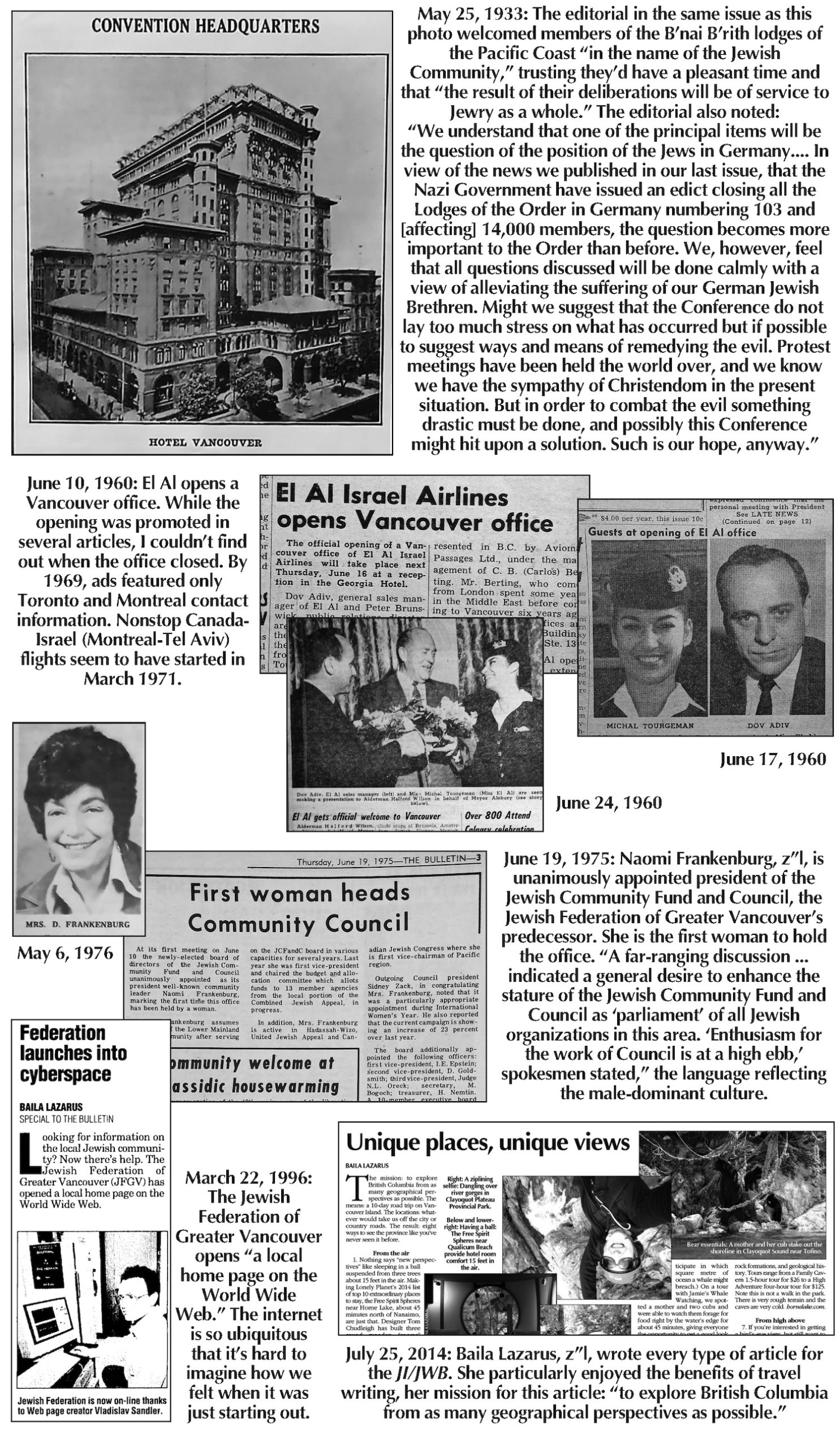
It is sometimes hard to look back over the pages of the Jewish Independent and its predecessor, the Jewish Western Bulletin, knowing what has happened since the articles were published. From the 1933 optimism that there was hope for German Jewry, to the enthusiastic welcome of a seemingly short-lived El Al office in Vancouver, to colleagues who have passed away.
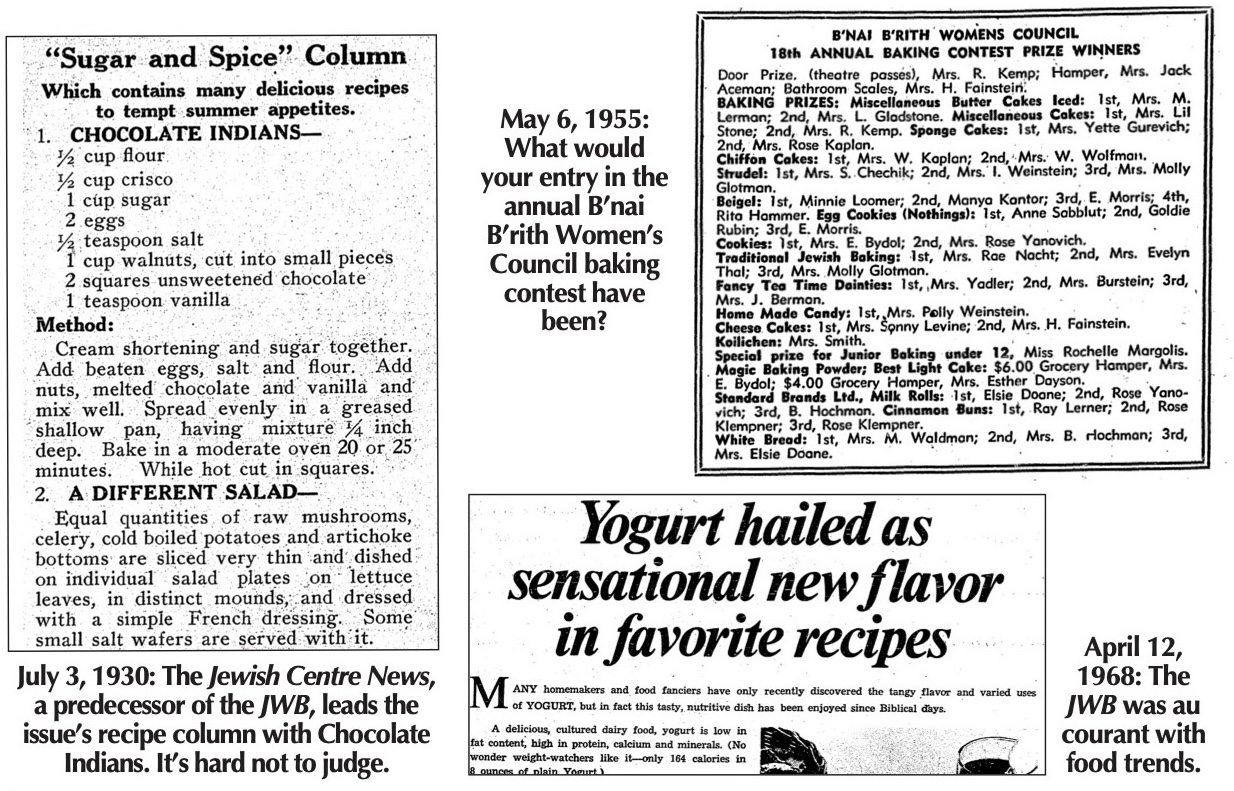
While the odd recipe or food-related article can be found in the Jewish Western Bulletin even before it became the Bulletin, regular food columns or special sections seemed to have become a part of the paper under Sam and Mona Kaplan, who owned the paper from 1960 to 1999. The Independent has carried on the tradition, with its annual Food & Drink issue, which you hold in your hand, and with the inclusion of recipes in our three holiday issues, Rosh Hashanah, Hanukkah and Passover. One thing that becomes apparent in flipping through the archives is that tastes change, and not every recipe, or recipe name, withstands the test of time.
King Charles was in Canada this week, delivering the Speech from the Throne. It was a monumental moment in many ways, not least because it was the first official visit by the monarch since he ascended to the throne. For those of us whose entire lives have been lived under the reign of Queen Elizabeth II, it remains a fascinating and jarring challenge to the tongue to hear the phrase “the King of Canada.”
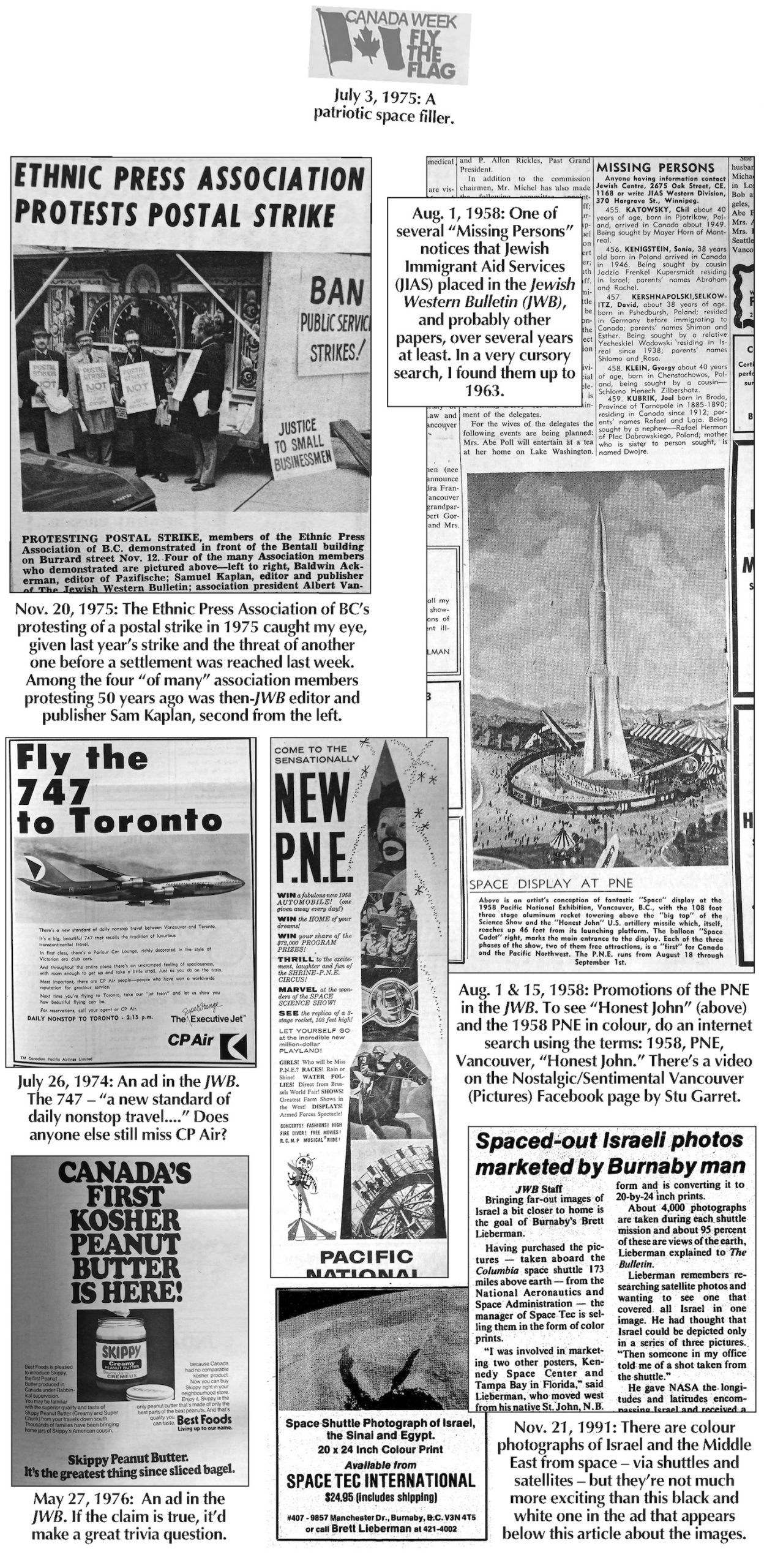
Paging through back issues of the Jewish Western Bulletin, which preceded the Jewish Independent, one of many striking things is the efforts that Jewish individuals, businesses and other advertisers have taken, over the decades, to express loyalty to king (or queen, as the case more commonly has been) and country.
Knowing what we know of antisemitic tropes, we suspect that this had more than a little to do with the stereotype of “dual loyalty.” Throughout history, Jews have been accused of being more loyal to their “tribe” than to their countries of domicile. Since 1948, this antisemitic idea has been applied to Israel, whose interests Jews today are often accused of prioritizing above the interests of their own countries, like Canada.
The sort of hyper-patriotic and monarchist messages we saw in the pages of this paper in decades past have largely disappeared. The trope of dual loyalty is not the most prevalent or dangerous threat to Jewish security in Canada or most other Western countries at the moment. Put succinctly, those who want to take offence with Jewish Canadians are less likely to go the extra step and accuse us of dual loyalty. They just cut to the chase and contend that any support for Israel at all is evidence of ill-will or immorality.
As we have turned the pages of the past in preparing for this special anniversary issue, that is just one small example of social change reflected from issue to issue in 95 years as an institution in this community.
As much as things have changed, so a great deal has remained the same. It is amusing, heartening and sometimes frustrating to see the repetitive nature of (we suppose) humankind in general and Jewishkind in particular across 10 decades. So many of the same discussions and arguments that our people were engaged in locally and globally 60 or 70 years ago remain on our lips today. More encouragingly, the leaders, activists and influencers (we certainly didn’t use that latter word until far more recent issues) of our community have often shared the same surnames, from the 1930s through to today, and so many new surnames – Jews from myriad different backgrounds – have joined the list of community contributors. The continuity combined with the growth in number and diversity is reassuring.
So much has changed in 95 years, such that the originators of the newspaper you hold in your hands (or, by a previously unimaginable magic of futuristic wonder, are reading on some whirring space-age illuminated rectangle) could not have foreseen.
These are not easy days for print media or, really, legacy media of any variety. We believe, and we hope you share our certainty, that the product we put out, as the latest iteration of a 95-year commitment to informing and reflecting our community, has value today, as it has across most of the past century.
As attention spans have shortened and the media landscape has refracted, keeping eyes on these pages is a challenge. At times, we content ourselves with the belief that the stories we write today will only increase in value as, at some unimaginable future time, and perhaps using some heretofore unimagined technological phenomenon, researchers or people with an avocational curiosity about the past, will finger through what we have written to understand better who we were and, therefore, how the Jewish community of the future became what it is, just as a review of our archives helps us understand how we came to be who we are today.
That a small, plucky newspaper operating on a shoestring at the remote edges of the Jewish universe could survive, and occasionally thrive, across 95 years is, even in the context of the much longer, always extraordinary, history of the Jews, something of a miracle.
This is a moment for us to thank everyone who made this possible, many of whose names have appeared in these pages across the years and many who have not. As a reader and supporter of the Jewish Independent, you are now part of that long legacy of people who have made this moment happen. Thank you for making this milestone possible. More importantly, thank you for making possible our present and our future.
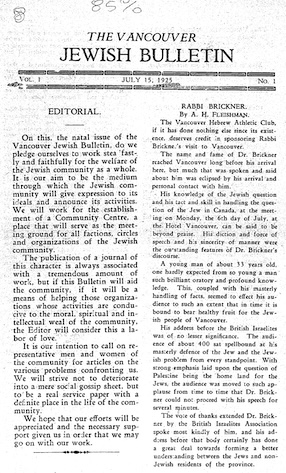
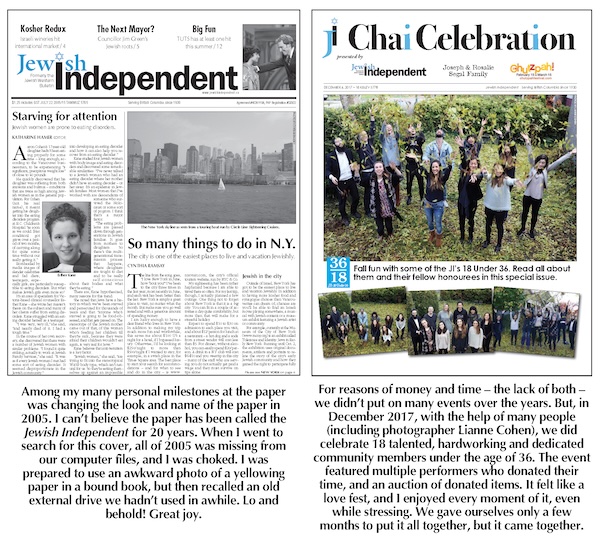
When does something begin? I’ve been thinking about that as I go through 95 years’ worth of Jewish Independents. Well, 20 years of JIs and 75 years of its predecessor, the Jewish Western Bulletin. The JWB also had its predecessors – mimeos and letter-sized versions. The paper’s founders started counting on Oct. 9, 1930, the official first tabloid edition, when they could have started July 15, 1925, “the natal issue of the Vancouver Jewish Bulletin.” Or maybe earlier. Who knows when the idea that brought into existence what would become, through thousands of issues, the paper you today hold in your hands or read on your computer.
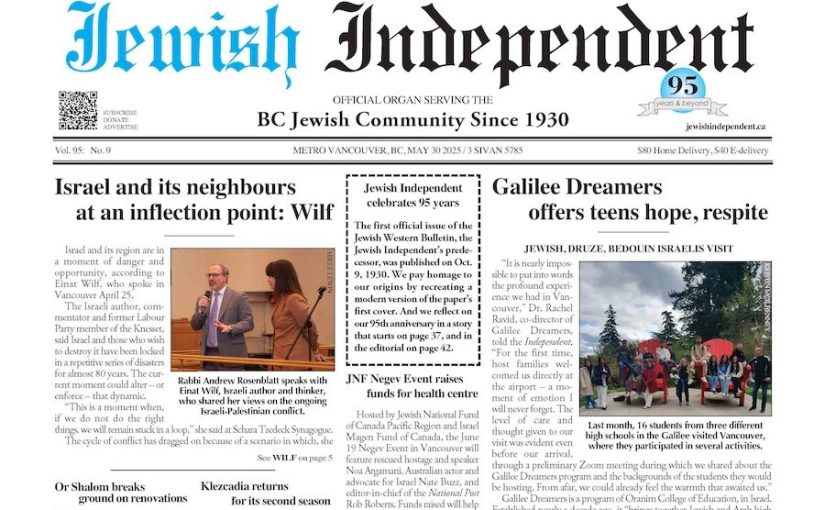
Making the cover of this special issue, where six stories jump to the inside and the rest of the stories are blurbs that direct readers to pages on the inside, was an organizational challenge. There was no way I could replicate the brevity of the 1930s articles, but I could mimic the style.
I know I’ve mentioned this fact in previous anniversary issues, that the JI could be considered five years older than the age we have deemed it to be. In looking through so many beginnings – and endings – throughout the years, it struck me again. So many organizations have multiple possibilities for the equivalent of their first edition. For example, the Louis Brier Home and Hospital was organized in 1945, but the idea for it probably came even earlier and the home didn’t open until 1946.
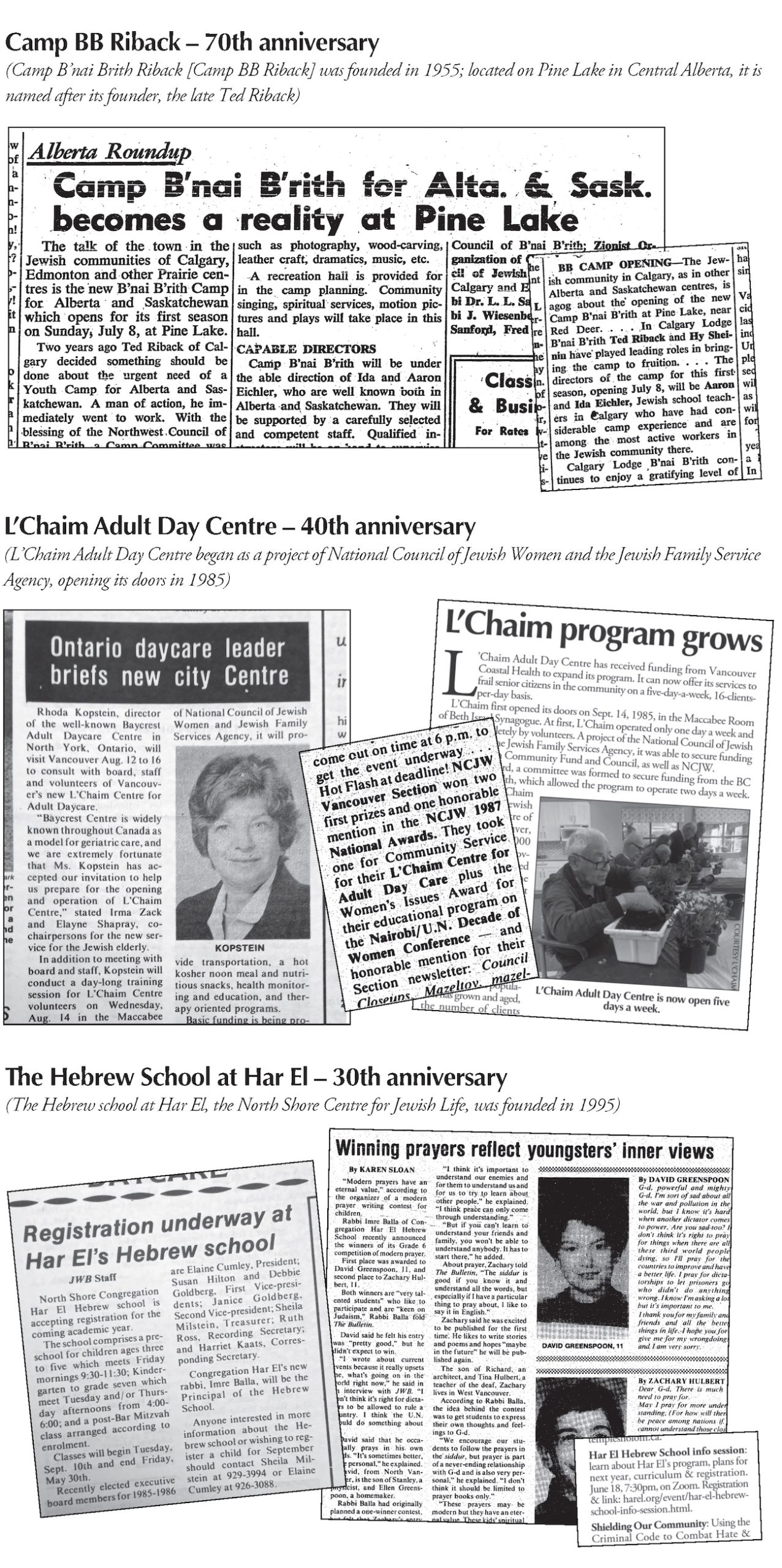
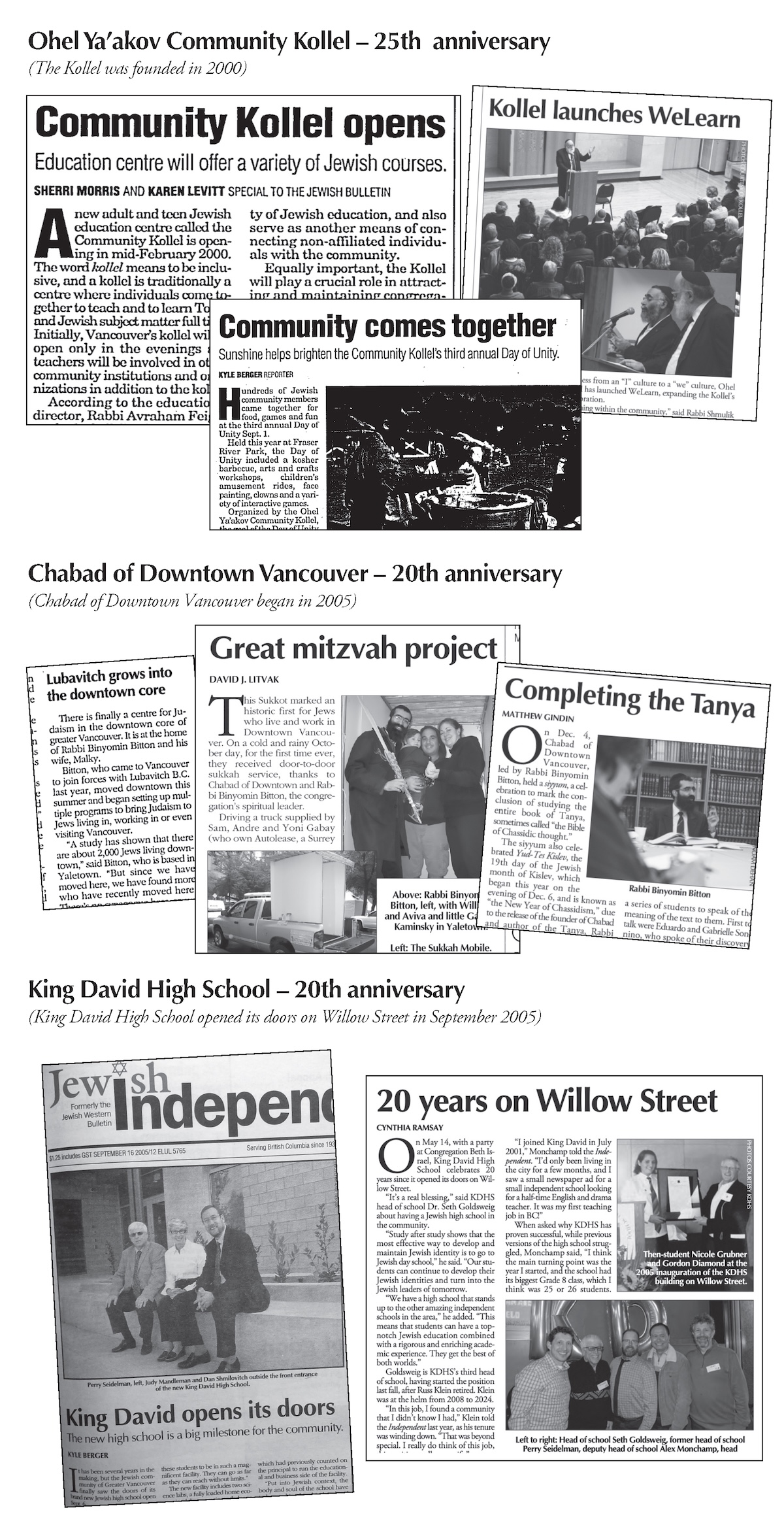
I share this as a caveat because, as I went through the paper’s archives, looking for other community organizations that are celebrating a significant anniversary this year, I no doubt have missed some. But my intent was good – I wanted to share the JI’s “special day” with others.
Unfortunately, I was hampered in my goal because the search function of the online Jewish Western Bulletin archives (newspapers.lib.sfu.ca/jwb-collection) is basically dysfunctional. If I had a 95th birthday wish, it would be to have the funding to have all the newspapers back to 1925 re-digitized and re-indexed, so that this priceless resource could be more accessible. In the meantime, I hope readers can embrace the random smattering of “clippings” that represent my attempt to show how the newspaper has grown with the community – our success being directly attributable to our collective success.
I continue to wish that the founders of the newspaper had started counting in 1925, when the “natal issue of the Vancouver Jewish Bulletin” was published.
Going through the pages of the newspaper over 95 years is both an inspiring experience and a sobering one. Countless people, organizations, businesses and events no longer exist, but there are always new people coming into the world, coming into the community; new groups being created, new businesses popping up, new ideas being discussed, new events being organized. If the size of the Community Calendar is any indication, there is more happening in the community today than there has ever been.
During my 26 years as publisher – or, one of my other beginnings, 27 years since I was hired by the paper – there have been recessions, wars, a global pandemic, and seemingly inexhaustible antisemitism, which has increased greatly since Hamas’s terror attacks on Israel on Oct. 7, 2023. I am still processing that massacre, the ensuing war and all the other violent conflicts happening in the world, the hate and the anger that threaten to overwhelm. It never ceases to amaze and sadden me, humanity’s ability to be as destructive and cruel as we can be creative and compassionate. I won’t dwell on the negative here.
In running the newspaper, I have tried to maintain a middle ground, to be inclusive but also respect my own boundaries. I think there are concerns that should be played out in public, and others that should be dealt with privately. The JI is not a gossip rag, it is not sensationalist or alarmist. That is a decision I have made, and that our editorial board (Pat Johnson, Basya Laye and me) considers every issue.
While not ignoring the hurtful, the divisions, the controversies in our community or the larger universe, we try to cover stories in a way that doesn’t depress and paralyze action, but rather opens the door for solutions or at least positive attempts at change. We don’t want readers to put down the newspaper in despair, but rather to think about what they can do to contribute to a better world, whatever that means to them. One ad in this paper heralds the JI for being the bearer of good news – it makes me happy that people think that, even as we report the news that’s not so good.
The Jewish Independent has survived so long because of one thing: community support.
In 95 years, there has been much to mourn, that is true, but there also has been so much to celebrate. Personally, during my tenure as publisher, I have benefited from many kindnesses, from generous landlords and donors to loyal subscribers and the people who support the paper through purchasing ads.
I have met, worked with and/or become friends with some truly amazing people. I consider myself lucky to have joined the paper early enough to have met in person several of the visionaries who built the organizational foundations of this community, not to mention those of the province, even of Canada, in some instances. There are afternoon teas, lunches and gala dinners I’ll remember forever, if the mind stays healthy.
The people I work with are smart, talented, dedicated and should be earning a lot more than they are. I might own the paper, but by no means do I run it alone. The people whose names you see on the masthead every issue are integral to publishing the paper. And all the people who have been on that masthead over the years – and the many more who have not been recognized in print – have helped keep the paper going, from its first days to today. I thank you all.
I am not a journalist per se, nor an entrepreneur. I’m trained as an economist, and still make myself chuckle when I think of the most uneconomical choice I have made in my life – to buy this newspaper. But it has kept me clothed and fed, with a roof above my head. It has taught me so many things and, though I’ve not always been a willing student, I am better for the lessons.
Most importantly, I am better for all the people I have encountered on this journey. I have made many friends and acquaintances. Not all my encounters have been pleasant or easy, but I have come to appreciate more as I’ve gotten older that, behind the organizations serving the community are simply people. Maybe people I don’t always agree with, but people who are undeniably committed. They are people who believe in community so much that they give of their time, either as volunteers or staff or both, working in one place, volunteering in others. Or they give of their financialresources, funding causes in which they believe, choosing to give away some of their money rather than letting it sit in the bank or using it for personal wants and needs.
It is a privilege to do what I do for a living. I am proud to be part of this extraordinary community. Kol hakavod to us all. May we go from strength to strength….
Now let’s party. Happy anniversary to all the other Jewish organizations celebrating a milestone this year!
Every time I put together one of these special five-year anniversary issues, I am both thankful for and awed by the community’s commitment to this newspaper. Even though I have owned it now for a quarter of its existence (!) and have experienced everything it has taken to keep publishing it, I still feel like it’s a miracle that, while so many other newspapers have folded, the Jewish Independent continues.
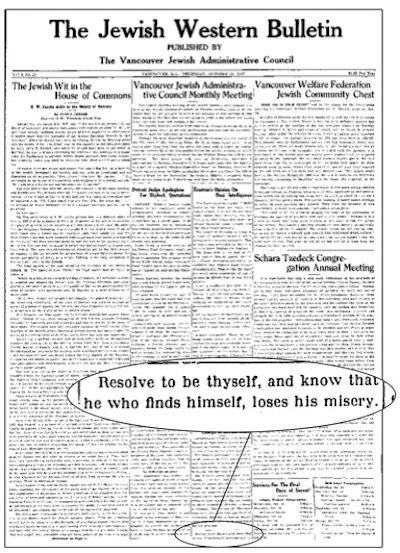
Cover of the Oct. 12, 1933, JWB
When I look back at old issues of the JI and the Jewish Western Bulletin, I get to see time move in almost an instant. In one sitting, I can follow the creation, the lifetime and, often, the transformation, or occasionally even the end, of a communal organization. I can see how a cohort of community members transitions into a whole new generation of dedicated volunteers and generous philanthropists. I can relate to the financial and other challenges that every former publisher and editor has gone through. I can feel the support of community leaders, readers and advertisers, who consistently have come to the rescue of a paper that has pretty much always been on the edge of solvency. I can share in so many people’s happinesses and sadnesses, their kudos and their complaints. I can appreciate the hard work of the paper’s publishers, writers and staff in every decade and that of countless community members, which has gotten us to today.
The community and the JI/JWB have survived the Great Depression, the Second World War, numerous recessions and other hardships. Currently, we are in the midst of surviving a global pandemic together. It has been a difficult year for all of us, to say the least. I’d be lying if I didn’t admit to having moments of despair and fear, and not just during COVID. I know how privileged and lucky I am, both personally and professionally, but, sometimes, I need reminding.
During this past year, as my few staff have switched to working at home or semi-retired, I have had more opportunities to speak and email with community members and others. While not a replacement for face-to-face encounters, it has been one of the pluses of this hard-earned +1 year of the newspaper, which had to postpone our special 90th anniversary issue until now. It is no exaggeration to say that we have only made it to 90+1 because of you. And not only your financial support, for which I am extremely grateful, but your indomitable spirit. We have pages to print because there are events to cover; classes, lectures and performances to attend; opinions to share; ambitious projects to promote; endeavours for which to raise funds; people offering help and people in need of assistance; people and milestones to celebrate; and losses to mourn. In this very newspaper you are holding in your hands or looking at on screen, there are stories on all of these aspects of our community.
Every time I prepare an issue of the JI, I’m buoyed by the promise that each paper holds – that there is a future, unknown as it may be, towards which we are all working. And, every time I look at past issues of the JIand the JWB, I am inspired by all that we’ve accomplished; by the no small feat that we are still here, showing up for one another and trying to make the world at large, or at least our small corner of it, a little bit better.
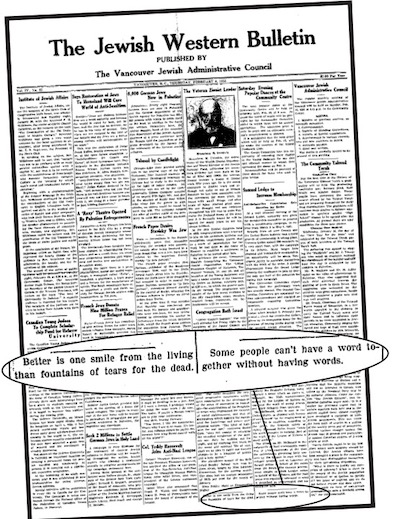
Cover of the Feb. 8, 1934, JWB
In my forays into the newspaper’s archives for this special edition, I came across, by chance, a few pithy sayings, no doubt intended to be motivational but, more pragmatically, to fill the small spaces that, in the olden days of typesetting, were hard to fill at the end of a column of news. From 1933 and 1934, they impart messages that could apply to any generation: “Resolve to be thyself, and know that he who finds himself, loses his misery”; “Some people can’t have a word together without having words”; “Better is one smile from the living than fountains of tears for the dead.”
I have no idea from where these aphorisms came, but they made me smile when I came across them. This newspaper never fails to surprise me. I just love it. And I thank all of you for helping me fill its pages and keep the presses rolling. May we all go from strength to strength.
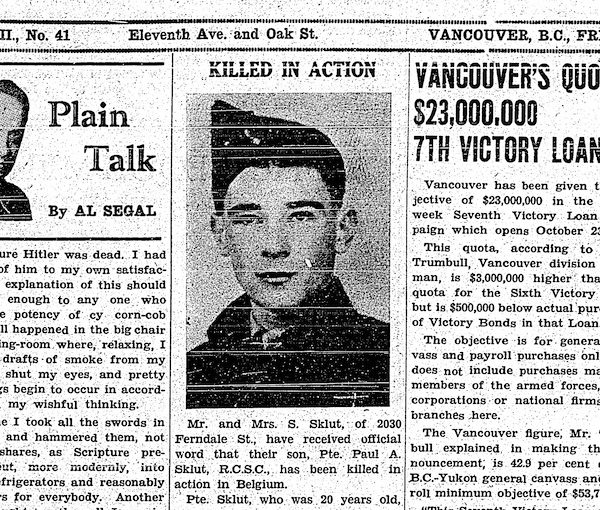
In looking through the Jewish Independent’s archives, after reading this article, this photo of Pte. Paul Sklut was found.
A Belgian tour guide and historian, Niko Van Kerckhoven, wrote to me recently. Van Kerckhoven, 50, and his teenaged son, regularly visit the graves of the Canadian soldiers who were killed liberating his town, called Wommelgem, during the Battle of the Scheldt, which was the Canadian campaign in the area surrounding the crucial port of Antwerp in fall 1944. It cost more than 6,000 Canadian casualties to take it, including that of Jewish volunteer Pte. Paul Sklut.
Van Kerckhoven has found photos of nearly all of the Canadian “boys” whose graves he visits, but not Sklut’s. As he wrote to me, “I’m quite desperate. You are pretty much my last chance for a picture!”
Sklut was the son of Russian-Jewish parents, and the family lived on Ferndale Avenue in Vancouver. It was a short walk to Britannia High School, where he was in the cadet corps, before he graduated.
Sklut’s name was often mentioned in the Vancouver newspapers, for he played competitive tennis, and also gave piano recitals at a venue on Granville Street.
Sklut was studying at the University of British Columbia when he was called up. He had just turned 19 on April 15, 1943. His two brothers, Harry and Donald, were already in uniform, with the army and the Royal Canadian Air Force, respectively. Sklut qualified as an infantry signaller in Kingston, Ont., then shipped out for England in July 1944. He was sent to France on Sept. 11, 1944, attached to the Calgary Highlanders. He was sent into action on Sept. 26. Twelve days later, he was dead.
“Many of them were just arriving here in Europe when they were thrown in this terrible battle of the Scheldt. I know the area well,” Van Kerckhoven wrote. “Many of the replacements died due to lack of training and experience. They really were used to plug the gaps in the infantry, although they were specialists by trade.”
Sklut was wounded on Oct. 8, 1944, and brought to a Canadian medical station that the Royal Canadian Army Medical Corps had set up inside one of the 19th-century forts near Antwerp, known as Fort 2, in Wommelgem. Military records confirm this happened.
Canadian medical personnel with the 18th Canadian Field Ambulance received Sklut at 13:00 hours. He was in really bad shape: he’d already lost his right leg at the knee, and his left leg and knee were fractured. He also had shell wounds in his chest and abdomen.
By 14:00 hours, Sklut was evacuated to the 21st Canadian Field Dressing Station and, then, still in shock, they took him to the Ninth Canadian Field Dressing Station, where he died at 16:30 hours. He was 20 years old.
Locals buried Sklut with other foreign soldiers, about 40 of them, mostly Canadians, in the civilian area of the Candoncklaer Hospital Cemetery in Wommelgen. Later, their bodies were reinterred at the Commonwealth War Graves cemetery in Bergen-op-Zoom, across the border in Holland.
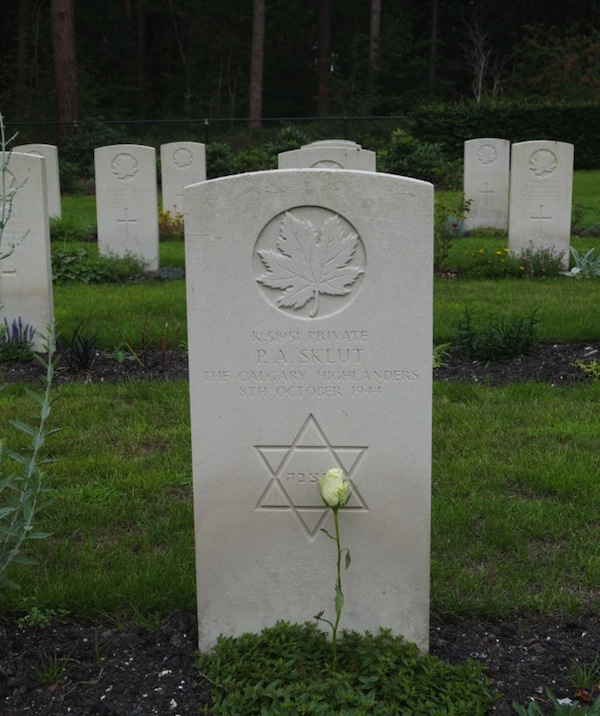
Grave of Pte. Paul Sklut in the Bergen-op-Zoom war cemetery, in Holland. (photo from Niko Van Kerchkoven)
That’s where my Belgian correspondent visits Skult’s grave. Van Kerckhoven is a member of his local historical society in Wommelgen, known as De Kaeck. He would like to find the Sklut family to tell them their relative has not been forgotten; he is also looking for a photo of Sklut.
Contact me through my website, ellinbessner.com, if you are able to help this man as he continues to carry out a mitzvah, although I am not sure he is aware of what that word means. (I will explain it.)
Ellin Bessner is a Canadian journalist based in Toronto. She is the author of a new book about Canada’s Jewish servicemen and women who fought in the Second World War, called Double Threat: Canadian Jews, the Military and World War II, which was published by University of Toronto Press (2019). She also contributed a chapter to Northern Lights, published by the Lola Stein Institute (2020); it is the story of the contribution of Canada’s Jewish community to the country’s military record from 1750 to today.
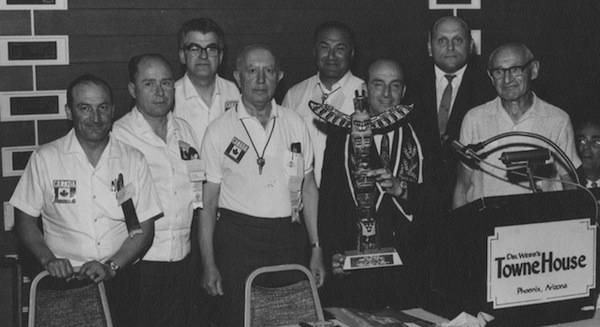
Group of B’nai Brith delegates at a Phoenix convention, 1975. Dave Jackson is on the left and Harry Buller is fifth from the left. (photo from JWB fonds, JMABC L.10220)
If you know someone in this photo, please help the JI fill the gaps of its predecessor’s (the Jewish Western Bulletin’s) collection at the Jewish Museum and Archives of B.C. by contacting archives@jewishmuseum.ca or 604-257-5199. To find out who has been identified in the photos, visit jewishmuseum.ca/blog.
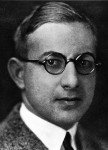
Portrait of Max Malit Grossman, circa 1926, copied from the book The Jew in Canada. Grossman’s mimeographs were the start of it all. (photo from Jewish Museum and Archives of British Columbia L.00011)
From 1930 until Abraham Arnold’s arrival in 1949, there was a new editor and/or publisher of the Jewish Western Bulletin every couple of years. Arnold lasted 11 years, Sam and Mona Kaplan about 36 all told. My first article ran in the JWB on March 28, 1997. I was listed as a contributor for the next year, becoming editorial assistant in May 1998, and assistant publisher that September. When Kyle Berger, Pat Johnson and I bought the paper, they graciously agreed that I become the publisher. Since that first issue, June 4, 1999, I have held that title. That makes 16 years. The second-longest term in the paper’s history.
For more than 10 years, I’ve been the sole owner of the Bulletin / Independent. While Kyle still contributes occasional articles and blogs, Pat is on the editorial board with former editor Basya Laye and me, and contributes weekly. I have worked with countless talented and kind people, many of whom have stuck with me, the paper and the community through some tough times, especially since the 2008 economic downturn. It is us, a handful of people, along with a few regular freelance writers, who get this paper to press every week. It is a labor of love for all of us. We do it for very little pay.
Financial struggle is as much a characteristic of this paper as is its Jewish character and its communal foundation, though that is one tradition I would happily leave to the dustbin of history.
Reviewing the 85-year history of the paper affirms my conviction that it is an absolute treasure, one of immeasurable value to Jewish life and this community. Yet, it is largely taken for granted. True, it has its admirers – thank you to all the organizations and businesses who advertise, and to all the readers who subscribe, donate or support our advertisers. But, on the whole, it is undervalued. And it has been almost since Day 1.
The newspaper got its start in 1928 as a mimeographed newsletter whose goal was to generate the funds and enthusiasm for a Jewish community centre. It succeeded in that regard, though the JCC would experience existential difficulties more than once in its life. Today, thankfully, the JCC is a strong and vibrant fixture in the community. When the mimeo became a tabloid in October 1930, its name was borrowed from a 1925 publication that was well-loved but, evidently, not well-funded, as it didn’t last for long.
More than one editor of the JWB has exhorted readers to pay their subscriptions and pleaded with organizations to buy advertisements. The relationship between editors and readers was much more contentious and frank during the 1930s and 1940s than it has been since. Reading these editorials every time I organize a special anniversary issue – this is my fourth – I am both saddened and heartened by the fact that, at their core, the issues remain the same.
This year, I have been particularly affected by the missives of editor and publisher Goodman Florence as he neared what turned out to be his last several months with the JWB. In the latter half of 1948, he starts to air some of the dirty laundry that has obviously been accumulating between himself and the Vancouver Jewish Administrative Council that took over control of the paper when the Jewish Community Centre, Jewish Community Chest and Hebrew Aid Society formed it in 1932, as well as other community organizations and even readers.
In August, he tackles head on the idea that readers have somehow gotten that “the Bulletin is a highly profitable proposition and is fought for. Such is not the case.” He points out that “subscriptions pay for only postage, paper and addressing, if it does that much. An attractive, newsy and acceptable publicity medium such as the Bulletin, is expensive to produce and its cost must be borne by advertisers.” This remains the case today.
That October, Florence’s one-year contract was coming to a close. Among his “many problems and many anxieties” is “the matter of the financial loss so far sustained in publishing for the community” under the terms of his contract, which he describes as “hastily arranged.”
He sums up his difficulties in being the publisher of an Anglo-Jewish weekly in November of that year, yet still holds hope that the situation is improving. In January 1949, he writes about all the ideas he has for the paper’s future, with only “a few final details” to be organized regarding a new contract. “I am hoping in the coming year to be able to devote more time and space to national and international affairs and will express a viewpoint in ‘editorials’ – and will endeavor to get prominent members of our community to also take their ‘pens in hand.’
“It will be my continued policy to assist every organization now in existence and which might come into existence, so long as the purpose is lawful and of good intention – to place itself before the public in as accurate a light as possible.”
After talking about an increase in the price of subscriptions and new help in finding advertisers, Florence concludes, “For 1949 I hope with your cooperation to make of our paper ‘one of the best’ – and to help build a progressive integrated community – and to spread the story of its good works throughout the land.
“For the opportunities of the past and the promise of the future, I wish to say, ‘Thank you.’ I will continue to do my best to serve you well.”
Less than a month later, his farewell editorial was published by the new team at the helm.
“Readers want world news, features, editorials . . . officers of all local organizations want their activities to be publicized. Up to date, I have not yet been able to completely sell the simple fact that to do all this requires considerable revenue,” Florence writes. “Some headway has been made in recent months, and there are now signs that more organizations are becoming aware of the need to place advertising that would be considered commensurate with the amount of news publicity their various activities require. There are signs also that more of the Jewish business men are coming to realize that there is after all some virtue in advertising in the Bulletin and doing business with the members of this growing Jewish Community.
“My decision [to leave] was arrived at after I realized that I had not been getting sufficient advertising support, and that without such assistance, progressive development could not be undertaken. I feel certain that now that the position has been drawn to your attention, the new publishers, Abe Arnold and Asher Snider, will get the support necessary to continue the venture, and I bespeak for them your utmost cooperation.”
When I look at the state of the publishing and newspaper industry today, I take heart that there have always been challenges and, despite the often-dire-sounding editorials of Florence and many of the paper’s other editors and publishers, here we are today. Many recessions have come and gone. Heck, the newspaper survived the Great Depression. Will it survive the internet? I certainly hope so, and not just because I would like to own a successful business.
I have looked through the physical pages of almost every JWB and searched through them online (multiculturalcanada.ca/jwb) ad nauseam for various people and events. I have read every single copy of the JI. Every time I look back at the articles and images in the papers, something surprises me, something sparks my imagination, something makes me think or makes me laugh.
I don’t know anyone who owns a community newspaper or any similar business. When I read that other editors, publishers and owners of the paper have had similar concerns, challenges and joys, there is a sense of solidarity, of not being alone. When I read about what various people in this community have had to endure, what they’ve accomplished, I am inspired. When I attended the rededication of the Jewish section of Mountain View Cemetery earlier this month, I felt like I had personally known many of those buried there. My connection to this community through its newspaper of record for 85-plus years is that strong and goes back that far.
But, ultimately, I didn’t know any of those people. I was born in Moncton and grew up in Winnipeg. My immediate family now lives in the Montreal-Ottawa-Toronto corridor and I came to Vancouver from Ottawa in 1992. My Winnipeg-based aunt had lived here in the 1960s. After I got my MA and a job – i.e. once it looked like I was staying awhile – she connected me with the Vancouver Jewish Folk Choir via her longtime friend and former musical colleague Claire Klein Osipov. It was one of my first connections to the Jewish community here and it has, obviously, led to other connections, including being the editor of the Jewish Museum and Archives of British Columbia’s annual journal The Scribe for the last seven editions.
I’ve always liked history, and I love having 85-plus years’ worth of it at my fingertips. It wasn’t until this special issue though that I decided to do a search for my aunt’s name – she passed away last fall.
My searches yielded more than a dozen results from 1962 through 1966, including the birth announcement of one of my cousins, her third son. And there was a photo of her, which was published twice, once with the wrong caption, a correction being noted in the following week’s paper. I knew that Aunt Chickie (married to Nathan Frankel at that time) was involved in the Peretz Centre and that she accompanied Claire on the piano, but seeing some of the committees she was on, the events she helped organize, the music she performed … seeing her face – I can’t describe the feeling, except to say, once again, this newspaper is such a vital resource in ways that I’m still discovering after almost 20 years working here.
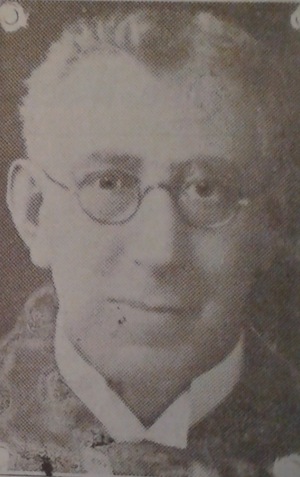
S.A. Goldston, in the JWB.
The JWB had two fifth anniversary issues, one in 1934, another in 1935. In the first, editor S.A. Goldston writes, “It seems hard to realize that time has flown so quickly. We all remember well the small mimeographed copy first issued in the office of Max Grossman, and we wonder how many thought that the day was not far distant when it would grow to a regular weekly newspaper.”
He wonders whether the Bulletin had “filled the mission for which it was first intended? Is it any use today?” He leaves the answer to readers, “for naturally we are somewhat prejudiced in our personal views on the matter.
“The paper was first produced to act as the voice of the Community and to bring its readers in closer touch not only with the happenings in its own surroundings but with Jewry all the world over – to awaken Jewish consciousness, and if possible to create a deeper sense of unity among the Jewish residents of this City. In this way we can, without exaggeration, say [we] have been fairly successful.”
I love this last sentence, which, to me, shows clearly Goldston’s great humility. Yet his purpose is grand: publishing news of all the city organizations and devoting “considerable space to world happenings,” trying “hard to preach through the columns of this paper the absolute necessity of a United Jewry not only in Vancouver but throughout the world…. We have also, during the past year, continued to spur on our readers in civic, philanthropic and educational services and have received congratulations from non-Jewish communities on our work.”
But, he notes, as others would, “There are two things apart from the reading matter that is necessary to make a paper a success…. We need subscribers and advertisers.”
Of the advertisers the paper did have, he says, “We get a very fair share…. But we also owe a duty to every advertiser who uses our columns. We must give them our patronage whenever possible. They have confidence in us and [we] must show that this confidence is not misplaced. We would therefore respectfully suggest that in making your purchases those who advertise in the Bulletin be given preference.”
Goldston and his colleagues have “the great ambition of doubling the size of the paper,” which was then eight pages, within the next year. He asks for help in getting there, saying he has “much to be thankful for,” despite his “failing health,” and is proud to hold the position of editor.
The very next issue carried a front-page obituary. Goldston had passed away suddenly, at age 63. According to B.C. Archives records, he died April 11, 1934. His given names were Sim Alfred.
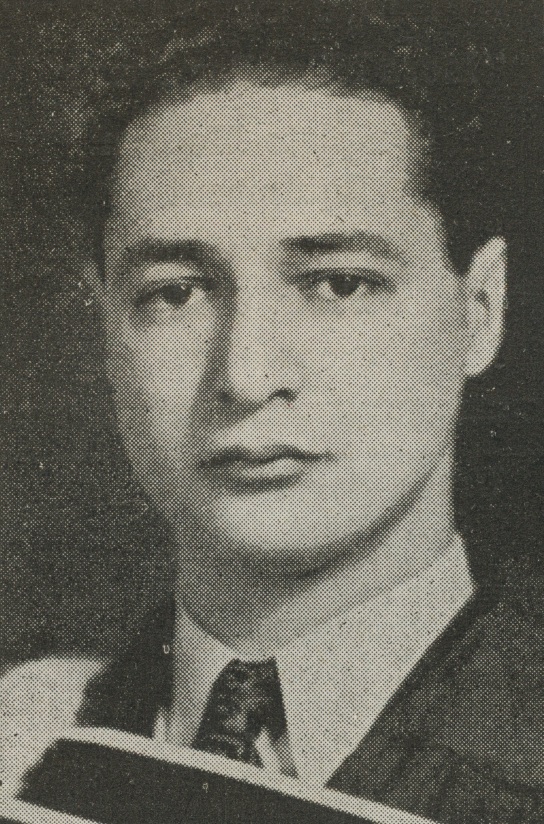
David Rome, in the JWB.
In the 1935 editorial marking “Five years of the Bulletin,” editor David Rome echoes some of Goldston’s remarks. He, too, speaks of gratitude and writes that the Bulletin’s “being taken as a matter of course by Western Canadian Jewry” is “the greatest compliment that can be offered to it,” showing that it “is not a freak venture but part of the life of its readers.
“But this sometimes blinds its readers to the phenomenon of a relatively small community successfully publishing a weekly newspaper for a number of years. Those who are daily in contact with the workings of the community publication realize fully the efforts that have to be made to maintain the standards set and to elevate them.”
Rome thanks all “those anonymous workers who have devoted unselfishly of their time and energy for this community enterprise. The Bulletin is a fairly big business and it needs a large amount of work and application to run this business. This devotion was given it by the members of the [Council’s Bulletin] committee and it is no more than fitting that thanks be given to them for their work.”
He notes that this anniversary of the paper also marks the first year since Goldston’s passing: “It is not at all an exaggeration to say that he worked beyond the limits of health, and the community should honor his memory and recognize his sacrifices for the community newspaper.”
Somehow I feel that, with every issue of this paper, we are honoring the people in this community who have made – and are making – sacrifices for whatever people and causes that are important to them. Every event, interview, photo, birth announcement, obituary … everything that gets recorded is proof of existence, of purpose, of being part of something larger than oneself.
This newspaper has always had a grand, even grandiose, view of the impact it could have on the community. But, looking back at 85 years – 90 if you count the original Bulletin, 87 if you start at Grossman’s mimeo – I’d say it has exceeded even the grandest of its expectations. And I’d like to see it continue to do so, whether or not I’m involved. But, as pretty much every publisher of the paper will tell you, “There are two things apart from the reading matter that is necessary to make a paper a success….” The future of this community treasure is, quite literally, in your hands.