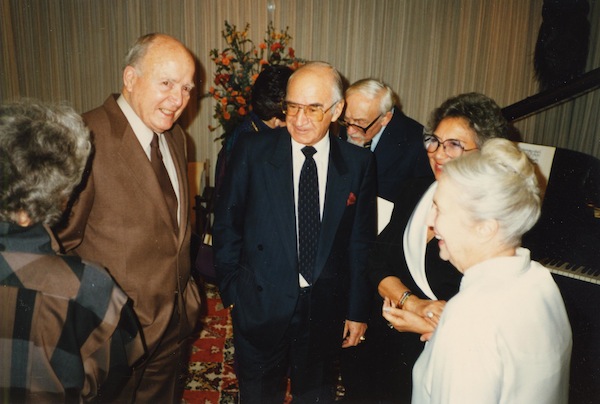
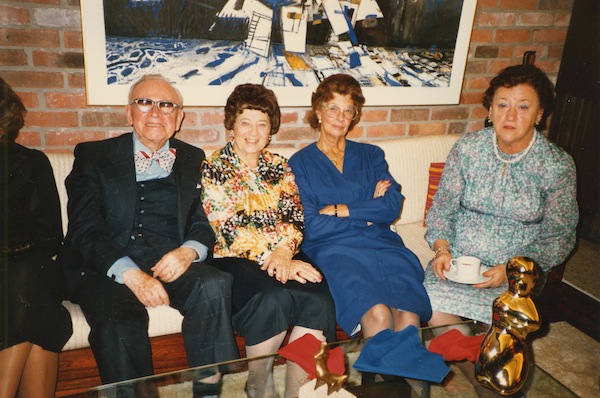
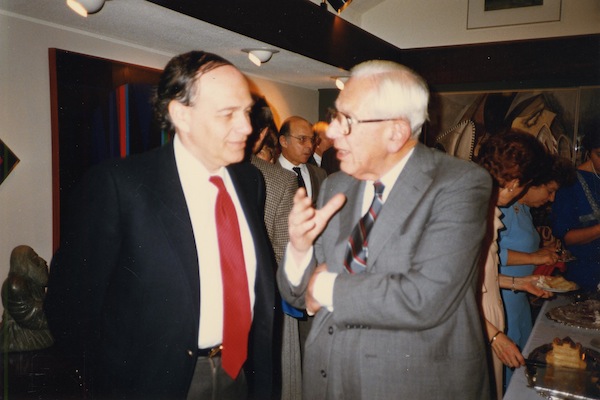
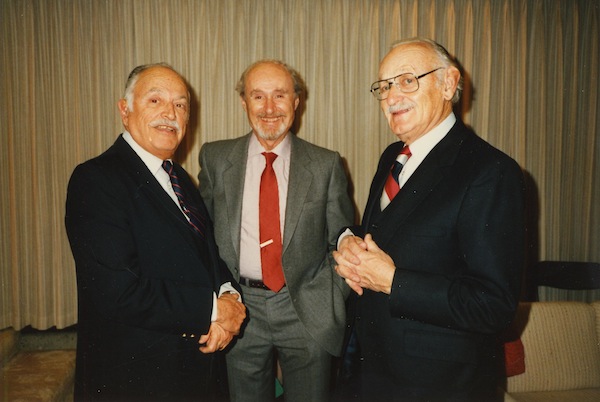
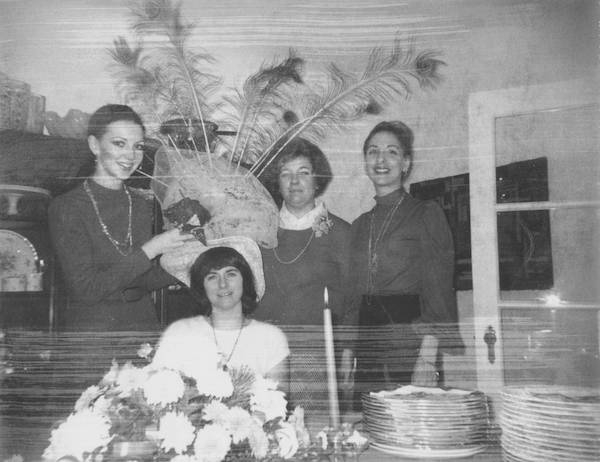
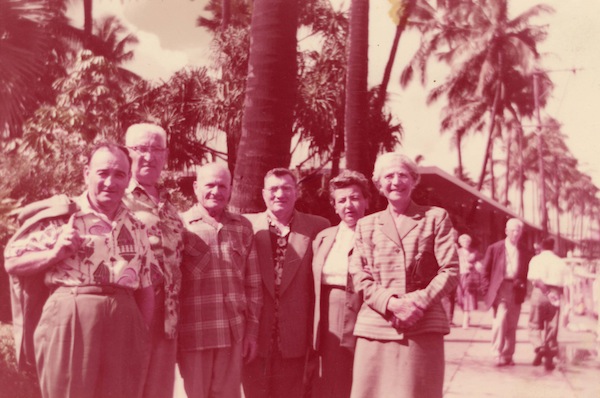
In the photo above and those below: People socializing at an unidentified event, possibly a University of British Columbia event in honour of Harry Adaskin, 1985. (The above photo is from JWB fonds, JMABC L.13764)
If you know someone in these photos, please help the JI fill the gaps of its predecessor’s (the Jewish Western Bulletin’s) collection at the Jewish Museum and Archives of B.C. by contacting archives@jewishmuseum.ca or 604-257-5199. To find out who has been identified in the photos, visit jewishmuseum.ca/blog.
(photo from JWB fonds, JMABC L.13784)(photo from JWB fonds, JMABC L.13775)Sol Kort, middle. (photo from JWB fonds, JMABC L.13762)
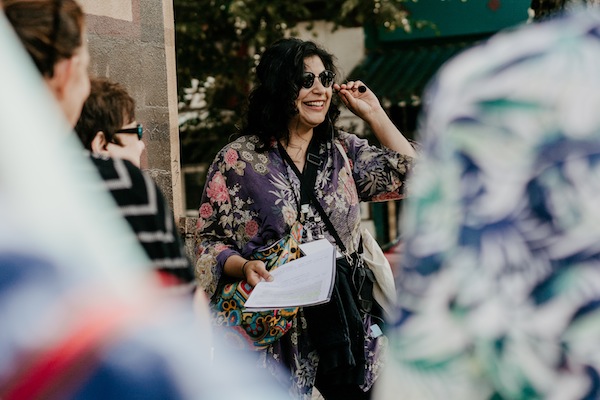
Tour organizer Carmel Tanaka at one of the tours last stops. (photo by Kayla Isomura)
The first Jewish neighbourhood in Vancouver was in Strathcona, which also served as the first home for many, if not most, cultural communities that make up the diverse fabric of the city. The neighbourhood welcomed wave after wave of immigrants of different backgrounds and continues to do so today. The rich multicultural history of this area – too often overlooked amid the social challenges of the larger Downtown Eastside – was given its due in a series of walking tours this spring.
Carmel Tanaka organized the tours, bringing together almost two dozen community organizations. Tanaka is chair of the human rights committee of the Greater Vancouver Japanese Canadian Citizens’ Association and an active member of the Jewish community, but the tour is an ad hoc, grassroots project with no umbrella organizing agency. Partnering agencies include Heritage Vancouver, the Dr. Sun Yat-Sen Classical Chinese Garden, the Nikkei National Museum and Cultural Centre, Vancouver Asian Heritage Month Society, the Jewish Museum and Archives of British Columbia and the Jewish Independent. The Cross Cultural Strathcona Walking Tour took place each Sunday in May, with two tours each day. Tanaka said she hopes to make the tour an annual event.
Tanaka came up with the idea after participating in a walk of Hogan’s Alley, Vancouver’s historic black neighbourhood, as part of Jane’s Walks, a global festival of citizen-led walking tours inspired by the late visionary urbanist Jane Jacobs. A week after her exploration of the neighbourhood’s black history, Tanaka took the Jewish Museum’s walking tour of Strathcona.
“We were walking similar streets and even talking about places that are right across the road from each other and I started to think, well, there must have been interaction between our communities,” she told the Independent. “Why not bring the guides, the experts, the archivists and the know-alls into one room and see if we can do something together. What started as a small group of four to five guides, who do existing tours, blossomed into 20-plus participating organizations, including community organizations, heritage organizations, the Vancouver School Board and more. We’ve been told there have been attempts to do something like this before, but not to this degree. It’s very exciting that we’re all working together.”
The tour, which took in Hogan’s Alley, Jewish Strathcona, former Japantown and Chinatown, was intended to build awareness of the contributions of immigrant communities then and now. It took place in May as part of the celebration of Vancouver Asian Heritage Month and Canada’s Jewish Heritage Month.
The theme of the walking tour this year was education and the starting point of the two-and-a-half-hour adventure was Lord Strathcona Elementary School, the city’s oldest. Referred to as the “League of Nations” for its diversity, the school remains one of the most multicultural in the country.
One former Strathcona student, Elder Larry Grant of the Musqueam Nation and Chinese-Canadian communities, recalled the experience of growing up in the area and the impact the cultural mosaic had on him and others.
Opened in March 1891 as East School, it was renamed in 1909 in honour of Donald Smith, Lord Strathcona, who drove the last spike in Canada’s first transcontinental railway. To get a sense of the extraordinary range of ethnicities, a survey in 1940 indicated that the students included 650 of Japanese descent, 300 Chinese, 150 Italian, about 150 Yugoslavian, Ukrainian and Polish students, about 100 of British descent, several from India and a scattering from other European countries. After the regular school day, many of the students would have proceeded to after-school programs in their heritage language at, for example, the Vancouver Japanese Language School and Japanese Hall, a 1906 building on Alexander Street where the tour finished.
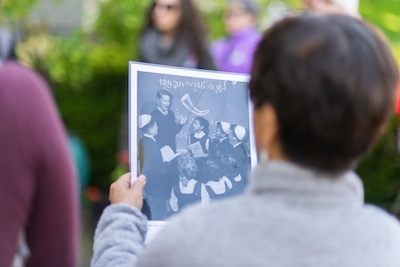
A tour participant holds up a picture from the Talmud Torah Grade 4 class, circa 1965; Gita Kron, teacher. (photo from Jewish Museum and Archives of British Columbia)
Jewish kids would have made their way down the block from Strathcona elementary to the B’nei Yehuda synagogue, since converted to condos but, at the time, the spiritual and figurative centre of Jewish life in the city. The synagogue opened in November 1911, with an after-school program in Jewish tradition. A full-time day school, Talmud Torah, opened there in 1921 and moved to its current location on Oak Street in 1948.
In 1942, when the Canadian government instituted a wartime policy against Japanese and Japanese-Canadians, about half of Strathcona school’s population disappeared, forcibly relocated to camps in the British Columbia interior and elsewhere east.
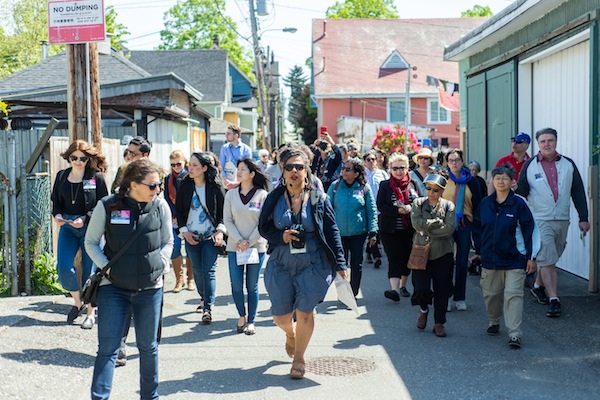
The tour featured different community guides at each destination along the route, bringing together a patchwork of knowledge about different communities to help participants form an impression about how different communities maintained their distinctiveness while interacting with the variety of cultures and languages around them.
Not far from the industrial waterfront, Strathcona grew, in part, from the maritime trade, especially the 1858 discovery of gold in the Fraser Canyon. But, as guides noted, the area has probably been a gathering place for thousands of years, initially as a summer campsite for the Musqueam, Squamish and Tsleil-Waututh First Nations. The 1858 gold rush, and successive ones further north, brought merchants from China and Jewish provisioners from San Francisco. Indentured labourers from China, who worked on the Canadian Pacific Railway, helped launch the beginnings of Chinatown in the area around Pender Street. Japanese, Portuguese and Italian immigrants followed, with many working in the Hastings Sawmill and other resource-related industries.
The tour passed the National Council of Jewish Women Neighbourhood House on Jackson Street, a locus of Jewish social activity that is seen as a precursor to the Jewish Community Centre. The Vancouver chapter of NCJW was founded in 1924 and helped new immigrants settle, learn English and find jobs. One of their landmark programs was the Well Baby Clinic, which immunized kids and helped new parents care for their families. National Council remains active today, providing services especially for families and youth, educational and advocacy programs around human trafficking and spreading awareness about Jewish genetic diseases.
Later, the tour passed Oppenheimer Park, named for the city’s first – and so far only – Jewish mayor, David Oppenheimer.
An important part of the tour was Hogan’s Alley. The creation of the Georgia Viaduct destroyed a large part of the historic black neighbourhood but Fountain Chapel, a branch of the African Methodist Episcopal church, still exists, though it is now a private residence.
Vanessa Richards of the Hogan’s Alley Society leads guests down Hogan’s Alley. (photo by Matt Hanns Schroeter)
From Hogan’s Alley, the old Canadian National Railway station looms large to the south, and it was the profession of Pullman porter, made up almost exclusively of African-American and black Canadians, that was a launchpad to the middle class for many black families. The development of the black neighbourhood in this location owed its origins to the proximity to the train station.
From there, the tour proceeded into Chinatown and the Dr. Sun Yat-Sen Classical Chinese Garden. A sawmill at the foot of Carrall Street, constructed in 1886, provided employment for many Chinese men and set in motion the establishment of Vancouver’s Chinatown on this block.
In 1947, the Chinese Immigration Act was repealed, rescinding a racist law and opening the door to more Asian newcomers and establishing equal rights, including the right to vote, for Chinese-Canadians. The tour also recalled how, in 1907, a group calling itself the Asiatic Exclusion League incited a mob of about 9,000 rioters who rampaged through Chinatown and Powell Street, smashing windows and destroying properties. This led to the federal government reducing immigration from East Asia.
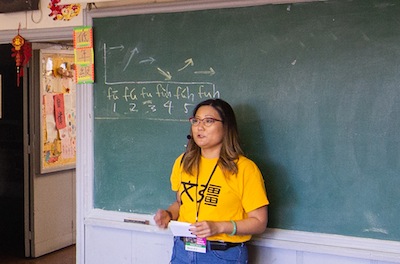
Aynsley Wong Meldrum welcomes guests to the Mon Keang School in the Wongs’ Benevolent Association building. (photo by Matt Hanns Schroeter)
The tour continued to the Mon Keang School in the Wongs’ Benevolent Association building, an example of a Chinatown clan society. These societies supported extended family members as they migrated, serving as housing agency, employment office, post office and bank for new arrivals. Chinese men could borrow money here to pay Canada’s discriminatory head tax and to send money home to their families in China.
Mon Keang School provided a classical Cantonese education to the first generation of local-born children and, in the 1930s, was just one of 10 such Chinese schools in the area. By the 1970s, Chinese families were living throughout the city and Chinese-Canadian kids were choosing sports and other extracurricular activities over Chinese school. Mon Keang School closed in 2011 but reopened in 2016 with a grassroots community program taking a different approach to Chinese language learning.
The history of Christian social action in the neighbourhood is demonstrated powerfully at the corner of Hastings and Gore, where the Salvation Army citadel, now boarded up, stands across from First United Church, a hub of social programs in the Downtown Eastside, and nearby Saint James Anglican, which also has a long activist history. While plenty of good work has emanated from these institutions, during the era of Indian residential schools in Canada, from 1883 to 1996, churches were complicit with the federal government in the genocide of indigenous Canadians through the deliberate and brutal attempts to exterminate indigenous cultures and languages.
The walking tour tries to highlight the main aspects of the area’s history, without romanticizing it.
“This is a grassroots initiative led by myself and a bunch of amazing, dedicated team members,” Tanaka said. “We’re really hoping that this will become an annual event and will be able to include even more communities next year. We’ll see what this turns into.”
Dayson Here portrays Ben Dayson’s innate business acumen and his economic success, as well as his unwavering devotion to his wife, Esther.
Following the publication of the Nemetz family biography Don’t Break the Chain: The Nemetz Family Journey from Svatatroiske to Vancouver, in 2017, comes a new book called Dayson Here: The Story Behind the Voice, compiled and written by Shirley Barnett and Philip Dayson.
Anyone who met Ben Dayson knows he was larger than life. Standing at five feet, six inches (or thereabouts), he was a giant among men. People knew him for many things, but primarily his business success, his deep and abiding love for his “beautiful wife” Esther, and his close family. What’s missing from that picture are his modest beginnings in Ukraine, the journey that brought him to Vancouver, and the man behind the voice. The new book, comprised mainly of direct quotes from Dayson – thanks to the Dayson/Barnett families and the Jewish Museum and Archives of British Columbia – and black-and-white photos, tells a more intimate story of his life. My favourite quote of his is: “I know nothing and you know even less!” Pure Ben Dayson.
The book portrays not only Dayson’s innate business acumen and the extent of his economic success, but also his unwavering devotion to his wife, Esther. She was the epicentre of his life, the voice of reason and the sole calming influence in his life.
It’s no secret that Dayson was an extraordinary character. He made his presence known, and loved to “work a room.” Within the space of a few hours, he could be loud, moody and assertive in his office, then morph into a charming, polite man in a social setting.
Dayson was very interested in real estate development, first residential and, later on, commercial. He had a natural business sense, despite having little to no formal education. There’s no question that his obsession with building and developing fed the fire in his belly. He’d often drive friends around to visit his buildings.
Starting life in Canada wasn’t easy, but, with determination and sheer energy, he parlayed his first business ventures into greater and greater things. Ironically, his difficult start in life (his father died when Dayson was 15) primed him for later success. Having witnessed pogroms and antisemitism, Dayson was determined to have a better life for himself and his family. When a cousin in Kamsack, Sask., sent papers to help him come to Canada, that gave Dayson the impetus to build that good life. Traveling from Ukraine to Moscow, then Riga, Berlin and Rotterdam, Dayson’s world opened up. In Rotterdam, “he became acquainted with new things in life – chocolate, coffee, white bread and girls.”
But Dayson became impatient to get to Canada. In anticipation of his future, he bought a few essentials: a new suit, a pair of shoes and a hat, which left him with only $7. His arrival in Canada took him from Halifax to Montreal to Winnipeg and then to Kamsack, where he settled in 1927. Beyond most everything else, gaining Canadian citizenship was one of his proudest accomplishments. A more patriotic man you could not find.
Friends from his hometown sent word that Esther Nemetz, who grew up just blocks from Dayson in Ukraine, was living in Vancouver – and she was a beauty. Despite never having met her, Dayson began a correspondence with her in 1931. He courted her by mail, despite that she was engaged to a doctor from London, Ont. Dayson’s trademark perseverance won the day and their romance grew. As some people know, Dayson began life as Boruch Deezik, but, at the urging of his wife-to-be, he Americanized his name and became Ben Dayson.
Nemetz’s six brothers had done well since their arrival in Canada and she benefited from their generosity, having the “wedding of her dreams,” after which, the couple moved to Viscount, Sask., where Ben Dayson had already purchased a general store. The book recounts that “Esther sold her furs and diamond rings to help buy inventory.” Their business grew, they made more money, and became community leaders.
Working together as partners, Ben and Esther Dayson grew their family and built a good life. They moved to Saskatoon and bought a meat market, which also did well. In 1949, Esther suggested they move to Vancouver, since her six brothers and two sisters lived there. Living in the big city, the Daysons involved themselves in the Jewish community, surrounded themselves with extended family and expanded their social circle.
In 1951, Dayson discovered real estate and became consumed by it; he built numerous apartment buildings in Vancouver, Richmond, Burnaby, New Westminster and West Vancouver. He had a remarkable sense of what would work and what wouldn’t in the real estate world. He was a pragmatist and a savvy, self-taught businessman. In the 1970s and 1980s, he discovered industrial property, and the book paints a picture of a tenacious but principled man who always got what he wanted. Unless his wife vetoed it.
Throughout their life, Ben and Esther Dayson were great philanthropists and ardent supporters of Israel. Among the many causes they supported was the Richmond Public Library, where I was first introduced to Ben. Having built the first high-rise apartments in Richmond and benefited from them, Dayson felt he owed a debt of gratitude to Richmond. So, in 2004, the couple gave $50,000 to the Richmond Public Library Endowment Fund, one of the library’s largest single donations.
An avid reader and lover of books, Ben Dayson also gave most of his personal Judaica book collection to the library, and established the Ben and Esther Dayson Judaica Collection at the Brighouse (Main) Branch. Thanks to the Daysons, the library is now home to one of the Lower Mainland’s largest Judaica collections, and includes Jewish books, DVD movies and newspapers. In 2004, Ben Dayson was awarded the British Columbia Library Association Keith Sacré Library Champion Award for his support of libraries, literacy and public access to information.
As a senior librarian at the Richmond Library, I had the honour and pleasure of working closely with Ben Dayson to develop this collection. He maintained a hands-on approach to the collection, and would regularly buy and donate Jewish-themed books to the library. Always insisting on an accurate (and usually immediate) accounting of the books he donated, I would often get calls from him, asking (telling?) me to come to his home with the library’s laptop, so I could type out an author/title list of the books he donated.
This was a regular occurrence. But I remember one particular time when there was a bad snowstorm. It was a Friday night and my home phone rang at around 8 p.m. It was Dayson. He said, “I have books for you. Come and get them.” I recall asking him, “You mean right now?” To which, naturally, he replied, “Yes.” It was around 2006 and I didn’t yet own a personal laptop. Knowing that few people ever say no to Ben Dayson (and live to tell the tale), I drove through the snowstorm to his home, bearing a pad of paper and a pen. The rest is history.
Dayson Here: The Story Behind the Voice is filled with fascinating information about the Dayson family business. But there are also plenty of surprising and humorous anecdotes demonstrating how passionate Ben Dayson was about issues that offended him personally. He pursued causes until he got a satisfactory resolution, or was forced to give up the fight, like when the government revoked his driver’s licence at age 95.
As Shirley Barnett said so eloquently in her father’s eulogy, Ben Dayson “lived his life loud and clear.” It’s nearly impossible to encapsulate the enormity of his personality, but this book does just that, with humour, honesty and love. His headstone says it all: “Once met, never forgotten.”
Copies of Dayson Here are available at the RPL Brighouse branch, the Isaac Waldman Jewish Public Library at the Jewish Community Centre of Greater Vancouver or by contacting the authors directly.
Shelley Civkin is a happily retired librarian and communications officer. For 17 years, she wrote a weekly book review column for the Richmond Review, and currently writes a bi-weekly column about retirement for the Richmond News.
Rochelle Levinson is second from the right. (photo from JWB fonds, JMABC L.10738)
If you know someone in this photo, please help the JI fill the gaps of its predecessor’s (the Jewish Western Bulletin’s) collection at the Jewish Museum and Archives of B.C. by contacting archives@jewishmuseum.ca or 604-257-5199. To find out who has been identified in the photos, visit jewishmuseum.ca/blog.
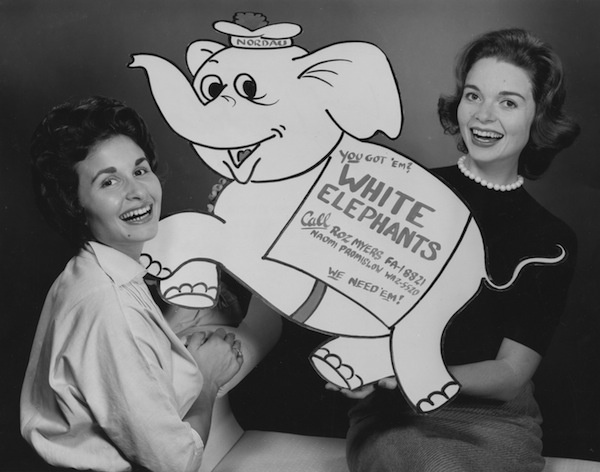
Two unidentified women hold a White Elephant sign for Hadassah Bazaar collection, 1953. (photo from JWB fonds, JMABC L.10545)
If you know someone in this photo, please help the JI fill the gaps of its predecessor’s (the Jewish Western Bulletin’s) collection at the Jewish Museum and Archives of B.C. by contacting archives@jewishmuseum.ca or 604-257-5199. To find out who has been identified in the photos, visit jewishmuseum.ca/blog.
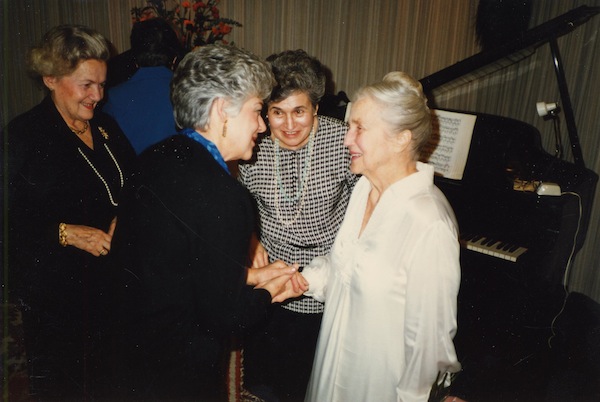
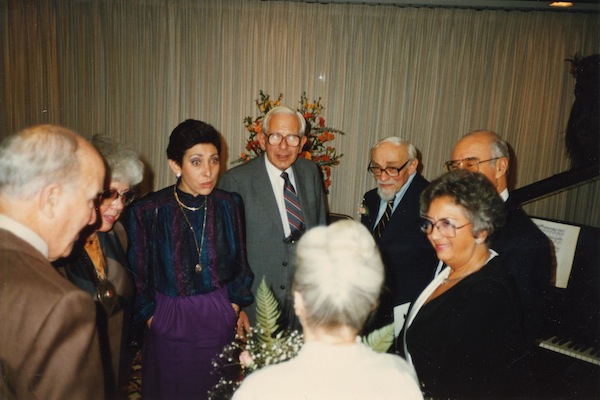
Photographs from an unidentified event, possibly a University of British Columbia event, likely in honour of Harry Adaskin, 1985. In the photo immediately below, of the women socializing by the piano, Shirley Kort is second from the right. (above photo JMABC L.13770)
Shirley Kort is second from the right. (JMABC L.13761)(JMABC L.13765)
If you know someone in these photos, please help the JI fill the gaps of its predecessor’s (the Jewish Western Bulletin’s) collection at the Jewish Museum and Archives of B.C. by contacting archives@jewishmuseum.ca or 604-257-5199. To find out who has been identified in the photos, visit jewishmuseum.ca/blog.
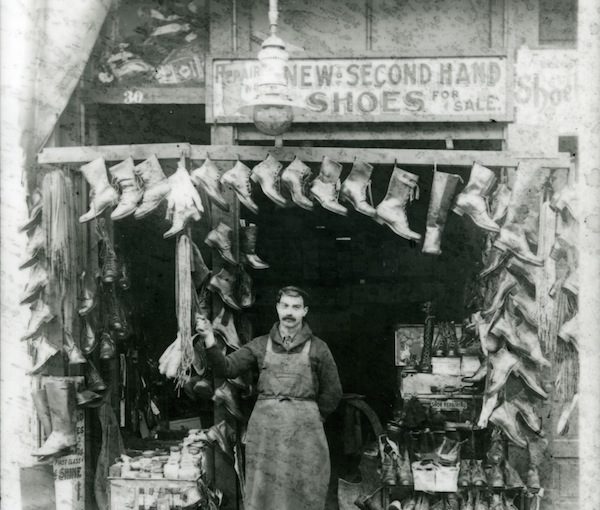
Nessim Menashe, born on the Isle of Rhodes in 1887, came to Portland in 1909. By 1914, he had established a shoe repair shop in northwest Portland, which he operated until 1921. (photo from Oregon Jewish Museum and Centre for Holocaust Education, OJM 03274)
Reading the history of the Oregon Jewish community can feel like reading B.C. Jewish history in a carnival mirror. Everything is familiar but just a little out of place.
Since the sister communities of Vancouver and Portland share both common history and common concerns about the future, there is much we can learn from each other. This is one reason why the Jewish Museum and Archives of British Columbia is excited to be hosting a trip to Portland in late May.
The three-day, two-night trip will take participants to historic sites and Jewish restaurants, and introduce them to engaging locals. Travelers will eat at Aviv, Lefty’s Café, Katchka, and Kenny & Zuke’s Deli. They will visit the Oregon Holocaust Memorial, Oregon Jewish Museum, Powell’s Bookstore, Beth Israel Historic Synagogue, Portland Art Museum, Oregon Historical Society Museum, Portland Rose Garden and Portland’s South End Jewish neighbourhood. They will also enjoy a curator-guided tour of the Oregon Jewish Museum.
As in British Columbia, it was the gold rush that attracted the first Jews to Oregon. German-born Jacob Goldsmith and Lewis May opened a general store in Portland in 1849 and helped found the Masonic Temple the following year. The community’s growth kept pace with the rapidly growing city and, in 1858, the Reform congregation Beth Israel was established. Jews had a disproportionate presence among the merchant class, with one-third of the 146 merchants on record in 1860 being Jewish. They worked in the industries of clothing, tobacco, furniture and wholesale.
Just 328 kilometres north, the Jewish population of Victoria followed a similar trajectory. The earliest arrivals stepped off boats arriving from San Francisco in 1858. They, too, established careers primarily as merchants and, in 1863, opened Congregation Emanu-El, which continues to operate today. In the 1870s, Jewish merchants began placing their bets on the future of a small encampment on the Fraser River, going by the name of Granville. These bets paid off when Granville became Vancouver in 1886, the terminus of the intercontinental railway.
The Jewish populations of Portland and Vancouver have grown dramatically over the decades since, with new arrivals from all corners of the world making their contributions. In both locations, community organizations blossomed early on, providing essential social and cultural services. Today, the Jewish population of Portland, at 50,000, is roughly double that of Metro Vancouver, thanks largely to a wave of young American Jews who were drawn to Portland in the wake of the 2008 market crash.
To learn more about the Oregon Jewish community and to experience it firsthand, join the JMABC-led trip, which departs by chartered bus on Monday, May 27, and returns Wednesday, May 29. For more information and registration, visit jewishmuseum.ca/program/portland-jewish-history-tour. The deadline to register is March 31.
Dave and Rose Nemetz with an unidentified group, undated. (photo from JWB fonds, JMABC L.16225)
If you know someone in this photo, please help the JI fill the gaps of its predecessor’s (the Jewish Western Bulletin’s) collection at the Jewish Museum and Archives of B.C. by contacting archives@jewishmuseum.ca or 604-257-5199. To find out who has been identified in the photos, visit jewishmuseum.ca/blog.
Susan Mendelson, founder of the Lazy
Gourmet, shares a little about herself and her business at the launch of this
year’s The Scribe. (photo by Kenneth I. Swartz)
One of Vancouver’s most successful food
industry professionals shared her story recently, helping to launch this year’s
edition of The Scribe, the journal of the Jewish Museum and Archives of
British Columbia.
The topic of the 2018 issue is food, covering
restaurants and related sectors from the early days of the community up to destinations
that are still operating today. Susan Mendelson, best known around town as
founder of the Lazy Gourmet, brought her thespian side to the audience at the
Western Front Nov. 28, eliciting laughter as she guided the packed hall on a
tour through her remarkable career.
“My mother’s mother, Grandma Faye, was a large
influence in my life,” Mendelson said. An extraordinary baker and cook renowned
in her small Jewish community of Quebec City, Grandma Faye took it as a
challenge to keep a deep freezer filled with baking for when friends dropped by
or to be ready for a tea party.
As a child, Mendelson loved to cook and bake.
When the Six Day War broke out in Israel, in 1967, the family rallied to raise
funds to send to Israel. Young Susan planned a bake sale in their backyard. She
made all of her favourite squares and cookies and the neighbours snapped them
up. Mendelson’s mother only told her years later that the cost of the
ingredients was on par with what was raised that day. Thankfully, Mendelson told
the audience, that wasn’t a harbinger of things to come.
Mendelson came to Vancouver to study at the
University of British Columbia and gravitated to the theatre department. Her
theatre professor, Larry Lillo, became a close friend. He broke the news to Mendelson
that she would never be a great actress … though he really loved her
cheesecake.
After third year, Mendelson took a break from
school and worked in a group home for troubled teens. There, she met Deborah
Roitberg, with whom she made the food for the kids in the group home. An
instant friendship developed.
After traveling to Europe and Israel, Mendelson
thought she would return to school and pursue social work. Around that time,
Lillo had founded Tamahnous Theatre, an experimental ensemble that was becoming
the resident company at the Vancouver East Cultural Centre. He hired Mendelson
as house manager, which allowed her to go to school during the day and work at
the Cultch, as the institution is familiarly known, at night. But the salary
didn’t cover her expenses, so she began to make cheesecake to sell at
intermission, later adding carrot cake and Nanaimo bars to her repertoire –
“when the curtain came down at intermission, the lobby was stormed by people
pushing in line to make sure that they got their piece of the cake.”
Anne Petrie of CBC radio’s afternoon show
called Mendelson, having heard about the cheesecake phenomenon, and asked her
to come on the program.
“I told her that I was putting myself through
university with the recipe, but that I would come onto her show to tell her
listeners how to make chocolate cheesecake, a recipe that my friend Miriam
Gropper had given me,” Mendelson said.
Her cheeky attitude was a hit with audiences,
and she was asked back. She returned for Valentine’s Day, talking about
aphrodisiacs. Soon she had a regular radio gig paying $25 per appearance.
Mendelson’s boss at the Cultch started asking
her to cater opening night parties. Wedding catering followed and then
Mendelson was given the responsibility of catering to all the performers at the
first iteration of the Vancouver Children’s Festival. She and Roitberg
discussed opening a take-out food business.
“Our concept was that people would bring in
their casserole dishes and platters and we would fill them with our food and
they would take them home and pretend that they had made them themselves,” she
said. “We would call ourselves the Lazy Gourmet, in honour of our customers who
wanted gourmet food but were too lazy to make it themselves.”
Over the years, Mendelson had shared scores of
recipes with radio listeners and some asked her to put them in book form. Mama
Never Cooked Like This sold out and went into reprints; it was picked up by
an American publisher.
To coincide with the publication of her second
book, which was written for children and titled Let me in the Kitchen,
the producer of the Children’s Festival, Chris Wootten, asked Mendelson to
produce her own show. The best part of that experience, Mendelson recalled, was
that a single dad in the audience brought his 7-year-old son and they bought
the cookbook and made recipes
from it. “Six years later, I met those two,”
she said. “And, seven years later, I married the dad and became stepmother to
the most wonderful young teen. I was so happy that Jack and Soleil had experienced
that show and that in some way we shared that amazing experience of my life.”
TV appearances followed and Mendelson was asked
to write a souvenir cookbook for Expo 86.
But the trajectory was not entirely positive.
After expanding the Lazy Gourmet from one store to three, the company began
losing money. They eventually abandoned two of the storefronts and Roitberg
left the business to raise a family.
Soon after the birth of daughter Mira,
Mendelson was invited to cater a new event that was coming to Vancouver: the
Molson Indy Vancouver.
“If you thought that the Children’s Festival
wore me out … you can’t even imagine what that event did to me physically,” she
said. “But, of course, I loved it and, by the last few years of the race, which
took place on Labour Day weekend – Jack will tell you that it was our
anniversary weekend that we didn’t celebrate for nine years – we were also
catering the Abbotsford Airshow, which took place two weeks beforehand and, two
weeks before that, we catered the Skins Game at Predator Ridge in the
Okanagan.”
In addition to hard work, Mendelson credits her
success to hiring people who she says are smarter and more talented than
herself. A couple of years ago, she gave shares in the company to two long-term
team members and moved into a part-time role. The company continues to expand,
including a lifecycle catering department. “We call it womb-to-tomb catering,”
she said, citing baby-namings, britot milah, b’nai mitzvah, weddings and
funerals, as well as personal events. More recently, Mendelson took on catering
the lunches at Vancouver Talmud Torah.
The Scribe launch also
included words from Cynthia Ramsay, editor and publisher of the Independent,
who has also, for the past nine years, edited The Scribe.
“When I started the job, the journal was a mix
of academic essays and community-related history,” Ramsay said. “But it soon
changed to become a means by which the museum could highlight its collection;
the oral histories, photographs and other artifacts that it houses on the
community’s behalf. We’ve done issues on the Jewish Western Bulletin,
the Jewish Independent’s predecessor; on the furniture industry; scrap
metal dealers; the clothing industry; on some of the community pioneers who are
buried in our cemeteries all around the province; and, this year, of course,
our issue is on the food and service industry.”
She credited museum staff Alysa Routtenberg,
Marcy Babins and Michael Schwartz, and the publications committee, which this
year included Routtenberg, Perry Seidelman, Gary Averbach, Debby Freiman, Fred
Swartz and Ronnie Tessler. The JI’s production manager, Josie Tonio
McCarthy, does the layout for the journals.
Seidelman, president of the JMABC, urged audience members not to
throw out photographs or documents. “Give them to us,” he said.
Women at the Beth Tikvah Sisterhood
spring conference, which took place at Beth Israel, 2000. Shelley Ail is the
first on the right, but the others are unknown. (photo from JWB fonds, JMABC
L.11302)
If you know someone in this photo, please helpthe JI fill the gaps of its predecessor’s (the Jewish Western Bulletin’s)collection at the Jewish Museum and Archives of B.C. by contacting archives@jewishmuseum.ca or 604-257-5199. To find out who has been identified in the photos,visit jewishmuseum.ca/blog.