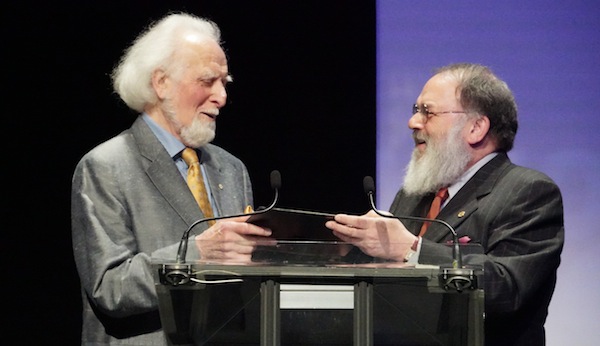
Dr. Yosef Wosk, right, with Max Wyman, 2017. (photo by Fred Cawsey)
The Yosef Wosk Poetry Initiative at the Jewish Community Centre of Greater Vancouver, which began in 2009, marked its 10th year with a celebratory gathering of artists and poets and with the publication of a commemorative book earlier this year. In addition, the Yosef Wosk Poets’ Corner, along with the adjacent Poet Laureates Garden, was inaugurated on the newly renovated top floor of the downtown central Vancouver Public Library – it was named in recognition of Dr. Yosef Wosk’s decades-long support of the VPL.
Wosk was an early major donor to the redevelopment of the eighth and ninth floors and the roof of the central branch of VPL and was asked to serve as honourary chair of the VPL campaign in 2018/19. The architect for the renovations, as for the library itself, was Moshe Safdie, while Cornelia Hahn Oberlander designed an extensive garden to complement her roof garden that crowns the award-winning structure.
In the library world, Wosk – who has established more than 400 libraries on all seven continents over the past 20 years – was able to fund more than 50 new initiatives in 2018/19, including 20 libraries in remote Himalayan villages and 37 in Jewish communities throughout the world.
As a writer and publisher, Wosk’s work has appeared in a number of publications. Most recently, these include having curated and written the preface for Memories of Jewish Poland: The 1932 Photographs of Nachum Tim Gidal, featuring photographs by Gidal from Wosk’s and the Israel Museum’s collections (Gefen Publishing, Jerusalem and New York, 2019). He also initiated and funded a biography, written by Christopher Best, of Faye Leung, the effervescent pioneer in the Chinese and real estate communities, affectionately known as the Hat Lady (Warfleet Press, 2020).
Wosk’s essay “On the Wings of Forever” was published in the online Ormsby Review this year in collaboration with the Canadian Academy of Independent Scholars. The editor’s preface notes that: “With prose as profound and learned as it is clear and accessible, here Wosk examines and appreciates the role of museums and museum workers in the digitizing modern world. It’s not gloom ’n’ doom. Instead, he outlines what he calls ‘a stirring vision, one of innovative technology on a human scale, heart-centred and soul-sized.’”
In collaboration with the Canadian Museums Association, Wosk helped transform the President’s Award into the President’s Medal; he also commissioned the medal and wrote the introduction in the booklet that accompanies the honorific, which was first awarded in 2019.
The province-wide Max Wyman Award for Critical Writing in the Arts, which was inaugurated by Wosk in 2017, formed an alliance this year with the VIVA Awards (the Shadbolt Foundation), which will begin in 2020.
In academia, Wosk was reappointed this year as an adjunct professor in humanities at Simon Fraser University and completed four years as a Shadbolt Fellow at SFU, where he was recently named a Simons Fellow.
During the year, Wosk served on 11 boards in the Jewish and general communities in areas such as education, medical research, museums, libraries, literature, business and the arts. These boards have included the Vancouver Holocaust Education Centre, Schara Tzedeck Cemetery Board, CHILD Foundation, Museums Foundation of Canada and Pacific Torah Institute. He was also an ambassador for the Vancouver Sculpture Biennale and is completing a second term with the B.C. Arts Council.
We are taught from an early age that giving, repairing the world and being kind are the tenets of living a Jewish life. In our community we don’t have to look very far to find people who fit this description. One of the latest projects that has come to fruition is the Diamond Residences in the Storeys complex in Richmond. Thanks to the generosity of the Diamond Foundation, Tikva Housing Society now owns 18 (chai!) units that are being rented at below-market rates to people in the community for whom stable, safe housing was unpredictable and unaffordable, at best.
Tikva Housing partnered with four nonprofit societies and the City of Richmond to build these and other apartments. Tikva worked hand in hand with community agencies such as the Jewish Family Service Agency to place tenants in need in these units, as well as with the Jewish Federation of Greater Vancouver and B.C. Housing. Most of the tenants will have moved into their units by the end of this month.
The Diamond Residences will house six singles and, of those, five are seniors. Also, 12 families and a total of 22 children will be living there. One 83-year-old woman cried when she was told she would be moving into a studio unit, as she has not had a place to live for years and was sleeping on someone’s couch. A single Israeli mother with two children is moving into a three-bedroom unit; her kids have never had their own rooms. Another single mother with three children has been sharing a two-bedroom place and has not had her own room in two years. One family has moved to Greater Vancouver from out of town and can now attend Shabbat services, be close to their family and the Jewish community. There are many more such stories.
– Courtesy of Tikva Housing Society
* * *
Simon Fraser University recognized four distinguished alumni on Sept. 13 at Four Seasons Hotel. Among them was Gary Cristall, co-creator of the Vancouver Folk Festival.
The annual awards, presented by SFU and the Alumni Association, recognize those whose accomplishments and contributions reflect the university’s mandate of engaging the world. An advocate for the arts and human rights, Cristall has been a cultural groundbreaker, having co-founded the Vancouver Folk Music Festival in 1978. In an industry plagued with an unscrupulous reputation, Cristall has been instrumental in fighting for the rights of artists to be treated professionally and with respect while also defending their rights to fair performance fees and copyright ownership.
Cristall served as acting head of the music section of the Canada Council for the Arts and was the founding president of the Public Service Alliance of Canada, the first union at the Canada Council. Today, Cristall continues to serve as a prominent mentor and educator, assisting artists in building their careers and guiding communities in enhancing dynamic cultural interactions that enrich and benefit a healthy, democratic society.
* * *
After a grueling 33 hours of programming, DragonFruit – Benjamin Segall, Jacy Mark, Viniel Kumar and Pritpal Chauhan – completed StoryTree and demonstrated it live to a panel of judges at Hack the North, an international student hackathon held at the University of Waterloo in Ontario, which this year took place Sept. 15-17.
Canada’s biggest hackathon, Hack the North was founded and is organized by Techyon, a student-run nonprofit organization, in partnership with Waterloo Engineering. The event brings together 1,000 students from top universities across 22 countries in the world. Students collaborate and create impactful new hardware projects or mobile and web applications of their own design for a weekend at the University of Waterloo, all expenses paid.
DragonFruit’s StoryTree was one of the 14 projects chosen out of the more than 250 demonstrated at Hack the North. StoryTree is an online workspace for aspiring authors to collaborate on books together. All you have to do is write a paragraph or a chapter, or even just a sentence, and, as more and more people add or branch off from a story, that story you’ve always wanted to write becomes a reality.
DragonFruit will be continuing the project and are looking for alpha testers for January 2018. If anyone is interested in being a part of this project or for more information on it, contact them via facebook.com/dragonfruitcode or dragonfruitcode.com.
* * *
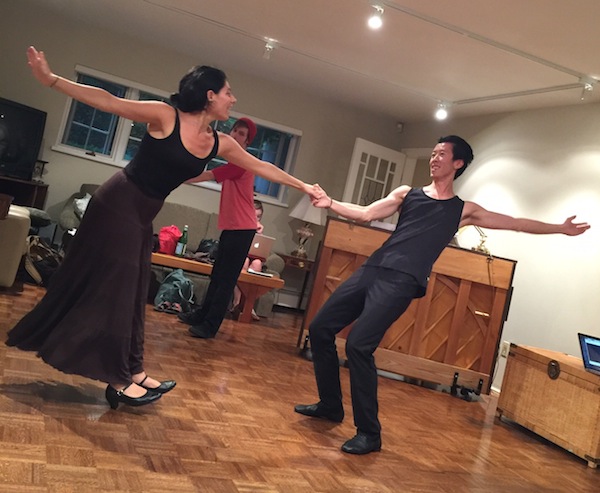
Swinging Sylvia rehearsals: Advah Soudack and Sky Kao create a whirlwind of action in rehearsal of the second one-act play that comprises Two Views from the Sylvia. (photo by Sue Cohene)
Rehearsals have started for Two Views from the Sylvia, a new musical theatre production by Kol Halev Performance Society. This original production – which will be at Waterfront Theatre Nov. 8-12 – tells the story of the iconic Sylvia Hotel and its historic connection to the local Jewish community and the city of Vancouver.
Two Views from the Sylvia comprises two one-act plays.
The first play, Sylvia’s Hotel, is set in Vancouver in 1912. It brings to life the origin of the Sylvia Hotel, named for Sylvia Goldstein (Ablowitz) and the story of the Goldstein family who built it. Young Sylvia Goldstein and the legendary Joe Fortes, the beloved English Bay lifeguard, develop a bond that helps Sylvia realize her dreams.
In the second play, The Hotel Sylvia, the story continues as we meet the characters whose lives and loves became interwoven with the story of the Sylvia over her 100-year history. It includes vignettes revealed to the production’s researchers by Huguette, the front desk clerk who worked at the Sylvia for 35 years.
Jewish community members play key roles in both plays. In the lead roles are Advah Soudack (as Sylvia) and Adam Abrams (as Abraham Goldstein); Anna-Mae Wiesenthal and Joyce Gordon are cast in important supporting roles. Behind the scenes are Sue Cohene (producer) and Heather Martin (associate producer), as well as Gordon (assistant producer) and Abrams (graphic designer and webmaster) and Gwen Epstein (production team). Marcy Babins and Michael Schwartz collaborate in their roles at the Jewish Museum and Archives of British Columbia, which has created an historical photo display to accompany the production.
Two Views from the Sylvia is a project of Kol Halev in partnership with the B.C. Arts Council, Government of British Columbia, City of Vancouver, Granville Island Cultural Society, CMHC Granville Island and the JMABC. For information and tickets ($28), visit sylviamusical.com.
– Courtesy of Kol Halev
* * *
Bema Productions’ Victoria Fringe Festival play Horowitz and Mrs. Washington was a great success. All seven performances at Bema’s Black Box Theatre at Congregation Emanu-El were sold out and the production company’s work was once again as one of the best dramas in the Victoria Fringe.
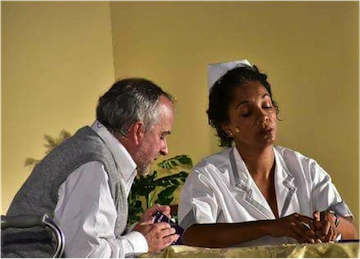
Bema Productions’ Victoria Fringe Festival play Horowitz and Mrs. Washington was a great success. (photo from Bema)
Mrs. Washington is hired to nurse Sam Horowitz, who’s been mugged and had a stroke. She’s a determined tyrant and he’s a bigoted Jewish widower. The two must find a mutually beneficial relationship when his daughter tries to make him leave his home. The play by Henry Denker reflects the attitudes of the 1970s and illuminates the power to be found in ordinary lives.
“The electric performance of the actors enabled the audience to visit uninhibitedly the issues of racism, stroke recovery and aging in place,” reads the review “Bravo Bema!” on Emanu-El’s website.
“For the most part,” said the review, “the actors were provided with a very humorous script that relied on stereotyping but went beyond it for its punchlines. The audience was asked to stretch their imaginations – who would have considered invoking Michelangelo to explain why the naming of a grandson ‘Douglas’ instead of ‘David’ was inappropriate? There were a few moments when the pace flagged but very few.”
While the play “revealed little about the face of contemporary racism,” the “potential disempowering of aging adults by their loving offspring is an issue of contemporary concern.”
The Bema production was directed by Zelda Dean and Angela Henry and was performed by David Macpherson, Rosemary Jeffery, Christine Upright, Alf Small, Cole Deo and Graham Croft.
– Courtesy of Bema Productions
* * *
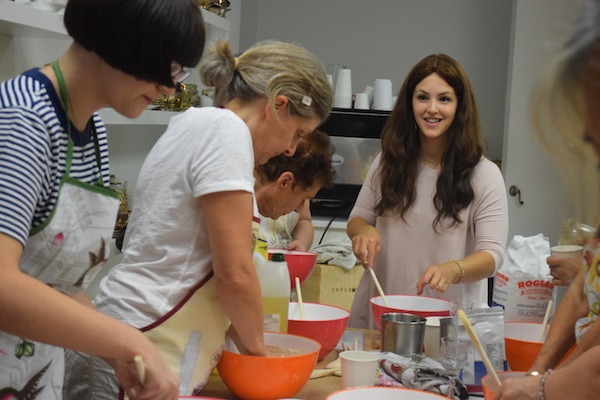
Miki Mochkin teaches a class on baking challah. (photo by Shula Klinger)
Chabad North Shore hosted a challah bake at Mia Claman’s store in West Vancouver on the night of Sept. 6. Miki Mochkin taught a class on baking challah to local women. While the bread was rising, she explained the significance of each ingredient for Jewish women. From the sweetness of the honey to the harshness of the salt, every element serves to remind the baker of its symbolic role in our lives as women and mothers.
– Courtesy of Shula Klinger
* * *
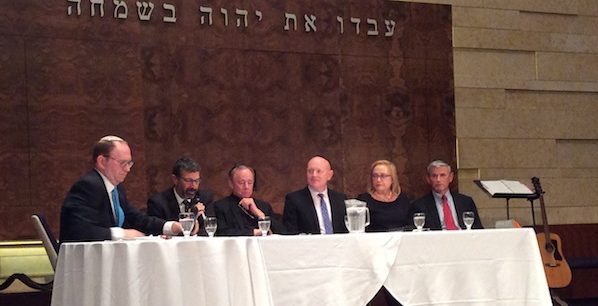
Panelists at Congregation Beth Israel discuss the topic Our Leaders: Are They Above the Law? (photo by Cynthia Ramsay)
In the photo, left to right, are Congregation Beth Israel Rabbi Jonathan Infeld, King David High School head of school Russ Klein, Vancouver Catholic Diocese Archbishop Michael Miller, Vancouver Police Chief Constable Adam Palmer, B.C. Court of Appeal Justice Sunni Stromberg-Stein and MLA Andrew Wilkinson. On Saturday night, Sept. 16, at the synagogue, this panel of speakers took on the topic Our Leaders: Are They Above the Law? Infeld framed the contemporary discussion around a talmudic discussion regarding an important rabbi in a community, rumours surrounding his conduct and whether the rabbi should be excommunicated. The panelists took this starting point to talk about their own professions, present-day accountability standards and various other issues.
SFU’s Teaching Support Staff Union voted 186 for and 227 against including a BDS campaign in the union’s bylaws and policies. (photo from RestfulC401 (WinterforceMedia) via commons.wikimedia.org)
The Vancouver Jewish community had another victory over the boycott, divestment and sanctions movement last week, this time at Simon Fraser University.
The university’s Teaching Support Staff Union (TSSU), a union for teaching assistants, seasonal instructors and non-full-time staff, held a referendum May 15-19 on whether to include a BDS campaign against Israel in its bylaws and policies. The motion was defeated, with 186 TSSU members voting for BDS and 227 voting against it.
When Rabbi Philip Bregman, executive director of Hillel BC, first heard about the referendum, he and his team at Hillel BC were in the midst of fighting BDS at the University of British Columbia. “It was like whack-a-mole,” he said. “We were fighting two battles at the same time and, when we weren’t dealing with UBC, we were dealing with SFU!”
Bregman estimates TSSU has around 600 members and a key part of Hillel BC’s strategy was reaching those members. That was a challenge, given the fact that TSSU would not give Hillel BC access to its membership list. Instead, Hillel BC had to research each SFU faculty individually to find out who its teaching assistants were, and then communicated with them via email. “It was like we were fighting ghosts – we had to try figure out who the part- time professors and TAs were in order to reach their members,” he said.
Bregman and his team also sent a letter to SFU faculty members, explaining how dangerous it was for an academic institute to be boycotting other academic institutions. “We were trying to show members of the TSSU that this was not a smart thing for them to do,” he said.
The week of the referendum, Bregman and his team were on the SFU campus with a sign requesting that TSSU members approach them and have a conversation – and many of them did. TSSU tried to counter Hillel BC’s arguments, but their counter-arguments were weak, Bregman said.
Still, Bregman was certain the BDS campaign would be voted into policy. “The TSSU held all the cards. They wouldn’t let us know who their membership was and most of the information they sent out was pro-BDS,” he said.
On its website, however, amid the wording of the resolution and other background information, TSSU included four documents that laid out reasons why members should vote no to the BDS motion.
While the administration at SFU did not issue any statements about its position on the BDS referendum, it did reach out to Bregman. “They called me to ask what was happening on their campus,” he said. “I told the university administration that SFU would get a black eye if this thing passes. It really would have been catastrophic for the university.”
Lauren Kramer, an award-winning writer and editor, lives in Richmond. To read her work online, visit laurenkramer.net.
ליף הידוע בעולם, אדוארד סנודן, שעבד בעבר בסוכנות לביטחון לאומי של ארה”ב (האן.אס.איי), השתתף ביום שלישי שעבר בפורום על נושא “המידע גדול” שאורגן על ידי אוניברסיטת סיימון פרייזר בוונקובר. סנודן שמסתתר במוסקבה מזה כשלוש שנים, דיבר אמצעות שידור וידאו לאלפי מעריצים שמילאו עד אפס מקום את אולם תיאטרון קווין אליזבת בדאון טאון. הכרטיסים לאירוע נמכרו מראש לפני מספר חודשים בתוך שעות.
סנודן נטש את ארה”ב במאי 2013 ומשם טס להונג קונג. הוא קיווה לקבל בהונג קונג או באיסלנד מקלט מדיני מפני השלטון האמריקני שמחפש להביאו למשפט אך זה לא קרה. סנודן טס ישירות לרוסיה ושם קיבל מקלט מדיני. הוא חשף בין היתר מידע על קשרי ישראל וארה”ב, שמתאר את מערכת היחסים הקרובה בין שירותי הביטחון של שתי המדינות (בתחומי ירוט, ניתוח ודיווח) כולל העברת מידע צבאי, אזרחי ותקשורת דיפלומטית.
בדבריו בפורום התייחס סנודן לסוגיות שעומדות כיום על הפרק. בהן הדלפת המסמכים הענקית ממשרד עורכי הדין על המשקיעים ידועים מכל העולם שמחזיקים הון גדול בפנמה, החשיבות שבהדלפת חומרים מסוג כזה, על החוק נגד טרור שאושר בקדנציה האחרונה של ממשלת השמרנים בראשות סטיבן הרפר, ומה יכולים לעשות כיום אזרחים מן השורה כדי שיוכלו לשמור על פרטיותם.
לגבי פרשת פנמה טען סנודן כי שוב הוכח שאנשים עשירים בעלי השפעה מנצלים את כוחם, ופועלים לפי חוקים אחרים לעומת אזרחים מן השורה, ואף משלמים הרבה פחות מס מהם. “אנו למדים שהשחיתות אינה רק נחלתן של סין, רוסיה ואוקראינה, אלא גם של מדינות אחרות” הוא הוסיף. סנודן חזר והדגיש כי רק הדלפות כמו זו של מסמכי פנמה, המסמכים שהוא בעצמו חשף ביוני 2013 על תוכניות המעקב של האן.אס.איי, יגנו על האזרחים. הוא הדגיש כי יש לעודד ואף לתמוך במדליפים. בתשובה לשאלה שהגיע מן הקהל, הוא ענה כי לא היה לו קשר למי שהדליף את מסמכי פנמה. לגבי קנדה ציין סנודן כי כידוע למדינה יש קשרים הדוקים עם ארה”ב והן שותפות במידע עם שלוש מדינות נוספות שחברות במועדון ‘חמש העיניים’ לנושאי ביטחון וביון (בריטניה, אוסטרליה וניו זילנד). לגבי ההגנה על פרטיות האזרחים הציע סנודן כי יש לנקוט במשנה זהירות בכל הקשור לשיחות טלפון, שליחת מסרים וכדומה. הוא הציע מספר אפליקציות שחסינות ממעקב.
סנודן הוא האחראי לכך שפתאם כולם מדברים על הצפנת מסרים, נושא שנמצא בחדשות בתקופה האחרונה וכולל את כל אמצעי המדיה השונים. לפני שהחל סנודן לחשוף את מסמכי האן.אס.איי לפני כשלוש שנים, היה קשה להסביר את הצורך שבהצפנה ברוב המכשירים והיישומים. עם חשיפת מידע הריגול האדיר על האן.אס.איי והשותפות של הארגון של ידי סנודן, הופנתה ביקורת קשה מאוד אל עבר הממשל האמריקני, מצד גורמים שונים בהם חברות תקשורת רבות וממשלות באירופה. סנודן הוא זה שהביא לתודעת התקשורת והציבור הרחב את החשיבות שנושא ההצפנה.
בשידור לוונקובר אמר סנודן שהוא תומך נלהב באפליקציית המסרים של וואטסאפ (בבעלות פייסבוק שרכשה אותה לפני כשנתיים תמורת 19 מיליארד דולר). כל ההודעות שנשלחות בוואטסאפ מקבלות שידרוג אבטחה גבוה ביותר מקצה אל קצה, ממש כמו הצפנה של תכנים. לדברי סנודן זהו המערך היחידי כיום שאי אפשר לדלות את האניפורמציה שמועברת בו כולל מספרי טלפון, מסרים ותמונות. על המשתמש בוואטסאפ לבדוק שהאפליקציה שלו מעודכנת והוא משתמש בגירסה האחרונה של השירות.
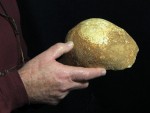
A skull found at the Dan David-Manot Cave supports other evidence that modern humans (Homo sapiens) evolved in Africa or in the Middle East, not in Europe. (photo by Clara Amit, Israel Antiquities Authority)
Francesco Berna, a Simon Fraser University assistant professor of archeology, is part of an Israeli-led team of scientists that has unearthed major clues about the first modern humans in northern Israel.
A paper published in Nature on Jan. 28 – co-authored by Berna – documents the discovery of a 55,000-year-old, partial human skull with a distinctive modern human, bun-shaped “occipital” region, at the Dan David-Manot Cave in the western Galilee.
The study involved researchers from the Israel Antiquities Authority, Geological Survey of Israel, Weizmann Institute of Science, Tel Aviv University, Ben-Gurion University of the Negev, Hebrew University, University of Haifa, University of Vienna, Harvard University, Case-Western University, Max Planck Institute for Evolutionary Biology, Columbia University and SFU. It is headed by Prof. Israel Hershkovitz, Dr. Omry Barzilai and Dr. Ofer Marder, and funded by the Dan David Foundation, Israel Academy of Sciences, Irene Levi Sala CARE Archeological Foundation, Leakey Foundation and IAA.
Berna and his colleagues believe that this skull’s date of origin and where it was found support other evidence that modern humans (Homo sapiens) evolved in Africa or in the Middle East, and migrated from there about 65,000 years ago. This contrasts with the hypothesis that the human species first evolved in Europe.
One of the migration routes by which modern humans spread out across the world passes through the Levant (the Mediterranean basin), which is the only land crossing between Africa and Europe, but until now, no modern human remains that date to the period between 65-45 thousand years ago had been discovered.
The Manot skull’s inner and outer surfaces were covered with cave deposits that were dated by means of uranium-thorium to 55,000 YBP (years before present). A morphometric analysis showed it is that of a modern human being with similarities to modern skulls from Africa on the one hand and the ancient skulls of modern humans from Europe on the other.
Berna helped the scientific team understand how ancient humans used Manot Cave at the time of the skull’s origin and how the cave, its archeological remains and the skull got to their present state.
Megan Thibodeau, one of Berna’s graduate students, explored the use of fire in this cave. Their work is helping scientists confirm whether this skull is from the most recent evolution of anatomically modern humans, which showed up in Europe first, and eventually the rest of the world.
“The skull found at Manot is absolutely comparable to ours and different from other skulls of early modern humans previously found in Israel and dated to 100,000 years ago,” explained Berna. “This earlier group of humans had some slight anatomical differences from us.
“But, most importantly, they didn’t produce stone tools, mobile sculptures and cave paintings such as the one that our direct ancestor produced in Europe and the Middle East, starting at around 40,000 years ago. Earlier modern humans apparently hadn’t yet developed our brain.”
To date, five excavation seasons (2010–2014) on behalf of IAA, TAU and BGU have been conducted in the cave, which is located 40 kilometres northeast of the Mt. Carmel prehistoric caves. Preparations are being made by the Ma’ale Yosef Regional Council, Moshav Manot and the Jewish National Fund for the development of the cave for visits by the public.
Surrey Mayor Dianne Watts, centre left, with the delegation in front of the Knesset Menorah. (photo from CIJA-PR)Last April, when Surrey Mayor Dianne Watts announced she planned to turn one square mile in her city centre into a leading centre for medical technology, the Centre for Israel and Jewish Affairs, Pacific Region, immediately started paying this leader attention.
“When we heard of her intention to create an Innovation Boulevard, we knew the mayor needed to tap into Israel’s spirit of ingenuity,” said Darren Mackoff, CIJA-PR director. Mackoff and his team helped organize Watts’ six-day trade mission to the Holy Land in December, a delegation that included individuals from the health-technology business sector and representatives from Simon Fraser University, the University of British Columbia and Kwantlen Polytechnic University – all of them key stakeholders in Surrey’s Innovation Boulevard.
In January, just a month after her return home, Watts signed a deal with Israel Brain Technologies, the first international deal of its kind secured since she and Innovation Boulevard co-chair, SFU neuroscientist and professor Ryan D’Arcy, announced the boulevard last year. Israel Brain Technologies, created by Israeli president and Nobel Peace Prize winner Shimon Peres, is a neuro-technology consortium. It unites Israel’s academics, neuroscientists and industry leaders under a single umbrella of brain research and innovation.
The IBT deal will give the City of Surrey access to some of Israel’s top thinkers and the development of innovative, life-saving medical advances, said Mackoff, but it will also give IBT the opportunity to engage in exchanges and partner on specific projects with their counterparts in Western Canada. “The outcomes of these joint ventures will undoubtedly serve the people of both Israel and B.C. well in the future,” he noted. In a press release, Watts said, “Israel and Surrey have common health-care challenges and share the goal of setting a new standard in medical care and innovation. By combining our remarkable pool of talents and expertise, I know that Surrey and Israel will together create groundbreaking and life-changing advancements in health care.”
Watts’ CIJA-led educational mission included 25 business meetings at Israeli universities, hospitals and centres of innovation, political briefings, tours of Israel’s most significant historic and contemporary sites, as well as a visit to Israel’s northern border with Syria, on the Golan Heights.
“In addition to gaining a strong understanding and appreciation for Israel and the challenges the Jewish state faces in the region, it was extremely important that Mayor Watts left Israel with tangible collaborative partnerships between the city, trip delegates and their counterparts in Israel,” Mackoff said.
The blizzard-like conditions in Jerusalem on the mayor’s day of arrival meant CIJA had to do some on-the-ground improvising and move the team to Tel Aviv at the last minute.
Mackoff traveled alongside the mayor and said she was tremendously moved and inspired by this visit. “The Jewish and pro-Israel community in Western Canada has a firm friend in Mayor Watts,” he reflected. “She saw firsthand what Israel is truly about – a country that has overcome tremendous obstacles to create a thriving democracy which is leading the world in scientific advancements.”
Due to personal circumstances, the mayor was unavailable for comment.
Lauren Kramer, an award-winning writer and editor, lives in Richmond, B.C. To read her work online, visit laurenkramer.net.