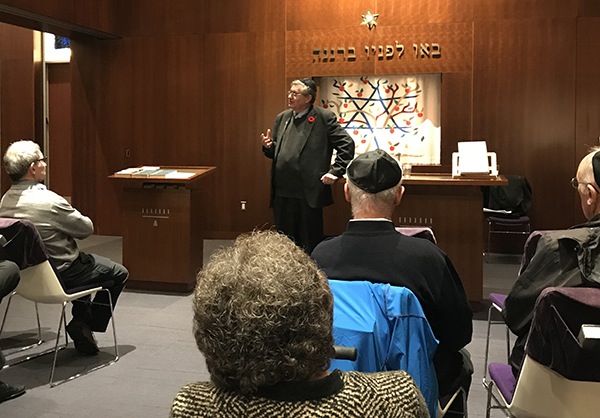
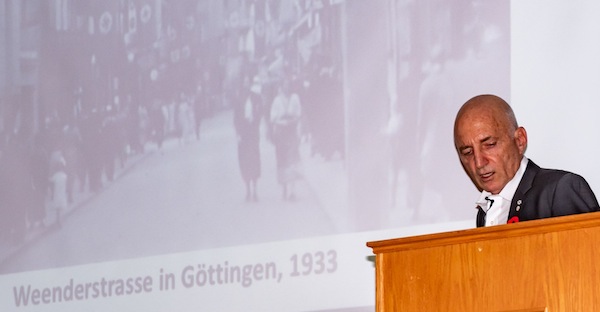
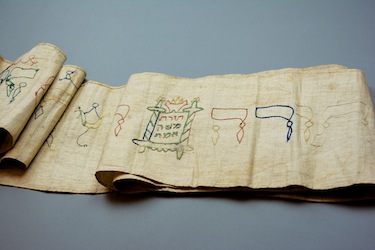
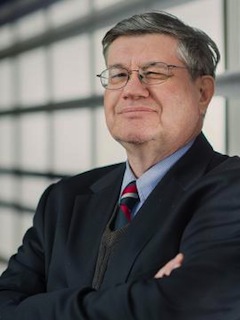
Dr. Chris Friedrichs will deliver the lecture “How to Steal from Jews: A Story from Nazi Germany and What It Teaches Us,” which will be available from Nov. 9, 7 p.m., from the Vancouver Holocaust Education Centre. The Victoria Shoah Project is also holding a commemoration, called “The Persistence of Creativity Emerging from the Shards of Tragedy.” (photo from VHEC)
On the evening of Nov. 9, both the Vancouver and Victoria Jewish communities will be holding virtual Kristallnacht commemorations. This year’s commemoration marks the 82nd anniversary of the state-sponsored Kristallnacht (Night of Broken Glass), which took place throughout Germany and Austria on the night of Nov. 9-10, 1938. In the course of just a few hours, hundreds of synagogues were burned, thousands of Jewish-owned places of business were destroyed, almost 100 Jews were killed, and 30,000 Jews were arrested and sent to concentration camps. The shards of broken window glass seen in front of Jewish-owned stores all over Germany the next morning gave the memorial event its name.
The Vancouver Holocaust Education Centre, in partnership with Congregation Beth Israel and with support from the Robert and Marilyn Krell Endowment Fund of the VHEC and funds from the Jewish Federation of Greater Vancouver annual campaign, is presenting the lecture “How to Steal from Jews: A Story from Nazi Germany and What It Teaches Us,” by keynote speaker Dr. Chris Friedrichs.
The Nazi regime not only murdered millions of Jews, it also relentlessly confiscated Jewish property from owners later sent to their deaths. The illustrated lecture by Friedrichs will describe the step-by-step process by which two elderly Jews from wartime Berlin were stripped of all their assets before they were deported to the death camps – and shows how Nazi officials then fought with one another about what to do with the stolen property.
Friedrichs is professor emeritus of history at the University of British Columbia, where he taught for 45 years before his retirement in 2018. He is a specialist in German history and has been active for many years in Holocaust awareness education.
The Vancouver event is pre-recorded and will be available for viewing any time after 7 p.m. on Nov. 9: visit vhec.org/events-gallery/#videos.
* * *
In Victoria, live-streaming via Zoom, the Victoria Shoah Project will present a program titled “The Persistence of Creativity Emerging from the Shards of Tragedy.” It is a remembrance of those who suffered on Kristallnacht and in the Shoah, as well as a reminder of how and why we, as a collective society, commemorate such tragic events. Remembrance is essential; however, we also must act in tangible ways to protect all peoples in our diverse community.
In recent years, there has been the unfortunate growth of attacks on minority groups and those who are “ the other.” This highlights the need for us to stand together to protect and safeguard all peoples, regardless of religion, race, sexual orientation or other factors, which may make them targets of a hateful few. And, in this context, the Victoria Shoah Project is inviting political and law enforcement leaders, as well as representatives from the diverse faith communities, to join together at the commemoration to lead the reading of a pledge of mutual respect and support.
It is also inviting the entire community to join the event – to remember the past and commit to take action for a better future, where we will respect and protect our neighbours, not remain silent in the face of any injustice against any person or group and work towards building bridges leading to unity and shalom (peace) in our community and beyond.
Dr. Michael Hayden delivers the keynote address at the annual Kristallnacht commemorative program Nov. 7. (photo by Al Szajman)
In the 1930s, German Jews were required to register all precious metals in their possession, a prelude to having them confiscated. In Hamburg alone, the Nazis collected 20 tons of silver, much of it Judaica. Of this, they melted down 18 tons. Two tons was deemed by the Nazi curator Carl Schellenberg to be of artistic or other value in its existing form.
After the war, Schellenberg was kept on by the British because his scrupulous indexing of artifacts made him valuable. His love of the city of Hamburg meant he ensured that some of the most precious pieces of stolen art and artifacts made their way to that city’s museum.
That is where Dr. Michael Hayden, a Vancouver researcher in molecular medicine and human genetics, and one of the world’s leading researchers in Huntington disease, was able to trace one of the few remaining pieces of his grandparents’ once-extensive collection of Judaica.
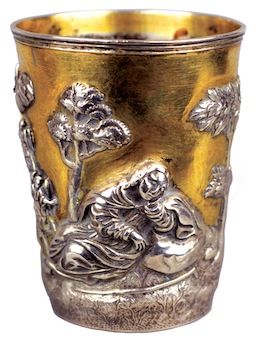
A silver Kiddush cup, crafted in 1757 and embossed with a vivid three-dimensional depiction of the story of Jacob’s vision of a ladder to heaven, which belonged to his grandparents, Gertrud and Max Raphael Hahn, has been restituted to the family. It is now on loan, a small artifact in size but one of the most stunning pieces in a just-opened exhibition at the Vancouver Holocaust Education Centre, titled Treasured Belongings: The Hahn Family & the Search for a Stolen Legacy.
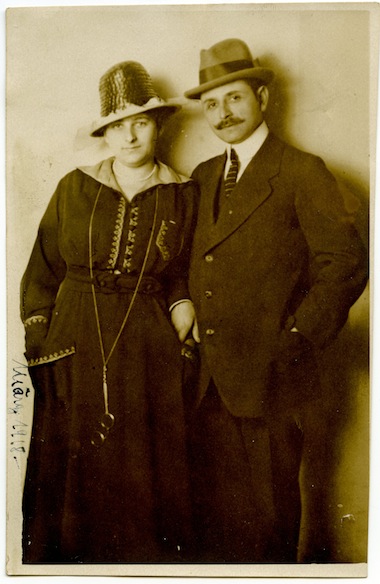
Max and Gertrud Hahn, the patriarch and matriarch of the German-Jewish Hahn family of Göttingen. Photo taken in Berlin, Germany, 1918. While their children, Rudolf and Hanni, emigrated to England, the couple did not survive the Holocaust. (photo from Hahn family)
Hayden delivered the keynote address at the annual Kristallnacht commemorative program Nov. 7, before the opening of the exhibition to the public. The exhibit runs to Nov. 27, 2020.
“It’s a story that it’s taken me a long time to confront,” Hayden told the Independent.
Hayden’s grandparents were transported to Riga, Latvia, in 1941, where they were murdered by Latvian collaborators of the Nazis. Max Hahn had been arrested for the first time on Kristallnacht, three years earlier, but, with Gertrud, had managed to secure the passage of many possessions to safe locations in the neutral countries of Sweden and Switzerland. More importantly, they had sent their two children, daughter Hanni and son Rudolf – Hayden’s father – to safety in London.
After the war, the orphaned pair retrieved the remnants of their family’s material possessions. Rudolf, who joined the British army in 1943 and adopted the less Germanic-sounding name Roger Hayden, moved to South Africa. There, more than a dozen boxes sat undiscussed in the family home. When Roger passed away, Michael Hayden shipped the boxes to his Vancouver home, where they sat, unopened, for another two decades.
When he finally confronted the parcels from his family’s past, he discovered a stamp collection, maps, artworks – and 9,000 original documents relating to his family’s history from the 1850s until 1941. These included heart-wrenching letters between Rudolf in England and his parents still in Germany.
While Michael Hayden was growing up, there were some items that his father had not kept stored away. One was a Paul Ritter violin that Rudolf had received on his bar mitzvah. Michael’s daughter, Anna, now a Vancouver hematology oncologist, played on it as a young person and Hayden hopes to one day hear grandchildren also play it. It is part of the exhibit. It is also a hint of how the family got its name. It was not a coincidence that, in anglicizing his name, Rudolf/Roger chose a variation on the surname of a legendary classical composer.
“There were piano recitals and all kinds of concerts in the Hahn family every Sunday,” said Hayden. “They used to have a little chamber orchestra, it was a totally different world. So, he chose the name Roger Hayden from Rudolf Hahn and I’m sure Hayden had some comfort for him because Haydn was so important in his life.”
Hayden credits the German government and museums for supporting restitution efforts. His family recently received a grant from the German federal government to hire a researcher to continue the search. Understandably, the challenges are great. The Hahn family’s collection of Judaica was considered one of the finest and most extensive in Germany, rivaling those of the Sassoon and Rothschild families. Because they had lent some objects to museums, and because of Max and Gertrud’s careful recordkeeping, the family has both photographs and detailed inventories of what the collection included before it was looted. Most families do not have such tangible proof.
Hayden emphasizes that any material value of restituted artifacts is irrelevant and the importance is because of personal significance, and that the process represents steps toward reconciliation and restoring dignity of Nazism’s victims.
“For me, personally, it’s been a process of coming to terms with the unimaginable horror and confronting it,” he said.
He has had very positive and some negative experiences during this work. He is impressed with the German government’s efforts to seek forgiveness for their country’s past, including memorializations like the 70,000 Stolpersteine, stumbling stones, that have been installed outside the last homes of victims of the Nazis, and the fact that the vast Holocaust memorial in Berlin is located between the embassies of major countries in the heart of the city.
“When I see Germany and I see what they’re doing, it’s been very instructive for me about confronting your history and confronting it unabashedly,” he said, making parallels with Canada’s reconciliation process with First Nations.
Germany’s response is especially admirable in comparison to other European countries that experienced collaboration and, rather than confronting their past, are actively denying it.
But, Hayden has had negative experiences, including the discovery that the school his father had attended in Hamburg had, as recently as a few years ago, what amounted to a museum to those students who had fought for the Nazis, with not a trace of the fate of the Jewish students who had attended. The Nazi display is now gone and a marker lists the names of Jewish students who were murdered. But he also discovered that the school’s long-held assurance that they had never participated in Nazi activities was fabricated, when photos emerged of the school festooned in Nazi flags and students and faculty making Heil Hitler salutes.
“At a personal level, for me, it’s trying to give up the stowaway of sorrow and pain on my shoulders that I’ve never confronted and to move forward,” Hayden said. “It’s not that I’m at forgiveness, but I recognize that forgiveness is not so much for those you are forgiving, but for the forgiver. You can give up your own toxic anger and move forward. For me, it’s also been a journey to acknowledge my own German ancestry and come to terms with it.”
He hopes that the exhibit, his family’s story and the larger facts of the Holocaust resonate in today’s world.
“We’ve got to be aware of ourselves as Jews of condemning other populations, we have to be aware of stereotyping, we have to be even more acutely aware from our own history about the struggles and making sure that we learn from that in the way that we conduct ourselves, so recognizing, as we look at children on television separated from their parents, that we too can be horrified by that and do whatever we can to make sure that we are not complicit or even silent in the face of all of this,” he said. “In certain circumstances, unless we really hold onto some deep principles of democratic culture and value of life, your neighbours can become your killers.”
As the search for additional family heirlooms continues, Hayden acknowledges the challenges. “I think it is a needle in a haystack to be honest, but it’s worth pursuing.”
Of the entire experience, he said: “It’s been an opportunity to give individuality and identity for two of six million people who were murdered, to rescue them from generalizations and understand who they were and understand their distinctiveness and to bring my grandparents out of obscurity and give them the warmth and respect they deserve.”
The Kristallnacht commemoration where Hayden spoke began with a candlelight procession of survivors. Cantor Yaacov Orzech chanted El Maleh Rachamim. Philip Levinson, president of the Vancouver Holocaust Education Centre (VHEC), introduced the event and Nina Krieger, the VHEC’s executive director, introduced the keynote speaker. Rabbi Jonathan Infeld offered reflections after Hayden’s address. Jody Wilson-Raybould, member of Parliament for Vancouver Granville, offered greetings, and Councilor Sarah Kirby-Yung read a proclamation from the City of Vancouver. The event was presented by the VHEC, in partnership with Congregation Beth Israel, the Jewish Federation of Greater Vancouver, the Jewish Community Centre of Greater Vancouver and the Robert and Marilyn Krell Endowment Fund of the VHEC.
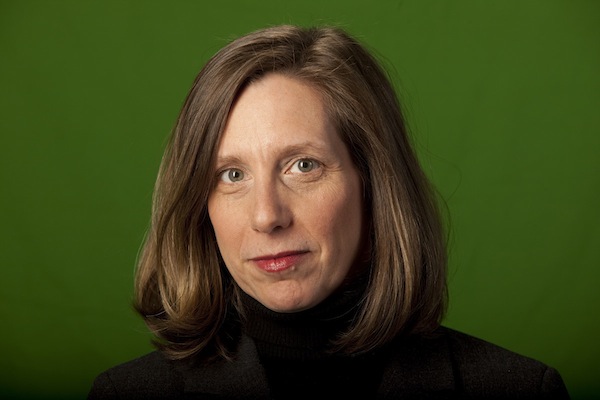
Marsha Lederman (photo by John Lehmann/Globe and Mail)
A few years ago, Marsha Lederman went with her mother, two sisters and a cousin on the adult portion of the March of the Living, which included a walk between the two main camps of the Auschwitz-Birkenau complex.
“The march from Auschwitz to Birkenau was somber and sorrowful, but it was also so empowering,” she recalled at the annual High Holidays Cemetery Service at Schara Tzedeck Cemetery in New Westminster Oct. 6. “We were marching with a statement to the world and a comforting message to the souls whose lives had ended so brutally on those grounds: ‘We are here, we are still living, we are multiplying, we remember you.’”
The family group proceeded to Radom, the town outside Warsaw where Lederman’s mother had grown up. The man who lived in the apartment where she had lived allowed them in and Lederman’s mother recounted her family’s years there.
“It was joyous,” Lederman said. “We were still on a high when we visited the memorial for the Radom Jews killed in the Holocaust. As I recall, it was in a fairly large square and seemed a little neglected. We were looking at this lonely memorial, the five of us women, when a group of, I would say, teenage boys began chanting something nearby. I don’t speak Polish, so I couldn’t understand what they were saying. But I did understand one thing: ‘Auschwitz-Birkenau.’ I don’t think they were offering their condolences.”
She reflected on the way she responded in that moment.
“We hurried away and said nothing. It was a safe thing to do, for sure. But, if that happened to me today, I would not walk away. I am done with walking away. Would I have put us in danger if I had turned around and confronted those boys? Maybe. But I know now that the real danger is in remaining silent.”
Lederman is the Vancouver-based Western arts correspondent for the Globe and Mail. Her father was born in Lodz, Poland, on erev Yom Kippur 1919. Her mother was born in Radom, Poland, in 1925. All four of their parents were killed in gas chambers at Auschwitz and Treblinka, as was Lederman’s father’s sister and little brother, and her mother’s little brother.
Lederman’s parents met in Germany after liberation and had one daughter there before moving to Canada, where they had two more daughters.
Lederman reflected on recent antisemitic incidents in North America and Europe, as well as her own encounters with antisemitism and racism, including a harrowing verbal attack on an Asian woman on the Skytrain at rush-hour, an incident in which Lederman was the only person to intervene.
“We have a duty to speak up,” she said. “We have a responsibility. This is our inheritance. I never had a bubbe or zadie to hug me or spoil me on my birthday or cook chicken soup for me. There’s nothing in my home that was theirs. I did not receive a single heirloom. But I did receive an inheritance – a duty to protect others from hate…. That is my inheritance and that is their legacy. Enough. Never again.”
She recalled being stunned during an interview with famed Vancouver photographer Fred Herzog, who died last month. Chatting after the main interview, Lederman asked the German-Canadian if he had experienced anti-German sentiment when he arrived here after the war. He launched into a discourse on the “so-called Holocaust” and said Jews died in the camps mostly because of lice and because Allied bombings prevented food from getting to them. Lederman agonized over whether to expose the admired photographer, eventually writing the story, for which she has been subjected to a range of criticism.
“Well, I have had enough,” she said. “And I’m going to fight to tell those stories and expose antisemitism and Holocaust denial and racism. I am not going to be quiet anymore. I think of all that was lost in the gas chambers; all the lives, of course, but also all the potential. With those millions of lives extinguished, what was lost with them? Poems were never written, beautiful artworks that were never painted, the cure for cancer, for Parkinson’s, the answer to the climate crisis?
“It was not just the people who were murdered that the world lost. It was all of their descendants and all of their descendants and all of that potential.… I talk about this because of what this leaves on our shoulders. I interviewed a Nisga’a poet, Jordan Abel, and he used a term to describe himself that I have adopted. He calls himself an intergenerational survivor of residential schools, which makes me an intergenerational survivor of Auschwitz. I do not take this lightly. With my parents’ survival came a hefty responsibility on me and on all of us who are descendants.”
At the service, Jack Micner, who led the ceremony and is also a member of the second generation, outlined a litany of antisemitic incidents and comments in Europe and North America in recent weeks.
“I suspect that those of our parents resting here in this cemetery would be furious to see what’s going on across the world,” he said. “We have to continue doing the type of work that VHEC [Vancouver Holocaust Education Centre] is doing in as many ways as we can think … it falls on us, because nobody’s going to do it for us.”
Rabbi Shlomo Estrin reflected on the loss of Chassidic communities during the Holocaust. Cantor Yaacov Orzech chanted El Maleh Rachamim.
Names were read of community members who have passed since the last High Holidays and a moment of silence was observed for the six million.
The Mourner’s Kaddish was recited by Jeremy Berger, a grandson of a Holocaust survivor. After the service ended, the Mourner’s Kaddish was also recited at the Holocaust Memorial in the cemetery.
The annual event is presented by the Vancouver Holocaust Education Centre with Congregation Schara Tzedeck and the Jewish War Veterans, and with support from the Jewish Community Foundation of Greater Vancouver.
Kristallnacht, which took place 80 years ago this month, saw hundreds of synagogues burned, Jewish-owned businesses destroyed, 100 Jews murdered and 30,000 incarcerated. (photo from commons.wikimedia.org)
Kristallnacht, which took place 80 years ago this month, was the “Night of Broken Glass” that saw hundreds of synagogues burned, Jewish-owned businesses destroyed, 100 Jews murdered and 30,000 incarcerated. The state-sanctioned pogrom was staged to look like a spontaneous uprising against the Jews of Germany, annexed Austria and occupied Sudetenland. It is frequently seen as the beginning in earnest of the Holocaust. According to Prof. Chris Friedrichs, who delivered the keynote address at the annual Kristallnacht commemorative evening Nov. 8, global reaction to the attack, which took place on the night of Nov. 9-10, 1938, sent messages to both Nazis and Jews.
“The world was shocked,” said Friedrichs, professor emeritus of history at the University of British Columbia. “Newspapers in the free countries of Europe and all over the Americas reported on these events in detail. Editorials thundered against the Nazi thugs. Protests took place. Demonstrations were held. Opinion was mobilized – for a few days. But soon, Kristallnacht was no longer front-page news. What had happened was now the new normal in Germany, and the world’s attention moved elsewhere. And this is what the Nazis learned: we can do this, and more, and get away with it. Nothing will happen.
“And the Jews of Germany learned something too,” said Friedrichs, himself a son of parents who fled the Nazi regime. “By 1938, many Jews had emigrated from Germany – if they could find a country that would take them. But many others remained. Much had been taken away from them, but two things remained untouched: their houses of worship and their homes. Here, at least, one could be safe, sustained by the fellowship of other Jews and the comforts and consolations of religious faith and family life. But now, in one brutal night, these things, too, had been taken from them. Their synagogues were reduced to rubble, their shops vandalized, their homes desecrated. Nothing was safe or secure. The last lingering hopes of the Jews still living in Germany that, despite all they had suffered at the hands of the Nazis, they might at least be allowed to live quiet private lives of work and worship with family and friends, collapsed in the misery of fire, smashed glass, home invasions, mass arrests and psychological terror on Nov. 9, 1938.”
Friedrichs’ lecture followed a solemn procession of survivors of the Holocaust, who carried candles onto the bimah of Congregation Beth Israel. The evening, presented by the Vancouver Holocaust Education Centre (VHEC) and Beth Israel, was funded by the Jewish Federation of Greater Vancouver annual campaign, with support from the Robert and Marilyn Krell Endowment Fund of the VHEC and the Azrieli Foundation, which provided every attendee with a copy of Dangerous Measures, the memoir of Canadian Joseph Schwartzberg, who witnessed Kristallnacht and fled Germany with his family soon after.
“We are gathered tonight in the sanctuary of a synagogue,” said Friedrichs, who retired in June, after 45 years of teaching and researching at UBC. “A synagogue should indeed be a sanctuary, a quiet place where Jews can gather, chiefly but not only on the Sabbath, for prayer, worship and contemplation. Recent events have reminded us only too bitterly that this is not always the case.
“Our minds are full of mental images of what happened in Pittsburgh less than two weeks ago, but I invite you to call up a different mental image,” he said, taking the audience back to the time of Kristallnacht. “Think of a synagogue. Just a few days earlier, on the Sabbath, Jews had gathered there, as they have gathered in synagogues for 2,000 years, for prayer, worship and fellowship with other Jews. But now, suddenly, in the middle of the night, a firebomb is thrust through a window of the synagogue. As the window glass shatters to the floor, the firebomb ignites a piece of furniture. Within minutes the fire spreads. Soon the entire synagogue is engulfed in flames. It is an inferno. The next morning, the walls of the synagogue are still standing, but the interior is completely gutted. No worship will ever take place there again.”
Friedrichs paused to note that some in the audience would recall a similar attack that destroyed Vancouver’s Reform synagogue, Temple Sholom, on Jan. 25, 1985. He recounted the reaction of police and firefighters, civic leaders and the general public, who rallied around the Vancouver congregation at the time, and compared that with the reactions of non-Jews in Germany and the territories it controlled at the time of Kristallnacht.
“Police and firefighters are on the scene,” Friedrichs said of the situation during Kristallnacht. “But the firefighters are not there to put out the blaze. They are there only to make sure the fire does not spread to any nearby non-Jewish buildings. The police are there only to make sure no members of the congregation try to rescue anything from the building.
“The next morning, crowds of onlookers gape at the burnt-out shell of the synagogue. Some of the furnishings and ritual objects have survived the blaze, so they are dragged out to the street and a bonfire is prepared. But first, the local school principal must arrive with his pupils. Deprived of the opportunity to see the synagogue itself in flames during the night, when they were asleep, the children should at least have the satisfaction of seeing the furnishings and Jewish ritual objects go up in smoke. Most of those objects are added to the bonfire, but not all. Not the Torah scrolls – the Five Books of Moses, every single word of which, in translation, is identical to the words found in the first five books of every Christian Bible. No, the Torah scrolls are not added to the bonfire. They are dragged out to the street to be trampled on by the children, egged on by adult onlookers, while other adults rip apart the Torah covers to be taken home as souvenirs.
“And now consider this: events like this did not happen in just one town,” Friedrichs said. “The same things took place in hundreds upon hundreds of cities and towns throughout Germany and Austria, all on the very same evening and into the next morning. There were minor variations from town to town, but the basic events were exactly the same, for it was a nationwide pogrom, carefully planned in advance.”
Prof. Chris Friedrichs (photo from VHEC)
Friedrichs, who devoted 25 years to serving on the organizing committee of the Kristallnacht commemorative committee, including eight as president, reflected on the history of Holocaust remembrance in Vancouver, including the decision to single out this date as one of the primary commemorative events of the calendar.
“Why should we commemorate the Shoah at this particular time in November?” he asked. “Consider this: 91 Jewish men died on Nov. 9th and 10th, 1938. Yet, on a single day in the busy summer of 1944, up to 5,000 Jewish men, women and children might be murdered in the gas chambers of Auschwitz on one day. Why not select some random date in August 1944 and make that the occasion to recall the victims of the Shoah? Why choose Kristallnacht?”
The earliest Holocaust commemorations in the city, he said, citing the work of local scholar Barbara Schober, was an event in 1948 marking the Warsaw Ghetto Uprising.
People who had founded the Peretz School in Vancouver, in 1945, hoped to preserve the memories and values of the East European Jewish culture, which had been almost totally wiped from the map, he said. “Yet, rather than focus on the six million deaths, their intention was to honour those Jews who had actually risen up to fight the Nazi menace – the hopeless but inspiring efforts exemplified above all by the heroic resistance of the Warsaw Ghetto fighters who used the pathetically meagre supply of weapons they could find to resist the final liquidation of the ghetto by the Nazis in the spring of 1943,” said Friedrichs. “That effort failed, but it was not forgotten.”
This event continued, with the support of Canadian Jewish Congress, into the 1970s, he explained.
“There was an emerging concern that Jews should not just recall and pay tribute to the victims of the Shoah,” said Friedrichs. “The increasing visibility of the Holocaust denial movement made it apparent that Jews should also make their contribution to educating society as a whole – and especially young people – about the true history of what had happened. Prof. Robert Krell and Dr. Graham Forst undertook to establish an annual symposium at UBC at which hundreds of high school students would learn about the Holocaust from experts and, even more importantly, from hearing the first-person accounts of survivors themselves. It was in those years, too, that the Vancouver Holocaust Education Society was established to coordinate these efforts. The survivor outreach program, through which dozens of survivors of the Shoah in our community spoke and continue to speak to students about what they experienced, became the cornerstone of these educational efforts. Their talks are always different, for no two survivors ever experienced the Shoah the same way, but the ultimate object is always the same – not just to teach students what happened to the Jews of Europe between 1939 and 1945, but to reflect on the danger that racist thinking of any kind can all too easily lead to.”
But this was education, he noted, not commemoration.
“With the decline of the Warsaw Ghetto event in Vancouver, the need to commemorate the Shoah came to be filled in other ways. One of those ways was the emergence of the Vancouver Kristallnacht commemoration. The origins of this form of commemoration lie right here in the Beth Israel congregation. In the late 1970s, members of the Gottfried family who had emigrated from Austria in the Nazi era, now members of Beth Israel, proposed that their synagogue host a commemoration of Kristallnacht.”
Friedrichs spoke of the burden carried by each of the survivors who carried candles onto the bimah moments earlier.
“You might think that a candle is not very hard to carry, but, for each one of these men and women, the flame of the candle has reignited painful memories stretching back 70 or 80 years, to a dimly remembered way of life before their world collapsed,” he said. “These men and women survived, and sometimes a few of their relatives did as well, but all of them, without exception, you’ve heard this before, had family members – whether parents, grandparents, uncles, aunts, siblings, or cousins – who were murdered. One could not reproach these men and women if they had chosen to stay home on a night like this. But, instead, they are here.
“Many of these men and women have done more, even more, as well,” he continued. “For many of them have done something for years and continue to do so even now: to speak of their experiences to students in the schools of our province. To stand in front of two or three or four or five hundred students of every race and every heritage and describe life in the ghetto or the camp or on the death march or the anxiety of living in hiding and being pushed into a basement or a closet every time some unwanted visitor arrived – this is not easy. But there is a purpose. The young people of our province are barraged with images and messages and texts telling them that people of certain religions or races or heritages are inferior and unwanted members of our society. They must be told just what that kind of thinking can lead to. No textbook, no video, no lecture can do the job as powerfully as hearing a survivor describe exactly what he or she experienced during the Shoah.”
Corinne Zimmerman, vice-president of the VHEC, welcomed guests and introduced the candlelighting procession. Cantor Yaacov Orzech chanted El Moleh Rachamim, the memorial prayer for the martyrs. UBC Prof. Richard Menkis delivered opening remarks and Helen Pinsky, president of Beth Israel, introduced Sarah Kirby-Yung, a Vancouver city councilor who read a proclamation from the mayor. Nina Krieger, executive director of the VHEC, introduced Friedrichs. Beth Israel’s Rabbi Jonathan Infeld provided closing remarks, and Jody Wilson-Raybould, minister of justice and member of Parliament for Vancouver Granville, sent greetings on behalf of the Government of Canada.
Today, Nov. 9, is the 80th anniversary of Kristallnacht. Seen by some historians as the moment when the Nazis’ legalized discrimination against Jews turned irreversibly toward genocide, the date has been marked by the Vancouver Jewish community for several decades.
Jews view the present and the future through a lens of the past. This has its advantages and disadvantages. Unable to see the future clearly, a keen awareness of the past can lead us to reasonably project expectations. But the memory of Kristallnacht and what came after it instils a rightful and necessary caution in interpreting current events. History tells us that vigilance is crucial and that complacency can be fatal.
Of course, no two moments in history are identical. Are we overreacting by drawing too instructive an historical parallel when we experience traumas like the mass murder at the Tree of Life synagogue on Oct. 27? We can’t be certain. It is probably wise to err on the side of caution and respond with vigilance.
The reaction from so many faith groups and other allies, including at a “solidarity Shabbat” last weekend that filled synagogue seats throughout Metro Vancouver and across North America, is not only a reassuring phenomenon. These demonstrations of intercommunal friendship are underpinned by the awareness that, while some might dismiss the events in Pittsburgh as the deranged act of a single madman, historical consciousness places the terrible act within a larger context.
History is important, too, because we live busy lives and a lot of things are slammed into our consciousness every day. Stepping back and placing contemporary events in a larger context helps us assimilate our place in society, individually and collectively. This is being demonstrated particularly well this week, as Remembrance Day (Nov. 11) approaches.
The Government of Canada’s apology for the 1939 refusal to accept the imperiled Jewish refugees aboard the MS St. Louis comes as part of a long line of apologies for historic wrongs. A cynic could look at the litany of regret and see political expediency. We prefer to look at it as a progressive, healthy way of not only addressing the past but of improving the future.
The journey of the MS St. Louis saw just 29 of the 937 passengers allowed to disembark in Cuba, the intended destination and presumed final refuge for the passengers fleeing the imminent Holocaust. The ship then sailed to the United States and on to Canada, where, in both places, xenophobic and antisemitic attitudes among the general public and the governing elites prevented the asylum-seekers from disembarking. Forced to return to Europe, 254 of the passengers would be murdered in the ensuing genocide.
At a time when many Jews are looking at the news with trepidation, the prime minister’s statement represents the voice of a country facing the antisemitism of its past and, more importantly, committing to face and combat similar sentiments today and in future.
Presaging the prime minister’s formal apology this week, Canada’s ambassador to Israel, Deborah Lyons, speaking at the General Assembly of the Jewish Federations of North America last month (see “Interdependent communities” and “GA pitches softballs at Bibi”) spoke movingly about the importance of applying historical knowledge to the present. She quoted a 17-year-old from Hamilton, Ont., who, after completing the March of the Living, observed that, “as our hearts were breaking, our hearts were also growing.”
Said Lyons: “We need to acknowledge these difficulties, we need to acknowledge these injustices. It may break our hearts, but it will teach our hearts to love again and to grow.”
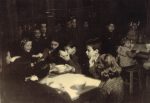
Breakfast at Andrésy circa 1945. René Goldman is holding his bowl out for more food. The children peering through the windows are from another dining room, who had likely finished their meal but had not yet been given permission to leave. (photo from memoirs.azrielifoundation.org)
René Goldman’s account of his childhood – A Childhood Adrift (Azrieli Foundation) – is set in Belgium and France during the Second World War, when Hitler’s plan was to annihilate all European Jews. Each European Jewish child was automatically sentenced to death. Only between six and 11% of European children survived the Holocaust. Ironically, this memoir describes both a heartbreaking and an uplifting story of one Jewish boy’s struggle to stay alive and sane despite all odds against him.
A Childhood Adrift is both personal and, at the same time, an important historical document. The story, written with a spatter of tongue-in-cheek humour, is a fascinating labyrinth of multiple narratives; stories within stories. It is not only about René the child, but also René the man, who revisits the past and examines the wounds left by war.
Goldman weaves his experiences throughout the periods of war and postwar, when he is a young man who travels back to the places that sheltered him and other children lost in the horror of war. The entire narrative is skilfully infused not only with historical and political facts but with the geography of various places so poignantly described one can feel and see them.
Goldman writes about the time when children lost parents, siblings and homes. These children had to depend on the kindness of strangers or were left alone to fend for themselves.
Goldman was 6 years old when the Nazis invaded his native Luxembourg, where he was born, and Belgium, where his family had taken refuge. In 1942, the family fled Belgium for France. From the last station before the French border, they walked on foot to the Demarcation Line between the German Occupied Zone and the Free Zone. No sooner did they cross the line than they were arrested by the French police, who were rounding up Jews escaping from the Occupied Zone, and the family was interned in Lons-le-Saunier. On Aug. 26, Goldman and his mother were taken to the city’s train station for deportation. His aunt appeared from nowhere and tried to take him away, but to no avail. Eventually, she found someone in authority to send two officers to rescue the young boy and save him from boarding the train. His mother was already in one of the cars waving goodbye as the train was pulling out of the station. This was the last time Goldman saw his mother. He was 8 years old.
His father disappeared that morning and it was only in 1944 that Goldman was reunited with him for a brief time, until his father was arrested and taken away. Only after the war did Goldman find out that his father died at the end of the death march from Auschwitz, in January 1945.
In 1942, Goldman was placed in the care of the OSE (Oeuvre de Secours aux Enfants) and brought to Château du Masgelier. After two weeks, he was taken to the village of Vendoeuvres, where a young couple offered to take care of him. Soon afterward, the Free Zone was invaded by the Germans.
What followed for Goldman were moves to several homes due to the changing circumstances, which necessitated a constant search for safe places for children.
Left an orphan in 1945, Goldman was placed in the care of the CCE (Commission Centrale de l’Enfance), an organization inspired by communist ideology, which was instrumental in shaping his political beliefs. His faith in this system remained unshaken until he lived in Poland for three years, when he became disillusioned, even shocked, by it.
He writes, “I can now in all candidness recognize that I caught myself wondering whether communism was not the greatest lie of the century, if not of all time.”
Goldman’s narrative strength, among his many others, leans towards the lyrical.
One of the immediate postwar places to which Goldman was moved in France was the town of Andrésy and its Manoir de Denouval, which inspired poetic instincts in him. Here, he found the beauty of gardens and serenity, a “sanctuary” that shielded him for a time from his loneliness and the postwar chaotic reality. Interestingly, Marc Chagall, who donated funds for the children’s care, would occasionally visit the manor.
“I was enthralled with the Enchanted Manor,” writes Goldman. “It nourished in me a fascination with mystery as I explored it for hidden nooks and ventured up the narrow winding steps that led to the turret, sometimes even in the dark of night.” And, indeed, these were dark times in the young boy’s life for it was then that he realized he was an orphan.
Friendships played a huge part during the war and in the postwar period. In the boys and girls Goldman befriended along the way, and some of the kind teachers, he found a certain relief from the loneliness he felt, and from the lack of affection and support. One person who played an important role in his life was Sophie Micnic, who became his caregiver and friend. This woman, a founding leader of the MOI, the Jewish communist resistance movement in Paris and Lyon during the war, later became the director of CCE. It was she who took Goldman under her wing, and recommended that he live in the “Enchanted Manor.”
A Childhood Adrift – a must-read – is a powerful testimony of a child’s response to the calamities of war and their everlasting imprint on his life. It is also a statement of courage and survival in the face of adversity. Eventually, Goldman developed a tremendous hunger for knowledge, education and a desire for communication in as many as 10 languages.
In the last section of the book, the author reveals himself as a poet and a grown man still deeply immersed in his past.
Lillian Boraks-Nemetz is a Vancouver Holocaust Education Centre outreach speaker, an award-winning author, an instructor at the University of British Columbia’s Writing Centre and the editor of the No Longer Alone section of VHEC’s Zachor, in which a longer version of this book review was originally published. René Goldman will be the keynote speaker at the community’s Kristallnacht commemoration on Nov. 5, 7 p.m., at Congregation Beth Israel. Copies of his memoir will be distributed to those in attendance. Holocaust survivors are invited to light a memorial candle. The ceremony is presented by VHEC, Beth Israel and the Azrieli Foundation. For Pat Johnson’s review of Goldman’s book, which was initially called A Childhood on the Move, visit jewishindependent.ca/fragmented-childhood.
Nearly two decades ago – and a full half-century after the end of the Second World War – a man in Switzerland cleaning out the apartment of his deceased aunt came across a stash of more than 1,000 letters. The discovery disclosed the aunt’s comparatively simple but valiant acts during the Holocaust and provides new insights into the lives of Jewish children and parents separated during the Holocaust.
The aunt, Elisabeth Luz, was an unmarried Protestant woman living near Zurich who appears to have stumbled into a role as the sole connection between hundreds of divided Jewish families. Because postal service between belligerent nations was restricted during the war, neutral Switzerland provided a potential channel for communication. Through what appears to have been happenstance aided by the compassion of a single devoted individual, thousands of letters made it to their intended recipients – and the record they provide demonstrates what families chose to say, and not say, in furtive missives in times of crisis.
The nephew knew that he had stumbled upon something important. He was familiar with the book Children with a Star by Prof. Debórah Dwork, a definitive study of the experiences of Jewish children under Nazism and the adults who helped them. He contacted Dwork to ask if she would like the letters. Dwork, Rose Professor of Holocaust History and founding director of the Strassler Centre for Holocaust and Genocide Studies at Clark University, in Massachusetts, now possesses the letters and has studied them for years. She will be in Vancouver in just over two weeks to speak at the community’s annual Kristallnacht Commemorative Lecture about what they tell us about families during the Holocaust.
Dwork cannot be certain how Luz came to be the intermediary for hundreds of families.
“From what I can piece together – and this is what I believe is the case – there was a refugee camp, sort of an internment camp, not a concentration camp, for refugees that had been established by the Swiss government in that town,” Dwork said. Luz went to the camp to give voluntary aid, Dwork believes, “to show with her presence that she cared about their plight.”
One of the men in the camp asked Luz whether she would be so kind as to send a letter to his wife.
“From there, it snowballed,” said Dwork. “Some of the letters that I have from the children, for example, say, ‘you don’t know me but Susie told me that you are an auntie who is willing to write to our mothers,’ and so on.”
The parents were mostly in “Greater Germany” – Germany and the areas it occupied. The children had mostly been sent to places thought to be safe, including Britain, France, Belgium and the Netherlands.
Remarkably, the letters do not end in 1945. In the course of being a conduit between hundreds of parents and their children, Luz became a confidant to many of them – “Tante Elisabeth” – and remained in contact with several who continued their correspondence. The fact that the collection of letters exists at all is due in part to the fact that Luz hand-copied each one, believing that this would be less likely to catch the attention of war-era postal censors. She maintained the originals.
“Parents sent their letter to her, she copied every letter and then sent it on to the children and the children did the same in reverse,” said Dwork.
Some of the children were on the Kindertransport, the effort to transfer Jewish children from Germany and Nazi-occupied Europe to the United Kingdom, while others were sent by their parents to places considered safer for Jewish children.
“There were a number of children who were sent to family members or to friends or to religious organizations by their parents independently, individually,” she said, adding that there is much to be learned from the letters. “It tells us an enormous amount about family, the importance of family and the way in which family members use letters as thread to bind the family together. I think also it tells us about how children absorbed, adjusted, adapted – or did not adjust or adapt – to their ever-changing lives.”
What the letters do not always indicate is the fate of the families who sent them.
“We know a lot about the children who went on the Kindertransport to Britain, because they survived,” said Dwork. Less is known about the children sent to Belgium, the Netherlands and France. “Many of them did not survive as the Germans conquered and occupied those countries,” she said.
Of those who continued corresponding with Luz long after the war, many had lost their parents.
“Because of the relationship that developed between the children and Elisabeth Luz, those who continued to write, by and large, were now young adults whose parents did not survive and she, Elisabeth Luz, was the last tie to their prewar and wartime life,” explained Dwork. “So, she had become their confidant and that’s very important, the way Elisabeth became a confidant to the parents and the children.”
Vancouverites should join her in November not only to hear specifics about the contents of the letters, but also to reflect on some of the broader issues raised by a collection of this sort, which is a focus of Dwork’s academic work.
“The larger question, I think, is how do people keep in contact?” she said. “What do parents in Greater Germany say to their children? And what do children tell their parents about their daily lives?”
While the letters represent voices from the past, they have much to say to people today. “This is a very human story,” said Dwork. “And, as we are looking at refugees today far-flung from one spot to another, it may help us to think about how each one is a member of a family.”
The Kristallnacht Commemorative Lecture takes place Nov. 1, 7 p.m., at Congregation Beth Israel.
Pat Johnsonis a communications and development consultant for the Vancouver Holocaust Education Centre. This article first appeared in VHEC’s Zachor.
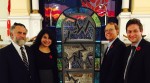
From left to right, Julius Maslovat, Carmel Tanaka, MP Murray Rankin and MLA Rob Fleming at the Victoria Holocaust Remembrance and Education Society’s annual Kristallnacht Commemoration on Nov 9. (photo from Victoria Hillel)
The following remarks have been slightly modified from the original welcoming and closing addresses given at the Victoria Holocaust Remembrance and Education Society’s annual Kristallnacht Commemoration, which took place at Congregation Emanu-El on Nov 9.
Shalom and welcome. Thank you all for coming to share in this evening of remembrance and resiliency. It is a dark Monday night in November, but you have chosen to be here. That is a statement in itself, and we thank you for taking part in tonight’s program.
We are remembering Nov. 9, 1938, a tragic night of destruction that carried on into the next day and was a portent of things to come. Remembering events such as these, as painful as they are, is vital. We don’t need to dwell on them so much as we need to draw on them for the lessons they can offer us.
Rabbi Harry Brechner of Congregation Emanu-El reminded me recently that one of our congregants, Steffi Porzecanski, may her memory be forever blessed, was a witness to the Night of Broken Glass. She lived in Berlin at the time. She would talk about how you couldn’t walk on the streets afterwards without feeling and hearing pieces of glass crunching under your feet. By the end of the destruction, some 1,000 synagogues had been burned, windows smashed, Jewish property damaged, ritual objects and cemeteries desecrated and some 30,000 Jews sent to concentration camps.
Sometimes, words are not sufficient in the face of epic horrors. Rabbi Leo Baeck, who also lived in Germany during this period, and who was eventually sent to Theresienstadt concentration camp in 1942 but did ultimately survive, wrote a prayer some years before for Jews to read at Yom Kippur. This prayer was eventually banned by the Nazis. Near the end of the prayer, he says: “We are filled with sorrow and pain. In silence, will we give expression to all that which is in our hearts in moments of silence before our G-d. This silent worship will be more emphatic than any words could be.”
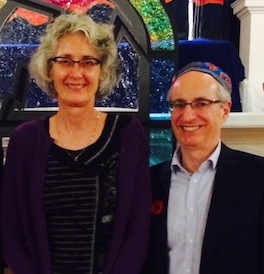
Elisheva Gray, left, and Micha Menczer. (photo from Victoria Hillel)
This is where we would like to begin tonight – allowing the silence to speak. I ask you to join me in just looking around our sanctuary and at our windows. All of the colors and nuances of our magnificently crafted windows can’t be fully appreciated at night, but they are, nevertheless, beautiful windows. At our early morning service on Thursdays, those of us who come are often treated to an extraordinary light show, as the soft, morning light gently begins touching on the blue glass.
We have all experienced the sound of breaking glass. Can we even begin to imagine the quiet and tranquility being shattered by the sound of window glass suddenly crashing to the ground and breaking into a thousand pieces, as happened in synagogues throughout Germany and Austria, beginning on that November night in 1938. The only reason? Because we were Jews. How would we feel if we witnessed that happening here, in our sanctuary, in our community, to these very windows?
As a symbol of our desire to work together in unity, to respect one another’s differences and to strive for a community that has tolerance and respect at its centre we will rebuild a window together tonight, a window resembling one of our very own windows.
While we are blessed to live somewhere where we haven’t had to witness an event like Kristallnacht, we also must be realistic of the need to remain vigilant and caring for one another in a world where such events have taken place and could, potentially, take place again. The more fractured and fragmented our world becomes, the more vital it is for us to come together, to put our differences aside and see each other on that most human level, stripped of labels and roles and categories. We may all pick our fruit from different trees, but we all share the same garden.
Tonight, as we commemorate the tragic events of that fateful November night and all that followed in its wake, we also recognize the strength and resilience of our people, the courage of the survivors, and we look towards the future with hope for a world where no group is targeted for attack, as the Jews were on the Night of Broken Glass and in the years that followed.
We are truly honored to have Holocaust survivors with us tonight, as well second- and third-generation descendants, representatives of political leadership, law enforcement agencies, faith groups and persons targeted for their sexual orientation, religious or political beliefs, participating in this symbolic reconstruction and in our candlelighting ceremony.
Our candlelighters will light seven candles. Six of them represent the six million lives lost in the Shoah. The seventh candle represents the many other persecuted victims of the Shoah. It is also our candle of hope.
Closing remarks
I’d like to thank our wonderful planning committee, our readers, volunteers and musicians for their hard work and dedication. Thank you, as well, to Rabbi Harry for his help and for his words. We are, again, especially honored and deeply grateful to our survivors, descendants of survivors and everyone who helped us with our candlelighting and our window building, especially Julius Maslovat (child Holocaust survivor), the b’nai mitzvah children from Congregation Emanu-El, local grandchildren of Holocaust survivors, MP Murray Rankin, Rabbi Harry of Congregation Emanu-El, Very Rev. Ansley Tucker, Constable Rae Robirtis from Victoria Police Department and Carmel Tanaka (Victoria Hillel director, granddaughter of Holocaust survivors and interned Japanese-Canadians).
The many problems out there in the world sometimes seem too big and too overwhelming for us to solve. Rebuilding our window here tonight may seem small in comparison to the challenges that face us in the wider world. But tonight, as we gathered to remember a difficult chapter from our past, it is our hope that, together, we injected a little more shalom into the world.
In Hebrew, every word has a three-letter root from which other words are formed. From the same root for the word shalom, peace, comes the word shalem, whole, and shlemut, wholeness. Each time we inject more shalom into the world, we are, in essence, diminishing brokenness and creating more wholeness. A little shalom goes a long, long way.
Our window may be fragile, but it is full of possibility. The cracks are a necessary reminder of our vulnerability. They are the scars that must be there, reminding us of our past, reminding us of the Night of Broken Glass.
A window allows us to look in – in this case, looking into the past, back to Nov. 9, 1938. And a window allows us to look out. What is that world that we, as individuals and as a community, want to see when we look out? A window also shows us our reflection. Who do we see looking back at us? Who do we want to see?
Elisheva Gray is a member of the Victoria Holocaust Remembrance and Education Society and is on the planning committee for the Kristallnacht Commemoration in Victoria.
A member of Israel’s Knesset spoke at a Kristallnacht commemoration event this week and equated Israel’s actions to the events of Nov. 9-10, 1938.
Hanin Zoabi, an Arab-Israeli member of the Knesset, spoke at a Kristallnacht “memorial” in Amsterdam that was organized by a group known for its antipathy to Israel and its sympathies for Hamas. It appears the event was not meant to sincerely mark the solemn anniversary but rather, as is so often a tactic among the most extreme anti-Israel hate groups, to rub salt in the wounds of Jewish history.
“Kristallnacht didn’t suddenly fall from the sky, come out of nowhere,” Zoabi said Sunday. “It was the result of a development over time. We can see a similar development happening in Israel over the last several years.”
She acknowledged that, during Kristallnacht, thousands of businesses and hundreds of synagogues were attacked and destroyed.
“Perhaps the majority of Germans did not approve, but they kept quiet,” she said. “When in Israel two churches and tens of mosques are burned; and hundreds of Israeli supporters of Beitar shout ‘death to the Arabs’ after each soccer match; when a family is burned to death; when a 15-year-old boy is burned to death, the majority keeps quiet, although they are perhaps shocked.”
Of course, Zoabi is wrong. When these tragic and despicable incidents have happened, they have been condemned from the highest offices, by the most respected voices and across the political spectrum of Israeli society. When the far more frequent incitements to kill Jews occur, and when terrorists stab or drive over Israelis, these acts are lauded by Palestinian political and religious leaders and are cause for celebration among Palestinian civilians. That’s a big difference.
Zoabi is a member of the Arab Israeli party Balad, which calls for a binational state between the Jordan River and the Mediterranean – in other words, the effective end of the world’s only Jewish-majority nation. She is an elected official in the parliament of a country she does not believe should exist. Fine. That’s a fact of democracy. We have such a phenomenon in our own federal parliament.
Zoabi is not only a citizen of a democratic state, but one who was democratically elected by other citizens to represent them in the Knesset, which, in itself, goes some distance in undermining her hyperbolic claims.
Zoabi, because she is a citizen of a free country, has the right to say what she wants, short of the sort of incitement banned by law in every democratic society. (Although she has crossed that line, with minimal repercussions, in calls for “popular resistance” and justifying the kidnapping of three Israeli teens last year who were later found murdered.)
How ironic that a person in her position could invoke such vicious, ahistorical imagery and do it at a time and place that should call for the barest sense of human compassion and decency – and get away with it. Because, despite a few outraged comments from politicians and media, she will get away with it. There will be no legal or parliamentary repercussions for her words. She is a free person – one of the freest and most powerful Arab individuals in the Middle East, when you come down to it. Were her political agenda to be realized and the land in which she lives to come under the governance of Hamas or Fatah or any other political entity currently on the scene or even on the horizon, and she were to use her words to attack her country in this manner, the outcome would almost certainly be far more grievous for her.
Beyond this individual case, though, this kind of language is a treasured tactic of the anti-Israel movement. Clearly it is a strategy of the Amsterdam group that invited her to speak and we have seen it even on campuses and at rallies here in Vancouver: anything that can be done to cause pain to Jewish people is not only acceptable, it is a legitimate tactic.
Whether it is literally a knife in the neck of a Jew in Jerusalem or the inhuman exploitation of Jewish history against the Jewish people themselves in Amsterdam or the exploitation of Holocaust imagery and language against the state of Israel at rallies worldwide, including here in Vancouver, there is a streak in the anti-Israel movement that is more concerned with inflicting pain than finding solutions.
“Vanity of vanities. All is vanity.” The day of remembrance for Kristallnacht was this week. Looking at what’s happening in Israel and globally, I’m reminded of the Preacher. By the Preacher, I mean Kohelet, traditionally thought to be King Solomon, whose writings in the Tanakh are known in English as Ecclesiastes. The first line, in Hebrew, reads: “Havel havalim. Hakol Havel.”
Everything is havel, which, better than vanity, is translated “vaporous, breathlike, fleeting.” Everything is vapor. Like Abel, whose Hebrew name is Havel, and whose life was like vapor, blown apart by Cain. Like what we thought we had gained in Israel, once upon a time: a state of our own that had mostly won the world’s respect and affirmation through blood, sweat and tears. A refuge. We thought we had pushed back the red sea of ancient, irrational hatred. The world had, to an amazing degree, recognized our right to a homeland in our homeland. The horrors of the Holocaust were understood and widely contemplated.
Yet, in the past months, much of what has happened has the character of a bad dream. The New York Times writes that the Temple Mount may not have been where the Jewish Temple was after all (later retracted under pressure). The United Nations declares ancient Jewish holy sites to be under the rightful control of a future Palestinian state, even as Palestinian Arab terrorists torch Jewish holy sites. In Europe, organizers of a Kristallnacht commemoration declare their plans to turn it into a commemoration of the Palestinian suffering for which Israel bears responsibility.
And the stabbings. The Palestinian leadership put the word out that Jews planned to change the “status quo” on the Temple Mount, where Al-Aqsa Mosque also stands. Currently, only Muslims have free access to the site, with everyone else having very limited or no access to this sacred space, revered by Jews especially but also Christians and Baha’is. “Changing the status quo,” according to Palestinian fears, would entail increasing access for non-Muslims (at least) or tearing down al-Aqsa and replacing it with a synagogue (at most). Israel has no intention of either: not of expanding access (although surely that would be a step forward for human rights and decency were that to happen) and certainly not of razing Islam’s third holiest site. Yet the claim enflames the Palestinian street, as it did at the start of the 2000 Intifada. Mothers begin celebrating the deaths of their children who died to “defend Al-Aqsa,” even giving out candy on TV. A Palestinian Arab mother names her newborn baby “Knife of Jerusalem” after the attacks. Mahmoud Abbas, who Western media falsely portray as a moderate, calls for the shedding of Jewish blood and declares that the “filthy feet” of Jews will not besmirch Al-Aqsa.
Mainstream Israel wants to negotiate an independent state for Palestinian Arabs yet a majority of Palestinian Arabs believes Israel wants to take their land and evict them. Tellingly, this is in fact what the Palestinian Arab leadership wants – to take back all Israeli land and eliminate Israeli Jews, as the Hamas charter and popular Palestinian songs, media and school textbooks demonstrate. In a classic psychological move, the Palestinian Arab imagination projects onto Israel its own desires: what is within is used to interpret what is without. This narrative has spread beyond the borders of Israel and the disputed territories to capture the imaginations of people all around the world. So, our refuge has begun to feel, increasingly, like a new ghetto, where we can be once again easily separated out and demonized.
Havel havalim. Hakol havel.
After experiencing years of checkpoints, poverty, “collateral damage,” the Gaza wars and more, it is certainly understandable that Palestinian Arabs feel sorrow and rage. It is even understandable that they hate the Israeli government. But to blame Israel and all Jews for their suffering, and not the racist, Israel-negating, violence-inciting, kleptocratic Palestinian leadership?
Israeli self-defence is viewed as aggression; the most enlightened state in the Middle East is slandered as an “apartheid state”; Zionism is viewed as racism by people whose denial of Zionism is in fact rooted in racism. Havel havalim.
Where do we look for something solid to hang on to? The opinions of the world, the justice of its courts and institutions, are failing us. And we ourselves are not immune to being blown apart by this hurricane wind on the inside and losing anything worth fighting for. In Israel, Jewish mobs have formed to attack “enemies” internal and external. Hatred and anger against the Palestinian Arabs grows. We are in danger of forgetting their humanity and their pain. We are in danger of losing our ability to think rationally, to think long term. We cannot and will not find security in the courts of the world. We must make our own reality, one that reflects what we know to be true. And we must hold to that reality with strength and with love. That is what we are already doing in our best moments:
A Jewish restaurant gives a 50% discount to Jews and Arabs who eat together.
There are peace rallies in Tel Aviv and Jerusalem.
Israelis find a variety of ways to laugh through what is happening and share them online.
Doctors in Israeli hospitals treat Palestinian terrorists alongside their victims.
We know that Israelis want peace, and that Jewish values in no way mandate injustice or aggression towards Palestinians or anyone else. We must make our own peace and our own future, through clinging to our own highest values like a rudder in the storm. And, as we find a way to a just divorce with the Palestinian Arabs, as Amos Oz so rightly said we need to do, both for their sake and for our own, we must at no time forget the humanity of each Palestinian Arab. We must not demonize them, must not forget that every Palestinian Arab is made in the image of God. Our own spiritual tradition, the beating heart of our highest values, mandates that we do not return hatred for hatred. At no time may we forget to fear the loss of our own humanity under the impact of their knife blades and bombs and stones. That is the way to commemorate Kristallnacht.
Matthew Gindinis a writer, lecturer and holistic therapist. As well as teaching holistic medicine, Gindin regularly lectures on topics in Jewish and world spirituality, and has a particular passion for making ancient wisdom traditions relevant in the modern world. His work has been featured on Elephant Journal, the Zen Site and Wisdom Pills, and he blogs at Talis in Wonderland (mgindin.wordpress.com) and Voices (hashkata.com).