Netanyahu warns Iran

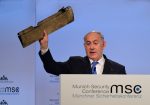
Prime Minister Binyamin Netanyahu at the Munich Security Conference. (photo by Amos Ben Gershom IGPO via Ashernet)

Speaking at the Munich Security Conference, which took place Feb. 16-18, Israeli Prime Minister Binyamin Netanyahu holds a piece of an Iranian drone shot down over Israel last week. Netanyahu warned that Israel could strike the Islamic Republic. Looking directly at Iranian Foreign Minister Mohammad Javad Zarif, Netanyhau asked, “Mr. Zarif, do you recognize this? You should, it’s yours. You can also take back with you a message to the tyrants of Tehran – do not test Israel’s resolve!” The drone, which entered northern Israel from Syria near the Jordanian border, was shot down by an Israeli attack helicopter. In response to the drone incursion, the Israeli Air Force attacked the mobile command centre from which it was operated. During the operations, one of the Israeli jets was hit by a Syrian anti-aircraft missile and crashed; its pilot and navigator were able to parachute out of the plane and land safely in Israel.

IDF colonel visits Vancouver

Left to right: Ilan Pilo, Jewish National Fund, Pacific Region; Col. Adam Susman, Israel Defence Forces defence attaché to Canada; and Rabbi Shmulik Yeshayahu of the Ohel Yaakov Community Kollel. (photo from Community Kollel)

While acknowledging that the situation in the Middle East is constantly changing, Col. Adam Susman told those gathered at the Ohel Yaakov Community Kollel on July 18 that the biggest threat to Israel is Iran, “as it has been for years.”

Susman, who is the Ottawa-based Israel Defence Forces (IDF) defence attaché to Canada, was in Vancouver at the invitation of the Jewish National Fund of Canada, Pacific Region.

Born in the United Kingdom, Susman moved to Moshav Sde Nitzan in southern Israel at the age of 3, according to JNF’s website. He joined the IDF’s Givati Brigade in 1987 and became a battalion commander after serving as head of the anti-ballistic and training branches. In 2005, he was appointed commander of Hanegev infantry brigade and chief of staff of the Sinai division, protecting Israel’s southern border. In 2009, he became commander of the Dan district in Home Front Command, working to ensure the safety of civilians in the metro Tel Aviv area. Prior to his appointment as the defence attaché to Canada in 2014, Susman was head of the International Military Cooperation Department of the IDF General Staff.

Rabbi Shmulik Yeshayahu of the Community Kollel was the emcee of the Vancouver event. “It is fitting to have this meeting during the weekly Torah portion of Matot-Masei,” he said in his opening comments. “In this parashah, a portion of the Jewish people stays behind on the way to the Holy Land, preferring to farm on the other side of the Jordan River rather than go in and fight for the land. They stayed there while the rest of the tribes fought and, later, they joined them. In Judaism, we have great respect for those who risk their lives to protect other people, and especially our homeland.”

Before introducing Susman to those gathered, Ilan Pilo, executive director and Jerusalem emissary of JNF Canada, Pacific Region, presented a brief video about JNF’s activities throughout Israeli history. He then invited the president of Royal Canadian Legion’s Shalom Branch, Ralph Jackson, to speak. Jackson, who introduced himself as “the only Jew in the Scots Guards during World War Two,” presented a donation of $5,000 to Susman for Beit Halochem, a nonprofit that cares for disabled Israeli veterans.

Leonard Shapiro, Shalom Branch vice-president, noted how the branch was formed during a time of great prejudice, when Jews needed their own veterans organization. “It has been a long time now since we’ve gone to war, however, thank God. We don’t get many new members. If anyone here would like to join and support our organization and activities, you don’t have to have been in the army, you just need to be over 18 and not have committed any horrible crimes. Little ones, OK,” he joked.

Susman shared a bit about himself and his experience in the Givati Brigade, which was the most highly decorated brigade in the 2014 conflict, a fact no doubt known to the many IDF veterans in the audience.

Susman is one of 16 Israeli attachés around the world – a small number that, he said, was due to Israel never having been part of a military coalition with another country. He outlined the ties between the Israeli and Canadian militaries, the chief threats to Israel today and the IDF’s response.

“There is cooperation between the IDF and the Canadian military strategically and practically,” he said. “The relations between the IDF and the Canadian military are good.”

Asked if the change of Canada’s federal government to the Liberals from the Conservatives had had any effect on that relationship, Susman said it had not.

Turning to the situation in Israel’s own region, he emphasized the lack of stability.

“The Middle East is an interesting neighbourhood, always changing – what I tell you today may not be true tomorrow,” he said.

“The biggest threat is Iran, as it has been for years,” he continued. “[Mahmoud] Ahmadinejad took every opportunity to say that Israel should disappear from the map of the world. The main threat they’ve posed has been building Hezbollah – without Iran, it would be a small organization. In recent years, Hezbollah has been fighting in Syria and they’ve lost a lot of people, but they’ve also gained a lot of operational experience. They have also steadily increased in rocket capabilities and can now reach Eilat.”

Susman said that Syria had previously been a big threat to Israel, but that’s no longer the case, due to its civil war and ISIS, as well as the reduction of the country’s chemical weapons by Western countries.

Hamas in Gaza is the next biggest threat, he said, noting that it is also supported by Iran. “They only exist to fight,” he said. “They are not building up Gazans as they claim. A good example is the tunnel found during 2014 Protective Edge, kilometres of resources that could [have been used] for clinics and schools. Gaza is a piece of cheese, there is 80 metres between the top and the water table, dotted with tunnels. That’s a major challenge.

“The Sinai is also a security problem,” he added. “Nobody controls it, and so everybody is in there. There was no Egyptian military following the peace agreement, so that’s the result. The MFO (Multinational Force and Observers) was created to survey the Sinai and, by the way, there are many Canadians in it.

“Some people say the IDF is a military that has a country,” quipped Susman. “We are strong, and we are good at finding solutions.”

Susman cited Iron Dome as an example. The IDF initially divided Israel into 157 zones with two missile interceptors for each missile. That was successful, he said, but each missile cost $70,000 so that intercepting one fired missile cost $140,000. Therefore, the IDF sought improvements. Israel was divided into 254 zones, he said, and each one had only one missile interceptor per fired missile. This system has a 90% success rate stopping missiles, which is still not good enough in Susman’s view. “We will improve yet further,” he said.

During the question-and-answer period, an audience member commented, “You said Iran is the biggest threat against Israel but you didn’t say what Israel is doing against Iran.”

“That’s right,” replied Susman without further explanation, eliciting laughter from the crowd.

The evening ended with the singing of “Am Yisrael Chai,” led by Yeshayahu.

Matthew Gindin is a freelance journalist, writer and lecturer. He writes regularly for the Forward and All That Is Interesting, and has been published in Religion Dispatches, Situate Magazine, Tikkun and elsewhere. He can be found on Medium and Twitter.

Creating dialogue, friends

The Peace Factory founders Joana Osman and Ronny Edry spoke at the University of British Columbia on Feb. 6. (photo by Zach Sagorin)

“Israel loves Iran,” “Palestine loves Israel,” “Israel loves Palestine,” “Iran loves Israel & Palestine.” The Peace Factory uses social media to connect people in the Middle East, to build relationships and see one another as human beings with visions of peace.

“People may not like the idea of inclusion, the idea of welcoming everyone, but that’s why we are here – to invite those people to learn about the various cultures and faiths that are around us,” said Shem Arce when introducing the Active Community Dialogue (ACD) event Make a Friend, Make Peace. “With some dialogue and understanding we can create a community for everyone – no matter their religion, culture or ethnic background.”

Arce, a University of British Columbia film studies student from Mexico, recently began ACD with the goal of combating discrimination through meaningful, respectful dialogue and interactions.

ACD’s Make a Friend, Make Peace event on Feb. 6 featured a presentation from the founders of the Peace Factory: Ronny Edry, an Israeli graphic designer living in Tel Aviv, and Joana Osman, a Palestinian living in Munich. The pair also spoke at King David High School.

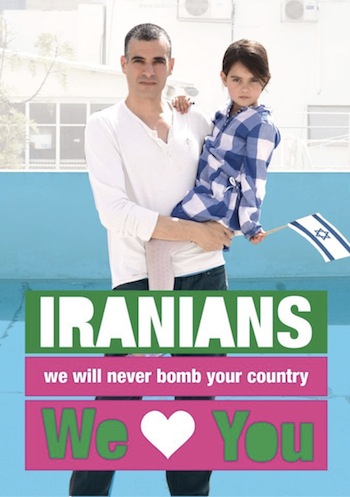
image - Israeli graphic designer Ronny Edry sent this poster out in 2012, when Israel was considering a preemptive strike against Iran
Israeli graphic designer Ronny Edry sent this poster out in 2012, when Israel was considering a preemptive strike against Iran.

The UBC event drew dozens of people, and Edry showed the crowd a poster he uploaded to Facebook in 2012, when Israeli Prime Minister Binyamin Netanyahu “was calling for preemptive strike on Iran,” when “it was quite stressing.”

The graphic designer decided to send something else to Iran. He designed a brightly coloured poster with a photo of him holding his daughter and bold text declaring, “Iranians / we will never bomb your country / We ♥ You.” Edry told the audience that the “five first comments were ‘delete it’” but, after leaving the poster online, he was surprised to find that “Iranians were commenting on the picture” and a line of communication was created.

“If something works, do it again,” said Edry. Soon, he added, “a lot of Iranians and Israelis started having a conversation.”

Interestingly, the security guard of the ACD event, an Iranian-Canadian man, had participated in the Peace Factory movement.

“When you don’t know someone and you close your eyes and think of the enemy, you end up thinking of some kind of monster,” said Edry. In Israel, “most of the time on the TV, they won’t show you the nice people of Iran.”

But, after starting the “Israel loves Iran” campaign, Edry received pictures from Iranians wanting to join. The movement has enabled many Iranians and Israelis to connect and build friendships online. And it continues to grow, with more than 121,000 likes and more than one million unique visitors each week to the “Israel loves Iran” Facebook page and more than two million views of Edry’s Ted Talk. The movement is continuing, with “both sides sharing stories and pictures of themselves,” said Edry.

With the success of “Israel loves Iran,” Edry said people were “coming up to me and saying, ‘Why don’t you do the same campaign with the Palestinians?’”

Soon after, Osman founded the group “Palestine loves Israel” to create a platform for Palestinians and Israelis to get to know one another through social media.

Together, Edry and Osman created the Peace Factory to “try to rehumanize the [other side] and give them a face and a story.”

Osman said building these connections “changes everything because, once you make a friend on the other side, everything changes for you.”

Osman said she asked herself, “As one person what can you do?” Her answer was, “You can be part of the change and you start communicating … if you can change one person’s mind, that may be enough.”

She added, “The enemy is nothing like you have in your mind … and, when you get to see his face and you see nice people,” you realize “they are not that bad.”

The Peace Factory’s vision is of a free and democratic Middle East, and they intend to build bridges and friendships to connect people with the same vision.

“It is not that we deny there is a conflict,” Osman said. “We have to pay attention to it, but I strongly believe that the solution can’t come from politics, it comes from people, real people connecting to each other…. Once you understand the other side is a real people with real pain … you come to the conclusion we are one people, one human race, with one goal to live in peace.”

To learn more, visit thepeacefactory.org. Anyone interested in future ACD events can find out more at acdmovement.com.

Zach Sagorin is a Vancouver freelance writer.

Iran dominates AIPAC talks

Republican presidential hopeful Donald Trump upset AIPAC organizers when he criticized President Barack Obama. (photo by David Zam)

There were clear signs of discord in Washington, D.C., as representatives of AIPAC publicly rebuked presidential hopeful Donald Trump after he harshly criticized the sitting president.

At the pro-Israel organization’s policy conference last month, in front of some 18,000 attendees, visibly upset AIPAC president Lillian Pinkus admonished Trump on stage for his remarks a day earlier.

“Whatever policy disagreements we may have, we must not condemn the sitting president on stage,” she said. “There are people in our AIPAC family who were deeply hurt last night and, for that, we are deeply sorry.”

Chairman of the board Robert A. Cohen said that booing and clapping speakers when they attack another person was unacceptable at the event, and that “AIPAC doesn’t pick sides.”

Trump, who was cheered wildly for noting that it was President Barack Obama’s last year in office, said that “Obama rewards our enemies” and “Hillary was a total disaster as secretary of state…. Obama and Hillary have been very bad to Israel. Obama may be the worst thing to happen to Israel.”

Every major party candidate for president spoke at the dais, except the senator from Vermont, Democrat Bernie Sanders, who is Jewish. All candidates who spoke placed heavy emphasis on Iran.

GOP frontrunner Trump didn’t mince words. He called the Iran deal brokered by the P5+1 – the United States, China, Russia, France and the United Kingdom plus Germany – “awful” and “bad for Israel, the Middle East and the world.”

The $150 billion channeled to Iran in the agreement, by his reckoning, was “unbelievable” with “nothing in return,” and that the Islamic Republic will have a nuclear bomb within several years.

As president, Trump said he would “stand up to Iran’s aggression” because “I know how to deal with aggression and that’s why I’ll win.”

The Middle East’s terror activity has Iran’s fingerprints all over it, he continued, including Hezbollah in Lebanon, Hamas in Gaza, reward money for Palestinian terrorists, and influence in at least two dozen other countries.

“I will dismantle Iran’s global terror network,” Trump said. “We will enforce this deal like you’ve never seen a contract enforced before.”

The New York billionaire mogul and reality TV host took aim at two other threats to Israel, the United Nations and Palestinian terror activity.

“The UN is incompetent and no friend of Israel,” he said. “A [peace] agreement imposed by the UN would be a total disaster. And the U.S. must use our veto, which I will use 100%.”

The Jewish state, he said, has always been willing to strike a deal with its neighbors, noting that prime minister Ehud Barak in 2000 offered nearly the entire West Bank as a Palestinian state, but the offer was dismissed by then-PLO leader Yasser Arafat. Other times, he said, “Palestinian leadership has rejected very good offers.”

Trump noted that, under his purview, the U.S. embassy would move “to the eternal capital of the Jewish state, Jerusalem.”

Texas Senator Ted Cruz, trailing a distant second to Trump in GOP delegates, began his speech, “America will stand with Israel and defeat Islamic terror.”

He spoke about his three trips to Israel as senator, including a visit to Israeli hospitals that treated Syrian refugees. He noted that he had proposed legislation to ban the Iranian ambassador to the UN from entering the United States since he was involved in the 1979 Iranian hostage crisis. It passed in both the Senate and House.

Taking a jab at the Obama administration, he said it was “unjust” for them to impose a travel ban on Israel in the summer of 2014. He further called out Democrats for boycotting Israeli Prime Minister Binyamin Netanyahu’s speech last year at AIPAC.

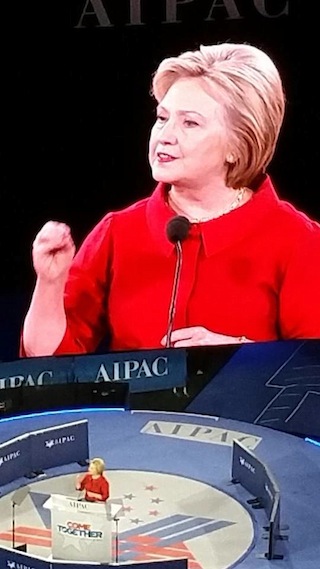
photo - At AIPAC, Democrat frontrunner Hillary Clinton advised a three-pronged approach to global security, focusing on Iran, extremism and the attempts to delegitimize Israel
At AIPAC, Democrat frontrunner Hillary Clinton advised a three-pronged approach to global security, focusing on Iran, extremism and the attempts to delegitimize Israel. (photo by David Zam)

Hillary Clinton, the Democratic presidential frontrunner, was taken to task for saying that Hamas fires rockets from civilian areas because Gaza is tight for space. “Rather,” said Cruz, “it’s because Hamas are beasts who use human shields.”

As for the “fundamentally immoral” Iran deal, Cruz said he will “rip it to shreds on the first day,” since the Islamic Republic won’t follow it anyway.

“Hear my words Ayatollah Khomeini: If I am president and Iran launches a missile test, we will shoot that missile down,” said Cruz. “And, in January 2017, we will have a commander-in-chief who says under no circumstances will Iran be allowed to acquire nuclear weapons: either you will shut down your nuclear program or we will shut it down for you.”

Cruz compared the Iran deal to the failed 1938 agreement between British prime minister Neville Chamberlain and Adolf Hitler, which led to the Third Reich’s takeover of Czechoslovakia and allowed its continued military build-up.

If elected president, Cruz said he would move the U.S. embassy from Tel Aviv to Jerusalem, yank federal funds from schools that boycott Israel and veto any UN unilateral declaration of a Palestinian state.

Governor of Ohio John Kasich, running third in the GOP delegate count, noted his 35-year support for Israel and his role in helping erect a Holocaust monument in his state.

He called for the suspension of the Iranian nuclear deal, particularly after recent test missiles in contravention of international treaties. As president, he would “defeat ISIS and stop arms flows to Hezbollah.”

He also spoke out against the boycott, divestment and sanction movement, and antisemitism on campus. On Israel, he noted the “culture of death that the Palestinian leadership has promoted for decades,” and that “Palestinians cannot continue to promote hatred.” In sum, he called Jerusalem the eternal capital of Israel.

When she took to the stage, Clinton noted that the “the ideological gap between the parties has increased, but there’s still common agreement on Israel.”

She took a three-pronged approach to global security: Iran’s aggression, the growing tide of extremism, and efforts to delegitimize Israel. “The deal with Iran is making the world safer, including Israel,” she said. “The supreme leader still calls all the shots in Iran, but we should support voices who want to bring change in Iran.”

Regarding other parts of the region, she said that “ISIS must not be contained; it must be defeated.”

On the issue of Israel, she noted that Palestinian leadership has to stop inciting violence. “Children should not be taught to hate in schools,” she said, adding that she would oppose any attempts to “push a [unilateral two-state] solution,” including in the UN. “Palestinians should be able to govern themselves in their state,” she said, while adding that Israeli “settlements are not helpful to peace.”

She condemned BDS and said, “we have to fight against it” because “antisemitism has no place in American society.”

Meanwhile, U.S. Vice-President Joe Biden took a risk mentioning to the 18,000 attendees at the policy conference that Israeli “settlements are a barrier in the way of a two-state solution.” That risk was welcomed by a chorus of boos – despite attendees being cautioned by AIPAC leadership to not do so.

Biden insisted that, notwithstanding political differences, the United States is “united in our unwavering commitment to the Jewish state of Israel.”

However, “violent acts of retribution must stop,” he continued, “terror is terror is terror … and it must be stopped.”

The White House “stands with Israel against delegitimization” and believes that “Israel is stronger today because of the Obama-Biden administration,” he said.

Biden touted last year’s Iran deal as a “success,” explaining that many “Iranian facilities are dismantled and destroyed” and that “Iran is further away from the possibility of being nuclear. If Iran violates [the deal] there will be consequences.”

Speaking by video link from Israel, Netanyahu both criticized, and suggested salvaging, the U.S.-brokered Iranian nuclear deal.

“Those who worked for the deal and against the deal can work together to ensure that the deal is followed,” he insisted, noting that, in March, Iran tested a missile that posed a threat to Israel.

“The writing isn’t just on the wall; it’s on the missile,” said Netanyahu.

He said that Israel is singled out for condemnation at the UN and said he hopes the United States will continue its moral voting record at the Security Council.

With regard to Israel’s neighbors, he said Palestinian children are taught to hate, and showed a video of television broadcasts that illustrate his point.

“We cannot compromise with terror and must defeat it,” he said. “We need a two-state solution with a demilitarized Palestinian state.… We are ready for negotiations anywhere and anytime without preconditions.” But, he said, Mahmoud Abbas, the leader of the Palestinian Authority, “isn’t ready or willing to come” to the negotiating table.

David Zam has covered political, cultural and historical events for Landmark Report, including the 50th anniversary of the Selma to Montgomery voting rights march as White House-approved press, two AIPAC policy conferences and several other political conventions. He has degrees in history and law.

מתהדק הקשר בין קנדה לאיראן

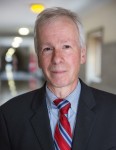
שר החוץ, סטפן דיון. (צילום: Facebook)

מתהדק הקשר בין קנדה לאיראן: הוסרו מספר סנקציות כלכליות נגד המדינה האיסלאמית

קנדה ואיראן פותחות בדיאלוג לאחר כשלוש וחצי שנים של נתק טוטאלי בין שתי המדינות. במסגרת זו הממשלה הקנדית החליטה להסיר כבר מספר סנקציות כלכליות נגד איראן, בהן הקשורות בשירותים פיננסיים, יצוא ויבוא. כך הכריז שר החוץ, סטפן דיון, בסוף השבוע האחרון. סנקציות נוספות יוסרו בהמשך הדרך בשלבים כולל חידוש היחסים הדיפלומטיים, תוך שקנדה בוחנת את הפיקוח של האו”ם על תוכנית הגרעין של איראן, כדי למנוע מאיראן להמשיך ולפתח אותה, כמו למנוע ממנה את הפיתוח של טילים בליסטיים ארוכי טווח. דיון ציין כי קנדה תמשיך לבדוק מה קורה באיראן ותפעיל מדיניות בשלבים להסרת הסנקציות, לאור החששות מתפקידה של איראן במזרח התיכון כולל מול בני הברית כמו ישראל, ולאור “הרקורד” של איראן בתחום נושא זכויות האדם. דיון הוסיף עוד: “אני חושב שזה טוב לישראל שקנדה תוכל לדבר עם איראן. זו הייתה טעות לחשוב כי הבידוד עדיף על קשר וקשר אינו מהווה הסכמה”.

לדברי דיון תחומים רבים של הכלכלה הקנדית ירוויחו ממערכת היחסים המחודשת עם איראן. זה לא רק תעשיית התעופה והחלל, אלה גם תחבורה, חקלאות, התעשייה הפטרוכימית, תעשיית הכרייה ותעשיות הנפט והגז. לקנדה יש עדיין חששות כבדים בנוגע לשאיפותיה הגרעיניות של איראן, ולכן ימשכו המגבלות החמורות של יצוא מוצרים רגישים שלא ישלחו לאיראן וכל היתר יצוא ישקל בכל מקרה לגופו. קנדה תמשיך אפוא לקיים הגבלות חמורות על היצוא לאיראן של מוצרים, שירותים וטכנולוגיה שנחשבים לרגישים מהבחינה הביטחונית, לרבות מוצרים שיכולים לעזור לאיראן לייצר טילים גרעיניים או בליסטיים.

בתגובה להחלטת הממשלה להסיר את הסנקציות הצרכז לענייני ישראל והיהודים בקנדה פרסם את תגובתו בנידון. המרכז מציין כי איראן ממשיכה להיות איום ממשי עבור ישראל והיהודים ברחבי העולם. הסרת הסקנציות הבינלאומיות בעקבות ההסכם על תוכנית הגרעין של איראן, תנוצל על ידי המשטר האיראני וזה מקור חרדה רציני למרכז לענייני ישראל והיהודים בקנדה ושותפיו ברחבי העולם. קיימת סכנה ממשית שהקהילה הבינלאומית, מתוך נאיביות לאור הסכם הגרעין עם איראן, תקבל את איראן כחברה לגיטמית בקהילה הלאומית, למרות שהיא ממשיכה לתת חסות לטרור, מתעללת בזכויות אדם, מחוללת כאוס באזור וקוראת להשמדת ישראל.

עמדת המרכז לענייני ישראל והיהודים בקנדה לגבי החלטת הממשלה הקנדית החדשה ברורה. איראן מהווה איום רב לשלום העולמי והביטחון העולמי, וקנדה צריכה להתעמת עימה באמצעות כלים דיפלומטיים וכלכליים.

המרכז יודע כי המפלגה הליברלית של קנדה למרות תמיכתה בעמדתה תקיפה נגד איראן, מזה זמן רב מעדיפה גישה המאופיינת במעורבות קונסטרוקטיבית בניגוד לממשלה השמרנית הקודמת שתמכה חד-משמעית בבידודה של איראן. המרכז ישאר מאוד מודאג מהמאמץ של הקהילה הבינלאומית לחידוש הקשרים אם איראן, “ואנו נמשיך להראות שדיפולמטיה ללא לחץ כלכלי לא הייתה מביאה שינוי בהתנהגותה של איראן. תפקידנו להבטיח לבחון את הציוד והסחורות שיועברו לאיראן מקנדה, כדי לבחון שחברות קנדיות לא יעזרו לתוכנית הגרעין שלה ולבניית מערך הטילים הבליסטיים שלה”.

המרכז אומר עוד: “עכשיו יותר מתמיד הקהילה היהודית בקנדה צריכה לקחת חלק במדיניות הציבורית המקומית. אנו זקוקים לחברי הקהילה באשר הם כדי שישמיעו את קולם. בימים הקרובים המרכז לענייני ישראל והיהודים בקנדה, ישיק קמפיין חדש לגיוס אזרחי קנדה שמודאגים לקרוא לשר החוץ דיון, להמשיך ולהפעיל לחץ על איראן. יש באפשרותה של הקהילה היהודית להשפיע על הטיפול הכושל של הממשלה בתיק איראן, כשנעים קדימה”.

נתניהו לא אוהב את זה

התאגיד הקנדי בומברדייה שמספק מזה למעלה מעשר שנים קטרים וקרונות לרכבת ישראל, החל לבדוק את האפשרות למכור מטוסי נוסעים לאיראן. (צילום: bombardier.com)

נתניהו לא אוהב את זה: קנדה החליטה להסיר הסנקציות נגד איראן בשלבים

קנדה שנחשבה עד לאחרונה ידידה קרובה ביותר של ישראל מצטרפת למחנה של מדינות המערב (בהן ארה”ב, האיחוד באירופאי ואוסטרליה), שהחליטו להסיר את הסנקציות הכלכליות נגד איראן. זאת לבקשת האו”ם לאור חתימת הסכם הפיקוח על תוכנית הגרעין של איראן. שר החוץ הקנדי, סטפן דיון, הודיע בפרלמנט לפני מספר ימים כי ממשלת הליברלים בראשות ראש הממשלה ג’סטין טרודו, תסיר את הסנקציות נגד איראן במספר שלבים. בין הסקנציות שיוסרו יכללו בהמשך גם נורמליזציה ביחסים בין קנדה ואיראן, ופתיחתה מחדש של שגרירות קנדה בטהרן. הממשלה הקודמת בראשות ידידה הקרוב של בנימין נתניהו, ראש ממשלת ישראל ומי שעמד בראשה, סטפן הרפר, סגרה את השגרירות בטהרן בספטמבר 2012 בטענה שאיראן היא איום על השלום והביטחון בעולם, במסגרת ניתוק היחסים הדיפלומטים בין שתי המדינות.

התאגיד הקנדי בומברדייה שמספק מזה למעלה מעשר שנים קטרים וקרונות לרכבת ישראל, החל לבדוק את האפשרות למכור מטוסי נוסעים לאיראן. בהקשר זה אמר דיון: “אם איירבוס מסוגלת לעשות את זה (התאגיד הצרפתי חתם על עיסקה עם איראן למכירת מאה ושמונה עשר מטוסים ר.ר) למה בומברדייה לא יהיה מסוגל לעשות זאת. באיזה דרך זה עוזר לקנדה, לאזרחי איראן או לישראל באם קנדה פוגעת בתעשייה שלה?”

בומברדייה סובל בשנים האחרונות מהפסדים כספיים גדולים שנאמדים בתשעה מיליון דולר אמריקאי, ופתיחת שוק חדש כמו איראן, יכולה לתרום מאוד לקופת התאגיד. איראן כידוע משוועת למטוסי נוסעים חדשים כיוון שצי המטוסים שלה ישן ביותר, והיא הצהירה כבר כי ברצונה לרכוש מאה ושישים מטוסים חדשים. חברות קנדיות נוספות מעוניינות לנהל מגעים עם האיראנים למכירת מרכולתם לאחר הסרת הסקנציות, והן רואות בשוק האיראני פוטנציאל גבוה, במיוחד לאור מצב הכלכלה בעולם. מומחה למסחר בינלאומי מטורונטו אומר כי חברות קנדיות רבות רואות באיראן הזדמנות גדולה לעסקים. יש לזכור ששמונים מיליון איש גרים באיראן, היא נחשבת למדינה עם חינוך ברמה גבוהה והיקף כלכלתה נאמד בארבע מאות מיליארד דולר. החברות שמגלות עניין באיראן שייכות בעיקר לתחומי ענפי הנפט, הגז, והטכנולוגיה, יצרניות מוצרי מזון ובעיקר חלב ובקר.

בינתיים ממשלת קנדה החדשה כבר כועסת על ישראל. הממשלה העבירה מסר חריף לישראל בשבוע שעבר, והביעה את דאגתה מהאלימות הגוברת בין הפלסטינים לישראלים, ומהמשך הבנייה בהתנחלויות. לדברי דיון: “קנדה כבעלת ברית איתנה וידידה של ישראל, קוראת לעשות את כל המאמצים על מנת להפחית את האלימות וההסתה ולסייע ביצירת תנאים לחזרה לשולחן המשא ומתן”.

יהודיה נדקרה באופן קשה במונטריאול אך לא על רקע אנטישמי

אישה יהודיה (בת 27) שמחזיקה בדרכון ישראלי וגרה במונטריאול, נפצעה ביום רביעי בשבוע שעבר על ידי גבר שדקר אותה. אירוע התקיפה החמור אירע בשדרות מונקלנד שבשכונת נוטרדאם-דה-גארס, בזמן שהאישה הלכה לבדה ברחוב שעות המאוחרות של הלילה. האישה שנפגעה בפלג גופה העליון הועברה במהירות לבית החולים הכללי של מונטריאול ומצבה הוגדר כקשה. היא לומדת באוניברסיטה לתואר שני ולא לבשה שום ביגוד עם סממן יהודי. לבקשת בעלה שמה לא הותר לפרסום

משטרת מונטריאול פתחה בחקירה מואצת של הפרשה והמניע לפגיעה באישה. השוטרים הצליחו לעצור את החשוד בדקירה (בן 25) שנמלט מהאזור. לדברי המשטרה לא מדובר באירוע על רקע אנטישמי. לחשוד ששמו הותר לפרסום (מתיו רוברז’) עבר פלילי והוא שוחרר בעבר על תנאי ונמצא בתקופת מבחן. רוברז’ כנראה היה נתון להשפעת סמים בעת שדקר את היהודיה.

יחסים יותר מאוזנת?

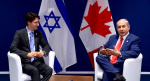
ראש הממשלה בנימין נתניהו נפגש עם ראש ממשלת קנדה ג’סטין טרודו בוועידת האקלים של האו”ם. (צילום: youtube.com)

האם רוחות קרות מנשבות מקנדה: ג’סטין טרודו צפוי להנהיג מדיניות יותר מאוזנת כלפי ישראל

ראש ממשלת קנדה החדש מטעם המפלגה הליברלית, ג’סטין טרודו, לא דומה כלל לראש הממשלה היוצא מטעם השמרנים, סטיבן הרפר, שהובס בבחירות הפדרליות האחרונות שהתקיימו בחודש אוקטובר. זאת גם בנוגע לייחס למדינת ישראל. טרודו נחשב עדיין לראש ממשלה “ירוק” כיוון שהוא בתפקיד מספר חודשים ספורים, אך כבר ניתן להבחין שמערכת היחסים ההדוקה ביותר בין ישראל לקנדה שאיפיינה את ממשלת הרפר, לא תחזור על עצמה. הרפר הרגיש מאוד בנוח עם ראש ממשלה של ישראל, בנימין נתניהו. שיאו של הקשר ההדוק הזה בין שני האישים, בא לידי ביטוי בביקור ההיסטורי של הרפר בישראל התקיים בחודש ינואר 2014. המשלחת הגדולה של של הרפר לישראל כללה פעילים בולטים בקהילה היהודית הקנדית. חלק מהם הוטסו במטוס שלו וחלק אחר “רק” התארחו בישראל על חשבון משלם המיסים הקנדי.

טרודו קיבל טלפון מנתניהו מייד עם זכייתו בבחירות בחודש אוקטובר. שני האישים נפגשו לשיחה קצרה ומתוקשרת היטב בסוף חודש נובמבר, במסגרת ועידת האקלים בפריז. הפגישה הייתה אמנם חיובית אך לא הזכירה במאום את חמימות היחסים בין הרפר לנתניהו. טרודו הודה לנתניהו על שהזמין אותו לבקר בישראל באופן רשמי אך הודיע שישמח להגיע “כשזה יתאפשר”?

בתשע וחצי שנות כהונתו של הרפר הוא נחשב לתומך הגדול של ישראל בעולם. וכידוע הוא עמד מאחורי ישראל בכל עניין ועניין. טרודו לעומת זאת כמו אביו, פייר אליוט טרודו ששימש רה”מ קנדה בשנים 1968-1979 ו1980-1984, צפוי להנהיג מערכת יחסים יותר מאוזנת עם ישראל, תוך ניסיון לחזק את הקשרים עם מדינות ערב, שנחלשו בתקופת הרפר. שר החוץ שלו, סטפן דיון, אמר כבר הזדרז והודיע שקנדה מבקשת לחזור לתפקידה המסורתי (לפני עידן הרפר), ולהיות מתווך הוגן בין הצדדים במזרח התיכון, תוך חיזוק הקשרים עם מדינות ערב. להערכת פרשנים ממשלת טרודו לא תתמוך עוד אוטומטית בישראל וכל נושא יבחן לגופו. הממשלה הקנדית צפויה להשמיע גם ביקורת קשה יותר על ההתנחלויות והבנייה בשטחים. טרודו כמו הרפר תומך בפתרון של שתי המדינות פלסטין לצד ישראל והוא בוודאי יזכיר זאת לראשי ישראל בדחיפות רבה יותר, כאפשרות היחידה להשגת שלום באזור. לפני השבעתו לראש הממשלה טרודו התקשר לראשי הקהילה היהודית בקנדה, הבטיח להם להמשיך ולעבוד בשיתוף פעולה מלא עימם והזכיר שוב את תמיכתו החשובה בישראל.

טרודו כמו אביו הודיע כי קנדה בתקופתו תתנגד לחרם על ישראל “שזה סוג חדש של אנטישמיות”. אך מצד שני הוא בחר לא הגיב על ההחלטת האיחוד האירופאי מחודש נובמבר, לסמן מוצרים מיוצרו בההתנחלויות. הרפר בוודאי היה נוהג אחרת. בנושא איראן הגרעינית הרפר עמד בקו אחד עם נתניהו (אך לא לא קיבל את “נאום הקווים האדומים” של נתניהו באומות המאוחדות). לעומתו טרודו מצדד בהסכם בין איראן למעצמות ואירופה. לדבריו: “מדובר בצעד בכיוון הנכון”.

טרודו שלח ברכה ליהודים קראת החנוכה שהייתה הרבה יותר צנועה, לעומת הברכות החמות והארוכות של הרפר. טרודו בוודאי לא ינהג כמו שהרפר שלקראת ראש השנה, היה שולח כרטיסי ברכה אישיים (עם תמונה שלו ומשפחתו) לרבים מבין חברי הקהילה היהודית. הדבר עורר תמיהה כפולה: כיצד משרדו של הרפר ידע מהן הכתובות של היהודים, ומדוע קהילות זרות אחרות לא “זכו” לקבל כרטיסי ברכה ממנו. הרפר ידע להעריך את כוחה הפוליטי של הקהילה היהודית כאן שכיום היא השלישית בגדולה בעולם מחוץ לישראל.

[vsw id=”JQZ0TgFIk6k” source=”youtube” width=”425″ height=”344″ autoplay=”no”]

Tone is important

Once we’ve watched the videos of our new prime minister Bhangra dancing, scrolled through the rehashed pics of him shirtless at the weigh-in for his boxing bout against Senator Patrick Brazeau and perused the swooning of global commentators, we may turn our attention to Justin Trudeau’s policies in his first days as our leader-designate.

One of his first acts was to inform U.S. President Barack Obama by telephone that Canada would withdraw from combat missions against ISIS. This was a central part of Trudeau’s election platform and Canadians voted for him strongly, so this move was consistent with what he said he would do.

Canada’s role in the fight has not been insignificant, though we are by no means the foremost military in this battle. In the past year, six Canadian CF-18 jets have been involved in more than 180 airstrikes against ISIS targets. Trudeau promises this will end. He says, though, that Canada will remain a part of the 65-country coalition by increasing humanitarian aid and continuing to train Iraqi security forces.

On other matters of foreign affairs, Trudeau says that his government will restore diplomatic relations with Iran. We do not know yet whether the multipartite agreement intended to prevent Iran from constructing nuclear weapons will meet this objective. It will be years before we can conclusively answer this. But we wrote in this space when the Conservative government cut diplomatic ties with the Islamic Republic – long before negotiations over the nuclear program even began – that it was wrong to do so.

If you want to make peace, you don’t talk to your friends. You talk to your enemies. These were the wise words of Moshe Dayan. More to the point, from a practical standpoint, diplomatic relations will improve the situation for Canadians of Iranian descent and those with families there, who were probably punished more than the government in Tehran by the diplomatic break.

Continuing on foreign affairs, circling from ISIS to Iran and around to Israel – Trudeau spoke by phone to Israeli Prime Minister Binyamin Netanyahu four days after the election.

The specifics of the conversation are private, but Israel’s ambassador to Canada, Rafael Barak, said he is optimistic Canada’s friendship with Israel will be unchanged.

“Mr. Trudeau has been very consistent from the very beginning of his campaign, in expressing his support for Israel,” Barak told Canadian Press. “I’m sure maybe the style will change. But I don’t feel there will be a change on the substance. I’m really reassured.”

A Trudeau spokesperson said “there would be a shift in tone, but Canada would continue to be a friend of Israel’s.”

We will watch closely, of course, to see what “a shift in tone” looks like. As we noted in this space two weeks ago, the Liberal party ran an ad in the last days of the election campaign in Canadian Jewish News promising, “On Oct. 19, our government will change. What won’t change is Canada’s support for Israel.”

That is an unequivocal statement and it probably reassured a great many voters who believed a change of government was desirable but a change in approach toward Israel was not.

The importance of a potential “shift in tone” is that, frankly, tone is just about all we have to offer. The impact we had under the Conservatives – for better or for worse, depending on one’s politics – was based almost exclusively on our words.

Proud as we may be of our significant sacrifices and achievements during the First and Second World Wars, which we will mark next week on Remembrance Day, and significant as our contribution has been in Afghanistan, Canada’s impact on the global stage today is mostly one of principled voice. We are not a major military power. We have economic power, but less than our major trading allies. Agree or disagree with the content, former prime minister Stephen Harper showed that a Canadian voice – even a lonely one in the wilderness, as it often was when he defended Israel – can have powerful resonance.

Tone matters a lot.

Mulcair talks about choices

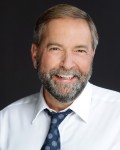
New Democratic Party of Canada leader Tom Mulcair. (photo from Tom Mulcair’s office)

“I think the values of the community that you’re writing for are very similar to the social values of the NDP historically, and I think that’s a strong connection that we have,” New Democratic Party of Canada leader Tom Mulcair told the Independent in a phone interview last week.

He added that his wife Catherine’s “family connection means that I’m the only person in this race who has a deep understanding of the Jewish community and of its history, and I’ll always be a strong stalwart based on that understanding.”

Even before the election campaign started, Mulcair always has been clear in his support for Israel.

“My position is very comfortable within the NDP,” he said, “because the party’s position has, for a long time, been in favor of a two-state solution. Essentially, we believe we have to be working with partners in the Middle East, in particular, in Israel and Palestine, within a framework of respect for UN resolutions and international law, that’s important. And, we always talk about working towards peace in the region, starting from a base where it has to be mutually agreed borders and, frankly, everyone free from attack of any kind: peace and security, in other words, within established and negotiated borders.”

He defended his strict enforcement of this view, which has included the dismissal of candidates who hold alternate opinions.

“I’ve tightened the reins in making sure people respect our position, and I think that that’s the key thing,” said Mulcair, adding that the NDP is “still the only party political party in Ottawa to have ever had a Jewish leader, in David Lewis [federally] and, of course, in Ontario, Stephen, Lewis’ son. And I’ve had a chance to visit Israel a couple of times and look forward to going back. I daresay that I’m the only leader in this campaign … who can count family in Israel, as well.”

“I think that free trade with a democracy is a good thing. We also backed the trade agreement with Jordan because we know that it’s also a very strong voice for stability and peace in a very tough region with a lot of problems.”

With respect to the expansion of the Canada-Israel Free Trade Agreement earlier this year, Mulcair said, “I think that free trade with a democracy is a good thing. We also backed the trade agreement with Jordan because we know that it’s also a very strong voice for stability and peace in a very tough region with a lot of problems.

“As you know, the NDP takes a pretty strong view that free-trade agreements have to represent dealings with countries that have values similar to ours, and that’s why in both cases we had no problem with it.”

The NDP also has no problem with the P5+1 (China, France, Russia, the United Kingdom, the United States and Germany) nuclear deal with Iran.

“I think that the P5+1 deal shows that diplomacy can achieve real results even after decades of hostility,” said Mulcair, who described himself as “very clear-eyed about the Iranians,” noting that the antisemitism there “is at a level rarely seen in the world today.”

He said, “I don’t have any illusions about what I’m dealing with … no Israeli government can ignore the threat of a nuclear Iran…. At the same time … as long as it is enforced rigorously, the deal shows the possibility of making sure that Iran’s nuclear ambitions are hemmed in.”

About security closer to home, and specifically Bill C-51, Mulcair said, “I think that it’s a question of approach and priorities. Don’t forget Mr. [Stephen] Harper’s approach is always about stark, false choices. He would have you believe, for example, that a government has to choose between the economy and the environment. Of course, that’s a false choice; you have to do both. He would have you believe that you either keep your communities safe or you respect your rights or freedoms. Well, the prime minister’s job is to do both: respect Canadians’ rights and freedoms, and keep communities safe. So, C-51 is a breach with that.”

Offering an example from the party’s history in balancing security and freedoms, Mulcair noted, “The NDP, you might recall, is the party that had the courage politically to stand up in 1970 against the imposition of the War Measures Act that put hundreds of Canadians in jail without trial, without accusation, and the NDP had the courage to stand up against that.

“When Mr. Harper came in with Bill C-51, I was told that I was being foolhardy to oppose it, that the vast majority of Canadians were in favor of it. Well, you know what? I don’t take that as the starting point in these issues. I am more than willing to stand up to Stephen Harper when he’s compromising Canadians’ rights and freedoms, and we did that. We did that with an articulate stance that explained to Canadians why it was a mistake, and you know what? At the end of that process, most Canadians agreed with us, so I’m proud of that.

“There are things that can be done here in Canada to help fight some of the situation there,” he said, referring to the conflict in Syria, as well as others in the region. “There are a couple of concrete things that I think Canada can and should be doing.

“First of all, Canada is the only country in NATO not to have signed the Arms Trade Treaty. Well, that’s something that’s easy to fix, and that can help stop the flow of arms to some of those conflicts right now.

“Deradicalization is entirely absent from Bill C-51 and that is, again, a mistake. Most of our partners in the world who are dealing with these issues realize that the flow of foreign fighters into those regions is one of the biggest problems and, instead of coming to grips with that, Mr. Harper completely ignores the problem.”

“There’s also an important element of deradicalization. And, again, Mr. Harper just doesn’t know how to get this right. For example, he doesn’t talk about going into houses of worship, as you hear President [Barack] Obama talk about. What Mr. Harper will talk about, specifically, are mosques. Now, of course, in that case, he’s finger-pointing a single community. That’s a mistake. Deradicalization is entirely absent from Bill C-51 and that is, again, a mistake. Most of our partners in the world who are dealing with these issues realize that the flow of foreign fighters into those regions is one of the biggest problems and, instead of coming to grips with that, Mr. Harper completely ignores the problem.”

Other problems that Harper has ignored, or about which he has been mistaken, according to Mulcair, concern the budget and jobs. The NDP’s approach to these issues, including its focus on the middle-class, has drawn some criticism that the NDP has strayed from its roots – a point with which Mulcair disagrees.

“We’ve been really clear all along, especially under my leadership, that Canada wants a government that knows how to deal with the big issues of the day in the interest of the population,” he said. “When we [the NDP] were in power in Saskatchewan, we ran 17 consecutive balanced budgets because we had taken over a province that was bankrupt after years of Liberal rule…. After those balanced budgets, we were able to bring in free, universal, public medical care – that was an NDP priority.

“This time around, I’m talking about the importance of bringing in quality, affordable, maximum-$15-a-day child care, and we’re going to do that on the basis of a balanced budget. There are some who would say, well, that’s not a very social-democratic thing, but if you look at the history of the NDP, we have a history of being very prudent public administrators. We know that we have that burden on us – that we’re always going to have to be the ones who have to be the most prudent because, if we’re not, people will judge us more harshly than the others.

“Some of the other parties are taking a different approach,” he continued. “Mr. Harper talked a good game but ran up $150 billion in new debt while he was in power. Mr. [Justin] Trudeau is promising to spend at least $10 billion a year more than what he takes in and, in the fourth year, he’s going to start cutting with, quote, everything will be on the table, in terms of cuts – that was the exact quote from Mr. [John] McCallum when he was asked how he was going to be able to cut $6.5 billion in the fourth year of his budget. So, that’s where the Liberals are, that’s where the Conservatives are.”

“Economically, we’re talking about balanced budgets, but we also want to create opportunities for good-paying jobs. There were 400,000 manufacturing jobs lost on Mr. Harper’s watch, and he wants to kill off tens of thousands more with this recent trade deal.”

Mulcair said the NDP are prudent administrators in other areas, as well. “I have a strong personal track record as a former environment minister as a strong enforcer of environmental legislation and I’m strong on principle on those things,” he said. “Economically, we’re talking about balanced budgets, but we also want to create opportunities for good-paying jobs. There were 400,000 manufacturing jobs lost on Mr. Harper’s watch, and he wants to kill off tens of thousands more with this recent trade deal,” meaning the Trans-Pacific Partnership. On Oct. 5, the 12 countries involved, including Canada, reached an agreement, which still has to be ratified by each country’s parliament.

“On the environment, on the economic issues, on social issues, we’re very different from the other two parties who, more often than not, are of one mind,” Mulcair said, giving three examples.

“Mr. Trudeau and Mr. Harper agreed with tens of billions of dollars of tax reductions for Canada’s richest corporations – we disagree, we’re going to start making them pay their fair share.

“We disagree with the Keystone XL Pipeline. We think that you don’t export your natural resources raw. Mr. Harper and Mr. Trudeau are of one mind, they think that it’s a good idea to send 40,000 Canadian jobs to the U.S. – we disagree.

“We’ve had a different approach on C-51. Mr. Trudeau was afraid of Mr. Harper. He said at the University of British Columbia that he was too afraid of Mr. Harper to stand up for what he thought was the right thing to do in that case. Well, I think that that’s sad, and I think that Mr. Trudeau has shown a lack of leadership and, frankly, a lack of experience.”

While the NDP would increase the corporate tax rate, its platform includes “supporting innovation and investment in companies.” When asked if this was not just a different way of subsidizing business, Mulcair responded, “No. For example, the Conservatives have continued to subsidize companies in the oil patch. We will remove subsidies. What we will do is bring back certain innovation tax credits because we know that the manufacturing sector is, and can be, a hub for innovation and technological jobs in the future that will be knowledge-based.

“We’ll also propose a small-business tax cut, so we’ll bring their taxes down from 11[%] to nine, which we think is a smart way of stimulating the creation of jobs by job creators because small- and medium-sized businesses in Canada create more new jobs. We don’t shy away from saying that government can play an active role in creating the conditions for the private sector to create jobs.”

“This is the first time in Canadian history that we actually have a choice. For 148 years, we’ve been told we have no choice but to alternate. When we get tired of the Liberals and the sponsorship scandal, we’re supposed to go back to the Conservatives. We get tired of the Conservatives and the Senate scandal, we’re supposed to go back. This time, the first time, there is a choice.”

Looking ahead to the last days of the campaign, Mulcair said, “This is the first time in Canadian history that we actually have a choice. For 148 years, we’ve been told we have no choice but to alternate.” For example, “When we get tired of the Liberals and the sponsorship scandal, we’re supposed to go back to the Conservatives. We get tired of the Conservatives and the Senate scandal, we’re supposed to go back. This time, the first time, there is a choice.

“For the first time in Canadian history, the NDP is forming the Official Opposition, we’re seen as a government-in-waiting. We’re doing great across the country but we’ve got very strong support in certain regions that are going to allow us to form a government, and we know that.

“B.C. is a good example of a province where we’re doing super well,” he said. “I just had an event there yesterday morning that showed me that the energy and the strength of the team and the campaign that we’re running are resonating … so we’re going keep that going.”

The Independent has interviewed Liberal leader Justin Trudeau (July 31), Minister of National Defence and Minister for Multiculturalism Jason Kenney (Sept. 18) and Green party leader Elizabeth May (Oct. 9). The federal election is on Oct. 19.

Nuclear comedy to be a hit?

Atomic Falafel poster. (photo from Atomic Falafel PR via israel21c.org)

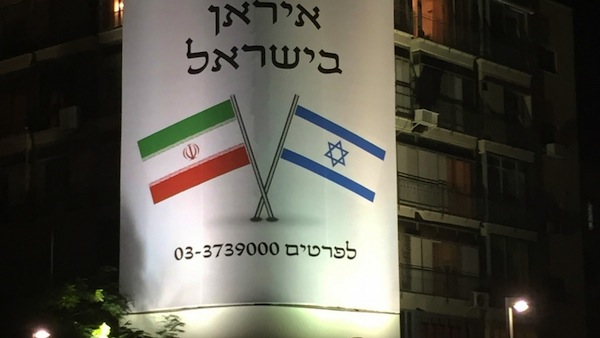
While world headlines focused on the landmark Iranian nuclear deal, an enormous billboard outside a Tel Aviv building announcing the upcoming opening of an Iranian embassy in Israel in August had the local social media community wondering whether it was an art installation, an anonymous peace group’s campaign or someone’s idea of a joke.

photo - The billboard announcement that had Tel Avivians talking
The billboard announcement that had Tel Avivians talking. (photo from Atomic Falafel PR via israel21c.org)

The Hebrew billboard included pictures of the two countries’ flags, a local phone number and the text: “Opening here soon – embassy of Iran in Israel.” It was erected at Rabin Square, the favored site for political peace rallies.

The mystery was solved in the last days of August by the people behind the sign. It was a public-relations stunt to drum up publicity for the new Israeli comedy Atomic Falafel, a madcap film about a nuclear conflict between Israel and Iran.

“A satirical comedy mocking ultra-militarism” is how producer Avraham Pirchi explained the film, which was scheduled to open in Israel on Sept. 10.

Atomic Falafel is the latest from director Dror Shaul, winner of the 2007 Sundance World Cinema Jury Prize for his semi-autobiographical film Sweet Mud. It tells the story of two girls – one in Israel, one in Iran – who spill their countries’ most valuable secrets on Facebook to prevent a nuclear crisis. The movie pits a wifi-connected younger generation against old-school warmongers in an effort to stop a preemptive Israeli attack on Iran’s nuclear facilities.

“Teenagers around the world today are much more similar than different to each other. They dress the same, listen to the same music and are not really interested in wars. I hope that the sane, logical side of Israel and the world will overcome the irresponsible one, and that my little boy born just two weeks after the end of shooting will be rewarded with a safe future,” said Shaul.

“When we started to make Atomic Falafel, we didn’t know we would be releasing the film when Iran’s nuclear power would be so relevant. But that’s what’s happened,” Pirchi told variety.com, adding that the film is “pro-peace and optimistic.”

The film is co-produced by New Zealand’s General Film Corp. and Germany’s Arden Film, Getaway Pictures and Jooyaa Film. It stars Israeli actors including Shai Avivi, Mali Levy, Yossi Marshak and Zohar Strauss, as well as Germany’s Alexander Fehling (Inglourious Basterds).

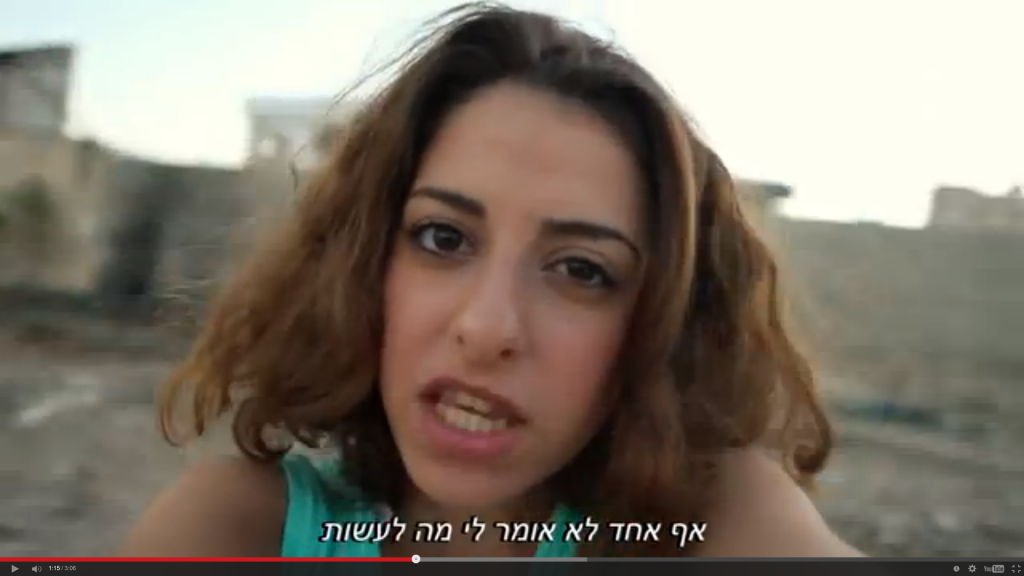
screenshot - Tara Melter, a German actress of Iranian descent who plays a supporting role in the film, raps the soundtrack’s title track, “Hitchki.”
Tara Melter, a German actress of Iranian descent who plays a supporting role in the film, raps the soundtrack’s title track, “Hitchki.” (screenshot)

Tara Melter, a German actress of Iranian descent who plays a supporting role in Atomic Falafel, raps the soundtrack’s title track, “Hitchki.” The song, composed by Bahar Henschel, is addictive.

Production company United Channel Movies (UCM) announced on Facebook that Atomic Falafel has all the makings of a hit, citing that the movie’s trailer (in Hebrew only) racked up more than 100,000 views in its first two hours online. UCM says it is in talks with international agents to secure wide distribution of the movie following its Israel release.

Israel21C is a nonprofit educational foundation with a mission to focus media and public attention on the 21st-century Israel that exists beyond the conflict. For more, or to donate, visit israel21c.org.