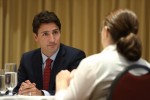
Liberal Party of Canada leader Justin Trudeau in an interview with Cynthia Ramsay of the Jewish Independent. (photo by Adam Scotti)
Justin Trudeau said he is cautiously optimistic about the Iran nuclear deal, insisted he is committed to fighting ISIS and reiterated his commitment to the environment and social fairness in an exclusive interview with the Jewish Independent.
The federal Liberal leader, who hopes to be prime minister after the Oct. 19 federal election, acknowledged the implications of Iran’s agreement with Western powers over its nuclear program, which the Tehran regime maintains is for energy purposes only.
“We all start from the same place on this – a nuclear-armed Iran is a threat not just to Israel, not just to the region, but to the entire world, and we have to make sure that Iran doesn’t achieve that,” Trudeau said.
There are only two ways to reach this objective, he said: direct military intervention on the ground against the Iranian regime or a diplomatic agreement. “We don’t have such a great record of military intervention in that part of the world,” he noted, stressing that the agreement is “not based on trust but on verification.”
“We are cautiously optimistic about the deal,” he said. “We’re not saying we should drop the sanctions today. Obviously, there are a lot of milestones to be addressed, but I think anything [is positive] that sets us down the path of both delaying the ability significantly of Iran to get the nuclear bomb and increases the ability of the Iranian people to put pressure on their regime to change – because we all know we can make a tremendous distinction between the Iranian citizens and their government that doesn’t represent them particularly well.”
Trudeau also advocated reopening diplomatic relations with Iran eventually. “I do feel that it would be very nice to hope to reopen that embassy at one point because you don’t have embassies with just your friends, you have your embassies with the people you disagree with,” he said. “However, on top of addressing the nuclear concerns, Iran has to do an awful lot to demonstrate that it’s no longer going to be a state sponsor of terrorism in the region, around the world, and they have to do an awful lot around human rights and repression of their own citizens and dissent within Iran before they can rejoin the community of nations. But I think we’re on a path that should be cause for at least a level of comfort that perhaps we’re in a positive direction now.”
In speaking with the JI after a speech to the Richmond Chamber of Commerce last Friday, Trudeau, in his second exclusive with the paper, clarified his stance around confronting ISIS.
“This is a great opportunity for me to spell out our position on this,” he said. “The Liberal party feels it is extremely important that Canada be a significant part in the effort against ISIS. We are absolutely supportive of being part of that coalition and, indeed, we feel there is a military role for Canada in the fight against ISIS that can make a very big difference. We disagree that bombing is the best way for Canada to do that. That’s why we voted against the mission and voted against the expansion of the mission into Syria, because it has a likely side effect of strengthening Bashar al-Assad’s grip on power and that we don’t necessarily want.”
“We are absolutely supportive of being part of that coalition and, indeed, we feel there is a military role for Canada in the fight against ISIS that can make a very big difference. We disagree that bombing is the best way for Canada to do that.”
What Trudeau would prefer, he said, is for Canada to provide more humanitarian aid, for example, and for this country’s military to provide the kind of role it does in Afghanistan. “We’ve developed tremendous expertise,” he said, “which is training the local troops to be able to take the fight more efficiently to ISIS. That would happen far from the frontlines because we don’t want Canadian troops to be involved [there] but also because we know that it is the local troops that are going to be effective at taking back their homes, their communities, and dropping in Western soldiers doesn’t make the situation better as, unfortunately, the Americans understood in Iraq awhile ago.”
He sees an opportunity for Canada to make an impact without being directly involved in the conflict. “We feel there’s a role for Canada to be a significant resource in training the local military, not in a direct combat role that Mr. Harper is proposing with the bombings,” he said.
Trudeau welcomed the opportunity to explain his support, with caveats, for the federal government’s anti-terrorism bill, C-51. “The Liberal party has always understood that we need to protect Canadian security and uphold our rights and freedoms – and you do them both together,” he said. “To our mind, Bill C-51, even though it has clear elements in it that increase the safety for Canadians – which is why we supported it – it doesn’t go far enough to uphold our rights and freedoms, which is why we’re committed to bringing in oversight, putting in a sunset and review clause onto our anti-terror legislation, and also narrowing and tightening some of the rules around what behavior CSIS [Canadian Security Intelligence Service] can have – warrantless searches and all those sorts of things.”
His political opponents, he said, go too far in each direction. “Mr. Harper thinks, ‘No, no, we don’t have to do anything more around rights and freedoms, we have enough, we’re just giving more power to our police,’” Trudeau said. “I think that’s a problem.
“Mr. Mulcair says, ‘No, we don’t need to do anything more on security. Even those things in C-51, we don’t need them, we’re fine the way it is.’” That is also a problem, according to Trudeau. “We have to do more,” he said. “But we have to do more on both sides.”
On other topics, the Liberal leader expressed support for increased trade with Israel. “We obviously support the latest announcement around Canada-Israel free trade,” he said. “I know it was a lot of agricultural stuff in this round, but it’s a very good thing. This was a deal that was signed by [Liberal prime minister] Jean Chrétien back in ’97 and the Liberal party believes in trade. We believe in free trade, and we’re happy to continue trade with Israel.”
Trudeau took the opportunity to reiterate his opposition to the movement to boycott, divest from and sanction (BDS) Israel.
“You can have all sorts of debates over positions, but when you’re engaged in demonization, delegitimization and double standards, that’s just not what we are as a country.”
“I think the BDS and anti-apartheid movement, as I’ve said many times, runs counter to Canadian values,” he said. “You can have all sorts of debates over positions, but when you’re engaged in demonization, delegitimization and double standards, that’s just not what we are as a country.”
The Independent also asked Trudeau about the Liberals’ approach to climate issues and social equality.
“At a very basic level, we get it, as Canadians, particularly here in B.C., that you cannot separate what’s good for the environment and what’s good for the economy anymore,” Trudeau said. “You have to do them both together, and you can’t get one without the other.
“You still have people saying, ‘Oh no, we have to work on the economy, so let’s forget about environmental oversight,’ or ‘We need to protect the environment, so, no, we can’t create jobs.’ Canadians know we need them both together,” he said. “One of the problems is we’ve had 10 years of such a lack of leadership on the environmental level that it’s hurting our economy. We need to get our resources to market in responsible, sustainable ways. We’re not able to do that right now because nobody trusts Mr. Harper to do it right. Restoring that sense of public trust, [so] that people know, we need jobs, we need economic growth … in a way that understands that it’s not just about governments granting permits, but about communities granting permission, as well.
“One of the things we’ve put forward in our environmental plan is that, in the 10 years of lack of leadership on the federal side, the provinces have moved forward,” Trudeau continued. “B.C. has a very successful carbon tax, Alberta put in a carbon levy-style tax, Ontario and Quebec are doing a cap-and-trade. What that means is that 86% of our economy has already put in a mechanism to put a price on carbon, so the federal government can’t suddenly say, ‘OK, we’re doing cap-and-trade. Sorry, B.C., you’re going to have to change your system,’ which would make no sense; or vice versa, ‘We’re doing a carbon tax.
Sorry, Ontario, you can’t do it.’ What we have to do is recognize that different jurisdictions will have different ways of reducing their emissions – the federal government has to be a partner, a supporter, an investor in our capacity to do that across the country, in order for us to reduce our emissions and be responsible about the environment.”
Trudeau acknowledged the solutions won’t be immediate. “We need to move beyond fossil fuels, but it’s not going to happen tomorrow,” he said. “Right now, a lot of people who are blocking and opposed to pipelines aren’t realizing that the alternative is a lot more oil by rail, which is really problematic – more expensive, more dangerous.” Under the circumstances, he said, people are just saying no: “No to everything, because we don’t trust the government in place.”
He said he hopes to form a government that addresses climate change, invests in clean technology, renewable resources and the kinds of jobs that advance beyond a fossil fuel economy. For now, “we have to make sure that our oil sands are developed going forward in a responsible, efficient way that doesn’t give us the black eye on the world stage and with our trading partners,” he said.
“The Liberal party believes in evidence-based policy and we believe in harm reduction. My own hometown, Montreal, is pushing hard to set up an Insite-type clinic. The Liberal party supports that. The Supreme Court supports that. This government, for ideological reasons, is pushing against it. I think that’s just wrong, and we’re happy to say that. ”
Vancouver has been the testing ground for new ways of dealing with addiction, particularly the Insite supervised drug injection clinic. “The Liberal party believes in evidence-based policy and we believe in harm reduction,” Trudeau said. “My own hometown, Montreal, is pushing hard to set up an Insite-type clinic. The Liberal party supports that. The Supreme Court supports that. This government, for ideological reasons, is pushing against it. I think that’s just wrong, and we’re happy to say that.”
In the same week that Canadian parents were receiving Universal Child Care Benefit [UCCB] cheques in the mail calibrated to the number of children in their home, Trudeau was promoting his party’s “fairness plan.”
“Mr. Harper’s child benefit, for example, goes to every family regardless of how wealthy they might be,” Trudeau said. “We, instead, decided, let’s make it means-tested so that people who need the help the most will get the best help. For a low-income family, it means up to $533 a month, tax-free, and then it grades down until someone making over $200,000 doesn’t get any child-care benefit at all. And the benefits that will go to the nine out of 10 Canadians will be tax-free, so the money you get is actually money you get to spend.”
The plan also proposes to lower the middle-class income bracket from 22 to 20.5, which will result in about $3 billion in lost revenue. “In order to get that $3 billion,” said Trudeau, “we’re bringing in a new tax bracket on the wealthiest Canadians, people who make over $200,000, to even things out. And it’s not just about redistribution, it’s also about growing the economy because we know, when middle-class families and the working poor have money in their pockets to spend, to grow, it stimulates the economy.
“Interestingly enough, the NDP is lined up with the Conservatives on those positions,” he added. “They support the Conservatives’ UCCB that gives big cheques, and they’re opposed to us bringing in a higher tax bracket for the wealthiest Canadians, which I don’t understand. They have their reasons for it but, for me, the NDP is supposed to be a party that stands up for the most vulnerable.”