This fall, a select number of Langara College students embarked on a project to write the memoirs of local Holocaust survivors, capturing personal stories from the Second World War. The project is called Writing Lives: the Holocaust Survivor Memoir Project.
Writing Lives is an eight-month collaboration between Langara’s English and history departments, the Vancouver Holocaust Education Centre (VHEC) and the Azrieli Foundation. In the first half, students learn about the history and impact of the Holocaust. In the second half, students are paired with local Holocaust survivors associated with the VHEC.
“Writing Lives provides an opportunity for students to immerse themselves in the history of the Holocaust beyond physical textbooks,” said Rachel Mines, Langara English instructor, and project coordinator. For example, on Nov. 9, students commemorated Kristallnacht (The Night of Broken Glass) by lighting candles in memory of the violent anti-Jewish events that took place on Nov. 9 and 10, 1938. The course also regularly features a series of guest speakers from different organizations giving their perspective on the events surrounding the Holocaust.
“I feel grateful for the opportunity to investigate the events and prejudices that served as a catalyst for the Holocaust. With the help of survivors, professors, librarians and fellow students, I am learning that individuals, communities and organizations all have agency when it comes to fighting racism, and how we can work together to prevent such tragedies in the future,” said Lucille Welburn, a peace and conflict studies student who is taking the course.
Robin Macqueen, a Langara instructor and chair of the health sciences division, is auditing the course out of personal interest. He said: “This is a fantastic opportunity to engage with and honor people who survived a time of unimaginable prejudice. I’m getting a lot out of the course, and enjoy being a student again.”
For the VHEC, survivor testimonies are seen as a useful and powerful method for teaching about the Holocaust.
“Holocaust testimony provides a connection with people, culture, persecution and survival,” said Ilona Shulman Sparr, education director for the VHEC. “Eyewitness testimonies have proven to be a powerful and effective teaching tool, which affords a personal connection to the events of the Holocaust as we hear survivors’ accounts of their experiences. Testimonies provide a way for students to connect with survivors’ stories and gain an understanding of events that other sources can’t give them.”
This spring, students will be matched with Holocaust survivors to write their memoirs. The memoirs will be archived at the Azrieli Foundation and the VHEC, with a possibility of being published for public awareness.
A letter of introduction, written and signed by the Rambam (Maimonides) in the 12th century, which is part of the Discarded History exhibition that will be opening in April 2017 at Cambridge University.Visitors will be able to see a small fraction of the more than 300,000 manuscripts and fragments that were originally found in the geniza, or storeroom, of Ben Ezra Synagogue in Fustat, or Old Cairo, in Egypt. Some of the items are more than 1,000 years old and, among them, are accounting records and parts of responsa and observations by some of the greatest Jewish theological minds, such as the Rambam, Isaac Luria and Joseph Caro. (photo by Edgar Asher with permission of the Syndics of Cambridge University Library)
Israel Antiquities Authority’s new 36,000-square-metre, three-level National Campus for Archeology of Israel, designed by architect Moshe Safdie to descend like excavation strata, is still under construction. (photo by Ardon Bar Hama, Israel Antiquities Authority, via Ashernet)
Located on Museum Hill in Giv’at Ram between the Israel Museum and the Bible Lands Museum in Jerusalem, the facility will allow the public to see some of the tens of thousands of archeological items presently being held in store rooms and to watch, through windows, conservation being carried out on a variety of national treasures. Twenty-six donors, together with a significant contribution from the state, made it possible to go ahead with the $105 million project, which is expected to be complete in about a year’s time.
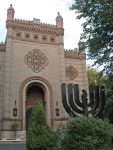
The Choral Temple in Bucharest. (photo from Wikimedia Commons)
We spent two weeks in Romania in the late summer of 2015, also visiting Bulgaria. We took this trip partly because it was an area of vibrant Jewish life from Roman days until the late 1930s. Romania also served as a commercial link between Europe and Asia, and was known for its café life. Its capital, Bucharest, was called the “Paris of the East.” Then came the Nazis and, after them, the Soviets. We wanted to see what remains in these two countries, primarily for Jews but also for the rest of the population.
We arranged a private tour with a knowledgeable guide that generally followed an itinerary designed as a Jewish heritage tour, supplemented by Ruth Ellen Gruber’s Jewish Heritage Travel: A Guide to Eastern Europe (2007). Local information on Jewish sites is surprisingly scant, nothing like what one finds in Lithuania and Latvia. However, the tour company had prearranged talks with people in the larger synagogues, museums and cemeteries, which helped to augment our own observations. There is a monthly Jewish newspaper in Romania, Realistatea Evreiasca, with one page in English and one in Hebrew. As mentioned, our tour in Romania was followed by a visit to Bulgaria, but space limitations permit only scattered references to our time in that country.
Romania and Bulgaria form the southern and eastern parts of the Balkan peninsula in Europe. Romania lies immediately to the north of Bulgaria, with the Danube River forming much of the border between the two before flowing into the Black Sea. Northern and central Romania is dominated by the Carpathian chain of mountains, and southern Romania by the plain of the Danube. Further south lie Greece and Turkey; to the west, various countries that used to be Yugoslavia; and to the east, Ukraine and the always menacing Russia.
Romania was a monarchy until the end of the Second World War. Supported by local antisemites, it fit rather comfortably under Hitler’s leadership and, then, under Nicolae Ceausescu, became one of the most harsh of all Soviet satellites. Today, Romania is best described by a guide at one synagogue who cautiously called it a “developing democracy.” (More on politics later.)
In contrast to the rest of Eastern Europe, Romanians speak a Romance language, which helps make many signs understandable to Anglos. Despite some bumps along the way, the economy in this proto-capitalist country seems to be improving year by year and, in 2007, it became a member of the European Union.
Almost everywhere one looks in Romania, there is an Orthodox church at the street corner. There are some Roman Catholic churches and a few mosques. The Jewish population is now only a few percent and heavily concentrated in Bucharest. Before the Second World War, large numbers of Jews lived in the northern and western parts of the country.
Romanian synagogues tend to have the plain exteriors but elaborate interiors that are common elsewhere in Eastern Europe and in Muslim countries. Romania was more Sephardi than Ashkenazi, but most synagogues now have the bimah at the eastern end rather than in the middle. In some cases, markings on the floor indicate that the bimah had been moved forward in the recent past. With some exceptions, the old Jewish quarter has been destroyed to make way for large, monotonous apartment buildings that are dubbed “Soviet Gothic.”
Restaurant food and wine was great everywhere we went, and available at modest prices – in contrast to what one hears, the white wine is just as good as the red (well, almost as good). Pork is the main meat, but chicken and veal are widely available, as are dairy products. The country is slowly returning to the café culture that was once so famous. The spirit is enhanced by wide avenues for pedestrians complete with street performers.
Some synagogues and Jewish community centres serve kosher meals, but otherwise we saw no kosher restaurants. And then there is rakija, or plum brandy, typically 60% alcohol; our advice is to sip slowly. David was delighted to see a few moderate-sized wind farms and some large solar electric farms. Less happily, there is a lot of smoking by people of all ages and in almost all places.
Our time in Romania began with a couple of days in Bucharest and then went from city to city elsewhere in Romania. Bucharest has two active congregations, one Chabad and the other in a 160-year-old Orthodox synagogue known as the Choral Temple. The adjective “choral” means that there is, or was, a choir. As with other synagogues that we visited, services are generally limited to Shabbat and holidays, though Chabad meets daily. Because of the small Jewish populations and the effects of assimilation, services are typically held in prayer rooms rather than in the large sanctuary. Unhappily, from our perspective, they all retain traditional restrictions on participation by women who, if they appear at all, are kept behind nearly opaque curtains. Synagogues in many of the larger cities are today undergoing renovations, thanks to Romanian, Israeli and European Union money, plus contributions from the Romanian diaspora. In contrast, with scattered exceptions, smaller cities today show little more than deteriorating synagogue buildings and ill-kept cemeteries.
When we visited the Choral Temple, we found that the exterior renovations had been completed but the interior ones were ongoing. About half of the visitors were Romanian, and the rest mostly from the United States or from Israel. As we ended our visit, about six of us were making our way out of the gate, which faces onto a busy street, and saw two local men watching us. One greeted us in French. He wanted to know, in a friendly way, why tourists came to Bucharest. He and David spoke together for awhile in French. The other man was large, probably in his 50s, and stood stock still, forcing us to walk around him to exit the gate. Toby remembers that she had never seen such glaring eyes and such a set jaw. She was transfixed by the unrelenting contempt pouring from this man’s face. She had no language in which to greet or to question him. Was he contemptuous of tourists, of Western tourists, or of synagogues? Toby retains a memory of these two men as two faces of Romania: the one open and friendly; the other full of animosity that may have been antisemitic.
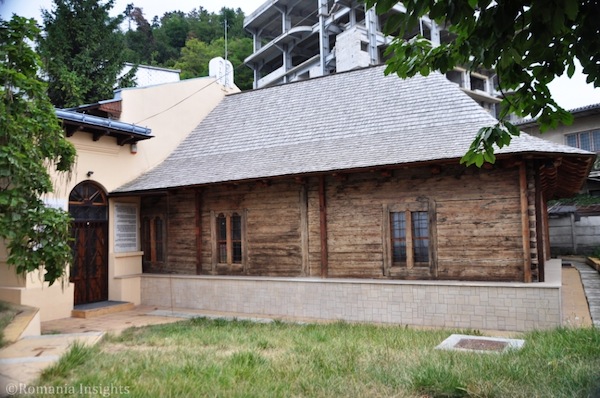
A high point in David’s trip was attending Shabbat services in the last wooden synagogue in Romania. It is located in Piatra Neamt in north-central Romania, and its sanctuary is built below street level to meet some old restriction about not being higher than any church. The building’s formerly wooden base has now been replaced by concrete to protect the wood from deterioration. Everything above the base is the original wood, as is most of the elaborately decorated interior, with many locally created crafts, carvings and paintings.
David entered the building on Shabbat when, clearly, tourists were not welcome. Even though wearing a kippah, he was eyed suspiciously. Was this just a Jewish tourist sneaking a look inside the building at a time when it was closed to tourism? The regulars relaxed a bit when he put on a tallit, and more when, out of a corner of their eyes, they saw him saying the brachah before putting it on. Later, the gabbai gave him an aliyah, and invited him to the kiddush, which was fun, not so much for the bun and wine as for the unlabeled bottle that emerged afterwards and, not surprisingly, turned out to be rakija.
Sighit is located in northwestern Romania, which is the part closest to Hungary, and perhaps for that reason has a long history of antisemitism. The large Jewish cemetery there is remarkable for the practice of adding the names of Jews who died in the Holocaust to the tombstones of family members who had died in the 1930s. The city is the birthplace of Elie Wiesel, and home to a museum dedicated to his works. This is also the area where the Ba’al Shem Tov, the founder of modern Chassidism, lived, and we heard half a dozen (conflicting) statements as to where he taught, studied or served as rabbi.
Tourists to rural Romania will also see a number of Orthodox churches that are densely painted on every surface, and also some monasteries built entirely of wood without the use of nails. And, of course, tourism entrepreneurs have built on the Dracula legend to encourage visits to castles within easy reach of Bucharest. They may be fun, and there is apparently a nugget of truth in the story of Vlad the Impaler. Instead, we wandered in the old city of Bucharest, which is just beyond the city’s modern centre, where one finds the presidential palace, the art museum and other sites of national importance. Within walking distance of the centre is the Peasant Museum, which not only has the usual displays of clothing and tools from different parts of the country, but also entire water mills (for grinding flour) and pressing mills (to make felt) with their roofs removed so they can be viewed from an elevated platform. The museum shop was the best place we found to purchase gifts.
According to the Anti-Defamation League, antisemitic acts are now at a low level in Romania, but the country has not yet emerged from quiet denial of what happened to Jews during first the Nazi era and then the communist era. (For more information, see the recently translated book entitled The Jews of Timisoara by Tibor Schatteles, which details Jewish life in one western Romanian city from Roman times through the present.) We found occasional plaques to commemorate the loss of Jews during the Holocaust, but they were erected by local Jewish groups, not by civil authorities.
Romania did send a lot of its Jewish citizens to their deaths in concentration camps. In some Romanian cities, pogroms were initiated by local antisemites. Statistics from Maramuresh province in the north, which at one time had 52 synagogues, are telling: 35,000 Jews in 1930, 3,100 in 1948 and 48 in 1992. On the other hand, during both Nazi and communist periods, the Romanian government allowed Jews to buy their freedom on ships that would dock at Black Sea ports and pass through the Bosporus en route to Israel or other safe havens.
During the communist era, Jewish communities and institutions suffered mainly from near-total neglect. A 7.2-level earthquake in March 1977 took a heavy toll on Jewish buildings, but only the most serious repairs were undertaken.
What about the future for Romanian Jewish communities? Almost everywhere we were told that most marriages today are mixed, and only a few involve conversion of the non-Jewish partner. The large and relatively active synagogue in Sibiu had only one bar mitzvah child that year. Adjacent to some synagogues are buildings that were formerly Jewish schools, but today most teaching takes place in extra rooms in the synagogue.
While the future for Romania – and for individual Jews who live there – seems distinctly positive, the future for Romania’s Jewish population as a viable minority seems much less assured.
David Brooksis environmental economist who works with a number of organizations in Canada and Toby Brooks works with organizations fighting abuse of women. They live in Ottawa.
Museloop’s app that it created for Israel Museum. (photo from Museloop via Times of Israel)
How do museums and other purveyors of history attract visitors and make the past relevant, especially as people come to expect more and more digital experiences?
Perhaps surprisingly, Werner W. Pommerehne and Bruno S. Frey recognized the problem more than 36 years ago. In their article “The museum from an economic perspective,” which was published in the International Social Science Journal in 1980, they stated:
“Museum exhibitions are generally poorly presented didactically. The history and nature of the artists’ work is rarely well explained, and little is offered to help the average, uninitiated viewer (i.e., the majority of actual and potential viewers) to understand and differentiate what is being presented, and why it has been singled out. Accompanying information sheets are often written in a language incomprehensible to those who are not already familiar with the subject. There is no clear guidance offered to the collections, and little or no effort is made to relate the exhibits to what the average viewer already knows about the history, political conditions, culture, famous people, etc., of the period in which the work of art was produced.”
Keren Berler, chief executive officer of Israeli start-up Museloop recently put the problem into current perspective. Younger visitors, she noted in an Israeli radio interview this past June, find museum visits passive and boring. She said, especially when seeing museum art exhibits, young people need something more to draw them into what they are seeing. So, her company has designed a museum-based application for iPhone and Android use. The application includes games, such as find-the-difference puzzles, plus information about the artist, all of which will hopefully make the visitor better remember the art and some facts about it.
Interestingly, in describing the games, two of the attributes she mentioned were competitiveness and the ability to take “selfies.” Children as young as 8 or 9 years old can use the app on their own, but younger children would need an adult to assist them.
Right now, the Museloop app focuses on Israel Museum’s under-appreciated (read: under-visited) permanent art collection. This exhibit includes the works of a number of “heavies,” such as Marc Chagall, Claude Monet, Pierre-Auguste Renoir, Paul Cézanne and Paul Gauguin. The goal is to make the experience so appealing that young visitors will then want to visit other museums. Since Israel Museum is paying the start-up for the development and use of the app, visitors benefit by having free use of it.
In contrast, Tower of David Museum has its own in-house digital department. This department has developed its own applications for heightened exhibit viewing.
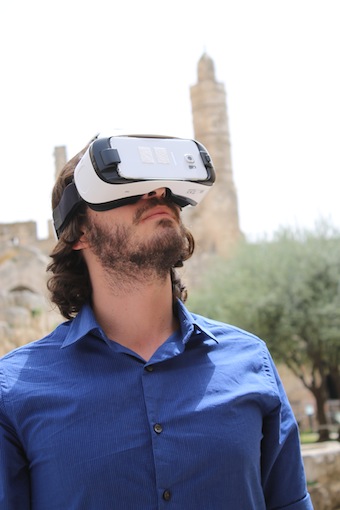
Virtual reality in the actual reality of Tower of David Museum. (photo from Tower of David Museum)
According to Eynat Sharon, the head of digital media, her department takes into consideration the visitor’s total museum experience. This experience consists of three overlapping circles: the pre-visit, in which a person visits either the museum’s website or mobile site; the actual physical visit; and the post-visit, in which the person digitally shares with friends and family on Facebook, Instagram and other social media what they encountered at the museum. The museum’s technical equipment and apps may be rented by museum visitors for a small fee.
Are these new applications then to be applauded? Some people still need convincing. Last year, art critic Ben Davis reflected on news.artnet.com, “For many, many viewers, interfacing with an artwork through their phone trumped reflecting on its themes. In effect, now every art show is by default a multimedia experience for a great portion of the audience, because interaction via phone is a default part of the way people look at the world.”
Dan Reich, who is the curator and director of education for the St. Louis Holocaust Museum and Learning Centre, said, “Personally, I am not big on technology. You end up with lots of button-pushing but not necessarily a lot of education. As a museum, we are pretty low-tech. We have an audio tour of the permanent exhibit, several stops in the museum where you can press buttons and hear testimony, an interactive map and – more recently – added an interactive screen entitled ‘Change Begins With Me,’ which deals with more recent or contemporary examples of hate crimes and genocide. We have been digitizing our collection of survivors’ testimonies. We have testimonies edited to different lengths. Generally, survivors like to be recorded, knowing their words are being preserved.”
And recent comments on TripAdvisor show that museums don’t necessarily have to be high-tech to succeed in their mission.
Visitors, for example, gave the St. Louis Holocaust Centre high marks.
Other Holocaust learning centres, however, have started taking current technology through uncharted waters. The USC Shoah Foundation now uses holographic oral history. According to Dr. Stephen Smith, the foundation’s executive director: “In the Dimensions in Testimony project, the content must be natural language video conversations rendered in true holographic display, without the 3-D glasses. What makes this so different is the nonlinear nature of the content. We have grown used to hearing life histories as a flow of consciousness in which the interviewee is in control of the narrative and the interviewer guides the interviewee through the stages of his or her story. [Now] with the … methodology, the interviewee is subject to a series of questions gleaned from students, teachers and public who have universal questions that could apply to any witness, or specific questions about the witness’ personal history. They are asked in sets around subject matter, each a slightly different spin on a related topic.” One educator confided that, while the technology is “creepy,” the public apparently likes it.
So, how do museums cope with the possibility that the medium in and of itself becomes the message? In other words, how do museums keep their audiences from being distracted by the technology? At the same time, how can museums survive financially if they follow goals that differ substantially from those of visitors, funders and other supporters?
A few months ago, Canadian entrepreneur Evan Carmichael offered guidelines at an Online Computer Library Centre conference. His suggestions seem applicable to museum administrators as well: express yourself, answer their questions, offer guidance, involve the crowd, “use your audience to create something amazing … create an emotional connection, get personal, and hold trending conversations, go to where things are happening, be there.
Time will tell whether the advent of museum-related high-tech will realize Don McLean’s 1971 tribute to Vincent Van Gogh’s art: “They would not listen, they did not know how. Perhaps they’ll listen now.”
Deborah Rubin Fields is an Israel-based features writer. She is also the author of Take a Peek Inside: A Child’s Guide to Radiology Exams, published in English, Hebrew and Arabic.
In August, Poland’s right-wing cabinet approved a bill that would criminalize using the phrase “Polish death camp” or “Polish concentration camp,” with punishments including fines or imprisonment.
The bill raises questions about Poland’s role in the Holocaust. It echoes the country’s communist-era stance on the Second World War – that Poland was a victim and heroically saved Jews.
Growing up, I was told the opposite by my family, my Jewish day school and the broader community – that Poland was antisemitic and complicit in the Holocaust.
But recently, I’ve come to believe that both narratives are true. As we approach the High Holy Days and Yizkor, I think it’s worth reflecting on whether we as a community can see Poland’s role in the Holocaust differently.
This summer, I visited Poland for the first time with my sister, and the trip was full of contradictions. For example, we learned that Christian Poles – including our local guide’s grandparents – were sent to concentration camps, too. The Nazis killed two to three million Christian Poles and three million Jewish Poles. In total, Poland lost one-fifth of its prewar population – more than any other European country. But, those numbers represent roughly 10% of the Christian Polish population and 90% of the Jewish Polish population.
At the POLIN Museum in Warsaw, I learned about Zegota, the Council to Aid Jews. The Polish government-in-exile created it to support and fund Jewish resistance in Poland, including the Warsaw Ghetto Uprising; it was the only such organization created by a European government.
At Yad Vashem, Poland has the most Righteous Among the Nations of any country. Yet, it also lost one of the highest percentages of Jews of all European countries.
We found that Holocaust memorials were also inconsistent, dependent on local policies rather than a unified national one. In our baba’s hometown of Wlodawa, the Jewish cemetery is now a park, without a Holocaust memorial, unlike the many memorials around Warsaw, Krakow and the preserved camps. This inconsistency seems to reflect the divisions within Polish society about whether, and how much, Poland took part in the Holocaust.
In our zeyda’s (z”l) hometown of Bilgoraj, we spoke with three people (through our guide) who live near his former house, which was recently torn down to build a shopping mall. One of them, who had the same build and attire as our zeyda, recognized our family name and said that our zeyda’s next-door neighbors were rumored to have hidden Jews (including, possibly, one of our zeyda’s younger sisters). Another neighbor said her mother hid a Jewish man for three days before he fled town, and that Jews and Christians lived in peace before the war. (Our grandparents never expressed that.)
Nearby, a new development claims to recreate the town shtetl, including Isaac Bashevis Singer’s house, a Belarusian-style (not a local-style) synagogue and luxury apartments. We called it “shtetl Disney.” We didn’t see any information on display about why the real shtetl disappeared, and I only hope that no one will want to live in a place that seeks to profit from nostalgia for a lost community. But that, too, depends on how people see their country’s role in that loss.
At the Krakow Jewish Culture Festival, we took a synagogue walking tour with a guide who, like a growing number of Poles, has discovered her own Jewish ancestry since communism ended. (She’s now a Yiddish lecturer at Columbia.) We learned that Polish-Jewish history dates back 1,000 years, since Jews fled the Crusades and got special protection, including freedom of religion, from a series of Polish kings. We also saw “Jewish-style” restaurants run by and for non-Jews, and “shtetl rabbi” statuettes being sold in the Old Town – we felt uncomfortable seeing people exoticize and capitalize on our culture.
We also saw a play, based on a true story, about a Jewish Torontonian with Polish roots who visits Poland for the first time, confronts the history and legacy of the Holocaust and witnesses the country’s “Jewish revival,” led by Jews and Christians. Seeing some of our experience reflected back at us emphasized, for me, that Polishness and Ashkenazi Jewishness are partly intertwined, whether or not we acknowledge it.
Realizing that our family is more Polish than we’d thought was both heartwarming and heartbreaking. On our way to Wlodawa, we bought fresh forest blueberries along a highway, and realized our grandparents would have grown up eating them, rather than discovering them in Vancouver as adults, as we’d assumed. In Wlodawa, the restaurant where we ate lunch could have been our baba’s dining room: the walls were peach, the curtains were lace and doilies covered the tables. In Lublin, flea-market stalls sold porcelain figurines just like the ones in her glass-doored cabinets. Were we in Poland, or at home?
Several times, I’ve wondered what to make of these contradictions.
The Jewish community, coming from collective trauma, can insist that Poland was a perpetrator; the Polish government, wanting to avoid collective reflection or partial responsibility, can insist it was a victim or martyr.
The truth is, some Christian Poles collaborated and killed Jews; some joined the partisans or hid Jews; most did nothing. The country was occupied and partitioned, and no one (Jewish or Christian) knew what was going to happen. There was a death penalty for resisting or hiding Jews. The truth is, societies are messy and heterogeneous, and we can’t make universal statements about them.
My question is, do Jews and Polish society want to perpetuate narratives that deny the differences within Polish society during the Second World War? Or do we want to heal?
If we want healing, I believe both communities need to accept that Poland was both perpetrator and victim, complicit and righteous – much as we may not want to, and much as that may feel difficult or even impossible. If we can accept this paradox, maybe then we can move from our respective pain to some kind of healing.
Tamara Micneris a playwright and journalist from Vancouver who lives in London, England. Her work has appeared in the Globe and Mail, Wall Street Journal and London Review of Books.
The Jewish Museum and Archives of British Columbia’s Feeding Community project wants your story. (photo from JMABC)
What does an egg taste like when it’s been boiled for hours with onion peels and coffee? Have you ever consumed a meal while sipping on a carbonated yogurt beverage? What kind of oven do you need to make cubana, a dough that you leave on the fire from Friday late afternoon to Saturday?
These are just some of the questions the Jewish Museum and Archives of British Columbia has encountered in the early days of its research for the Feeding Community project. JMABC researchers have devoured cheesecake on Shavuot while talking about the use of dried lime in Persian cooking. They have asked a rabbi to divulge the secrets of his cholent recipe. They have pored over handwritten recipes and black and white photographs of Sephardi Jews in Seattle’s Pike Place Market. It’s been a rewarding and immersive sensory experience, learning about the community’s diverse roots and traditions – and the findings will be shared through a podcast being developed for the JMABC.
Some might say that too many cooks in the kitchen spoil the broth, but the opposite goes for making a podcast. The more people the JMABC hears from, the richer the podcast will be. The JMABC is interviewing members of the community, hoping to unravel what the act of eating and traditions of food mean for individuals and in terms of family. As much as the JMABC hopes people will listen to the series, it also encourages people to be contributors.
Whether your family arrived in Canada by way of Mexico, Minsk or Morocco, Argentina, Albany or Azerbaijan, South Africa, Sri Lanka or Shanghai, the JMABC would like to hear from you. To learn more about Feeding Community or to contribute information, email info@jewishmuseum.ca or call 604-257-5199.
Isaac Bashevis Singer and Sholem Aleichem gave us delightful fables about the shtetl, the overcrowded villages of Eastern Europe, with endearing characters that contended with abysmal poverty, deadly pogroms and false messiahs. However, life in the shtetl was not always so dreary.
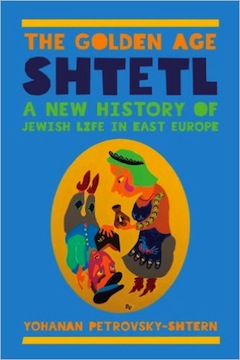
In a new book that effectively undermines the archetypical shtetls of our imagination, Yohanan Petrovsky-Shtern in The Golden Age Shtetl: A New History of Jewish Life in East Europe (Princeton University Press) redraws the image of the shtetl. A professor of Jewish studies at Northwestern University and author of several books, Petrovsky-Shtern documents a brief period in history, from the late 17th century to the mid-18th century, when life was not so bad in those towns of our ancestors in eastern Poland and Ukraine.
Petrovsky-Shtern looks closely at three provinces with 44 shtetls in Eastern Europe. Relying mostly on documents that were previously overlooked, he discovers that many of the shtetls at that time were neither poor nor especially pious. On the contrary, they were thriving communities with stable economies built around popular market fairs. Some shtetls had trading firms that rivaled those found in large cities. Some had fancy restaurants and a rich cultural life.
Although Jewish businessmen were prominent, the Jews were a minority in many of the towns. Jews and Christians lived and worked together.
As might be expected in any neighborhood, the Jewish community also had its share of characters of questionable integrity. Petrovsky-Shtern goes through historic court records that reveal stories of bribes, counterfeiting, smuggling, informants and collusion of Jewish businessmen with crooked clerks. Even the rabbinical leadership comes under his microscope.
Jews came to Eastern Europe with the Greek colonizers more than 2,000 years ago but the Jewish presence in the region was minimal until Polish nobility encouraged Jewish migration from Western Europe.
The Jews were invited to run country fairs and sell liquor, two activities that provided significant tax revenues to the Polish authorities. The Jewish businessmen brought new “Western” approaches to trade. They put stores and stalls under one roof, and sold exotic merchandise from distant lands. They opened inns offering a place to drink and a bed. They injected a cosmopolitan slice of urban life into rural agricultural areas. They expanded trade, bringing prosperity to the region.
By 1840, however, the golden era had started to fade. The Russian monarchy, which had ruled the region with benign neglect since the partition of Poland in the late 1700s, began asserting its authority. Discriminatory laws against Jews contributed to the decline of the shtetl, as authorities shifted economic and political power to larger urban centres. Once-vibrant communities turned into depressed outposts of the Russian Empire, the shtetl of popular Yiddish literature. They struggled to survive in their diminished state, until the Nazi regime wiped them out.
A fascinating and often ignored aspect of the shtetl described by Petrovsky-Shtern is the relationship of the shtetl Jews with the Holy Land.
In the late 18th century, about 500 Jews from the Polish-Lithuanian Commonwealth went to Palestine to build a religious utopian community. Followers of Rabbi Eliyahu ben Zalman, the Mitnagdim idealists, were convinced that resettlement would pave the way for the Messiah. The rabbi, also known as the Vilna Gaon, had predicted the Messiah would arrive in 1840, coinciding with the year 5600 in the Jewish calendar.
Not to be undone, followers of the Ba’al Shem Tov, the rival Chassidic sect, made aliyah in even greater numbers, settling in Safed, Tiberias, Hebron and Jerusalem. By 1800, the Jewish population of Palestine had expanded to 6,000, accounting for roughly two percent of the population.
Petrovsky-Shtern recounts the impact of this aliyah on those who remained behind in the shtetl. In some respects, reverberations of the migration continue to be felt almost 200 years later.
The pioneers in Palestine faced unimaginable challenges: poverty, illnesses, natural disasters, famine and discriminatory Ottoman Empire laws. In order to survive, the Jews of Palestine developed a sophisticated network of rabbinic fundraisers who went from shtetl to shtetl, giving sermons, selling books and sparking the imagination with stories about the Holy Land, including tales about inscriptions on the tombs of the prophets.
The rabbinic messengers assured shtetl Jews that supporting Jews in the Holy Land was comparable to fulfilling the commandment of settling in the Holy Land themselves. The rabbis, who kept meticulous records, told donors that prayers were chanted on their behalf at the Cave of Machpelah, the gravesite of Abraham, Isaac,
Jacob, Sarah, Rebecca and Leah.
The authorities tried to stop the flow of funds to Palestine. They suspected that the Jews, who they blamed for the death of Jesus, were sending money to rebuild the Temple in Jerusalem. They believed that the fundraising was reinforcing Jewish separateness, undermining assimilation, increasing fanaticism and possibly hindering Jews’ ability to pay local taxes.
Also, as the years passed, raising funds for the Jews in Palestine was viewed as aiding an enemy of the state. By the 1800s, the Polish-Lithuanian Commonwealth had been partitioned and territory that included many of the shtetls became part of the Russian Empire, which had hostile relations with the Ottoman rulers.
Yet, Jewish communities still managed to raise money, especially in the years from 1810 to 1830. Aiding the Jews of Palestine became one of the highest priorities for Eastern Europe’s Jews, comparable only to the commandment of ransoming prisoners, Petrovsky-Shtern says.
The communal leadership of dozens of shtetls in the provinces of Volhynia and Podolia imposed a tax to help establish a synagogue in Jerusalem and maintain Chassidic groups. Charity boxes were on many dining tables and store counters. As well, sacks of earth from the Holy Land and ritual objects produced by the Jews of Palestine found their way into everyday life of the shtetl. Unpublished manuscripts by Holy Land rabbis and mystics were much sought-after reading, passing from hand-to-hand in the shtetl.
In a tale that echoes across two centuries, Petrovsky-Shtern recounts the role of the legendary charity boxes that are now found in many Jewish homes in North America. He writes that Jewish women in the shtetl of Kremenets, and possibly surrounding towns, turned the “commandment” to help the Jews of Palestine into an intrinsic part of the blessings over candles before Shabbat: right before the blessing, they put some money aside in a wooden charity box or tin mug to support the Holy Land communities.
By the time of the devastating earthquake in Safed in 1837, whatever hurt Palestine was felt just as strongly in the shtetls of Eastern Europe. The relationship between the shtetl and the Jews of Palestine appears to have many similarities with contemporary links between Israel and the Diaspora.
Petrovsky-Shtern provides a wealth of information about many different aspects of daily life, woven between lively vignettes to illustrate the comfortable standard of living enjoyed by many shtetls before their precipitous disintegration.
Unfortunately, the book is too easy to put down. Petrovsky-Shtern’s encyclopedic descriptions of the shtetl provide solid background for an academic understanding of the shtetl, but the pace is uneven. Interesting stories, such as the account of the relationship to the Holy Land, are interspersed with lengthy reports of dry historical records.
As Petrovsky-Shtern wanders back and forth across the years and jumps from shtetl to shtetl, the locations and dates turn into boring lengthy lists of trivia. Despite the endless string of names of real people, the reader does not come to know anyone in the shtetl. The facts may be on Petrovsky-Shtern’s side, but Isaac Bashevis Singer and Sholem Aleichem tell much more memorable stories.
Robert Matas, a Vancouver-based writer, is a former journalist with the Globe and Mail. This review was originally published on the Isaac Waldman Jewish Public Library website and is reprinted here with permission. To reserve this book or any other, call 604-257-5181 or email library@jccgv.bc.ca. To view the catalogue, visit jccgv.com and click on Isaac Waldman library.
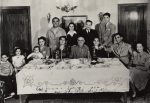
Calof family festive meal, spring 1942. This is but one of the thousands of photos that have been collected and preserved by the Jewish Museum and Archives of British Columbia. (photo by Cyril Leonoff; JWB fonds, JMABC L.13866)
The Jewish Museum and Archives of British Columbia (JMABC) has launched a new campaign called Sustainers of the Archives. The B.C. Jewish Community Archives contains an unmatched collection of material documenting the more than 150-year history of Jewish life in the province, from family mementos to the founding documents of major organizations.
Housed in a secure, climate-controlled 3,000-square-foot facility in Richmond, the collection includes 750 oral history audio and video recordings, extensive photographic collections, as well as art and artifacts. This invaluable community asset is managed by a full-time professional archivist, and access to the material in the archives is available to researchers and other interested parties through the offices of the JMABC.
The purpose of the Sustainers campaign is to invite members of the public to become friends of the archives by making an ongoing financial commitment. These funds will help the JMABC preserve the archives for future generations, as well as help the JMABC achieve its mandate: to tell the story of Jewish life in British Columbia. To become a Friend of the Archives, visit jewishmuseum.ca/become-a-sustainer. For more information, visit jewishmuseum.ca or contact the museum at 604-257-5199.
An old audio reel that writer Shula Klinger found in a suitcase of her late father’s mementoes features a revealing interview with Viennese author Edith de Born. (photo by Shula Klinger)
When my father died in 2014, I was given an old suitcase containing his mementoes. There were photos, much of his early writing and an audio reel in a box. All it said on the box was, “Interview with Edith de Born.” I had never seen this tape before and had no idea who de Born was. I also didn’t know why my father would have had the reel because, to the best of my knowledge, he had never worked in radio.
A quick Google search told me that de Born was a novelist, born in Vienna when it was still part of the Austro-Hungarian Empire. During the Second World War, she and her banker husband both worked for the Resistance. An obituary of another writer on theguardian.com mentions her as a “now-forgotten Austro-Hungarian novelist,” a gauntlet of a phrase if ever I read one. The next website I visited was a bookseller with secondhand copies of de Born’s books. The Price of Three Cézannes and The House in Vienna arrived a few weeks later.
Like de Born, my father’s family lived in Vienna in the early 20th century, in the final days of the Habsburg Empire. But what was behind my father’s desire to interview her? I took the reel to a digital studio and had the material transferred to a CD, hoping to find some answers.
The first time I listened to it, I thought I was listening to my father’s voice but couldn’t be sure. The recording was clean, without any extraneous noises, but still, technology distorts the human voice and it didn’t really sound like my dad. This man’s English was excellent and he spoke quickly, but his vowel sounds weren’t quite right, weren’t quite what I remember. His phrases lacked the colloquial idioms you’d hear in a native speaker.
A few minutes in, I was sure this was indeed my father. The recording was made not long after he had moved to England. His first language was (I think) Yiddish, followed by Arabic and Hebrew, English and French. Was my memory playing tricks or was this simply evidence of what my friends had observed in the 1970s – that my dad “had an accent”?
I listened carefully to the rest of the interview. Mostly my father asks de Born about her writing habits, literary preferences and the authors she has met. He wants to know if she keeps notes in a little book, whether her characters are based on people she knows. She answers no, no, no again and again. He seems to be looking for tips on how to be a novelist. He gets nothing.
The conversation is stilted but my father doesn’t seem dissatisfied with the author’s brief answers. Are these the questions of a novice reporter, just learning the tricks of his trade? Or is he working to a personal agenda, trying to glean something useful for himself?
I get a partial answer when de Born speaks of the authors she has met. Evelyn Waugh, she says. And Vladimir Nabokov, whose writing she describes as “divine.” Knowing that Nabokov emigrated to the United States, my father asks, “Did he have an accent?” An odd thing to focus on, one might think, when you’re discussing a world-renowned novelist.
But there’s my answer. I may have grown up oblivious to my father’s accent, but he certainly wasn’t. Like all immigrants, he was aware that it marked him out as different. In a country where one’s identity is defined by the class system, this put him outside regular society. It told others that he was different, and he was just as conscious that, to fit in and be accepted into middle class, professional life in England, one had to be more than educated, more than capable – one had to sound English, to sound as though you belonged. With tanned skin, curly hair and – as he well knew – an abrasive manner, he did his best to tone down the chutzpah and mimic the mannerisms and diction of those around him. But not before he met de Born.
I managed to date the recording to 1960 or 1961 by looking at the publication date of the book de Born is writing when she meets my father. At that time, my father had not seen most of his family for years. Was the conversation a way for him to maintain a connection to his own heritage? Or was he simply looking for professional guidance? De Born could have been the perfect mentor – if only she had agreed. It is clear, however, from her guarded answers that she is not looking to nurture an emerging new talent.
There is, however, a short conversation about her memories of Austria. For the most part, she refuses to discuss her past, but she does talk briefly about her father, a Viennese nobleman. When the emperor Franz Josef died in 1916, her father walked in the funeral procession through the streets of Vienna. She describes her fondness for her father, and speaks warmly of his influence on her life.
Fascinated to learn that there were only two degrees of separation between me and a person who had attended an emperor’s funeral, I decided to look up some of the events she described. I soon found the Pathé News archive. Turns out they have thousands of files online. Here, I found a silent movie of the 1916 procession.
Twenty-six seconds in, I was startled to see something that didn’t fit. In the midst of all the smartly dressed adult aristocrats, prancing black horses and royal footmen, there is a tall, dignified looking man. This man is holding the hand of a little girl. She must be 4 or 5 and she’s holding a teddy bear in her other hand. They turn in front of the camera for a second before they are obscured by the heads of royal guards. She reappears fleetingly, later on, and then she’s gone. Could this be de Born, the woman whose voice I hear in conversation with my father when he was still a young Israeli immigrant?
De Born’s work is not in vogue now but this is – I believe – a tremendous shame. An astute observer of human nature, her dialogue is incisive and the inner lives of her characters richly explored. The world of Viennese aristocrats is opulent but restricted, the women stifled by their positions in society. Even as the characters cling to old traditions, singing of a Habsburg emperor whose fate will be tied to Austria’s for all eternity, de Born’s narrator feels that her world is an anachronism: “No waxwork exhibition could possibly reproduce the atmosphere of a vanished epoch so uncannily as did those creatures who continued to move with old-fashioned grace in their own meaningless world,” she writes.
Soon after, she describes a very different scene, being “in the midst of people who spoke my language, but with whom I could not feel in harmony. ‘Ein Volk, ein Reich, ein Führer …’ chanted, yelled, screamed hysterically.” Little by little, de Born introduces ever more troubling elements, gradually building on a sense of a looming catastrophe – for Austrian nobility, for Europe at large and for Jews in particular. It may be set in polite society, but The House in Vienna is an exquisitely tense and emotional read. It is no wonder my father chose de Born as his interviewee. I have not found her described as a Jewish author, but – to me at least – her photograph on the dust jacket tells me everything I need to know.
As a daughter listening to her father’s voice after his death, the reel of tape is a gift and, like the work of his interviewee, it is a little eerie. It feels like eavesdropping. I don’t know if my father meant me to have it – or even find it – but I loved hearing his chuckle as he talked about something that he cared about, so deeply, as the young man I didn’t know. It’s a great way to remember him and his accent – full of life and Israeli/European inflections – hints at how he must have felt as a newcomer in England, all those years ago.
And, of course, it’s not a particularly smooth interview. At one point, the author laughs, somewhat revealingly, “Now we’re getting somewhere!” in her own gently accented English. Up to that point, my father’s questions have mostly been dead-ends. This question, however, was different, and the pace of the conversation quickens, the tone is light, almost cheeky. Hearing him make a genuine connection with another human being – something I rarely saw myself – was pure gold. It’s an infinitesimally small hunk of gold, but when you lose a complex and extremely guarded parent that you tried throughout your life – and failed – to connect with in this way, it can feel like winning the lottery.
Shula Klingeris an author, illustrator and journalist living in North Vancouver. Find out more at niftyscissors.com.




 Petrovsky-Shtern looks closely at three provinces with 44 shtetls in Eastern Europe. Relying mostly on documents that were previously overlooked, he discovers that many of the shtetls at that time were neither poor nor especially pious. On the contrary, they were thriving communities with stable economies built around popular market fairs. Some shtetls had trading firms that rivaled those found in large cities. Some had fancy restaurants and a rich cultural life.