Skip to content

  • Home
  • Subscribe / donate
  • Events calendar
  • News
    • Local
    • National
    • Israel
    • World
    • עניין בחדשות
      A roundup of news in Canada and further afield, in Hebrew.
  • Opinion
    • From the JI
    • Op-Ed
  • Arts & Culture
    • Performing Arts
    • Music
    • Books
    • Visual Arts
    • TV & Film
  • Life
    • Celebrating the Holidays
    • Travel
    • The Daily Snooze
      Cartoons by Jacob Samuel
    • Mystery Photo
      Help the JI and JMABC fill in the gaps in our archives.
  • Community Links
    • Organizations, Etc.
    • Other News Sources & Blogs
    • Business Directory
  • FAQ
  • JI Chai Celebration
  • JI@88! video
image - Weizmann Canada Physics Tournament 2025
image - The CJN - Visit Us Banner - 300x600 - 101625

Recent Posts

  • היהירות היא אחד האויבים הגדולים ביותר של ישראל
  • Vrba monument is unveiled
  • Music to build bridges
  • A better future possible
  • Anne Frank exhibit on now
  • Human rights in sport
  • Telling the story of an icon
  • Crawl bigger than ever
  • JCC Maccabi in Toronto
  • A way to meet fellow Jews
  • Time to include
  • Add Jewish joy to the mix
  • Reminder of humanity’s light
  • From the archives … editorials
  • Year-round holiday recipes
  • מדוע עזבתי את ישראל ואינני חושב לחזור ארצה
  • OJC hosts Oct. 7 memorial
  • A journey beyond self
  • Antisemitism a problem
  • Young man is missed
  • Orr action sparks complaint
  • Prison sentence for hate
  • Etgar Keret comes to Vancouver
  • New fall lecture series
  • Series explores music
  • Doc on Zapiro screens Nov. 6
  • Joy of shared existence
  • Community milestones … October 2025
  • MAID vs Jewish values
  • Cheshvan a great month, too
  • Bull, bear or bubble?
  • From the archives … a coin, etc.
  • מדוע האנטישמיות הולכת וגואה בעולם
  • New bio gives Vrba his due
  • Joy brighter than ever
  • When approaches differ

Archives

Follow @JewishIndie

Tag: Jewish National Fund of Canada

JNF Negev Event raises funds for health centre

JNF Negev Event raises funds for health centre

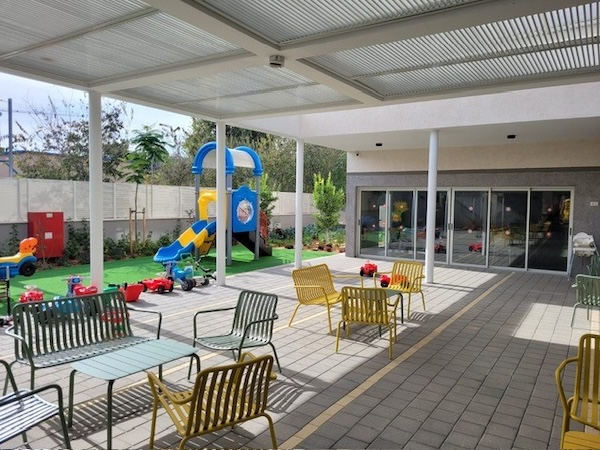
An artist’s rendering of the new Ashdod Rehabilitation and Therapy Centre for which the 2025 Negev Event is raising funds. (photo from jnf.ca/PacificNegev2025)

Hosted by Jewish National Fund of Canada Pacific Region and Israel Magen Fund of Canada, the June 19 Negev Event in Vancouver will feature rescued hostage and speaker Noa Argamani, Australian actor and advocate for Israel Nate Buzz, and editor-in-chief of the National Post Rob Roberts. Funds raised will help build the Ashdod Rehabilitation and Therapy Centre, providing increased levels of care for trauma victims, children with disabilities and children with cancer. 

As the name indicates, the new centre will be located in Ashdod, which is about 50 kilometres north of the border with Gaza. With almost 250,000 residents, it is Israel’s sixth largest city. “It is home to the largest Moroccan and Karaite Jewish communities in Israel, and the largest Georgian Jewish population in the world,” notes the JNF.

However, there is a shortage of rehabilitation services in southern Israel, a shortage that has worsened since the Oct. 7, 2023, terror attacks and the ensuing war. 
photo - The June 19 Negev Event raises funds to help build the Ashdod Rehabilitation and Therapy Centre, thereby increasing levels of care for trauma victims
The June 19 Negev Event raises funds to help build the Ashdod Rehabilitation and Therapy Centre, thereby increasing levels of care for trauma victims, children with disabilities and children with cancer. (photos from jnf.ca/PacificNegev2025)

“Thirty percent of wounded patients and most of the war victims are residents of the south,” according to JNF. “Fourteen thousand residents were treated in hospitals following Oct. 7, with 42% coming with injured limbs and 35% seeking support with emotional trauma. The system cannot support the hundreds of thousands of children, adolescents and adults who were physically injured and emotionally crushed by horrific traumas that left deep scars.”

There are only 11 rehabilitation centres in Israel’s periphery communities, while central Israel has 43, says JNF. “Currently, wait times for rehabilitation in the south are at least one year…. Southern residents, including recovering patients and children, must travel about an hour-and-a-half to Israel’s centre for care.” 
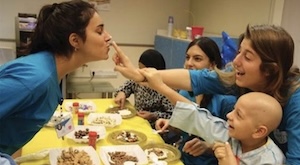
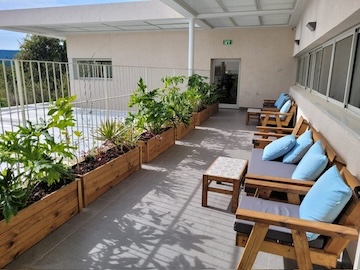
photo - The June 19 Negev Event raises funds to help build the Ashdod Rehabilitation and Therapy Centre, thereby increasing levels of care for children with cancer
(photo from jnf.ca/PacificNegev2025)

Among the services the Ashdod Rehabilitation and Therapy Centre will expand upon is the range of care and support that Rachashei Lev, which was established in 1989, provides in other medical centres. (Rachashei Lev roughly translates as Whispers of the Heart, or Heart of Compassion.)

“I visited Rachashei Lev in July [last year] as part of JNF’s resilience task force, a group consisting of professional leaders and lay leadership from across Canada,” David Greaves, executive director of JNF Manitoba/Saskatchewan and Vancouver/Pacific region, told the Independent. “I was there with Harvey Dales and we were all touched by what this organization did. As well, while touring the facility, we were surprised when Noa Argamani joined us and shared her story and how much support she and her family received from Rachashei Lev after her rescue and repatriation. This is, of course, why we chose this particular project, as Noa will be one of our special guests on June 19.” (Argamani was chosen by TIME magazine as one of the 100 Most Influential People of 2025.) 

Greaves will be here for the event, working out of the Vancouver office with the local JNF team and Megan Laskin, the event chair. He took on the additional role of Vancouver/Pacific region head after Michael Sachs left the position to become the director for Western Canada of the Friends of Simon Wiesenthal Centre.

“My first official meeting with the board was mid-December,” said Greaves. “They were so welcoming, I felt like I had been here for months.”

Greaves gave the JI an update on the Canada Revenue Agency’s revocation of JNF Canada’s charitable status.

“We have two pending court dates,” he said. “We have a judicial review scheduled for May 28 [after the JI went to press]. We are calling on the court to overturn our revocation, as we had a commitment from the CRA that our revocation would not be published, which finalizes the revocation process, until we exhausted our legal options. We assert that a pillar of Canadian justice is the presumption of innocence, so taking action to revoke us before the opportunity to appeal to the courts is fundamentally unjust. Our underlying appeal, which will focus on the merits of our case, does not yet have a date set. We have called upon the CRA to settle this matter before we litigate, as this is a waste of time and resources for both the taxpayer and JNF. Disappointingly, the CRA has rejected our offer to settle.”

JNF Canada is partnering with the charity Israel Magen Fund of Canada (IMFoC) for all the Negev events across the country. 

“We are sharing the responsibilities in executing these campaigns and galas,” Greaves said. “Both organizations have signed agreements outlining the nature of the collaboration. The IMFoC has an agency agreement with the two organizations in Israel at which these projects will be realized, the Parenthood Home in Sderot and the Ashdod Rehabilitation and Therapy Centre. We have the same passion for Zionism and supporting vulnerable Israelis from all walks of life, so it was sensible to work together as, through this collaboration, we can achieve more.”

Intergenerational support

JNF Pacific board president Shannon Gorski is excited about the Rachashei Lev project. She knows firsthand the impact that JNF initiatives can have.

“In 2017, our family supported the Tzofei Tzamid (Israeli Scouts) centre in Ra’anana,” she said. “The project raised money to remodel the centre to ensure that it was inclusive to all the scouts who participated. This meant providing resources and equipment that made it possible for all teens to be able to participate in the outdoor excursions regardless of physical or mental limitations.”

She visited the centre that same year and saw how the money raised here positively affected the participants in Israel. “It was quite emotional,” she said.

Gorski is in her third year as board president; she was vice-president from 2019 to 2023.

“I began my service on the JNF board in 2017,” she said, “following the 2017 Negev, in which my father [Gary Averbach] was honoured with the support of my brother, Michael [Averbach], and me.”

It truly has been a lifelong endeavour for Gorski.

“My father was JNF president from 1991 to 1992, and I remember many occasions that I spent time at the home of the residing shaliach’s [emissary’s] residence,” said Gorski. “Of course, our home always had a JNF box, which I believe I took trick or treating with me in place of the UNICEF box. Purchasing trees to forest Israel became a gift that I either gave or received to commemorate many Jewish milestones.”

Board vice-president Howard Jampolsky also grew up with JNF.

“As a child,” he said, “I first became involved in JNF raising money for trees and driving around with my uncle, John Eskin, z”l, picking up blue boxes in the 1970s. Uncle Johnny was a tireless worker for JNF and was honoured in 1976 with a Negev Dinner. 

“My father, Abe Jampolsky, z”l, was also involved in JNF as a regional president. He, too, was honoured by JNF in 1987 with a Negev Dinner, during which the guest speaker was Prime Minister [Binyamin] Netanyahu, who, at the time, was Israel’s ambassador to the United Nations.”

In 2015, then-executive director of JNF’s regional office, Ilan Pilo, asked Jampolsky to join the executive committee of the local board, and he has been involved ever since, becoming vice-president in 2023. Jampolsky has been on the JNF national board since 2022.

For Jampolsky, helping fund projects like the Ashdod Rehabilitation and Therapy Centre is what we, as Jews, do.

“We value life, and part of valuing life is to ensure that each life is fulfilled in every possible way,” he said. “On Oct. 7, 2023, that fulfillment for thousands of Israelis was dashed when Hamas attacked us. I say ‘us’ because when one of our people is attacked, we are all attacked.

“This centre provides life-saving health care for young cancer victims, but it also provides vital health care for many who were impacted by the terrible events of Oct. 7. Both those with physical injuries and emotional trauma will benefit from this important place.”

For tickets to the June 19 Negev Event in Vancouver, go to imfoc.org/pacific-negev.
Format ImagePosted on May 30, 2025May 29, 2025Author Cynthia RamsayCategories LocalTags Ashdod Rehabilitation and Therapy Centre, David Greaves, fundraising, health care, Howard Jampolsky, Israel Magen Fund of Canada, Jewish National Fund of Canada, JNF, Negev event, Rachashei Lev, rehabilitation, Shannon Gorski
CRA “blindsides” JNF

CRA “blindsides” JNF

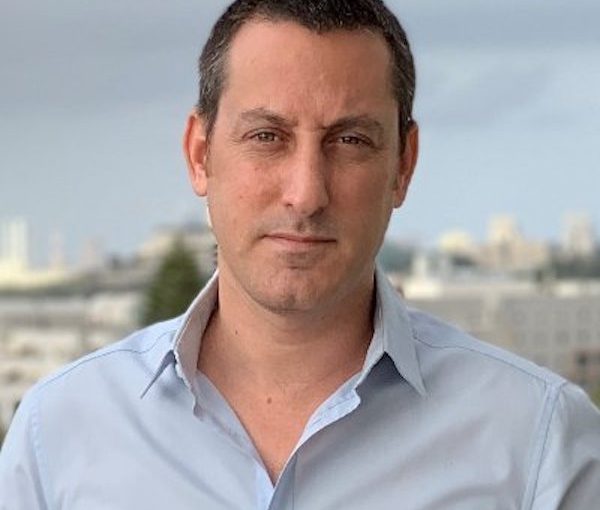
Lance Davis, chief executive officer of JNF Canada. (photo from JNF Canada)

The Jewish National Fund of Canada is fighting the Canada Revenue Agency over the revocation of the organization’s charitable status, accusing the federal taxation department of “blindsiding” them and treating them differently than other charities. The head of JNF Canada sees bias at play.

“Do we think the CRA is antisemitic?” asked Lance Davis, JNF Canada’s chief executive officer, in an interview with the Independent. “No. Do we think there is bias involved here? Yes. That’s actually part of our court application. We have said in writing that we believe there is bias.”

The difference, Davis explained, is that, while CRA officials may not carry prejudice toward Jewish people, their decision may have been influenced by a concerted, multi-year campaign attacking JNF – Independent Jewish Voices Canada has a website dedicated to the campaign.

Through a Freedom of Information Act request, JNF Canada obtained the files used by CRA to make their determination. 

“So we know what was written in the file that the CRA is using with respect to JNF Canada and it is littered with complaints in an organized and systematic way from anti-Israel groups, unions, political parties, etc.,” he said. “After you read all of this material, one can reasonably say that bias may have come to play into the decision-making process.”

Davis is emphatic that media have so far got the story wrong. The revocation is not about JNF Canada’s support for projects on Israel Defence Forces bases or on the other side of the Green Line, outside of Israel proper. CRA expressed concerns about these projects several years ago and JNF Canada immediately ended those undertakings, he said.

“Yes, we have over the last number of decades built all sorts of public amenities on IDF bases,” he said. “Those amenities include swing sets, playgrounds, parks, play areas … shaded areas, rest areas, all that kind of stuff. We disagree that that is not charitable. Helping the children who have to live on a base … we believe is charitable.”

Moreover, the money for such past projects did not flow to Israel’s military, said Davis. It went to a charity that built the projects.

“Nevertheless, when it was brought to our attention that this is a problem according to the CRA, we stopped doing it in order to be cooperative and collaborative with the CRA,” he said. “That’s not what this revocation is about. It might be an interesting subject for the media or those outside parties to conflate, but this issue that we’re dealing with the CRA is fundamentally about our founding charitable object. They’ve come to the conclusion that it is not charitable.”

The issue, Davis said, is that CRA, after 57 years, has abruptly reversed the 1967 acceptance of the organization’s charitable objective.

In 1967, said Davis, CRA’s predecessor agency accepted JNF Canada’s purpose of funding projects in which economically disadvantaged individuals in Israel, especially new immigrants as well as Palestinians, are hired to complete projects like tree-planting and digging reservoirs, with the intention of keeping them off welfare rolls and combating poverty.

The current troubles between CRA and JNF Canada started during an audit that began in 2014. When the auditor cited the original objective as incompatible, Davis said, the organization immediately set out to negotiate new charitable purposes that would satisfy CRA.

“We presented 10 of them in writing and said, please work with us, let’s pick any or all of these and we’ll get to work,” said Davis. “CRA did not negotiate with us at all about any of those charitable objects.”

Those objectives, he noted, were replicated by JNF Canada from other recognized charities that had received approvals from CRA. 

The organization’s leaders say they were “blindsided” by the decision, which was released Aug. 10, via the Canada Gazette, the federal government’s avenue for publicizing legislation and government decisions.

The revocation is the culmination of a crisis that began at the end of June, when JNF was notified that CRA intended to revoke their charitable status. Within weeks, the organization’s lawyers had filed suit with the Federal Court of Appeal.

In every similar instance JNF’s lawyers reviewed, Davis said, CRA refrained from revoking the status at least until the organization had their day in court.

“There is this idea of a presumption of innocence until you’ve exhausted all your appeals,” said Davis. “Why weren’t we given a presumption of innocence? Why weren’t we given a chance to say our piece before the judge? It’s a right that every Canadian business, individual, charity is entitled to.”

For now, JNF Canada is not permitted to provide charitable receipts.

“We are still a nonprofit, we still exist, we’re still an entity,” Davis said. 

If the Federal Court of Appeal sides with CRA, JNF could take the matter to the Supreme Court, Davis said. Alternatively, they could potentially restructure the way they do their work. 

“We are working through thoughts and plans with our legal counsel as to how we could best continue the work of JNF in a legal, charitable manner,” he said. “But we are confident in our case and we feel that it’s vitally important for us to challenge the CRA and the facts that they’ve presented.”

JNF Canada has not yet publicly released documents relating to the matter, as they await their lawyers’ annotations to provide both the CRA’s perspective and the JNF’s replies to the government agency’s concerns.

In dealing with JNF Canada, Davis contends, CRA has behaved differently than they routinely do with other charities. The due process they should expect has not been forthcoming and the government agency has leapfrogged several steps that charities are generally provided in the progression of an issue, he said.

Format ImagePosted on August 23, 2024August 22, 2024Author Pat JohnsonCategories NationalTags Canada Revenue Agency, charitable status, Jewish National Fund of Canada, JNF, JNF Canada, Lance Davis, law
A new refuge from violence

A new refuge from violence

Western Canada House, a shelter for women and children escaping domestic violence, is now open in Rishon LeZion, near Tel Aviv. The project is a result of support from Jewish National Fund of Canada supporters in Vancouver and Winnipeg. (photo from JNF Pacific Region)

Western Canada House, a shelter for women and children escaping domestic violence, is now open in Rishon LeZion, near Tel Aviv. The project, a result of support from Jewish National Fund of Canada supporters in Vancouver and Winnipeg, provides a temporary home to families in crisis, as well as access to counseling services, programs for mothers to become self-supporting and assistance in finding permanent, secure housing.

The project was made possible by revenue from 2016 Negev Dinners in Vancouver and Winnipeg and was chosen by that year’s Vancouver dinner honouree, Shirley Barnett. The honouree of the Winnipeg dinner was Peter Leipsic. (An additional Vancouver connection is that Leipsic is the father of Dr. Jonathon Leipsic, who is, among many other things, a leader in the Jewish Federation of Greater Vancouver.)

Barnett said she was motivated to choose the project in part because it is a joint initiative with No2Violence, whose founder, Ruth Rasnic, Barnett had met previously. Rasnic, who was awarded the Israel Prize in 2009 for her life’s work, founded No2Violence in 1977, to enable women and children suffering from domestic violence to break away and start a new life – by providing them with shelter, professional help, vocational training and legal aid – as well as to raise awareness about domestic violence. The group now operates three shelters in Israel.

“When I was honoured by the JNF, they asked me what kind of a project I would like the proceeds to go to,” Barnett recalled. The agency provided a number of options and, based on her background in social work and her familiarity with Rasnic’s work, she chose this one.

“No2Violence is interesting,” Barnett said. “They are not a religious organization. There are other shelters in Israel that cater only to the Orthodox. No2Violence is nonsectarian and, in addition to that, it is open to women who are not Jewish. It is also open to women who do not have legal status in Israel, who have not been deported because their children have been born in Israel. So, their doors are open to women who have come from Sudan, women who have come from Russia, who have been trafficked into Israel by their Israeli boyfriends. That was also attractive to me.”

photo - Western Canada House, a shelter for women and children escaping domestic violence
Western Canada House, a shelter for women and children escaping domestic violence. (photo from JNF Pacific Region)

Rabbi David Bluman, director of youth engagement at Congregation Beth Israel, visited Western Canada House earlier this month as part of a joint mission to Israel by Beth Israel, JNF Canada and Congregation Har El.

“It’s a beautiful place,” Bluman said. “They have different areas for children to play. They have a communal kitchen where each family signs up at a different time to do the cooking for the group that’s there. It’s obvious that JNF Western Canada did a really good job, put a lot of money in to build that place. It’s beautiful.

“I don’t think anyone wants to be there, they need to be there,” said the rabbi. “JNF Canada has made it as welcoming as possible, making it so it’s like home for them while they are there.”

The shelter has capacity for 10 to 12 families, providing needed refuge in a country where, statistics indicate, as many as 70% of women and children experiencing domestic abuse cannot access alternative housing.

Michael Sachs, Pacific region executive director of JNF, visited the project last year to assess progress and is delighted that the shelter is now open and providing housing to families. There were delays in completion of the initiative, Sachs said, because of municipal bureaucracy. 

Format AsidePosted on April 26, 2024April 26, 2024Author Pat JohnsonCategories Israel, LocalTags David Bluman, Jewish National Fund, Jewish National Fund of Canada, JNF, Michael Sachs, Negev Dinner, Rishon LeZion, Shirley Barnett, Western Canada House
Peace hopes still alive

Peace hopes still alive

Barak Ravid (photo from Twitter)

An end to the Israeli-Palestinian conflict may be nowhere in sight, but the Israeli-Arab conflict may be coming to an end, says a leading Israeli diplomatic journalist.

Barak Ravid spoke virtually Feb. 20 in a presentation organized by the Jewish National Fund of Canada. Ravid, who reports for Axios from Israel, was formerly with Ha’aretz, where he worked for a decade as diplomatic correspondent and columnist, and is also a familiar face on Israeli TV. He was interviewed by Cynthia Ramsay, publisher and editor of the Jewish Independent.

Ravid spoke about his new book, Trump’s Peace: The Abraham Accords and the Reshaping of the Middle East, which is currently available only in Hebrew but should be out in English this summer.

Ravid acknowledges that Trump is a controversial figure and that the book’s title has received some pushback. “Peace is not the first thing that comes to mind when you say the word Trump,” he said. “I chose that name because it happens to be true.”

The author maintains that the Abraham Accords and the expanding normalization between Israel and Arab states would not have occurred under any other president.

“At the end of the day, Trump’s policies in the region closed down the trust gap that was open between the U.S. and the Israeli government … a gap that was opened during Obama’s term in office,” he said. “Whether it was warranted or not doesn’t matter. The gap was there. Trump’s policies in the region, mainly on Iran, closed down the gap and brought Israel and the Arab countries closer together.”

Trump’s decision to appoint his son-in-law, Jared Kushner, to deal with peace in the Middle East was key, according to Ravid. In interviews with Israelis and Arabs for his book, Ravid found that both sides viewed the appointment as proof of how central this issue was for Trump and served as an assurance that, when they spoke to Kushner, they were speaking to the president.

The ultimate reason the Abraham Accords were cinched, said Ravid, is that Trump did what he always claimed as his strength – he made deals. In return for normalizing relations with Israel, each party to the accords got something they wanted.

“For the United Arab Emirates, it was the arms sales, the sales of the F-35 fighter jets,” he said. “For Bahrain, it was an upgraded trade deal [with the United States]. For Sudan, it was removing them from the [U.S.] state department’s terrorism list. For Morocco, it was the U.S. recognition of Moroccan sovereignty over the Western Sahara…. Without those tangibles, those countries would not necessarily agree to take those steps.”

Ravid contends that Trump is not the only leader who deserves credit – Binyamin Netanyahu, who was Israeli prime minister at the time, was pivotal to the success. Ironically, he noted, the decision by most Arab politicians in Israel to reject the accords led Mansour Abbas to break away from the Joint (Arab) List and form a new party, Ra’am, whose participation in the new coalition government ultimately brought Netanyahu’s reign to an end.

“For the first time in history, an Arab party is a part of the coalition in Israel,” Ravid said. “In a strange way, the Abraham Accords enabled this change in Israel where Jews in Israel feel more comfortable towards Arabs and Arabs feel more comfortable joining the coalition and, therefore, Netanyahu’s biggest foreign policy achievement created the political conditions to get him out of office.”

It has long been an assumption that peace between Israel and Arab states would come only after a resolution of the Palestinian issue. When Netanyahu earlier tried to bypass the Palestinians and make friends in the neighbourhood, he was publicly shunned, said Ravid. But he kept plugging away behind the scenes, building relations in the region.

“It’s hard to go from zero to 100 in one step,” said Ravid. “You need to get to a situation where you narrow this gap and Netanyahu managed to take Israel and the Arab world from zero to, let’s say, 70. So, when the decision for the Abraham Accords came, the Arab countries didn’t have to go zero to 100, they needed to go 70 to 100.”

A third crucial contributor – who Ravid said deserves perhaps the most credit and who wants the least recognition – is the Crown Prince of Abu Dhabi, Sheikh Mohamed bin Zayed, the de facto leader of the United Arab Emirates. Bin Zayed has been trying to modernize his nation and he saw normalization with Israel as advantageous to his project. At the time, Netanyahu was threatening to annex about 30% of the West Bank into Israel. According to Ravid, bin Zayed saw a way to manoeuvre.

“He decided to be the most vocal opponent of annexation,” Ravid said. Bin Zayed told the Trump White House that, if Netanyahu dropped the annexation initiative, he would be ready to sign a peace deal with Israel.

For the White House, the annexation issue was a huge headache, said Ravid, and bin Zayed’s offer solved that problem while delivering a generational diplomatic breakthrough at the same time.

The big question is, what’s next? What about Saudi Arabia?

“That’s the crown jewel,” Ravid said. U.S. President Joe Biden sent his national security adviser, Jake Sullivan, to Riyadh and received a list of demands from Crown Prince Mohammed bin Salman Al Saud. All the demands were on the United States, not Israel, including that the Saudi monarch be invited to the White House.

Bin Salman has been an international pariah since the Washington Post commentator and Saudi dissident Jamal Khashoggi was murdered and dismembered in the Saudi consulate in Istanbul in 2017. The U.S. Central Intelligence Agency concluded that bin Salman ordered Khashoggi’s killing.

“Biden will have to take a very hard decision if he wants to move ahead with the Abraham Accords,” said Ravid, walking the fine line between rewarding a foreign leader who American intelligence has dubbed a murderer of a journalist and seeking to advance peace in the Middle East. But, if it works, the dominos will almost certainly fall into place, said Ravid.

“If Saudi comes in, then Indonesia comes in, then Kuwait comes in, then Oman comes in, then Muslim countries in Africa join, Pakistan,” he said. “It’s literally the end of the Arab-Israeli conflict – while the Israeli-Palestinian conflict will continue, obviously.”

In this regard, Ravid said, “The Palestinians decided to boycott the Trump administration in December 2017 after Trump announced he is recognizing Jerusalem as the capital of Israel and moving the embassy there. While I can understand Palestinian frustration and anger, and it makes complete sense to protest, the decision to boycott Trump until his last day in office, I think, was counterproductive to their goals, and didn’t get them anything in the end.”

On the flip side, Ravid argued, Netanyahu’s annexation of a big chunk of the West Bank would have put another nail in the coffin of the two-state solution.

“I think the Abraham Accords, even though the Palestinians won’t admit it, saved the two-state solution, at least for now,” said Ravid. “Some people think it’s gone already, but if you think the two-state solution is still alive, the reason it’s still alive is that the UAE normalized relations with Israel and stopped Netanyahu from annexing the West Bank.”

Bernice Carmeli, president of JNF Canada Pacific Region, opened the event, and Michael Sachs, executive director of JNF Pacific Region, closed it. Lance Davis, chief executive officer of JNF Canada thanked Ravid.

Format ImagePosted on March 11, 2022March 10, 2022Author Pat JohnsonCategories BooksTags Abraham Accords, Barak Ravid, Israel, Israeli-Arab conflict, Israeli-Palestinian conflict, Jewish National Fund of Canada, JNF Pacific Region, Middle East, politics, Trump's Peace, two-state solution
Proudly powered by WordPress