Skip to content

  • Home
  • Subscribe / donate
  • Events calendar
  • News
    • Local
    • National
    • Israel
    • World
    • עניין בחדשות
      A roundup of news in Canada and further afield, in Hebrew.
  • Opinion
    • From the JI
    • Op-Ed
  • Arts & Culture
    • Performing Arts
    • Music
    • Books
    • Visual Arts
    • TV & Film
  • Life
    • Celebrating the Holidays
    • Travel
    • The Daily Snooze
      Cartoons by Jacob Samuel
    • Mystery Photo
      Help the JI and JMABC fill in the gaps in our archives.
  • Community Links
    • Organizations, Etc.
    • Other News Sources & Blogs
    • Business Directory
  • FAQ
  • JI Chai Celebration
  • JI@88! video
image - Weizmann Canada Physics Tournament 2025
image - The CJN - Visit Us Banner - 300x600 - 101625

Recent Posts

  • מדוע עזבתי את ישראל ואינני חושב לחזור ארצה
  • OJC hosts Oct. 7 memorial
  • A journey beyond self
  • Antisemitism a problem
  • Young man is missed
  • Orr action sparks complaint
  • Prison sentence for hate
  • Etgar Keret comes to Vancouver
  • New fall lecture series
  • Series explores music
  • Doc on Zapiro screens Nov. 6
  • Joy of shared existence
  • Community milestones … October 2025
  • MAID vs Jewish values
  • Cheshvan a great month, too
  • Bull, bear or bubble?
  • From the archives … a coin, etc.
  • מדוע האנטישמיות הולכת וגואה בעולם
  • New bio gives Vrba his due
  • Joy brighter than ever
  • When approaches differ
  • New leadership at the JCCV
  • Find the funny in you
  • Human rights in sports
  • Granirer returns to Carnegie
  • A last solidarity cycle
  • Grammar insight on holidays
  • Deciphering “oy”
  • From the archives … social life
  • Canada recognizes Palestine
  • Harper speaks at local event 
  • Working with “the enemy”
  • More unenforced laws?
  • CHW expands helping efforts
  • Seeking middle ground
  • Impacts of oppression

Archives

Follow @JewishIndie

Tag: JNF Canada

CRA “blindsides” JNF

CRA “blindsides” JNF

Lance Davis, chief executive officer of JNF Canada. (photo from JNF Canada)

The Jewish National Fund of Canada is fighting the Canada Revenue Agency over the revocation of the organization’s charitable status, accusing the federal taxation department of “blindsiding” them and treating them differently than other charities. The head of JNF Canada sees bias at play.

“Do we think the CRA is antisemitic?” asked Lance Davis, JNF Canada’s chief executive officer, in an interview with the Independent. “No. Do we think there is bias involved here? Yes. That’s actually part of our court application. We have said in writing that we believe there is bias.”

The difference, Davis explained, is that, while CRA officials may not carry prejudice toward Jewish people, their decision may have been influenced by a concerted, multi-year campaign attacking JNF – Independent Jewish Voices Canada has a website dedicated to the campaign.

Through a Freedom of Information Act request, JNF Canada obtained the files used by CRA to make their determination. 

“So we know what was written in the file that the CRA is using with respect to JNF Canada and it is littered with complaints in an organized and systematic way from anti-Israel groups, unions, political parties, etc.,” he said. “After you read all of this material, one can reasonably say that bias may have come to play into the decision-making process.”

Davis is emphatic that media have so far got the story wrong. The revocation is not about JNF Canada’s support for projects on Israel Defence Forces bases or on the other side of the Green Line, outside of Israel proper. CRA expressed concerns about these projects several years ago and JNF Canada immediately ended those undertakings, he said.

“Yes, we have over the last number of decades built all sorts of public amenities on IDF bases,” he said. “Those amenities include swing sets, playgrounds, parks, play areas … shaded areas, rest areas, all that kind of stuff. We disagree that that is not charitable. Helping the children who have to live on a base … we believe is charitable.”

Moreover, the money for such past projects did not flow to Israel’s military, said Davis. It went to a charity that built the projects.

“Nevertheless, when it was brought to our attention that this is a problem according to the CRA, we stopped doing it in order to be cooperative and collaborative with the CRA,” he said. “That’s not what this revocation is about. It might be an interesting subject for the media or those outside parties to conflate, but this issue that we’re dealing with the CRA is fundamentally about our founding charitable object. They’ve come to the conclusion that it is not charitable.”

The issue, Davis said, is that CRA, after 57 years, has abruptly reversed the 1967 acceptance of the organization’s charitable objective.

In 1967, said Davis, CRA’s predecessor agency accepted JNF Canada’s purpose of funding projects in which economically disadvantaged individuals in Israel, especially new immigrants as well as Palestinians, are hired to complete projects like tree-planting and digging reservoirs, with the intention of keeping them off welfare rolls and combating poverty.

The current troubles between CRA and JNF Canada started during an audit that began in 2014. When the auditor cited the original objective as incompatible, Davis said, the organization immediately set out to negotiate new charitable purposes that would satisfy CRA.

“We presented 10 of them in writing and said, please work with us, let’s pick any or all of these and we’ll get to work,” said Davis. “CRA did not negotiate with us at all about any of those charitable objects.”

Those objectives, he noted, were replicated by JNF Canada from other recognized charities that had received approvals from CRA. 

The organization’s leaders say they were “blindsided” by the decision, which was released Aug. 10, via the Canada Gazette, the federal government’s avenue for publicizing legislation and government decisions.

The revocation is the culmination of a crisis that began at the end of June, when JNF was notified that CRA intended to revoke their charitable status. Within weeks, the organization’s lawyers had filed suit with the Federal Court of Appeal.

In every similar instance JNF’s lawyers reviewed, Davis said, CRA refrained from revoking the status at least until the organization had their day in court.

“There is this idea of a presumption of innocence until you’ve exhausted all your appeals,” said Davis. “Why weren’t we given a presumption of innocence? Why weren’t we given a chance to say our piece before the judge? It’s a right that every Canadian business, individual, charity is entitled to.”

For now, JNF Canada is not permitted to provide charitable receipts.

“We are still a nonprofit, we still exist, we’re still an entity,” Davis said. 

If the Federal Court of Appeal sides with CRA, JNF could take the matter to the Supreme Court, Davis said. Alternatively, they could potentially restructure the way they do their work. 

“We are working through thoughts and plans with our legal counsel as to how we could best continue the work of JNF in a legal, charitable manner,” he said. “But we are confident in our case and we feel that it’s vitally important for us to challenge the CRA and the facts that they’ve presented.”

JNF Canada has not yet publicly released documents relating to the matter, as they await their lawyers’ annotations to provide both the CRA’s perspective and the JNF’s replies to the government agency’s concerns.

In dealing with JNF Canada, Davis contends, CRA has behaved differently than they routinely do with other charities. The due process they should expect has not been forthcoming and the government agency has leapfrogged several steps that charities are generally provided in the progression of an issue, he said.
Format ImagePosted on August 23, 2024August 22, 2024Author Pat JohnsonCategories NationalTags Canada Revenue Agency, charitable status, Jewish National Fund of Canada, JNF, JNF Canada, Lance Davis, law
Reflections on April mission

Reflections on April mission

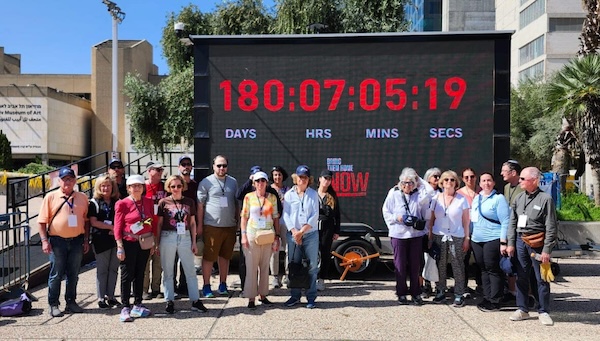
JNF Canada, Har El and Beth Israel mission participants in Hostages Square in Tel Aviv. (photo from Lorraine Katzin)

About 20 volunteers – from Vancouver, Edmonton and Toronto – went on the JNF Canada Bearing Witness Mission to Israel April 1-8. Organized by Jewish National Fund Canada, Congregation Har El and Congregation Beth Israel, the trip was led by BI’s Rabbi David Bluman and JNF Edmonton executive director Jay Cairns. On his Facebook page, Cairns thanks JNF Pacific executive director Michael Sachs, BI Senior Rabbi Jonathan Infeld and Bluman “for spearheading this important mission.” Among the volunteers were Har El members Lorraine Katzin and Karen Shalansky, who shared some of what they experienced with the Jewish Independent.

Some first impressions
(Lorraine Katzin)

Stepping onto the El Al plane from Los Angeles to Tel Aviv reminded me of the olden days of flying – a blanket, pillow, headphones and a bag with a toothbrush, toothpaste and eye mask. Two meals were served and, during the flight, you could help yourself to snacks, sandwiches and drinks.

Walking through Ben Gurion International Airport, you see photos of the hostages still in captivity. When we went through the foreign passport area, it was chilling – we were literally the only people passing through passport control. There were no tourists. Our hotel was quiet as well.

Walking on the promenade in Tel Aviv to Jaffa on our arrival, it felt as if there were no war – people were out on the beach, swimming, playing beach bats, foot volleyball, and jogging.

Tuesday, April 2, was our first full day of touring. We started at Kibbutz Kissufim in the south. We heard stories of the murders and saw the devastation made by the Hamas terrorists. One of the stories that haunts me is that of the chief fireman whose only child, his daughter, and her husband were shot to death in their safe house, then their home was burnt down. Searchers only knew by finding a nose ring and bracelet in the ashes that the bodies had been burnt. 

We were very close to Gaza and could hear artillery every now and again, which was scary. At the site of the Nova music festival, there was a memorial of photographs: 364 people were killed there by Hamas, 44 hostages were taken.

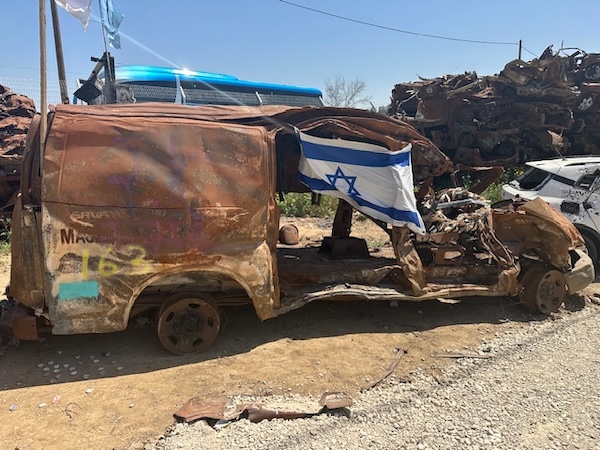
On Wednesday, we toured Adi Negev-Nahalat Eran, which is a village for children with disabilities, which JNF supports. Karen and I volunteered at the therapeutic farm, cleaning the goat pen and washing the tortoises. That day we were also taken to the car cemetery, where you see two burnt ambulances, as well as burnt and bullet-holed cars numbering more than 1,000. In Sderot, we saw where the police station used to be – the building was taken over by Hamas terrorists and then an Israeli tank destroyed the building, killing the terrorists inside.

photo - A burnt-out Magen David Adom ambulance in the car cemetery near the Gazan border, where burnt and bullet-holed vehicles numbering more than 1,000 are being kept for further investigation
A burnt-out Magen David Adom ambulance in the car cemetery near the Gazan border, where burnt and bullet-holed vehicles numbering more than 1,000 are being kept for further investigation. (photo from Lorraine Katzin)

The first few days of the mission, I found it difficult to sleep, the images and stories kept going through my head.

On Thursday, we picked lemons and went to Rachashei Lev Israel Children Cancer Centre, another JNF project. We also visited Hostages Square.

Friday included a visit to Western Canada House, a No2Violence shelter for women and children fleeing domestic violence, the building of which was funded by JNF Canada supporters in Vancouver and Winnipeg. [For more on Western Canada House, see jewishindependent.ca/a-new-refuge-from-violence.] We also went to the ANU Museum of the Jewish People, which had on display models of different shuls in Europe and the United States, a replica of the Codex Sassoon and an Oct. 7 exhibit. After stopping at the Carmel Market, we went back to Hostages Square for Kabbalat Shabbat, which was very moving.

Saturday, we went to the beach in the morning and walked around Tel Aviv in the afternoon. That night, we had a survivor come speak to us and it happened to be Shalev Biton, who had come to speak at Har El and elsewhere in Vancouver a few weeks prior. Amazingly, he remembered me!

On another night, we heard from Jacqui and Yaron Vital, parents of Adi Vital-Kaploun, who was murdered on Oct. 7. Jacqui, who is a Canadian, was in Ottawa visiting family when the Oct. 7 Hamas terror attacks happened. Adi, her husband and two children lived on Kibbutz Holit in the south and Yaron had come to visit; he was put up in a room in a vacant house opposite his daughter’s. Adi texted her husband, who had gone on a hike, warning him not to return home. Adi was killed, and her two children and a neighbour were kidnapped but let go at the Gaza border, by some miracle. Yaron survived, as the terrorists had determined which homes had how many people and who had dogs, which were shot first, but the room Yaron was in was usually vacant, so went unchecked by the terrorists.

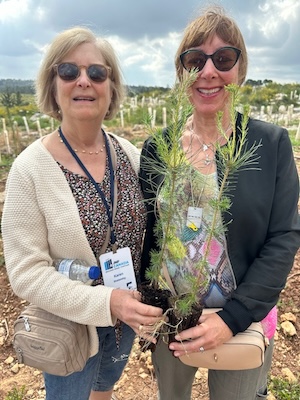
photo - Karen Shalansky, left, and Lorraine Katzin tree planting
Karen Shalansky, left, and Lorraine Katzin tree planting. (photo from Lorraine Katzin)

On Sunday, April 7, we went JNF tree planting. We visited the Black Arrow Memorial, where, from the lookout, you can see Gaza. There, we were given a briefing by retired colonel Kobi Marom, whose opinion was that the Palestinian Authority should be enlisted to run Gaza. We then traveled to the Israel Defence Forces base at Nahal Oz for lunch with the soldiers – these 19-, 20- and 21-year-olds going into Gaza are truly amazing! The soldier I sat with, his name was Daniel and he was from Eritrea. We were so close to Gaza that we could see convoys of food trucks going through the Rafah Border Crossing.

Monday, our last day, we went to Jerusalem to two places that JNF supports: the Jerusalem Hills Therapeutic Centres, which provides services for at-risk children, and the Glassman PTSD and health centre at Herzog Hospital. We then visited the market and went for a walk down Ben Yehuda Street, the Kotel and the tunnels, and had dinner at Piccolino restaurant before heading to the airport. We were joined by Jewish Federation of Greater Vancouver executive director Ezra Shanken and Rabbi Jonathan Infeld from Congregation Beth Israel.

Israel trip highlights
(Karen Shalansky)

I went to Israel to show my support in its time of need, as well as to hear the views of Israelis and their feelings toward the war. Through our many experiences, I felt I accomplished my mission.

Listening to the diverse perspectives of our guide, the young soldiers and guards on our bus, my 31-year-old cousin who made aliyah right after high school and is now fighting in the reserves, Lorraine’s Israeli friends, a retired colonel and others, I heard varying opinions on many topics. For example, should Israel invade Rafah, should there be a ceasefire, should the release of the Israeli hostages be the No. 1 priority, should there be an election, who should oversee Gaza after the war? While there was always more than one answer to every question, there were consistent feelings among everyone we met of resilience, strength and perseverance – that this war is another of many, and that Israel will carry on. As well, everyone we met was both amazed that we came during war and so happy that we had made the effort. That happiness alone made Lorraine and I feel that this trip was worthwhile. 

Some highlights of the trip for me were:

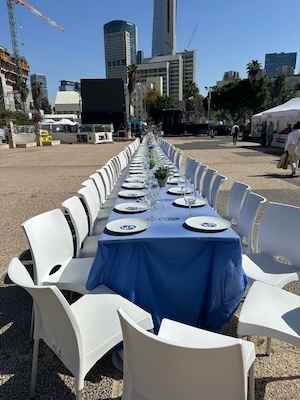
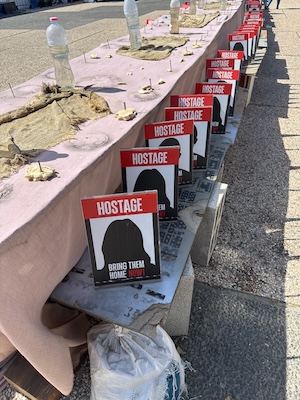
1) Visiting Hostages Square in Tel Aviv for Kabbalat Shabbat. This is a square that has Shabbat tables set up for both the released hostages (with blue tablecloth and wine glasses) and for the hostages still being held (with dirty water and stale pita). There was a wonderful band playing, with a singer, and, at one point, there was a chance for people to stand up and say something. Lorraine was our spokesperson and announced that we were on a trip from Canada to support Israel. Several Israelis came up to us afterwards to shake our hands and welcome us. When the band sang Lecha Dodi, a few people got up to dance the hora, including Lorraine and me. 

photo - In Hostages Square, there are two tables set up: one for the hostages who have been released (left) and one for those still being held in Gaza (right)
photos - In Hostages Square, there are two tables set up: one for the hostages who have been released (left) and one for those still being held in Gaza (right)
In Hostages Square, there are two tables set up: one for the hostages who have been released (left) and one for those still being held in Gaza (right). (photos from Lorraine Katzin)

2) Visit to Shlomit settlement in the southern Negev. This was a religious settlement that JNF helped build. As an aside, JNF has been very active in rebuilding bomb shelters and kibbutzim that were destroyed on Oct 7. At Shlomit, we heard from Dana, a mother of six children, about how her husband and four other men went to a neighbouring kibbutz to fight the terrorists. While the men were successful in killing all five terrorists, her husband, unfortunately, was shot dead. Dana said she wanted her children to remember her husband as a hero, and to foster a sense of hope, not hate. In this inspirational talk, she kept emphasizing that we can’t live with hate, only with love and hope. 

3) A talk from a trauma psychologist at the Glassman centre. While post-traumatic stress has risen substantially in Israel, this psychologist told us a story of an army unit that recently returned from a three-month stint in Gaza. Prior to going home, the unit visited one of the soldier’s grandmothers, who was a Holocaust survivor. The attacks by Hamas on southern Israel have been equated to a second holocaust, but, upon asking the grandmother’s views, she said “no,” the attacks were nothing like the Holocaust. We have a country and a people that will fight for us now, whereas in 1940 we had nobody, she said. She concluded: we are never alone again, as long as there is an Israel. 

Format ImagePosted on May 10, 2024May 8, 2024Author Lorraine Katzin and Karen ShalanskyCategories IsraelTags Beth Israel, Har El, Israel, JNF Canada, JNF Pacific, kibbutzim, mission, Oct. 7, terrorism
Negev campaign goes virtual

Negev campaign goes virtual

In closing the Heart Stirring Negev Event on Zoom, Ilan Pilo, executive director of JNF Pacific Region, talked about the important work done by Save a Child’s Heart, the organization at the centre of this year’s fundraising campaign. (screenshot)

Jewish National Fund of Canada, Pacific Region, held its first virtual Negev campaign event on Aug. 30. The original Zoom was recorded and shown again on Sept. 13 and 16. The object of the fundraising campaign is Save a Child’s Heart (SACH), an Israeli-based global organization with the mission of improving “the quality of pediatric cardiac care for children in developing countries.”

“This year, we’re collaborating with Save a Child’s Heart to build a treatment room in the pediatric surgical wing,” explained Lance Davis, chief executive officer of JNF Canada. “Thanks to your support, JNF can fund the bricks and mortar to house the wonderful doctors and staff who perform life-saving surgeries. JNF will literally fund the foundation of the [new children’s] hospital to provide the necessary facilities to advance this beautiful tikkun olam project. Together with you, our generous donors, we truly are building Israel.”

This tagline – “Building Israel Together” – forms part of the new logo for JNF Canada. The change comes in part because, while JNF Canada continues in its environmental mission, it has become more involved in social infrastructure projects, such as youth centres, playgrounds and healthcare facilities. The current Negev campaign is the latest example of this shift: the treatment room is one of possibly two that JNF Canada will fund (depending how much the campaign raises), which are being constructed in the International Pediatric Cardiac Centre at Wolfson Medical Centre in Holon, Israel.

After Ethan Doctor, a King David High School student, sang O Canada, and Beth Hamidrash’s Rabbi Shlomo Gabay sang Hatikvah, Bernice Carmeli, JNF Pacific Region president, welcomed everyone to the virtual Negev event, which was emceed by JNF Pacific Region past president David Goldman.

Dr. Saul and Lindsay Isserow were honourary chairs of the evening. “Our family became aware of Save a Child’s Heart when my oldest daughter, Jenna, volunteered there one summer,” said Lindsay Isserow. The chance to support an Israeli organization that highlights the contributions Israel makes to the world and to the region is another reason the family was part of this event, said her husband, who specializes in preventive cardiology, among other areas. “The cardiology [aspect] is important to me, obviously, because this is something that’s treatable,” he said.

A video showed some of the work SACH has done – it has saved the lives of more than 5,400 children from 62 countries.

Co-campaign chairs Lana and Doug Pulver first visited Wolfson Medical Centre years ago. “I was moved by the way that this organization takes care of children from all over the world regardless of their background, regardless of where they come from, and ensures that their lives are saved,” said Lana Pulver, who was so taken with SACH that she joined its national board a few years ago.

“Each child that is saved is a whole world – and those worlds learn of the compassion of the Jewish people and the nation of Israel,” said Dr. Lior Sasson, lead surgeon at SACH, in his remarks and thanks.

The remainder of the evening was spent with David Shore, one of the producers of The Good Doctor and of House, interviewing Israeli TV show Fauda’s co-author, Avi Issacharoff, and actor Itzik Cohen, who plays the character of Captain Ayub (Gabi). They talked about many topics, including Fauda’s international popularity; how Cohen, a comedian who does musicals, got his (very serious) part as an interrogator; some of Issacharoff’s and Cohen’s favourite scenes; and, of course, SACH.

Ilan Pilo, executive director of JNF Pacific Region, wound up the program by thanking all those who made the event possible: the donors, the boards, staff and others.

After the Sept. 16 streaming, Pilo spoke with the Independent. About 250 people viewed the event over its three nights, he said, noting that it was just the first of two main parts to the local Negev campaign. The next is called Join Us in the JNF Virtual Sukkah, on Oct. 8, 7pm. “It is a Jewish cardiologist panel,” said Pilo. Isserow will spearhead that conversation, and the cardiologists on the panel with him are Drs. Arthur Dodek, Zach Laksman and Joshua Wenner. For more information and registration, visit jnf.ca/vancouver/campaigns/negev-campaign.

The annual Negev Dinner would have normally taken place in the spring or summer. Looking back to March, when COVID hit in full force, Pilo said, “We had plans, and then we were thinking about doing something in April or May, but we realized that people were not going to leave their homes and we had to reconsider our plans…. We had to do everything very quickly. In a month we had to put together an event. And it’s different. On the one hand, it’s in a way easier because you don’t have to serve dinner. On the other hand, you have to be very creative and prepare everything in advance for the online campaign.

“For instance, we have made videos of local young Vancouverites who had volunteered in the past for SACH,” he said. To do this, the former volunteers had to be tracked down and convinced to record themselves. “This way,” said Pilo, “they became part of the online campaign…. You need to get people’s attention and interest and this was a great way [to do that].”

He hoped that the Heart Stirring Negev events would inspire people to contribute to the SACH’s project, “a cause that brings so much pride to the Jewish people everywhere.” Donations are still being accepted at vannegevdinner.ca, 604-257-5155 and [email protected].

Format ImagePosted on September 25, 2020September 23, 2020Author Cynthia RamsayCategories LocalTags Fauda, healthcare, Ilan Pilo, Isserow, Jewish National Fund Canada, JNF Canada, JNF Pacific Region, Lance Davis, Negev campaign, philanthropy, Pulver, SACH, Save a Child's Heart
We need to act earlier

We need to act earlier

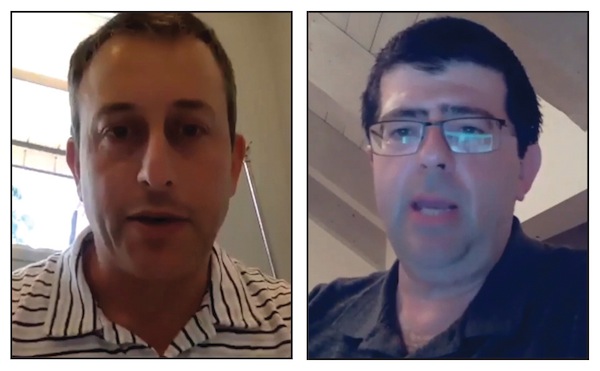
Drs. David Fisman, left, and Jacob Moran-Gilad discuss climate change and future pandemics. (screenshots)

The Jewish National Fund of Canada recently brought together Toronto-based epidemiologist Dr. David Fisman and Israeli clinical microbiologist Dr. Jacob Moran-Gilad to discuss the relationship between climate change and potential future pandemics.

“It is important to remember that there are a lot of linkages,” said Fisman, a professor of epidemiology at the University of Toronto’s Dalla Lana School of Public Health and a physician at Michael Garron Hospital. Both climate change and viruses like COVID-19 share similar drivers, such as human population growth, environmental degradation and the need for expanded food production, he explained.

Rising temperatures around the globe create a more fertile breeding ground for infectious diseases and accelerate their evolution, he said. Furthermore, climate change is exacerbated by the tearing down of natural environments, which then brings humans in closer proximity to animal habitats – increasing the chances of diseases being passed on to humans from other species.

“We do have a lot of mouths to feed on the planet. Intensive factory farming has been a driver of some really important challenges in infectious diseases,” said Fisman.

It is crucial to act early, Fisman argued. “With climate change, there are different time scales than with the pandemic. You want to shut down the carbon increase way early. If we wait until we are in the soup, it comes with great cost,” he cautioned.

Trade and travel have been around throughout history, he acknowledged. The difference now, he said, is “turning the dial up on temperature, which makes everything worse.”

Moran-Gilad, chair of Israel’s national advisory committee for microbiology and member of the country’s epidemic management team, went through some of the possible ways to prevent the next pandemic.

“We are now all experts in flattening curves – as compared to four months ago – which shows how effectively we can disseminate information,” Moran-Gilad observed.

While not discounting the severity of COVID-19, he said it has not been the pandemic that people who study infectious diseases have been preparing for, one known in the scientific community as Disease X, which would cause a mortality rate of 10 to 30%.

“COVID-19, in this sense, can be viewed cautiously as a drill to the real thing,” Moran-Gilad said, adding that a pandemic of much greater magnitude “could occur in one year, 10 years or 100 years from now.”

About COVID-19, he admitted, “The dynamics of the disease are still not clear. Without a vaccine, we are going to see coronavirus with us for a couple of years.”

Moran-Gilad advocated for investments in scientific research in the area of pathogen discovery, to understand the viruses in animal hosts better, which, he said, could help prevent the global economy from experiencing the losses encountered this year. He recommended, as well, that further studies could examine whether human exposure had taken place before the outbreak emerged.

He warned, though, of the propensity of academic research in high-quality journals to stop printing papers on diseases once they recede from public consciousness. He said this happened with SARS and Ebola, and expressed hope that the legacy of COVID-19 would be a continuation of studies on the virus “or we will find ourselves unprepared for the next pandemic.”

Returning to the proverbial pachyderm in the room – climate change – the doctors did offer a glimmer of hope: action on the environment would bring with it a health dividend. Riding a bike instead of driving a car, for example, has health benefits and reduces emissions.

Extreme weather events also have a deleterious impact on health, and thus we would be acting in our own self-interest to address climate change, the scientists said. They noted that, in the Canadian response to COVID-19, all governments had to do was ask people to maintain a two-metre distance from one another and wear a mask in public, and people mostly did as instructed. The desire, then, would be that similar policy guidelines could be used to ward off environmental disasters.

In his closing remarks, Fisman praised the Japanese approach to fighting the pandemic by avoiding closed and crowded spaces. He also called into question the opening of bars in certain regions of Canada before opening schools. And he stood for an aggressive testing approach.

“There are vaccine candidates that look amazingly promising,” said Fisman. “It’s very hard to fly and land an airplane while we are building it. A positive outcome of the current pandemic would be if vaccine development could be done proactively.

“Our ultimate challenge as scientists,” he concluded, “is to show people what an alternative universe looks like and why it is important to take early and immediate action.”

Sam Margolis has written for the Globe and Mail, the National Post, UPI and MSNBC.

Format ImagePosted on July 24, 2020July 22, 2020Author Sam MargolisCategories NationalTags climate change, coronavirus, COVID-19, David Fisman, Jacob Moran-Gilad, Jewish National Fund, JNF Canada, pandemic, science
Community milestones … Suedfeld, Averbach, Phillip, Gutteridge, BI

Community milestones … Suedfeld, Averbach, Phillip, Gutteridge, BI

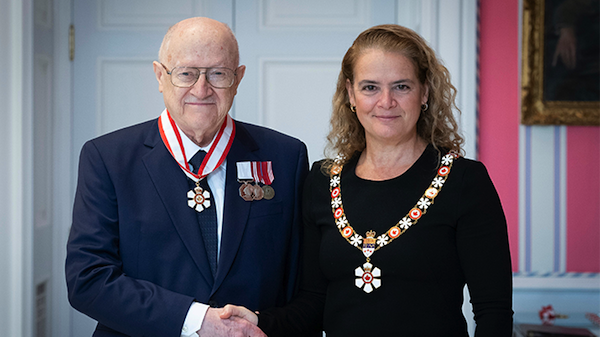
Dr. Peter Suedfeld with Governor General Julie Payette at Rideau Hall. (photo by Sgt. Johanie Maheu)

On Nov. 21, 2019, Vancouver’s Dr. Peter Suedfeld was among those invested into the Order of Canada by Governor General Julie Payette during a ceremony at Rideau Hall in Ottawa.

The Order of Canada is one of the country’s highest civilian honours. Its companions, officers and members take to heart the motto of the order: “Desiderantes meliorem patriam” (“They desire a better country”).

Suedfeld was invested as an officer of the order. The honour’s website notes that his “groundbreaking research expands our notions of resilience and transcends academic fields. Professor emeritus at the University of British Columbia and a prolific writer, he is internationally acclaimed for documenting previously ignored positive psychological and physical effects of extreme and challenging environments. His work has taken a critical look at the impacts on humans experiencing polar isolation, space exploration, sensory deprivation, decision-making during international crises, and such traumatic experiences as genocide. He is highly regarded both as a mentor and active member of his community.”

Created in 1967, the Order of Canada recognizes outstanding achievement, dedication to the community and service to the nation. Close to 7,500 people from all sectors of society have been invested into the order. Those who bear its iconic snowflake insignia have changed Canada’s measure of success and, through the sum of their accomplishments, have helped build a better country.

Appointments are made by the governor general on the recommendation of the Advisory Council for the Order of Canada. For more information about the Order of Canada or to nominate someone, visit gg.ca/en/honours.

* * *

photo - Gary Averbach at the Israeli Scout’s facilities in the city of Ra’anana
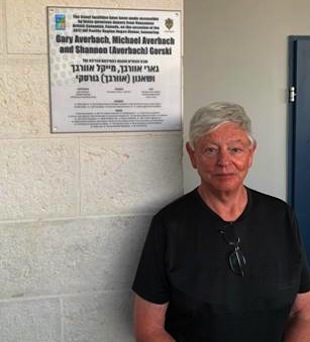
Gary Averbach at the Israeli Scout’s facilities in the city of Ra’anana.

JNF Canada is proud to have completed renovating the infrastructure of the Israeli Scout’s facilities in the city of Ra’anana, to be more accessible for children and youth with disabilities. This project was the focus of the JNF Vancouver 2017 Negev Dinner, honouring the Averbach family.

The Israeli Scouts, Tzofei Tzamid, run programming for more than 80,000 members aged 9-21 (including more than 2,500 with disabilities) throughout Israel. They bring together children and youth from across the spectrum of Israeli society to learn leadership skills and the value of inclusive community, and to enhance their self-image.

A special thank you to Gary Averbach, Michael Averbach and Shannon (Averbach) Gorski, and the entire Vancouver community for taking this vision forward and helping JNF improve the lives of the members of Tzofei Tzamid. To learn more about the project, visit jnf.ca/tzofei-tzamid.

* * *

photo - Rob Philipp will start his position as chief executive officer of Hillel BC in June
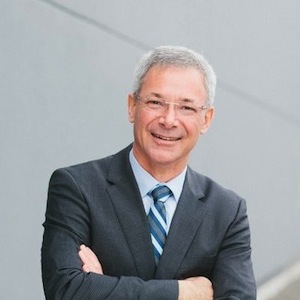
Rob Philipp will start his position as chief executive officer of Hillel BC in June.

Rob Philipp has been appointed to the position of chief executive officer of Hillel BC, effective in June.

Philipp’s appointment follows a Canada-wide process engaged by the search committee of the Hillel board of directors, comprised of Gordon Brandt (chair), Eric Andrew, Rebecca Recant, Frank Cohn, Talia Magder, Alexis Pavlich, Rachael Segal and Isaac Thau (board president). Philipp was the unanimous recommendation of the search committee and unanimous choice of the board of directors.

Philipp has a long history with the Vancouver Jewish community, having served on several boards, including 20 years on the board of Temple Sholom and being president of that organization. He participated in the Vancouver Wexner Heritage Leadership Group, which was a selected group of local Jewish leaders that studied and learned together for two years.

Philipp brings a unique and impressive set of experience, credentials and passion to Hillel. After graduating from the University of British Columbia, where he was an active member of Hillel, he worked as a chartered professional accountant. He then developed his career in sales, marketing and management in both for-profit and nonprofit organizations, most recently as the chief executive officer of the Fraser Valley Real Estate Board and as interim executive director of Temple Sholom.

He is known for being a creative and innovative leader, with a warm and strong team approach and a people-first mentality. His experience in developing and executing strategy, program development and delivery, combined with his business, governance and financial acumen, will be tremendously valuable to the continued growth of Hillel based on the strong foundation built by Rabbi Philip Bregman and Sam Heller in recent years.

* * * 

photo - Jessica Mann Gutteridge is the new artistic managing director of the Rothstein Theatre and Chutzpah! Festival
Jessica Mann Gutteridge is the new artistic managing director of the Rothstein Theatre and Chutzpah! Festival.

The Jewish Community Centre of Greater Vancouver welcomes Jessica Mann Gutteridge as the new artistic managing director of the Norman and Annette Rothstein Theatre and Chutzpah! Festival. The position was previously held by Mary-Louise Albert, who is leaving after 15 successful years. The JCC thanks Albert for her excellence in service and dedication to the community and the arts.

Gutteridge joins the JCC from Boca del Lupo, where she managed Performance Works on Granville Island. She was also a founding board member of the Granville Island Theatre District. She held positions of managing director and education manager at Carousel Theatre for Young People. Her work as a dramaturg has included new plays for young audiences and playwrights from Shakespeare to Genet to Edwin Sánchez.

She received her master’s in fine arts from the Yale School of Drama’s department of dramaturgy and dramatic criticism, and studied directing at Wesleyan University. Born and raised in New York, she returned to the theatre after nearly two decades as a lawyer specializing in advertising and trademark law. At Columbia Law School, she was editor-in-chief of the Columbia-VLA Journal of Law and the Arts. Her nonprofit board work has included serving as co-president of Landmark on Main Street (a performing arts and community centre on Long Island, N.Y.), the Vancouver International Burlesque Festival, and the Bayview Treehouse Preschool. She was a member of the 2018-19 Cultural Leadership Program at the Banff Centre in Alberta.

“I look forward to continuing to bring diverse, world-quality artists to present their work to Chutzpah! Festival audiences and to reach a new generation with exciting performances. I am also delighted to steward the Rothstein Theatre as a gem appreciated by professional artists and community members throughout Metro Vancouver.”

The JCC is excited to see Gutteridge apply her industry experience and talents to the management of the centre’s fully equipped 318-seat performance venue, and the creative direction of the Chutzpah! Festival, one of the major art events in Vancouver’s cultural calendar.

* * *

At Congregation Beth Israel’s annual general meeting Dec. 5, several volunteers were recognized. Mazal tov to Howard Mickelson and Keren Gertsman (President’s Award), Lloyd Baron (Board of Directors Special Service Award), Michael Harris (Board Recognition Award) and Lissa Weinberger (Special Service Volunteer Award).

The congregation also welcomed its incoming board for 2019-2020: Helen Pinsky (president), David Silver (vice-president), Heather Sirlin (secretary), Keren Gertsman (treasurer), Lisa Averbach, Anton Bloem, Alexis Doctor, Kevan Jacobson, Lisa Marcoe, Christie Menzo, Dale Porte, Jennifer Wolf and David Woogman.

Format ImagePosted on January 31, 2020January 28, 2020Author Community members/organizationsCategories LocalTags Averbach, Beth Israel, Chutzpah!, Hillel BC, Jessica Mann Gutteridge, JNF Canada, Order of Canada, Peter Suedfeld, Rob Philipp
Proudly powered by WordPress