הנפת דגלים פלסטינים היא חלק מהלחץ להכיר במדינה פלסטינית. בעקבות המלחמה הארוכה מדי והרג חפים מפשע שלא לצורך ישראל הפכה לאחת המדינות השנואות בעולם. ולפיכך, ישראלים ויהודים בעולם משלמים את המחיר הכבד ומסתכנים בחייהם. מה שאני עושה בוונקובר לא מסכן את הישראלים בארץ אך מדוע מה שממשלת ישראל עשתה צריך לסכן אותי
נשיא ארה”ב דונלד טראמפ הגיע להבנות עם חמאס שהביאו להפסקת אש – ולא להסכם שלום כפי שהוא טוען. אותו הסכם הושג כבר לפני שנה אך ג’ו ביידן היה חלש מדי לאלץ את נתניהו לקבלו. לעומתו, טראמפ לא השאיר לנתניהו שום אופציה. אגב, אנשי טראמפ נפגשו עם נציגים של החמאס ותארו לעצמכם מה היה קורה עם נשיא דמוקרטי היה מאפשר זאת?
ראש הממשלה בנימין נתניהו המשיך במלחמה הארוכה והמיותרת הזו בעזה במשך שנתיים רק כדי שיוכל לשרוד פוליטית. לאור זאת, חיילים רבים נהרגו שלא לצורך וגם חטופים נהרגו ואו השתחררו מאוחר מדי. בצד הפלסטיני נהרגו רבים מדי שלא לצורך. זה ימשיך להזיק גם לישראל בעתיד כיוון שהיא נמצאת עם רצועת עזה בשכנות
עוד מספר מילים על טראמפ הנוכל. הוא נפגש לאחרונה עם שני דיקטטורים: ראשי המדינות של סוריה וערב הסעודית. הוא ביטל את הסנקציות על סוריה ומאפשר מכירת אף-35 לסעודיה שזה מאוד מסכן את ישראל. טראמפ בטיפשותו גם מעריץ את המנהיגים האלה, כי כהרגלו הוא מעריץ דיקטטורים. בואו נבחן את הצביעות של המצביעים הרפובליקנים והבוחרים היהודים של טראמפ: אם קמלה האריס הייתה נבחרת לנשיאה ומעיזה להיפגש עם מנהיגי סוריה וסעודיה, ומאשרת למכור לסעודיה את האף-35, הייתה כמה צעקה גדולה מקרב הרפובליקנים שהיו טוענים שזה לא מתאים לערכי ארה”ב ומסכן מאוד את ישראל. אך כרגיל לטראמפ מותר לעשות מה שהוא רוצה כאשר אין לו מושג על משמעות מעשיו וגם ממש לא אכפת לו מכך
טראמפ גם ביודעין או שלא ביודעין עוזר לקדם את נושא המדינה הפלסטינית. והיכן הרפובליקנים והיהודים שבחרו בו
ארה”ב וקנדה היו המדינות הקרובות ביותר שנים על שנים עד שהגיע טראמפ המטורף והפך אותן כמעט לאוייבות. הוא גם מעז לטעון שקנדה היא המדינה ה-51 של ארה”ב. במעשיו טראמפ בסך הכל מחליש את המערב ועוזר לרוסיה וסין. מנהיגי שתי מדינות אלה ודיקטטורים אחרים בעולם בוודאי מחייכים שהם רואים מה טראמפ עושה. כיצד הוא הורס את הדמוקרטיה בארה”ב מדי יום. האמריקאים עוד ישלמו מחיר כבד על בחירתם בטראמפ
בוחרי הימין בישראל שרואים בנתניהו נביא חדש שמחו מאוד על בחירותו של טראמפ לנשיאות ארה”ב בפעם השניה, כאשר הריס הפסידה. אני לא בטוח היום שכול תומכי טראמפ בישראל שמחים על מה שהוא עושה, כאשר הוא אונס את נתניהו פעם אחר פעם לקבל את עמדותיו. זה כולל את מכתב ההתנצלות לקטאר, הסכם הפסקת האש עם החאמס ואי לוחמה בלבנון
טראמפ גם לא מתבייש להתערב בפוליטיקה ומערכות המשפט של מדינות אחרות ובמקרה של ישראל, הוא טוען שיש להעניק חנינה לנתניהו על ידי נשיא המדינה יצחק הרצוג. נתניהו מצידו פועל בכל דרך לבטל את המשפטים נגדו, טראמפ הוא עזרה מצויינת. לא מפתיע ששני מנהיגים נוכלים אלה, דואגים אחד לשני ומעריצים אחד את השני. נתניהו מצידו טוען שטראמפ הוא הנשיא האמריקאי התומך הגדול ביותר של ישראל, ושמגיע לו פרס נובל לשלום. צפויות עוד התפתחויות נוספות לאור היחסים בין השניים
הישראלים יודעים הכל, מבינים בכל והם הכי טובים בכל דבר ועניין. ולמרות זאת שורת המחדלים הקשים של השבעה באוקטובר הוכיחה שבמציאות זה רחוק מהאמת
המודיעין לא תיפקד, השב”כ לא תיפקד, לקח לצה”ל 6-8 שעות להגיב על קריאת האזרחים (“הורגים אותנו”), החומה הטובה והטכנולוגית ביותר בעולם נפלה בתוך פחות מחמש דקות. צה”ל אישר לערוך מסיבת טבע ליד הגבול – שזה טמטום משווע. משאירים בסיסי צה”ל ריקים כי מדובר בחגים – וזה טמטום משווע נוסף. ממשלת המחדלים והשחיתות העבירה גדודים של חיילים לשמור על המתנחלים במקום על אזרחי העוטף. והיכן התצפיתניות שצפצפו על המידע שלהן כי הן “רק” חיילות
ומעל הכל התפיסה של ראש הממשלה בנימין נתניהו ורבים אחרים שעדיף “לשמן” את החמאס שישתוק במקום לקדם את הרשות הפלסטינית
ישראל של היום היא מדינה ימנית מתחרדת ומשיחית. ולאור האמור לעיל אינני חושב שהיא יודעת כיצד באמת להתמודד עם השכנים ולדאוג לאזרחים
בישראל שכחו כי מחר צריך לחיות עם השכנים האלה אחרי שהפציצו אותם יומם ולילה. ארה”ב עשתה זאת באפגניסטן, עיראק ווייטנאם – והיא מזמן לא נמצאת במקומות האלה שהם רחוקים מאוד מארה”ב. לעומת זאת, ישראל תאלץ להתמודד עם השכנים שלה כל העת. אני לא חושב שנתניהו שעומד בראש ממשלה כושלת, הוא זה שאפשר לסמוך עליו. הוא ובעיקר תומכיו הרבים לא הולכים לשום מקום. הם רק הורסים את דמוקרטיה יום יום (ממש כמו בארה”ב של הדיקטטור דונלד טראמפ)
הסכם הפסקת האש הנוכחי נכפה על ישראל על ידי המושחת השני טראמפ שרוצה פרס נובל (כי אובמה קיבל אותו) ובעיקר כי יש לו, למשפחתו ולחבריו עסקים ענפים בקטאר ובאזור כולו. את המלחמה המיותרת בעזה אפשר היה לעצור לפי חודשים ארוכים. את אותו הסכם הפסקת האש אפשר היה להשיג אז, להציל יותר חטופים, והרבה פחות חיילים היו נהרגים. אז גם השנאה לישראל בכל העולם הייתה פחותה
טראמפ ונתניהו קוראים להסדר – הסכם שלום. באמת? האם ישראל והפלסטינים יחליפו שגרירים? עתה יותר מתמיד העולם הערבי לא יקבל את העבודה שישראל מסרבת לתת לפלסטינים מדינה והיא ממשיכה לעבות את ההתנחלויות
ולסיום עוד נקודה: מדינה שיודעת מול מי היא מתמודדת לא היתה מאפשרת לרבים רבים (החרדים) להשתמט מהצבא. ולא הייתה נותנת למחנה המשיחי לשלוט בסדר היום הציבורי
ובנימה האישית: הפעם היחידה שפחדתי ב-20 השנים האחרונות (בהן אני גר בקנדה) הייתה דווקא בביקור בישראל ליומיים אשתקד. אירעה הפסקת חשמל ארוכה וחששתי שהאיראנים מתקיפים. חבר שלי עובר מרמת השרון לתל אביב כי נמאס לו לגור ליד הצבא ולהוות מטרה להתקפות בעתיד. הוא גם ציין בפניי שבישראל הסתירו את ממדי הנזק העצום של הטילים האיראנים
הפעם הקודמת שפחדתי בחיי הייתה בעת מלחמת המפרץ בעיראק הראשונה (1991) עת 40 טילים נפלו על אזור תל אביב שאז גרתי בה. לי זה הספיק לכל החיים
אינני יודע מה יהיה בעתיד ואני מודע לסכנה של האיסלאם הקיצוני. אני באופן אישי אתאיסט ומתנגד באופן עקרוני לדתות שמביאות רק נזק ושנאה. האם הותקף כאן ע”י מוסלמים? אולי? בשלב זה מרבית המוסלמים הגרים במחוז שלי (בריטיש קולומביה שמכילה כ-4.5 מיליון תושבים) ומספרם מגיע לפחות מ-200 אלף – הם איראנים – ואין בהם שום סכנה לנו
אני לא צופה עתיד טוב לעולם אשר נהיה קיצוני דתי, ימני וכוחני והדיקטטורים הולכים ומשתלטים על כל הדמוקרטיות שנשארו
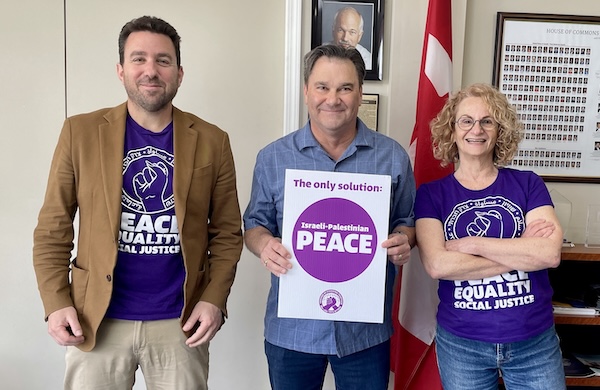
Interim leader of the New Democratic Party of Canada Don Davies, centre, with Itai Bavli and Avril Orloff of Vancouver Friends of Standing Together. (photo from Vancouver FOST)
This summer, Vancouver Friends of Standing Together has been holding weekly vigils in front of City Hall to continue the call for the return of the hostages, an end to the war in Gaza and an end to settler violence against Palestinians in the West Bank.
“We organize rallies, vigils and information sessions to raise awareness of the situation in Israel/Palestine and promote ‘another way’ that is not exclusively pro-Israel or pro-Palestine but pro-humanity,” Avril Orloff, who started the Vancouver Friends of Standing Together (FOST) chapter, told the Independent.
Adi Keidar, one of the chapter’s co-administrators, said, “If you are willing to accept that both Israelis and Palestinians deserve to live freely and safely on this land, I will be standing with and supporting you. Someone told me, ‘if you need to choose between pro-Israel or pro-Palestine, it is obvious for me, as a Jew/Israeli where I stand. However, if I knew and trusted that there is another way, I would choose both.’ Standing Together, for me, brings that other voice.”
“I joined the FOST group in June 2024 because it reflects my values and my belief that finding a just solution to the conflict is the only way forward,” Itai Bavli, also a Vancouver FOST co-administrator, said. “I care about all people living between the river and the sea and believe that both peoples can thrive if given the chance. I support Israelis and Palestinians alike and believe they both have the right to live freely and safely. Which means ending the occupation and supporting a Palestinian state. For me, it’s a responsibility I carry.”
Currently, there are nine local co-administrators, who play active roles as their other work and responsibilities permit, Orloff explained. “We try to divide up responsibilities, so no one is overburdened,” she said, noting that everyone involved is a volunteer. “We meet on an ad hoc basis as needed to brainstorm ways to increase awareness, bring out the voice of Standing Together and address issues that come up.”
Standing Together is an Israeli grassroots social movement made up of Jewish and Palestinian citizens that, according to its website, “envision[s] a society that serves all of us and treats every person with dignity. A society that chooses peace, justice and independence for Israelis and Palestinians, Jews and Arabs. A society in which we all enjoy real security, adequate housing, quality education, good healthcare, a liveable climate, a decent salary and the ability to age with dignity.”
Since the Hamas terror attacks on Oct. 7, 2023, and the ensuing war, Standing Together in Israel has been organizing demonstrations – attended by tens of thousands – calling for a hostage deal and a ceasefire agreement. They also have been engaging in public campaigns “aimed at re-humanizing the discourse, retaining humanity, mourning all lives lost and rejecting violence on social media in Hebrew, Arabic, and English.” Last May, they launched the Humanitarian Guard initiative at Tarqumiyah checkpoint to protect “aid trucks headed to Gaza from attacks by extremist settlers that come out to attack the trucks.” This month, they started a campaign to collect food and humanitarian aid for residents of Gaza.
In addition to the eight chapters of Standing Together that operate in Israel, there are Friends of Standing Together chapters worldwide that have formed since Oct. 7. The chapters in the diaspora raise awareness of and funds for Standing Together, as well as offer a local communal space for people who share the movement’s values and goals. Orloff is an ambassador for ST’s global crowdfunding campaign and recently surpassed her personal goal of raising $6,000 for the movement.
“I started the Vancouver FOST group in February 2024, when I first learned about Standing Together and discovered they had support groups around the world,” said Orloff. “I was drawn to ST because I felt that a lot of groups advocating for either Israel or Palestine focused on only one side or the other, which seemed short-sighted to me. Standing Together’s stance, by contrast, is that, with seven million Jews and seven million Palestinians living ‘between the river and the sea,’ none of whom are going anywhere, the only sustainable future is a shared one grounded in equality, security, peace and justice for all.”
Orloff, Keidar and Bavli said they appreciate that ST is about more than ending the war and that it’s “a broad-based social movement that goes beyond the specifics of Jewish/Palestinian issues to encompass social change at all levels of society, from the bottom up.”
“One of the biggest concerns and confusions I had on Oct. 7 and the events that followed was the rise of hate and polarization on both sides,” said Keidar. “It was rare that I could agree with much that was said, and I was constantly trying to hold two thoughts at the same time. I felt alone and was not seeing the benefit of supporting one side – it felt wrong and unjust and it didn’t fit my values.
Adi Keidar at one of Vancouver Friends of Standing Together’s vigils. (photo from Vancouver FOST)
“When I learned about Standing Together, it was the closest group that I felt spoke to my values and beliefs, as their focus is not one side or the other but humanity, which was the voice I felt was drowning in the hate that was brewing. I wasn’t willing to accept just one side. I believe that the only way to get out of this cycle is by compassionately seeing both sides, taking responsibility, finding the people that speak these values and bringing their voices out.”
Keidar participates in the weekly Bring Them Home rallies. Both she and Bavli spoke at a BTH rally this summer to raise the voice of Standing Together, to show “that it’s possible (indeed, necessary) to support both Israel and Palestine, and remind people that the immediate end of this war is only the beginning of the work to build a shared society in which all peoples live in peace and security.”
Vancouver FOST does local community-building through their WhatsApp group, social events (for example, film evenings, picnics, in-home gatherings), rallies and other activities. They raise awareness on social media via Instagram and work to build their membership, liaising with Standing Together and FOST groups globally. They meet monthly on Zoom with other Canadian FOSTs and build relationships with groups that share ST’s values and principles, like Women Wage Peace and various faith organizations. They have started doing outreach to Canadian politicians.
“We have endorsed Canada FOST’s Call to Action to the Canadian government and politicians to advance key priorities,” said Orloff, “including taking urgent diplomatic action to permanently end the war in Gaza; providing long-term support for peace and equality, not war; and supporting solidarity and partnership in our own society.”
The group organized and hosted an event in June last year, which brought Raja Khouri and Jeffrey Wilkinson to Vancouver to talk about their book, The Wall Between: What Jews and Palestinians Don’t Want to Know About Each Other. (See jewishindependent.ca/not-such-a-great-divide.) They have plans to host an information table at the University of British Columbia in the fall.
In an email, Orloff, Keidar and Bavli described Vancouver FOST as being “for more than we’re against. We don’t argue about terminology or labels or traffic in simplistic black-and-white ‘solutions,’ but are comfortable living with complexity and difference. We love to have juicy discussions, but, more than talk, we’re about supporting action that will bring about real, practical, sustainable change. We aren’t pro-Israel or pro-Palestine but pro-humanity,” they reiterated, “and we don’t see this as a left-right divide or an Israel-Palestine divide, but a divide between those who want peace and life for everyone and those who traffic in death and destruction. We’re here to offer a different way of thinking about the conflict and a different path forward, not to convince people that we’re right.”
Orloff said group members aren’t “settling for simplistic, one-sided solutions that make heroes of one side and villains of the other, but recognize that geopolitical issues have history and context that create layers of complexity, compounded by historical and intergenerational trauma on both sides. What I tell people is that, in this ongoing conflict, there is no win/lose: it’s either win/win or lose/lose. If we don’t find a way to justice, equality, peace and security for all, there won’t be justice, equality, peace or security for anyone.”
“We are involved with Standing Together,” the three co-administrators stressed, “because of deep feeling for Israel and the people living in the land. Many of our FOST members are Israelis who are heartsick at what Israel is doing in Gaza, the West Bank, and to its own Palestinian Israeli citizens. We believe in Israel’s promise and want to hold Israel to its highest ideals. There is no other way. It’s our responsibility to bring about the change.”
This week’s suggestion of a time-limited ceasefire that would free remaining hostages in Gaza and return the bodies of the dead to their families seems, in the context of a bleak historical moment, encouraging. The optics of bartering for the lives (and dead bodies) of Jews is something that should (but won’t) make the world recoil in revulsion. Nonetheless, anything that brings the hostages home is worthy of consideration.
A comprehensive agreement brokered by third parties could have positive results, even as it includes the releasing of Palestinians imprisoned in Israel, including those who are guilty of terrorism. At a minimum, it would not be the vague “ceasefire” some have been calling for, which others might view as letting Hamas off the hook for their atrocities. A blanket ceasefire without a release of hostages is, and should be, out of the question.
All this talk of ceasefire, though, should raise a question almost no one seems to be asking. With so many calls for Israel to declare a ceasefire, why is no one – seemingly no one, including Israel-supporting voices – calling for Hamas to surrender?
Conceivably, this particular war could end tomorrow if Hamas conceded. Why aren’t the voices who want to end this war now calling for the one step that could realize that goal?
Certainly, the idea of Hamas surrendering and their leaders facing justice is unpalatable to sympathizers in the West. There is a not-negligible number of activists and commentators who not only support the Palestinian “resistance” in theory, but support it at its most brutal, celebrating the kidnappings, rapes and murders as “amazing” and “brilliant” (in the words of just one college instructor on the steps of the Vancouver Art Gallery in October).
There is also the slightly more convincing idea that, while a democratic government like Israel’s may be swayed by overseas public opinion, a terror regime will not be. As fair as this assumption may seem on its face, evidence debunks it. Millions of people marching worldwide, dressings-down by the United States’ president and top diplomat, a show trial over “genocide” at the International Court of Justice and what seems like a world aligned against it seems to have altered the Israeli resolve not a gram.
The inevitable fallback position in these discussions is that Israel is the powerful party here and so holds the cards. The power differential does not mean, though, that Israelis either are not vulnerable or that they are to blame for the war. For the families of those murdered on Oct. 7 and the Israeli soldiers killed in this conflict, power differentials are a pile of dirt next to empty chairs at their tables. For whatever power discrepancies might exist, Hamas has shown its ability to breech Israel’s defences, and its resolve to do so again, if it can. Hamas has the one card up its sleeve that could end this war: surrender.
Calls for a ceasefire imply that Israel should surrender itself to a future of perpetual terror, because Hamas has repeatedly expressed the determination to fight until Israel is eliminated – setting up a zero-sum situation in which anything short of the complete eradication of Hamas is a defeat for Israel. On the other hand, Israel has made unilateral moves in the past – disengaging from Gaza in 2005, for example – and will likely be forced to do so again as perpetual war is untenable on several levels.
As numerous commentators recently have suggested, total de-Hamas-ification of Gaza is probably unlikely. Perhaps the endpoint will be a situation in which Israel has achieved a position of unequivocal strength, with the likelihood of a repeat of Oct. 7 eliminated, and some as-yet-unimagined political structure in place in Gaza. While street activists and diplomats worldwide think they have all the answers to what Israel should do, not one group has stepped up to suggest they would serve as peacekeepers or otherwise oversee Gaza’s transition away from Hamas’s regime. There are, of course, larger geopolitical imperatives, including the maintenance and expansion of the Abraham Accords, which Saudi Arabia has said depend on a two-state solution. Prime Minister Binyamin Netanyahu, to the consternation of American and other officials, is insisting Palestinian statehood is off the table for now.
Another realistic reason why Western observers may not be calling on Hamas to give up is the understanding – intuitive, if not conscious – that Hamas will never surrender because it is determined to continue this fight regardless of cost and futility. Their stated goal is the eradication of Israel even if that takes generations. Hamas leaders have indicated that thousands upon thousands of dead Palestinians are a small price to pay for a centimetre’s advance toward that ultimate goal. The embedding of terror infrastructure in civilian areas, the use of human shields and child combatants are evidence that Hamas will fight to the last person.
In Jewish cyberspace and in Israel-minded media, there have been millions of words spilled in recent weeks about the necessity of victory, the justness of the war even in the face of the mounting casualties and much more. There also have been calls for a ceasefire as a way to get the beloved hostages back home with their families and their hurting nation.
Given what’s at stake, we hope and pray for what seems impossible, a Hamas surrender. We also hope and pray for the possible – that Israel will be victorious in achieving its security, that there will be a world in which both Israel and Palestine coexist in peace. And, more immediately, that the hostages will be returned.