In the dystopia of the Holocaust, pregnancy and childbirth were life-threatening situations – for the mother and the child. In Auschwitz, if a woman were able to conceal her pregnancy long enough to come to term, despite malnutrition and epidemics, the women who helped deliver the baby would sometimes kill the child and dispose of the body in order to save the mother from the Nazi overseers.
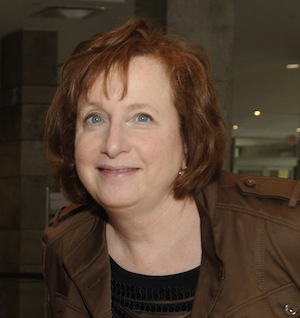
Dr. Sara R. Horowitz (photo from York University)
Ending Jewish civilization, which was the goal of the Nazi Holocaust, focused particular attention on children and pregnant women, according to Prof. Sara R. Horowitz, who delivered the annual Kristallnacht memorial lecture Sunday night at Congregation Beth Israel.
Jewish men, women and children were all targeted by the Nazis, but their experiences were different, said Horowitz. While female victims of the Nazis may have been doctors, businesspeople, farmers or had other roles, they were particularly under assault as mothers. Horowitz based her lecture, Mothers and Daughters in the Holocaust, on many recorded narratives from mothers and daughters affected by the Holocaust. The harrowing stories involved both unthinkable choices during the Shoah and strained relationships thereafter.
For Jews in hiding, babies could be particularly dangerous. A baby’s cry could betray entire families hiding in attics or under floorboards. In one case, Horowitz recounts a mother pulling her hair out in silence while an uncle smothered her baby as Nazis searched the house in which they were hiding.
Women were routinely forced to make impossible choices between their own welfare and that of their children. In many cases, she said, women given a choice opted to die so that their child would not die alone. In others, mothers knew they could do nothing to forestall the inevitable and saved themselves.
In the concentration camps, pregnant women and young children were automatically selected for death. Horowitz quoted Dr. Josef Mengele, the infamous Auschwitz doctor, as saying that the mothers could have been spared but that it would “not be humanitarian” to send a child to death without its mother.
Secret abortions were performed and pregnancies hidden. In one case, Horowitz said, a woman survived to deliver her child by positioning herself among beautiful young women during naked inspections by Nazi guards, hoping, successfully, that the guards’ attentions would be distracted from her condition.
One of the experiments Mengele undertook was to see how long a newborn could survive without nourishment. A woman delivered a baby under his direct supervision and then had her breasts bound so she was unable to feed the baby. Mengele came daily to inspect the situation and take notes.
Experiences during the Shoah had indelible impacts on its victims, their children and grandchildren.
Horowitz reflected on Motherland, a memoir by the writer Fern Schumer Chapman, whose mother was sent from her home on the Kindertransport, which took Jewish children from their homes in Europe to safety in England and elsewhere. Her mother, Edith, never forgave her parents for “abandoning” her, even though she understood that she would have perished along with them had she remained behind.
“At least we would have been together,” Horowitz quoted Edith, noting that the author-daughter’s conclusion was that her mother’s understanding of those early events was “stuck in a 12-year-old’s heart.”
Horowitz also discussed Sarah Kofman, who would go on to become a leading French philosopher. She survived as a hidden child in Paris, with her mother, but the woman who provided them shelter worked to detach Sarah from her mother and from Judaism, which led to difficult relations between all three women after liberation. Kofman never wrote about her experiences during the war until her 60th year, when she penned a memoir of the time and shortly thereafter committed suicide.
Relationships between parents and children after the Holocaust were often difficult. Adults understood both the “preciousness and precariousness” of children. For children born after 1945, many of whom bear the names of victims of Nazism, their relationships with the past and with their parents can bear varieties of scars.
Many parents, having missed normal upbringings, did not intuit how to parent. In one case Horowitz mentioned, a woman who had never witnessed a normal pregnancy and whose mother died in the Holocaust lamented that no one told her what to expect or how to prepare. When labor began while her husband was at work, the woman rode a bicycle to the hospital.
A woman who was forced to murder her own baby during the Holocaust went on to have two sons after liberation. In an Israeli hospital, when a nurse momentarily took her baby away, the woman became hysterical.
“Nobody knew and nobody cared about people from the concentration camps,” Horowitz quoted the woman. “They thought we were mad.”
Mothers who were unable to protect their children during the Holocaust carried concealed memories that sometimes prevented them from normal mothering after liberation.
In many cases, though, the mother-daughter relationship was credited with saving one or both parties. Mothers provided inner strength, a moral anchor and often ingenuity, said Horowitz.
One mother, a seamstress, ingratiated herself with the town mayor by making dresses for the mayor’s wife and daughters, thereby delaying her family’s selection for successive roundups. When at last her family was lined up for the trains, the mayor’s wife insisted the woman be removed so she could finish the dresses she was working on. When the seamstress insisted she could not possibly do good dressmaking while worrying about her family, the mayor’s wife insisted the rest of the family also be removed from the transport.
In last words between mothers and daughters, strength and continuity prevailed, said Horowitz. In face-to-face goodbyes, and in letters and postcards received after a death, mothers granted children “permission to survive” without guilt, urged survivors to tell the world what happened and instructed them not to internalize the perceptions the Nazis had of them.
In one instance, where a young woman was spared while her mother and two young sisters were selected for death, the mother implored her daughter not to become bitter and hateful.
“Don’t let them destroy you,” the mother said.
Horowitz is the director of the Israel and Golda Koschitzky Centre for Jewish Studies at York University, and a professor of comparative literature. Her diverse areas of research and writing include cultural responses to the Holocaust. She is a member of the academic advisory board of the U.S. Holocaust Memorial Museum and a former president of the Association for Jewish Studies.
At the start of the evening, Prof. Chris Friedrichs, representing the Kristallnacht committee, reflected on the symbolism of coming together in the recently completed new Beth Israel synagogue to commemorate an historical event in which “hundreds of synagogues like this were put to the torch and destroyed.”
Cantor Lawrence Szenes-Strauss recited El Moleh Rachamim, the memorial prayer. Holocaust survivors participated in a candlelighting procession. Barry Dunner reflected on being a child of Holocaust survivors. Prof. Richard Menkis introduced the keynote speaker and Rabbi Jonathan Infeld thanked her. Vancouver Mayor Gregor Robertson read a proclamation from the city.
The annual Kristallnacht commemorative event is a partnership between the Vancouver Holocaust Education Centre, Congregation Beth Israel and Jewish Federation of Greater Vancouver.
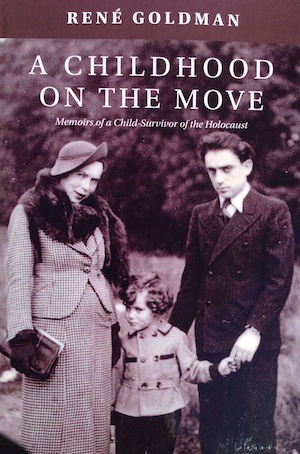
In a recently published memoir, A Childhood on the Move: Memoirs of a Child Survivor of the Holocaust, René Goldman, professor emeritus of Chinese history at the University of British Columbia, pieces together a fragmented and tragic childhood and adolescence.
Having migrated to Luxembourg from Poland, Goldman’s parents then fled the advance of the Nazis into the Benelux countries. The family made their way through occupied France hoping to sail from a Mediterranean port to South America. While their passage was interrupted, the family at least found themselves in France’s “free zone,” the southern area governed by the German-puppet Vichy regime, but not directly administered by the Nazis. While granted a period of comparative normalcy – unlike, Goldman notes, Jews in the north like Anne Frank and her family – eventually there was a roundup.
Goldman was awakened by his mother and told that police were demanding they go to the train station. Why his father was not with them at that time Goldman does not know. Nor does he know why he was spared the fate of his mother.
“The entire station was a scene of bedlam, with men, women and children being pulled, shoved and hurled into the train,” writes Goldman. “Just as the commissar was about to throw me into the train as well, two gendarmes in khaki uniforms appeared in the nick of time to stop him. Without a word he let go of me…. That was the last time I saw my Mama.”
An aunt arranged for Goldman to be hidden in a rural village, which would become the first of countless temporary shelters for him. In an excruciating series of hasty moves, Goldman was transferred from the protection of one adult or institution to another. In some instances, the adults and his fellow children were amiable, in others far less so. Despite the instability and constant uprooting, he usually managed to attain some education in almost every one of his hiding places. At a Catholic institution, he and other Jewish children were assigned new identities and warned never to let anyone see their private parts, “since in France only Jews were circumcised.”
When finally the allies reached the village where Goldman was hidden, and he reconnected with his aunt, she told him that his father had joined the Free French forces and would return after the war. It’s not clear if she believed this. “Alas, even as Paris was about to be liberated, [Klaus] Barbie [the Nazi known as the ‘Butcher of Lyon’] hurriedly filled up one last train with victims destined for the death camps, a train which the Resistance vainly sought to derail, or otherwise prevent from reaching Germany,” writes Goldman. “Decades later I learned that my beloved Papa was among them.”
Though now liberated, things did not, of course, return to normal for Goldman. The winter of 1944-45 was a harsh one and food was scarce. Meanwhile, the war continued and the allies suffered setbacks in the Battle of the Bulge. “That unanticipated delay caused the Allies heavy losses, while thousands more victims, among them my father, perished in the Nazi death camps,” he writes.
Moreover, Goldman’s surviving aunt and uncle in France, with three children of their own, found they could not care for him. They sent him to a colony run by a Zionist organization, where he received a Zionist education, including a bit of Hebrew, to prepare the young people for aliyah. When the war finally ended, the children at the colony waited for news of their parents. “Daily I hung around the little railway station after school hours, sometimes alone, sometimes with others, scrutinizing the passengers who came off the afternoon train from Grenoble in the vain hope that Papa might turn up among them,” he writes.
The Jewish community in Grenoble hosted a photographic exhibition of the Shoah. “I felt my head spinning with shock and disbelief as I stared at the photos of emaciated, skeletal looking ‘déportés’ in striped uniforms; of heaps of corpses stacked like cord wood; and of the gas chambers and crematoria, in which millions were burnt to ashes.”
Goldman was entrusted to the Commission Centrale de l’Enfance (CCE), a product of the underground groups that had hidden Jewish children and that was now attempting to reunite them with surviving relatives or adopt them if they were orphaned. At the CCE homes, the children were indoctrinated with communist ideals. Some did not take to them, but Goldman emphatically did. He was enraptured with the idea of the socialist experiment taking place in Poland, the land of his parents’ ancestry. He opted against joining his maternal aunt and uncle in migrating to Canada, instead moving to Poland, where his huge extended family on both sides, save one paternal uncle, had all been killed in the Shoah.
He worked at the Polish national radio station, reading news and commentary and translating material for broadcast to France and Belgium, while struggling to master the notoriously complex Polish language. Disenchantment with communism began when he was chosen to participate in a summer program for boys at a beautiful resort town at the southern end of Poland in the Karkonosze mountains. The program was primarily aimed at the children of Polish émigrés in the West. While Goldman was excited to speak French again with some of the campers, the “counselors” were warned not to let on that they understood the languages the youngsters spoke. The director of the colony demanded of the boys who knew French to translate into Polish the letters the children were writing home to ensure the news from the old country met the standards of propaganda. Goldman refused to be a spy, however, and the other French-speakers followed suit. The protest was effective, and the boys could again enjoy the camaraderie of their guests.
Goldman was also aware of the antisemitic purges in Czechoslovakia and Moscow at the time, in which Jewish party activists were convicted as “agents of American imperialism and Zionism.”
In 1953, a delegation visited Goldman’s school, inviting students to apply to study abroad, primarily in the Soviet Union. Being an excellent student, he applied and was accepted to a program to study in China, where he would spend five years, during which time his enchantment with communism would come to an end. He was there during the period when Mao Zedong declared that China would “let 100 flowers bloom, let 100 schools of thought contend.” This was a trap, luring people into expressing their true beliefs and then dragging them into “struggle meetings” in which they were denounced, beaten, humiliated and forced to incriminate others. Then, in 1958 began the Great Leap Forward, the collectivization and forced industrialization of rural Chinese society, which resulted in a famine that claimed between 30 and 40 million lives.
Abandoning China, Poland and communism, Goldman received a scholarship to Columbia University, and reconnected with what was left of his family, in Canada, and eventually spent a long career as a professor of Chinese history at UBC. “The wonderful port city of Vancouver became the end destination of a life of wandering from country to country,” Goldman writes.
While his life on the move finally ended, he would never find solace. It would take decades for Goldman to piece together what he could of his parents’ fates. In 1965, he met a man in whose arms his father had died during a death march from Auschwitz in 1945. He never found any witnesses to his mother’s death, but he found a record of the convoy she had been on to Auschwitz-Birkenau: “Of the 407 women who arrived at Birkanau on that train, only 147 were registered and had a number tattooed on their forearm; the others were sent directly to the gas chambers,” he writes. “I can only assume that my mother, being small and frail, was among the latter, unless she died because of the atrocious conditions in which the doomed passengers of that train traveled. I never learned for certain what happened to her; there will never be closure for me.”
In her film The German Doctor, Lucia Puenzo tries to capture Josef Mengele’s “very sociopathic, complex personality.” (photo from Vancouver Jewish Film Festival)
As a high school student in the 1990s, Lucia Puenzo was fascinated and mystified by an open secret: hundreds of Nazi war criminals found refuge in her native Argentina.
“I was intrigued that so many families knew what was going on because they had a German man on their block or somewhere in their neighborhood,” recalled the acclaimed novelist and filmmaker. “Maybe they didn’t know so much in the ’60s and ’70s but, by the ’80s or ’90s, everybody knew. How could they not open their mouths and say what happened? It had a lot of echoes of our military coup d’etat, where so many Argentine families didn’t speak out.”
In her 2011 novel Wakolda, Puenzo explored the devious machinations of a German doctor in the Patagonian town of Bariloche circa 1960 who befriends a young girl. The erstwhile physician injects her with growth hormones before turning his attention to her pregnant mother, distracting the suspicious father with a plan to mass-market his handmade dolls.
Puenzo adapted the novel for the screen, shifting the point of view from the doctor to the child. The German Doctor, which swept Argentina’s major film awards and was the country’s official submission for last year’s Oscar for best foreign language film, is a creepy, precisely crafted thriller made more unsettling by its restraint. It screens Nov. 12 in the Vancouver Jewish Film Festival.
At 37, Puenzo has already published five widely translated novels and directed three singular films, including XXY, her prize-winning tale of an intersex teenager. Smart and fearless, she is attracted to subjects that others find off-limits or taboo – like the Nazi presence in Argentina.
“For me, the big mystery has always been why this subject, that could be a hundred films and a hundred novels, has never been taken to film before,” she explained in a long-distance phone interview. “We have maybe a few excellent documentaries on the subject but not one fiction film, and maybe we have five or six novels, and that’s all speaking about the subject.”
The German Doctor did solid box office in Argentina, which Puenzo sees as confirmation of pent-up interest. The film has been released in dozens of countries, including several European nations.
The film succinctly illustrates how a cautious physician who adults would view with suspicion, let’s call him Josef Mengele, could win a child’s trust.
“In the camps, there were so many horrible testimonies of how kids would call him Uncle Mengele. He would have sweets to give to the children and then he would take them to his experiments,” Puenzo said.
The German Doctor captures that deviousness and single-mindedness, while persuasively depicting the polite veneer Mengele devised to mask his lunacy and deceive people.
“After the war, after the concentration camps, he disguised himself as this very civilized, seductive, enchanting man that lived for decades in three countries of Latin America without anybody suspecting who he was,” Puenzo said. “I think that’s how you have to portray this very sociopathic, complex personality who disguised himself. He was not the stereotype of the bad guy whom you could see coming.”
Puenzo comes across as earnest and serious but, befitting someone with a master’s degree in literature and critical theory, she recognizes the relationship between pop culture and popular perceptions of history.
“I remember films like The Boys of Brazil,” she said. “I loved it in a way, it’s such a strange film, but at the same time it’s a stereotype of Mengele. I think to honor these most horrific monsters, you really have to show them in all their complexity. They were much more dangerous than we think.”
The German Doctor is in Spanish and German with English subtitles; it is rated PG-13 for thematic material and brief nudity. For the full schedule of this year’s VJFF, which started Nov. 6, visit vjff.org.
Michael Fox is a writer and film critic living in San Francisco.
In late August, a $250 million fund for Jewish child survivors of the Holocaust was established. (photo from Memorial de la Shoah, Paris, via claimscon.org/2014/09/child-survivors)
On Wednesday, Aug. 27, a symposium was held at the Centrum Judaicum in Berlin. The topic was Lost Childhood, referring to the impact of the Shoah on Jewish children who survived and continue to live with its consequences to this day. The audience was comprised of German government officials, members of the Conference on Jewish Material Claims Against Germany, and child survivors of the Holocaust.
Among those present were members of the negotiating committee, including Ambassador Colette Avital from Israel, Ambassador Stuart Eizenstat from the United States, Roman Kent, treasurer of the Claims Conference, and Greg Schneider, who serves as executive vice-president of the Claims Conference. From Germany, representative Rüdiger Mahlo and deputy director of negotiations Konrad Matschke were in attendance, as was Stefanie Seltzer, president of the World Federation of Jewish Child Survivors of the Holocaust and Descendants, and Max Arpels Lezer, its European representative.
A variety of speakers, from historians to psychiatrists, politicians to psychoanalysts, participated in order to press the case for restitution to previously overlooked Jewish children, now aging in trying circumstances connected directly to their early childhood deprivations and traumas. The negotiations following the symposium took place on Aug. 28, and resulted in the recognition of child survivors as a distinct entity deserving of restitution. Mahlo noted, “German politics has been made aware of the particular fate of the child survivors and its negotiations with the German government, the Claims Conference succeeded in establishing a Child Survivor Fund. With this, the loss of childhood is recognized for the first time as a case of damage.”
A fund of $250 million was established for Jewish child survivors worldwide. My address, entitled The Continuing Struggle to Survive After Survival, follows:
I stand before you keenly aware that I am here only because of a narrow escape from those who sought to murder me. As a Jewish child born in 1940 in The Hague, Holland, my family was ordered to report on Aug. 19, 1942, for “resettlement to the east.” That meant being assembled at Westerbork and, from there, deported primarily to Auschwitz or Sobibor.
My mother and I would have been killed shortly after arrival. Mothers with babies were doomed. One hundred and eight thousand Dutch Jews were sent to the factories of death. About 5,500 returned.
I stand before you keenly aware that I am in Berlin, the city in which were conceived the most grotesque crimes in human history. It was here that the minds of well-educated and presumably civilized Germans formulated plans for the annihilation of Europe’s Jews: men, women and children. And, by war’s end, in German occupied countries, 93 percent of Jewish children had been murdered.
I survived in the care of my Dutch Christian rescuers, Albert and Violette Munnik and their daughter, Nora, who I shall visit in The Hague in two weeks. Nora is 83 years old, nearly the age of Anne Frank had she lived. But the Frank family was betrayed and deported on the last train to leave Holland, on Sept. 3, 1944, destination Auschwitz.
And I stand before you also aware of the great strides that Germany has made to preserve this history and to remember not only what it has done but to teach this history to succeeding generations, indeed, to the world.
For those who pose the question concerning whether there are long-term consequences, a story. One day, my mother, in her mid-80s, suddenly apologized for giving me away into hiding. I was stunned. I told her she had been heroic; there was nothing to apologize for. Her response, “When I left you, you tried to follow me pulling a little suitcase, and I looked into your eyes and knew you would never forgive me.”
And it is true. She was so smart. She knew that having saved my life through her uncommon courage that I would nevertheless be unable to truly forgive her for abandoning me. A child cannot comprehend the reasons for such a rejection. That, we learn only as adults. We live with such complexities, we Holocaust children.
What was done to us involved not only physical annihilation. Those who survived also experienced the touch of death, the murder of the soul. My parents, who miraculously survived in frightening circumstances, never recovered. How could they?
In 1945, my father learned that his parents and two sisters were dead; my mother was informed that her parents, two brothers and little sister were dead. And so, there were three of us. Only the son of one of my father’s sisters survived also.
We spent those postwar years in shock. While Dutch citizens resumed their lives, traumatized by years of occupation but largely intact, Dutch Jews were shattered. I saw them. They came to our home, some with whip lashes on their backs. I heard them describe the horrors of the camps, the smell of the crematoria. It was too much for a little boy aged 5 or 6. And you may ask, even today, were there consequences and did they last all these years? The answer is, “What was done to us, never, ever left us. The Shoah envelops us like a shroud. But we put it aside so that we can function as if normal.”
For children under the age of 16 in 1945, there was little help. Most surviving children were orphaned and housed in orphanages or shelters such as Ecouis in France, where 426 boys from Buchenwald were looked after by the OSE [Oeuvre de Secours aux Enfants]. And yes, of these boys told by a psychiatrist or psychologist that they would never recover, the majority led productive lives, even attained great achievements. They included Elie Wiesel, a Nobel Peace Prize winner, Rabbi Israel Meir Lau, a chief rabbi of Israel, George Goldbloom, a U.S. businessman, and Kalman Kalikstein, a physicist who worked with Einstein.
But who can say that they recovered from the Shoah? Elie Wiesel, who devotes his life to healing, injustice and Holocaust remembrance and education? Rabbi Lau, who is now the director of Yad Vashem, Jerusalem’s Holocaust Remembrance Authority? Their lives remain rooted in Holocaust memories. The Holocaust’s imprint was too traumatic to overcome, too painful for healing, and medical professionals shied away from us in the postwar years. There was no help.
Think of it. Before the war, every psychiatrist, psychoanalyst and psychologist focused on the traumas visited upon a child in the developmental years. Anna Freud discussed the vulnerability of a child’s ego. One symptom, and therapists recommended years of individual or play group therapy to heal children suffering from anxieties. But postwar, where was this legion of therapists? They were nowhere to be seen. They were not prepared to deal with us, we were the carriers of traumas too great to confront.
We left for Canada in 1951 and I set about becoming a normal Canadian. With after-school jobs and summer work, I put myself through medical school, then psychiatry in Philadelphia and Stanford, and became professor of child psychiatry at the University of British Columbia in Vancouver, Canada.
In the 1970s, Holocaust survivors brought me their children and I worked with Holocaust survivor families struggling with overwhelming memories, some of which complicated the lives of the entire family. I helped some of the adults fill out restitution forms. A particularly poor and troubled survivor patient who had worked in the mines as a slave laborer, and who lost eight brothers and sisters, was awarded $1,300. I was furious upon hearing this. He saw it differently: “They acknowledged my suffering. They owned up to what they did to me.” I learned from him that reparation is not just about money, it is also about justice.
I soon discovered that Holocaust survivors who sought restitution were, in many instances, directed toward German psychiatrists for evaluation. Can you imagine it?
One child taken by her mother in an effort to obtain some financial help faced a particularly gruff doctor who yelled at her in German. This particular child, who, when hidden with a Polish family, had sat in total silence under a dining table at which German soldiers had a meal. Had she spoken, moved or coughed, her death was inevitable. And, years later, she endured this harsh treatment from a German physician. Dr. Kurt Eissler, in his powerful article “Perverted Psychiatry” in the American Journal of Psychiatry (1967), cites instances of reparations exams performed by appointed German psychiatrists:
“A Jewish woman aged 23 years lost her father and two younger sisters upon arrival in Auschwitz. She went through four concentration camps in which she often had to collect corpses. Amongst her complaints during examination were lack of initiative, difficulty in concentrating, poor memory and hypermnestic preoccupation with traumatic events. The psychiatrist’s diagnosis was ‘anxiety neurosis, unconnected with the persecution.’
“A woman was interviewed whose parents, brother, three sisters with their children, husband and 8-year-old daughter had been killed during the course of the persecutions. She herself spent years in a ghetto and in several concentration camps and had frequently been beaten to unconsciousness. She complained of depression, anxiety, phobia, feelings of guilt. The doctor denied any connection between these symptoms and the experience of persecution. He included in his report, ‘despite such grave experiences, of which no one is spared, most people continue their lives and have no chronic depressions.’”
It may stretch belief, but these psychiatrists frequently attributed the excruciating symptoms of atrocity to the patient’s prewar personality or to that of their upbringing.
It is no wonder that children who survived the Shoah all but disappeared into their own lives. The few who tried to talk were told that, as children, they had no memories and, therefore, did not suffer; or, if it looked like they were suffering, were told to forget it and get on with their lives. The comparative few who applied for compensation were humiliated and shamed again.
I got on with my life. My Holocaust preoccupations never stopped. I did not let on. But, when I presented myself for a Dutch restitution program to personally experience the process, the examiner, a pleasant lady representing the Netherlands, asked me why I thought I should seek compensation. After all, her Dutch husband had been a child during the war and he did not need any help. She did not even recognize that her non-Jewish husband suffered neither loss of family nor required hiding, at risk of discovery and death. Yes, he was hungry also.
As protocol dictated, she referred me for a psychological interview. I felt confident. After all, I was a 60-year-old professor of psychiatry, successful in my career and with a lovely family. I was asked the reason for my assessment and then I cried for two hours. I remained in therapy for five years.
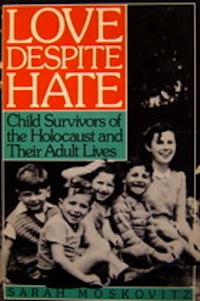
From 1982, Dr. Robert Krell worked with Prof. Sarah Moskovitz, author of Love Despite Hate.
I became deeply involved in the self-discovery of child survivors and our emergence as a distinct group of Holocaust survivors that culminated in the 1991 Hidden Child Conference in New York. From 1982, I worked with Prof. Sarah Moskovitz, author of Love Despite Hate, concerning 24 child survivors found in Terezin and brought to England for their recovery, and followed up by her nearly 40 years later. In 1982-83, I helped found the Los Angeles Child Survivor group and we began to write about child Holocaust survivors and their coping skills and adaptation.
In the course of that work, we defined child survivors generally as those children who were aged 16 and under by 1945, and we also examined restitution issues concerning children.
In 1998, Sarah and I coordinated a survey of child survivors to inquire about their experiences for war-related consequences. One thousand questionnaires were sent out. At that time, child survivors were aged mid-50s to mid-60s and were asked, “As you look back on your life, how do you think you were affected by your Holocaust experiences in childhood, physically, socially, emotionally, educationally and economically?” Six hundred and sixty-four child survivors responded.
The general findings revealed a staggering number of separations from parents with three-quarters of fathers and two-thirds of mothers never returning. More than half of respondents lost both parents.
Three-quarters of the child survivors in this survey reported themselves to have suffered serious to severe lifelong effects emotionally as a result of their traumatic past.
With respect to restitution, there were at that time, six main road blocks to obtaining restitution.
Missed deadlines: Many children did not know how to make claims. Nor did they know if their families had property or insurance. Children placed in adoptive or foster homes were not in touch with the community. They were taught not to think of themselves as survivors. When they did, it was too late to apply. According to our survey, over half never applied or had applied and been rejected. One third of those who applied received a one-time lump sum payment, one half of them less than $700 US.
Documentation requirements: In most cases, young children had neither the knowledge nor resources to obtain proof of country of origin, birth certificates, death certificates or names of witnesses. As one respondent stated, “First they killed my family and now they want proof that they existed.”
Time requirements for those in hiding or in ghettos: In order to qualify, a child was required to have been in closed hiding (confined) for 18 months. “Open” hiding (able to be outside) did not warrant restitution – as if these children had not also suffered loss of home, family, identity and religion, leaving them with feelings of abandonment, identity confusion and loyalty conflicts. A 1987 study by Moskovitz had also revealed that over one half of child survivors in hiding were harshly treated, beaten, and one in five were sexually abused.
Time requirements for six months in concentration camp: In Treblinka and Majdanek, young children were unlikely to live more than one day. In Auschwitz, the majority of adults lived no longer than three months. It raises the question, “How many days in Auschwitz are required for the experience to have left its mark on a child?”
The means test: One’s economic status was required to be at poverty level, precisely the persons who cannot afford legal advice or the resources to pursue rightful compensation. Even today, the annual net income for residents of Canada to meet the income eligibility requirement for a monthly pension is $29,103.
Requirement to be interviewed by German psychiatrists: Under certain circumstances, such as continuation of pension, an interview is arranged with a German psychiatrist rather than simply a board-certified psychiatric practitioner. This raises a single question: Where any Jewish child survived the Nazi occupation, what could possibly be grounds for discontinuing a pension? Each and every child has suffered enormous losses, profound disruptions, fear and malnourishment, and lifelong consequences.
To summarize, in our survey, child survivors reported themselves, despite personal successes and achievements, as seriously and permanently affected to this day: emotionally, 81 percent; socially, 69 percent; educationally, 66 percent; physically, 67 percent; economically, 65 percent.
We are 15 years beyond our 1999 survey and child survivors are now aged mid-70s to mid-80s. And, for many, the war’s memories are returning to cripple them once again. For those persons who have had reasonably normal lives, childhood recollections are a nostalgic review of mostly cherished memories. For child Holocaust survivors, it is a trip back into bottomless despair.
It should be noted that in Los Angeles this year there is a shortfall of $1.1 million for the care of Holocaust survivors. This is being raised by the local Jewish community. A typical account follows:
“I am a 78-year-old survivor of the Holocaust. I was a child during the Nazi occupation and I was hidden in the countryside by a Christian farm family. Both of my parents perished in German concentration camps. I immigrated to the United States in the early 1950s.
“I live on a limited income. I receive $800 in monthly income from social security and a $1,100 monthly pension from Holland. I rent a small apartment on the west side of Los Angeles that costs $1,180 per month. I have a lot of medical bills related to hearing loss, arthritis and psychiatric care relating to chronic depression.
“Last year, I was granted about $4,800 from the Holocaust Survivors in Urgent Need Fund. This was a life saver for me. I used the funds to cover dental work and bills relating to my apartment. I am feeling much better and able to eat and chew without pain.”
I suggest you view those who express need with compassion. Do not humiliate them with seeking proof beyond establishing they lived under the Nazi domination and survived. And do what is right and just to ensure their remaining years are dignified.
Remember that it is not only about establishing a degree of
financial security. It is also about assuring a measure of justice. And justice demands an official acknowledgement by responsible governments, particularly those that collaborated in the murders of my people.
It is growing late in the day. Our sun is setting.
Engaging in issues pertaining to economic aspects of the Holocaust is never an easy task. However, it is morally incumbent upon us as a society, as a people and as a nation to deal with these issues. In addition to the atrocious genocide that it was, the Holocaust also witnessed the largest and most heinous art thefts in history. Alongside building and operating a massacre machine, the Nazis systematically stole property from the Jews, robbed them of their money, stripped them of their wealth and plundered the cultural treasures that they had collected.
In 2006, following a parliamentary inquiry committee chaired by MK Colette Avital, the Israeli Knesset enacted a law regarding Holocaust victims’ assets that were purchased or deposited in Eretz Israel. Hashava, the Company for Location and Restitution of Holocaust Victims’ Assets Ltd., was established first and foremost to locate assets purchased by Holocaust victims in Israel. Once these assets become entrusted to Hashava, Hashava works to locate the rightful heirs, who are for the most part completely unaware that their relatives had left behind private property.
As chief executive officer of the company, I am frequently asked about these Holocaust victims who had purchased assets in Israel. Who are they? My answer is as follows. Although it sounds like a cliché today, the common denominator for these individuals was that investing in the Eretz Israel was considered part of a greater vision and dream. The majority of these investors were ardent Zionists responding to the call to purchase real estate and settle the land of Israel by opening bank accounts there, buying stocks and depositing savings. After the war, Israel even saw an influx of cultural treasures such as books and Judaica items, as well as works of art and other objects that had been stolen by the Nazis.
According to estimates by international organizations, close to 600,000 paintings were looted along with hundreds of thousands of other art masterpieces. To our chagrin, while Israel expects European countries – including Germany, Austria and France, as well as countries such as the United States, Russia and Canada – to make a concerted effort to identify stolen cultural items in their national collections, Israel fails to act with this same fervor regarding the assets in her own backyard. The Washington Principles, a set of guidelines that requires museums to research the origins of their pieces in order to identify their original owners prior to the items’ appropriation during the Holocaust, was adopted by 44 countries, including Israel. The principles were adopted, yet the implementation of them has lagged behind.
Artwork, Judaica and books that made their way to Israel after the Holocaust are not just economically and historically valuable cultural assets, they are also a symbol and a testimonial to the people and communities that once were and now no longer exist. They are memorials, albeit anonymously. Unless the museums conduct investigations into the origins of their collections, the owners of these pieces of art will receive no recognition or memorial, since this important provenance research is the only means of identifying the true owners of the artwork and bringing this circle to a close.
Practise what you preach. At the very least, Israel must abide by the standards that it demands from the rest of the world. Israel must assume the same responsibilities as it did for the assets of Zionists who perished in the Holocaust. It is our duty to promote the implementation – via proper legislation – of the obligations held by the museums, libraries and other similar bodies to make an effort toward identifying artwork and objects that were seized by the Nazis and eventually found their way to Israel and into their collections. This applies to artwork that arrived in Israel as a unit, such as the famous JRSO (Jewish Restitution Successor Organization) collection that arrived at Bezalel and was subsequently transferred to the Israel Museum, as well as artwork that trickled into museums during later years by way of donations, gifts or innocent purchases.
These stolen treasures must not remain hidden assets. To this end, Israel must carry on with the important process that it already set in motion, implementing the Washington Principles by way of legislation that would require museums to conduct provenance research about the origins of their pieces. It would be of great respect for the museums in Israel if they allocate resources to locate art and cultural pieces that were stolen during the Holocaust and are currently in their own collections, whether the items are on public display or hidden away in basements.
Dr. Israel Peleg is chief executive officer of Hashava, the Company for Location and Restitution of Holocaust Victims’ Assets Ltd. (hashava.info).
The Catholic Church did not initiate diplomatic relations with the state of Israel until 1993 and, according to the Italian writer Giulio Meotti, things haven’t been all rainbows since then either.
The creation of a thriving Jewish state creates a theological conundrum for the Catholic Church, Meotti writes in The Vatican Against Israel: J’Accuse (Mantua Books, 2013), because it is a refutation of the theological view that Judaism should wither and die in the shadow of a successor religion, Christianity. The theological imperative of Jewish disappearance is now accompanied, he writes, by a geopolitical imperative that Israel should vanish.
“Replacement theology stated that Christians had inherited the covenant and replaced the Jews as the Chosen People. The concept of replacement geography similarly replaces the historical connection of one people to the land with a connection between another people and the land,” Meotti writes. “The existence of a restored Israel in the land of the Bible, proof that the Jewish people is not annihilated, assimilated and withering away, is the living refutation of the Christian myth about the Jewish end in the historical process.”
The necessity of rejecting Zionism and, in its time, Israel, bested even the liberalizing influence of the Second Vatican Council, the near-revolutionary reconsideration that took place within Catholicism in the early 1960s. This period, which saw the Church recognize Judaism and Christianity as familial theologies and renounce the millennia-old deicide charge against the Jews, nevertheless has a stream that abhors Zionism. Meotti writes that two conflicting Vatican tendencies developed at that time and still dominate: “theological dialogue with Judaism, and political support for the Arabs.” (The gushing lamentation offered by the Vatican on the death of Yasser Arafat is particularly striking.)
Meotti contends that this process has involved the Catholic Church differentiating between “good” and “docile” Jews of the Diaspora and the “bad” and “arrogant” Jews of Israel.
The book is a litany of indictments. The Church had relations with the PLO before it had relations with Israel. Top Church leaders have repeatedly accused Israel of behaving like Nazis. They routinely use crucifixion motifs in the Israeli-Palestinian context, with Jews playing the Romans and Palestinians, of course, playing the beatific victim. Israel, said one archbishop, was imposing “the sufferings of the passion of Jesus on the Arab Christians.” Another, at the time of the Palestinians’ seizure of the Church of the Nativity in Bethlehem, declared: “Our Palestinian people in Bethlehem died like a crucified martyr.” Arafat himself jumped on the bandwagon, declaring: “Jesus Christ was the first Palestinian fedayeen who carried his sword along the road on which today the Palestinians carry their cross.”
The first translation into Arabic of the Protocols of the Elders of Zion was courtesy of the Catholic Church. One archbishop was convicted of using his immunity to smuggle explosives to Palestinian terrorists and served just four years of his 12-year term after intervention by the Pope and a promise to make no more trouble. (He turned up again in 2010 on the fatal “Freedom Flotilla” that sought to bring aid to Hamas terrorists and has goaded Palestinian Christians to violence, insisting it is the only thing that will move Israelis.) Today, Catholic-affiliated nongovernmental organizations are among the leaders in the anti-Israel boycott, divestment and sanctions movement.
The Vatican’s relationship to the Holocaust is particularly dissolute. Pope John Paul II, in 1979, spoke at Auschwitz, noting that “six million Poles lost their lives during the Second World War, one-fifth of the nation,” failing to note that these were almost all Jews. Instead, he called Auschwitz “the Golgotha of the contemporary world,” Golgotha being the place in Jerusalem where Jesus is said to have been crucified.
More perversely, after visiting Mauthausen, the Pope said that the Jews “enriched the world by their suffering,” He seemed to be echoing the thoughts of John Cardinal O’Connor, then archbishop of New York, who a year earlier had visited Yad Vashem, Israel’s Holocaust museum, and asserted that “the Holocaust is an enormous gift that Judaism has given to the world.”
John Paul also infuriated Jews, among others, by conferring a papal knighthood on Kurt Waldheim, the former Austrian president, United Nations secretary-general and Nazi war criminal.
When Jews objected to a proposal to build a Carmelite convent at Auschwitz, the mother superior of the order asked: “Why do the Jews want special treatment in Auschwitz only for themselves? Do they still consider themselves the Chosen People?”
The “J’Accuse” part, which channels the moral outrage of Emile Zola, is fair enough, but this book is only partly about the Vatican. Meotti dredges up equally egregious affronts perpetrated by countless other Christian denominations.
The book is a searing indictment of the Catholic Church, but it is also deeply flawed. At the least, the title is deceptive. The “J’Accuse” part, which channels the moral outrage of Emile Zola, is fair enough, but this book is only partly about the Vatican. Meotti dredges up equally egregious affronts perpetrated by countless other Christian denominations. By no means is Meotti’s condemnation limited to the Vatican, and it is difficult to discern why the title should suggest it is.
Meotti frequently puts uncited statements in quotations. For example, during the 1967 war, when Israel faced annihilation from the Arab states, Meotti claims the Vatican gave the order: “Cheer for the other side.” The quote marks suggest someone literally said this, but whom? On another occasion, he attributes, in quotes, the statement “Jerusalem must be Judenrein.” But who is alleged to have said it? One can also frequently sense comments being stretched out of context to fit the thesis.
Too many times to count, Meotti declares one Christian assertion or another “a blood libel.” The term’s over-usage diminishes whatever power the accusation carries. And nowhere is his over-usage more disturbing than in his casual, often flippant invocation of Nazism.
He writes, “Like Hitlerism, Palestinianism is not a national identity, but a criminal ideological construct…. Worse, the Netanya Passover bombing that killed 30 is a “mini Holocaust.” And, “The dark irony is that the Europeans who are supporting the Palestinians’ ‘right of return’ are living in homes stolen from Jews they helped to gas.”
Meotti’s book has the potential to make an important case against Christian antisemitism and anti-Zionism. While it doesn’t fail completely – the evidence being compendious – the charge to the jury is so overwrought that one feels resentful at being manipulated. The facts would speak for themselves if the author would step back a bit.
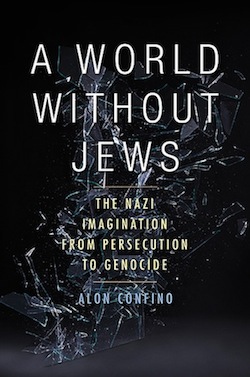
Near the end of World Without Jews (Yale University Press, 2014), we find this passage from a letter written in June of 1943 by a Wehrmacht officer named Wilm Hosenfeld, a Catholic, a schoolteacher in civilian life who had come to know a lot about the fate of the Jews deported from the Warsaw Ghetto: “With this terrible mass murder of the Jews we have lost the war. We have brought upon ourselves an indelible disgrace, a curse that can never be lifted. We deserve no mercy, we are all guilty.” Hosenfeld was later captured by the Soviets and died in a Siberian gulag.
The remarkable thing about this letter is not just that it was written, but that its author was a member of the notorious Sturmabteilung who later became a full member of the Nazi party. One may ask: doesn’t the fact that one Nazi could feel this way repudiate the “we had no choice – we were following orders” excuse so often heard from other Holocaust perpetrators?
These are the kinds of questions posed in the meticulously researched new book by Israeli-born historian Alon Confino of Ben-Gurion University and the University of Virginia, which draws upon many non-traditional sources to present an answer to a new Holocaust question: not whether or not the Holocaust was intentional, or how it was carried out, but rather how did Germans come to conceive of a world without Jews? (And, as Confino makes clear: it was indeed a world without Jews, not a Germany without Jews, that the Nazis envisioned.)
Drawing upon untraditional sources, many of which have only recently been found or made available – wartime letters, diaries, journals, newspapers and photographs – Confino provides a shocking answer to this question: “Germany went after the Jews … not in spite of being a nation of high culture but because it was such a nation…. The Nazis perpetrated the Holocaust in the name of culture.”
Confino notes that the burning of the Bible was a Nazi obsession: thousands and thousands of Bibles were heaped on the flames, culminating in the great fires of Kristallnacht, during which not only Bibles, but 1,400 synagogues were set on fire.
Confino’s goal in World Without Jews is precisely to explore the very backgrounds and influences that created a uniquely genocidal culture. He begins his quest at a new starting point by asking, if Nazi policies were fueled by master-class racism, why were the Nazis so anxious to prioritize the burning of the Bible? Confino notes that the burning of the Bible was a Nazi obsession: thousands and thousands of Bibles were heaped on the flames, culminating in the great fires of Kristallnacht, during which not only Bibles, but 1,400 synagogues were set on fire.
Confino’s subject, then, is not Auschwitz, as it is of many Holocaust historians. Rather, it is this: how could Germans imagine a world without Jews? Where could such an absurd, fantastic notion come from? How could it become legitimized? How could it possibly be carried out?
Confino is certain of one thing: the Judeocide was fully anticipated before it began in 1941. This conviction contradicts that of most Holocaust historians, who feel that the Holocaust was an ex tempore “solution” to the “Jewish Problem” raised by the German forces’ occupation of Eastern Europe. Not so, says Confino, because the Holocaust was a result of “an accumulation of ancient [largely Christian] hatreds” fueled by 19th-century nation-building and given precedent by the mass murders perpetrated around the world in the 19th century by British, French, Dutch and Belgian colonizers. But why Jews? Why was their extermination seen as so central to German survival?
Confino’s answer to this question is that Jewish culture had always been a culture of chaim, of life; the Nazis wanted to found a culture of death. To do so, they had to “eliminate the shackles of a past tradition” to “liberate their imagination to open up new emotional, historical and moral horizons that enable them to imagine and to create their empire of death.” Thus, life-centred Jews had to go, and their books with them.
What we have here, in other words, is “the first experiment in the total creation of a new humanity achieved by extermination, a humanity liberated from the moral shackles of its past.”
On the question of who knew what was happening, Confino is uncompromising: no one in Germany could not have known – not necessarily about the mass murders, but that “something terrible” was happening.
On the question of who knew what was happening, Confino is uncompromising: no one in Germany could not have known – not necessarily about the mass murders, but that “something terrible” was happening. To prove his point, Confino cites hundreds of articles, pamphlets, radio speeches and photographs “showing what Germans saw when they walked in the street, drove on the road, or made their way to work” – all of which refer to the need to eliminate the “Jewish influence.”
In Confino’s view, the extermination of the Jews was fully intentional; all it required was a passive populace, and the active participation of the Christian Church. The Nazis got both, in spades.
Confino doesn’t hesitate to directly implicate the Christian Church in the Nazis’ program to eradicate Christianity’s Jewish origins: time and again he reasserts the “fundamental affinity” between Nazism and Christianity regarding the need to eliminate Christianity’s “Jewish roots.” The difference between them was that for the Nazis, they produced Christ; for the Church, it was because they killed him.
Nazism, then, was to be a new Bereishit, a new beginning point. Canadian scholar Northrop Frye said often that Western culture was permanently “anchored” in the Bible: the Nazi project was to cut this anchor and drop a new one, rooted in the crazed dogmas of Mein Kampf. Getting rid of Jews was, in other words, “akin to making a clean historical slate.”
One of the most unforgettable and heretofore never published photos contained in World Without Jews, shows a small statue of a crucified Christ in front of a church in Westphalia. Under the statue, in large letters, there is the sign “No Jews Allowed.” Just over the head of the Christ are the letters “INRI”: that is, in Latin, “Jesus of Nazareth, King of the Jews.” May this irony not be lost and, to that end, may we be thankful for books such as Confino’s World Without Jews.
Graham Forst, PhD, taught literature and philosophy at Capilano University until his retirement and now teaches in the continuing education departments at Simon Fraser University, University of British Columbia and Banff School of Fine Arts. From 1975 to 2010, he co-chaired the symposium committee of the Vancouver Holocaust Education Centre.
What began as a last-minute visit to one of the most solemn places in history has grown into a nationwide campaign supported by many distinguished people and groups, including the Canadian and Polish ambassadors and the Centre for Israel and Jewish Affairs. Canadians Remember is a grassroots campaign relying on the goodwill of average Canadians to spread the word of the need for preservation and restoration at Auschwitz-Birkenau in Poland. The former German Nazi concentration camp – where more than 1.1 million Jews, Roma, Sinti, Poles, Russians and other Europeans were systematically killed during the Second World War – is reaching out for support of its Perpetual Fund.
“Since visiting Auschwitz, we’ve learned that a remarkable number of connections to the camp exist in Canada,” said campaign director Rob Carter. “Many Canadian success stories began with the small number of people who survived the Holocaust.”
Canadians Remember logo (CNW Group/Seed Communications Inc.)
Funds raised by Canadians Remember will be presented to the Auschwitz-Birkenau Foundation in 2015 to commemorate the 70th anniversary of the camp’s liberation. The foundation’s director, Piotr Cywinski, endorses the Canadian campaign and has pledged to install permanent recognition at Auschwitz, listing Canadians as a “Pillar of Remembrance” if the campaign can raise one million euro. All net funds raised go to the foundation’s Perpetual Fund, created in 2009 to enable the redevelopment of the museum and the preservation of the historic facility. In 2012, Canada’s federal government donated $400,000 to the fund. The Canadians Remember team hopes to raise $2.5 million, a figure in line with donations pledged by other countries, including Germany, France, Great Britain and the United States.
Each year, many more than one million visitors from around the world arrive at Auschwitz-Birkenau to view the museum and memorial. The remains of the concentration camp stand today as a cemetery and as evidence of the horrors of which humanity is capable. The site is also a warning to future generations about the realities of the Holocaust, genocide and prejudice.
In addition to Auschwitz survivors like George Brady (widely known from Hana’s Suitcase, the story of his sister), the campaign’s early supporters include Canada’s Ambassador to Poland Alexandra Bugailiskis and Polish Ambassador to Canada Marcin Bosacki. “We believe that Canadians of all walks of life will recognize the importance of this initiative not only for Auschwitz, but its relevance in today’s socio-political environment,” said Bosacki.
For only $1, donors can add a photo of themselves to the website’s donor wall. By encouraging Canadian citizens – of all ages, religious affiliations and cultural backgrounds – to donate just $1 each, the Canadian public can make a gesture of remembrance and support for Holocaust education. Canadiansremember.ca provides the details of the campaign, and accepts donations via PayPal.
Teens on this year’s March of the Living helped Lillian Boraks-Nemetz face down haunting memories. (photo by Adele Lewin Photography)
Lillian Boraks-Nemetz, a Vancouver poet and author who was a child survivor of the Holocaust, initially declined the offer of a trip to her Polish homeland. She had been there, and written books and poems about her experiences as a child and as a returning adult. She didn’t know that an invitation to go again would lead to an emotional and psychological closure for which she had waited seven decades.
When first invited to participate in last spring’s Canadian contingent of March of the Living, Boraks-Nemetz demurred. March of the Living is a program that brings Jewish young people from around the world to the sites of Nazi atrocities in Europe and then to the Jewish homeland of Israel, marching from Auschwitz to Birkenau on Yom Hashoah, Holocaust memorial day, and traveling to Israel in time for Yom Hazikaron, Israel’s remembrance day for fallen soldiers, and Yom Ha’atzmaut, Israeli independence day. March of the Living’s teenage participants are accompanied by Holocaust survivors.
“I thought, how am I going to keep up with a bunch of 16-, 17-year-olds?” Boraks-Nemetz said in a recent interview. But she was assured that survivors are well taken care of on the trips and she was convinced to go.
“There were difficulties, but I rose to the occasion,” she said, laughing. On the extremely long day traveling from Canada to Poland, which then continued immediately with more travel and programming, Boraks-Nemetz was aided by one of the young participants. “One of the girls had chocolate that had extra caffeine in it, so she gave it to me,” she explained.
Boraks-Nemetz was accompanied by another survivor, chaperones and young people from Edmonton, Calgary, Winnipeg and Ottawa, as well as eight Jewish teens from Vancouver. In all, there were 78 people on the trip. (Young people from Ontario and Quebec made up their own contingents and traveled on different buses.)
The program was intensive. The week in Poland involved stays in Krakow and Warsaw, where they visited the Museum of Polish Jews, and they went to the extermination camps Auschwitz-Birkenau and Majdanek.
“The young people who came with us are so beautiful and so good and so well behaved and so moved by everything. You could just see how they took it all in. For them, it was a life-changing experience.”
“The young people who came with us are so beautiful and so good and so well behaved and so moved by everything,” she said. “You could just see how they took it all in. For them, it was a life-changing experience.”
In Warsaw, they also went to the orphanage that had been run by Janusz Korczak. A Polish Jew who was a respected published author, Korczak was offered multiple opportunities to save himself from the advancing Final Solution. When the Warsaw Ghetto was created, Korczak’s orphanage, its staff and nearly 200 young charges were forced to move into the ghetto. When the ghetto was liquidated, in 1942, Korczak was again offered immunity, but instead stayed with his orphaned children as they were deported to Treblinka.
In Lodz, the group visited the cemetery and the place where the second-largest Nazi-enforced Jewish ghetto had been. (More than 200,000 Jews were held in Lodz Ghetto during its existence. About 10,000 of those were alive in 1945.) There, the Canadians boarded one of the rail cars that had transported Jews to the camps.
“It was dark and there were many of us,” said Boraks-Nemetz. “It was tight. It was scary. We got the feel of it. Of course, the fear wasn’t there, but there was something foreboding about it.”
At the camps, the participants said prayers and sang mournful songs.
“There was a lot of poetry,” she said. “I brought my book Ghost Children, which was written after one of my trips there. And, whenever we went to a certain place, I would read a poem and it really got to them.”
An unexpected insight came during conversations with young Polish Jews during an arranged dinner at the hotel in Warsaw.
“They sat down, one at each table of students, so they were able to talk,” said Boraks-Nemetz. “At the end of the dinner, I saw the five or six of them standing in the lobby of the hotel, the Polish Jews, and so I went to talk to them. We went to the side and it was really interesting what they told me. They’re quite modern. They’re a little bit shy. They’re a big change from the Israeli youth,” she said, laughing.
The young Polish Jews told her that things were pretty good for them. Some go abroad – to France or elsewhere – to study, but jobs are hard to find and the standard of living isn’t great. They had a question about March of the Living.
“They said, ‘Why do you always come here looking for what’s dead?’ And I explained to them that this is an educational trip,” said Boraks-Nemetz. “But they said, ‘You know, there are some of us here, there is beauty here too, we are alive and there is a Jewish community – small, but there is a Jewish community. And I could see that that was maybe something to address.”
From Poland, the group flew El-Al to Israel.
“It’s like walking in from the shadow into light,” she said. “The Jerusalem of Gold! And we went straight to Masada off the plane.”
There, the other survivor on the trip, Max Iland, an octogenarian from Sault Ste. Marie, Ont., celebrated his bar mitzvah, a few decades late.
“The students were singing and he and I were dancing, it was really fantastic,” said Boraks-Nemetz.
The entire experience, she said, was life-altering for the participants.
“They felt that their Jewishness was strengthened, that they are a part of history,” she said. “They cherish their homes and their families after finding out what happened to Jews over there. And, above all … they were becoming witnesses to my story. That’s what one of them said. She felt she was a witness to it. I did speak to them about the legacy that we, survivors who were on our way out, are leaving them.”
Boraks-Nemetz found especially notable the connection of young Canadian Jews to those who had given their lives in defence of the Jewish state.
“What I didn’t realize was how strongly they feel about the fallen soldiers who fought for Israel,” she said. “They read poetry again to the fallen soldiers.”
When the national moment of silence came, the experience was transfixing.
“We’re standing on [Tel Aviv’s central street] Ben Yehuda and the sirens sounded and, all of a sudden, it was like everyone was made of wax figures. That was an incredible thing.”
For Boraks-Nemetz, the trip provided an unexpected closure to the darkest chapter of her life.
Lillian Boraks-Nemetz accompanied teens on this year’s March of the Living. (photo by Adele Lewin Photography)
For her, the climactic moments of the March of the Living took place in the small Polish village of Zalesie. It was here that young Lillian survived the Holocaust in hiding. After spending two years in the Warsaw Ghetto, she was smuggled out by her father before the ghetto was liquidated and its residents – more than a quarter million Jews – were sent to Treblinka and other death camps. Outside the ghetto, she was met by a Christian woman who transported her to a little white home in Zalesie, where her grandmother was in hiding, posing as the wife of the Polish man who lived there.
Boraks-Nemetz has written about that time in her poetry and in her book for young adults, The Old Brown Suitcase. As an adult, she has returned to the little house at Spokojna Street, Number 16. But this visit was different.
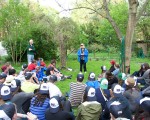
“These two buses went down this dusty road, and there were all these [people in] houses wondering what was going on,” she said. “Nobody bothered us. We filed out and we went into the garden. We all stood in the garden and I told them the story of hiding.”
There was one part of the story she hadn’t intended to tell, but she had developed closeness and trust with the participants accompanying her. She felt confident and compelled to share more than she ever had before, which led to an unprecedented emotional catharsis after almost seven decades.
“I told them something about the man with whom we were in hiding. He was both good and bad,” Boraks-Nemetz said. “How does a child of eight take that? That, on the one hand, he saved us, our lives, and, on the other hand, he was a drunk who could have given us away and didn’t, and, thirdly, he abused me when my grandmother wasn’t there. This is life and that’s how it was.”
In small groups of six or eight, the young people accompanied Boraks-Nemetz into the home.
“When we went into the house, I explained where I slept and where I stood by the window and watched for my parents to come, the road, the garden, the whole thing,” she said. “They were very moved, and a funny thing happened. Each time a group would come out, I would come out with them onto the little porch and they would all hug me. Every one of them. And I think what happened to me was probably, for the first time in my life, I was able to face what happened there. That was an awesome experience for me. I had been there before many times but I always blocked it out. I never faced it properly. And, this time, because of the kids … I just couldn’t believe how it opened me up, this experience with the kids.”
The Six Day War may have been history’s most illustrative example of the limitations of a weekly newspaper. Reviewing this newspaper’s archives from 1967 shows one week’s paper filled with ominous foreboding and the next issue, triumphal jubilation.
Every year, we take a short publishing break in the usually quiet news period that is the summer doldrums. Unlike in 1967, though, we now have a spiffy new website that has allowed readers to follow some local events and commentary from abroad during these especially tumultuous few weeks.
The news has not been pleasant. Israel has somewhat successfully stanched some of the infrastructure of the Gazan terrorist regime. The cost has been tragic and the worldwide reverberations deeply disturbing.
“Victory” is difficult to discern. In the biggest picture, victory for all civilians would be peace in the region, but even the most optimistic among us see that as a long way off – the stated objective of Hamas remains the destruction of Israel. For Israel, victory has historically meant a few months or a couple of years of relative peace. By beating back the immediate threat (whether the combined Arab armies in 1948-49, 1967 and 1973, or the PLO in the 1970s and ’80s, and the assorted terrorist entities since), Israel has managed to buy a few periods of comparative peace. And, as a result of Operation Protective Edge, Israel has undermined the strength of Hamas and so that may result in a period of relative peace for Israelis and Palestinians.
There has been another battle: the battle of words around the world. It’s not all words, of course – some of the battle has been violent, with anti-Jewish attacks in Europe and elsewhere – but the discourse about Israel globally, even when largely non-violent, has been unprecedentedly grotesque and incendiary. The United Nations, reinforcing its long failure to live up to the promise of its founding charter, has made a mockery of justice and peace by condemning only Israel. Armchair commentators have declared themselves military authorities to parse Israeli actions. Cartoonists have exhumed Nazi-era imagery to employ against Israel. Street rallies around the world, while accusing Israel of bloodlust, have themselves turned into bloody and violent displays of hatred.
Even some of the more thoughtful contributors to the “debate” have exhibited assumptions that seem to rely on old familiar stereotypes. And people who have never uttered a word of concern in the past nine years while the repressive Hamas regime has tightened its grip on the people in Gaza suddenly, when Israel becomes involved, declare, “I don’t support Hamas. I support the people of Gaza.” Would that they actually did.
In Canada, things are somewhat brighter. All major federal political parties have rightly stood with Israel in its fight against terrorism. (The exception being the Green Party of Canada, but then, it isn’t “major.”) We have a fairly balanced media that has generally not succumbed to the extremism or misrepresentation we have seen in Europe. Still, Canadian opponents of Israel purvey the idea that they can denounce Israel in the most horrible terms without that level of rhetoric having an impact on Jewish Canadians or our country’s multicultural harmony.
Explaining why this type of anti-Israel action affects us as Canadian Jews is not simple. Most Diaspora Jews have a deep and passionate connection with Israel. In part, this has to do with the Holocaust. The Holocaust did not happen because of Hitler and Nazism. It happened, at least in the magnitude it did, because there was not a country on the planet (save the Dominican Republic) that was willing to welcome the imperiled Jews of Europe. The need for Israel as a nation where Jews control the immigration policy is not due to the Holocaust per se, but the world’s nonchalance toward it.
More than this, after the magnitude of the Holocaust became known to the survivors and to the entire world, the unfathomable disaster might reasonably have sunk the Jewish people into a collective depression of hopelessness and fatalism. Instead, the rebirth of the Jewish homeland in Eretz Israel allowed a people seeking some light from a catastrophic darkness to find hope and optimism. Those Jews who made aliyah – and, to no small extent, those who remained in the Diaspora – threw themselves into building the state of Israel, a task that has proven successful beyond any dreams and allowed an optimistic future to salve the horrors of the immediate past.
When street mobs, politicians, UN resolutions, cartoonists and Facebook authorities heap loathing on Israel, despite all their feeble assurances that it is Israel, not Jews, they target, the words and the hatred behind them hurt. There are other historical, cultural, familial and political reasons why Jewish Canadians and others in the Diaspora feel deeply a part of Israel. It might help our neighbors understand us if we told our personal and collective stories better.
***
The JI’s Pat Johnson spoke with David Berner about the Israel-Hamas conflict, global antisemitism and other issues on Aug. 7 2014: