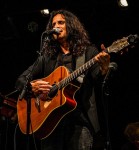
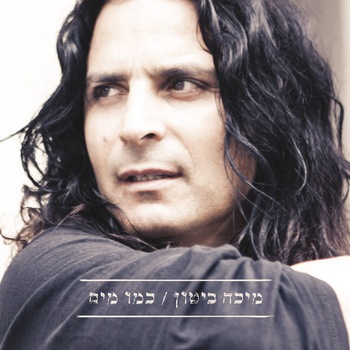
Israeli musician Micha Biton headlined the community’s Yom Ha’atzmaut celebration. (photo by Rhonda Dent)
It was just shy of a sellout crowd on April 22 at the Chan Centre for the Performing Arts, as Israeli rock pioneer Micha Biton headlined the community’s main celebration of Yom Ha’atzmaut.
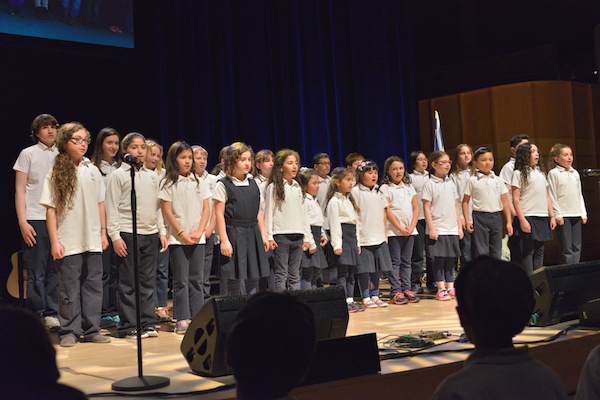
Richmond Jewish Day School Choir (photo by Rhonda Dent)
As it does every year, the evening began with the conclusion of Yom Hazikaron, led by Geoffrey Druker. In the singing of the national anthems, Vancouver Talmud Torah Choir was joined by Partnership2gether twin school Alei Givah Choir in Kfar Giladi (by video) for O Canada, while Richmond Jewish Day School Choir and Partnership2gether twin school Hameginim Choir in Kiryat Shmona (by video) sang Hatikvah.
Diane Switzer, board chair, Jewish Federation of Greater Vancouver, which led the celebration supported by some 50 community partner organizations and countless sponsors and volunteers, spoke briefly. She provided an overview of how the funds raised here for our partnership region in Israel – Eztabah Hagalil (the Galilee Panhandle) – are spent.
“Our Gesher Chai (Living Bridge) program aims to deepen connections with Israel on a person-to-person basis,” she said. “It builds lasting ties between our two communities, and is a cornerstone of Jewish Federation’s work.
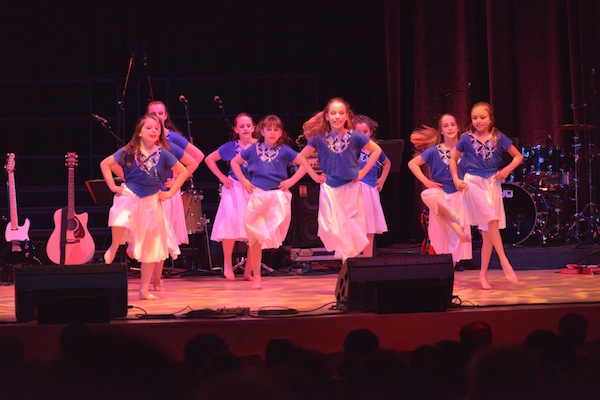
JCC Or Chadash dancers (photo by Rhonda Dent)
“Through Gesher Chai, we help local day school students build enduring relationships with their peers at their sister schools in Israel. We fund exchanges between local educators and their Israeli counterparts so they can develop a shared curriculum. And we help connect the JCC Or Chadash dancers you’ll see tonight with the Hora Goel dancers from our partnership region. The impact of these programs, which promote Jewish identity and unity for elementary and high school students, can be felt around the world and here at home.
“Etzbah Hagalil is geographically, economically and politically removed from the centre of Israel,” she continued. “It is surrounded on three sides by Syria and Lebanon, and often bears the brunt of attacks when tensions flare. High unemployment and limited opportunities for education and advancement are ongoing concerns, and the area is home to many at-risk youth. Jewish Federation’s strategic investment in this region is aimed at breaking the cycle of poverty, improving living standards and developing the region’s long-term economic prospects.”
Warming up the crowd before Biton’s performance was the Or Chadash dancers. The evening also included greetings by video from Premier Christy Clark, as well as from mayors Benny Ben Muvchar (Mevo’ot Hermon), Giora Saltz (Galil Elyon), Rabbi Nisim Malka (Kiryat Shmona), Ilan Or (Yesod Hama’ala) and Herzel Boker (Metula).
At Israel’s Yom Ha’atzmaut celebration marking the 67th anniversary of the state of Israel, one of the 14 individuals selected for the honor of lighting torches kicking off the celebration was Lucy Aharish, a television newscaster and actor who happens to be an Arab citizen of Israel.
Of course, “happens to be” is an obfuscation given the charged nature of life in Israel and its region. The fact that she is an Arab citizen of Israel is not at all an insignificant fact. That, certainly, was the opinion of critics from across the political spectrum when it was announced that she would be among those centre-stage at the annual Independence Day ceremony at Mount Herzl Cemetery.
Her participation in the ceremony was politicized by both left and right – by the right for reasons that can hardly be described as anything but racist and by the left for reasons that seem based on the assumption that any Arab who participates in an official Israeli ceremony is a collaborator with some sort of Zionist … whatever.
Hopefully, the critics were schooled by Aharish’s magnificent, emotional words at the ceremony. Holding back tears, Aharish said that she was lighting the torch “for all human beings, wherever they may be, who have not lost hope for peace, and for the children, full of innocence, who live on this earth…. For those who were but are no more, who fell victim to baseless hatred by those who have forgotten that we were all born in the image of one God. For Sephardim and Ashkenazim, religious and secular, Arabs and Jews, sons of this motherland that reminds us that we have no other place. For us as Israel, for the honor of mankind, and for the glory of the state of Israel.”
Aharish, the only Arab lighting a torch in the ceremony, shifted into Arabic, Israel’s other official language, saying: “For our honor as human beings, this is our country and there is no other.”
A different yet parallel development occurred at the same time, when the annual Israel Prize for poetry and literature was bestowed on Erez Biton.
The Israel Prize is widely considered the country’s highest civilian honor and the jury that selected Biton described his five collections of poetry as “an exemplary, brave, sensitive and deep grappling with the wide range of personal and collective experiences, revolving around the pain of immigration, the travails of rooting oneself in Israel, and the establishment of eastern identity as an inseparable part of the full Israeli profile.”
Biton happens to be the first Sephardi Jew to receive the award in this crucial cultural category. Again, “happens to be” is a phrase that diminishes the cultural and historical realities that make this achievement one that transcends the individual and stands in for the history of neglect felt by this significant minority in Israeli society.
These two stories, each pleasant in their way yet tinged with the deep and diverse troubles of Israeli society, carry innumerable lessons for not only Israel but countries around the world.
There are people in every country who, because of the groups to which they belong, have experienced discrimination, decreased opportunities and, well, far worse. Yet within these groups are individuals who have nevertheless achieved accomplishments that suggest there is room for a better future, one that accepts diversity, that encourages creative grappling with a society’s complexities and that respects those who are unafraid to assert their rights.
Here’s hoping that this year, and in future years, a more diverse and equal world means that “happens to be” becomes the norm, not the exception.
In the past several weeks, we have celebrated liberation and redemption on Passover. On Yom Hashoah, we mourned the victims of Nazism and the generations that never were. On Yom Hazikaron, we honored the brave defenders of Israel who gave everything for the dream of the Jewish people’s right to live as a free people in our own land. Then we joyously celebrated the realization of that dream on Yom Ha’atzmaut.
These four commemorations are drawn together in many ways by rabbis and thinkers. We are mere journalists, but if you give us a moment, we, too, have some thoughts that may be worthy.
There is a troubled narrative connecting the Holocaust and the creation of the state of Israel, a connection that is sometimes misunderstood and often deliberately misrepresented.
Critics have called Israel a “reparations payment” given to the Jews as recompense for the Holocaust. This formulation is a desecration, because there could be no recompense for the Holocaust. More to the point, it is false history. Israel was not given to the Jewish people. The Partition Resolution, significant as it was as a fulcrum for historical events, turned out to be another hollow United Nations vote. Israel came into being only because the Jews of Palestine, some from the Diaspora and a small group of idealistic non-Jews from abroad fought – some to the death – for the dream of a Jewish homeland.
The connection between the Holocaust and the creation of the state of Israel is not, as the popular narrative has it, because the world felt sympathy. If anything, the world wanted to create a place for the surviving remnant so that they wouldn’t have to take responsibility for them.
Where the genuine connection lies between the tragedy of the Holocaust and the joy of independence is in the realization that the Holocaust was a direct result of Jewish statelessness. Had Israel come into being a decade earlier, there may have been no Holocaust, or its magnitude would have been much diminished. That is one connection.
Another is the psychological effect the creation of the state had on Jewish people individually and collectively, in Israel and in the Diaspora.
After the Holocaust, the Jewish people worldwide could have been expected to plummet into individual and collective despair. Instead, Israel gave hope – and a future to imagine and to build after the collective future was almost destroyed. Whether Jews made aliya – or even visited – or not, Jewish Canadians helped build the state of Israel through a million acts of philanthropy and volunteerism.
Israel is many things to many different Jews. It is a resolution to 2,000 years of statelessness, the fundamental fact that was at the root of our tragedies. It is the culmination of the quest for sovereignty and freedom and, while Israel is not perfect by any stretch, we endeavor to work toward that ideal. Israel is the dream for which so many have given so much, as well as a complex, thrilling, sometimes infuriating, always cherished reality.
In the context of millennia of Jewish civilization, the comparatively new state of Israel is a part of all of us and we are all, in some way, a part of it.
This month – and in this issue – we celebrate Israel. Few regular readers would disagree with the assertion that the state of Israel represents a modern miracle. For whatever criticisms are fairly and unfairly leveled at Israel and its governments, this tiny country, populated mostly by refugees and their children, has accomplished and built one of the greatest societies in the world in what is, by historical standards, a blink of an eye.
There are so many quantitative examples of Israeli achievements: per capita numbers of Nobel prizes and other recognitions of achievements, world-leading academic publishing, number of businesses launched and successes reached, diverse and life-altering scientific breakthroughs and exceptional contributions across almost every discipline of human endeavor.
Then there are the incalculable measurements that are what strike so many of us when we visit Israel – or when we are visited by Israelis. In just the coming weeks alone, we are offered numerous samples of the cultural richness of the country.
The community-wide Yom Ha’atzmaut celebration on April 22 features Micha Biton, whose music is an example of the beauty that can emerge even in places and times of challenge, he being a part of the music scene in Sderot. A week-plus later, we will be treated to Ester Rada, an actress and singer who just emerged on the international scene.
These are just two of the most immediate examples of Israeli culture offered to local audiences year-round, including an embarrassment of riches during festivals like Chutzpah!, the Jewish book and film festivals, and during regular programming at the J. Israeli artists and photographers are regularly featured, as are speakers on diverse topics, brought here by local affiliates of Israeli universities and institutions.
To say that we – even 10,000 kilometres away – are enriched by the abundance of culture and knowledge that defines Israel is to underestimate the blessing it is to us. But this is not a one-way relationship. There is a greatness, too, in the way our community has mobilized for seven decades to help Israelis flourish. These bilateral connections are deep and important. From the moment the state of Israel was proclaimed 67 years ago, Vancouverites have been integrally involved with Israel in countless ways.
Before intercontinental travel became commonplace, stories appeared in the pages of this newspaper about locals traveling to Israel – as tourists, as volunteers, as dreamers seeking to see in their lifetimes the reality of a revived Jewish nation. More common still was the plethora of organizations emerging to assist in the nurturing of Israel through acts of tzedaka and volunteerism here at home. Women’s groups, youth movements, Zionist agencies of all stripes, “friends” of universities and hospitals, and so many other great institutions popped up, mobilized by the passion local community members felt for the rebirth of the Jewish nation.
Though these connections have changed, they have not diminished. Thanks to improved technologies and transportation, our community sends athletes to meet and compete with their Israeli cousins – and welcome Israelis here in return. We continue to support so many projects and institutions in Israel that “Vancouver” and local family names proudly adorn countless buildings, facilities, medical machinery, ambulances and other resources in Israel.
In a world that sometimes seems mad to us (as well as mad at us), there are few in our community who take for granted the blessing that Israel is to us and to the world.
As we celebrate Yom Ha’atzmaut this year, marking Israel’s 67th anniversary, let’s make a commitment to ourselves, a new year’s resolution of sorts for Israel’s new year.
Let’s be even more conscious of our relationship with Israel. Let’s go out of our way to buy Israeli products and support Israeli initiatives. Find an Israeli cause you haven’t yet supported – there are plenty of advocates right here in town for universities, charities and other great projects – and make it one of your causes. Take more of the opportunities offered to us throughout the year as Israeli speakers, performers and artists visit. Head to the Isaac Waldman Jewish Public Library and learn about an aspect of Israel that’s new to you. Watch more Israeli film. Take Hebrew lessons. The options are endless without even leaving the comfort of your hometown.
If you can, of course, travel to Israel. An “on-the-ground” education is invaluable. One of the best ways to express your curiosity, and support Israel is to spend time there, meeting Israelis, investigating for yourself aspects of Jewish history and culture, experiencing new tastes, sounds, smells and sights. And, while you’re there, open your heart and mind to the realities of this great country; pledge to learn more about the land, its people, its creatures, its ecology, the good, as well as the more challenging aspects that could use some work. Pack up the family, join a community mission or grab a backpack and head over on your own – the mishpacha is waiting for you.
Micha Biton headlines the community’s Yom Ha’atzmaut celebrations April 22. (photo from Micha Biton via Jewish Federation of Greater Vancouver)
Seven years in the making, Laura Bialis’ documentary Rock in the Red Zone premièred last October at the Haifa Film Festival, and has since enjoyed several other prominent screenings in Israel. Less than a kilometre from the Gaza Strip, Sderot has been a favorite target of Hamas rocket fire for the last decade and a half – but it has also been the birthplace of a unique style of rock music, producing more than its share of popular bands and singers. One of the rock pioneers featured in the documentary steps off the Israeli silver screen and into Vancouver’s Chan Centre for the Performing Arts on April 22 to lead our community’s Yom Ha’atzmaut celebrations – Micha Biton.
JI: Your stop in Vancouver is part of a North American tour for Like Water. Are you traveling with a band? If so, who and what instruments?
MB: Exactly a year ago, my fifth album, Kmo Mayim (Like Water), was released in Israel and we performed a series of concerts around the country in celebration of the release – a tour that was very successful and drew attention from radio, television and media outlets. Subsequently, I performed in both San Francisco and New York and realized that, despite the fact that over half of the audience does not understand Hebrew, the music touched the hearts of those who heard it. For this concert in Vancouver, I am coming with five amazing musicians: Yossi Shitrit (electric guitar), Shir Yerushalmi (electric guitar), Hillel Shitrit (keyboards), Itamar Abohasera (drums), Shai Zrian (bass).
JI: In which other cities are you performing on this tour? For how long are you here?
MB: We are coming directly from Israel, and Vancouver is the first city on our tour. After Vancouver, I will perform in Los Angeles and San Francisco. I’ll be in North America for less than two weeks. Due to my heavy performance schedule in Israel, I couldn’t carve out more time to tour on this trip, but I always manage to make a little time to take in the atmosphere of the cities in which I perform. This is not my first time in Vancouver – last year, during the war between Israel and Gaza, I brought my whole family to Vancouver to visit my wife’s family and I fell in love with your beautiful city and people. I’m excited that on my second trip to Vancouver I will get to perform for the wonderful people that I met in Vancouver.
JI: Like Water is your fourth solo recording?
MB: Kmo Mayim is my fourth solo recording, but it is my fifth album. In 1997, I produced my first album, Tanara, with a group of talented musician and it received critical acclaim in Israel. Soon after, I became a solo artist and, over two decades, I recorded four albums of original music. For me, Kmo Mayim is a very personal album that I wrote about relationships – friendships, love, connection with God. Every song tells a different story, and every story has an open-ended moral attached to it. I’m very proud of this album and I’m happy that my audiences like it.
Micha Biton’s latest CD is Kmo Mayim.
JI: You are one of the pioneers of the renowned rock music scene in Sderot. Could you share a bit about its development, how it has changed over the years?
MB: In the 1990s, I created a band called Tanara, a period that saw an incredible explosion in the Israeli music scene, especially in Sderot. Bands like Tippex, Knesiyat Hasechel and ours developed a new sound that was special and unique to Sderot, combining rock music with the Moroccan/ethnic sounds of our neighborhoods and our childhoods. In those early days, Sderot was underdeveloped and family-oriented. We didn’t have much to do, so music became our lives and we played and composed in the bomb shelters all of the time. (In those days, we used the shelters for writing music and rehearsing for concerts. Today, unfortunately, they are used as shelters from the rockets fired from Gaza.) In addition, it was a town where everyone knew everyone – there was no such thing as a stranger in our town, and the warmth created by this strong community significantly influenced our ability to create something unique musically.
JI: How about your own style? How would you describe it now versus when you first started out?
MB: My musical style hasn’t really changed much over the years. I’ve been very successful continuing to write ethnic rock in the style that I helped to create and I am lucky that my audience appreciates my style and my sensitivity. While my roots are strongly planted in Sderot, I am different than most of my fellow musicians from the area. At the age of 10, after my father died, I left my Moroccan biological family and was fostered by an Ashkenazi family in Jerusalem. From that early, tender age, I started to live between two cultures, understanding the beauty of each, and using both of them to influence the way I compose and the way I live. It turns out that my foster mother, Galila Ron-Feder, was a modestly successful author in Israel who shortly after my arrival chose to write an entire book based on my life and my journey (and I was only 10!). This book, El Atzmi (To Myself), became her most successful book. It became a series of books, and then a movie. It has been translated into 27 languages. The influence of Galila and her world, and the world of my parents together, helped me to create a new world of my own. My music and the lyrics that I write are very connected to the fact that I have lived most of my life straddled between these two worlds.
JI: A 2007 New York Times article refers to “Biton’s anthem for Sderot,” which was “I don’t leave the town for any Qassam.” What is it like living in Sderot these days? Are you hopeful for the future?
MB: In the quiet days of peace, we love living in this area. My nine brothers and sisters and their families live in Sderot, and my family and I live on the border between Sderot and Gaza in Netiv Haasara, a moshav where we can see Gaza from our backyard. This is my home, and we are very drawn to this place. For the past 10 years, we have lived with the reality that at any moment, day or night, the sirens will start and we have 15 seconds to run to our bomb shelters. Our children have grown up with the feeling that life is beautiful but uncertain. This past summer, and several times in the past, we have been forced to leave our homes and our community because of the imminent danger that the conflict caused. Rockets fell on our yard. A rocket hit my wife’s parents’ home, who live a block away from us, destroying precious family heirlooms. For every rocket that fell last summer, there are hundreds of rockets that have landed around us in the past 10 years that go unreported but, for us, they are very real. When we came to Vancouver last summer, my 4-year-old son looked at me and asked, “Abba, why don’t they have tzeva adom (warning sirens) here in Vancouver?” and I explained to him that not everyone has to deal with rockets falling on their heads all of the time. It was a very sad moment for me.
In 2007, when I wrote the song ‘I don’t leave the town for any Qassam,’ I felt that people were deserting Sderot and all of her beauty because of the situation. I wanted to give them strength and remind them that it was critical to stay and to fight for our hometown. Less than a year later, I wrote HaTzad HaMuar (The Lighted Side) from the same place in my heart. Despite all of the pain, I wrote, don’t forget the light, the hope, the optimism. Because that is really what Sderot is all about. Not a place where rockets fall, but a place of warmth and love and peace.
JI: In the same article, you speak about Hagit Yaso as a star almost certain to rise to the top. She has, of course. And she played here in Vancouver last year for Yom Ha’atzmaut. Are there any current young Sderot musicians for whom we should be keeping watch?
MB: Hagit is an amazing singer and an extraordinary human being. I’m proud to stay that she was one of my most talented students when I taught music and theatre in Sderot. I am so happy for her success and that she represents a new generation of musicians that has emerged from Sderot. The wonderful thing about this young generation is that they are succeeding to continue the tradition of Sderot, bringing exciting new musical projects to Israel and to the world. During one of my tours, I invited her to the stage to sing with me, and it was a really beautiful moment of connection between the pioneers of the music scene and the young musicians of this generation.
One of the new, talented musicians climbing up the ladder at the moment is my cousin Tzafrir Yifrach, who concentrates on world music. He has exceptional talent and is performing quite a bit these days around Israel, and musicians from all over Israel love coming to his recording studio in Sderot to work on their own projects with him. Another rising talent is Nir Vaknin, who is in the process of finishing his debut album.
JI: If there is anything else you’d like to add, please feel free.
MB: During the time that I was in production for Kmo Mayim, I started another project with a musician from the U.S., Lisa Tzur, who was the executive producer of Kmo Mayim. I’ve traveled a lot in North America and have performed at synagogues where the singing was so beautiful that I never forgot it. I wanted to be a part of that somehow. Taking words from the prayer service and from Psalms, as well as a few original texts, we recorded a project that is different than anything else that I have recorded. The idea was to create music that was accessible and singable by audiences that were not necessarily Israeli. Lisa comes from that world (as a lifelong member of the Reform Jewish movement and as an ordained rabbi) and together we created something very special that will be released this summer both in Israel and in the world.
The April 22 festivities at the Chan start at 7:30 p.m. For tickets ($18) and more information, visit jewishvancouver.com/yh2015.
Hagit Yaso, the 2011 Kochav Nolad winner, will sing in Vancouver on May 5 at the Chan Centre in celebration of Israel’s 66th birthday. (photo from hagityaso.co.il)
One July night in 2011, on a crowded Haifa beach, the 21-year-old singer Hagit Yaso became that year’s winner of Kochav Nolad (A Star is Born), Israel’s version of American Idol. The outsider had triumphed. “It was the most exciting and most life-changing experience I’ve ever had,” she told the Independent by telephone from her home in Sderot.
Yaso is a fully qualified outsider. She is working-class, the child of Ethiopian refugees and a resident of the missile-and-mortar target town of Sderot. Only one kilometre from the Gaza Strip, Sderot is the target of frequent rocket assaults. A small town of only 20,000 people, everyone, she said, knows everyone. “It’s a small town. You get to know the people,” she said. “And I got a lot of support when I was on Kochav Nolad.
Now 24, Yaso has toured the world and released her first CD, a self-titled CD that is available at cdbaby.com and at amazon.com. Vancouver audiences will get a chance to see her May 5 when she headlines the community Yom Ha’atzmaut celebration at the Chan Centre for the Performing Arts at the University of British Columbia. The event’s main presenter, the Jewish Federation of Greater Vancouver, can take some pride in Yaso’s success. A scholarship from the Canadian Federations provided her voice lessons at Sderot’s Music Centre and the Vancouver Federation itself has taken a special interest in helping Sderot’s Ethiopian community. Federation also provides assistance to Sderot’s trauma victims.
The three months she spent on the television competition were grueling, Yaso said. ‘“The competition is very long, very confusing, with a lot of pressure and media.” She always believed she would win, though.
Her friend, the American filmmaker Laura Bialis, who lives in Tel Aviv, noted by phone that Yaso’s determination is one secret to her success. “You know, it was like everything she set out to do, she did,” Bialis said. “She wanted to get into the army band, she got into the army band. She wanted to get on Kochav Nolad, she got on Kochav Nolad. She wanted to win Kochav Nolad, she won.”
The two met when Bialis was shooting a documentary about music in Sderot. That film, Sderot: Rock in the Red Zone, is now in its final editing stage.
Yaso’s success is a point of pride for Sderot. Her win is also significant to Israelis of Ethiopian heritage. Vancouver resident Ronit Reda-Yona, an Ethiopian Israeli, said Yaso’s 2011 win “was an exciting moment for the Israeli society and especially for the Ethiopian community. Everyone in Israel who is Ethiopian feels like me: this is a good model for young people.”
Not only is Yaso well known in Israel but, in a short time, she has become an international success. She has performed at Jewish events in Paris, London, Canadian cities, American cities and Ethiopia. After Vancouver, she will tour Brazil.
“What is really amazing is that her career has taken off internationally in a really interesting way,” said Bialis. “She’s got this amazing voice, she’s gorgeous, she’s gracious, she’s sweet, and she has an amazing story.”
Thankful for parents’ courageous journey
Yaso’s parents, Yeshayahu and Tova, grew up and got married in rural Ethiopia. “They got married by shiddach,” said Yaso, who explained that the marriage was arranged and the two did not meet until their wedding day. In the early 1990s, the couple was forced to leave home. “Because they were Jewish, they suffered a lot and they had to run away from there and the option was to come to Israel,” Yaso explained.
Tremendous hardship stood between them and that destination. “They walked 400 kilometres by foot,” she said with some pride and awe in her voice. “It took them two and a half months to walk because it’s through the desert. They had to walk only at night and hide during the day because they were not supposed to leave [Ethiopia], and they were afraid…. They had to hide during the day because they were afraid of being caught.”
Yaso’s parents finally crossed the border into Sudan and were airlifted to Israel.
“They had nothing when they came here,” she said. Her parents built a life and a family of five children, in the small town where they still live. That home remains her home, too.
The Vancouver performance will include four songs she performed on Kochav Nolad. Yaso will sing in English, Hebrew, Moroccan Arabic and Amharic, the language of Ethiopia. The four-piece band that accompanies her is a group with whom she served in Israel’s army band. All three backup singers are from her hometown, including her sister, Shlomit.
Both of Yaso’s sisters performed with the town’s youth music ensemble. Many of Sderot’s young people dream of music careers. The ubiquitous bomb shelters sometimes double as rehearsal spaces. Perhaps this love of music helps soften a hard life that includes regular bombardment. When the air raid warning sounds you have 15 seconds to find shelter. Drills are constant, so life itself is always uncertain.
“It’s a city that suffers a lot from what’s going on in the south, from bombing and stuff,” said Yaso. “It’s not easy to live there. I manage by being optimistic, smiling and, when it gets harder, I sing.”
In addition to Yaso, performances at the community celebration of Israel’s 66th birthday at the Chan Centre will include the JCC Festival Ha’Rikud Dancers and a musical tribute written by Jonathan Berkowitz and Heather Glassman Berkowitz.
Michael Groberman is a Vancouver freelance writer.