Skip to content

  • Home
  • Subscribe / donate
  • Events calendar
  • News
    • Local
    • National
    • Israel
    • World
    • עניין בחדשות
      A roundup of news in Canada and further afield, in Hebrew.
  • Opinion
    • From the JI
    • Op-Ed
  • Arts & Culture
    • Performing Arts
    • Music
    • Books
    • Visual Arts
    • TV & Film
  • Life
    • Celebrating the Holidays
    • Travel
    • The Daily Snooze
      Cartoons by Jacob Samuel
    • Mystery Photo
      Help the JI and JMABC fill in the gaps in our archives.
  • Community Links
    • Organizations, Etc.
    • Other News Sources & Blogs
    • Business Directory
  • FAQ
  • JI Chai Celebration
  • JI@88! video
image - Weizmann Canada Physics Tournament 2025
image - The CJN - Visit Us Banner - 300x600 - 101625

Recent Posts

  • Vrba monument is unveiled
  • Music to build bridges
  • A better future possible
  • Anne Frank exhibit on now
  • Human rights in sport
  • Telling the story of an icon
  • Crawl bigger than ever
  • JCC Maccabi in Toronto
  • A way to meet fellow Jews
  • Time to include
  • Add Jewish joy to the mix
  • Reminder of humanity’s light
  • From the archives … editorials
  • Year-round holiday recipes
  • מדוע עזבתי את ישראל ואינני חושב לחזור ארצה
  • OJC hosts Oct. 7 memorial
  • A journey beyond self
  • Antisemitism a problem
  • Young man is missed
  • Orr action sparks complaint
  • Prison sentence for hate
  • Etgar Keret comes to Vancouver
  • New fall lecture series
  • Series explores music
  • Doc on Zapiro screens Nov. 6
  • Joy of shared existence
  • Community milestones … October 2025
  • MAID vs Jewish values
  • Cheshvan a great month, too
  • Bull, bear or bubble?
  • From the archives … a coin, etc.
  • מדוע האנטישמיות הולכת וגואה בעולם
  • New bio gives Vrba his due
  • Joy brighter than ever
  • When approaches differ
  • New leadership at the JCCV

Archives

Follow @JewishIndie

Tag: Jonathan Berkowitz

Hear from Wexner scholars

photo - Sefaria’s Sara Tillinger Wolkenfeld speaks Dec. 15 and Jan. 12, as part of Our Story, Our Heritage: A Speaker Series with Wexner Scholars
Sefaria’s Sara Tillinger Wolkenfeld speaks Dec. 15 and Jan. 12, as part of Our Story, Our Heritage: A Speaker Series with Wexner Scholars. (photo from facebook.com/thejewishnetwork)

Our Story, Our Heritage: A Speaker Series with Wexner Scholars launched here in September. It features top Jewish educators from across North America who teach in the two-year Wexner Heritage Program, which focuses on Jewish learning and leadership training. While in Vancouver, the scholars give a talk that is open to the public, and also hold learning sessions with the local Wexner cohort, a diverse group of young local community members set to steer the community. 

The speaker series began Sept. 22 with Yonatan Cohen, the rabbi of Congregation Beth Israel in Berkeley, Calif., and a senior fellow at the Shalom Hartman Institute. His talk, titled Our Texts in Tense Times, offered insights into Jewish texts that help frame recent experiences, particularly as the first anniversary of Oct. 7 approached. 

Cohen spoke again on Nov. 17, giving a lecture called Agree to Disagree: The Seeds of Jewish Pluralism Revealed in Talmudic Debate. In it, using classic cases from the Talmud that elucidate the rabbinic approach to makhloket (debate or dispute), he considered how the rabbinic tradition distinguishes between “ultimate truth” and “public policy,” and how ancient texts might help guide the way one operates in a contemporary pluralistic Jewish community.

Next up on the Wexner speaker circuit is Sara Tillinger Wolkenfeld, chief learning officer at Sefaria, the free online library of Jewish texts, on Dec. 15. Her topic will investigate how ancient wisdom might offer insights into navigating the realities of social media. Wolkenfeld will return on Jan. 12 to examine tikkun olam, repair of the world, what it means and why it is important.

An alumna of the David Hartman Centre at the Hartman Institute of North America, Wolkenfeld also serves as scholar-in-residence at Ohev Sholom Congregation in Washington, DC. Her current research and writing focus is on the intersection between Jewish ethics and technological advancements. 
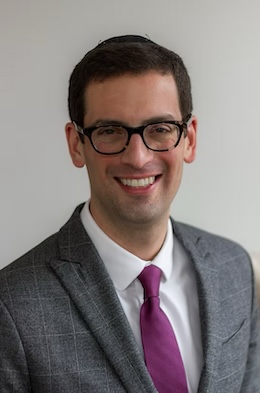
photo - Dr. David Shyovitz, a professor of history and Jewish studies at Northwestern University, gives online talks Feb. 9 and March 2
Dr. David Shyovitz, a professor of history and Jewish studies at Northwestern University, gives online talks Feb. 9 and March 2. (photo from from davidshyovitz.com)

Dr. David Shyovitz, a professor of history and Jewish studies at Northwestern University, will talk on Feb. 9 and March 2. His first lecture will look at Jews and Muslims from an historical perspective. His second asks, “Has there ever been a ‘Judeo-Christian’ tradition?” and digs into what the registration page for the talk describes as “an uneasy alliance.”

“Obviously, these are both very big and complex topics, so there is no way we will do either of them justice fully,” Shyovitz told the Independent. “But they are also topics about which many people have limited knowledge or dramatically oversimplified assumptions, so the goal will be to share some interesting ideas and sources and give participants a glimpse of the rich and nuanced history of inter-religious relations.”

Rabbi Dr. Tali Zelkowicz, director of curriculum and research at the Wexner Foundation, is slated to speak on March 16. She will revisit a debate in Jewish education.
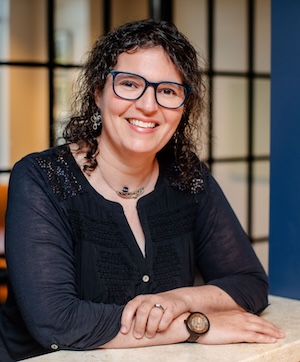
photo - The Wexner Foundation’s Rabbi Dr. Tali Zelkowicz, speaks on Jewish education on March 16
The Wexner Foundation’s Rabbi Dr. Tali Zelkowicz, speaks on Jewish education on March 16. (photo from Wexner Foundation)

“It has become a widely accepted fact that, across every age and stage, the field of Jewish education has split between the sub-fields of so-called ‘formal’ versus ‘informal’ (also known as ‘experiential’ education) or, alternatively, between ‘education’ versus ‘engagement,’” Zelkowicz said. “But how did we get to this default assumption, and is it helping us?”

By taking a closer look at assumptions about how learning works in Jewish life, Zelkowicz hopes to show how we are mired in what she sees as a “nonsensical debate” around which kind of learning setting is most needed or effective in Jewish life while avoiding the much more important question, what counts as great learning? 

Devin E. Naar, a professor of history and Jewish studies at the University of Washington, winds up the series with lectures on March 30 and June 2. His first will study the formation of Sephardi Jewish communities in the Ottoman Empire.

“This lecture traces the trans-Mediterranean journey of the exiled Spanish Jews to the sultan’s realm and the cultural and political dynamics that shaped the communities they created and developed over the subsequent centuries. In short, it explores how the descendants of Spanish Jews eventually became Ottoman Jews, and the implications of those transformations today,” Naar told the Independent.
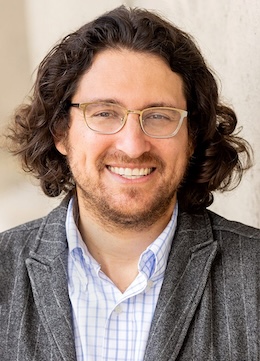
photo - Devin E. Naar of the University of Washington winds up the Wexner series with lectures on March 30 and June 2
Devin E. Naar of the University of Washington winds up the Wexner series with lectures on March 30 and June 2. (photo from University of Washington)

Naar’s second session will probe how the history of Middle East Jews might change the perception of Israel.

“This talk moves beyond polemics to delve into the history of the long-standing Jewish presence in the geography that now forms the state of Israel,” he said.

“The talk situates Jewish experiences within the broader framework of the Ottoman Empire (which ruled from 1517-1917) during which Ladino – not Hebrew, Arabic or Yiddish – largely remained the primary Jewish language of Jerusalem,” Naar continued. “The talk also introduces some of the key challenges that Sephardic and Mizrahi Jews confronted with the establishment of the state of Israel. What are the lingering effects of those transformations today?”

The Wexner Heritage Program has returned to Vancouver after a 24-year absence thanks to the support of the Diamond Foundation, the Jewish Federation of Greater Vancouver and alumni of the first local cohort.

“It was a transformative experience for me. Because of Wexner, I became a better Jewish leader,” said Jonathan Berkowitz, a member of the original cohort, and a former Vancouver Federation president and chair of Federation’s annual campaign. He was an instrumental figure in rebooting the program in Vancouver.

To register for any of the lectures, go to jewishvancouver.com/wexner-speaker-series. 

Sam Margolis has written for the Globe and Mail, the National Post, UPI and MSNBC.

Posted on December 13, 2024December 11, 2024Author Sam MargolisCategories LocalTags David Shyovitz, Devin E. Naar, education, history, Jonathan Berkowitz, Judaism, Sara Tillinger Wolkenfeld, speakers, Tali Zelkowicz, Wexner Foundation, Wexner Heritage Program
Enjoy the gift of words

Enjoy the gift of words

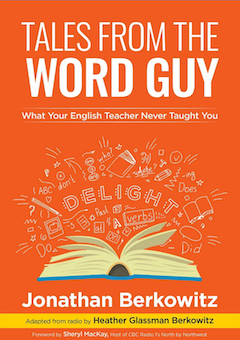
When someone loves what they do or is passionate about a certain topic, it’s obvious. In the case of a book, if this someone is also proficient with words and excels at writing, their enthusiasm figuratively jumps off the page and inhabits the reader, getting them as excited as the author. This is how I felt reading Jonathan Berkowitz’s latest book, Tales From the Word Guy: What Your English Teacher Never Taught You(FriesenPress). Excited about the wonder that is language – in this case, the English language.

With the help of his wife, Heather, Berkowitz has compiled a collection of essays adapted from his segments on CBC Radio 1’s North by Northwest over several years as the Word Guy. Noting that people “perceive the spoken word differently from the written word,” he writes: “Adapting the radio columns into written essays requires a sensitivity to the difference between listening and reading. Heather has that sensitivity, not to mention a keen sense of style and grammar.”

North by Northwest host and producer Sheryl MacKay has written the book’s foreword.

“I first met Jonathan when he came in to talk about the National Puzzlers’ League convention, which was taking place that year in Vancouver,” she writes. “I was struck right away by his enthusiasm, his depth of knowledge (in the field of puzzles and beyond), his sense of humour, and by the fact that he could identify patterns in words and numbers everywhere. It’s like a superpower he has!

“I immediately asked him to do a regular column on the show. Jonathan, who is always up for a new adventure, agreed and, for the next year, he was our Puzzling Professor. Every month, he’d appear on the show and introduce listeners to a different kind of puzzle, talk about its history and then challenge them to solve a few. It was such fun and so mind-bending!

“The next year, Jonathan changed focus a little and became the Word Guy for the show. Each month, he takes us on a radio journey through some of the vagaries of the English language. As Jonathan owns more dictionaries and language reference books than anyone I know, he’s well equipped to lead this particular expedition!”

image - Tales From the Word Guy book coverIn Tales From the Word Guy, Berkowitz admits that his favourite books are dictionaries, followed perhaps by thesauri (I admit that I Googled the plural of thesaurus).  “In fact,” he writes, “thesaurus comes from Latin, meaning ‘treasure,’ and the first dictionary definition of thesaurus is treasury or storehouse. Indeed, what a treasure house it is.”

Words have always been a passion for Berkowitz, but he is also a fan of numbers and mathematics, having chosen a career as a statistician. With his facility for words, numbers and problem-solving, it is no wonder that MacKay, in 2015, invited him to present puzzles on her show. I never heard him in that role, but I did very much enjoy the book those puzzles led to: The Whirl of Words, also published by FriesenPress. (See jewishindependent.ca/playing-with-words-and-more.)

Berkowitz’s breadth and depth of knowledge can be overwhelming at times. To build off his metaphor of this latest book as a box of chocolates, you might get the equivalent of a sugar rush if you read too much of it in one sitting. While the chapters are short, amusing and easy to read, there is just so much information “filling,” from the erudite to the silly to Berkowitz’s trademark puns. (Among those he shares is one of his favourites: “The only thing flat-earthers have to fear is sphere itself.”)

I learned so much in Tales From the Word Guy. For example, I knew that A, E, I, O, U and sometimes Y are vowel letters – but also sometimes W?! Berkowitz gives the example of the “uncommon word, cwm, a synonym for cirque, [which] means ‘a deep steep-walled basin on a mountain usually forming the blunt end of a valley.’ Linguists sometimes refer to Y and W as semivowels,” he writes. “Conversely, U and I sometimes represent consonants, as in quiz and onion, respectively.”

I can understand the U being considered a consonant in quiz, but remain confused about the I in onion. But in a good way. I enjoy having my mind challenged, my assumptions upended.

I also enjoy being wowed and there are many “really?!” moments in this book, such as W being a vowel sometimes, albeit rarely. To name just a few of the other things that made me ooh and ah – the origins of the terms uppercase and lowercase; the number of words Shakespeare created (and some examples); and the name for and function of “um,” “uh,” “like,” “you know,” all those annoying sounds or words most of us unconsciously insert into our sentences when we talk.

But it’s not just the many fun facts that make Tales From the Word Guy such fun to read. Berkowitz shares a bit of himself, from more serious topics, like how his mother and father influenced his life, to his favourite, or most beautiful, words, his language pet peeves and his efforts at making up new words. It is easy to see why CBC’s the Word Guy is so popular.

To order a copy of Tales From the Word Guy, go to talesfromthewordguy.com.

****

Tales From the Word Guy: What Your English Teacher Never Taught You book launch with author Jonathan Berkowitz in conversation with Sheryl MacKay; adapted from radio by Heather Glassman Berkowitz. Nov. 29, 7pm, at the Jewish Community Centre of Greater Vancouver. No registration required.

Tales From the Word Guy: Jonathan Berkowitz talks about his new book with Daniella Givon. Dec. 12, 7:30pm, at Beth Israel. bethisrael.ca.

Format ImagePosted on November 25, 2022November 23, 2022Author Cynthia RamsayCategories BooksTags CBC, Heather Glassman Berkowitz, Jonathan Berkowitz, language, North by Northwest, Sheryl MacKay, the Word guy, words
Playing with words, and more

Playing with words, and more

Think you’re not a puzzle person? Think again. “We solve puzzles of every sort, every day. They show up in so many of our life choices – in our decision-making, in our development of human relationships, in time-management, and so on,” writes local Jewish community member Jonathan Berkowitz. “Although puzzles are usually considered to be activities of recreation, having any facility with puzzle-solving enhances other life skills. It helps you with listening, parsing, decoding, defining, lateral thinking – in short, problem-solving.”

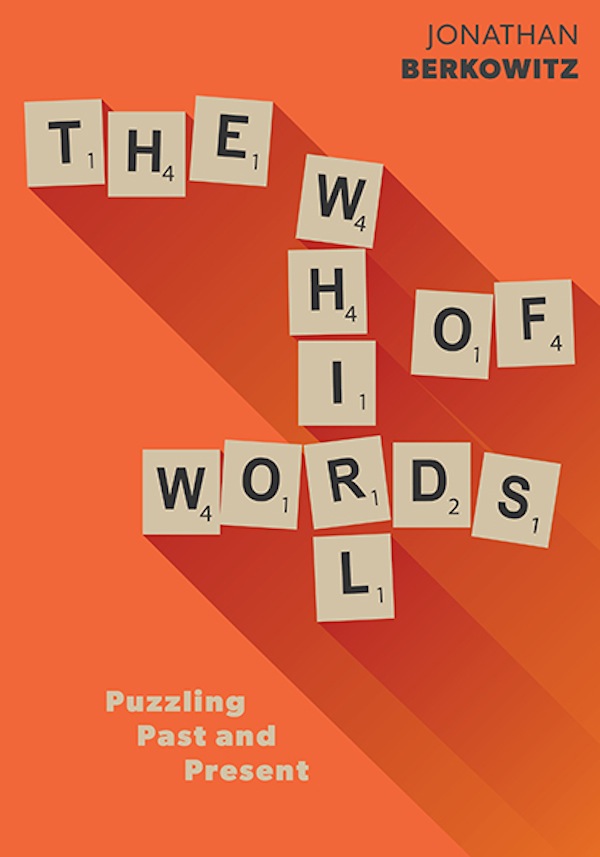
In his recently published book, The Whirl of Words: Puzzling Past and Present (FriesenPress), Berkowitz gets into the nitty gritty – history, philosophy, etymology, mechanics – of puzzle construction and solving in a conversational style that makes for good reading, even if you don’t absorb all the details on the first go. In fact, an ability to give something the once-over and then revisit it is an important aspect of puzzle-solving. It’s the second of eight steps that Berkowitz offers for solving puzzles, which would serve well for any puzzling situation.

Puns, by the way, are a part of wordplay, which, writes Berkowitz, “involves perceiving patterns where none were expected. Pattern matching is a hallmark of intelligence. It is at the root of science and art. Much of thinking is really just finding the underlying pattern.”

Berkowitz is adept at both science and art. He appears regularly on CBC Radio 1, where he is “the Word Guy” on the show North by Northwest. He creates and solves puzzles and is a member of the National Puzzlers’ League. Oh, and he’s a professor of statistics at the University of British Columbia’s Sauder School of Business.

image - The Whirl of Words book coverThe Whirl of Words is about all kinds of wordplay, the main types of which, Berkowitz explains, “involve letter play (wordplay involving the letters of the alphabet and their usage in words without regard to sound or sense), sound play (wordplay involving the sounds of words without regard to letters or meanings) and meaning play (wordplay involving the meanings of words without regard to letters or sounds).”

There is a chapter on numbers, both as words (one, two, three, etc.) and as mathematical concepts. There are discussions of the potential cognitive and other benefits of puzzle-solving, such as learning about a range of topics, from sports to geography to politics.

“Word puzzles improve vocabulary, grammar, spelling and communication skills, boost memory and enhance cognitive and analytical skills,” writes Berkowitz. “By improving your problem-solving skills, you may also improve your performance at work and in other areas of life. They can be a positive factor for your mental health, because focusing your attention on a puzzle can aid relaxation, ward off anxiety, and keep your emotions under control. After all, how can you think negative thoughts when you’re concentrating on a puzzle? And, doesn’t it feel fantastic when you solve a puzzle?”

Going back to his eight steps, out of context, they could be mistaken for a self-help guide:

  1. “The puzzle is in the details. Read the instructions carefully. Then read them again.”
  2. “Give it the once-over, twice. Assess the challenge.”
  3. “Don’t just sit there, try something.”
  4. “Don’t give up; persist.”
  5. “Open your toolbox.” What approach might lead to a solution?
  6. “Use the force wisely. Be systematic and efficient.”
  7. “Sleep on it…. Like a train, once you are on a track, it is difficult to change tracks. Put the puzzle aside and come back to it with fresh eyes and a refreshed brain.”
  8. “You are not alone. It is perfectly fine to seek help from resources.”

As is also true with general life circumstances, the key to getting better at something is to practise. And Berkowitz provides plenty of puzzles for readers to solve, as well as the answers to them at the end of each chapter.

The Whirl of Words includes a selected biography for those interested in further learning, and a much-needed glossary – most readers will discover many new words and terms while enjoying this book.

To read excerpts from The Whirl of Words and to purchase a copy of it for yourself or a fellow puzzle lover, visit thewhirlofwords.com.

Format ImagePosted on October 22, 2021November 2, 2021Author Cynthia RamsayCategories BooksTags Jonathan Berkowitz, puzzles, Whirl of Words, wordplay
Hagit Yaso headlines local Yom Ha’atzmaut

Hagit Yaso headlines local Yom Ha’atzmaut

Hagit Yaso, the 2011 Kochav Nolad winner, will sing in Vancouver on May 5 at the Chan Centre in celebration of Israel’s 66th birthday. (photo from hagityaso.co.il)

One July night in 2011, on a crowded Haifa beach, the 21-year-old singer Hagit Yaso became that year’s winner of Kochav Nolad (A Star is Born), Israel’s version of American Idol. The outsider had triumphed. “It was the most exciting and most life-changing experience I’ve ever had,” she told the Independent by telephone from her home in Sderot.

Yaso is a fully qualified outsider. She is working-class, the child of Ethiopian refugees and a resident of the missile-and-mortar target town of Sderot. Only one kilometre from the Gaza Strip, Sderot is the target of frequent rocket assaults. A small town of only 20,000 people, everyone, she said, knows everyone. “It’s a small town. You get to know the people,” she said. “And I got a lot of support when I was on Kochav Nolad.

Now 24, Yaso has toured the world and released her first CD, a self-titled CD that is available at cdbaby.com and at amazon.com. Vancouver audiences will get a chance to see her May 5 when she headlines the community Yom Ha’atzmaut celebration at the Chan Centre for the Performing Arts at the University of British Columbia. The event’s main presenter, the Jewish Federation of Greater Vancouver, can take some pride in Yaso’s success. A scholarship from the Canadian Federations provided her voice lessons at Sderot’s Music Centre and the Vancouver Federation itself has taken a special interest in helping Sderot’s Ethiopian community. Federation also provides assistance to Sderot’s trauma victims.

The three months she spent on the television competition were grueling, Yaso said. ‘“The competition is very long, very confusing, with a lot of pressure and media.” She always believed she would win, though.

Her friend, the American filmmaker Laura Bialis, who lives in Tel Aviv, noted by phone that Yaso’s determination is one secret to her success. “You know, it was like everything she set out to do, she did,” Bialis said. “She wanted to get into the army band, she got into the army band. She wanted to get on Kochav Nolad, she got on Kochav Nolad. She wanted to win Kochav Nolad, she won.”

The two met when Bialis was shooting a documentary about music in Sderot. That film, Sderot: Rock in the Red Zone, is now in its final editing stage.

Yaso’s success is a point of pride for Sderot. Her win is also significant to Israelis of Ethiopian heritage. Vancouver resident Ronit Reda-Yona, an Ethiopian Israeli, said Yaso’s 2011 win “was an exciting moment for the Israeli society and especially for the Ethiopian community. Everyone in Israel who is Ethiopian feels like me: this is a good model for young people.”

Not only is Yaso well known in Israel but, in a short time, she has become an international success. She has performed at Jewish events in Paris, London, Canadian cities, American cities and Ethiopia. After Vancouver, she will tour Brazil.

“What is really amazing is that her career has taken off internationally in a really interesting way,” said Bialis. “She’s got this amazing voice, she’s gorgeous, she’s gracious, she’s sweet, and she has an amazing story.”

Thankful for parents’ courageous journey

Yaso’s parents, Yeshayahu and Tova, grew up and got married in rural Ethiopia. “They got married by shiddach,” said Yaso, who explained that the marriage was arranged and the two did not meet until their wedding day. In the early 1990s, the couple was forced to leave home. “Because they were Jewish, they suffered a lot and they had to run away from there and the option was to come to Israel,” Yaso explained.

Tremendous hardship stood between them and that destination. “They walked 400 kilometres by foot,” she said with some pride and awe in her voice. “It took them two and a half months to walk because it’s through the desert. They had to walk only at night and hide during the day because they were not supposed to leave [Ethiopia], and they were afraid…. They had to hide during the day because they were afraid of being caught.”

Yaso’s parents finally crossed the border into Sudan and were airlifted to Israel.

“They had nothing when they came here,” she said. Her parents built a life and a family of five children, in the small town where they still live. That home remains her home, too.

The Vancouver performance will include four songs she performed on Kochav Nolad. Yaso will sing in English, Hebrew, Moroccan Arabic and Amharic, the language of Ethiopia. The four-piece band that accompanies her is a group with whom she served in Israel’s army band. All three backup singers are from her hometown, including her sister, Shlomit.

Both of Yaso’s sisters performed with the town’s youth music ensemble. Many of Sderot’s young people dream of music careers. The ubiquitous bomb shelters sometimes double as rehearsal spaces. Perhaps this love of music helps soften a hard life that includes regular bombardment. When the air raid warning sounds you have 15 seconds to find shelter. Drills are constant, so life itself is always uncertain.

“It’s a city that suffers a lot from what’s going on in the south, from bombing and stuff,” said Yaso. “It’s not easy to live there. I manage by being optimistic, smiling and, when it gets harder, I sing.”

In addition to Yaso, performances at the community celebration of Israel’s 66th birthday at the Chan Centre will include the JCC Festival Ha’Rikud Dancers and a musical tribute written by Jonathan Berkowitz and Heather Glassman Berkowitz.

Michael Groberman is a Vancouver freelance writer.

Format ImagePosted on April 18, 2014April 27, 2014Author Michael GrobermanCategories MusicTags Chan Centre, Hagit Yaso, Heather Glassman Berkowitz, JCC Festival Ha’Rikud Dancers, Jewish Federation of Greater Vancouver, Jonathan Berkowitz, Kochav Nolad, Laura Bialis, Sderot: Rock in the Red Zone, Yom Ha'atzmaut
Proudly powered by WordPress