Skip to content
  • Home
  • Subscribe / donate
  • Events calendar
  • Business Directory
  • FAQ
  • News
    • Local
    • National
    • Israel
    • World
    • עניין בחדשות
      A roundup of news in Canada and further afield, in Hebrew.
  • Opinion
    • From the JI
    • Op-Ed
  • Arts & Culture
    • Performing Arts
    • Music
    • Books
    • Visual Arts
    • TV & Film
  • Life
    • Celebrating the Holidays
    • Travel
    • The Daily Snooze
      Cartoons by Jacob Samuel
    • Mystery Photo
      Help the JI and JMABC fill in the gaps in our archives.
  • Community Links
    • Organizations, Etc.
    • Other News Sources & Blogs
  • JI Chai Celebration
  • JI@88! video

Recent Posts

  • SFU honours Gloria Gutman
  • Lifting people’s spirits
  • Wedding a ray of light
  • Indigeneity and Zionism
  • Rule of law broken: councilor
  • Football and its roles
  • The burden of defence
  • Fish Café returns after fire
  • All right in what goes wrong
  • Nuns & mermaids at TUTS
  • Camp offers holiday retreat
  • Students and mentors inspire
  • Once-in-a-lifetime trip
  • 100 dancers, one heart
  • Money for the sciences
  • What “Jewish food” means
  • Have a cookie, schnitzel too
  • Federation now across BC
  • Israel fighting for its existence
  • Deal strengthens Iran
  • Patriotic belonging diminishes
  • A campaign to engage
  • Upstanders’ first live event
  • Responding to Carney
  • Having your own home
  • Music a family tradition
  • Musical to warm heart
  • Community milestones … June 2026
  • Sharing her passion for Israel
  • Or Shalom reopens its doors
  • JFS from past to future
  • Need holistic approach
  • Sharing stories, advice
  • Journalist shares fears
  • Skills to live together
  • Road to independence

Archives

Follow @JewishIndie
image - CJN box ad Rockowers 2026

Tag: Israel

Israel trip inspires choreographer

Israel trip inspires choreographer

Crystal Wills in rehearsal for The Way They Walked Through the World. The work includes the use of more than 300 pairs of army boots. (photo by Christie Wood)

The female experience of war. This part of the description of choreographer Caitlin Griffin’s The Way They Walked Through the World – a contemporary dance piece set to première at the Scotiabank Dance Centre’s open house on Sept. 13 – particularly intrigues me.

Despite the number of conflicts taking place around the world, images of women are few and far between, except for the odd photo, in which the subject(s) is either screaming out in anguish or quietly wiping tears in mourning. Other images come to mind with more thought, but not many, and words also have fallen short in helping me understand my feelings about the violence in general, but my concern and sadness over the situation in Israel specifically. Perhaps a dance performance, its physicality, its abstract nature, will allow me to process some of the emotions that have, to this point, eluded identification, expression.

I have known Griffin for several years. I don’t know her well, but well enough to know that she is a very talented dancer and teacher – and a mensch. When she told me that she was applying to a program at Kibbutz Contemporary Dance Company, I was thrilled. When she came back from five months in Israel with a new work in progress, one inspired by her time there, I knew I would want to see it once it was ready to be shared publicly. Fortunately, while I missed an earlier version that was performed at the Firehall Arts Centre’s BC Buds showcase in May, a good friend attended. She was impressed, not only with the performance, but with Griffin; so much so that she connected me to Griffin, not knowing that I already knew her. When I asked Griffin to send me some information on The Way They Walked, she included the following:

“The preliminary movement vocabulary [for the work] was created there [in Israel], as a personal answer to the questions I began to ask myself after seeing armed conflict in a new immediate perspective. I was inspired by the maturity of the young Israelis preparing to serve, and by the strength of Israeli mothers whose realities included the conscription of their children. I was struck by the intense beauty of life framed by conflict.”

It was only weeks later that Israel and Hamas went to war.

“The current conflict has definitely hit close to home for me, as I still have several friends living in Israel who send updates regularly,” shared Griffin in a recent interview with the Independent. “The changes that have happened within the work aren’t at all to do with the content … or message of the work, but a general change in tone – almost a sadness, a level of more raw exposure. I think the work has lost a bit of its naivety.”
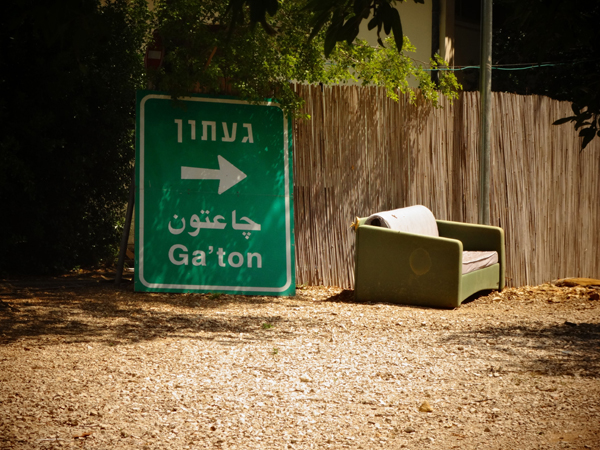
photo - Kibbutz Ga’aton, where KCDC’s International Dance Village is located
Kibbutz Ga’aton, where Kibbutz Contemporary Dance Company’s International Dance Village is located. (photo by Caitlin Griffin)

The Way They Walked has been an ongoing project since Griffin was in Israel in the first part of 2013.

“Some of the solos that are featured in the show in its current form were created from single images that came to me while living on the kibbutz,” she said, referring to Kibbutz Ga’aton, where KCDC’s International Dance Village is located. “Most of the imagery in the work was born in the studios after long days of rehearsals, while processing the overwhelming stimuli of my new surroundings. It has taken many months to explore those images and find out what was so intriguing to me about them. It’s been a process of uncovering what happens before and after these images in the dance, and how to frame them to resonate with an audience.”

Griffin, who is not Jewish, discovered KCDC online, and applied to its Dance Journey (Masa) program, which, explains the website, offers dancers 18-35 years old from around the world the “opportunity for professional development while dancing side by side with KCDC dancers [and] learning from one of the leading dance companies in the world.”

“I learned about the long-term immersive environment available to young performers and decided it was something that fit what I was looking for creatively and personally,” she explained. “I began writing grants and researching ways to make it a possibility. It took just over a year to gather the necessary resources, and to heal a broken foot I had sustained in the meantime. In 2012, I was awarded a professional development grant to attend the program from the British Columbia Arts Council. I successfully wrapped up a crowd-funding campaign that brought over 65 individuals and in-kind corporate sponsors together and, a few short months later, I was on a plane to Tel Aviv.

“I attended the program from February 2013 to June 2013, along with 24 other young artists from across the globe. The experience of living in the Galilee Dance Village, surrounded by other equally passionate and determined artists has changed everything for me. The friends I made continue to support me personally and professionally. In fact, much of the rehearsal footage from The Way They Walked has made its way to these friends – in Mexico, in Italy, in the U.S., who have all informed the direction of this work and inspired pieces of it along the way.”

Performing in The Way They Walked are Delphine Leroux, Crystal Wills and Heather Dotto. Griffin first worked closely with them in 2011, when MOVE: the company performed in the 13th International Festival of Dance and Music in Bangkok, in celebration of 50 years of Thai-Canadian relations.

Leroux, Wills and Dotto “have been absolutely integral” to The Way They Walked, said Griffin. “These are some of the most supportive and lovely artists I have had the pleasure of sharing a studio with. To date, my professional choreographic experience has been exclusively creating on myself, which is an entirely different process than directing three dancers of world-class calibre. Each of them has contributed not only their artistic expertise to the process, but has shared ideas about the work that have informed its direction. They have breathed life into something that at one time was an idea and some simple movements and pictures in my head.”

The Way They Walked has undergone several phases of development so far.

“We are currently working under Restless Production’s Project CPR5, which is a choreographic research opportunity run by Claire French, providing rehearsal space and guidance to emerging choreographers,” said Griffin, describing French as “an invaluable mentor during this process, and it is with her whom we have been working the most closely.”

In addition to the show at the Firehall, the group also had rehearsals in May and June through the Dance Centre’s 12 Minutes Max program.

Griffin said the piece will continue to evolve, as long as she feels there’s something to say with it. “I am thrilled to have the opportunity to showcase the work at this phase and will be welcoming audience feedback from the Dance Centre open house event in September to take on into the next, yet-to-be-determined developmental phase,” she said. “My hopes are that audience members can find something to relate to, coming from inside the work. Whether it’s reacting directly to a dancer’s actions, an image we create, a sound, a relationship between the dancers. To give people a chance to escape even for a moment into an atmosphere that we created would be a big success.”

Griffin, who was born in Toronto, grew up in Oakville, Ont. Dancing since the age of 4, she said she “realized it was a career option around 13 years of age.” Her family was “extraordinarily supportive … instilling in me the ideals of equality, family, hard work and creativity.”

“I have given some consideration to returning to a more traditional academic path, but honestly have never been fulfilled in the same way with any of my brief explorations into other fields. My passionate curiosity lies within the processes of performing, creating and teaching dance.”

“I had considered alternate careers and educational opportunities,” she admitted. “After graduating from high school with outstanding academic excellence, I deferred my acceptances from the science programs at Queen’s University and a scholarship from Guelph University to pursue my continued dance training with the Goh Ballet Academy in Vancouver. I have given some consideration to returning to a more traditional academic path, but honestly have never been fulfilled in the same way with any of my brief explorations into other fields. My passionate curiosity lies within the processes of performing, creating and teaching dance.”

Griffin was among the performers at the opening ceremonies of the 2010 Olympic Games. In rehearsal, she said, “Witnessing k.d. lang’s ‘Hallelujah’ to a near empty stadium in the days leading up to the event was hauntingly beautiful, and is one of my most treasured memories.” Another is teaching a ballet class to her peers in the Masa program, “with several of the KCDC company members in attendance. This is a teaching highlight for sure, though I have many highlights from my teaching career that are simply moments of understanding lighting the faces of my students. When I can teach someone that dance and well-being can go hand in hand, that’s a highlight.”

As to the future? Following the performance at the Dance Centre open house, Griffin said, “I will be headed to Montreal to dance with Les Grands Ballets Canadiens de Montréal’s annual production of Casse-Nosisette. In December, I will be accompanying Team Canada West to Poland for the International Dance Organization’s World Dance Championships. I’m not sure what’s in store after this, but I’m excited to find out!”

***

The Way They Walked Through the World premières as part of the Restless Productions CPR5 showcase at the Scotiabank Dance Centre’s open house on Sept.13, at 4 p.m., in conjunction with other performances. Updates on the work can be found at facebook.com/caitlingriffincpr5.

Format ImagePosted on August 29, 2014August 28, 2014Author Cynthia RamsayCategories Performing ArtsTags Caitlin Griffin, Israel, Kibbutz Contemporary Dance Company

Talking about Israel

In British Columbia, this summer has been among the finest in living memory. Yet, for Jewish British Columbians and for all those watching events around the world right now, the summer has brought a very dark cloud.

It has not only been the terrible violence between Israel and Gaza, but violence elsewhere in the Middle East that is claiming exponentially more lives and causing horrific hardship and inhumanity.

The advance of the so-called Islamic caliphate from Iraq into parts of Syria opens the potential for additional Western military involvement in the region. The horrors that are taking place under the extremist ISIS dictatorship are almost beyond human imagination. In Syria, meanwhile, the death toll from the now two-year-old civil war has reached 190,000.

Despite all this, global attention remains focused on Israel. At the United Nations, Israel is singled out for condemnation, while Hamas is given a pass. Marches in the streets around the world declare Israel a pariah. Violence against Jews and attacks on Jewish institutions worldwide are legitimately striking fear that a generation or more of Diaspora Jews have never experienced.

There really is no silver lining. But, if there were, perhaps it would be that several fictions have been debunked.

Time was, even Zionists accepted the position that “anti-Zionism does not equal antisemitism.” This has been almost a required disclaimer at the beginning of any conversation on the subject for at least the last 15 years. This needs to be revised, however, to recognize that anti-Zionism at least sometimes equals antisemitism. As we have seen in recent weeks, there are those in the anti-Zionist movement who are motivated by anti-Jewish animus, and then there are those who refuse to condemn them. When it comes down to it, the moral difference between the two groups is minimal.

There is also the position that, by definition, anti-Zionism should legitimately be considered a form of antisemitism. After all, Zionism is simply the national representation of the Jewish people. If one is opposed to that, especially while supporting self-determination for every other national identity in the world, it must stem from some intellectual or emotional process that views Jews differently from other people.

There are certainly reasons why a conflict in a place that is holy to several religions should draw an outsized interest from people around the world. Yet, when the global reaction is so extraordinarily imbalanced, something is clearly beyond reason.

We know what motivates at least a significant part of the anti-Israel movement. More words have been spilled on this subject in the past two months than perhaps ever in human history, given the ability of everybody to broadcast their positions via social media. We have been able to see in greater detail the narrative subscribed to by many of Israel’s critics, from well-known commentators to elected officials to ordinary Facebook friends. Overwhelmingly, it is a simple one: Israel is just plain evil and, because its legitimacy and right to exist are explicitly or implicitly denied, its right to defend itself is likewise repudiated.

These are not words that generally come out of the mouths of anti-Israel activists, because they are not palatable to those who would otherwise consider themselves progressive, well-intentioned people. But push has come to shove and, all over the internet and in face-to-face conversations – yes, those still take place sometimes – we have been able to learn more about what a lot of “ordinary” people think about Israel. It has been painful. The conversations have been difficult. Many of us have lost friends.

But it is always better to know than to proceed in ignorance. We have a new understanding of what we are up against. We also have discovered many new friends, and new ways of engaging with those who don’t share our views.

Others in our community have no doubt had similar experiences. Many of us have felt challenged to present our positions with clear heads and hearts, and we invite all readers to contribute to the discussion by sharing their suggestions for continuing this dialogue constructively.

Posted on August 29, 2014August 28, 2014Author The Editorial BoardCategories From the JITags dialogue, Diaspora, Israel

How to talk about the Middle East peacefully

Some of the violence in the Middle East has inflamed tensions closer to home. Online, there is a recent interview conducted by the University of British Columbia with its resident expert Prof. Robert Daum, who offered his thoughts on navigating these frictions. Daum is a faculty associate with the Institute for Gender, Race, Sexuality and Social Justice, a faculty member of Green College, project lead in UBC Transcultural Leaders, a Reconciliation ambassador for Reconciliation Canada and a dialogue associate at Simon Fraser University’s Centre for Dialogue.

UBC: How do conflicts afar, like the Israel-Gaza situation, spark local tensions?

RD: Sadly, some conflicts push people into rigid positions rooted in insufficiently rigorous, self-critical and nuanced analysis. Simplistic narratives about historical and contemporary events resulting in loss of life raise tensions. Inadequate media coverage heightens tensions, and people tend to gather in narrowly circumscribed assemblies of like-minded thinkers. Conflicts such as these are teachable moments, but learning and teaching require an attitude of openness to authentic inquiry on the part of everyone.

Imagine what we can do in addressing any number of complex conflicts and challenges if we can cultivate a culture of evidence-based, authentic inquiry and dialogue. I have seen this approach in action in my work with UBC’s Transcultural Leaders 2014 Conversation Series, SFU’s Centre for Dialogue and Reconciliation Canada.

UBC: Have you been surprised by the tensions arising locally and across Canada?

RD: No. In the context of genuine human suffering, we encounter hateful slogans, racist images, one-sided narratives, vicious social media comments and self-righteous oversimplifications. This does not honor the dead. Inflammatory rhetoric gets most of the headlines. Research shows that anxiety and clear thinking tend not to be compatible. Our discourse has to be as levelheaded, sober and reasonable as possible. People need to feel that they can learn in an environment of safety, civility and mutual respect. I consider myself to be a principled pragmatist. It is precisely when we feel angriest about world events that we need to take a deep breath. Imagine if the Supreme Court had to reach decisions under fire. If we cannot learn how to share narrative space – that is, how to reconcile competing, deeply held, national narratives, in a way that does not require the annihilation or complete negation of the other’s position – then how can we expect geographical space to be shared at one of the most fraught intersections of regional and global politics?

I have participated in forums on antisemitism, Islamophobia, homophobia, the Indian residential schools and many other issues. Two years ago, I co-sponsored with the Vancity Office of Community Engagement a three-hour public forum downtown on Islamophobia, featuring a critical media analyst, three Muslim speakers from very diverse backgrounds and perspectives, and three equally diverse non-Muslim speakers, including myself. A mixed audience of more than 250 listened to stories of prejudice experienced and prejudice confronted. It was a thoughtful, nuanced and multi-layered conversation over the course of three hours. And we were just getting started.

UBC: What are some healthy ways in which people can deal with tensions that may arise between themselves and others?

RD: Seek to engage in a dialogue, rather than a debate. Ask genuine questions: “What did you mean by that? What are you trying to say? Have you considered different perspectives on this? Have you tried to understand why others hold positions different than yours? On what can we agree? Is there another way to understand the phenomenon, whereby our positions might be reconciled, even partially?” Try building on ideas and making connections between ideas. Don’t reduce multi-faceted conflicts to a single variable such as religion or oil, for example.

Politics, history and ethics are not reducible to simple equations. Complex questions can rarely be reduced to the logic of black and white, right and wrong. I may see the world very differently than you, but that does not necessarily make you (or me) wrong. Of course, moral assessment matters, and I believe that some behaviors, like the intentional murder of civilian non-combatants as prohibited in the Geneva Conventions, are abhorrent. But, as any first-year law student knows, such an assertion is the beginning, not the end of the inquiry. If such matters were simple enough to be reduced to trial by megaphone, we would not need faculties of law or courts, let alone courses in ethics, history, politics, religion, gender, media or much else.

This interview was originally published by UBC News/University of British Columbia. It is reprinted with permission.

Posted on August 29, 2014August 28, 2014Author UBC News/University of British ColumbiaCategories Op-EdTags Israel, Middle East, Palestinians, Robert Daum
Winnipeg’s CMDA donates second ambulance

Winnipeg’s CMDA donates second ambulance

The ambulance being sent to Israel by the Winnipeg CMDA is the same type as the one pictured here. (photo from CMDA)

With the recent violence and tensions in Israel, Magen David Adom (MDA) is, once again, being pushed to its limits – working in a state of high alert and keeping most of its equipment in service 24 hours a day. And though tensions are high in Jewish communities outside of Israel, as well, the recent Operation Protective Edge seems to be bringing out the best in people, including additional financial support for Israel.

One such Canadian example is in Winnipeg, where people are pouring their energy into helping to send ambulances and medical equipment to Israel via Canadian Magen David Adom (CMDA). Winnipeg’s local CMDA chapter sent an ambulance to Kiryat Shmona last year. Now, it is sending its second ambulance to Israel, which will be stationed in the south.

While most of the support has come from the local Jewish community, there is growing support from Manitoba’s Christian community, who are eager to show their support for the Jewish state.

One of the leading figures in that group is Pastor John Plantz, who has been leading tours to Israel every year via his Beauty Field Tours to Israel. Plantz said he was looking for a tangible way to help Israel aside from visiting the country with his tours. He was first introduced to CMDA through materials he came across at a local Jewish community centre and, later, around 2009, through a meeting with CMDA Winnipeg member Ami Bakerman. Plantz invited Bakerman to set up a CMDA table at a local Bible conference he organizes each year.

Looking for even more ways to support Israel, Plantz recently purchased a grove of 1,000 trees, along with Beauty Field Tours group-mates John and Janice Thiessen, through the Jewish National Fund. The grove will be planted in the Yatir Forest.

“My joining the Winnipeg CMDA chapter came through an invitation from Ami [Bakerman],” said Plantz. “I was very excited about the opportunity to help this organization get ambulances for the state of Israel and to be able to help get practical resources to people in a time of need in a country that I’ve truly come to love.”

Some 25 years ago, Plantz discovered that his grandfather was Jewish. Since then, he said, “I decided to support, in practical ways, the Jewish community here, in Winnipeg, and also the state of Israel.”

Plantz sees it as “a privilege” to introduce many more Christians to CMDA at the many events he attends by handing out CMDA tzedakah boxes and other CMDA materials. Also, Plantz said, “By informing people of the need[s] in the state of Israel, it gives them the opportunity to give and help.

“I was so pleased to hear when CMDA had sent their first ambulance to Israel just over a year ago, as I was a part of that through our Bible conference, along with many others from that event.

“And now to think that another ambulance will be sent this month brings great joy to my heart and it should be celebrated by all who’ve had a part. I’d like to give the glory to the God of Abraham, Isaac and Jacob for putting it into the hearts of many to respond.”

He added, “I believe that the time to help is now, for the need is great in Israel and lives are at stake. Let’s get involved today.”

photo - Laurelle Harris
Laurelle Harris (photo from Laurelle Harris)

Another local CMDA chapter member is Laurelle Harris, a lawyer and a director of Levene Tadman Golub Law Corp.

“I’m thrilled to have been able to play a very small role in the chapter having been able to send two ambulances so far,” said Harris. “To be able to contribute to the safety and well-being of people in Israel is amazing.”

Harris joined the Winnipeg chapter of CMDA about two years ago. “The ability for MDA to provide emergency services is essential to the well-being of all those living in or visiting Israel,” she said.

“At the time, I didn’t know how long it would take to be in a position to send one ambulance. Actually sending two makes me believe that we’re on a roll and can achieve our goals in the future.

“To be able to send a second ambulance – an intensive care unit (MICA), no less – during the current conflict with Hamas makes me feel that Winnipeggers have done something tangible to make a difference right now,” she added. “Winnipeggers have, quite literally, helped MDA save lives in real time.”

According to Harris, the Winnipeg chapter’s ability to send more ambulances depends on the continued financial support of the general community in Winnipeg and throughout the province, as well as adding more volunteers with diverse skill sets and backgrounds.

“During this particularly difficult time for Israel, as she remains under attack, there are a number of ways that people can help,” said Harris. “But, most importantly, is to give to any cause that will have a direct impact on service provisions. CMDA is one such organization that will not just be of benefit in the immediate, but will also have a lasting impact in times to come. When this crisis is over, gifts given now will continue to have a lasting impact for years into the future.”

For more information or to donate to the Winnipeg chapter ambulance drive, email Winnipeg chapter treasurer Bakerman, [email protected]. You can also donate online at cmdai.org or by calling 1-800-731-2848. CMDA is a registered charity and all donations receive a tax receipt.

Rebeca Kuropatwa is a Winnipeg freelance writer.

Format ImagePosted on August 22, 2014August 21, 2014Author Rebeca KuropatwaCategories NationalTags Beauty Field Tours, Canadian Magen David Adom, CMDA, Israel, John Plantz
Tunnels pose serious threat

Tunnels pose serious threat

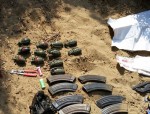
Weapons recovered from a Hamas tunnel. (photo from IDF/FLICKR)

“One hundred Israeli schoolchildren killed in Hamas attack.” Israelis say this would have been just one of many similar headlines announcing untold loss of civilian life had Operation Protective Edge not been launched last month. The goal of the operation was to silence the seemingly endless barrages of Gaza rockets aimed at Israeli cities and towns, and to detect and destroy the vast network of underground tunnels dug beneath Gaza and into Israel by the Islamist Hamas terror organization.

As details of the tunnel system became public, Israelis were at once fascinated and infuriated to learn specifics of the intricate Trojan-horse-like network lurking beneath their communities; an engineering feat so potentially lethal that the national discussion is rife with unsubstantiated worries about terrorist plans for the execution of “an Israeli 9/11.”

Frequently heard were comments like, “Surely the high-tech nation should have the ability to detect tunnels!” while others ask how such an elaborate feat of engineering and construction could have proceeded right under the noses of the military in a security-savvy country with vast counter-terrorism experience.

In October 2013, Israeli army intelligence located entrances to one such tunnel just a couple of hundred metres from the entrance to Kibbutz Ein Hashlosha, a collective community in southern Israel near the border with Gaza.

On a tour of that network, standing at ground level, one can see the tunnel split in the middle, its branches extending deep into the earth, with one entrance/exit nearly a mile away – through Israeli territory and into the Gaza Strip – and the other a mere 600 metres (almost 2,000 feet) to the right: exiting into Israeli territory.

Moving closer required man- oeuvring through a steep downward 46-foot trek, assisted by the steadying hand of an IDF officer to navigate the distance from the surface to the underground passageway itself. Crawling through the deceptively small opening and out of the desert’s summer heat into the coolness of the subterranean concrete-encased structure, it was surprising to find myself standing upright, able to see far enough to sense the vast distance it covers. Though visibility was limited by the dearth of ambient light, helped only slightly by the lighting unit attached to our camera, the immense dimension of the tunnel was perceptible, the elaborate nature of the structure striking. From the sophisticated construction to the array of cables, conduits, finished ceilings, communication lines and pulley systems, it made sense that each tunnel was estimated to have required several years and millions of dollars to build – mostly by hand, with jackhammers and shovels.

Also discovered in many of the recently destroyed tunnels was a variety of weapons, army uniforms, motorcycles, chloroform and handcuffs: macabre “kidnapping kits.”

Read more at themedialine.org.

Format ImagePosted on August 22, 2014August 27, 2014Author Felice Friedson TMLCategories IsraelTags Hamas, IDF, Israel, Israel Defence Forces, terrorism, tunnels

Our Israel connections – the need to tell our stories

The Six Day War may have been history’s most illustrative example of the limitations of a weekly newspaper. Reviewing this newspaper’s archives from 1967 shows one week’s paper filled with ominous foreboding and the next issue, triumphal jubilation.

Every year, we take a short publishing break in the usually quiet news period that is the summer doldrums. Unlike in 1967, though, we now have a spiffy new website that has allowed readers to follow some local events and commentary from abroad during these especially tumultuous few weeks.

The news has not been pleasant. Israel has somewhat successfully stanched some of the infrastructure of the Gazan terrorist regime. The cost has been tragic and the worldwide reverberations deeply disturbing.

“Victory” is difficult to discern. In the biggest picture, victory for all civilians would be peace in the region, but even the most optimistic among us see that as a long way off – the stated objective of Hamas remains the destruction of Israel. For Israel, victory has historically meant a few months or a couple of years of relative peace. By beating back the immediate threat (whether the combined Arab armies in 1948-49, 1967 and 1973, or the PLO in the 1970s and ’80s, and the assorted terrorist entities since), Israel has managed to buy a few periods of comparative peace. And, as a result of Operation Protective Edge, Israel has undermined the strength of Hamas and so that may result in a period of relative peace for Israelis and Palestinians.

There has been another battle: the battle of words around the world. It’s not all words, of course – some of the battle has been violent, with anti-Jewish attacks in Europe and elsewhere – but the discourse about Israel globally, even when largely non-violent, has been unprecedentedly grotesque and incendiary. The United Nations, reinforcing its long failure to live up to the promise of its founding charter, has made a mockery of justice and peace by condemning only Israel. Armchair commentators have declared themselves military authorities to parse Israeli actions. Cartoonists have exhumed Nazi-era imagery to employ against Israel. Street rallies around the world, while accusing Israel of bloodlust, have themselves turned into bloody and violent displays of hatred.

Even some of the more thoughtful contributors to the “debate” have exhibited assumptions that seem to rely on old familiar stereotypes. And people who have never uttered a word of concern in the past nine years while the repressive Hamas regime has tightened its grip on the people in Gaza suddenly, when Israel becomes involved, declare, “I don’t support Hamas. I support the people of Gaza.” Would that they actually did.

In Canada, things are somewhat brighter. All major federal political parties have rightly stood with Israel in its fight against terrorism. (The exception being the Green Party of Canada, but then, it isn’t “major.”) We have a fairly balanced media that has generally not succumbed to the extremism or misrepresentation we have seen in Europe. Still, Canadian opponents of Israel purvey the idea that they can denounce Israel in the most horrible terms without that level of rhetoric having an impact on Jewish Canadians or our country’s multicultural harmony.

Explaining why this type of anti-Israel action affects us as Canadian Jews is not simple. Most Diaspora Jews have a deep and passionate connection with Israel. In part, this has to do with the Holocaust. The Holocaust did not happen because of Hitler and Nazism. It happened, at least in the magnitude it did, because there was not a country on the planet (save the Dominican Republic) that was willing to welcome the imperiled Jews of Europe. The need for Israel as a nation where Jews control the immigration policy is not due to the Holocaust per se, but the world’s nonchalance toward it.

More than this, after the magnitude of the Holocaust became known to the survivors and to the entire world, the unfathomable disaster might reasonably have sunk the Jewish people into a collective depression of hopelessness and fatalism. Instead, the rebirth of the Jewish homeland in Eretz Israel allowed a people seeking some light from a catastrophic darkness to find hope and optimism. Those Jews who made aliyah – and, to no small extent, those who remained in the Diaspora – threw themselves into building the state of Israel, a task that has proven successful beyond any dreams and allowed an optimistic future to salve the horrors of the immediate past.

When street mobs, politicians, UN resolutions, cartoonists and Facebook authorities heap loathing on Israel, despite all their feeble assurances that it is Israel, not Jews, they target, the words and the hatred behind them hurt. There are other historical, cultural, familial and political reasons why Jewish Canadians and others in the Diaspora feel deeply a part of Israel. It might help our neighbors understand us if we told our personal and collective stories better.

***

The JI’s Pat Johnson spoke with David Berner about the Israel-Hamas conflict, global antisemitism and other issues on Aug. 7 2014:


Posted on August 22, 2014September 3, 2014Author The Editorial BoardCategories From the JITags Diaspora, Hamas, Holocaust, Israel, Palestinians
“The matzav” in Israel

“The matzav” in Israel

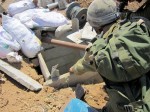
Gaza, July 28, 2014: An Israel Defence Forces soldier examines a newly revealed tunnel in the Gaza strip. (photo by IDF via Ashernet)

It’s been awhile since I’ve written. There’s a story I’ve been meaning to share but, unfortunately, circumstances have led me to write a different story entirely, about “the matzav.”

“The matzav” means, literally, “the situation,” but it’s used to refer euphemistically to a current bad security situation in Israel. You say it in a half whisper, the way our parents used to say, “cancer.”

“How’s business going now, with – the matzav?”

“We’re going up north for a few days because of – the matzav.”

“My mother-in-law has been with us for two weeks, thanks to – the matzav.”

It’s definitely not an easy time to be in Israel, though now, more than ever, there is no place I would rather be.

I didn’t grow up in a particularly Zionist household. Most of what I know about Judaism and Israel I learned in college. People used to say to me that being in Israel is like being with family, and making aliyah is like coming home. My family never shoved in front of me to get on buses or overcharged me for souvenirs, so I guess I just couldn’t relate.

I got a little taste of the family thing when I was visiting Israel 12 years ago on a mission during the Second Intifada, when tourism was at an all-time low. I went to the falafel stand in the Old City by the Cardo with my 10-month-old son. There were no other tourists to be found. The owner, who was usually just interested in taking orders and keeping the line moving, insisted on holding the baby while I ate. This was like my family – not always warm and fuzzy, but there for you in hard times.

These are hard times. There’s been a constant barrage of rockets in southern Israel for weeks, keeping the population within 15 seconds of a bomb shelter. As I wrote these words, four people were killed by a rocket fired from a playground in Gaza. This morning, a man on the radio was saying that he’s terrified to shower or even go to the bathroom for fear a siren will go off.

Another woman was asleep and didn’t hear a siren. She only heard the rocket hit her house. She is being treated in the hospital for wounds to the head, legs and knees, but no treatment will cure the fear you can hear in her voice, unable to speak in full sentences.

On the other side of the border, the suffering in indescribable and the media images haunting. I feel torn apart by my pain for the Palestinian losses on the one hand and the need for us to defend ourselves on the other. Then there’s the sadness for the soldiers who are trained to minimize civilian casualties, but who find themselves hurting innocent civilians, behind whom the cowardly terrorists hide.

Our “adopted” lone soldier Danna tells us stories of what her friends see who are serving in Gaza – hospitals and UN schools hiding weapons and terrorists; gunmen literally hiding behind families; terrorists shooting with a gun in one hand and a baby in the other.

As Golda Meir said to Anwar Sadat just before the peace talks with Egypt, “We can forgive you for killing our sons. But we will never forgive you for making us kill yours.”

Before the war started, I got a call one Friday afternoon.

“Hi, Emily. We’re thinking of cancelling the partnership minyan this week, but I just want to check with you, because I know you worked hard on your speech.”

“Oh, well, sure … but why?”

“We just thought it would be better for the whole community to pray together tonight because of, you know – the matzav.” (Pause) “Did you not here what happened?”

That’s how I heard about the three kidnapped soldiers.

You would think all three of them were from our kibbutz, the way people spoke of them and cried and prayed for them and organized around helping their families. The whole country was suddenly one big family. One big, sad family.

At school, the teachers held special meetings with their pupils to help them digest the news and share their feelings. They had a meeting in the evening to help parents with how to talk to their kids. All this despite the fact that the three boys were from a different part of the country and not at all connected to our school or our region, except that here everyone is connected. At these times, we’re all cousins, brothers, sons.

The news a few weeks later – that the boys were killed – hit hard. I was out for the day to Beit Shean with my son Abaye to get braces on his teeth. Abaye is very sensitive to “the matzav” and I try to keep him away from the news most of the time so we can share things with him in our own way, but there was no escape. The news was on in the dentist’s office, and staff and patients were openly crying. Afterwards, we went for ice cream and the ice cream shop was playing the tape over and over again. Everyone’s eyes were glued to the screen.

“You’re an ice cream shop!” I wanted to yell at them, but it wouldn’t have mattered. The whole country was in mourning.

Then the rockets started in the south. Everyone’s hearts turned to the families under fire. Our kibbutz Google group filled up with suggestions of where you could bring food and supplies, requests to run programs, and even invitations to drive down south into the fire to help entertain kids in bomb shelters. There were so many projects being run out of so many places that volunteers had to quickly set up a committee to manage them all.

Our area happens to be one of the safest parts of the country. We haven’t heard any sirens. We haven’t even unlocked our bomb shelters. So, everyone is opening their homes.

Several families have come to our kibbutz for a break, and our youth group organized a camp for a week with peers from a kibbutz in the south. I heard on the radio about a resort nearby that has opened its doors to another kibbutz (200 people!), feeding and housing them and running programs for the kids. And these are just a few tiny examples. Every community is doing something.

Then there are the troops fighting in Gaza.

photo - Tel Aviv, July 29, 2014: Israeli Prime Minister Binyamin Netanyahu at the press conference announcing an extension of the Gaza operation
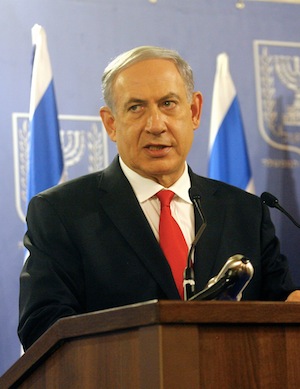
Tel Aviv, July 29, 2014: Israeli Prime Minister Binyamin Netanyahu at the press conference announcing an extension of the Gaza operation. (photo by Ashernet)

Soldiers were sent to the border to defend our country from rocket attacks. Prime Minister Netanyahu tried to stave off a ground incursion, but the rockets kept falling and, it seems, there was work that could only be done on the ground.

When the army finally went in, they discovered a complex underground tunnel network that Hamas had built to infiltrate Israel. It seems they were planning a massive operation for the upcoming Rosh Hashanah – hundreds of terrorists were scheduled to appear from nowhere in kibbutzim and villages across the south, dressed in Israeli uniforms, for a mega terrorist attack. It’s chilling to think about what they might have done.

Several of the fatalities of this war, including the three kidnapped boys, have resulted from terrorists coming through these tunnels. They lead from private homes in Gaza right into Israeli neighborhoods, one ending directly beneath the dining hall of a kibbutz. It was reported that children on the kibbutz had been complaining they could hear someone digging under them, but adults hadn’t taken them seriously, because how could that possibly be?

So, now we are at war in Gaza until we get rid of the tunnels, of which 30 have been discovered so far, and many destroyed. Meanwhile, the number of fallen and wounded soldiers continues to rise, as well as, of course, the massive toll on both terrorist and innocent Gazans.

But I wanted to tell you about the efforts to support our troops.

Being the army of the Jewish people, the aid started with, of course, food. Fresh meals, cakes and treats – you name them. A renowned chef opened shop to provide gourmet cuisine for the soldiers.

At one point, we got the message that it’s enough food, and now could we please send personal hygiene products (soaps, deodorants, etc.) and “fresh towels with the scent of home”? In addition, children sent so many letters of love and support that the soldiers use them to wallpaper their tanks and living spaces. At the camp for Adin, my nine-year-old son, they changed the program this week so that every day was a different activity to support the soldiers – making gifts, preparing food and raising money.

And, of course, it’s difficult for soldiers to communicate with their families, so the radio has taken to running extra programs in which they can send personal messages.

“Hi Mom, Dad and, of course, my girlfriend Tal. I’m here to protect you and I’m fine, so you can sleep without worrying. I love you.”

And I’m sure Mom, Dad, Tal and half the country are crying with me.

Among the first losses of the war, we heard about the falling of two lone soldiers – people like our “adopted” daughter, who moved to Israel voluntarily to protect our country, who are here with no family. It made me sad to think these people would be buried alone, but what could anyone do? Their whole family is overseas.

A photo of one of these fallen boys, Sean Carmeli from Texas, appeared on the news in a Maccabee-Haifa soccer T-shirt. They were his favorite team. The team apparently shared my concern and made an appeal for people to attend his funeral. Twenty thousand people showed up!

You could call it a social media ploy, but I don’t think so. The next day, there was a funeral for the other lone soldier, Max Steinberg from California. I was afraid his funeral would pale in comparison to Sean’s, seeing as he wasn’t a major sports fan. But my fear was baseless. Thirty thousand people were in attendance. Those who were interviewed about why they came simply said that he made the ultimate sacrifice for them when he didn’t need to, and it was the least they could do.

Max’s family had never been to Israel before. I thought about my own mother, who did not want us to make aliyah, and who would never forgive me if, God forbid, anything happened to any of my kids. Max’s parents and siblings were overwhelmed by the turnout.

His mother Evie told the mourners, “We now know why Max fell in love with Israel. It was all because of its people. He was embraced with open arms and treated like family,” she said, “and, for that, we are eternally grateful.”

When his sister began, “We come from a very small family,” I held my breath expecting to hear her anger or sadness at having lost her brother. Instead, she continued, “But that seemed to quickly change after meeting people in Israel, who made it feel like one big family.”

This morning, I was out walking in the forest around the kibbutz when a new song came on the radio by Ariel Horowitz, son of one of Israel’s greatest singers, Naomi Shemer. The song is about the lone soldier Sean Carmeli. The writer had attended the funeral and was deeply moved. The chorus goes something like this:

20,000 people and you’re at the front.
20,00 people are behind you, Sean.
Marching in silence with flowers,
Two sisters and 20,000 brothers.

Sgt. Nissim Sean Carmeli and Sgt. Max Steinberg, and all our fallen soldiers will never be forgotten, because we don’t forget family.

Emily Singer is a teacher, social worker and freelance writer. Singer and her husband, Ross, were rebbetzin and rabbi of Vancouver’s Shaarey Tefilah congregation until 2004. The Singers spent two years in Jerusalem and then moved to Baltimore, Md., where Ross was rabbi at Congregation Beth Tfiloh and Emily taught Judaic studies at Beth Tfiloh High School, until they moved to Israel in 2010. They have four children, and live on Kibbutz Maale Gilboa.

Format ImagePosted on August 1, 2014July 31, 2014Author Emily SingerCategories Op-EdTags IDF, Israel, Israel Defence Forces, Max Steinberg, Nissim Sean Carmeli
“Israel is an example”: Premier Christy Clark

“Israel is an example”: Premier Christy Clark

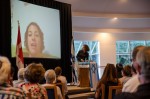
Kibbutz Magen member Shunit Dekel speaks via Skype to the almost 800 people who came out to Temple Sholom to show support for Israel. Dina Wachtel, executive director, Western Region, Canadian Friends of the Hebrew University, is at the podium. (photo from JFGV)

Close to 800 people gathered at Temple Sholom the night of July 27 to show solidarity between Canadians and the state of Israel.

Temple Sholom Rabbi Dan Moskovitz started the evening by leading the crowd in “Am Yisrael Chai,” and Jewish Federation of Greater Vancouver chair Diane Switzer read aloud a letter of support from Premier Christy Clark who wrote, “The current conflict in Israel and Gaza is of great concern to anyone who believes in democracy and human rights…. At this difficult time, let us remember the values we share with Israel: a vibrant, culturally rich, democratic nation committed to maintaining the rights of its citizens, regardless of gender or religion. Israel is an example not only to the region, but the world.”

photo - Farid Rohani, a businessman, social activist and a board member of the Laurier Institution, speaks to those gathered at Temple Sholom
Farid Rohani, a businessman, social activist and a board member of the Laurier Institution, speaks to those gathered at Temple Sholom. (photo from JFGV)

The event featured a number of guest speakers, including Shunit Dekel, a member of Kibbutz Magen, and Farid Rohani, a businessman, social activist and a board member of the Laurier Institution. Dekel spoke via Skype from her home 4.3 kilometres outside of Gaza. Her kibbutz was forced into lockdown three times last week, because of the danger posed by the underground tunnels connecting it with Gaza. Rohani addressed the issue of antisemitism in recent social media. Through his own analysis of Twitter, he concluded that the coverage is remarkably lopsided and that “remaining quiet is a disservice not only to the values that we share as Canadians, but to order and what is right.”

The event was a collaborative effort between several local organizations: Canadian Friends of Ben Gurion University, Canadian Friends of Hebrew University, Canadian Jewish Political Affairs Committee, Magen David Adom, Congregation Beit Hamidrash, Congregation Beth Israel, Congregation Temple Sholom, Congregation Schara Tzedeck, Hillel BC, Jewish Community Centre of Greater Vancouver, Jewish National Fund, Or Shalom, State of Israel Bonds and the Centre for Israel and Jewish Affairs, Pacific Region.

At the end of the night, community member Bill Levine remarked, “The tone of the evening was respectful, and stressed our desire for a peaceful resolution. It was good to see the community react in the spirit of coming together.”

Format ImagePosted on July 28, 2014July 28, 2014Author Jewish Federation of Greater VancouverCategories LocalTags Bill Levine, Canadian Friends of Ben Gurion University, Canadian Friends of Hebrew University, Canadian Jewish Political Affairs Committee, Centre for Israel and Jewish Affairs, Christy Clark, Congregation Beit Hamidrash, Congregation Beth Israel, Congregation Schara Tzedeck, Congregation Temple Sholom, Farid Rohani, Hillel BC, Israel, Jewish Community Centre of Greater Vancouver, Jewish National Fund, Magen David Adom, Or Shalom, Shunit Dekel, State of Israel Bonds
Hundreds rally in support of Israel

Hundreds rally in support of Israel

Rally in support of Israel drew a few hundred people to the Vancouver Art Gallery on Sunday afternoon. (photo by Shahar Ben Halevi)

Nearly 300 people gathered around the Vancouver Art Gallery on Sunday, July 27, at noon, to show support for the state of Israel and for peace in the Middle East.

The rally – organized by a Facebook group of Israelis in Vancouver – went peacefully, and there were no apparent counter protests in the area. The supporters carried signs calling for an end to the conflict, and emphasizing that Israel is fighting terrorists and not the people of Gaza.

The rally was covered by several local media representatives, but there were no speeches. The crowd sang together a few traditional Jewish songs and ended the event with Hatikvah, the Israeli national anthem.

Format ImagePosted on July 27, 2014July 27, 2014Author Shahar Ben HaleviCategories LocalTags Israel

Internet mostly good thing

What can we possibly add to the billions of words shed on the topic of the Israel-Hamas conflict? If this paper is in your hands – or you’re reading this on our new website or in our affordable and environmentally friendly e-edition – you probably already know where we stand.

If you are on social media, you probably know where every one of your friends stands on the issue as well. There has been a barrage of posts, tweets, emails and media pieces on every conceivable aspect of this conflict, its causes, its potential solutions, the actors, the victims, the sound and the fury.

There has also been a vast amount of analysis of media coverage of the events. It is fair enough to call out media for consistently biased reporting. But it does seem excessive sometimes to catalogue every instance of poor or malicious reportage. Media outlets we have never heard of before are getting widespread attention for bad journalism. The irony is that in the PR biz there’s an old saw that there’s no such thing as bad publicity as long as they spell your name right. Some newspapers and broadcast outlets that would be best ignored are instead going viral for all the wrong reasons.

This is not to say egregious reporting should go unchecked. Organizations like CAMERA, the Committee for Accuracy in Middle East Reporting, MEMRI, the Middle East Media Research Institute, PMW, Palestinian Media Watch, and the acronym-deficient Honest Reporting, do a bang-up job keeping reporters’ feet to the fire and illuminating journalistic atrocities around real-world atrocities.

In one of the most imaginative volleys, some anti-Israel brainiac took a still from the Hollywood horror film Final Destination 4, depicting grotesquely mangled human remains, and alleged that it was the work of Operation Protective Edge. Other “evidence” of Israel’s inhumanity turned out to be photos from the Syrian civil war.

For a few hours last week, there was an online rumor that the murder of Palestinian teen Mohammed Abu Khdeir was not the work of Jewish Israelis, but an “honor killing” by his own family allegedly because he was gay. Such a scenario would have reassured us of the uprightness of our side and the baseness of the other, but the facts came out and, sadly, did neither. In either case, a boy is no less dead.

There is certainly cause for concern over fair reporting, and false accusations and misrepresentations should, of course, be challenged, but is this where so much of our energy should be going? We live in a wired world where access to information is almost beyond the human imagination of just two decades ago. No matter on what side of an issue people fall, they will find data and stories that support their views. This is what the internet does well: it provides information and makes it accessible to almost everyone. What people do with that information, if anything, is up to them.

People in some parts of the world do not have the access we do to electronic information, which makes it easier for their powers-that-be to control the message, to propagandize. In North America and Europe, though, anyone who is undecided about an issue and who truly wants to learn more has the opportunity to do so from millions of articles, blogs, newscasts and other sources. This is a good thing. We should be vigilant when major media outlets skew the facts, but we should not expect them to take our position simply because we think we’re right. (We are.)

Instead of being fearful and demanding more regulation of ideas, the reality of this still-new electronic world is that we need to learn – and we need to teach our children – to be effective media critics who can tell good sources from bad. We have the freedom to engage in dialogue and we should. For the most part, we can’t control how others present themselves and their views, but we can choose to present our own wisely and with civility.

Posted on July 18, 2014July 17, 2014Author The Editorial BoardCategories From the JITags CAMERA, Committee for Accuracy in Middle East Reporting, Honest Reporting, Israel, MEMRI, Middle East Media Research Institute, Operation Protective Edge, Palestinian Media Watch, PMW

Posts pagination

Previous page Page 1 … Page 109 Page 110 Page 111 Next page
Proudly powered by WordPress