
Football and its roles

On June 24, the Vancouver Holocaust Education Centre hosted The Dual Role of Football During the Holocaust, an online conversation with Paul Salmons, Kevin E. Simpson and Liz Berger, three scholars on sport and its place in modern Jewish history.
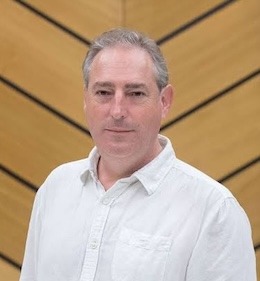
photo - Paul Salmons
Paul Salmons (photo from vhec.org)

Salmons, an historian and curator, began with a grim chapter in football’s story: the Mauthausen Concentration Camp in Upper Austria, where, from 1938 to 1945, some 200,000 prisoners were held and 100,000 died.

Immediately outside the camp, said Salmons, a football (soccer) field was constructed through the labour of the prisoners. SS soldiers formed a team that played league games on the pitch from 1943 to 1945.

Players, fans and officials would have had a clear view of the camp’s infirmary, where sick and dying prisoners were quarantined to prevent the spread of disease. There are reports, Salmons said, that the dead were taken out of the infirmary, past the field while a game was being played and up a pathway towards the gates of the camp. Additionally, he said, there were reports that the stench of burning bodies from the crematoria permeated the surrounding areas for the period of the camp’s existence.

“This is a very visible picture of the atrocities that are going on while they are cheering on their team, while they are celebrating those goals,” Salmons said. “What does that do in terms of the attitudes or the opinion of the footballers themselves? These members of the SS, this team of murderers, are being cheered on by the local people. Maybe in the pub that night they’re being bought a drink, maybe people are patting them on the back for the goals that they scored.”
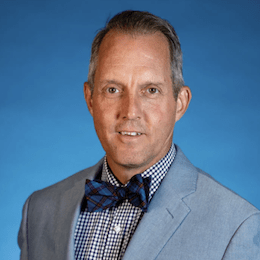
photo - Kevin E. Simpson
Kevin E. Simpson (photo from vhec.org)

Simpson, an author and professor of psychology at John Brown University, discussed the prisoner experience at Terezin, north of Prague, a camp that housed Jews prominent in science, the arts and sports, and was used by the Nazis to deceive the outside world into thinking prisoners were treated well.

Football participation at the camp was so widespread that prisoners were able to create a league, Liga Terezin, and teams were formed by the nationality of the player or the particular job they were assigned, explained Simpson.  

Female prisoners at the camps would design kits for the players; games were wildly popular and tickets were highly in demand, as photos from the camp illustrate. Hundreds of matches were played during a season, he said. With the liquidation of Terezin in October 1944, many of the players, like the rest of the prisoners, would be sent to Auschwitz, where they would die.

Among the professional players who were imprisoned at the camp was a standout Czechoslovakian goaltender, Jirka Taussig. Simpson cited an interview with Taussig, a survivor who later moved to the United States and would also be known as George Tesar. Of the games, Taussig said, “We were the stars of Terezin. Every Sunday afternoon, 3,500 fans came to watch the league matches. The youth saw us as a model to imitate.

“We gave them hope, and we represented life. In all the misery and suffering, hope was a rare thing,” said Taussig. “We played for them because we knew that shortly they would be sent east, and we felt that we gave them a little spark of light before their death.”

photo - Liz Berger
Liz Berger (photo from vhec.org)

Berger, a research consultant with UNESCO, spoke about the postwar period to the present, examining what sport has meant to Jewish communities and what the consequences are when that meaning is denied or weaponized.

“Sport is never just athletic competition. It’s one of the main domains through which societies talk about and express and sometimes form their deep values,” she said. Sport is a powerful tool for “communal recovery, identity transmission and the assertion of continued presence and vitality,” she noted.

At the same time, sport can be used as a venue for antisemitic or racist expression. Antisemitism in sport can be viewed as an indication of a society’s broader tolerance for antisemitism.

“Antisemitism in sport is not a lesser form of antisemitism. It’s not minor. It’s a manifestation of how a society relates to their Jewish communities if they have them or their concept of who Jews are if they don’t,” she said.

Berger pointed to football fandom, particularly in Europe, which is organized around tribal loyalties, class identities and historical memories. Fan support in Europe is frequently an expression of who a person is ethnically, historically and politically.

Meanwhile, Berger said, some European clubs, such as Tottenham Hotspur in England or Ajax in the Netherlands, are seen as Jewish teams, despite what might seem at times tenuous connections to the Jewish community. These teams have been the target of antisemitic hostility from the opposing fans and, conversely, demonstrate a form of solidarity with the Jewish community from supporters.

The day of the VHEC webinar happened to be a notable one in Canadian football. A few hours earlier, the men’s national team advanced beyond the preliminary round of the World Cup for the first time in its history. They were eliminated later in the tournament.

The VHEC will host two more football-related events: Football, History and Society, an online discussion with journalist Simon Kuper, on Aug. 25, and Holocaust Education in the Modern Stadium, a conversation at the Italian Cultural Centre, on Oct. 27. To watch the June 24 webinar, go to vhec.org/football_during_the_holocaust. 

Sam Margolis has written for the Globe and Mail, the National Post, UPI and MSNBC.
Making soccer political

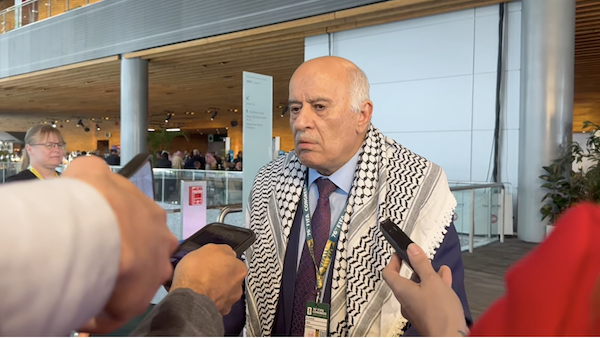
Palestinian Football Association president Jibril Rajoub talks to reporters at the FIFA Congress, held in Vancouver on April 30. (Screenshot youtube.com/@thebreakernews)

While the World Cup doesn’t kick off until June 11 – at Mexico City’s Estadio Azteca when Selección de fútbol de México faces off against the South African squad, nicknamed Bafana Bafana (the Boys, in Zulu) – penalty cards have already been drawn. Palestinian Football Association (PFA) president Jibril Rajoub, general secretary Firas Abu Hilal and vice-president Susan Shalabi Molano were initially denied entry to Canada to attend the FIFA Congress on April 30, and the Asian Football Confederation confab two days earlier – both events were held at Vancouver Convention Centre.

Ultimately, Immigration, Refugees and Citizenship Canada (IRCC) allowed the three sports bureaucrats to attend, and Rajoub, 72, has made the Mondial into a political football. Since 2024, he has repeatedly raised the issue of Israeli football clubs allegedly playing illegal matches in what the PFA argues is occupied territory that Israel captured in the 1967 Six Day War.

In March, FIFA (which stands for Fédération Internationale de Football Association) issued a report on the issue, ruling it would “take no action” over the PFA’s claim. The report noted that resolving “the final legal status of the West Bank remains an unresolved and highly complex matter under public international law.”

At the FIFA annual meeting in Vancouver, Rajoub – who also serves as secretary general of Fatah’s Central Committee – snubbed FIFA president Gianni Infantino, who attempted to orchestrate a handshake between the heads of the Palestinian and Israeli delegations. Following individual addresses toward the end of the assembly, both Rajoub and the Israel Football Association’s vice-president, Basim Sheikh Suliman, were summoned to the stage by the FIFA president.

“We will work together … let’s work together to give hope to the children. These are complex matters,” he said. But Rajoub refused to stand alongside Sheikh Suliman. Instead, he pledged to take his complaints to the Court of Arbitration in Sport, based in Lausanne, Switzerland. No date has been set for the hearing.

“I refused to shake hands. Sport is sport … for me that should be respected,” he told Reuters. “But, if the other side is representing a criminal like Bibi [Netanyahu] … how can I shake hands or have a photo with such a man?”

The PFA’s three-member delegation wasn’t the only one held up by the IRCC. Iranian soccer federation president Mehdi Taj said Canadian officials cleared him to enter the country for the FIFA Congress, but Iran’s delegation chose to turn back after being held for three hours and questioned at Toronto’s Pearson International Airport, Iranian media reported on May 1.

Rajoub, also known by the nom de guerre Abu Rami, has long been connected to Palestinian terrorism. In September 1970, he was arrested for throwing a grenade at an Israel Defence Forces bus near Hebron. Tried and convicted of this attack and of membership in an armed group, he was sentenced to life in prison. Fifteen years later, he was one of 1,150 security prisoners Israel released in exchange for three hostages held by the Popular Front for the Liberation of Palestine – General Command.

Re-arrested in 1987 for his activities during the First Intifada, Rajoub was deported to Lebanon in 1988. Relocating to Tunisia, he served as an advisor to Fatah deputy leader Khalil al-Wazir. After Wazir’s assassination by Israeli agents, he became a lieutenant of Yasser Arafat, then head of the Palestinian Authority (PA), and was allegedly behind a 1992 plot to assassinate Ariel Sharon.

Rajoub was allowed to return to the West Bank in 1994, following the signing of the Oslo Accords. He served as head of the PA’s Preventive Security Force until 2002. The following year, Arafat appointed him national security advisor.

The FIFA Congress was the 76th since FIFA was founded in 1904. It brought together more than 1,600 international delegates from 211 FIFA member associations.

This summer’s 48-team competition – the most widely watched sporting event in the world – takes place in multiple cities in Canada, the United States and Mexico from June 11 to July 19. Neither the Israeli nor the Palestinian team qualified for the tournament. 

Gil Zohar is a journalist and tour guide who lives in Jerusalem.

Love for country is earned!

You don’t have to be a sports fan to have been intrigued by the biggest story in the National Football League the past month.

Colin Kaepernick, the now back-up quarterback of the San Francisco 49ers made a stand (or a kneel, per se) in support of the imbalance he sees in how African Americans are treated in the United States by refusing to stand for the US national anthem before games.

Kaerpernick, who is of mixed race, stated that he will not stand for the anthem of a country that does not offer African Americans proper respect and equal treatment.
Colin Kaepernick from Wikipedia
The response has been mixed, with either loud voices calling Kaepernick’s actions a distraction to his team or screams from patriotic Americans raucously booing the quarterback any chance they get for betraying his country.
A seemingly small few have supported his right to take a knee (although his jersey soon became the hottest on the market).
I am not here to get into a debate over the Black Lives Matter movement or even to discuss the issue of equal rights in the United States. That’s for another forum.
While I appreciate all sides of the argument around pro athletes using their platform to make political statements, my take on this issue lies within the question of what a national anthem is supposed to represent.
Whether you agree with Keapernick’s opinion on the state of affairs in his country or not, a national anthem is a show of pride, of patriotism, of love and affection for the country you live in. It is a way to say “I love you” to your country.
But if you are not proud of the country you live in, pay taxes in, work in, contribute to society in, then you should not be expected to unconditionally stand and sing her praises.
Just as a child who is abused by her father should not be expected to unconditionally say “I love you” simply because he is her father, citizens of the United States should not be expected to sing The Star Spangled Banner unconditionally if they feel their community is being abused by their country. Nor should they be asked to leave “if they don’t like it.”
Kaepernick, and the many athletes who have since followed his lead, are staying. And they are asking more from their country if their country wants them to stand and say “I love you.”. Kaepernick has stood in front of any microphone that asks the question and stated exactly what he expects for from his country. He is not proud to be an American right now and he is not wrong to feel that way.
I have also heard many argue that the singing of anthems are a time to show respect to the many men and women who have given their lives for their country, and I respect that take. However, I also suspect those men and women would be rolling in their graves right now if they knew what the country had done with those rights and freedoms they fought to defend. Did they die so that political corruption and immoral behavior would lead the way in their country? Did they die so that America would have only two legitimate political choices at each election? So that children would be born into homes that identified themselves as either Republican or Democrat regardless of the petulant child that was leading their party
I’d like to think not.
Rather than starting every conversation on the topic with the words “I’m proud to be an American, but…”, ALL Americans should be demanding more from their country.
Clashes with police, race wars, mass shootings, ridiculous gun control debates, and the ultimate embarrassment of Donald Trump being considered a legitimate candidate to run their country are embarrassing for the so-called leaders of the free world.
I respect any American for feeling proud of many of the things their country has stood for over the years. More specifically, I respect the challenges of managing the responsibility of playing the worldwide role the USA accepts on a daily basis. But today, in the United States, it is ok not to be so proud.
Standing for a national anthem should not be a requirement of being a citizen of a country. Doing what you can to support, advocate for or improve that country should be. Kaepernick’s actions were designed to instigate much-needed debate and awareness in his country. This will serve them far better than unconditionally standing for a song.
Let’s hope he decides, once again, to stand proud.
In the mean time….”Ohhh Canadaaaaa!!!”