
Skip to content
  • Home
  • Subscribe / donate
  • Events calendar
  • Business Directory
  • FAQ
  • News
    • Local
    • National
    • Israel
    • World
    • עניין בחדשות
      A roundup of news in Canada and further afield, in Hebrew.
  • Opinion
    • From the JI
    • Op-Ed
  • Arts & Culture
    • Performing Arts
    • Music
    • Books
    • Visual Arts
    • TV & Film
  • Life
    • Celebrating the Holidays
    • Travel
    • The Daily Snooze
      Cartoons by Jacob Samuel
    • Mystery Photo
      Help the JI and JMABC fill in the gaps in our archives.
  • Community Links
    • Organizations, Etc.
    • Other News Sources & Blogs
  • JI Chai Celebration
  • JI@88! video

Recent Posts

  • SFU honours Gloria Gutman
  • Lifting people’s spirits
  • Wedding a ray of light
  • Indigeneity and Zionism
  • Rule of law broken: councilor
  • Football and its roles
  • The burden of defence
  • Fish Café returns after fire
  • All right in what goes wrong
  • Nuns & mermaids at TUTS
  • Camp offers holiday retreat
  • Students and mentors inspire
  • Once-in-a-lifetime trip
  • 100 dancers, one heart
  • Money for the sciences
  • What “Jewish food” means
  • Have a cookie, schnitzel too
  • Federation now across BC
  • Israel fighting for its existence
  • Deal strengthens Iran
  • Patriotic belonging diminishes
  • A campaign to engage
  • Upstanders’ first live event
  • Responding to Carney
  • Having your own home
  • Music a family tradition
  • Musical to warm heart
  • Community milestones … June 2026
  • Sharing her passion for Israel
  • Or Shalom reopens its doors
  • JFS from past to future
  • Need holistic approach
  • Sharing stories, advice
  • Journalist shares fears
  • Skills to live together
  • Road to independence

Archives

Follow @JewishIndie
image - CJN box ad Rockowers 2026

Tag: Winnipeg

Museum tries to instil hope

Museum tries to instil hope

Canadian Museum for Human Rights researcher and curator Dr. Jeremy Maron discussed some of the issues the museum faced in deciding what to exhibit. (photo by Rebeca Kuropatwa)

The Canadian Museum for Human Rights (CMHR) in Winnipeg is one of the newest museums on the block. Dr. Jeremy Maron, a CMHR researcher and curator, discussed some of the issues the museum faced in deciding what to exhibit. The March 4 brown-bag lunch meeting at the University of Manitoba was open to students and the general community.

Maron’s main work at the museum is on the fourth floor, an area dedicated to the Holocaust. Displays on three perimeter walls take a case study approach, emphasizing themes closely related to the Holocaust as well as universal human rights.

“The first theme we look at is the abuse of state power,” he said. “This wall explores how Nazis used and deployed instruments of state power, such as the police, judiciary, laws and regulations, and even education to undermine human rights … and acquiring total dictatorial control of German society, promoting their racist and antisemitic ideology, targeting Jews and other specific groups for social exclusion and persecution, ultimately culminating in genocide.”
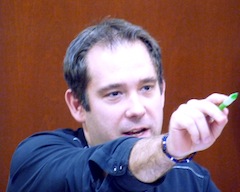
photo - Dr. Jeremy Maron makes a point at a March 4 meeting in Winnipeg
Dr. Jeremy Maron makes a point at a March 4 meeting in Winnipeg. (photo by Rebeca Kuropatwa)

Maron said the modern nation state, in its ideal sense, is supposed to be the guarantor of human rights. But, in reality, the centralized power of the modern state very often sets the stage for it to be the worst violator of human rights.

“The case of Nazi Germany is a good example of the centralized power and the capacity for it to be mobilized toward the violation of human rights, rather than protection,” he said. “There are many other stories in the museum in which state power is also being utilized in such a manner.

“The second thematic wall in this gallery … moves on to look at persecution and targeting of specific groups in Nazi Germany. This wall explores the increasing intensity of systematic oppression under the Nazis.”

According to Maron, the Allies did not fight the Second World War specifically because they were trying to save the Jews in Europe. However, their winning of the war ended the Nazi massacre of Jews, which continued nearly up until the day of the Germans’ surrender.

“Another exhibit, from which we try to draw human rights connections, is a large digital study table in our Breaking the Silence gallery, also on level four,” said Maron. “This gallery looks at breaking the silence specifically as a human rights act.”

Human rights violations are always accompanied by silence, distortion, justification, minimization and denial, he said. Perpetrators want to hide their crimes; victims who survive may feel scared for themselves or their families, or feel ashamed; witnesses and bystanders often look the other way, so the cycle continues.

The goal of the CMHR is to encourage people to speak out about these violations, to drag the violations out into the light of day and pursue justice, recovery and reconciliation, he said.

“This particular exhibit, Breaking the Silence … looks at a wide scale of human rights violations, putting an emphasis on how people have responded to them in order to break silence,” said Maron. “We tried to place the emphasis of the human rights response in this particular case. It’s a question of focus that tries to adopt a forward-looking perspective, rather than one that is trying to wholly examine the past in and of itself.”

While some visitors feel that the message and exhibit is too watered down, Maron said this was necessary to a certain degree, as the museum’s main focus is to educate and not to horrify or shock.

“It’s not just a sense of sensitivity we think about, it’s also a question of a fact,” said Maron. “Sometimes, when confronted with material that is explicitly horrific, even for someone like myself who has worked on this material extensively, it almost can shock you into silence as it overwhelms you. I think back to when I was doing my master’s in 2005. I went on a Holocaust commemoration tour [and] we toured Auschwitz. After you go through the gas chambers and you see the walls and the showerheads, you get back on that bus and you are just beaten down. You are sitting there and the guides are trying to debrief and talk, but no one wants to talk because they are beaten down.”

While the CMHR does not back away from the truth or gloss over troubling aspects, they choose to visualize these histories differently, he said. One of the concepts the museum is designed to highlight is that everyone’s actions are the result of choices, and that the consequences of these choices are not inevitable.

“That’s not to say that there are not constraints on choices,” said Maron. “If you’re in the midst of a particular human rights catastrophe and you do something like hide a potential victim in your attic, it’s very possible that you might be targeted as well. So, there are constraints on choices in certain historical circumstances. But, it’s still important to consider that these are choices and actions, and what happens isn’t inevitable. Some objects in the museum speak to some of the less obviously consequential choices that individuals might have made that allowed the Holocaust to be perpetrated on that scale.”

While Maron understands that it’s impossible to know for sure what a single individual could have done, with his display, he hopes to create a deep and meaningful reflection for CMHR visitors and, especially, students.

How to convey a history of conflicts accurately without reigniting tensions is another challenge the museum has taken into consideration, by using careful word choices and avoiding blanket statements. But, maybe the most important aspect and aspiration for the CMHR is ensuring that visitors leave with a sense of hope.

“This hope is not a naive hope that everything is going to be OK, but that … hope is possible as long as we promote the human rights of everyone, and the idea that hope is possible if people are willing to make hard choices and take action,” said Maron. “So, again, we hope our visitors leave with the idea that change is possible if people are willing to do something, while silence and acquiescence is the ally of rights violations.

“Until atrocities are recognized and acknowledged, until people believe action is possible, cycles of violations will continue. Such cycles, we hope, our museum, in some small part, can help improve by inspiring a lot of hard work and devotion by our visitors, who may become dedicated human rights advocates and defenders.”

Rebeca Kuropatwa is a Winnipeg freelance writer.

Format ImagePosted on June 3, 2016June 1, 2016Author Rebeca KuropatwaCategories NationalTags Canadian Museum for Human Rights, CMHR, Holocaust, human rights, Maron, Nazi, Winnipeg
Finding joy in food and art

Finding joy in food and art

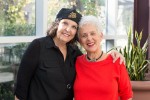
Talia Syrie (photo from Talia Syrie)

In 1999, Israeli-born longtime Winnipegger Talia Syrie spent her summer working as a tree planter in British Columbia. Trained as a heavy diesel mechanic, she was tree planting to pay off her student loans. A month into the summer, Syrie stepped on some broken glass and injured herself. Not yet ready to leave, however, she found work in the kitchen, helping feed 90 planting staff.

“I kind of endeared myself to the kitchen staff and they let me stay on,” said Syrie. “I realized, doing that, that I really enjoyed it, really liked cooking. I came back to Winnipeg and did that for the next year or two.

“I really liked the bush-camp cooking experience, when you’re out in the middle of nowhere and you don’t have the resources available to you that a regular kitchen provides. I liked that challenge.”

With this newfound passion, Syrie started working in the catering world. Then, a friend suggested that she open her own catering business.

With that, Syrie began searching for a commercial kitchen from which to work, eventually finding a small one at a downtown hotel. The owner offered her the kitchen, as long as she also agreed to open a restaurant at the hotel.

“There wasn’t anything like that in the neighborhood, on Main and Logan,” said Syrie. “It’s now the Red Road Lodge, but it used to be the Occidental Hotel. I had grown up in the North End, where my grandfather on my father’s side had a business. Today, too, I live quite close to there (in North Point Douglas).

“It felt nice to be working in that neighborhood, I was happy to do it. I didn’t really think that anyone would come into the restaurant. I thought it was going to be mostly for show and then we’d run the catering company and have this ‘fake’ restaurant.”

When Syrie first opened the Tallest Poppy, they only had three or four tables. As it turned out, these tables were always occupied, so they had to add more. In no time, the restaurant was so busy that Syrie did not have much time for catering.

“It was very challenging at the beginning, the restaurant industry,” she said. “Having little to no restaurant experience, there was a pretty steep learning curve. It was exciting and there was a lot of fun and a lot of things were great, but, in a lot of ways, it was pretty messy.

“I always say that I’m really grateful that we started out where we did. The North End is pretty forgiving, pretty gentle with us, so we were able to make mistakes and learn things.”

After a few years, Syrie found enough time to start developing the catering part of her business, doing office lunches, barbeques and small parties. “We also cater a lot of funerals,” she said.

“I love making party sandwiches,” added Syrie. “If I could do anything, I’d probably just make party sandwiches. That would be my dream job. I like the practical nature of a lot of catering. You have a whole bunch of people and they have to eat, people working that have to be fed.”

Syrie said her primal drive to feed people has its roots in her Jewish upbringing, being taught at an early age that the only way to really show someone you care is by feeding them.

“That’s the only way that really counts,” she said. “You buy somebody a car, it doesn’t matter. If you make them soup when they’re sick, that’s how they know you actually love them.”

About three years ago, a new community marketplace, Neechi Commons, opened in the neighborhood. The owners asked Syrie for help setting up their restaurant. She agreed, as she was happy to help a worthwhile project in her neighborhood. She ran both places for awhile and, later, decided to close the Tallest Poppy.

Once the Neechi Commons restaurant Come ’n Eat was up and running, Syrie opted to move on. She returned to British Columbia to do some consulting work for a friend and then returned to Winnipeg to find a new location to reopen the Tallest Poppy.

“I was walking down Sherbrook Street with a friend one day,” said Syrie, “and, as we were passing by the Sherbrook Hotel, he said, ‘I think that’s a restaurant … I think you should check that place out.’ All the blinds were shut. My friend said it used to be a Chinese food restaurant, but that there is nothing in there now…. I called and made an appointment to come down and take a look. The rest is history, as they say.”

Syrie reopened the Tallest Poppy in its new location last September. Not knowing the neighborhood well, she did not know if her concept would be a good fit, but she has found the people to be very welcoming, generous and kind.

Wanting to give space to the arts community, Syrie has offered her restaurant walls to local artists.

“I don’t know if I support the artists or they support me,” she said. “It’s important to me to have art around me all the time. It makes me feel better. It’s kind of selfish. The Winnipeg arts scene is so exciting. I work a lot and I’m stuck in my restaurant a lot of the time. I can’t always get out to gallery openings or go to shows. It’s really convenient for me to have them come do it right at my place.”

Syrie has formed a connection with a local company that displays art in public places, called Synonym Art Consultation, and the company organizes and programs all the restaurant’s art-related happenings. This includes a residency project that brings in an artist once a month to the restaurant to create art in the restaurant, while also interacting with clientele. “They are these super people doing this wonderful work,” said Syrie. “We sort of ride on their coattails. I’m very privileged and honored that they’re willing to work with us.”

The artists are varied, and some are performers.

“They come for two to three days, generally on the weekends, and people are able to engage them, which is a lot of fun,” said Syrie. “So, regular people having breakfast can come and talk to the artist about the work they’re doing.

“The artist has an opportunity to engage a lot of people they may not normally have access to. Their work is shown in the restaurant for a month, whatever it was that they built or did.”

The Tallest Poppy also hosts an after party on the first Friday of every month for people who go from gallery opening to gallery opening, including food and an arts presentation with DJs.

“A lot of things about Winnipeg make it really hospitable for independent business,” she said. “Our economy is pretty stable and there’s a bunch of hardworking people who are generally pretty down with jumping on board if you have a good idea. If I was going to do something else, this is the only place that makes sense for me to do it.”

Rebeca Kuropatwa is a Winnipeg freelance writer.
Format ImagePosted on April 15, 2016April 13, 2016Author Rebeca KuropatwaCategories NationalTags restaurant, Syrie, Tallest Poppy, Winnipeg
Klezfest in Winnipeg

Klezfest in Winnipeg

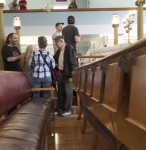
Winnipeg Klezfest co-producers Bev Aronovitch, left, and Miriam Bronstein. (photo from Rady JCC)

After attending the week-long KlezKanada Laurentian retreat near Montreal, Miriam Bronstein and Beverly Aronovitch wondered, why not do the same in Winnipeg? And so, they began planning – the city’s first Klezfest took place at the Rady Jewish Community Centre on Oct. 10 and 11.

Bronstein, a retired music and high school drama teacher who continues to perform at the Fringe Festival, is also very involved with Soup Sisters, an organization that makes soup for women’s shelters. Aronovitch is a jazz musician, producer and retired teacher.

As both Bronstein and Aronovitch are of Eastern European decent, klezmer spoke to them. “I’m a singer, she’s a piano player, so we thought it might be fun to go spend time in that scene,” said Bronstein. “I never realized that I actually speak Yiddish because, as I grew up, my mother spoke Yiddish with me, but I only answered her in English. So, it’s actually quite remarkable that I can speak Yiddish.”

Of the KlezKanada experience, Bronstein said, “It was life changing. It reconnected me with that Eastern European community. It was very, very cool.”

At KlezKanada, Aronovitch and Bronstein enjoyed seeing people of all ages, from toddlers to 90-year-olds, dancing to the music, as well as McGill University students taking a klezmer course.

“There were people from all over the world, musicians from all over the world, and they weren’t all Jewish,” said Bronstein. “It was just such a scene that both of us just said, ‘Oh my gosh! We have to do this in Winnipeg!’ We just took it on when we came home. We didn’t forget about it. We just pursued it.”

Although KlezKanada was a week long, Bronstein and Aronovitch felt that the first such festival in Winnipeg had to be shorter, at least for starters. They began by booking the world-famous Klezmatics from New York and, with the help of Winnipeg’s own Finjan – Kinzey Posen, Shayla Fink, Myron Schultz and Daniel Koulack – they put together a full day of festivities. It kicked off with a Saturday night Klezmatics performance, followed by several Sunday workshops, culminating in a concert led by members of Finjan and the Klezfest faculty.

“We had a wonderful workshop about great Yiddish composers and beginner klezmer playing sessions, and then a more advanced session called Readers’ Romp,” said Bronstein.

“One idea we had that is unique to Winnipeg was that we very much wanted to cross borders and recognize we have many ethnic communities in Winnipeg, so we had a workshop called Common Roots,” she said. “We got Ukrainian musicians and Romanian musicians. We brought people in from the city and the theme was ‘Weddings.’ They played what you’d play at a Ukrainian wedding and then the members of Finjan played what you’d play at a Jewish wedding.”

Bronstein would like to expand on the Common Roots concept next time, as there is a big Eastern European contingency in Winnipeg. She’d also like to see annual Mamaloshen Festival of Yiddish Entertainment and Culture attendees participate in Klezfest.

With their first Klezfest behind them, Bronstein said, “We’re just kind of basking in the glow. It was hugely successful. In the end, everybody was dancing in the foyer. It was so wild, it was so thrilling. People were so elated to be part of it. I taught at the Jewish day school here and there were 25 high school students who were part of the event.

“There were some people, some non-Jews – a considerable amount considering it’s Winnipeg and it’s a small community in general – but it would be nice if it was even more widespread. I think that, the more we do it, we increasingly make the name known, and it will open up even more to the general community.”

Bronstein and Aronovitch would eventually like to see participants get to a point where they are able to lead a performance at the end of the festival. Bronstein envisions this as “a participatory type of performance, where people who did dance classes can present what they learned and people who did the playing workshops can be a part of the band.”

She added, “It was a pleasure to work with our fantastic working committee and the Rady JCC. Without them, it could not have happened.”

Rebeca Kuropatwa is a Winnipeg freelance writer.
Format ImagePosted on December 4, 2015December 3, 2015Author Rebeca KuropatwaCategories MusicTags Beverly Aronovitch, Finjan, Klezfest, Klezmatics, Miriam Bronstein, Winnipeg
Walk Winnipeg’s North End

Walk Winnipeg’s North End

Walk participants explore the Ashkenazi synagogue, the oldest in Winnipeg, on a tour led and organized by Zach Fleisher. (photo from Zach Fleisher)

Not so long ago, Winnipeg’s Jewish community hub was the city’s North End. With Yiddish spoken on the street, Jewish businesses could be found on many corners, as could kosher butchers and synagogues. Since then, however, many Jews and Jewish-owned establishments have moved south or closed down entirely. Some of the North End buildings have been rebuilt or redesigned, while others have been preserved for various reasons. A recent walk – set up via Jane’s Walk – showcased the area’s history and current-day reality.

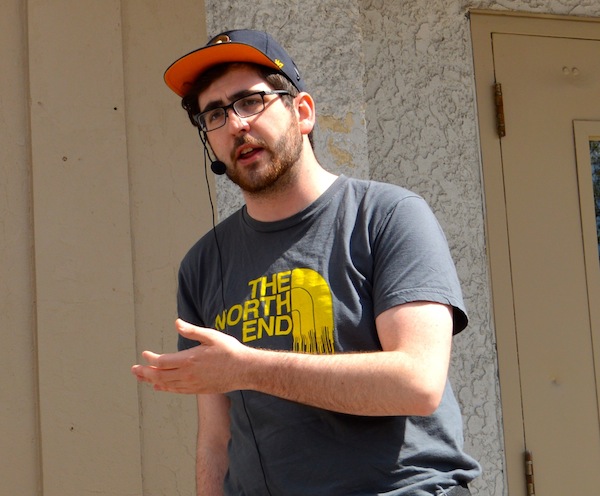
The early May tour was led by Zach Fleisher, 22. A history buff and University of Winnipeg student, he is chairperson of the Canadian Federation of Students Manitoba. In his spare time, he is involved with other projects, with the main goal of making Winnipeg a better place.

“I’ve always found myself enamored with the work of famous American-Canadian urbanist Jane Jacobs (for whom Jane’s Walks are named),” said Fleisher. “And, I’ve always been interested in how we build and define community. In that spirit, I’m quite interested in the history of Winnipeg and the Jewish population, especially the North End area.” He hopes people who took the tour will see the area differently now that they are aware of its history.

According to its website, “Jane’s Walk is a movement of free, citizen-led walking tours inspired by Jane Jacobs. The walks get people to tell stories about their communities, explore their cities, and connect with neighbors.” The free walks are held annually in more than 100 cities in 22 countries around the world on the first weekend of May each year, including in Vancouver.

Fleisher attended a few Jane’s Walks in Winnipeg last year and has informally given tours of different areas for a friend of his, Nicholas Audette, who suggested he get involved with the movement in a more formal way.

While some people RSVPed for his walk, there was no requirement to do so. “That’s what makes the Jane’s Walk so unique – the lack of commitment and organized structure that culminates in a strong sense of community,” he said.

Fleisher’s May 4 walk attracted more than 70 people. “I think a lot of people know that the North End carries a lot of history, but they are always interested in hearing a bit more about the area and its unique history,” he said.

The tour began from what used to be the old Canadian Pacific Railway station at 181 Higgins Ave. “The CPR station, where thousands of immigrants passed through, is now home to an aboriginal centre, housing a variety of offices,” explained Fleisher. “It was a place of great significance and a proper starting point, as almost every Jewish newcomer to the city would also have begun their story in Winnipeg at that same spot.

“This station was one of two major train stations in Winnipeg, the other being Union Station on Main Street.” The station fell out of use in the 1970s, he said.

Walking through Point Douglas on Austin Street, the tour headed toward Chesed Shel Emes funeral home. Along the way, Fleisher pointed out what was formerly the Sharon Home, which was originally established as a rehab centre, but became a personal care facility; it is today located in the city’s South End, and called the Saul and Claribel Simkin Centre.

Although the North End has not seen a significant Jewish population in two generations, the many buildings and sites that are historically relevant remain, along with a number of other key cultural institutions.

“At its peak, it’s believed that over 15,000 Jews – primarily from the Ukraine, Poland and Russia – called the North End home,” said Fleisher.

Once at Chesed Shel Emes, participants were given a brief history of the facility by Sharon Allentuck, who was representing the chapel because its executive director, Rena Boroditsky, was away. The funeral home was founded in 1930 by volunteers who wanted to ensure that every Jew had access to a proper Jewish burial and, in 1947, the chapel was built, she explained.

The walk then continued along Main Street to Burrows Avenue, to Congregation Ashkenazi. “The Ashkenazi is the oldest synagogue in Winnipeg and has a second floor only for women,” said Fleisher. “According to [its] tradition, non-married Jewish men don’t wear tallit, because the women on the second floor then got to pick their husband.”

Saul Spitz, who organizes the maintenance and care of the building, was on hand to give a talk and lead a tour of the synagogue.

“The North End has a rich tradition that continues today,” said Fleisher. “Along with the times, the type of community has changed. While the Jewish North End may be a memory of years past, it’s important to recognize the heritage of the area.”

photo - Zach Fleisher in front of what used to be the building housing the city’s Hebrew Sick Benefit Association
Zach Fleisher in front of what used to be the building housing the city’s Hebrew Sick Benefit Association (photo from Zach Fleisher)

After passing by the German Club at Flora and Charles streets, which was the home of the Talmud Torah at one time, the walk continued on to one of the few Jewish businesses still around in the North End – Gunn’s Bakery, which opened in 1937.

Fleisher noted that Gunn’s is located next to what was formerly the Hebrew Sick Benefit Hall, now home to a Christian worship group, though the building still retains the initials HSB.

Fleisher said he would love to organize another walk if there’s interest, and “to branch out a bit as well. So many of the folks who made it out had their own additions to the oral history of the walk and were able to contribute as necessary. I aimed to provide a basic framework for the walk and so many people were able to bring their own lived experience to the table.

“The walk was a great experience and it was great to see that I’m not the only one with a passion for the rich diversity of the area,” he continued. “The Jewish component is only one part of the rich diversity of the North End and I’d encourage everyone to read up a bit more on such a dynamic area.”

The next Jane’s Walk weekend is scheduled for May 6-8, 2016. To find out about walks in the various cities or to organize one of your own, visit janeswalk.org for more information.

Rebeca Kuropatwa is a Winnipeg freelance writer.
Format ImagePosted on June 26, 2015June 25, 2015Author Rebeca KuropatwaCategories NationalTags Chesed Shel Emes, Gunn’s Bakery, Jane Jacobs, Jane’s Walk, Jewish history, Winnipeg, Zach Fleisher

Posts pagination

Previous page Page 1 … Page 4 Page 5
Proudly powered by WordPress