Skip to content
  • Home
  • Subscribe / donate
  • Events calendar
  • Business Directory
  • FAQ
  • News
    • Local
    • National
    • Israel
    • World
    • עניין בחדשות
      A roundup of news in Canada and further afield, in Hebrew.
  • Opinion
    • From the JI
    • Op-Ed
  • Arts & Culture
    • Performing Arts
    • Music
    • Books
    • Visual Arts
    • TV & Film
  • Life
    • Celebrating the Holidays
    • Travel
    • The Daily Snooze
      Cartoons by Jacob Samuel
    • Mystery Photo
      Help the JI and JMABC fill in the gaps in our archives.
  • Community Links
    • Organizations, Etc.
    • Other News Sources & Blogs
  • JI Chai Celebration
  • JI@88! video

Recent Posts

  • SFU honours Gloria Gutman
  • Lifting people’s spirits
  • Wedding a ray of light
  • Indigeneity and Zionism
  • Rule of law broken: councilor
  • Football and its roles
  • The burden of defence
  • Fish Café returns after fire
  • All right in what goes wrong
  • Nuns & mermaids at TUTS
  • Camp offers holiday retreat
  • Students and mentors inspire
  • Once-in-a-lifetime trip
  • 100 dancers, one heart
  • Money for the sciences
  • What “Jewish food” means
  • Have a cookie, schnitzel too
  • Federation now across BC
  • Israel fighting for its existence
  • Deal strengthens Iran
  • Patriotic belonging diminishes
  • A campaign to engage
  • Upstanders’ first live event
  • Responding to Carney
  • Having your own home
  • Music a family tradition
  • Musical to warm heart
  • Community milestones … June 2026
  • Sharing her passion for Israel
  • Or Shalom reopens its doors
  • JFS from past to future
  • Need holistic approach
  • Sharing stories, advice
  • Journalist shares fears
  • Skills to live together
  • Road to independence

Archives

Follow @JewishIndie
image - CJN box ad Rockowers 2026

Tag: Winnipeg

Bridging communities

Bridging communities

Ariella Kimmel, left, and Sophie Hershfield at last summer’s Winnipeg Pride Parade. Hershfield has been on CIJA’s LGBTQ+ Advisory Council since its inception. In that capacity, she is trying to break down barriers and clear up misconceptions about Israel within the LGBTQ community. (photo from Sophie Hershfield)

As part of the Limmud festival that took place in Winnipeg March 18-19, LGBTQ activist Sophie Hershfield gave a presentation.

A student at the University of Winnipeg, studying English and philosophy, Hershfield became active in the LGBTQ community when she was at Gray Academy of Jewish Education. She has been on the Centre for Israel and Jewish Affairs’ LGBTQ+ national advisory council since its inception last year.

“The talk I gave at Limmud was largely on advocacy within LGBTQ communities, because a lot of them are hostile towards Israel,” Hershfield told the Independent. “Last year, for example, at the Chicago Dyke March and the fallout from that … it was apparent that the LGBTQ community was hostile toward Israel and often to Jewish Zionists within their organizations. At the Chicago Dyke March, people who were on the Pride side were actually told to put their flags away, because of their connection to Israel.”

Hershfield is trying to break down barriers and clear up misconceptions about Israel within the LGBTQ community.

“One of the most successful things I think we did last year was we had an Israel-themed float in the Pride Parade,” said Hershfield. “And we had Jewish people and Israeli people on this float. We actually won best float in the entire parade. People were associating Israel with fun and happiness and being inclusive, those positive connections. There were definitely some positive responses. There were people saying, it was so cool, that Israel is so fun. I didn’t see any negative pushback, just positivity.”

Hershfield is already working with a planning committee on next year’s parade in Winnipeg.

Through CIJA, Hershfield plans to continue her efforts to improve inclusiveness within Jewish communities across Canada and to do Israel advocacy in LGBTQ communities.

“Halifax’s Pride board was incredibly hostile toward Jewish people and toward pro-Israel people – to the point where there were death threats to people who were involved,” said Hershfield. “I wanted to be more preventative, by building positive connections instead of negative ones.”

Jonathan Lerner favours a similar approach. He is assistant director of the Vancouver Holocaust Education Centre, and is also on CIJA’s LGBTQ+ Advisory Council.
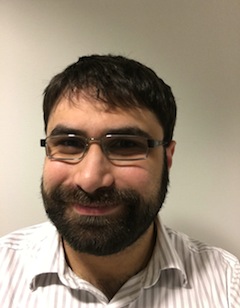
photo - Vancouver’s Jonathan Lerner, a member of CIJA’s LGBTQ+ Advisory Council, finds that many LGBTQ Jews “choose one or the other – either they’re involved in the Jewish community or the LGBTQ community, but not necessarily both”
Vancouver’s Jonathan Lerner, a member of CIJA’s LGBTQ+ Advisory Council, finds that many LGBTQ Jews “choose one or the other – either they’re involved in the Jewish community or the LGBTQ community, but not necessarily both.” (photo from Jonathan Lerner)

“Vancouver is a very welcoming place for LGBTQ people, with a society that is very diverse and welcoming,” he said. “The annual Pride Parade draws 600,000 people or more, and there is a month-long celebration. The municipal government is very supportive of these events and, while discrimination still exists, Vancouver as a whole is very welcoming.

“I’ve had great experiences with Vancouver synagogues, including the Reform and Reconstructionist movements,” he added. “I can say that even the Conservative synagogue in Vancouver has sponsored our booth at the Pride festival.”

Still, Lerner feels there remains a disconnect between the Jewish and LGBTQ communities.

“There are plenty of LGBTQ Jews and they’re often involved in Jewish or LGBTQ communities,” he said. “However, I find that most choose one or the other – either they’re involved in the Jewish community or the LGBTQ community, but not necessarily both. Sometimes, one may feel a necessity to choose an identity. For example, if one is associated with LGBTQ organizations, they may be anti-Israel … and so, one may choose to hide one’s Zionism or even Judaism.”

Lerner said that, while CIJA and the Jewish Federation of Greater Vancouver have worked hard at increasing collaboration and sharing between the communities – with recent workshops, training and outreach – more is always welcome.

“It has been challenging at times for LGBTQ people to be out in the Jewish community, and also for Jews to be open about their religion and Zionism in the LGBTQ community,” he said. “I’d like to see that change.”

Meanwhile, in Winnipeg, there have been other initiatives to increase awareness and inclusivity. On Feb. 21, Shaarey Zedek Synagogue hosted at the Jewish deli Desserts Plus an event called LGBTQ Jews: Sexuality, Gender Identity and Judaism, with some 20 attendees. It was led by the synagogue’s Rabbi Anibal Mass.

“Our vision is an inclusive space, a nonjudgmental environment, where you can express your Judaism pretty much your way,” Mass told the Independent.
photo - Spiritual leaders of Winnipeg’s Shaarey Zedek Synagogue, Rabbi Alan Green, left, and Rabbi Anibal Mass. The synagogue is working to become more inclusive
Spiritual leaders of Winnipeg’s Shaarey Zedek Synagogue, Rabbi Alan Green, left, and Rabbi Anibal Mass. The synagogue is working to become more inclusive. (photo from Shaarey Zedek Synagogue)

An LGBTQ group had approached the synagogue, said Mass. Some people from the group attend Shaarey Zedek and were concerned about the level of acceptance at the shul.

“I don’t blame them,” said Mass. “We’ve been changing … the last few years, and some people are unaware of all the changes we went through. We thought that it would be a good time to share with this specific group of people our vision and our values, for them to have it clear. If they have any doubts or questions, they can ask a member of our clergy – what we stand for, what we’re willing to do or not do, etc.”

Mass sees rabbis of the Talmud as examples to follow in regards to being nonjudgmental and inclusive. “They speak about compassion, about loving your fellow human beings,” said the rabbi. “We feel empowered by the works of the rabbis to embrace all these people in our synagogue and make Shaarey Zedek their home.

“I was expecting to have lots of questions [at the event]. I didn’t have too many. I guess maybe they weren’t expecting me to say how open we are. Maybe people thought I would come there and preach … and to say, ‘Yeah, we accept you, but….’ But there was never a ‘but.’ We do accept you, period. So it was a great event.”

At that information event, a gay male couple from the synagogue shared their story with the group, about how they were turned down for a wedding from pretty much every synagogue in town – until they arrived at Shaarey Zedek. The couple said they could not believe how welcoming the congregation was.

“We ended up celebrating their wedding,” said Mass. “Many times, people complain that synagogues don’t offer the answers. The problem is, sometimes we don’t have the questions. We want to know what people in the LGBTQ group actually want, and to make that part of our vision.

“We also detect there will be some challenges for the future that we don’t know how to handle,” he admitted. “For example, how do you serve people who define themselves as non-binary? Do they have a bar or bat mitzvah? Both terms are appropriate.”

To keep things moving forward, Mass plans to start by hosting a group at his house. He understands that it might take awhile for some people to feel comfortable coming to a synagogue. “But, that’s OK,” he said. “If they don’t come to the synagogue, the synagogue will come to them. That’s my philosophy.”

Rebeca Kuropatwa is a Winnipeg freelance writer.

Format ImagePosted on April 13, 2018April 11, 2018Author Rebeca KuropatwaCategories NationalTags advocacy, Anibal Mass, CIJA, inclusion, Israel, Jonathan Lerner, LGBTQ, Shaarey Zedek, Sophie Hershfield, Vancouver, Winnipeg
Separate but connected lives

Separate but connected lives

“I remember the deep pleasure I had as a child when I first began reading,” author Méira Cook told the Independent. “It was like climbing into a book and pulling the covers down over my head. When I write, I feel as if I’ve returned to that world. My greatest wish is that readers experience the absorption in reading my novels as I’ve had in writing them.”

Cook’s latest novel – her third – is Once More With Feeling (House of Anansi Press Inc., 2017). Readers will be immediately drawn in by the cheerful, optimistic and a bit naïve Max Binder, whose “many friends tend to exaggerate the dozens of half-full glasses – and some of them considerably less than quarter-full, it’s been pointed out by a couple of the more sour and dill-picklish ones – that he has eagerly poured into another until presto, not only is the glass full but it runneth over.”

Because, for Max, “hope is not merely a feathered thing, a bird, or an equation for water and glass. Hope is where he lives, where he hangs his hat and unbuckles his belt.”

So begins Once More With Feeling, with Max at the airport – where he’s never been “without running into someone he knows, however tangentially” – to pick up a visitor he’s invited as a surprise for his wife Maggie on her 40th birthday. The light tone lulls readers unfamiliar with Cook’s previous work into the expectation of a nice, light read, albeit one full of insight into human nature and wry observations on life. But, while there is much humour throughout, the novel is substantive and serious, and the writing demands that readers do some work.

The story of the Binder family – Max, Maggie and their two sons – and the community they live in, Once More With Feeling “explores how different family members are affected by tragedy, and how the Binder family’s trauma ripples out into the larger community,” explained Cook. “The novel began as a series of linked short stories centring on the Binders, but also veering off into other characters and situations. The structure I’d envisioned was of a year in the life of a city (Winnipeg), with each story taking place during a different month. I loved that sense of turning seasons and changing weather that we prairie folk experience so keenly.

“In the process of writing Once More With Feeling,” she continued, “I began to realize that, while we often like to believe that we are the protagonists of our own autonomous stories, really we are all connected, all linked in hidden and sometimes unexpected ways, all parts of a larger novel. In Winnipeg, we cherish the fond belief that we’re connected by two degrees of separation rather than the customary six degrees. I wrote my novel with this in mind – that people who live in different parts of the city, different neighbourhoods, are nevertheless connected not only through mutual friends and acquaintances but also in their shared humanity.”

The connections aren’t always easy to make in Once More With Feeling, and readers who like linear narratives will find the novel challenging. Some of the chapters have little to nothing to do with the Binders. But Cook is a master at creating characters – and Winnipeg would be one of the many in this book – that seem real, like people we know or have known, or who resemble ourselves in ways. The writing is excellent; many passages are hilarious, others are breath-catching. Cook is a perceptive observer and intelligent commentator. Perhaps not surprisingly, she was a journalist in her home country of South Africa.

“I came to Canada in the early nineties and lived for a couple of years in a small town three hours north of Winnipeg,” she said. “I’d previously lived an entirely urban existence in a large, bustling city, Johannesburg, where I was a film and drama reviewer. Suddenly, I found myself in a very small town (the population was about 500), where I could no longer work as a journalist. I’d never seen snow before and, since I’d arrived in February, there was an awful lot of it. I experienced culture shock as a devastating loss of identity, the loss of everything I’d known before. When I looked out my window, the snow seemed as white and blank as a page. I began to write – first poetry, later fiction – as a way of leaving my mark on that page.”

In addition to her three novels, Cook has published five books of poetry. In Canada, she also has lived on the West Coast for a spell.

“My husband and I lived in Vancouver for four years while we were studying. In those four years, I received my PhD in Canadian literature and had three children,” she said. “Despite how fertile a place Vancouver was for us, we returned to Winnipeg for work reasons. (Perhaps we were afraid that if we remained in Vancouver we’d have another three children!) My daughter had her naming ceremony and my twin sons had their britot at Beth Israel Synagogue on Oak.”

image - Once More With Feeling coverOnce More With Feeling has numerous Jewish aspects, from several characters, including Max, to topics such as the Holocaust, and how we remember and learn from it.

“Maggie isn’t Jewish but I didn’t have a specific reason for this in the sense of wanting to portray an intermarried couple,” said Cook. “I was interested in representing a city that is as diverse and vibrant as the Winnipeg I live in.”

For Cook herself, she said, “Judaism has always been important to me but I didn’t always feel that I was important to Judaism. When I was growing up in Johannesburg, my family attended an Orthodox synagogue and I often felt excluded and sidelined as a young girl and, later, as a woman.

“Through the years, I found my way back to my lost religion via the Conservative movement. My family attends an egalitarian synagogue in Winnipeg, where we sit and pray together, and where my daughter had her bat mitzvah six years ago. Watching my daughter reading from the Torah was such a deeply meaningful experience; it inspired the section of the book related from the point of view of the mothers watching their children grow up and become sons and daughters of the commandments.”

This chapter – called “Tree of Life” – is especially poignant, while also providing a critique of various social mores with wit and tenderness. And Cook doesn’t only put a lens on the Jewish community, but also on larger societal issues, such as racism toward First Nations people and the problem of homelessness.

“I don’t censor myself when I write but I certainly do when I revise,” she said about tackling controversial subjects. “Stephen King once said: ‘Write with the door closed, edit with the door open.’ And Hemingway is supposed to have advised: ‘Write drunk, edit sober.’ The model I follow is less decadent but similar in intent: write in a dream, edit when you wake up.”

And how does she know when to step away from the keyboard?

“There is a point where the writing doesn’t feel personal anymore. The story that has for so long been floating in your head or been messily transcribed from longhand notes to a Word document, that story hardens into conviction, becomes real.”

Format ImagePosted on March 23, 2018March 23, 2018Author Cynthia RamsayCategories BooksTags fiction, Méira Cook, Winnipeg
Reuniting in Winnipeg

Reuniting in Winnipeg

Among those at the reunion were, left to right, Helen Pinsky (Vancouver), Barbara Moser (Montreal), Chana Thau (Winnipeg), Avrum Rosner (Montreal), Cecil Rosner (Winnipeg) and Zev Cohen (Israel). (photo from the reunion)

Anyone who went to a Jewish day school in Winnipeg in the 1950s and 1960s was invited to a reunion recently – and 220 former students attended.

The Oct. 6-9 reunion was organized by Avrum Rosner, who now lives in Montreal, Zev Cohen, who now lives in Israel, and Eileen Margulius Curtis and Bert Schaffer, who both still live in Winnipeg.

Rosner started posting high school photos on Facebook. A closed Facebook group followed and then Rosner created a page inviting people to share photos from Winnipeg Jewish schools.

“So, some genius – Zev Cohen – asked on the Facebook group, ‘How about a reunion?’ And he then started laying the groundwork,” said Rosner. “It went viral after that.”

Rosner and his wife, Marnie Frain, both attended the reunion.

“There were many different Jewish schools in Winnipeg in the 1950s and ’60s, of diverse languages, attitudes to religion, attitudes to Israel, left and right,” said Rosner. “And, what was a thriving community, with unique cultural and social institutions, that reached its numerical peak around 1960, has been drastically diminished by emigration ever since.”

The main venue of the October reunion was Holiday Inn West Airport, where some of the out-of-towners stayed. But, on the Sunday, Gray Academy of Jewish Education (GAJE) hosted the reunion. The academy is the entity into which nearly all the Jewish schools have amalgamated.

The first reunion event was a dinner on Friday evening that included speeches. There was a discussion on Saturday; a brunch and greetings by GAJE staff and students, as well as a bus tour and dance party, on Sunday. On Monday, there was a farewell brunch with live entertainment, performing Hebrew, Yiddish and klezmer songs and 1960s/70s rock ’n’ roll.

Participants included students, and a small number of former teachers, from Winnipeg’s Talmud Torah, Joseph Wolinsky Collegiate, I.L. Peretz School, Rosh Pina, Herzlia, Ramah, and Sholem Aleichem School.

“For me, the highlights are not hard to identify – renewing half-century-old friendships. For me, and for many, it restored my belief in magic,” said Rosner. “Personally, I think I gained the pure pleasure of reconnection with childhood friends. Also, the confirmation of the importance and ongoing vitality of the social, cultural and ethical values … and principles many of us absorbed – not solely through formal education, but by growing up in a unique-in-many-ways Jewish community in an isolated prairie city. It was what I expected and hoped for, though exponentially better.”

Vancouver reunion attendee Helen Pinsky said, “I watched the whole thing happen on Facebook. And, despite the fact that I’d heard very little from other people who I’d gone to school with, the reunion appealed to me a lot. I made arrangements to see all my cousins in Winnipeg, and booked the trip. I attended with my boyfriend, Yossi Amit, who, at that point, knew none of my Winnipeg relatives and had never been to that city.”

Pinsky and Amit stayed at the reunion’s “official” hotel and, though the schedule for the weekend had looked quite bare, that was a plus for them, as it allowed for personal visits. “In the end, most of my cousins attended the reunion, too,” said Pinsky. “Then, we made plans for spending our free time together. The programs were well-received and gave us all a structure from which to build other plans.”

Pinsky enjoyed many aspects of the weekend, including the talk about the history of Winnipeg Jewry, the music and food at Hops, the band Finjan and reminiscences at brunch. “There were lots of photos, laughter, warmth, memories sharing, good feelings and catching up,” she said.

Helen Nadel also attended the reunion. Nadel met Vancouverite Tevy Goodman in Winnipeg in 1975, and the couple were married at what was then Rosh Pina Synagogue.

“My childhood stories of growing up in North End of Winnipeg have always interested my children,” said Nadel. “I heard about the reunion when I was in Winnipeg in April for a reunion of my high school Grade 12 class [of 1952] who all turn 65 this year. I also knew I’d have a 40th-year medical school reunion this year [Sept. 15-17]. So, I decided that this was the year to make it a trifecta.”

When Nadel and her husband decided that he would accompany her, Nadel invited her daughter, Daniella, along, too.

“For me, it was fun to see the older girls who were my cousins’ age, as I was the tag-along with my cousins when I was at Peretz School,” said Nadel. “After pointing out that I was the little pisher who was with Carol and Sandi, recognition was achieved. Reminiscences were exchanged. It was remarkable that, by the end of the weekend, people no longer looked unfamiliar. I remembered them as they were some 50 years ago.

“My daughter loved seeing me with my grade school mates. She loved hearing the stories and began texting her posse about what fun this was, wondering what they might be doing when they are our age. She particularly loved seeing us reminisce when we stopped at the two schools, Peretz and Talmud Torah. I had goose bumps when a few of us spontaneously started singing the Peretz School anthem a cappella in front of the school, although only one in the group – Pam – really remembered all the words.”

Nadel was taken aback by how close Peretz School and Talmud Torah were to one another. She had remembered them as being very far apart – not only ideologically, but in distance.

“All in all,” she said, the reunion was “a chance to re-form and strengthen our bonds and ties to Winnipeg and the wonderful community we all grew up in.”

For Myron Calof, word of the reunion reached him about a year ago, when his wife, Ros-Lynn Sheps, called him at the office to say that she had just checked their voicemail and there was a message from Bert Schafer.

“Although I had not heard that name for over 50 years, I instantly put the name to a face and called Bert,” said Calof. “After confessing that, as a kid, I had routinely stolen crab apples off his parents’ crab apple tree, Bert told me a Winnipeg Jewish schools reunion was in the works and asked if I’d attend. I didn’t hesitate for a second to say that both my wife and I would be there.”

Calof anticipated that the reunion would be a positive experience, but, he said, “It was far better than that. First, although I don’t know when I’ll see them again, I feel reconnected with old friends. Second, the experience made me realize that my classmates and I played a vital role in continuing and strengthening Jewish education – not just in Winnipeg, but in the many North American, Canadian cities where we eventually settled. We carried with us the spirit, value and importance of a Jewish education which, in the raising of our children and through participation in community endeavours, we’ve helped perpetuate.”

Calof noted the similarities between his early Talmud Torah years – less than 10 years after the founding of the state of Israel and the end of the Holocaust – and the threat the world and world Jewry face today with the rise of nationalism, antisemitism, xenophobia and challenges to liberal democracy. “I hope history is not repeating itself, especially where Jews are concerned,” said Calof. “But, if it does, I hope and I truly think, we and the generations of Jewish students who have followed us will be better prepared to oppose and push back our enemies.”

The best part of the weekend for Calof was Monday morning, when so many former students from different years and schools had the opportunity to express their gratitude to teachers, parents and school founders for helping enrich the lives of thousands of students who attended a place of Jewish learning.

Anyone who attended Jewish school in Winnipeg in the 1950s and 1960s can still add their name to the organizers’ contact list by e-mailing [email protected] and can join the 800 others in the closed Facebook group facebook.com/groups/winnipegjewishschools.

Rebeca Kuropatwa is a Winnipeg freelance writer.

Format ImagePosted on November 24, 2017November 23, 2017Author Rebeca KuropatwaCategories NationalTags Helen Nadel, Helen Pinksy, Jewish school, memory, Winnipeg

Grandparent parents

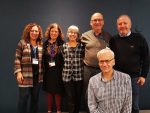
This past summer, the topic of grandparents parenting their grandchildren was front and centre at the Jewish Child and Family Services Winnipeg (JFCS) annual general meeting. The Independent spoke recently with a couple of the participants in the June event.

Corinne Ackerman, 73, was joined by her husband, Harvey, 75, at the AGM. The couple has two grown children – a son who lives and works in Auckland, New Zealand, and a daughter who lives in Winnipeg. Seven years ago, their daughter’s family began experiencing difficulties, to the point that Manitoba Child and Family Services (CFS) became involved.

“Harvey and I were aware there were problems in their home, but we didn’t know how bad,” Corinne told the Independent. “We got a phone call from our daughter, saying that CFS was coming to the school to apprehend their three boys. And, of course, when I heard that, I just was absolutely stunned…. I grabbed my car, went to the school and met the social worker. I said, ‘You’re not taking them. I’m their grandmother and they are coming with me.’”

Everyone ended up at CFS, which then evaluated the possibility of the Ackermans taking charge of their grandsons. “They came to our apartment. They checked it,” said Corinne.

By that evening, all three boys were with their grandparents in their apartment. However, said Corinne, “We had them here with us for about 10 to 12 weeks. They [CFS] wouldn’t let us keep them. You can’t have three children in a two-bedroom apartment.

“At that point, friends of mine … and even the principal at the kids’ school called me … and said to call JCFS. It took a lot for me to do that. You become so embarrassed. Harvey and I were just mortified.

“I did, and God bless Emily Shane [who was then at the helm of JCFS]. She sent workers and the process began. They found a foster home for the three boys, but it very quickly deteriorated. It was just awful.”

Ian, now 14, the youngest, was having the most trouble. He also needed some major dental work. All of those involved decided it would be best if Ian went back to live with his grandparents. Ian’s brothers are now 18 and 20.

“I don’t even remember how it all happened, but the agreement was, the boys were going to another foster home and Ian would stay with us,” said Corinne. “And he’s been with us now since he was 7 years old.”

The Ackermans have made a point of assuring Ian that his parents and brothers love him.

“I think that he knows that he’s loved and that we still love his mom, dad and brothers,” said Corinne. “Ian would like to be home with his mom and dad if it was possible. But, I think he’s pretty happy here. And, for as long as he needs us to be here, we are going to try to take care of him.”

While there were some hurt feelings within the family when all of this happened, of course, everyone has made amends for Ian’s sake. They all speak regularly, and Ian visits his mom and dad regularly.

When asked about the difference between raising your own kids versus raising your grandchildren, Corinne said, “Well, when you raise your grandchildren, you get a better appreciation for the love you have. I love my daughter, I love my son, I love my in-laws, but you love your grandchildren on a different level, and we just adore Ian. At times, he’s very difficult, but at times, he’s an absolute blessing.”

The Ackermans have had to realign their lives in order to parent their grandson. It was a drastic change and they depend on JCFS for respite.

“We are not people who go out all the time, but it does cut down on the freedom to do so,” said Corinne. “But, we’re OK with that. Ian is important enough to us that it’s worth it.

“Ian has some challenges in school and that makes it quite difficult for any parent. We’ve done our best to get him the help he needs, and I can say that JCFS has been fabulous. Ian had a reading clinician, as he had a little speech impediment, and now it’s gone. JCFS has been wonderful with whatever Ian has needed.

“There are issues when a child is taken from their parents, and issues before that, and they’ve been very helpful throughout,” she continued. “As far as Harvey and I, when I really have it up to my head … I’ll give the social worker a call and she’s always there to help and give advice.

“Ian is the most invaluable young man because, whatever we do for him, he does back for us tenfold. He’s a wonderful kid. A million foster homes are wonderful, but family is family and there’s a difference.”

The other panelist at the JCFS AGM was Karla Berksen, 73, who also took in her two grandchildren seven years ago. Berksen was awarded custody because her daughter was unwell and her husband could not care for the kids.

Berksen and her partner of many years, Arthur Chipman, took in the children when Paige was 4 and Jacob was 8. At the time, Berksen was a newly retired financial planner and was spending part of her winters in Mexico.

“My daughter was still alive when I got the kids,” Berksen told the Independent. “She wasn’t a very well person, so we spent a lot of time with her. When they came to me, they were just dropped off. Arthur’s been quite amazing, because people my age don’t think this is something they want to do for their retirement. But, this is what we’re doing, although Arthur is still working.”

Both children attended and graduated from Brock Corydon School’s Hebrew immersion program. “Jacob had his bar mitzvah two years ago and Paige will have her bat mitzvah in March,” said Berksen.

“I feel very grateful to have the kids. It makes me a little tired sometimes. But, as I said at the JCFS AGM, I’ve only had two anxieties in my whole life. One was nine months after I stopped smoking – I had an anxiety attack realizing I wasn’t going to have a cigarette again. The other one happened a couple years after I got the kids, and I realized that I’m going to have teenagers again. That’s my biggest fear – going through the teen years again. You can only build them up, but they have to take charge and you never know what will happen.”

Berksen said both of her grandchildren are very talented. Her grandson is a gifted musician who is self-taught on the saxophone, drums, guitar and piano, with plans to one day become a studio musician and music teacher; he also enjoys playing hockey. Berksen’s granddaughter loves the arts and curling. Both kids spend part of their summers at Camp Massad.

Although Berksen hopes one day to again spend time in Mexico, her current priority is to raise her grandchildren up through their university studies. “I don’t see it as my life being on hold,” said Berksen. “This is it. This is my life and I enjoy it for the most part. I enjoy watching these two kids grow up. They keep me alive and busy.”

Rebeca Kuropatwa is a Winnipeg freelance writer.
Posted on November 10, 2017November 9, 2017Author Rebeca KuropatwaCategories NationalTags family, JCFS, parenting, Winnipeg
Trying to foster community

Trying to foster community

Two things will immediately strike readers of From the Outside In: Jewish Post & News Columns, 2015-2016 by Joanne Seiff – Seiff’s knowledge of Judaism and her empathy. She really knows her Jewish texts, as well as a thing or two about human nature. Yet, she doesn’t criticize from on high. She’s right in there in the muck, so to speak, not just making suggestions for others to carry out, but trying to play a positive role herself in whatever transformations she thinks might engage more Jews in Judaism and in community. Her heart is in the right place, and it shows.

Readers of the Jewish Independent were introduced to Seiff’s writing earlier this year, thanks to the JPN’s Bernie Bellan, who thought her work might be a good fit for the JI as well. He was correct. Her columns mix Torah lessons, everyday life moments and community-building ideas seamlessly, in an uplifting manner that invites contemplation rather than merely prescribing answers. She is not dogmatic, but rather is struggling herself to see what works in her and her community’s life.

book cover - From the Outside InWhile Seiff writes about the Winnipeg Jewish community, pretty much every issue she brings up – from involving younger congregants in synagogue life to getting more out of the weekly Torah portion to countering antisemitism to making communal activities more inclusive – can be found in our community. No doubt other communities will also see themselves in Seiff’s writing. And each of us will see a bit of ourselves, how we define our identity and how we move in the world.

And though you might not know it from her casual writing style and humble approach, Seiff has the education to back up her commentary. She has a master’s degree in religious studies from the University of North Carolina at Chapel Hill and a master’s in education from the George Washington University; she earned her bachelor’s cum laude in Near Eastern studies and comparative literature from Cornell University. Even so, she doesn’t have all the answers, and she doesn’t pretend to. She calls on many sources, from Jewish traditions and writings, to rabbis who have visited her community with advice, to lessons she has learned from family (her parents and as a mother of twins), community members and others. She brings in her own experiences of living in places where there weren’t many Jews – Kentucky, for example – and that of being a relatively recent immigrant to Winnipeg. She and her husband moved to the city in 2009 and the title of her collection reflects this perspective. As she writes in the introduction, “As a newcomer to Canada, I often see things differently than someone who was born and raised in Winnipeg.”

There is a lightness and energy to Seiff’s writing, which makes the book easy to read, even though she’s tackling some heavy topics and, often, the lethargy of a well- and long-established communal structure. It takes a delicate touch to be constructively critical and not disrespectful to those who either helped set up or maintain the way things “always” have been done. Her solutions-oriented outlook and can-do attitude will inspire anyone who would like to see change but thinks that anything that’s well-established – from our identity, to our Jewish community, to our larger world – is immutable. We may not have a huge amount of control over most things in life, but there are ways in which we can make things better. For ideas of where to start, From the Outside In can be purchased online. To read more of her writing, visit joanneseiff.blogspot.ca.

Format ImagePosted on September 15, 2017September 14, 2017Author Cynthia RamsayCategories BooksTags community, Joanne Seiff, Judaism, Winnipeg
Illness, not weakness

Illness, not weakness

Can We Talk About … event committee, left to right: Karen Dana (event co-chair), Jenn Ritter (event co-chair), Harriet Zimmer, Rietta Floom, Einat Paz-Keynan (JCFS staff), Meytal Lavy (JCFS staff), Michael Landsberg, Sherry Lercher-Davis, Randee Pollock (JCFS staff), Danita Aziza (JCFS board chair), Pam Vine, Tara Greenberg and Jill Atnikov. (photo from Jewish Child and Family Service Winnipeg)

On Nov. 3, as part of Jewish Child and Family Service Winnipeg’s series Can We Talk About …, TSN celebrity Michael Landsberg spoke about Darkness and Hope – Depression, Sports and Me.

Landsberg has suffered from anxiety for as long as he can remember, and depression for the past 18 years.

“In 2009, I spoke about it publicly for the first time,” Landsberg shared with those gathered at Shaarey Zedek Synagogue. “I told everybody I knew. I just hadn’t used the platforms available to me to discuss it [until then], because I didn’t think it was relevant to anyone’s life.

“One day, when I was, by chance, interviewing someone who had suffered from depression, I asked him about it. I commented that I, too, had suffered. The next day changed my life.”

Landsberg received emails from people saying that the interview had been the first time they had heard two men discussing their struggles with depression; in particular, without sounding embarrassed or seeming weak.

“Because of that, they said their lives were changed,” said Landsberg. “Since that moment, I’ve tried to do exactly the same thing over and over again in as many venues as I can, including in Winnipeg.”

Landsberg tries to find ways to bring the topic to the fore whenever he feels it’s appropriate or thinks he has the opportunity to make a difference, whether it’s a public talk he’s headlining or a discussion on radio, TV or the internet.

“Every time I say I suffer from this illness and I’m not ashamed, embarrassed or weak, it changes someone’s life,” he said. “My coming out gave a purpose to this illness. It allowed me to take this poison that’s been inside me, that’s detracted from my life…. It allowed me to help someone else … so my poison is someone else’s medicine. That makes me feel good and makes me feel like I have a place in the world other than the one I was occupying before.”

According to Landsberg, before going public, his level of contribution to society was neutral, like most people’s. But, since coming out and talking about how his depression makes him feel and how it robs his self-confidence and self-esteem – yet he’s not ashamed of it – he’s no longer neutral.

“I think what I have to share most of all is me,” he said. “The more deep I go, the more details I give, the more of my struggles – not just that I’m struggling, but how my struggles feel – the more valuable it is to someone else. You want people to say, in the audience, ‘That’s me.’ And ‘Oh my gosh. My husband has that illness and I never knew that’s what was going on in his head. I understand better now.’

“I think we’re in a time now when every person is really deciding what side of history they’re on. Do you want to be on the side of history that’s changed the way we deal with mental health or do you want to be on the other side? I try to encourage people to get on the right side of it.”

Landsberg has always been a sharer and encourages others to share their struggles. As there is a deep sense of hopelessness and loneliness when it comes to depression, he said it is critical to encourage others to listen and realize they are not alone with the illness.

“More so than any event than I’ve ever been to, I was riveted and was really grabbed by several of the questions [posed to me in Winnipeg],” Landsberg told the Independent. “They weren’t so much questions as they were statements about audience members’ own situations.

“If you have a good night and you do it the right way, and there’s an audience that’s engaged that way, you’ll hear stories that have never before been shared – empowering people to share.

“My analogy is always, what I’d really like to do, is to have everyone in Canada who suffers from this illness [get together] – in the basement of a synagogue or a church, where Alcoholic Anonymous meetings take place – and [have] each of us draw from the collective strength and, at the same time, make deposits into that strength. When you turn to someone for help, you ultimately give them strength just by asking for it. That’s the spirit we felt in Winnipeg.”

One female audience member shared that she has had cancer and that it has come back, adding that she has suffered from depression for 15 years. Landsberg recalled, “She said, ‘You know, I have to be honest with you, I’ll take the cancer over the depression.’

“Also, an army veteran shared that he served in the army for 12 years and that, when he returned to Canada, there were 13 of them in his army group who had served and that, now, there are only two – the other 11 took their own lives. He said, ‘I was in the closet, so to speak, and felt desperately alone and unable to reach out. I watched a TV show you [Landsberg] did two years ago and thought, wow, if he can share, I can, too.’

“That’s enough reason to keep doing this for the rest of my life – just the knowledge that doing something that’s so easy for me, takes no effort, is a joy, [is helping]. To get up on stage and use my struggles for someone else’s benefit … it’s so easy, yet the payoff can be so massive.”

When it comes to helping a loved one who suffers from depression, Landsberg said one should start by admitting they cannot fully understand, as they have never had the disease. Then, they should ask their loved one what they want from them.

“That’s a huge thing – telling me what not to do,” said Landsberg. “The second thing is to reduce guilt. Many of us who have this illness like to please those around us. But, when we’re sick, we lose that ability, because we’re not ourselves – we can’t. I feel terribly guilty when I’m not the person I want to be.

“The people around me aren’t living their lives better because I’m there. Quite the opposite. I feel terrible that I’m actually worrying them, that I’m actually making the room worse because I’m in it. But, if you reduce my guilt, it will make a difference.”

As for someone who discovers they have the disease, Landsberg suggested education, as the more one knows about one’s illness, the more they can be an advocate and fight.

“Then, establish the thought that I will fight for my happiness,” he said. “And that’s incredibly difficult to commit to because the illness takes the life, the drive, out of us. It makes us apathetic. It makes us really incapable of doing stuff, or highly challenged to do stuff.

“If you commit to fighting for your happiness, that’s a big step. If you commit to sharing, that’s a big step. Sharing is incredibly difficult for most people because they feel shame and embarrassment. They feel like their illness is a weakness.

“You can overcome that, to some extent, by educating yourself. When you go on the internet and Google ‘depression’ and get five billion hits, you realize that 10% of the population right now may be feeling similar to you.

“People take their lives – 4,000 every year in Canada, 40,000 in the United States, and there are 25 attempts likely for every ‘successful’ suicide … that means 100,000 suicide attempts. We know there’s at least 10 to one that think about suicide, but don’t attempt it; suicide becomes appealing to them and plays out over and over in their brain.

“If you start realizing you’re just like a million other people in this country, then you’ll realize this is a sickness, not a weakness. All of these people, people that take their lives because they’re in so much pain, that’s not weakness.”

Landsberg added that speaking with someone who you know is struggling with depression is the easiest way to start sharing and healing, as you know they will not judge you and that they understand you.

“Winnipeg people liked what I did, so they went home with something,” said Landsberg. “But, I think I went home with more. I took away more than I left. What I took away were stories from people who I felt privileged to listen to…. I just loved it.”

For more information, visit sicknotweak.com.

Rebeca Kuropatwa is a Winnipeg freelance writer.

Format ImagePosted on December 23, 2016December 21, 2016Author Rebeca KuropatwaCategories NationalTags depression, health, JCFS, Michael Landsberg, TSN, Winnipeg
A leader by example

A leader by example

Janice Middleman, left, Rabbi Shaul Osadchey and Bobbie Osadchey, with Florence Middleman in the foreground. (photo from Rabbi Shaul Osadchey)

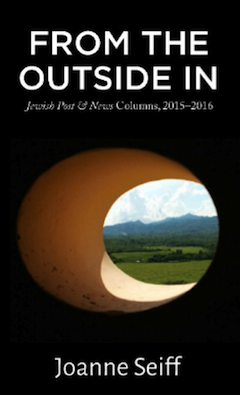
While it is becoming more commonplace to see people reach the age of 100 in fair health, it remains rare that an individual reaches the age of 110. So, Florence Middleman has beat the odds. And one person in particular has helped her achieve this milestone – her daughter, Janice Middleman.

Florence’s parents moved to eastern Canada at the turn of the last century. At the time, Alberta was vying to become a province. “They went east and recruited, and asked my grandparents and many others to be homesteaders,” said Janice. “As they stayed on the land a certain length of time and worked the land and raised animals, the land would become theirs.

“So, my grandparents came to Alberta and were homesteaders for quite awhile. It was during the dry-land period. There were many dust storms. At some point, they had to put the animals in the house and had to stay in the shelter on the hill they’d built for the animals – to protect themselves and the children from the dust storms.

“After a period of time, they moved to a small town near Edmonton, called Daysland. My grandfather, Max Goldberg, was a tailor. He made the red jackets for the Mounties, as well as everybody else’s clothes.

“My grandmother, Molly, was a midwife and spoke many languages. She delivered all the babies in the town and also accompanied the doctor on his rounds, as many people were immigrants who couldn’t speak English. She translated, so he could treat them.”

Florence was about 19 when the family moved to Edmonton and opened a store. She married Harry Middleman, who had moved from Montreal to Edmonton during the First World War. Janice was their only child.

The family moved to Calgary. While she lived in Toronto during her university years, Janice returned to Calgary afterward to be close to her parents. She took more university courses in Calgary.

When Harry passed away in 1985, Janice moved in with Florence. She found a flexible job she could do from home, while also caring for her mom, as there was no other family in the city.

Florence had four brothers who all passed away many years ago. Janice likes to describe her mom as having won the gene pool by living so long. “She’s got a tremendous spirit, plus the marvels of medicine as well,” said Janice.

Florence worked until the age of 68 as a librarian at an elementary school. She would have continued working and the library tried hard to keep her on, but, at the time, there was a law in place that you had to retire at the age of 65.

“When she did retire, she took a nap every day,” said Janice. “She has just a very, very good attitude. Besides working and helping to support our family, she volunteered at shul, Hadassah, the Red Cross and the Cancer Society – just to name a few.

“She had an interest in everybody, in Judaism, a belief in God, and kept a kosher home. She had an interest in the world. She appreciated everything and the beauty of nature, and appreciated children, animals and people in general. She still does.

“She always had a lot of friends. Regrettably, most of them are gone now, but she always had a lot of friends. She realized how important it was to give to the world. That’s also part of Judaism, to make the world a better place.”

When asked about her keen interest in child welfare and education, Florence said, “I worked at Glamorgan elementary school, including their library and the rest of the school, and bonded with the students. I was well liked by the children and got to know their likes and dislikes, their needs for education and their quality of life.

“One boy was Jewish and asked me if the library had any Jewish books. There were none in the library, so I brought some from home for him to read. He was very happy to have them.”

Janice added, “After that, my mother was very instrumental in inspiring the school to have multicultural books in their library. It spread to all the schools after that, a great deal due to her influence.”

Florence shared that some of her most-loved reading includes many “biographies, books on Judaism and prayer … biographies on artists, politicians like Abe Lincoln, history, art books, history of art, Canadian history, and all different countries.”

Janice noted, “She was and still is interested in countries and how they got where they are. She has a great love for literature, like Shakespeare, Dickens and William Blake. Also, my mother has written and continues to write our family history, as well as short stories and poetry.”

Florence had this to say about the most-treasured people in her life, such as her daughter, Janice: “I keep good people around me who care about other people, care about doing good works and doing good things in the world. My parents contributed greatly to the town of Daysland.”

As to whether she has any words of wisdom she would like to impart to readers, Florence said, “Keep on going. Surround yourself with good people who have good thoughts and care about their families, friends, the world, who care about contributing to the world and making it a better place and doing good work.

“Volunteer,” she added. “Give to charity when you can. Enjoy Judaism in any manner you are able. Give your time to your friends. Listen to them when they need you. Have a positive attitude. Be optimistic. Be grateful for what you have – your health, family, friends, home, food on the table and clothes on your back.

“Don’t think of the past or what you don’t have. Enjoy every moment, the moments you are in. Keep liking everyone. Don’t forget to thank people in your lives, in your family, and to appreciate everything you have.

“And take time to be good to yourself,” she concluded. “Take a nap every afternoon to refresh yourself. Be good to everyone. Be good to your family and friends. Don’t forget to thank God everyday for everything you have. Before Friday, during the week, don’t forget to be grateful to God and to everyone for everything in your life.”

Rebeca Kuropatwa is a Winnipeg freelance writer.
Format ImagePosted on December 16, 2016December 14, 2016Author Rebeca KuropatwaCategories NationalTags aging, Winnipeg
Getting through menopause

Getting through menopause

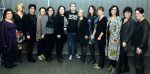
Harriet Berkal unveils the secrets of menopause. Berkal began the support group Menopause Matters after experiencing a lack of help when she went through that stage of life. (photo by Manny Berkal-Sarbit)

Medical advocate Harriet Berkal recalls eagerly anticipating going through menopause, imagining it to be a fabulous life stage without having a period every 28 days or so.

“Now, if I could go back and have my periods and not go through this other nonsense, I would say, give me my periods back,” Berkal told the Independent.

Berkal works as an executive financial consultant for Sarbit Advisory Services in Winnipeg and has been struggling with menopause-related issues for the past seven years. She has leaned from experience that there is next to no help out there for dealing with the effects of menopause, and this has led her to take matters into her own hands and create a support group.

“One problem with this issue of menopause is, if you complain to a physician about something like weight gain, a symptom of menopause, they bundle everything you say after that behind that carriage,” said Berkal. “So, my GP missed the fact that I had a thyroid condition, because it was thrown into menopause – the same way that people get thrown into the irritable bowel syndrome (IBS) or the fibromyalgia hole … where anything you complain about is automatically assumed to be related to that, when it might not actually be.”

Menopause symptoms for many women include hot flashes, night sweats, migraine headaches, bladder infections, gastroesophageal reflux disease, lost libido, and painful intercourse. There are also some very rare reactions, such as feeling as though you have bugs crawling all over you, and emotional depression or anxiety, which are also related to hormonal fluctuations.

While typically menopause begins in one’s 50s, it can start in one’s 40s, where the cycles become more erratic, and, in some cases, even earlier, from induced conditions via cancer treatments, for example.

As Berkal searched for solutions, she decided to share the information she gathered with other women undergoing menopause. She approached Winnipeg’s Jewish Child and Family Services (JCFS) about starting up a learning and support group.

The idea was welcomed and the group was called Menopause Matters. Some 20 women meet once a week for five weeks to learn about different approaches to dealing with menopause symptoms and management.

“Most of the primary group are those in the throes of menopause and who aren’t functioning well,” said Berkal. “We had about 18 at last week’s meeting. It was an emotional meeting. There were some people who were extremely – not just frustrated with the system, but at the end of their rope. They don’t know who to turn to, what to do. We provide them, each week, with a different speaker and go through the whole gamut of solutions from traditional to non-traditional.”

Some education is provided by the clinic Vitality Integrated Medicine, which is run by a former pharmacist. Participants are informed about drug interactions, different kinds of tests to help determine actual lacks in their systems, and three different kinds of estrogen. According to Berkal, what often happens is that menopause-affected women consult their doctors and are told they need estrogen, and then they just take whichever one is prescribed.

Recently, Menopause Matters participants had a guest speaker who is an acupuncturist discussing stress control and how it affects hormones, and various acupuncture relaxation techniques that could help. “She brought needles and tried them out on some people,” said Berkal. “People were appreciative of that approach.”

Another scheduled guest speaker at the time of Berkal’s interview with the Independent was gynecologist Dr. Maggie Morris. She was to speak “about mainstream methods for dealing with things like Premarin estrogen application.”

Berkal’s personal experience with conventional medicine in general is that its practitioners are uncooperative from the moment she mentions that other approaches will be presented.

“The pharmacies have these ready-made solutions,” she said. “They aren’t one-size-fits-all solutions in my mind. We’re trying to provide people with a range of different solutions and methods to cope with this. One solution doesn’t do everything. You don’t want to mask symptoms. You want to get to the root. Everyone’s jockeying for position here and everyone has different approaches, so you should try figuring out what system fits you the best.”

Another speaker booked to address the support group is to talk about the importance of exercise, while another will highlight a treatment called Mona Lisa Touch, which involves the use of a laser inserted into the vagina to stimulate vaginal collagen production.

“It rejuvenates the tissue in the vagina without hormones, so you can get increased libido and increased moisture,” explained Berkal. “It helps create a better balance of health in the vagina.

“Many women get bladder infections, because the bladder and the vagina are closely linked. And, if you don’t have the right environment in the vagina, which is decreased because of menopause, you can end up with UTIs [urinary tract infections] … which I had probably 10 of last year before I started treatment.”

When Berkal underwent menopause, she said, “It was a pretty extreme and exacerbated reaction. Mood swings are a very big issue. Last week, there were several women in the group who said, ‘Does anyone feel like they’re going crazy?’ Almost everyone raised their hand.

“Hormones are so powerful. When they are working great, that’s great. When they are depleted, you are left with a shell of a body, susceptible to bone loss, memory fog, you think you’re getting the early stages of Alzheimer’s … but really, you’re not.”

Berkal believes that integrated medicine is the right direction and, in fact, integrated clinics are popping up in many places.

“But, the fact that I couldn’t find a menopause support group was mind-boggling,” said Berkal. “I approached the Mature Women’s Clinic at the Victoria Hospital and asked if they would start a support group. They said ‘no.’

“Why would they not want to help women in need? Yet, when the pharmaceutical companies sponsor a forum for one of their gynecologists to speak, they get thousands of women to come down who are in dire need of help … but they are only giving one approach.”

Shelley Levit, a social worker at JCFS, was very receptive to the integrated approach Berkal described, and the concept of letting women choose for themselves what they want to pursue.

Berkal hosted a Menopause Matters free, five-week support group from Sept. 15 to Oct. 13, via JCFS.

“We call it ‘the Sisterhood of Sharing,’” said Berkal. “Sharing is deeply required in order to feel camaraderie and kinship with these other women who really have no one else to talk to. It wasn’t intended to be targeted at Jewish women specifically. It’s like cancer – not specific to any ethnicity.”

Berkal wants to see if the group would be receptive to having partners and spouses join, so they can be present and hear from other women.

Rebeca Kuropatwa is a Winnipeg freelance writer.
Format ImagePosted on November 11, 2016November 11, 2016Author Rebeca KuropatwaCategories NationalTags health, menopause, Winnipeg
Making a life in Israel

Making a life in Israel

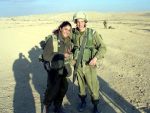
Emily Rose and Aviv Eisenstat in the Israel Defence Forces’ officer’s training school in 2008. (photo from Emily Rose)

When Emily Rose, 28, moved to Israel almost 10 years ago, her plan was to serve in the Israel Defence Forces and then return to Winnipeg. It didn’t happen quite as planned.

Rose was born in Odessa, Tex., and grew up in Winnipeg. Taking a similar road as many Jewish kids in the city, Rose studied at Gray Academy of Jewish Education (GAJE).

“The Winnipeg Jewish community is truly saturated with role models for social justice and it had a major impact on me growing up,” said Rose. “I grew up watching my aunt, Faye Rosenberg, who works for our Jewish community, help bring hundreds of Jews to Winnipeg from Argentina, where they suffered from antisemitism, and watching my best friend’s dad work tirelessly in court to help victims of residential schools receive compensation from the government.

“Winnipeg is an incredibly Zionist and supportive community,” she added. “The longer I am away, the more I appreciate what a wonderful community it really is.”

When Rose was 14, she went to Israel on a Jewish Federation of Winnipeg Partnership 2000 (or Gesher Chai) trip, which sent 10 high school students from GAJE to their sister school, Danziger, in Kiryat Shmona.

She fell in love with the city and the people. “My host family had three sisters and I was thrilled because, up until then, I only had big brothers. And, I remember writing to my mom, ‘Now I have three sisters!’ on the first night. I realized at that point that all my new friends in Israel would be going to the army soon and I remember thinking I had the responsibility to do that as well.”

This is what led Rose to move to Israel at the age of 18, starting with a mechina (a pre-military program) in her first year there.

She lived in Sde Boker in southern Israel and volunteered as an English teacher’s aide in an unrecognized Bedouin village. “Can you think of anything more polar opposite to a very cold Winnipeg, Man., than the middle of the Negev Desert?” she quipped.

“Your first year in Israel is always the most challenging, I think. There were a lot of tears. I was the only foreigner in the program, so I had to learn Hebrew very quickly. But, the program itself was also very intense, because we had classes every day and political tours and hikes every month.”

Something Rose was especially thrilled about in Israel was getting to sleep outside. As a child, she eagerly anticipated going to summer camp for canoe trips and sleeping under the stars.

“When you see the stars in the Negev, you really think it’s got to be the best seat in the house,” said Rose. “And, that first year, my roommate used to wonder why I’d always drag my sleeping bag out of our room to sleep outside.”

The next year, Rose joined the IDF as a lone soldier and served as a combat fitness officer. She recalled that some of her trainees used to call her “M&M,” as she was “hard on the outside, but sweet on the inside (and very small).”

She added, “My first job was training infantry soldiers on a combat training base where I worked with a unique battalion of Druze soldiers. The soldiers I worked with spoke Arabic. This really sparked my interest in the language, which is why I studied Modern Standard Arabic (MSA) in school.”

Today, Rose serves in reserve duty in Jerusalem’s Homefront Command. Her job is to communicate with the civilian population in Jerusalem during times of emergency.

A few years after her IDF service, Rose volunteered at the Michael Levin Centre for Lone Soldiers, which helps soldiers before, during and after their service. At the centre, the first thing she was asked to do was to tell those thinking about joining the IDF “don’t.”

Rose explained, “If we couldn’t convince them not to, then we’d help them as much as we possibly could. Nobody told me not to join the IDF, but also no one would have been able to convince me not to. And, the day I joined, I remember I wasn’t nervous – I just knew it was the right decision.

“I also didn’t plan on staying. I thought I’d serve for two years and then return to Canada. Here I am, almost 10 years later.”

After the army, Rose took Middle Eastern studies (along with MSA) at Hebrew University of Jerusalem. She still lives in Jerusalem, where she recently started writing for the Times of Israel.

Just prior to that, she was an editor at Israel National News, where, she said, she mostly wrote the breaking news but also covered longer form stories. “A few weeks ago,” she said, “I broke a story with exclusive footage of a former Australian minister who got caught in a firefight clash between Kurdish forces and ISIS in Iraq.

“The plight of the Kurdish people is an issue that is very close to my heart. I jumped at the chance to write about it. I’m also so proud to say I come from Winnipeg, [as] our Jewish community sponsors Operation Ezra, bringing Yazidi refugees safely to Canada.”

When on leave from the army a few years back, Rose returned to GAJE to speak to the students. When she visited Winnipeg this past summer, some community women stopped to say hello to her and her mom. “One of them told me that her grandson was going to be a lone solider, an IDF paratrooper, this fall … and she said that I’d spoken to him when he was in high school,” said Rose. “That was very nice, like coming full circle.”

Currently, Rose is working on a short story collection, a novel and three plays.

Her first play was presented at the JCC Berney Theatre in Winnipeg in 2006, the year she graduated high school. Called Radyo, it is about a group of high school kids in Kiryat Shmona who run their local high school radio station during the Second Intifada.

“The second play is a children’s musical I wrote called Don’t Touch the Glutch, which was performed as a part of the Next Wave of Musicals Festival in Montreal and then at the Centaur Theatre children’s series in 2013. It’s about a boy who gets lost in the zoo on a school field trip and discovers that the zoo has a whole host of strange creatures that only come out at night. My brother wrote the music and lyrics and I wrote the book. The show has an anti-bullying theme, because it’s a topic we both feel very strongly about.”

When asked about her feelings about Israel, Rose quoted Rabbi Abraham Isaac Kook: “The truly righteous do not complain about evil, but rather add justice; they do not complain about heresy, but rather add faith; they do not complain about ignorance, but rather add wisdom.”

She added, “Israel is in everything I write, in some form or another, and, though I may not always succeed, I try my best to contribute justice, faith and wisdom with my words.

“For now, I love reporting the news as it happens. Israelis, and those who care about Israel, want to stay informed and I feel privileged to be working with a team that is very committed to keeping our readers updated at all times.”

Rebeca Kuropatwa is a Winnipeg freelance writer.

Format ImagePosted on November 11, 2016November 11, 2016Author Rebeca KuropatwaCategories IsraelTags aliyah, IDF, Israel, journalism, Winnipeg
Overlapping exhibits

Overlapping exhibits

“Girl with Flower” by Esther Warkov, 1964, acrylic on canvas. (WAG collection; gift of Arthur B.C. Drache, QC, G-98-296; photo by Leif Norman)

Russian-born Jewish artist Marc Chagall (1887-1985) was a modernism pioneer. So much so that Pablo Picasso proclaimed that, when Henri Matisse dies, “Chagall will be the only painter left who understands what color really is.”

In the early 1920s, Chagall left Russia for Paris. In 1941, he escaped France and reached safe haven in New York. He returned to France a few years after the end of the Second World War.

“This sense of displacement Chagall feels throughout his life is reflected in his works, often featuring characters who hover over the earth…. Even if they’re lying down, they’re sort of levitating,” said Andrew Kear, Winnipeg Art Gallery (WAG) historical Canadian art curator. “There’s a sense of rootlessness to his work that’s quite interesting, and it’s reflected in his later work, too. By the 1940s – an important time for Chagall – he loses his first wife, his first love really, Bella, to cancer in or around 1944 … and is absolutely distraught.”

In an exhibition overseen by Kear, WAG has brought in the exhibit Chagall: Daphnis & Chloé from the National Gallery of Canada (NGC). It will be in Winnipeg until Sept. 11.

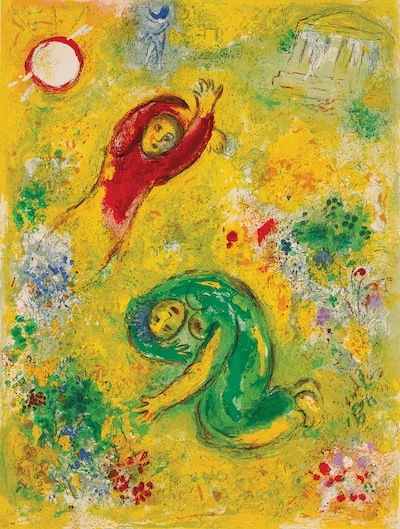
The exhibit, the latest NGC-WAG collaboration, features 42 lithographs, widely considered the crowning achievement of the artist’s career as a printmaker. The series depicts the semi-erotic tale written by the ancient Greek poet, Longus. Through fanciful compositions and bright hues, Chagall expresses the pastoral idylls of the young goatherd Daphnis and the young shepherdess Chloé on the island of Lesbos.

At WAG, there is also a complementary mini-exhibit called Chagall & Winnipeg, which tells the little-known tale of friendship between Chagall and former WAG director Dr. Ferdinand Eckhardt through letters, photographs and works of art.

image - Marc Chagall, “The Trampled Flowers / Les fleurs saccagées” (detail), circa 1956-1961, printed in 1961
Marc Chagall, “The Trampled Flowers / Les fleurs saccagées” (detail), circa 1956-1961, printed in 1961. (NGC/MBAC, Ottawa; gift of Don de Félix Quinet, Ottawa, 1986, in memory of Joseph and Marguerite Liverant)

“In addition to sketching out the story, this second exhibition … include[s] a number of paintings by Chagall that we’ve borrowed from the NGC and the Minneapolis Institute of Art,” said Kear.

In addition to these two Chagall exhibits, WAG is featuring Winnipeg Jewish artist Esther Warkov in an exhibit that includes her work from the 1960s to the 1980s. It runs until Oct. 16.

Born in 1941, Warkov did not do that well in school, but there was a lot of family pressure to succeed. By chance, she discovered jewelry making as a young teen, which, in turn, exposed her to the world of fine art. She eventually studied art at the University of Manitoba.

Today, Warkov is one of Manitoba’s most distinguished artists. This current exhibit highlights a celebrated and defining period of her work, which was forged in Winnipeg’s North End. Her stylized motifs reveal the clear influence of the eastern European immigrant community’s Jewish folk art roots.

“Although abstract painting was the most common form of contemporary art in the 1960s and 1970s, Esther really bucked the trend,” said Kear. “She was very interested in the human figure, representational drawing/painting, and in paintings that tried to convey a story. It’s this kind of point where she really outlines nicely with Chagall. Chagall’s paintings are very much recalling memories and tell[ing] a story.”

Warkov’s work during this featured period was large-scale and multi-paneled. “It’s not just a painting on one canvas,” said Kear. “It’s multiple canvases that are sort of cobbled together, in a way, to make almost loose grids. Her work is narrative, seems to tell a kind of story, but you’re not sure what the story is. It’s very whimsical and draws a lot on memory.

“I had the pleasure of meeting her for the first time a couple weeks ago,” he added. “I was curious about how she paints, or went about making these works. Apparently, she very rarely started with a coherent plan. She would start with one canvas and do an image on it. That would lead into another image that she’d tack on this other canvas next to the original one, to build the … visual story. But, it was a story she was making up as she went along. I thought she would plan it out first, but that’s not how it went down apparently.

“She’s got a wild sense of humor and great wit, which are really reflected in the titles of her works, [which] are often very long.”

WAG director and chief executive officer Stephen Morris said, “When we installed the exhibition a few weeks ago and we had the works up – many of them painted 40 to 50 years ago – they were as fresh, relevant and dynamic, I think, as the day they were painted. They reference so many interesting stylistic developments, but I’d also say they reach into the heart of who Esther is – someone who has lived in the North End for years, exposed to not just the Jewish culture, but also to Jewish folk art and eastern European traditions … that whole interesting development in terms of painting which you see in her work.

“Esther also brings people into interesting scenarios with her paintings and, in the composition, it can be a little unnerving, a little jarring. But, there is, with both her and with Chagall, a surreal aspect. So, while they’re painting recognizable images and motifs, the way they’re composed takes us back a bit and actually twists things. Some call it ‘the dream,’ others something else. Regardless, it’s delightful and one could see an overlap between the artists in terms of imagery.”

Morris enjoys being able to “bring cultures and ethnicities together.” He said having a famous Russian artist like Chagall next to Warkov, “who, in a way, had a much more regional impact, I think it’s interesting. I love the fact that a visitor can walk between Chagall and Warkov and, yes, they know they’re in a different space, in a different time, with a different artist, but they’ll also see connections.”

Of those connections, Morris pointed to how Warkov’s “roots overlap with Chagall’s roots, in terms of her life, faith and culture.”

The Chagall exhibit is set up in a series of small spaces to highlight the story of Daphnis and Chloé – visitors walk through it in a chronological way. Warkov’s work is displayed in one large gallery and visitors are surrounded by her canvases.

Also at WAG this summer are several permanent galleries, as well as a major retrospective of Winnipeg artist Karel Funk, who, Morris said, “is at the height of his career.”

Rebeca Kuropatwa is a Winnipeg freelance writer.

Format ImagePosted on July 22, 2016July 19, 2016Author Rebeca KuropatwaCategories Visual ArtsTags art, Chagall, Daphnis and Chloé, WAG, Warkov, Winnipeg

Posts pagination

Previous page Page 1 … Page 3 Page 4 Page 5 Next page
Proudly powered by WordPress