Skip to content
  • Home
  • Subscribe / donate
  • Events calendar
  • Business Directory
  • FAQ
  • News
    • Local
    • National
    • Israel
    • World
    • עניין בחדשות
      A roundup of news in Canada and further afield, in Hebrew.
  • Opinion
    • From the JI
    • Op-Ed
  • Arts & Culture
    • Performing Arts
    • Music
    • Books
    • Visual Arts
    • TV & Film
  • Life
    • Celebrating the Holidays
    • Travel
    • The Daily Snooze
      Cartoons by Jacob Samuel
    • Mystery Photo
      Help the JI and JMABC fill in the gaps in our archives.
  • Community Links
    • Organizations, Etc.
    • Other News Sources & Blogs
  • JI Chai Celebration
  • JI@88! video

Recent Posts

  • SFU honours Gloria Gutman
  • Lifting people’s spirits
  • Wedding a ray of light
  • Indigeneity and Zionism
  • Rule of law broken: councilor
  • Football and its roles
  • The burden of defence
  • Fish Café returns after fire
  • All right in what goes wrong
  • Nuns & mermaids at TUTS
  • Camp offers holiday retreat
  • Students and mentors inspire
  • Once-in-a-lifetime trip
  • 100 dancers, one heart
  • Money for the sciences
  • What “Jewish food” means
  • Have a cookie, schnitzel too
  • Federation now across BC
  • Israel fighting for its existence
  • Deal strengthens Iran
  • Patriotic belonging diminishes
  • A campaign to engage
  • Upstanders’ first live event
  • Responding to Carney
  • Having your own home
  • Music a family tradition
  • Musical to warm heart
  • Community milestones … June 2026
  • Sharing her passion for Israel
  • Or Shalom reopens its doors
  • JFS from past to future
  • Need holistic approach
  • Sharing stories, advice
  • Journalist shares fears
  • Skills to live together
  • Road to independence

Archives

Follow @JewishIndie
image - CJN box ad Rockowers 2026

Tag: Winnipeg

Artistic telling of strike

Artistic telling of strike

The book 1919: A Graphic History of the Winnipeg General Strike by the Graphic History Collective and artist David Lester is not education for education’s sake, but rather a “useful organizing tool,” according to the preface. “This comic book revisits ‘the workers’ revolt’ in Winnipeg to highlight a number of important lessons that activists can lean on and learn from today as they fight for radical social change,” notes the collective.

Lester, a Vancouver-based illustrator, musician, and graphic designer and novelist, will give the talk Getting Graphic with Labour History on June 7, 7 p.m., at the B.C. Government and Service Employees’ Union Lower Mainland Area office. He will also give a presentation as part of the World Peace Forum Society event 100 Years After the Winnipeg General Strike, in which Jewish community member Gary Cristall (activist and grandson of a 1919 solidarity strike activist) and others will participate on June 8, 2:30 p.m., at SFU Harbour Centre, Room 7000. In addition, he and members of the collective are participating in a few panels at the Congress of the Humanities and Social Sciences (congress2019.ca), taking place at the University of British Columbia June 1-7, and are then heading to Cumberland, B.C., for a June 23 event during the Miners Memorial Weekend.

In the Acknowledgements section of 1919, the Graphic History Collective describes itself as “a not-for-profit arts collective. For us, solidarity is not just a winning strategy in class struggle. It is our artistic methodology. In taking seriously the idea that we can accomplish more by working together, we prioritize collaboration…. As GHC members, we volunteer and share our artistic vision and share our artistic, writing and administrative skills.” The collective recognizes the many people who “contributed knowledge, labour and funding to this project. Most importantly, we recognize that this comic book would not have been completed without David Lester’s incredible talent and artistic labour.” Other GHC members who contributed are Sean Carleton, Robin Folvik, Kara Sievewright and Julia Smith; Prof. James Naylor of Brandon University’s history department wrote the book’s introduction.

“In 1919, 35,000 workers in Winnipeg, Manitoba, staged a six-week general strike between 15 May and 26 June,” the narrative begins. Lester’s two-page depiction of the strikers gathering at Portage and Main gives an idea of the vastness of the protest and the small area within which it took place. It is easy to see how people would have had nowhere to run and the panic that would have ensued when the Royal Northwest Mounted Police and the “special constables,” violently broke up the strike on “Bloody Saturday,” June 21, 1919. The police were among those who had voted to strike but were given dispensation to work by the strike committee; however, the city dismissed the whole force on June 9. The mayor, the Citizens’ Committee of One Thousand (formed of business leaders and others) and the federal government opposed the strike and worked together to end it by various means, using fear of immigrants (aka racism) and eventually violence to do so.

1919 gives a history of the pivotal event from the perspective of the strike leaders, workers and their supporters. The textual narrative drops away, for the most part, in the telling of what happened on Bloody Saturday and the impact of Lester’s images builds as the day progresses, from 9:30 a.m. to 11, to 2:20 and so on. Just before 3:35 p.m., two strikers are shot, one dies on the spot, the other from gangrene. The violence continues. At 4 p.m., the special constables take control. By 6 p.m., Canadian Army Service Corps trucks – equipped with machine guns – are patroling Main Street. By the end of the day, in addition to the two strikers killed, many are wounded and 94 people are arrested. The book then describes some of what happened in the trials that followed, and the strike’s legacy.

Lester shares some of his artistic process and inspiration in the essay “The Art of Labour History,” especially the Bloody Saturday pages, and this is followed by a photo essay called “The Character of Class Struggle in Winnipeg.” The notes are useful in providing context for some of the images, and the bibliography shows the depth of research. Short bios of the contributors and a list of the Manitoba unions that supported the publication conclude the book.

“Art bears witness to the injustices of the world and, in reflecting on the pain and struggles of the past, offers hope in working together for a better present and future,” writes Lester. “Art can aid the momentum of progressive social change, and that is what keeps me going…. I am trying to capture and convey the inspiration and spirit of solidarity in class conflict. That is the art of labour history.”

Format ImagePosted on May 31, 2019May 30, 2019Author Cynthia RamsayCategories BooksTags David Lester, general strike, graphic novel, history, social justice, Winnipeg
Trying to make access equal

Trying to make access equal

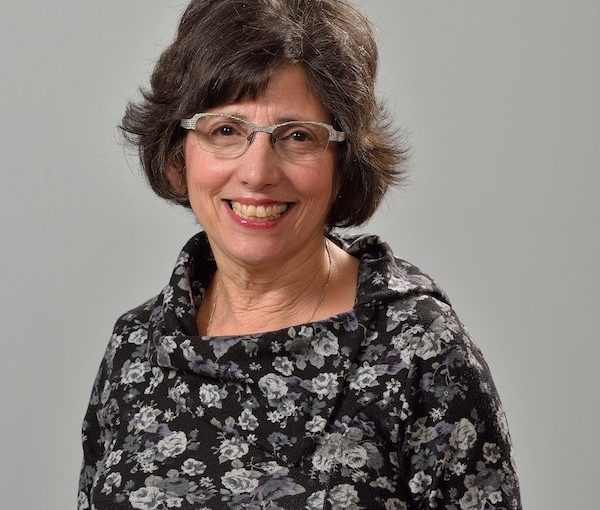
Dr. Cheryl Rockman-Greenberg (photo from Rockman-Greenberg)

In the 1970s, when Dr. Cheryl Rockman-Greenberg was eyeing the budding field of genetics as a career, she had to become a pediatric doctor first. Now, Rockman-Greenberg counts her clinical background as a blessing, one that, today, geneticists no longer require.

“Having a strong background in clinical medicine certainly always helped me in my career, because the kind of genetics I was always interested in was in rare metabolic diseases,” said Rockman-Greenberg. “These are diseases often caused by enzyme deficiencies that go by very elaborate names. Having a good foundation in clinical medicine through pediatrics certainly helped me.”

Rockman-Greenberg, who lives in Winnipeg, was invited to speak at the city’s Congregation Shaarey Zedek Sisterhood Interfaith Luncheon on April 30.

“I learned that the luncheon was spearheaded through the sisterhood in many ways to promote information sharing between the faiths,” she said, noting that a purpose of the event is education and “to look at how we can build bridges between people of different faiths and not build walls.”

“From a global perspective,” she said, “I think it fits the themes of the interfaith luncheon. And, from a Jewish perspective, I’ve certainly been involved over the years, particularly with the National Council of Jewish Women, of increasing awareness of the importance of genes for health, and bringing together some of the advocacy groups in rare genetic disorders.

“I helped the National Council put out a brochure on carrier testing on new genetic disorders in the Ashkenazi Jewish population that has been extremely well-received worldwide. This information is always evolving.”

At the luncheon, Rockman-Greenberg was planning to discuss, among other things, Bill S-201, also known as the Genetic Non-Discrimination Act, which passed into law in Canada in 2017, though it is still being challenged by insurance companies in Quebec.

“This is a remarkable act in the sense that it does protect Canadians from the use of genetic test results outside of medical care and medical research,” Rockman-Greenberg told the Independent. “In other words, genetic test results do not have to be disclosed to insurance companies or employers. We’re one of many countries who have such legislation in place, and many people here have worked for years and years lobbying for similar legislation for Canada.”

Methods of genetic testing continue to advance, said Rockman-Greenberg. Tests that were nonexistent or very complicated to administer as recently as two decades ago can now be done quickly and inexpensively.

“The evolution has dramatically changed over the past 10 years, particularly in the sense that the techniques we use to diagnose genetic disease have dramatically changed – from studying one gene at a time, to being able to sequence the entire genome of an individual,” she explained.

When Rockman-Greenberg refers to “new genetics,” she is referring to the ability to offer state-of-the-art, revolutionary genetic testing that was not possible just 10 years ago. It is this access that Rockman-Greenberg is lobbying for now.

“Everybody doesn’t have the same access to the testing in Canada,” she said. “It’s certainly not uniform from province to province or within provinces. So, many people are very committed to ensuring there are strategies in place to promote fairness.

“Notwithstanding that, the legislation is going to protect people against disclosing information that is already in place. I think we are ahead of the game because we have this in place. But, we are not ahead of the game in making sure people are going to have access to new diagnostic testing and new therapeutics in a way that’s going to be equal across the board.”

Rockman-Greenberg’s focus on rare metabolic diseases means that she has witnessed firsthand the struggles to get specialty drugs approved through a system focused on the big diseases, such as diabetes and cancer.

“You may get a new drug for diabetes that will be approved and available for patients very quickly, whereas some of the new drugs for other diseases I treat can take years and years before they go through the approval process,” she said.

Rockman-Greenberg thought that the topic was an appropriate one for an interfaith gathering, “as everybody having the same chance to be successful is very important to me. I work with families and patient support groups to help remove barriers and help people feel empowered.”

She said, “There are many challenges in dealing with rare diseases and I try to work both sides: the patient side, as well as advocate for changes at the government level, to make sure there is fairness in access to new therapies.”

Rebeca Kuropatwa is a Winnipeg freelance writer.

Format ImagePosted on April 19, 2019April 17, 2019Author Rebeca KuropatwaCategories NationalTags Cheryl Rockman-Greenberg, equality, genetics, health, human rights, interfaith, law, NCJW, Shaarey Zedek, Winnipeg
Sports talent runs in family

Sports talent runs in family

Sarah Jacobsohn is the Ultimate Canada 2018 Junior Female Athlete of the Year. (photo from Sarah Jacobsohn)

Last month, Ultimate Canada named Sarah Jacobsohn the 2018 Junior Female Athlete of the Year.

“I was in the middle of biology class, looked at my phone, and saw that one of my teammates had texted me saying congratulations and a long paragraph,” recalled Jacobsohn about hearing of the award. “And I was like, what’s going on? I had no idea.

“Then, I saw the article that was written about me and I got the notification that they had selected me for the award … and I started crying in the middle of class and I called my mom. It was so surreal and just amazing.”

Jacobsohn was born in St. Louis, Mo., in 2000, and moved with her parents and older sister to Winnipeg in 2006. She has been attending Gray Academy of Jewish Education since then, and will be graduating this year.

Athleticism runs in the family. Both of Jacobsohn’s parents played sports into adulthood. She also gets her height from her parents: her mom is 5’11” and her dad is just over six feet.

photo - Sarah Jacobsohn is the Ultimate Canada 2018 Junior Female Athlete of the Year
Sarah Jacobsohn is the Ultimate Canada 2018 Junior Female Athlete of the Year. (photo from Sarah Jacobsohn)

Jacobsohn has played sports for as long as she can remember. “I played Timbits soccer since I was in Grade 1, then I continued playing competitive tennis and soccer. Once I found ultimate, I quit all those other sports to play ultimate,” she told the Independent. “For my high school, I still play volleyball, basketball and ultimate but, on a competitive level, I gave the others up for ultimate.” (That said, she remains a competitive player at the other sports. For example, on the school’s varsity basketball team, she has been averaging 37 points per game.)

Ultimate was designed to be played without referees. “The spirit of the game is heavily emphasized, which is something you don’t find a lot in competitive sports in this day and age,” said Jacobsohn. “Essentially, it’s about maintaining a level of sportsmanship and integrity while playing the sport. You have to make the calls yourself and communicate with other players on the other team. And, it’s always maintained, that sportsmanship and respect for other players. Even at the highest level, ultimate is still heavily dependent on player communication, which I think is amazing.”

At the higher levels, there are “observers,” who help the players regulate the game, but they only intervene when asked by the players to do so. And, even after having been asked for their opinion, it is still up to the players to accept or disregard an observer’s call.

“I think that’s what a lot of sports have lost in the past few decades,” said Jacobsohn. “That competitive atmosphere takes away from the sportsmanship, and it shouldn’t. There should be a balance.”

In ultimate, she said, “people understand that, to keep that respect of the game, they have to be honest. It’s really amazing to see that, even at the highest level.”

Jacobsohn started playing ultimate in Grade 6 and, at 14 years old, her coach convinced her to try out for the provincial junior team. She made the team, as one of the youngest in the group. It was there that a national coach spotted her and, at age 15, she traveled to Vancouver for the national tryouts and made the team.

Jacobsohn participated in her first world championship in Poland in 2016, and Canada took home the gold. Last summer, Jacobsohn, as captain, led the provincial team to a gold medal. She went on to captain Team Canada to a bronze medal at the world championship in Waterloo, Ont.

All of these feats, as well as her extensive involvement in the ultimate and broader communities, contributed to Jacobsohn being chosen for the athlete-of-the-year award.

“The award is strictly based on achievements from the past year,” said Jacobsohn. “So, last year, I was captain of my provincial team and we won gold at nationals for the first time ever. Then, as captain of Team Canada, we won bronze at the worlds. And, I’ve done a lot of community stuff locally.

“I’ve been involved in the Winnipeg ultimate community for six or seven years, which is a lot, when I’m only 18 years old. I’ve gotten to know essentially the entire ultimate community. I’ve literally grown up in this community – finding a lot of leadership opportunities in it and chances to voice my opinion. I fight a lot for gender equity and voice that opinion a lot in the Winnipeg ultimate community.”

Jacobsohn serves on the Manitoba Disk Sports board, offering suggestions, as a high school student, about tournament arrangements and how the province runs the sport. She also has been very involved in the Winnipeg Ultimate Women’s Competitive League, helping to get a lot of juniors involved.

“As a very competitive female athlete, I understand my responsibility growing up as a female athlete in today’s world,” she said. “I have an immense responsibility to stand up and role model for other female athletes, and I’m not scared to do that.

“And, going to school where I’m one of six girls in my grade, I’ve been able to gain respect from a lot of boys and change perspectives on what being a female athlete means.”

Now, Jacobsohn is busy training for the under-24 national team tryouts. And, while her main aspiration is to become a doctor, like her dad, she is hoping to continue playing ultimate competitively for many years to come.

Rebeca Kuropatwa is a Winnipeg freelance writer.

Format ImagePosted on February 22, 2019February 21, 2019Author Rebeca KuropatwaCategories NationalTags Sarah Jacobsohn, sports, Winnipeg, youth
A first of its kind in Canada

A first of its kind in Canada

The University of Manitoba is now accepting applications for its interdisciplinary master’s degree in human rights. (screenshot)

The first interdisciplinary human rights graduate degree program in Canada will be starting soon, spearheaded by the director of peace and conflict studies at the University of Manitoba, Dr. Adam Muller, who helped design it.

The new degree will be the first of its kind in the country. Offered by the faculty of law at the U of M, it will train students for careers in human rights work in collaboration with the university’s faculties of arts, education and social work, as well as the Centre for Human Rights Research. Up until now, students wanting an interdisciplinary education in human rights law, theory and qualitative research methods had to go to the United States or Europe.

“We’re going to be training generations of students to serve domestically and abroad in a way that’s deeply inflected by rights, culture and ideas of dignity and social justice that, I think, in some ways, is uniquely Canadian and importantly Canadian,” Muller told the Independent.

“It’s worth noting that, when South Africa transitioned from an apartheid to a post-apartheid state, and they needed to rewrite their constitution, and particularly their charter of rights and freedoms, they drew upon the Canadian model and used Canadian jurists to assist in that drafting process.”

photo - Dr. Adam Muller spearheaded the new human rights program
Dr. Adam Muller spearheaded the new human rights program. (photo from Adam Muller)

Muller spent the first nine years of his life in South Africa. His family emigrated from there in the late 1970s in the wake of the Soweto Uprising, for political and other reasons. In addition to his position at the U of M, he is also the first vice-president of the International Association of Genocide Scholars.

Most of his work is about representations by artists of mass violence and atrocity, said Mueller. “So, I’m particularly interested in photographers, but also painters, musicians … people who try to give shape to unimaginable violence with the view of educating people about it.”

While there are other master’s of human rights programs in Canada, this is the first interdisciplinary master of human rights program in the country, said Muller.

The program will be housed in the faculty of law for a number of reasons, he said, the main one being that the language of human rights is first and foremost a legal language.

While other aspects of the program will look at the philosophical, sociological and anthropological discourses, Muller said, “There are different cultural inflections on the idea of human rights, partly because of the [perspective] that human rights practitioners have – an idea of a universal moral subject, which is complicated when you look at it anthropologically. Not all communities around the world share the same moral presuppositions, so those differences matter in terms of the understanding of global rights culture.”

While students will be encouraged to be human rights champions and advocates, the aim is that they not be so in a naïve way. “We want them to actually understand that human rights can be seen by other people as potentially unwelcome, super-impositions of a Western frame of reference over indigenous ways of thinking about the relationship with a person to the group,” said Muller.

In learning about what happened in genocides such as the Holocaust, students in the program will also be taught the continuing implications. For example, Muller wants the master’s students to go into the German studies class and learn, not just about the Holocaust, but about why it still matters in the German context today.

One of the unique aspects of this interdisciplinary program is that the courses available to students will vary from year to year, depending on what is being offered by the different faculties that have agreed to open up their classes to MHR students.

“We expect there to be, for example, considerable coverage of indigenous issues, just because there is a lot of that kind of work going on at the U of M,” said Muller. “We fully expect the MHR students to be both interested in and to become cognizant of the kind of debates surrounding human rights and indigenous people in the Americas.

“What we have is, I think, a healthy elasticity, in terms of the actual curriculum of the program,” he said. “So, there are three required courses, and then three courses students will be able to select from a vast range of options made available.”

Applications are now being accepted through the Centre for Human Rights Research at the U of M for admission in September 2019. It is not a prerequisite to have a degree in human rights.

Since the goal is to train students to become human rights professionals, the program will offer a practicum component for those students who prefer a hands-on approach.

Belle Jarniewski, who recently took on the role of executive director of the Jewish Heritage Centre of Western Canada and is probably most known for her work at the Holocaust Education Centre, which is an integral element of the JHCWC, is one of the scholars who was asked to review the MHR program proposal.

photo - Belle Jarniewski of the Jewish Heritage Centre of Western Canada was one of the scholars who reviewed the master’s in human rights program proposal
Belle Jarniewski of the Jewish Heritage Centre of Western Canada was one of the scholars who reviewed the master’s in human rights program proposal. (photo from Belle Jarniewski)

“I was quite honoured that Adam asked me to be one of the people across the country to review the proposal for the program and to submit a recommendation,” said Jarniewski. “I think that it’s very exciting to have a post-graduate human rights program offered. One of the things that I really like about it is that it really allows people to work in or concentrate on different areas of human rights.

“Certainly, I think human rights have always been important. But, in this particular time, where human rights are being abused in so many different countries, and where the mere understanding of what human rights are is being clouded, I think that a program such as this, that will produce scholars in this area, is of extreme importance.”

Jarniewski said Winnipeg is the perfect place to host such a program, with the Canadian Museum for Human Rights being in the city.

“Winnipeggers don’t fully appreciate the importance of it,” said Jarniewski. “When I go overseas, this museum has put us on the map. I think it’s just a logical city to host such a program, given that we have this wonderful museum, and our ability to access it for research purposes, as well as the ongoing work that they do in hosting lectures.

“I’m thrilled that this is happening, that it’s happening in Winnipeg, and that Winnipeg is taking on an important role in the area of human rights.”

For more information about the program, visit law.robsonhall.com/future-students/master-of-human-rights-mhr.

Rebeca Kuropatwa is a Winnipeg freelance writer.

Format ImagePosted on November 30, 2018November 28, 2018Author Rebeca KuropatwaCategories NationalTags Adam Muller, Belle Jarniewski, education, genocide, human rights, Winnipeg
Adversity leads to innovation

Adversity leads to innovation

Sara Raposo-Blouw, left, and Erin Goldberg taste the chocolate mocha and vanilla blueberry flavours of Thrive. (photo by Ian Blouw)

Erin Goldberg, 30, was only 5 years old when it was discovered that she had rhabdomyosarcoma in her abdomen, attached to one of her ovaries.

Rhabdomyosarcoma (RMS) is an aggressive and highly malignant form of cancer that develops from skeletal muscle cells that have failed to fully differentiate. It is generally considered to be a disease of childhood, as the vast majority of cases occur in those below the age of 18.

Growing up in Winnipeg, Goldberg spent almost 130 days at the Health Sciences Centre (HSC) receiving treatments and recovering from procedures over a two-year span before she was cleared of RMS.

Goldberg’s struggle with the cancer and her unwavering will to make the world a better place have served as a driving force in her life ever since. And her memories from that time, as a child struggling to keep food down, have led to her helping develop a liquid food replacement that would have been priceless to her when she had RMS.

“Basically, everything I ate was making me nauseous, and that was due to chemotherapy,” Goldberg told the Independent. “It sort of alters your taste. And I would also throw up anything I would eat. It was important to have as many bland foods as possible. With liquid nutrition, it’s a lot easier to consume your calories than with anything solid. It’s denser and is a better option in the hospital.”

Goldberg said she went into nutrition because she was interested in disease prevention. After meeting Sara Raposo-Blouw and Lisa Reed, dieticians at the HSC, and them sharing their experiences with one another, they came up with the idea of a liquid nutritional drink. They knew, firsthand, the lack of options people had.

“The beverage options in hospitals were really lacking,” said Goldberg. “Patients find the taste of what there is too sweet. I recently spoke to my friend’s dad, who is a psychiatrist, and he actually prescribes Boost six times a day for one of his patients, because he has a motor disorder … he’s constantly moving, so his caloric requirement is elevated so much. He needs to have six of these beverages in addition to his regular food intake. When you have that much of something that is too sweet and has ingredients that are highly processed, or if you’re vegan or have allergies, you just can’t do it. You need an alternative. And there was really nothing out there.”

Goldberg and partners have developed a new option, called Thrive, that uses local ingredients, two of them being flax oil and pea protein. The formula is completely plant-based and free of major allergens, like dairy, soy, corn and wheat.

The trio solicited the help of a Burnaby beverage developer to help them produce the drink with the necessary specialized equipment.

While competitors have come out with flavoured drinks and drinks that cater to particular groups of users, Thrive differs in that it is a basic formula that everyone can use, adding their own ingredients as desired, depending on their needs.

“Currently, we have one adult formula, but we’re working on one for children,” said Goldberg. “The main difference between the one for adults and the one for children is the protein content. It’s very easy for us to adjust the formula accordingly. And, as far as different patient populations, we don’t have other types of formulas. Basically, if a higher caloric content is necessary, then more of the beverage would be prescribed. But, at this time, we only have one formula.

“The palatability really stands out for our product compared to these other competitors,” she said. “A lot of the ingredients they use are bitter. They are trying to mask that bitter taste with the sweetness, coming up with flavours like chocolate, strawberry and vanilla.”

Because of its mild flavour, Thrive also can be used to make solid food, similarly to milk, but with a much higher nutritional punch. For those seeking a flavoured drink, they can choose to add whatever flavour they wish to the degree of sweetness they like.

A couple of months ago, Goldberg flew to Montreal to accept the Social Mitacs Entrepreneur Award and a $5,000 cheque, in recognition of what she and her partners are doing. Different levels of government have also stepped up with funding, as has North Forage.

“We’ve been receiving support from North Forage, a business incubator in Winnipeg,” said Goldberg. “They’ve helped us get off the ground and understand the business side of things, because we are coming at it from a science background. So, the three of us needed some input there.

“We are currently looking for investors,” she added. “We have a couple that are interested, but we need more to move on to our next phase and are looking at government funding. Once we are up and running, our first year, we are planning on having online sales direct to the consumer.”

Based in Winnipeg, their initial target is to partner with the Winnipeg Regional Health Authority, as well as other health authorities across Canada. Goldberg is confident that, once they taste the product and look at the nutritional information, the authorities will sign on.

The partners are also confident that their target timeline of production by next summer can be met, even with the need to do a scale-up and validation trial in Quebec because no facility in Manitoba is currently capable of doing this.

“We require very specialized equipment when it comes to the aseptic packaging that we require, because we want our product to be shelf-stable, so it doesn’t have to be in the refrigerator,” said Goldberg. “That equipment is very expensive and very specialized. They have it in Quebec. Once we scale-up, we will go to Toronto and that will be our facility to actually produce the product on an ongoing basis.”

At the moment, the partners are working with their lawyers to set up the deal structure to bring in investors for the validation tests (costing $250,000).

For more information, visit vitalfoods.ca.

Rebeca Kuropatwa is a Winnipeg freelance writer.

Format ImagePosted on October 5, 2018October 3, 2018Author Rebeca KuropatwaCategories NationalTags cancer, Erin Goldberg, health, nutrition, Winnipeg
Eliminating chlorine’s effects

Eliminating chlorine’s effects

Elliot Kimelman’s C-Spray is available online at amazon.ca. (photo from Elliot Kimelman)

Going for a swim is something many people enjoy. But, many times, even if you shower right after, you can still smell the chlorine. If only there was a way to prevent that. Now, thanks to Winnipegger Elliot Kimelman, there is.

Kimelman attended Gray Academy of Jewish Education for elementary and high school. He took to swimming as a child and kept it up, eventually becoming a swimming instructor in Grade 10.

“I was really enjoying my job, but that’s how the idea for C-Spray started – because my skin started getting really irritated by the pool water,” he explained. “I have quite sensitive skin, so it bothered me a lot. I knew I had to be in the pool for work, but, at the same time, I could literally feel the damaging effects on my skin, which I didn’t like.”

He tried various products, but didn’t find them very effective. So, he researched the topic more deeply and found that certain combinations of minerals and vitamins have the potential of eliminating chlorine molecules. And, with help from some friends who were studying chemistry at the University of Manitoba, he developed a chlorine-eliminating body spray.

“Basically, I found that Vitamin C is one of the active ingredients in a solution I created that eliminates chlorine on skin, hair, swimsuits, or anything,” said Kimelman. “I felt that this was cool and very interesting.

“I started creating the solution, just for myself, and I used it and loved it … and didn’t think much of it. Then, I was discussing it with my coworkers and friends, and they all said, ‘Elliot, you have a really interesting product there. Why don’t you try bringing it to market?’ So, I thought to myself, ‘That sounds great. But, how do I do that?’”

He was in high school at the time.

In Grade 12, Kimelman enrolled in an entrepreneurial program for students, called Junior Achievement. When his group was looking for an idea for a product or a service to create in a four- to five-month period, Kimelman pitched the idea of C-Spray and the group liked it.

“They all thought it was quite unusual,” he said. “They didn’t really understand it. I don’t think I understood it at that point. But, they didn’t have any other interesting ideas, so we thought, ‘Why not?’ That’s when C-Spray was born.

“I was the president of that entrepreneurial group. And so, we met every week for five months. We created this product – the beta version, the testing, the prototype – and we brought it to market, in the sense that there were a few trade fairs that were organized for us that we sold the product at … which was all very exciting.”

Then, Kimelman found his first client – the owner of Swimming Matters, a swimwear accessory outlet in Winnipeg. They were interested in the product and agreed to carry it on a trial basis.

But, being part of a short-term program, C-Spray was shelved when Kimelman’s Junior Achievement stint ended. He went off to business school but soon decided to re-launch C-Spray, which he did this past summer.

“At that point, I’d studied business for almost two years,” he said, “so I had a better sense of what accounting was, what marketing was, how operations worked, etc. And, I felt I might as well try to start this business up again when I come home for the summer…. I arrived back in May and I put the pedal to the metal, and basically started C-Spray again. I started Winnipeg production, getting all the pieces moving. Then, of course, the most difficult part – getting the sales. I started talking to everyone I knew, every store I could think of – a store for luxury swimwear, cheap swimwear, anything related to aquatics whatsoever.”

Kimelman has been getting feedback from a wide range of customers, from high-end swimwear retailers who are worried about chlorine on their swimwear, to people who swim all the time and are worried about the chlorine’s effect on their skin and hair.

C-Spray has been on sale via amazon.ca, as well as at 10 other retail outlets in Winnipeg and Toronto. The product comes in two spray bottle sizes, 240 millilitres, which should be good for about 160 uses, and half that size.

“How it works is, after you swim, whether in a chlorinated pool or hot tub, you get out, hop in the shower and rinse off whatever pool water you have on you,” said Kimelman. “Then, you spray an ample amount of C-Spray all over your body and hair – anywhere you’d like to eliminate chlorine…. It doesn’t actually turn soapy … there aren’t any additives in it whatsoever. You spread it around your body and hair, and then shower as usual. You can use whatever products you’d like. At the end of the process, you’ve completely eliminated chlorine, which soap alone doesn’t do.”

Kimelman said that, even in saltwater pools, high levels of chlorine are used, so you should follow the same process.

While other products on the market claim to eliminate chlorine, Kimelman has found that they mostly just mask the smell.

C-Spray differentiates itself in a few ways. First, it is made with a combination of vitamins, minerals and stabilizing salts. “There are no additives, parabens (preservatives), perfumes, colours or sulfates,” said Kimelman. “It’s a completely natural, raw formula, which a lot of customers like.”

Second, he said, “When you do chemical tests to other products specifically marketed as being chlorine-eliminating shampoo and body wash … in beakers, you see the concentration of chlorine via these DPD tablets…. C-Spray eliminates the chlorine instantly, but these other products either don’t or they only mask the smell of chlorine, but it still exists. So, C-Spray is more effective than most sprays on the market.”

The only reason you will not find C-Spray in retail stores in other places in Canada, including Vancouver, is because Kimelman has not yet had time to spread the word.

“I’m happy to work with any retailer, to give some samples or give an introduction remotely,” said Kimelman. “My plan is now to primarily focus on maintenance and building the company slowly and organically while I finish school.”

Rebeca Kuropatwa is a Winnipeg freelance writer.

Format ImagePosted on October 5, 2018October 3, 2018Author Rebeca KuropatwaCategories NationalTags business, Elliot Kimelman, swimming, Winnipeg
New way to see apartments

New way to see apartments

Jordan Billinkoff, left, and Josh Glow started the company Gryd, winner of the Canadian Federation of Apartment Associations’ New Product or Service of the Year Award. (photo from Gryd)

The Toronto-based start-up Gryd is reinventing the look and feel of finding a place to rent.

Created by Winnipeg Jewish community members Jordan Billinkoff and Josh Glow – who started their careers as b’nai mitzvah photographers/videographers – Gryd provides property management companies with a virtual reality (VR) video of the place they want to rent out.

The idea is sometimes a hard sell to management companies, Billinkoff told the Independent, but renters are lining up to use it. The Canadian Federation of Apartment Associations has recognized Gryd as the best new product on the market.

“I’ve always been very interested in technology and digital media,” said Billinkoff. “And, when I was younger, I was making a lot of videos for fun, and people started saying I could make money shooting videos. So, I started shooting bar mitzvah videos.”

At 24, he started doing more commercial work, mainly in real estate, which led him to start a company called Property Reel, which produced photos and videos for real estate properties.

“And then,” he said, “I realized there are a lot more opportunities for new technologies and enhancing the user experience … the way people search for properties online. So, I decided to change the name to Gryd and we got involved with VR [virtual reality], augmented reality (AR), technologies.”

Billinkoff went to Gray Academy of Jewish Education until Grade 7 before transferring to Grant Park High School and then finishing high school at the University of Winnipeg Collegiate.

“I was always curious about what was coming up next and I wanted to experiment with new technologies that I thought would be promising,” said Billinkoff. “I saw a lot of promise and potential in 3-D technology.

“When I say 3-D technology, I think of VR and AR. Both of these technologies are built on video game engines. The same tools that developers use to make video games are what our developers use to create 3-D models for VR and AR apps.”

So, they bought a 3-D camera and started filming some properties and some 3-D models of properties to gauge public interest. It was a hit with some of their already existing clients.

The product takes a couple of different forms.

“There are the 3-D tours,” said Billinkoff. “With the 3-D tours, you can view them with the headset on. So, the 3-D tours you can put online and you can use them on a desktop, tablet or phone.

“Taking it to the next level, you have a virtual reality headset and can view it in VR. So, you’re immersed in the property, which creates a dimensionally accurate 3-D model.”

To achieve this, Gryd uses a 3-D scanning camera that creates a wire frame of the environment it’s in. It places each VR photograph on top of the wire frame to make a 3-D model of the property. It is not a mere rendering, but a 3-D model that is dimensionally accurate.

On top of this, there is the floor plan, which users can view by clicking that option. “You can move it around in 3-D, so you can see different vantage points of the floor plan,” said Billinkoff. “The traditional virtual tours were 360-degree panoramic photos, where you click on one, wait for it to load, then click on another. But, with these 3-D models, you can actually walk around with a full range of motion … and, there are no loading wait times.”

photo - Gryd allows users to see a rental space as if they were actually in it
Gryd allows users to see a rental space as if they were actually in it. (photo from Gryd)

VR goggles are a new technology and most companies are just starting to use them in their leasing centres or corporate offices. The technology allows a potential lessee or buyer to be immersed in a place that is not yet built.

Because the technology is so new, Billinkoff has been holding off on releasing his 3-D videos for the past few years in order to build up a content library of tours before they launch.

While the 3-D headsets cost close to $300, Gryd is selling ones that are only $15 and allow anyone to use their own smartphone as the 3-D screen.

The biggest challenge has been convincing property managers to invest $250 on a property that typically rents in a couple of weeks during a slow period.

“So, we’re kind of fighting for the renters, to create a better user experience even in these markets where everything is leasing anyways,” said Billinkoff.

While most property managers are open to the idea of shooting 3-D tours, he said, “They just have such low vacancies that, a lot of times, they won’t even have a vacancy available, to be able to shoot the unit, for another half a year. So, there are a lot of logistical issues with that, because of the low vacancy.

“Also, property management isn’t known for being the most innovative industry. So, a lot of property managers are comfortable with their old-school routines and processes. This is something very new and high-tech.”

When Gryd first started shooting VR in 2015-2016, they would not mention it in the sales pitch, knowing it would likely cause resistance. Instead, they shot as many 3-D tours as they could over two to three years. Then, they launched a VR app, which has a library of 3-D tours, and property managers receive this bonus.

“We sold them the 3-D tours,” said Billinkoff. “Then, one day, which was a couple months ago, we put the switch on, and all the tours turned VR. And we informed all our clients that they now have this new and awesome bonus.”

At first, Billinkoff did all the shooting, but now Gryd has a network of trained photographers all over the country. Both Billinkoff and Glow have relocated from Winnipeg to Toronto to expand their business.

If someone visits gryd.com now, they will not yet be able to search for a place in Vancouver. But, that addition is currently in the works. Billinkoff anticipates that it will come into effect as of spring 2019.

“The number one thing we hear from all the property managers is that having the 3-D tours pre-qualifies the renters,” said Billinkoff. “So, if a renter is coming in to see the unit in person, they’re already very well-informed. They’ve already seen everything they need to know online. So, if they are coming in, they are already ready to put down a deposit on the property. They are just confirming everything is what it looks like online.

“It just makes the process more efficient, as they [the property managers] are weeding out tire kickers from coming in and taking a look at the apartment. Then, on the opposite end, it works great for renters, as they don’t need to waste time going to apartments they aren’t interested in. When they go to an apartment, they already know they like it, as they’ve seen everything online.”

For more information, visit gryd.com.

Rebeca Kuropatwa is a Winnipeg freelance writer.

Format ImagePosted on August 31, 2018August 29, 2018Author Rebeca KuropatwaCategories NationalTags Gryd, housing, Jordan Billinkoff, Josh Glow, technology, Winnipeg
Kakagi comes to B.C.

Kakagi comes to B.C.

Kakagi is, left to right, Jacob Brodovsky, Jesse Popeski, Jonathan Corobow and Max Brodovsky. (photo by Jen Doerksen)

The band Kakagi (pronounced ke-KA-gi) is coming to Vancouver next month as part of a tour that includes several B.C. stops.

Officially formed in September 2015, Kakagi is Jacob Brodovsky (guitar and vocals), his brother, Max Brodovsky (drums), Jonathan Corobow (bass) and Jesse Popeski (guitar). The four Winnipeg-area musicians met and first started jamming together when they were campers at B’nai Brith Camp in Kenora, Ont. Lake Kakagi is 100-plus kilometres south of Kenora.

“When me, Max and Jonathan were all staff (at BB), we all started playing together,” said Jacob Brodovsky. “We’ve been playing now for two-and-a-half years. Jesse and I played in the band in high school, from around ages 12 to 18. And then, Max and John always jammed together in high school, so it worked out nicely.”

The four each went their own way in university, but, once they finished school, they came back together to form the band.

“We are all either done with school or are taking a break, to be able to focus on this full-time … so the timing was good to do some heavier touring,” said Brodovsky.

Kakagi’s music is reminiscent of Neil Young, on the folk rock or indie rock spectrum.

Being a young band, Kakagi has so far been playing mainly locally, but they headed east on tour in July – Toronto, Ottawa, Peterborough and Sault Ste. Marie – and will head out west in September. The tour is called Staying Up Late, and is in support of their first EP, which they recorded in Winnipeg over the winter.

“I think we’re getting a better hang of being an actual touring band, figuring out how to make that sustainable, how much forward planning is needed to make that possible,” Brodovsky said.

After the western leg of the tour, he said, “we’ll probably head back to Winnipeg to do some song writing. We’ll be putting out another EP in January 2019, called High Hopes. That’s pretty much in the can. We just have to do a little fixing on it. Then, we’ll head to Montreal in the spring to record our first full-length album.”

Kakagi has wanted to play in Vancouver for some time now and are happy to have created enough of a buzz with their music to warrant the trip.

“We know a bunch of people in Vancouver, and it’s also one of the bigger markets in the country, so it’s a good city to get our footing,” said Brodovsky. “There is a lot of (music) industry in Vancouver. Also, we just love B.C., so we’re making the tour as long as possible to be in Vancouver and to the island.”

Kakagi will be at the Roxy in Vancouver on Sept. 5 and at Wheelies in Victoria on Sept. 8. They are also playing in Kelowna, Nelson and other B.C. communities. For more information, visit kakagimusic.com.

Rebeca Kuropatwa is a Winnipeg freelance writer.

Format ImagePosted on August 24, 2018August 22, 2018Author Rebeca KuropatwaCategories MusicTags indie rock, Kakagi, Winnipeg
Operation Ezra update

Operation Ezra update

Khalaf and Gawre’s family is the 10th to come to Winnipeg thanks to Operation Ezra. (photo from Michel Aziza)

What started as a small local initiative has grown to be a leader, by example, and a reminder of what can be achieved when an intention is set and action is taken.

About a year ago, the Jewish Independent ran a story about Operation Ezra in Winnipeg that, at the time, was aiming to sponsor five Yazidi refugee families. Led by Michel Aziza, a local businessman and once a refugee himself (from Morocco), and a small group of individuals connected to the Jewish community, the initiative was a response to the plight of the Yazidi people being viciously persecuted by ISIS in Iraq.

Nafiya Naso, now a young woman, who came to Winnipeg as a child with her family, has been an instrumental figure in Operation Ezra.

“She was reaching out to people outside their community to raise awareness of the genocide that was going on, March of 2015,” said Aziza, recalling Naso’s early involvement. “I was semi-retired and looking for something to occupy myself, and this was a good opportunity for me to get involved with a volunteer-type of project. Essentially, that’s what I have been involved with over the last almost three years.

“At the beginning,” he said, “we knew nothing about the Yazidi people. After talking with Nafiya, we identified a family of eight people and thought we could raise the necessary funds to submit a sponsorship application. We started lining up a few speaking engagements for Nafiya…. We started speaking to people, making calls, and … the original target was $34,000 for this family of eight … [and] within three or four weeks, we raised $34,000. And that number kept on growing as people talked to other people.”

To date, with the generous help of people in Winnipeg and elsewhere, Operation Ezra has raised just over $500,000. This has made it possible for them to sponsor 10 Yazidi families – 55 people – with the last family having arrived in March.

“As soon as we realized this was bigger than a grassroots project, we decided to incorporate Operation Ezra within the organized Jewish community,” said Aziza.

Jewish Child and Family Service (JCFS) saw this as an opportunity to do something in line with what they were already doing – helping with the settlement of immigrants and refugees – so they came on board, gradually reaching out to other organizations and agencies.

Gray Academy of Jewish Education and the Jewish Foundation of Manitoba joined the effort and, currently, Operation Ezra is an umbrella group of some 20 different agencies and organizations. Most of the members are Jewish, but not all. There are two churches involved, the Salvation Army and a number of corporate partners, with IKEA being the biggest name.

Many volunteers help Operation Ezra in various aspects of the settlement process. Naso has been hired by JCFS to manage everything.

One service Operation Ezra offers is an English-as-an-additional-language (EAL) program, which takes place at a synagogue every Thursday, with 70 to 80 refugees attending and about 20 volunteer teachers. Some Yazidi participants are government-sponsored.

Out of the total 250 refugees who are government-sponsored, about 100 have asked for help from Operation Ezra. “So, we are touching the lives of about 200 people,” said Aziza. “We have organized and have helped organize many community events for the Yazidi people. We celebrated Yazidi New Year’s 6768 on April 18, 2018, with a very large number of people coming out for that dinner,” he said by way of example. “We’re trying to help this group of newcomers to get organized, and to organize themselves as a community … to socialize and to help each other and so on.”

According to Aziza, Operation Ezra is the only multifaith group doing this work in North America.

One recipient family of Operation Ezra is Majid and Safya, along with their children. They shared their thoughts on their experience to date, with translating help as needed from Naso.

“My name is Majid. I was born and raised in a small village…. I am married with two kids – one boy who is 4 and one girl who is 6. My wife, Safya, and I are currently enrolled in EAL classes, hoping to learn English and find work in the near future.

“On August 3rd, 2014, at around 9 a.m., my family, community members and I fled to Mount Sinjar. We were lucky to have escaped when we did. If we had stayed any longer, I would be in a mass grave with many other Yazidis. I can still hear the rapid gunfire as ISIS members surrounded everyone who wasn’t able to flee and started shooting.

“We then reached Mount Sinjar, where we stayed for seven days with little to no food or water. As we were coming down the mountain closer to the Kurdistan region, we were able to hop into a truck. But, soon after, we saw ISIS members driving at us, firing round after round. I still don’t know how we escaped that day. Everything was such a blur. All I really remember was covering my kids and wife, hoping they would make it. Fortunately, we all made it to a refugee camp in Dohuk.

“The conditions in the camp were very scary. We were always worried about getting enough to eat, drink … about medical treatment. And we stayed for a few months, but couldn’t make it. So, we left for Turkey hoping for better living conditions.

“After spending almost two years in Turkey,” he said, “we heard about Operation Ezra and reached out. And, by some miracle, we were sponsored. Everything felt like it was going to be OK after we received confirmation we would be coming to Canada.

“I will never forget the welcome we received coming down at the airport. I was in awe of all the people who had come to greet us and welcome us into their community.”

Majid said they arrived in Canada in December 2016. “My experience in Canada has been great and could not be any better!” he said. “I have many friends and family who are in refugee camps in Iraq and Turkey who call me and tell me that the situation in the camp is getting worse by the day. My dreams are that my family and I are able to live in Canada without the fear we faced back home – the constant fear for our lives, hate and discrimination we faced because of our religious beliefs.

“I encourage all Canadians to reach out to Operation Ezra and learn about this amazing program, the only program of its kind in the world today. We have thousands of Yazidi still living in segregated refugee camps, fearing for their lives and waiting for anyone to reach out and lend a helping hand. I also encourage the Canadian government to support groups like Operation Ezra to help out more refugees.”

Khalaf and Gawre’s family are the most recent Operation Ezra arrivals to Winnipeg. (Although they were the last family Operation Ezra had planned to sponsor, the group has unanimously decided to continue their efforts.)

“My name is Khalaf and I arrived in Winnipeg on March 29th with my mother, who is 83 years old, my wife, and five kids – two boys and three girls, ages ranging from 12 to 24. I was ripped away from my four older kids after ISIS attacked our village (Dugere).

“At 8 a.m., we heard gunshots and got calls from other Yazidi villages that ISIS had murdered hundreds of men and was kidnapping all the women and young girls. Ten minutes later, my family and I started walking toward the mountain. My mom and dad were so lucky they were able to get rides to the refugee camp in Dohuk. My wife, Gawre, and five children were stranded on the mountain for seven days.

“We were able to escape the mountain with the help of PKK [Kurdistan Workers’ Party]. We lived in a refugee camp on Dohuk for six months. The conditions were horrible and heartbreaking. Many people died in the camps, because there was no humanitarian aid, no water and no medical care. My father passed away, because we could not get him the medical attention he needed.

“Shortly after, we decided to go to Turkey. It was no better there, but we did not have a choice and could not afford to move back to Iraq again.

“My sister and her family were sponsored by Operation Ezra just over a year ago. We got on the list when we heard about this amazing project from the people in the refugee camp.

“Months after contacting Nafiya [Naso] and Asmaeil, we were told we would be sponsored! My family and I definitely won the lottery here. We will always be grateful for everyone who made this possible.

“My dream is to see my family and Yazidis around the world live free of persecution. We hope and encourage all Canadian and other countries around the globe to support groups like Operation Ezra and help them in saving lives.”

Naso added, “Operation Ezra is working to raise more funds and keep sponsoring Yazidi refugees. There are thousands waiting who are in desperate need of help. They have no voice, so we must be a voice for them and speak out for them.”

For more information and to make a donation, email [email protected] or visit jewishwinnipeg.org/community-relations/operation-ezra.

Rebeca Kuropatwa is a Winnipeg freelance writer.

Format ImagePosted on May 4, 2018May 2, 2018Author Rebeca KuropatwaCategories NationalTags immigration, Iraq, ISIS, Michel Aziza, Nafiya Naso, Operation Ezra, refugees, terrorism, tikkun olam, Winnipeg, Yazidi
S Word changes perceptions

S Word changes perceptions

Craig Miller in a shot from the documentary The S Word, which screened for the first time in Western Canada on March 22 in Winnipeg. (photo from MadPix, Inc.)

Jewish Child and Family Service of Winnipeg (JCFS) partnered with the Suicide Prevention Network and the Jewish Federation of Winnipeg’s Young Adult Division to show the documentary The S Word for the first time in Western Canada. The screening took place March 22 at the JCC Berney Theatre, and the event’s aim was to help put a stop to the silence surrounding the subject of suicide.

“Suicide is widespread and affects all age groups and communities,” said Carli Rossall, JCFS addictions and mental health caseworker. “There are many ‘S words’ that reinforce the behaviour around suicide, such as silence, stigma, shame and struggle. The hope is to turn this around into S words such as support, survival, sharing and solutions.”

Rossall has taken the lead in organizing this project, along with Cheryl Hirsh Katz, JCFS manager of adult services, and Shana Menkis, JCFS director of operations.

JCFS is a member of the Suicide Prevention Network, which is a group of agencies and individuals committed to enhancing the mental wellness and quality of life of people in Winnipeg, preventing suicides and supporting those bereaved by suicide.

“I think our goal with this [event] was to begin to create a safe space within the community where topics like suicide can be freely and openly discussed,” said Rossall. “Staying silent doesn’t make an issue cease to exist. Suicide is a reality in our community as it is in all communities. Healing requires openness, acceptance and dialogue. The more we talk about these things, the more fluency we develop when it comes to hard conversations, [and] the better equipped we all are to support one another.”

“Bringing this film to our city and specifically to this community,” Hirsh Katz added, “will hopefully give a voice to this problem and put a face to the solution.”

The S Word aims to open the conversation surrounding suicide. Its director, Lisa Klein, is a survivor of both her father’s and her brother’s suicides. In the film, she wanted to show the voices of those who survived suicide attempts, as well as others, to provide an honest portrayal of the thoughts and feelings surrounding suicide. She further wanted to provide positive messaging.

“It’s an outstanding collection of stories that, unlike other films on the same subject, shines a light on hope,” said Klein. “It talks about language, relationships, relapses in mental health, and about how recovery is rarely a straight trajectory. It’s very real and raw. I consider it to be one of the best mental health documentaries I’ve ever seen … unique in its approach to an otherwise familiar topic.

“We hear about suicide epidemics, about over- and under-medicating, about the bereaved when it comes to suicide in the community, but, rarely do we hear from survivors. Frankly, I don’t know if ‘survivor of suicide’ is a concept most people even know exists.”

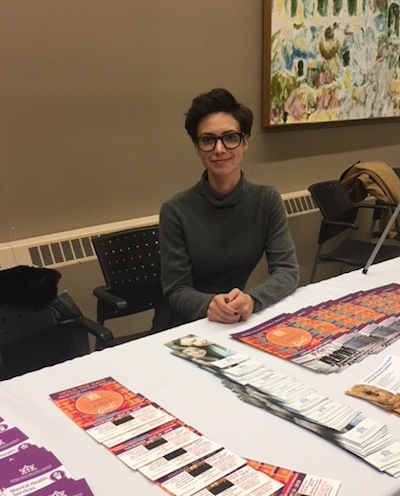
photo - Carli Rossall, Jewish Child and Family Service of Winnipeg addictions and mental health caseworker, at the information table on March 22
Carli Rossall, Jewish Child and Family Service of Winnipeg addictions and mental health caseworker, at the information table on March 22. (photo from JCFS)

“Loss is never easy to talk about,” said Rossall. “But, when loss gets tied together with morality, as suicide often does, an added layer of stigma exists. Anything that challenges our definition of ‘right,’ ‘moral’ or ‘normal’ tends to make us uncomfortable – and it often makes people look to blame.

“Generally,” she said, “people who have thoughts of suicide suffer from intense psychological pain, where there is a feeling of hopelessness, isolation, and no alternative. The reasons for this can vary, from those experiencing mental health challenges or physical illness, to those who have experienced trauma, are struggling financially or have addictions. The rise in suicide rates may be due to life’s increasing pressures and complex circumstances.”

It was in her late teens that Klein lost her father and then, three months later, her brother, to suicide.

“It’s something that obviously is a huge part of my life, my existence, and it wasn’t something that right away I knew what I’d do with,” said Klein. “It affected me greatly. I really didn’t know who to talk to. That was a big part of why I did this film, because it’s so difficult to talk to people when you’ve lost people. They don’t know what to say to you.

“When I came out to L.A. and went to graduate school, I did a film prior to this one…. We started to do documentaries. We did one on bipolar personalities and, when we did that one, we had someone who was in the film who had lost their daughter to suicide. I thought, OK, I’ve dealt with this. And then, almost immediately, I realized that I actually hadn’t. I thought it was time to do something, because people weren’t, and aren’t, talking about it enough, not talking about it responsibly.”

As Klein began researching the topic, she found a large community of people dealing with suicide – so great a number that they were holding conventions in the United States about it. Klein found this resource helpful when it came to finding specific stories to include in her film.

While The S Word is not yet widely available, Klein has worked to get the message across through teachers, mental health professionals and survivors. And she created a toolkit that is on the movie’s website that anyone can access to find ways to bring the message to their communities.

“We’ve signed with an educational distributor and eventually it will be available – probably in the late fall…. We want to help open the conversation, for sure,” said Klein. “We want people to feel less alone, like they’re not the only ones going through this. And we want people to know that they can be there for somebody else, too. Also, to know that, if you, yourself, are struggling, there are people to talk to.

“A lot of times, what can really kill people, what can drive people to this is the silence or the hopeless feeling of being alone – feeling that they have nobody to talk to, and the stigma and shame keep people from talking about it.

“We see this also in the rape culture and the whole #MeToo movement,” she added. “People who were so afraid to talk are now coming forward. And it’s so important to be able to do this. We want to be part of that conversation.”

Klein invited everyone to visit the film’s website – theswordmovie.com – for more information and to watch the many interviews conducted with suicide survivors that did not make it into the film (click on the “#SWordStories” link). She further encouraged people to send in written stories about their own experiences to the website.

In Winnipeg, JCFS is ready to help anyone in need, via their active mental health services program for the Jewish community and counseling services that are open to the general public. In Vancouver, Jewish Family Services is also ready to help.

“Through these supports, there are opportunities for individuals and families to address their concerns, feelings related to suicide, and other issues on a proactive basis,” said JCFS’s Hirsh Katz. “There are also several other community-based agencies in Winnipeg that provide both crisis and non-crisis work with suicide. The Canadian Association for Suicide Prevention is a nationwide organization dedicated to offering support. Livingworks Education Inc. is a leading provider of suicide intervention training through various workshops – the training is focused on identifying, speaking and intervening with people who have thoughts of suicide, and it is invaluable for individuals ages 15 and over who want to help people be safer from suicide.”

Rebeca Kuropatwa is a Winnipeg freelance writer.

Format ImagePosted on April 20, 2018April 18, 2018Author Rebeca KuropatwaCategories TV & FilmTags #SWordStories, Carli Rossall, health, JCFS, Lisa Klein, suicide, survivors, Winnipeg

Posts pagination

Previous page Page 1 Page 2 Page 3 Page 4 Page 5 Next page
Proudly powered by WordPress