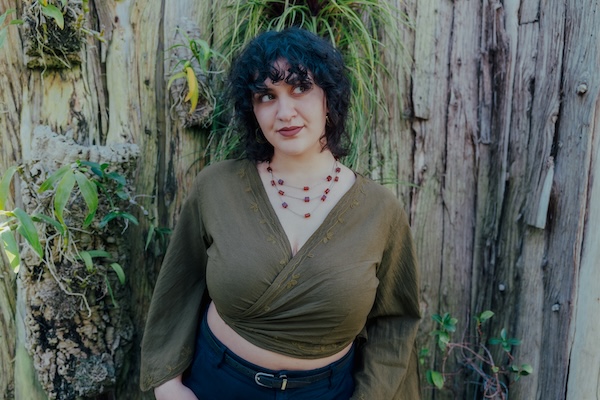
Rebecca Sichon will perform a set at the Mission Folk Music Festival on July 26. She, her father Boris Sichon, DIVKA and Nastasia Y share the stage earlier that day as well. (photo by Sara De Ledesma)
Ukrainian-Canadian jazz, soul and R&B artist Rebecca Sichon grew up attending the Mission Folk Music Festival, and performed there as part of the Youth Open Stage in 2017. At this year’s festival, July 24-26, she will take to the stage with her own music and band – she will also perform with her father, Boris Sichon, a festival veteran, as part of the show Unorthodox.
“I believe this will be my 16th time performing at the Mission Folk Music Festival,” said Boris Sichon. “What keeps bringing me back is the atmosphere. It is a very special festival, where there is a real connection between artists, organizers, volunteers and the audience.
“People come not only to listen to music, but also to discover something new,” he said. “As a musician who plays unusual instruments from different cultures, I always feel that people at Mission are open, curious and ready to travel with me through sound.”
Trained in classical percussion in Ukraine, where he was born, and in St. Petersburg, Sichon has traveled extensively – as a composer and performer – learning countless musical traditions along the way. In his performances and workshops, he draws on his collection of more than 400 instruments gathered over decades.
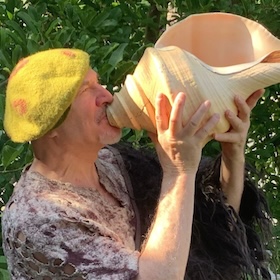
This year, though, his participation in the folk festival will be a little different than usual.
“I will be supporting Rebecca’s songs by creating atmosphere around her voice and piano,” he said. “I will be playing different instruments, including flutes, the Armenian duduk and maybe the Australian didgeridoo. I will also bring some atmospheric percussion instruments like the ocean drum, rainstick and wind machine. These instruments bring sounds of nature into the music and create a space around the songs.
“I may also share some solo pieces during the festival, with instruments from different parts of the world,” he added.
“For the Unorthodox set, I will be mostly performing with my dad and singing a few tunes that marked the start of my artistry,” said Rebecca Sichon.
“We grew up singing folk songs in Yiddish, Ukrainian and Romani and plan to showcase a few of our favourites,” she said.
Her personal set will include songs from her album, which is currently in the works, and her more popular tunes – “all living in the world of soul, jazz and R&B.” She will be joined in concert by Nicholas Bosman (bass, electric guitar, vocals), Mat Trewhit (backing tracks, cajon, percussion) and Elias Cerpa (keyboards, vocals).
“I grew up immersed in music, thanks to my very musical father, Boris, and my very encouraging and noise-tolerating mother, Faina,” said Sichon about her choice of career. “The radio was always on in the house, playing classical, jazz, world music or whatever CD my dad would bring home from his tours. I was put into piano lessons at the age of 7, my dad hoping it would give me the skills needed to songwrite and accompany myself in the future. I went on to complete six levels of the Royal Conservatory in piano and, just as my dad hoped, started writing and accompanying myself at the age of 11.”
She has always gravitated to jazz, soul and R&B. “I remember transcribing Ella Fitzgerald’s ‘Airmail Special’ at the age of 9, and loving the complexity of rhythm, enunciation and melody,” she said. “However, in my teens, I primarily wrote and listened to pop, thinking it was the ‘right’ direction to go in artistically. In my early 20s, I realized soul, and its relative genres, are exactly where I want to be musically.”
In addition to the piano, her father encouraged her to try out different instruments when she was young.
“I was a bit resistant to it,” she admitted. “But, as I’ve gotten older, I have slowly started a collection of instruments he’s gifted me, and I have a much bigger appreciation for it now. I do love the guitar and find it the most versatile, but I always come back to the piano; it feels the most grounding and inspiring for songwriting.”
While her dad is a musician through and through, Sichon said, “My mom would tell you she isn’t, but she’s got a beautiful voice, can play piano and is immensely creative in visual arts (she makes clothing and accessories out of wool, aka felting).”
Growing up, her parents instilled in her “a deep respect and admiration for Judaism and its traditions,” she said. “Growing up in a small town, I didn’t have much access to Jewish community, something I later found through attending Camp Miriam, a Jewish summer camp that gave me a meaningful sense of connection and belonging. While I no longer actively practise Judaism, being Jewish remains an important part of my identity. I carry a lot of love for the community and feel proud of my heritage and the generations of family history that came before me.”
Boris and Faina Sichon have five children. “Music was always a natural part of our family life,” said Boris Sichon. “At different times, all of the children played instruments…. Today, Rebecca is the only one who is a professional musician, but, for us, music was never only about becoming a musician. It was about creativity. We often improvised together at home. It was not important whether someone was a great player or just starting. The important thing was to listen, experiment and create something together.”
Father and daughter were making music together long before they shared a stage.
“What I remember most is how emotional those moments were. Of course, she is my daughter, and I love her very much. I shared with her everything I knew about music and the world of instruments,” said Boris Sichon. “But there was also something special in her from a very young age. Even when she was 2 or 3 years old, she could sing children’s songs very clearly, with perfect pitch. She had a natural gift. Her voice always had something that could touch people. She has always been a very sensitive and caring person, and I think that feeling comes through in her singing and in the songs she writes.
“Our first public performance together was around 2011, when she was 10 years old,” he said. “I remember feeling that I was not only accompanying my daughter anymore – I was sharing music with another artist.
“What I admire most about Rebecca is that she has always been herself. She never tried to copy anyone else.”
Both Sichons have a busy summer ahead.
Rebecca Sichon will take part in Canada Together on July 1, at Canada Place. She also has an engagement on July 9 at Intrigue Wines, in Lake Country, BC, and at the Burnaby Blues + Roots Festival Aug. 8, at Burnaby Village Museum. For more information, visit rebeccasichon.com.
Boris Sichon will take part in a festival on Hornby Island in July, “with the Borealis String Quartet and composer Paul Alexander, who has written music especially for this event,” he said. “Before that, I will be involved in a summer camp, sharing music and instruments with young people and encouraging creativity.
He’s looking forward to the Mission Folk Music Festival and, later in the season, the Mission Renaissance Faire.
“All of these projects,” he said, “are connected by the same idea: using music to bring people together, create curiosity and remind us that sound is a universal language.”
The Mission Folk Music Festival takes place at Fraser River Heritage Park. It offers more than 25 acts from across North America and elsewhere, performing a range of genres. Both the show Unorthodox, which also features DIVKA and Nastasia Y, and Rebecca Sichon’s concert take place on July 26. Visit missionfolkmusicfestival.ca.