Bringing our seniors home

The author and her youngest son, Joel, enjoy Purim at the Louis Brier Home and Hospital. Her eldest son, Benjamin, was the photographer. (all photos by Benjamin Harrington)

When the Hebrew Men’s Cultural Club met in 1945 to talk about starting a home for the elderly, their project began with 14 men, with $5 each. The first home opened in 1946 with 13 residents. Now home to more than 200 seniors, the Dr. Irving and Phyliss Snider Campus for Jewish Seniors includes the Louis Brier Home and Hospital, and the Weinberg Residence. With many new programs and services, the campus has formed powerful bonds with the surrounding community.

This spring sees the launch of a new fundraising campaign by the Louis Brier Jewish Aged Foundation, which provides financial support to the campus. To interview members of the foundation board and staff about the campaign, I made my visit to the Louis Brier Home with both of my children during their spring break. Benjamin, 8, and Joel, 5, are used to volunteering in a seniors home, and are quite comfortable coming to work with me. Without grandparents in the area, it was a blessing for us all to be able to visit the home.
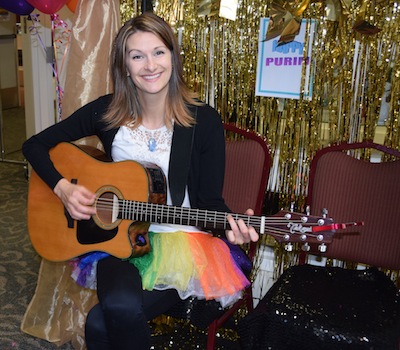
photo - Music therapist Megan Goudreau provides holiday entertainment
Music therapist Megan Goudreau provides holiday entertainment.

Before even shaking any hands, the first thing we noticed was the art. There is art everywhere, and not mass-produced art but carefully curated, vibrant images, full of life, movement and different textures. According to foundation president Harry Lipetz, this is thanks to the organization’s art committee. Every piece is a donation.

We met first with Dr. Judith Globerman, interim chief executive officer of the Snider Campus. Asked to point to some of the home’s distinguishing features, she described an atmosphere that is “more personal than institutional. Our staff feels it’s their home, too, and they tend to stay with us a long time.”

Residents also have a sense of agency, so, for example, if the seniors want to suggest changes – even to the art hanging outside their room – these changes can be made quickly.

Describing her place of work, Globerman spoke about energy, love and understanding. “The energy is warm, celebrating life; people’s faces here light up, there’s always life going on around you, even if you’re not moving yourself.”

Lipetz joined the Brier Foundation for this very reason. “It is a happy place,” he said. “I saw the level of caring, from custodial staff right through to top management.”

Bernard Pinsky, chair of the current fundraising campaign, can attest to the heimish (comfortable, homey) quality of the Louis Brier Home.

“Both of my parents lived there, as well as my uncles and aunt,” he said. “For a period of 21 years, at least one of my relatives lived there. My mom was at Louis Brier for 13 years. I was there a lot and saw for myself the warmth, the quality of the care. The program director goes into residents’ rooms personally to check in, to encourage seniors to join activities. It makes such a difference to be invited personally, to keep you connected to community life.”

The Louis Brier is the only Jewish home for seniors in the province. As such, it carries a certain responsibility, said Pinsky. He speaks of the community’s pride in being able to offer a life with dignity in a warm and stimulating environment to our seniors.

“Donors’ contributions make it a Jewish home,” he said. “They allow us to offer the special things that help people to live more fulfilling lives: kosher food, a weekly minyan, festivities for every Jewish holiday.”

That said, nothing prepared us for our visit at Purim, where we were greeted by staff wearing rainbow tutus, feather boas, glittery glasses and spotted mouse ears. As we stood in the entrance hall among the balloons, an elderly resident wearing googly-eye glasses strolled through with some friends waving groggers. Needless to say, this was a little different from my sons’ previous experiences of seniors facilities.
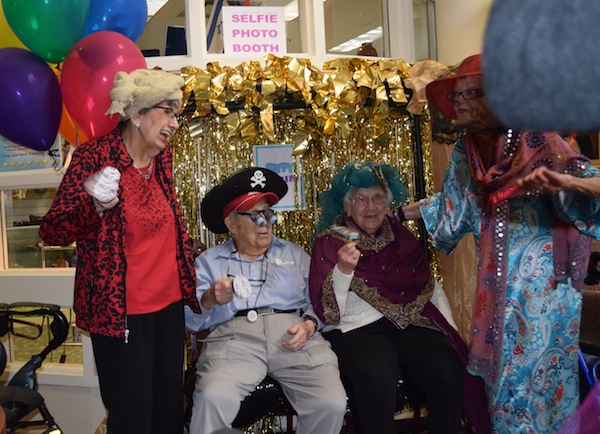
photo - Residents get into the spirit of Purim
Residents get into the spirit of Purim.

When I spoke with Pinsky, he talked at length about the Louis Brier’s music therapy program. Offered by a team of professionals, it is based on research that shows how music calls on a different part of the brain than speech. Pinsky observed, “People can sing songs they knew 60 or 70 years ago, when they can’t even speak.”

He added, “We have the best seniors music therapy in the province. There’s music every single day.”

The March calendar includes weekly Shabbat music, ukelele sing-alongs and jam sessions, as well as a concert of Russian music and a piano recital. We caught a flavor of this during our visit when music therapist Megan Goudreau played her guitar and sang one of the residents’ favorite songs, “Kol Ha’olam Kulo.”

photo - Even a friendly dog joins in the festivities
Even a friendly dog joins in the festivities.

The home was a hive of activity when we visited, with youngsters volunteering, residents – and a couple of friendly dogs! – milling about. Costumed kids came by with their families and sang on both floors of the home. Nothing beats the sight of a mini race-car driver delivering a “Chag Purim!” message with a huge smile to delighted seniors.

“The three things that concern residents the most – beyond housing – are food, music and companionship. The foundation provides that. It’s beyond public funding,” said Lipetz.

The seniors “are not coming here to be housed,” he added, “they are coming here to live.”

Pinsky agreed. “It’s amazing what we’re able to do. Loneliness is one of the biggest problems for seniors, so seniors with families who live out of town can be visited by special companions.”

Louis Brier residents have access to their own rabbi, Hillel Brody, spiritual leader of the Chava and Abrasha Wosk Synagogue. Located within the home, the synagogue is funded solely by the foundation. In other words, like the music, the companions and occupational therapy, it is a gift from the community.

The new campaign is a quest to raise $1 million. Pledges are for two years, so a $5,000 donation would be given in two portions of $2,500 each.

“These funds are essential to maintain continuity in the programming,” said Pinsky. “The home needs to budget 12 months ahead, for the next fiscal year. If we fall into deficit, these life-improving programs need to be cut.”

Added Lipetz, “For many residents, this is their last home. We want to make it their best home.”

Shula Klinger is an author, illustrator and journalist living in North Vancouver.
Folk music in the Holy Land

The author enjoying a day of folk music from around the world at Israel’s Jacob’s Ladder festival. (photo from Miri Garaway)

I have always been a folk music aficionado, so when I heard about the Jacob’s Ladder Music Festival in Israel, I planned a trip there entirely around the idea of attending the festival. Not only was it a phenomenal event, it exceeded all my expectations and was the highlight of our month’s stay.

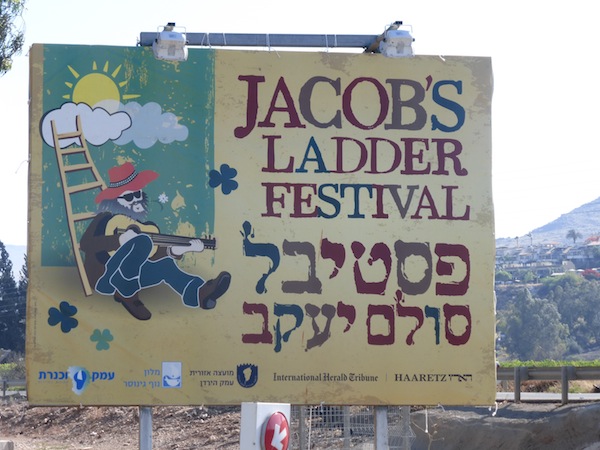
photo - Jacob's Ladder Festival sign
(photo from Miri Garaway)

Established in 1976, Jacob’s Ladder (Sulam Ya’akov) is held twice a year, in May and December, with the spring festival on a larger scale. It is billed as “Israel’s friendliest musical and social event, a unique bluegrass, folk, country, blues, Irish and world music extravaganza.” That it was.

With the venue on the grounds of Kibbutz Nof Ginosar on Lake Kinneret, nine kilometres north of Tiberias, the setting could not be more beautiful and the atmosphere is very relaxed, “green” and peaceful. Approximately 4,000 people attend the spring festival, yet it did not feel crowded or overwhelming.

How wonderful to be able to attend a two-and-a-half-day event and know that there is free camping on site, in addition to the pleasant Hotel Nof Ginosar. From the moment we entered the site, on a Thursday afternoon in May 2014, we could feel the energy of the special event that was about to take place.

The organizers have registration down to a science. We bought our tickets upon arrival, received our fluorescent wristbands and joined the throngs of festival goers entering the site. Considering the volume of people arriving, we were amazed that we only had to wait a short time in the line-up for tickets. Pre-festival online tickets helped to ease any congestion.

And, perhaps only in Israel would they provide free agalot, large wheely carts in the parking lot so you can carry all your belongings into the grounds. I found this so civil and convenient and it was fun to watch the hordes of people streaming in with their tents, barbecues, bicycles, chairs, strollers, blankets, duffle bags, food coolers and other camping paraphernalia.

This is a festival that everyone can enjoy: young families, teenagers, baby boomers, aging hippies and young-at-heart seniors. While it originated as more of an anglophone festival, today, many non-anglophone Israelis and tourists attend, too.

The festival is extremely well organized, with activities such as free early morning outdoor yoga and tai chi classes, holistic treatment kiosks, a craft fair, children’s handicraft workshops, a children’s puppet-making workshop, storytelling, juggling, Irish, tap and square dancing workshops. Food booths are also set up on site with pre-purchased tickets to be used throughout the festival.

We chose to stay at the kibbutz guesthouse, Hotel Nof Ginosar. Although the hotel is fully booked for the festival from year to year, the reservations clerk suggested we put our names on the waitlist (this was in October) with a good chance that a room would become available closer to the date of the festival. In the interim, we booked a nearby bed and breakfast to ensure that we had some accommodation in place. We were fortunate that space at the hotel did open up a couple of months before the festival.

It was convenient to stay on site rather than commuting. The hotel is basic, but clean and comfortable and every room has a fridge. The bountiful and delicious Israeli breakfast, included in the room rate, gave us a great start to the day.

While exploring the grounds, I met my Israeli cousin from a nearby moshav, who promptly invited us to his tent for a communal Shabbat dinner. Suddenly, we were among family and friends for a feast. This unexpected rendezvous was indeed a treat.

Jacob’s Ladder is easy to navigate. The main stage is a huge expanse of grass where you can put down blankets, towels or low chairs to reserve a spot for the entire weekend. This is unheard of at most festivals, since you usually have to collect your things at the end of the day and race for the coveted spots each day. It is an unspoken rule at Jacob’s Ladder that if you are not using your space, anyone can sit in your place until you return. The whole area is covered by an enormous see-through tarp, so the sun does not beat directly down on you. Once you are settled in, it is pure joy to sit back, relax and enjoy the outstanding talent and the incredible music. On many occasions, people are moved to get up and dance. You also get to know your neighbors and it feels like a community within a community. It is interesting to make connections with the people who are around you.

There is also the lawn stage, a smaller space with chairs set up on the plaza outside the hotel lobby. Another music venue within the hotel is Hermon Hall, an indoor auditorium, as well as the balcony stage and the sports hall for music and dance workshops.

The performers are often available to meet right after the concert, at a table beside the stage, where they sell their merchandise.

In addition to Israeli artists, musicians come from all over the world to perform at the Jacob’s Ladder. A sampling of some of the stand-outs for 2014 included the Jammin Divas; Maya Johanna, Shay Tochner and Yonatan Miller in a tribute to Pete Seeger; the Slocan Ramblers; and a variety of singers who belted out a moving medley of the songs of Janis Joplin, Joni Mitchell, Eric Clapton and Ray Charles. From the strumming of the Ukeleles for Peace Children’s Orchestra to the lilting sounds of Nava Tehila singing Jewish world music for Kabbalat Shabbat, this was a festival that moved and energized me.

The hotel kindly allows jamming sessions in the lobby and bar areas and people bring guitars, banjos, violins, flutes, clarinets, harmonicas, drums and an assortment of other instruments to showcase their talent. What a wonderful hive of activity and a delight to hear music wafting throughout the hotel. There are also pop-up jamming sessions on the grounds, away from the stages. People-watching is an activity unto itself.

If you want to take a break, there is a swimming pool, as well as the lake beach of the Kinneret, but we came for the music and it was truly an exceptional experience.

Miri Garaway is a freelance travel writer.

Friendships via music

The YMCA Jerusalem Youth Chorus prior to their 10-day tour of Japan in August 2014. (photo from Micah Hendler)

There are many creative ways to bring about a peaceful dialogue between Israelis and Palestinians. In one particular case, an American Jew by the name of Micah Hendler combined choral singing and dialogue to help bring Palestinian and Israeli teens to a place of trust in Jerusalem.

Hendler, originally from Bethesda, Md., has been singing for as long as he can remember.

“For me, singing is a very powerful way of connecting to other people and creating communities, a sense of common identities, all the things that make people feel close to one another,” he said.

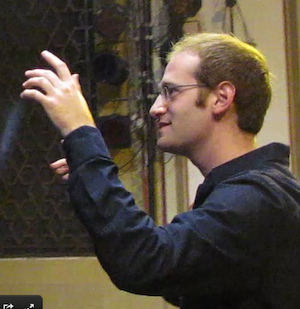
photo - YMCA Jerusalem Youth Chorus founder and conductor Micah Hendler
YMCA Jerusalem Youth Chorus founder and conductor Micah Hendler. (photo from Micah Hendler)

In his high school years, Hendler participated in Seeds of Peace, a program for teens from conflict regions around the world. For the first time, he had the opportunity to hear the stories of both Palestinians and Israelis.

“It made me realize the power of talking to others who are different, the power of showing people there are other ways to see things, more complete ways to see things,” he said of Seeds of Peace. “That’s what really got me interested in the Israeli-Palestinian conflict. In many ways, this was in contrast to the education I’d received.”

Over the years that followed, as Hendler continued his involvement with Seeds of Peace, he thought about ways in which he could create a new community, and decided on a singing group.

“I thought that would be really cool,” said Hendler, now in his 30s. “I could empower people and show them that they could sing and be part of something like this. For me, I thought … this is a way I can do things I really love to do in the context of needing ways for people to come together.”

When Hendler was ready to kick things off, he had just graduated from Yale. “I thought, if I’m ever going to do this, now’s the time.”

With degrees in music and international studies, and a host of other experience, both in music and in conflict transformation, Hendler moved to Jerusalem. He spent the first couple of months having coffee with anyone and everyone. He also spent a lot of time at high schools, sharing information about the choir, the YMCA Jerusalem Youth Chorus. Eighty youth auditioned, with the majority coming from East Jerusalem.

“There were so few extracurricular options in East Jerusalem at all, let alone singing options,” said Hendler. “For kids that liked to sing, I was one of the very few possibilities around.”

Hendler accepted 30 kids (ages 14-18), an even split of Israelis and Palestinians.

A friend connected Hendler with Israeli singer/songwriter David Broza, who was working on the album East Jerusalem/West Jerusalem at the time. Broza invited the chorus to be part of it. “It’s pretty amazing – that was three months into the choir, and we were recording with David Broza in the studio,” said Hendler.

The YMCA Jerusalem Youth Chorus program begins and ends with singing, with dialogue embedded in the middle. It does not take long for the kids to mingle. “They were in a completely unstructured context, already hanging out across linguistic and national lines,” said Hendler. “A lot of girls were singing pop songs on the piano and the guys were doing their thing, and different people were talking.”

The cost for the program is covered by the Jerusalem Foundation and private donors in and outside of Israel; the kids pay a symbolic fee to attend, as long as they are able.

Hendler’s main focus now is on ensuring that the kids feel part of a group, which is a moving target as the chorus grows. Currently, there are 44 kids divided into three dialogue groups, but Hendler is looking at other options. “There’s a limit of how big the choir could be in terms of what is manageable,” he said. “But, it would be possible to have multiple ensembles at different levels.”

When selecting kids for the chorus, Hendler looked for kids who wanted to meet new people and experience new things. As well, potential members needed both to be able to express any opinions they may have, as well as listen to those of others. “We also, of course, wanted people suited for singing,” he added.

Rehearsals are 3.5 hours and take place once a week. From as early as the second rehearsal, he said, “it was amazing that the kids were so open to one another. Obviously, with the linguistic and social challenges, the group had gone through a lot, but fundamentally there’s this openness and a joy that’s pretty inspiring.”

The dialogue is run by professional facilitators, “but I still have a good sense of what goes on,” said Hendler. “And, it’s actually really beyond inspiring, the way they listen to each other and create a space. The kids are real with each other, sharing their fears and hopes … but what’s really been amazing is that even outside the choir, the kids have started to speak up in their communities.”

Israeli high schooler Avital said of the program, “You get to know the other side, you get to be together, to see what it’s like being with kids different than you.” Shifra, another Israeli participant, said, “[Before] I only knew Israelis, I had never met any Arabs before I came here. I didn’t know what I was going to see … I wasn’t sure what I expected, but what I realized was that we’re all the same.”

Palestinian high schooler Alaa commented, “I learned from the sessions how not to stay silent, to express myself.” And Ameer, another Palestinian participant, said, “The choir is beautiful and we enjoy it, because we are Arabs and Jews, together at the same time.”

Rebeca Kuropatwa is a Winnipeg freelance writer.