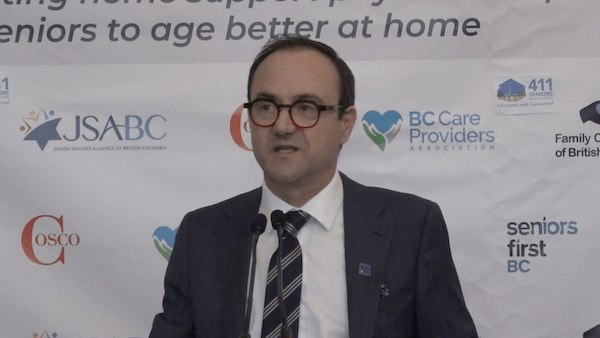
Jeff Moss, executive director of the Jewish Seniors Alliance, speaks at the June 2 launch of the Health Care Needs Home Care campaign. (screenshot)
The Jewish Seniors Alliance of British Columbia is leading a broad coalition calling on the provincial government to eliminate fees for publicly funded home-support services, arguing that helping older adults remain safely at home would improve their quality of life while reducing pressure on hospitals and long-term-care facilities.
The Health Care Needs Home Care campaign was launched June 2 at the 411 Seniors Centre in Vancouver. Its partner organizations collectively represent or serve more than 400,000 seniors, caregivers and supporters across the province. The coalition is calling for access to home support to be determined by medical and practical need, rather than by a senior’s income or ability to pay.
Home-support workers assist people with daily activities such as bathing, dressing, preparing meals, taking medication and moving safely around their homes. Unlike many physician and hospital services, publicly delivered home support in British Columbia can require income-tested co-payments. The campaign argues that these charges place potentially essential care beyond the reach of many seniors. Its website says a senior earning $31,000 annually can be charged about $10,000 for one hour of home support a day over the year. Ontario and Alberta provide comparable publicly funded services without such fees.
Jeff Moss, executive director of the Jewish Seniors Alliance, said the campaign is not seeking merely to reduce the co-payments. It wants them abolished.
The principle of universality is important, Moss said, because means-testing adds another layer of complexity to a system that can already be difficult to navigate, particularly for people experiencing cognitive changes, language barriers or other challenges.
“It’s the opposite of being a hospitable system,” he said. Under the proposed approach, once someone is assessed as requiring support, “we’ll get it for you.”
Questions inevitably arise about why affluent seniors should also receive publicly funded home support. Moss argued that seniors able and willing to buy customized private care would probably continue doing so. A universal public program, however, would avoid forcing vulnerable people to prove repeatedly that they are sufficiently poor or otherwise deserving of assistance.
The campaign’s broader argument is economic as well as humanitarian. When people cannot obtain affordable help at home, relatively manageable difficulties can escalate into emergencies. Seniors may end up in hospital after falls, medication problems, malnutrition or other preventable complications. Others may be moved into long-term care earlier than necessary because they lack sufficient support to remain at home.
The campaign estimates that an average 24-day hospital stay for a senior can cost about $24,000, compared with approximately $1,200 for 24 days of home support. It also says 61% of people entering long-term care received no home support during the preceding 90 days.
Moss said governments cannot build long-term-care spaces quickly enough to meet the anticipated demand from an aging population. New facilities are expensive, require years of planning and construction, and often replace older beds rather than adding substantially to the total supply. In the Vancouver Coastal Health region, he said, projects completed or anticipated between 2009 and 2029 represent approximately 600 long-term-care beds, but only about 200 are net additions. A bed can cost more than $1 million to build, he added, while the provincial waiting list is already in the thousands and projected to grow substantially.
Providing more home support would not eliminate the need for residential care. It could, however, reserve those limited spaces for people whose medical and personal care needs genuinely cannot be met at home, said Moss.
The coalition involved in the campaign includes the Jewish Seniors Alliance, the Council of Senior Citizens’ Organizations of BC (COSCO), the Independent Long-Term Care Councils Association of BC, Family Caregivers of BC, the BC Health Coalition, the BC Care Providers Association, and Seniors First BC.
Together, they represent a range of perspectives, including seniors themselves, unpaid family caregivers, long-term-care residents and families, care providers and advocates for the public health-care system.
The campaign developed from advocacy work already underway at the JSA when Moss became executive director about two years ago. Its advocacy committee had identified home-support co-payments as a major barrier to aging in place and had begun meeting with public officials.
As the 2024 provincial election approached, the organization shifted from contacting individual MLAs to seeking commitments in party platforms. Moss said the proposal was included in the platforms of both BC United and the Conservative Party of BC.
After the election, advocates continued meeting with politicians, government representatives and seniors’ organizations. As more groups endorsed the objective, the effort grew into the present province-wide coalition.
Moss hopes the public campaign will generate at least 1,000 letters to MLAs and create sufficient pressure for meetings with the premier, health minister and finance minister during the coming fall legislative session.
The campaign website provides a form through which British Columbians can contact their MLAs. It is also collecting personal experiences from seniors and families who have experienced difficulty accessing home support because of the required fees.
“Seniors are a big voting bloc,” Moss said. If the government does not move on the issue, he said, the coalition will continue approaching opposition parties to build support for a future policy change.
For Moss, JSA’s leadership in a campaign serving seniors of every background is significant in another respect. At a time when Jewish individuals and organizations have sometimes experienced exclusion from coalitions and public institutions, he views the campaign as an opportunity to demonstrate the Jewish community’s investment in the well-being of society as a whole.
The Jewish Seniors Alliance is rooted in Jewish tradition but provides programs and advocacy intended to benefit older adults throughout the province, regardless of identity. Moss said he deliberately connects the organization’s public work to Jewish values, whether he is addressing political caucuses, seniors’ organizations or community audiences.
“Too often,” he said, “people see our Jewish organizations as only focused on the Jewish community when, in reality, we all know that the Jewish community, as part of tikkun olam, [tries] to repair the world for all.” The home-care campaign, he said, is “a living testament to that.”
And its message is straightforward: home support should be considered part of health care, said Moss, not as an optional service available only to those who can afford it.