JSA leads BC-wide campaign

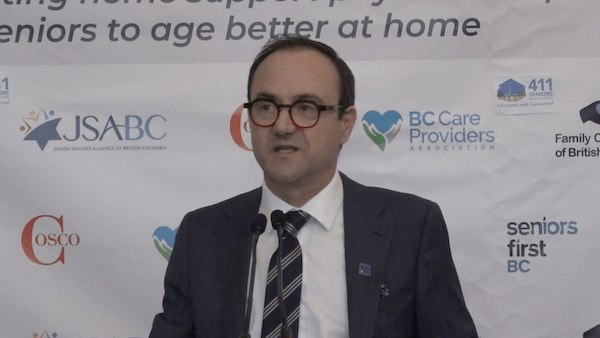
Jeff Moss, executive director of the Jewish Seniors Alliance, speaks at the June 2 launch of the Health Care Needs Home Care campaign. (screenshot)

The Jewish Seniors Alliance of British Columbia is leading a broad coalition calling on the provincial government to eliminate fees for publicly funded home-support services, arguing that helping older adults remain safely at home would improve their quality of life while reducing pressure on hospitals and long-term-care facilities.

The Health Care Needs Home Care campaign was launched June 2 at the 411 Seniors Centre in Vancouver. Its partner organizations collectively represent or serve more than 400,000 seniors, caregivers and supporters across the province. The coalition is calling for access to home support to be determined by medical and practical need, rather than by a senior’s income or ability to pay.

Home-support workers assist people with daily activities such as bathing, dressing, preparing meals, taking medication and moving safely around their homes. Unlike many physician and hospital services, publicly delivered home support in British Columbia can require income-tested co-payments. The campaign argues that these charges place potentially essential care beyond the reach of many seniors. Its website says a senior earning $31,000 annually can be charged about $10,000 for one hour of home support a day over the year. Ontario and Alberta provide comparable publicly funded services without such fees. 

Jeff Moss, executive director of the Jewish Seniors Alliance, said the campaign is not seeking merely to reduce the co-payments. It wants them abolished.

The principle of universality is important, Moss said, because means-testing adds another layer of complexity to a system that can already be difficult to navigate, particularly for people experiencing cognitive changes, language barriers or other challenges.

“It’s the opposite of being a hospitable system,” he said. Under the proposed approach, once someone is assessed as requiring support, “we’ll get it for you.”

Questions inevitably arise about why affluent seniors should also receive publicly funded home support. Moss argued that seniors able and willing to buy customized private care would probably continue doing so. A universal public program, however, would avoid forcing vulnerable people to prove repeatedly that they are sufficiently poor or otherwise deserving of assistance.

The campaign’s broader argument is economic as well as humanitarian. When people cannot obtain affordable help at home, relatively manageable difficulties can escalate into emergencies. Seniors may end up in hospital after falls, medication problems, malnutrition or other preventable complications. Others may be moved into long-term care earlier than necessary because they lack sufficient support to remain at home.

The campaign estimates that an average 24-day hospital stay for a senior can cost about $24,000, compared with approximately $1,200 for 24 days of home support. It also says 61% of people entering long-term care received no home support during the preceding 90 days. 

Moss said governments cannot build long-term-care spaces quickly enough to meet the anticipated demand from an aging population. New facilities are expensive, require years of planning and construction, and often replace older beds rather than adding substantially to the total supply. In the Vancouver Coastal Health region, he said, projects completed or anticipated between 2009 and 2029 represent approximately 600 long-term-care beds, but only about 200 are net additions. A bed can cost more than $1 million to build, he added, while the provincial waiting list is already in the thousands and projected to grow substantially.

Providing more home support would not eliminate the need for residential care. It could, however, reserve those limited spaces for people whose medical and personal care needs genuinely cannot be met at home, said Moss.

The coalition involved in the campaign includes the Jewish Seniors Alliance, the Council of Senior Citizens’ Organizations of BC (COSCO), the Independent Long-Term Care Councils Association of BC, Family Caregivers of BC, the BC Health Coalition, the BC Care Providers Association, and Seniors First BC. 

Together, they represent a range of perspectives, including seniors themselves, unpaid family caregivers, long-term-care residents and families, care providers and advocates for the public health-care system. 

The campaign developed from advocacy work already underway at the JSA when Moss became executive director about two years ago. Its advocacy committee had identified home-support co-payments as a major barrier to aging in place and had begun meeting with public officials.

As the 2024 provincial election approached, the organization shifted from contacting individual MLAs to seeking commitments in party platforms. Moss said the proposal was included in the platforms of both BC United and the Conservative Party of BC.

After the election, advocates continued meeting with politicians, government representatives and seniors’ organizations. As more groups endorsed the objective, the effort grew into the present province-wide coalition.

Moss hopes the public campaign will generate at least 1,000 letters to MLAs and create sufficient pressure for meetings with the premier, health minister and finance minister during the coming fall legislative session.

The campaign website provides a form through which British Columbians can contact their MLAs. It is also collecting personal experiences from seniors and families who have experienced difficulty accessing home support because of the required fees. 

“Seniors are a big voting bloc,” Moss said. If the government does not move on the issue, he said, the coalition will continue approaching opposition parties to build support for a future policy change.

For Moss, JSA’s leadership in a campaign serving seniors of every background is significant in another respect. At a time when Jewish individuals and organizations have sometimes experienced exclusion from coalitions and public institutions, he views the campaign as an opportunity to demonstrate the Jewish community’s investment in the well-being of society as a whole.

The Jewish Seniors Alliance is rooted in Jewish tradition but provides programs and advocacy intended to benefit older adults throughout the province, regardless of identity. Moss said he deliberately connects the organization’s public work to Jewish values, whether he is addressing political caucuses, seniors’ organizations or community audiences.

“Too often,” he said, “people see our Jewish organizations as only focused on the Jewish community when, in reality, we all know that the Jewish community, as part of tikkun olam, [tries] to repair the world for all.” The home-care campaign, he said, is “a living testament to that.”

And its message is straightforward: home support should be considered part of health care, said Moss, not as an optional service available only to those who can afford it. 
JSA revamps advocacy

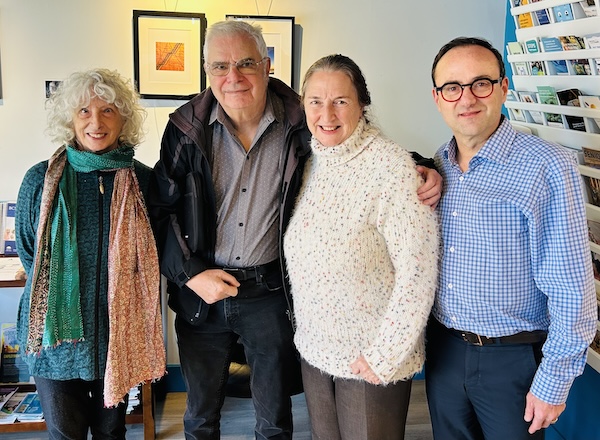
Jewish Seniors Alliance of British Columbia’s Margot Beauchamp, left, and Jeff Moss, right, with advocate for seniors’ rights Howard Glick and Parliamentary Secretary for Seniors’ Care and Long-Term Care Susie Chant. (photo from JSA)

Jewish Seniors Alliance, whose mission is to reduce isolation, build connection and uplift and support Jewish and other seniors    in the province, started 2025 with a new name. 

At its annual general meeting last November, the organization chose to rename itself the Jewish Seniors Alliance of British Columbia. Formerly, it was called the Jewish Seniors Alliance of Greater Vancouver. One of the motivations for the change was to better reflect the organization’s goals and the services it provides.

The new name comes as JSA expands its advocacy work throughout the province, with efforts such as extending its reach, via its Senior Line magazine, to more communities. The new name, it maintains, recognizes the need to connect with more seniors in the province. Initially, JSA intends to partner with outreach programs in the Sea-to-Sky, Burquitlam and Surrey regions.

Similarly, the JSA Peer Support Services program has been rebranded. It will now be known as Community Support Services (CSS), which the organization believes will express its objectives and more clearly define the services it offers with senior volunteers and clients: senior peer support and friendly visiting/calling.

Concurrently, JSA has relaunched its advocacy work around free home support for all BC seniors, stating that it had success with this effort in the run-up to the provincial election. It will continue to meet with government and opposition MLAs, as well as work with and through community partners to ask people to contact their MLAs to voice their support for the initiative.

“The JSA approach to advocacy and government relations has been focused and targeted on decision-makers,” said JSA executive director Jeff Moss during a Jan. 22 Zoom event, in which he discussed the proposal for universal home care in British Columbia as a way to reduce the burden on individuals and government spending.

Moss summarized a recent mandate letter to Susie Chant, parliamentary secretary for seniors’ care and long-term care, which advocated for increased health-care availability, cost containment, responsive health systems, increased senior care, engagement with stakeholders and communication with the health ministry.

Howard Glick, an advocate for seniors’ rights and barrier-free healthcare, joined Moss on the Zoom panel. Glick had recently produced a short video, The Home Care Imperative: A Humanitarian Solution, on the need for free home support in the province, which was shown to the audience. 

The video emphasized the advantages of home care, including aging in place, which can allow seniors to preserve their independence and dignity. It can also produce systemic savings that reduce waits for long-term care and free up hospital beds. And its implementation can be expedited, as home care can be scaled more quickly than construction for long-term care facilities. 

Also stressed in the video was the idea of accessible, personalized home care as a better way to benefit seniors in their daily lives. The video argued that such a measure would foster independence and connection while strengthening the health-care system overall. This issue is particularly pressing, as the number of seniors in the province, and across the country, is set to increase in the coming two decades. 

Most older adults, the video pointed out, would prefer to stay at home. Research from the Office of the Seniors Advocate, under the leadership of both former seniors advocate Isobel MacKenzie (now a JSA board member) and current advocate Dan Levitt, shows that many admissions to long-term care could have been treated at home with the right supports. Women, people in rural communities and those living alone make up a greater percentage of those moving into long-term care, according to the office’s report.

According to the video, British Columbia, when compared to Ontario, is lacking in several features that pertain to senior care, such as funding, services, eligibility, caregiver support and integration. The costs associated with accessing care for seniors in British Columbia greatly exceed those of other provinces as well, the video contends, noting that Alberta, Ontario and other provinces offer free home support for older adults.

Following the video, Moss reviewed a long list of advantages of providing free home care.

“The benefits are personalized at-home care, ease of access, reduced hospitalizations, fewer unnecessary admissions to long-term care, better health outcomes, increased independence and peace of mind,” he said.

During the question-and-answer session, it was conceded that the home-care model proposed in the video is, at present, far from the current reality. 

“At this point, the system is fragmented, disorganized and unreliable, and there are a whole bunch of other problems. What our video is advocating is how to make things work for people in the future and that means reevaluating the structure of the system completely,” Glick said.

“Before any changes can be made, we have to have influence and contacts, we don’t have that yet. We’re just in the starting process of trying to get our foot in the door with the people who have the money and make policy,” he added.

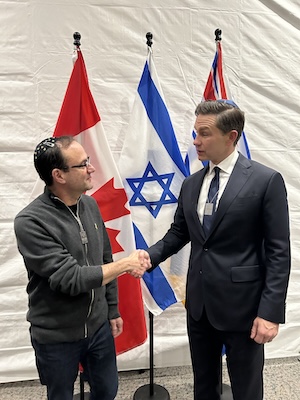
photo - Jewish Senior Alliance of British Columbia executive director Jeff Moss, left, with Conservative Party of Canada leader Pierre Polievre
Jewish Senior Alliance of British Columbia executive director Jeff Moss, left, with Conservative Party of Canada leader Pierre Polievre. (photo from JSA)

The January event was part of the JSA-Phyliss and Irving Snider Foundation Empowerment Series and was co-sponsored by the Kehila Society of Richmond, COSCO and West End Seniors’ Network. 

Moss, Glick and Margot Beauchamp, JSA’s quality assurance liaison, have since met with Chant. According to Moss, Chant gave them her support to move the initiative forward by way of making an introduction to the ministers of finance and health, along with opportunities to speak with all MLAs. JSA is also seeking the support of Brennan Day, opposition critic for rural health and seniors’ health.

JSA is working to advance the interests of seniors at the national level as well. During Conservative Party of Canada head and leader of the Official Opposition Pierre Poilievre’s visit to Temple Sholom on Feb. 2, Moss said he took a moment to let Poilievre “know that 65% of BC seniors are living on less than $40,000 annually and that adjustments are needed in the Guaranteed Income Supplement for seniors so that they can ensure more sustainability to age better.”

Poilievre directed Moss to follow up with his policy team.

For more information on JSA’s home-care advocacy, visit jsalliance.org/advocacy. 

Sam Margolis has written for the Globe and Mail, the National Post, UPI and MSNBC.

Seniors advocates honoured

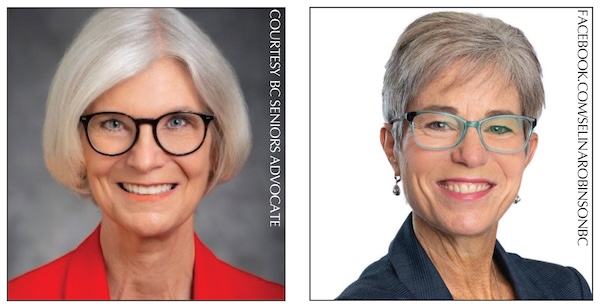
Isobel Mackenzie, left, and Selina Robinson will be honoured at Jewish Seniors Alliance’s AGM Nov. 3.

The Jewish Seniors Alliance of Greater Vancouver’s annual general meeting on Nov. 3 will serve as an opportunity to welcome the organization’s first-ever executive director, Jeff Moss, and to honour two prominent women in provincial politics who have been dedicated to seniors throughout their careers: Selina Robinson and Isobel Mackenzie.

JSA chair Tammi Belfer will introduce Moss, whose hiring marks a significant change in the alliance’s 21-year history. The shift, she said, will enable the board of directors to focus on policy-making and high-level planning, while collaborating with the new executive director and staff on implementation. 

“This transition is a gradual process, and I want to extend my heartfelt thanks and appreciation to each board member for their years of unpaid work,” said Belfer. “Together with our executive director, we can now strategically plan every event, raise much-needed funds, and improve and expand our services to our ultimate clients – the seniors of Greater Vancouver, the Lower Mainland, and the entire province.”

Moss told the Independent that he is looking forward to his first AGM as executive director, a job he started in July, and that, in his new position, he plans to recognize the past and look ahead to the future of the “modern, inclusive and dynamic charity.”

“I am pleased to work alongside our incredible community partners, with the support of our generous donors, a committed board and motivated staff,” he said. “I look forward to continuing to build on our strong reputation for positively impacting the lives of lonely and isolated seniors.”

Belfer praised Moss as JSA prepares for its move away from an operational board, noting that the coming year will not be an easy one, but it will be exciting.

“Jeff and I form a great partnership and I hope, together, we bring the name and extreme value of JSA to the forefront of all seniors. This population is growing and the need is increasing. Vancouver and BC can count on us to be there for seniors. We are seniors stronger together,” she said.

“Jeff’s caring nature and strong management skills are the exact combination we need for our first executive director,” she added. “When he reaches out to you, make a point of meeting with him – you are in for a treat.”

Robinson, who has been the member of the legislative assembly for Coquitlam-Maillardville since 2013, is not running for reelection on Oct. 19. She made the decision to retire for several reasons (jewishindependent.ca/the-aftermath-of-resignation) and is in the final stages of writing a memoir, which is set for release in November.

Before gaining a seat in the legislature, Robinson worked as a family therapist and was a city councilor in Coquitlam for two terms. Her career includes having been associate executive director of Vancouver’s Jewish Family Service Agency. As an MLA, she served as opposition critic on seniors, mental health and addictions, and other issues. In government, she served as minister of municipal affairs and housing, and as British Columbia’s finance minister. She was minister of post-secondary education and future skills until earlier this year.

“Representing people in my community and being their voice in government has been the greatest honour, and having JSA acknowledge that work warms my heart,” Robinson told the Independent. “Thank you, JSA, for being such great partners.

“Jewish Seniors Alliance understands that, in order to have a strong community, you need to make sure that the community has what it needs,” she said. “JSA engages Jewish seniors to provide them with services and supports, and to better understand their needs so that they can advocate for resources to better meet those needs.”

Mackenzie – who is nominated for a term this year on JSA’s board of directors – served for 10 years under both Liberal and NDP governments as the province’s first seniors advocate, before her retirement earlier this year. Her efforts won her widespread plaudits and dispelled initial skepticism concerning the effectiveness of the new office.

In a piece for the Orca in March, shortly after it was announced that Mackenzie would leave her role as seniors advocate, political commentator Rob Shaw wrote, “She left widely respected by all sides at the legislature, inside the Ministry of Health and even amongst the seniors care groups she has occasionally clashed with in her reports.

“Mackenzie’s work highlighting care hour shortages in long-term care homes, first-bed refusal policy problems, partners split up in assisted living, consent and admission concerns, and the underperformance of private long-term care facilities using public funding have all led to government reforms. She created a useful and relevant database on care homes. And she’s still fighting for a hike to the Shelter Aid for Elderly Renters (SAFER) rates.”

In the 1990s, long before she became the province’s seniors advocate, Mackenzie was chief executive officer of the provincial nonprofit Beacon Community Services, where she led a new model of dementia care that has become a national best practice, and established safety accreditation for home-care workers.

Jewish community member Dan Levitt is the new provincial seniors advocate, taking over from Mackenzie. 

The JSA AGM on Nov. 3 will be held at Congregation Beth Israel, starting at 5 p.m. Dinner tickets are $75 and attendees are requested to RSVP by Oct. 20 to office@jsalliance.org or 604-732-1555. 

Anyone who has made a donation to JSA of $18 or more in the past 12 months is considered a member in good standing and is eligible to vote at the AGM. 

Sam Margolis has written for the Globe and Mail, the National Post, UPI and MSNBC.

Moss takes the helm of JSA

Jeff Moss (photo from JSA)

This summer, Jeff Moss became the first executive director of the Jewish Seniors Alliance of Greater Vancouver. Moss has long served the local community, following the example of his parents, who were deeply involved in building the Jewish community in Richmond.

The father of three adult children, Moss was co-chair of Richmond Jewish Day School, where, he said, the board took an active role, which helped him build a solid understanding of how an involved board could work alongside professional management. Moss spent three decades in the private sector before leaving to work at United Way British Columbia and then making his way to JSA.

“I reached out to United Way for an opportunity to become a campaign manager,” Moss told the Independent. “I went into work helping them with fundraising and campaign management, telling their story. And I had the opportunity to connect with a lot of great people and got some experience working in nonprofits. I had really wanted to get engaged with the nonprofit world. My desire was to go out and make an impact in the community.

“Then, Oct. 7 happened,” he said, “and I felt very strongly that I wanted to make an impact on the Jewish world if I could. So, I began to look for opportunities to serve in Jewish nonprofits and, eventually, the opportunity with JSA came along.”

Moss says that the executive director role has allowed him to tie his experiences of leading an organization and fundraising together. Further, it is an opportunity to bring his commitment to the community and bring a positive effect for those in need. He is thankful for the framework the late Serge Haber, JSA founder and often its guiding light, set in place.

“It is a great opportunity for me personally, and I hope I am able to meet the needs of JSA as we look to build upon the incredible successes that Serge and his team had built in terms of being able to create this organization,” Moss said, adding that he is intent on bolstering the pillars of the organization: peer support, education, outreach and advocacy.

“After 20 years of success so far, the way I see it, my role is to make sure that, as an organization, we are set up for the next 20 years,” he said.

Moss, who started the new position on July 2, praised the “incredible” board members at JSA and is planning to connect more with the organization’s stakeholders – that is, the community partners, donors and staff – to make sure they get the support they need. He looks forward to the future of JSA and its ability to have a beneficial influence in the Jewish community and the community at large.  

“I am trying to ensure that we are going to be set for building out the structures that are needed to grow and be a sustainable organization,” he explained. “I want to continue the amazing work we are doing and enhance it – and to make sure that we are able to meet the needs of our growing seniors community.

“We are eager to connect with more volunteers in our Jewish community for our friendly visitor and peer support programs, and to connect with more Jewish senior clients to be matched in our seniors programs. We would like to extend beyond our current geographic reach, as our advocacy and outreach work is province-wide.”

The positive role JSA has goes well beyond the 140 clients and 100 volunteers who offer peer support – it impacts people’s family and friends, as well, Moss said. “The support we provide reduces the needs of others within the community, it makes it easier for kids and relatives to know there is additional home support for their loved ones.”

JSA also publishes Senior Line. With more than 4,000 copies per print run, JSA is hoping to expand the magazine’s presence into more seniors residences, through Vancouver Coastal and Fraser Health, and province-wide.  JSA recently updated its website, which includes archives of the magazine going back several years.

Moss said JSA is “grateful to the Ronald S. Roadburg Foundation for supporting JSA’s organizational restructuring, and to all our valued donors who have been keen to help us along the way. We look forward to continuing to work and partner with them and other community organizations to meet the goals and objectives that we all set out.”

According to JSA’s mission statement, a senior is a person aged 55+. Those who volunteer for peer services are all 55+ but anyone who wishes to participate in the Friendly Visitor Program needs only to be 18 or older.

JSA will hold its annual general meeting on Nov. 3. The proceedings will include the recognition of former BC seniors advocate Isobel MacKenzie and retiring MLA Selina Robinson for their work on behalf of seniors.  

This year’s JSA Fall Symposium will take place Nov. 17 and will feature Dan Levitt, current BC seniors advocate.

For more information, visit jsalliance.org. 

Sam Margolis has written for the Globe and Mail, the National Post, UPI and MSNBC.