
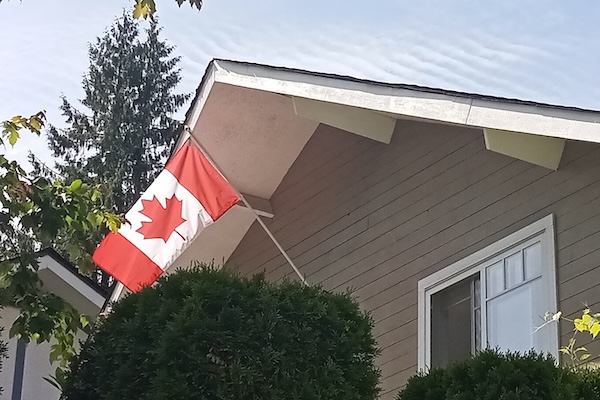
Patriotic belonging diminishes

(photo by Cynthia Ramsay)

When I was a kid, living near Washington, DC, my dad would hang an American flag up out in front of our house on US holidays. We’d all go outside for Memorial Day or 4th of July and raise the flag together. It was a solemn ritual. It was uncomplicated and patriotic. 

As my understanding of US history and geopolitical actions changed, I still remember feeling a sense of awe as we sat on a blanket under the night sky, celebrating Independence Day with fireworks and Sousa marches. I carried that mostly uncomplicated feeling with me when we moved to Canada in 2009, the feeling of pride in where I lived. I became a dual citizen, believing I could hold that feeling for two nations at once.

A few years ago, Winnipeg changed its celebrations around Canada Day. Some of the huge gatherings resulted in spikes in crime. Many events also didn’t properly acknowledge Indigenous peoples’ roles in this country. We found, with younger kids, that the crowds, loud noises and late nights required to celebrate with others became too hard. 

The choice to downplay some aspects of Canada Day reflected a new understanding. Manitoba’s Indigenous population is 18.1%, larger than any other province. Winnipeg is home to the largest urban Canadian Indigenous population. Our kids attend public school in a division where the student population is approximately 30% Indigenous. Indigenous peoples have complex relationship with patriotism for many valid reasons.

I felt this nuanced understanding of patriotism and how it related to my country was only fair as a critical thinker who reads the news. Little of it had to do with my Jewish identity, I thought. Since Oct. 7, I realized that was incorrect. 

On June 1, Prime Minister Mark Carney announced that “Canada’s civic compact is failing Jewish Canadians.” This speech was, unfortunately, too little, and too late. While he did this, there were more incidents of hate, and little done to enforce the laws to stop it. Carney has created a new advisory council to combat hate, which has only one Jewish person on it. While one of their tasks is to tackle antisemitism, the council has a participant who supports Palestinian resistance via Iranian proxies like Hamas and Hezbollah. Another member is a lawyer who represented Palestinian protesters in a university encampment. This doesn’t strike anyone in the Jewish community as an unbiased or safe environment to combat Canadian antisemitism.

Sorting through my feelings, I found a strange parallel in the Babylonian Talmud Tractate Chullin, which I am studying as part of Daf Yomi (a page of Talmud a day). This tractate, about kosher slaughter, is technical but contains insights that have broader implications. On page 44, there’s a discussion of treifa and how to detect it. In this situation, treifa refers to an animal that has a physical defect and will likely die soon. This type of animal isn’t kosher. 

Sometimes, this is discovered only after slaughter. For the animal’s owner, this is a financial loss, too. In Dr. Sara Ronis’ essay on My Jewish Learning on Chullin 44, she highlights Rav Hisda, “who says: Who is a Torah scholar? This is one who sees his own treifa.” This is someone who sees his animal’s status, takes the financial loss and keeps potentially non-kosher meat out of the food supply. This person thinks critically enough to recognize when something might be harmful even when it’s difficult and the outcome doesn’t benefit them. 

All my thoughts about patriotism felt emotional but abstract until October 2023. Then it became personal. The following situation is one I had but illustrates multiple Jewish Canadian experiences.

Someone I knew posted on social media. I’d sat on a committee with her. I visited her farm. I supported her business. Right after Oct. 7, this person cheered “resistance.” She promoted a “walkout for Palestine” at an urban high school near me. This person lived out in the country, not in the city. Still, she had lots of followers and this reaction to the Oct. 7 attack contributed to the antisemitism in Winnipeg. 

When I asked her why she did this, I heard that this non-Jewish, leftwing Canadian once dated a leftwing Israeli. She believed in “one state” for Israelis and Palestinians. She’d once raised money to visit the West Bank but hadn’t managed the trip. She then defined antisemitism for me. After this online confrontation continued, I broke off contact, but this person still follows me on Instagram. It feels like I’m being stalked by someone who wants to monitor my minority identity.

My kids now attend that public high school, and I imagine how dangerous it could be if they were there during a “walkout for Palestine.” There’s a straight line from having a leftwing non-Jew feel confident enough to define Jew-hate to me, a Jewish person, and the hate we’re dealing with now. If a walkout happens at school, do my Jewish kids stay in the building, thus getting singled out as targets? My kids’ choice to side with Israeli friends and family and the Jewish state means they could be endangered at school by such “resistance” activism. 

When I moved to Canada, I reveled in how safe and public Jews felt in Winnipeg. It was a novelty after moving from Kentucky, where I’d often felt worried about my safety. When someone recognized me on a Winnipeg street and called out to me from her bicycle, yelling that she knew me from synagogue, I felt unsettled. Six months later, I too felt safe enough to put my menorah in the dining room window during Hanukkah.

Sadly, that first Hanukkah in Canada, in 2009, is when my house got egged. It felt safe to be Jewish here, but we still couldn’t be that public about who we were.

When my twins were preschoolers, they walked to synagogue with us, wearing kippahs, because they felt proud of their identity. It was also easier than getting the kippahs on just outside the shul. We’re now in a situation where everyone’s toque, sun hat or ball cap comes off and the kippah comes on – sometimes even inside the building. We’ve had to change. It wasn’t safe. 

Like many in Canada and the United States, I am now significantly less trusting of government and our country’s actions. I wonder if I will know when it’s time to move, when things are too unsafe. The older me sees value in the ways of Rav Hisda. It’s a sign of wisdom and maturity when we can identify and predict a loss or risk before it happens, and even cut our losses.

Part of me wishes for that uncomplicated time when I could lay back on my blanket, watch the fireworks and feel soaring pride. I’m sad to have lost that pride and the easy feeling of belonging I had in the past. Now, I wonder if I ever really belonged then, either. 

Joanne Seiff has written regularly for the Winnipeg Free Press and various Jewish publications. She is the author of three books, including From the Outside In: Jewish Post Columns 2015-2016, a collection of essays available for digital download or as a paperback from Amazon. Check her out on Instagram @yrnspinner or at joanneseiff.blogspot.com.
Seeing the divine in others

I recently participated in a conference panel on hope in a time of divisive politics. A friend in the Jewish community couldn’t do it, so she asked me to help instead. I won’t lie, I felt nervous.

I worried that I wouldn’t measure up to some of the speakers, who had big job titles, awards and experience. This was compounded by a few missteps that left me feeling embarrassed and humbled. First, my friend’s name was left on the conference program and mine wasn’t listed, even though organizers had ample time to update the panelists’ names. Second, social media amplified the panel on Facebook and Instagram, but listed my name with incorrect, made-up undergraduate degrees. I’d provided my graduate degrees in religious studies and education because I felt they were relevant. Somehow, five years of education went away due to clerical errors.

The weird part was that my brief talk, and my presence at the panel, was to elevate Jewish experience and Jewish hope in an approachable way. Two academics spoke, using big concepts and bigger words, while minimizing their personal approach to the issues. Then, an amazing African Canadian legal professional spoke of her family’s journey and deep roots in Canada – it was personal, compelling and important. I was up next.

I’d prepared my notes in advance. I spoke from them, but, first, I changed gears. The night before the panel, held at Winnipeg’s Canadian Museum for Human Rights, I encountered members of the Persian community, holding up their lion flags to represent the Iranian people and their opposition to the Islamic Republic. I stopped to tell a young woman holding the flag that our hearts were with her, and we were thinking of her, and hoping the people of Iran were safe. She seemed shocked. Surprised that I saw her, knew what she represented, and embraced this message against extremism and violence of the Islamic Republic of Iran. She asked where I was from, I smiled and only said, “Winnipeg.” 

The day of the panel, I struggled with a parking meter. Then I crossed a street, sharing a warm smile with an Indigenous man on a bicycle who passed by. My heart thumped hard. Though I’ve done plenty of public events and teaching, I felt on edge. Maybe it was because I was one of the only representatives of the Jewish community in that multi-faith gathering. Maybe it was because I’d been checking on where the Iranian missiles were landing in Israel right before I came. I worried about repercussions following me into the Canadian Museum for Human Rights.

Pretending to check if the microphone was on, I said, “Welcome. Thank you for coming …” and, looking at the crowd, I greeted everyone with a “Hello y’all!” After that informal start, I made sure to mention the Jewish concept of the world as a broken pot, in which the vessel’s shards, our souls, are in each of us. I talked about tikkun olam, repairing the world, and putting those shards back together, as an act of hope that we work towards, as an act of ongoing creation – a human and divine partnership. Throughout the morning, I took time to look at people, greet them and try to see G-d in each of them. I decided that the way to confront my feelings of embarrassment, and the erasure of my name and credentials, was to fully see others the way I would want to be treated.

At this conference, there were many references to reconciliation. An Anglican bishop who is also a residential school survivor spoke during our panel question period. When I recounted all this later to my family, we recognized an important theme.

As a professor, my husband often attends events with a land acknowledgement. Working with a group of Indigenous students last year, he asked them how they feel about the “workshopped” statement the university uses. They said it was often done by rote and perhaps lost its meaning as a result. They didn’t feel seen by it. 

Almost immediately, I recalled that our congregation had changed its Prayer for Canada. The new one feels genuine to me. It includes aspects of a land acknowledgement by mentioning by name the first inhabitants of the land. It also includes the current Canadian political infrastructure. It’s a prayer to maintain our diversity, so that never again will Canada say, “None is too many,” in reference to the antisemitic exclusion of Jewish refugees fleeing Europe during the Second World War.

My husband will meet again this summer with a new group of Indigenous students. He’s considering a different discussion. What does it mean when society suggests that some people’s innate connection to the land must be acknowledged, but others don’t deserve a similar acknowledgement of their homeland? This issue isn’t “just” about Israel, either. What about the Kurds? What about the Druze? The dispossessed list is a long one.

When we moved to Winnipeg 16 years ago, celebrations for Canada Day included enormous festivals and bombastic firework displays. Over time, due to the pandemic and to a change in how we perceive the day, this has changed. Many Indigenous Canadians don’t celebrate Canada Day. 

Having my name left out and hard-earned credentials jumbled was difficult, but it reminded me of how acknowledgement works. We can choose, as Canadians, to look up from our phones and really see one another. We all deserve to take up space and be here, recognized for our special contributions, in this land of plenty. We may not be able to control the huge geopolitical events around us, but we can see one another and pray for our loved ones and our neighbours, too, both here and elsewhere. Recognizing the divine, individual spark in each person is crucial.

I’m hoping for a family cookout at home this Canada Day. We might talk about how we connect to Canada, and how we fit in the Jewish diaspora and homeland. It’s a complicated equation, worth talking about during a war. We should also choose to see, greet and value all those we walk with on this land and in the world. Let’s recognize everyone’s names, identities – and souls – as meaningful, too. 

Joanne Seiff has written regularly for the Winnipeg Free Press and various Jewish publications. She is the author of three books, including From the Outside In: Jewish Post Columns 2015-2016, a collection of essays available for digital download or as a paperback from Amazon. Check her out on Instagram @yrnspinner or at joanneseiff.blogspot.com.

A musical Canada Day

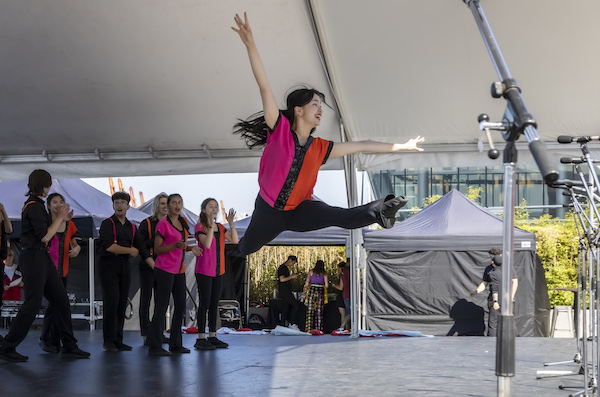
Perry Ehrlich’s ShowStoppers at Jack Poole Plaza (photos by David P. Feng)

Perry Ehrlich’s ShowStoppers performed at Jack Poole Plaza on Canada Day – it was Ehrlich’s 29th year celebrating Canada Day at Canada Place.

photo - Perry Ehrlich’s ShowStoppersShowStoppers is a glee troupe that performs in concert, on radio and television, and at galas, awards shows, conventions, corporate and charitable events.  Previous shows include with Barry Manilow and Eric Church at Rogers Arena; with the group Foreigner at various venues; at the Pacific National Exhibition; on the Variety Club Telethon; and singing the national anthems at Vancouver Canucks games. The troupe’s repertoire includes everything from Motown and disco medleys to Canadian favourites and pop songs like “Let’s Get Loud” and “Shut Up and Dance.”

For more information about ShowStoppers, visit theimpresario.ca or contact Ehrlich at ehrlich@kzellaw.com or 604-315-1850.

– Courtesy Perry Ehrlich