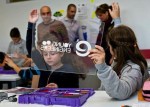
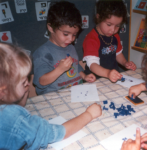
Reading aloud aids learning

An important tip from Israeli experts: children recall information better when they repeat the material aloud. This is the conclusion of a study conducted at Israel’s Ariel University by Prof. Michal Ichet from the department of communication disorders in collaboration with Prof. Yaniv Mama from the department of psychology and behavioral sciences.

They found that when children hear new information and then repeat it loudly and clearly, this significantly improves their ability to remember the words, compared with their memory of words spoken by someone else.

This simple “listen and repeat” method can be used to help even pre-reading students learn and memorize information – including facts, vocabulary and foreign languages – more effectively.

The study was conducted in Hebrew but is applicable to any other language of instruction, say the researchers.

“I personally have always thought that repeating something aloud helps me commit it to memory. Now we’ve found that the research that supports this theory is indisputable,” Ichet said.

The learning is not as effective if the children hear the words spoken by someone else or if they repeat the words to themselves quietly or silently.

Previous studies on the “listen and repeat” technique have focused mostly on adults who have the ability to read and write. The increase in an adult’s capacity to remember information using this method is about 20%. In the 5-year-olds tested by Ichet and Mama, the increase was as high as 35%. They theorize that repeating words aloud creates a pathway in the brain. These words then receive “preferential status” when being set into memory and thus become more familiar.

The researchers suggest that teachers, parents and caregivers take this tip to heart in order to improve young children’s mastery of new information.

Israel21C is a nonprofit educational foundation with a mission to focus media and public attention on the 21st-century Israel that exists beyond the conflict. For more, or to donate, visit israel21c.org.

Consider the maps we use

I always enjoy seeing my kids bring home assignments from Hebrew school, and last week was no exception. On a map of Israel were labeled five major cities whose names the students had to write in Hebrew. For my part, I delighted in reminding my son that we have relatives or friends in Jerusalem, Tel Aviv and Haifa, and near Be’er Sheva. There was only one problem with the map, I noticed. There was no Green Line. So, to the untrained eye, it looked like Israel’s borders span from the Mediterranean Sea to the Jordan River.

As I often do when I want to tease out a political conundrum, I took to social media. On my public Facebook page, I offered to donate $36 to charity for the first person who can show me a Green-Line-indicated map of Israel currently being used in any Jewish educational setting. Laurie MacDonald Brumberg wrote that a Washington, D.C., Jewish day school has a National Geographic map containing the Green Line hanging in the classroom. Karin Klein of Chicago showed me a Green Line map she said was used at a Schechter day school. And from Gabriel T. Erbs I learned that J Street U has launched an initiative to circulate Green Line maps to educational institutions. Apparently, URJ President Rabbi Rick Jacobs has agreed to champion this among URJ camps and Hebrew schools, according to a March 22 article published on JewSchool by David A.M. Wilensky. Gila Miriam Chait added that Yachad, a pro-Israel, pro-peace group in the United Kingdom, is following suit.

What is at stake in the mapping debate? We all know that Middle East maps are heavily invested with the symbolism of legitimacy and delegitimization. The Palestinians have long been accused of erasing Israel from their school maps of Palestine – both from the Palestinian Authority and from Hamas. An article in the current online Jewish virtual library makes precisely this point. It’s clearly ironic that we are doing the same thing we accuse our adversaries of doing.

Some might argue, however, that since the Green Line is an armistice line, not a border, that there is no need for Israel to include it. It is true that it is not a border, but neither does Israel’s international territory extend eastward from Jerusalem all the way to the Jordan River. The point is, the West Bank is under occupation – whether one sees the occupation as justified or not – and maps should reflect this geopolitical reality.

Now, beyond simply making more accurate and, therefore, educationally useful maps, what might a more politically informed Israel curriculum entail? From my kids, I have heard about the ingenious ways that Israel foiled the Egyptian invasion of 1948, including placing stones in irrigation pipes to create noise simulating artillery. My 8-year-old was impressed. I know that for Yom Ha’atzmaut, their Hebrew school served falafel, and I hoped and expected that my kids will learn some Israeli folk songs. Some folk dancing would be great, too. What I remain less certain about, however, is how much complexity about Israel’s future our kids’ schools are willing to impart. Will kids learn who the “Palestinians” are? I know that I am guilty of frequently muttering to them about “Israel and the Palestinians” without proper context. While narratives of inter-state war can be much simpler to impart, when it comes to the Palestinian civilian aspect of Israel’s founding, and the current military occupation over millions of Palestinians, it’s difficult to know where to begin.

When we learn about the past, it’s equally important to consider the future. In fact, no one knows more about the importance of historical memory in shaping today’s collective political outlook as the Jewish community. As Wilensky writes in the context of the maps, “it’s unpleasant for many to hear, but the final status of a two-state solution – if such a thing can ever be achieved – is going to rely heavily on the Green Line. Putting visual depictions of that reality before the eyes of American Jewry will go a long way toward showing them the somewhat unpleasant truths that will help build a more absolutely pleasant future.”

As for the J Street U’s map initiative, given that Jacobs has pledged to roll them out at Reform schools, I hope he will make Ottawa’s very own Reform Judaism supplementary school an early stop.

Mira Sucharov is an associate professor of political science at Carleton University. She blogs at Haaretz and the Jewish Daily Forward. This article was originally published in the Canadian Jewish News.

Brush up kids’ STEM

(photo from e2 Young Engineers)

The Israeli education revolution is here. e2 Young Engineers, which started operating in 2008, is pioneering the concept of “edutainment” in the classroom, combining education and entertainment. The edutainment method is used to develop children’s knowledge and understanding of STEM (science, technology, engineering and mathematics) subjects. In turn, Young Engineers is helping foster the next generation of engineers.

e2 Young Engineers was founded by Amir Asor, a young Israeli entrepreneur. Asor, who dealt with learning difficulties as a child, understood from firsthand experience that the way schools teach STEM does not engage all children, challenge them or give them the desire to continue learning these subjects. Inspired to change this reality, Asor began to develop the Young Engineers’ curricula. In its first year of operation, the company opened 10 centres across Israel. During the following year, 2009, the company grew to 90 centres.

The curricula created by Asor are aimed at children between the ages of 4 and 15, and operate in community centres, after-school programs, private schools, teen centres, private homes and more. e2 Young Engineers lessons are built on a logical progression of teaching theoretical material in a lively way – using engaging stories, demonstrations and experiments – and then giving the children the opportunity to build a K’nex (for the younger age group) or LEGO bricks model that illustrates the principle being studied in that lesson. At the end of the year, children who have participated in a e2 Young Engineers lesson will be able to explain, for example, what transmission is, the difference between a power-increasing transmission and a speed-increasing transmission, what centripetal and centrifugal force are and how Bernoulli’s Law works. These concepts and basic principles of physics and engineering are not sufficiently covered by traditional school curricula, and e2 Young Engineers’ courses give children great exposure and access to these professions.

e2 Young Engineers operates from north to south in Israel, and continues to grow. International recognition arrived for the company in 2011, when Asor was awarded the Youth Business International Entrepreneur of the Year prize, presented by YBI’s founder, HRH Prince Charles. Building on this, e2 Young Engineers’ franchise operation was launched in 2012; in the space of two years, franchisees from 15 different countries spanning five continents signed up, forming a family of 40 franchisees – a number that is still growing. In addition, the University of Carnegie Mellon has chosen to market Young Engineers courses through its subsidiary, iCarnegie.

The company is continuing to develop its curricula at both the technological and pedagogical levels. An intensive project to bring digital technology to the classroom is nearing completion, with the development of a 3-D application exclusive to e2 Young Engineers. The application, which is used on a tablet, contains all the building stages for every model, which can be viewed 360°. It also contains pop quizzes, fun and educational cartoons (featuring Eureka, the e2 Young Engineers mascot), and a very popular function that allows the child take a photo of themselves with the model they built and email it to their parents – or whomever they choose – via the app. In this way, parents can receive instant insight into what their child is learning and how much they are enjoying themselves.

As an Israeli company, Young Engineers has a particularly special connection with Jewish communities worldwide and, to this end, has generated much interest from Jewish schools and educators across the world, supported by the company’s active approach to cultivating such ties. The Jewish community in Vancouver – and the wider British Columbia area – has been identified as having potential for being a flag-bearer for the company in Canada. The company is open to potential franchisees from across British Columbia. Find out more by visiting youngeng.net/franchise or by emailing natasha@e2youngengineers.com.

Writing key to kids’ literacy

Prof. Dorit Aram noticed that young children, prior to going to school, long to write. (photo from Dorit Aram)

According to a recent research from Israel, learning to recite the alef bet alone does little to help children advance their literacy – children should be learning to write, and before they even enter the school system.

The team’s lead researcher, Prof. Dorit Aram, maintains that longstanding misconceptions are getting in the way of children’s abilities.

Aram teaches at Tel Aviv University’s Jaime and Joan Constantiner School of Education specializing in adult/child early interactions and their relationship to children’s early literacy and social-emotional adjustment. The research was conducted in collaboration with colleagues at American universities and was published last year in Early Childhood Research Quarterly.

“My research started with children that come from lower socio-economic backgrounds,” said Aram. “What we see is that there are gaps between children in terms of their reading and writing achievements.”

As reading and writing are key to children’s academic success, Aram “was interested in how parents could promote their children’s literacy, in particular those from lower socio-economic backgrounds.” This particular study, however, looked at a group of ethnically diverse, middle-income preschoolers.

Aram began studying literacy with one of the leading early literacy researchers in the world, the late Dr. Iris Levin, working with her, examining children’s early writing development. Levin was a developmental psychologist at the School of Education at Tel Aviv University. She passed away in 2013.

“People are so busy with reading,” said Aram, “but considering young children, in particular, I felt writing was even more fascinating than reading, because it’s more active in its communication.”

Aram noticed that young children, prior to going to school, long to write. She recalled a child asking his father how to write a word, in one case. The child’s father gave him the letters, and Aram was left to wonder, “Did the father know he was really mediating, ‘scaffolding,’ his child’s early literacy?”

Aram began studying such interactions to determine ways in which a parent can “scaffold” his/her child’s understanding of the writing system, help them segment a word into its sounds, connect the sounds with the letters, and understand how to build words.

“I saw in my research that the more the parents help the child understand that written language is really symbolizing the spoken words, and that … when the parents really encourage the children to segment the word into its sounds and then retrieve the letters, the more the parents did it (this is what we call the graphophonemic mediation) … the children were doing better,” said Aram.

Working with children in preschools, Aram discovered that teachers were reluctant to work with kids on their writing literacy. “In the beginning, it was difficult for them because they connect writing to school and felt like they were taking away from the kids’ childhood,” she explained. “They’d say, ‘Well, these kids will have so much writing in school. Why do we have to bother them with writing now?’”

According to Aram, the teachers were not considering the possibility that the kids might want to be able to write out the names of their friends, their telephone number, or how they feel.

“Then they saw it’s not against the preschool spirit, that it can fit very well with it,” she said. “And because they were practising letters and phonological awareness, these things were part of their early literacy curriculum anyway.

“The teachers were unaware that you can combine it and have kids write. And, the writing makes the children happy, because they’re doing something meaningful – allowing them to do more than just practise letters, allowing them to really communicate.”

Aram and her team worked with children as young as 3.5-years-old on writing and letter knowledge, graphophonemic understanding, and early writing – not with a pencil, but with magnetic letters or stickers, for example.

“We saw that it worked beautifully,” said Aram. “These children did very well at the end of our intervention year, and it even predicted their achievements and the pace of their development the year after.”

According to Aram, the key is helping the child segment the different letters and the sounds they make. In her research, Aram has found that kids who were taught to connect a letter with the sound the letter makes progressed more than the other groups.

“What amazed us was that the children who received feedback – like so many children of American parents do – by just giving the children the names of the letters, it didn’t help the kids. It was just as good as saying to the kids, ‘Write this word again,’ without any feedback.”

The technique is more challenging to teach in English than in Hebrew, said Aram. However, she added, “From the studies done in English, we found it is still very useful to segment the word into sounds and connect sounds with their letters. Also, to motivate children to write and to respect their writing, even if it’s not 100 percent.”

About English, she explained, “If you think about Italian or other Romance languages, English took all the ‘difficulties,’ and it’s so difficult to see the connection between sounds and letters.”

But that shouldn’t stop parents and teachers from introducing writing into the kids’ daily lives. “For example, if you want, you can send emails, you can [help them] send a ‘Hi Daddy, I love you’ note … or you can write what you want to eat tomorrow, just little things – a word here, a word there.”

Aram noticed, on her visits to North America, that many homes in the United States and Canada have magnetic letters on their fridges. She suggested, “Instead of just naming the letters, write [a] word and do things that are meaningful. Letters, by themselves, are less meaningful. But writing is for communication and writing is meaningful…. It doesn’t have to mean you do a lot of writing, just two words here or there, a sentence here or there – that makes a huge difference, and children love it.”

Rebeca Kuropatwa is a Winnipeg freelance writer.