Changing face of libraries

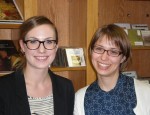
Isaac Waldman Jewish Public Library librarian Helen Pinsky, left, and master’s student Alisa Lazear, who is working on the library’s audiobooks collection. (photo by Olga Livshin)

In past centuries, reading aloud was an integral part of family life. People gathered in their parlors to read books to friends and family. In the 20th century, the experience migrated towards radio. When favorite personalities read new novels or classics on the radio, it was a unique pleasure in many communities, especially where access to live entertainment was limited. Then came the TV and the internet. But reading aloud is seeing a comeback – with audiobooks.

The Wall Street Journal ran an article recently about how audiobooks are the fastest-growing sector in the book business today. In 2015, audiobook sales in the United States and Canada increased 21% from the previous year.

The Isaac Waldman Jewish Public Library has reacted to this latest development by expanding their audiobook stacks.

“The modern libraries have to change to keep up with the times,” said Helen Pinsky, Waldman’s head librarian, “but they also stay the same. As ever, they answer the patrons’ curiosity, provide access to information. They are the source of knowledge, whether on their shelves or through their computers. The changes come from different angles. For example, some libraries in the Greater Vancouver area explore novel ways of organizing books: by theme or by the time of publication instead of alphabetically by the author’s name. Such a method is especially convenient for teachers – who could find books on a particular theme grouped in one spot of the library – or for researchers.”

Pinsky also expressed concern about the negative impact of technology, however. With internet search engines, in particular Google, and sites like Wikipedia, people have stopped coming to libraries for information.

“They Google their questions and get a thousand websites as the answers,” she said. “But who could guarantee that the data they find in the first 37 hits is correct? Google is dangerous. It is destroying the value of encyclopedias, while librarians know where to find the right stuff. It is specifically true for the medical or legal areas.”

Of course, there are positive technical innovations, and Pinsky emphasized those, especially the digital formats. After ebooks became a huge segment of publishing in the last decade, and audiobooks followed a few years later, public libraries had to adapt to the new demands, although print books still dominate in the Waldman Library catalogue by a ratio of approximately 20 to one.

“It might be a different ratio for the city libraries,” Pinsky mused. “The exclusive supplier of digital books to Canadian libraries is Overdrive. There were a few smaller companies before but they’ve all gone out of business by now. Unfortunately, Overdrive doesn’t have much interest in the Jewish content, so their selection of Jewish-themed books in both epub format and audio format is rather narrow. They don’t have anything in Hebrew either. It might change in a few years, or publishers might start distributing digital content themselves.”

Still, there are some books available through Overdrive that are of specific interest to a Jewish readership, and the Waldman takes steps to broaden its digital choices.

“Audiobooks are trendy now,” said Alisa Lazear, who is working on the Waldman’s audiobook collection.

Lazear is studying for a master’s degree in library and information studies at the University of British Columbia.

“I need to do 120 hours of professional experience as part of my program. It’s an equivalent of one course,” she explained. “I approached Helen to do my professional experience at the Waldman because I love the library. It was Helen’s idea that my focus should be the audiobook collection. We already have some audiobook CDs, so I concentrated on the online streaming from Overdrive. I had to figure out how to download their books, choose which ones would interest our readers, and integrate them with the main catalogue. Then I had to design flyers to educate the patrons how to use such audiobooks.”

In Lazear’s opinion, the current popularity of audiobooks has to do with people’s chronic shortage of time.

“Audiobooks are great for multitasking,” she said. “You can drive, do chores, work out at a gym, and listen to an audiobook at the same time. A narrator also plays a huge role. He is part of the experience, almost like a friend reading to you. Some narrators have a huge following; people would listen to anything by them.”

Lazear thinks that the new digital formats are accessible across the generational spectrum.

“My young cousins enjoy listening to their favorite audiobooks before bed or in a car,” she said. “Some older people develop visual impairment, and audiobooks might be the only choice for them as a form of reading.”

Regarding this latter point, Lazear created an audiobook program, Coffee & Stories, for the Louis Brier Home and Hospital.

“We had our first meeting on Aug. 7,” she said. “Several people came to the activity room. I brought cookies and selected two different audiobooks. We listened to 10-minute clips from each and then discussed them. It was a very active discussion.”

Olga Livshin is a Vancouver freelance writer. She can be reached at olgagodim@gmail.com.

Barbershop memories

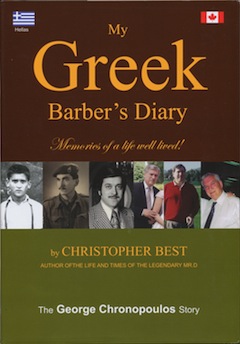
Christopher Best’s recent book, My Greek Barber’s Diary, is a biography of George Chronopoulos, told in the barber’s own words. In recent years, Best has been writing about history and people. Not celebrities but regular citizens who have made Canada a thriving multicultural country. His goal as a writer and as a publisher is to preserve precious memories.

Best will talk about My Greek Barber’s Diary at the Isaac Waldman Jewish Public Library on March 2.

The book follows Chronopoulos’ life from his childhood in Greece, through wars, hardships and immigration to Canada, to the modern day. Through the years, he has tried his hands at various business ventures, from restaurants to real estate, but he always comes back to being a barber. His hair salon has always been a hub of friendships and conversations, confidences and laughter.

Chronopoulos’ bright, ebullient personality, his courage and insatiable curiosity to try new things, to learn new skills, attracted the young entrepreneurial crowd of the 1960s, ’70s and ’80s. Many of Vancouver’s industry leaders started out during those years, and many of them became Chronopoulos’ personal friends and golf buddies.

book cover - Christopher Best’s recent book, My Greek Barber’s DiaryMy Greek Barber’s Diary is a series of more or less chronological stories as remembered by Chronopoulos. A large part of the book is dedicated to the barber’s extended family and their adventures. He sponsored many of his relatives into Canada and helped many others with their first jobs or first homes. A man of big heart, he also was one of the founders of the Gold Plate Dinner charity event in Vancouver in 1977, which was later picked up by the Hellenic communities all across Canada. Today, the events are considered the most important fundraiser in the Canadian Greek community.

Chronopoulos talks in the book about the many people he got to know from different cultural and ethnic backgrounds. Among his many Jewish clients and friends are business tycoons and philanthropists Joe Segal, Bob Golden, Syd Belzberg and Max Fugman. Everyone first came to his shop because of Chronopoulos’ well-known talent for styling men’s hair, but they stayed for their barber’s charisma and the joy of his friendship. The book includes tributes to Chronopoulos, friends sharing their memories of good times and bad times together, of triumphs and losses.

As did the others, author Best first met his subject at the barbershop. “We started talking,” Best recalled of that haircut a couple of years ago. “George asked me what I do, and I said I’m a writer. He said he always wanted to write a book – his life story. Afterwards, we met many times, and George told me about his life and about the people he knew.”

It took Best a year to record and transcribe Chronopoulos’ memoirs, and about six months to edit the book, which he published in 2015.

My Greek Barber’s Diary is not Best’s first book. The writer owns his own publishing company, Warfleet Press, and, since 2007, has published eight books, all of them on local history, including one about Canadian Airlines.

His first publication was By Jove What a Band, about Arthur Delamont and the Vancouver Boys Band. Before becoming a writer and publisher, Best was a musician and a music teacher and, in the 1960s, he was a member of Vancouver Boys Band. He recorded his memories and those of others about the band and its legendary leader, Delamont, who became a member of the Order of Canada in 1980 and even had a park in Vancouver named in his honor. It took three decades and the founding of Warfleet Press before the memoirs became a published book in 2007. Best writes about By Jove What a Band: “It is a story about the band which never grew old. The band that won over 200 trophies and awards during its unprecedented 50-year history. The band that made 15 European tours and attended five world fairs. The band that dined with royalty but never lost the common touch.”

Best’s talk on My Greek Barber’s Diary at Waldman Library on March 2 starts at 7:30 p.m.

Olga Livshin is a Vancouver freelance writer. She can be reached at olgagodim@gmail.com.
World is at your fingertips

At the latest Empowerment session, co-hosted by Jewish Seniors Alliance and JCC Seniors on Jan. 27, Philip Morris offers advice on avoiding fraud, scams and identity theft. (photo by Binny Goldman)

It was interesting to me – a person who still enjoys using one of the “original computers,” namely, the pencil – that I was about to attend a workshop entitled Technology: Give us the Tools to Finish the Job.

On Jan. 27, about 100 people gathered in the Jewish Community Centre of Greater Vancouver’s Wosk Auditorium to hear three experts in the field of technology at a workshop hosted by Jewish Seniors Alliance in partnership with the JCC seniors department. It was the second session of the current season’s JSA Snider Empowerment series.

JCC seniors program coordinator Leah Deslauriers welcomed the audience and outlined the afternoon’s activities, while Gyda Chud welcomed everyone on behalf of JSA. Chud explained how she was introduced to JSA via the Peretz Centre for Secular Jewish Culture four years ago and that JSA is always looking for new partners in its aim to make its workshops easily available and accessible to all who may be interested. Chud added that she hoped the Technology session would help build her own confidence when it came to computers and other aspects of the tech world.

Noting that living is learning, the first speaker, Stan Goldman, demonstrated the simplicity of mobile technology. Once one learns how to use the iPad, the knowledge can be applied to the iPhone, which uses the same system, and one may watch free movies, read free ebooks and newspapers, and get email by accessing the right app. To illustrate, Goldman and Deslauriers used voice commands to ask for directions, dictate an email and do advanced math. Goldman offered a seemingly endless list of things that can be done with this technology, including Skyping with family and friends in other countries, enjoying music, playing games, etc. – all by using apps, many of which are free. The world is, indeed, at your fingertips.

Philip Morris, an expert on fraud, scams and identity theft, spoke next. He said that, once we have let the world in, so to speak, we must be cautious when using our devices – protecting them with passwords, and keeping private our personal information (social insurance numbers, birth certificates, passports, etc.) and not easily accessible to hackers. Morris advised shredding all discarded documents and, when buying a new cellphone, making sure all of the personal information has been deleted from the old phone, as hackers can retrieve data from seemingly wiped phones. It is important to be alert in public places, to keep wallets and purses out of easy reach and to ensure that you have received your own credit card from the server in a restaurant. He also suggested taking a photograph of passports and credit cards in case of theft.

New words have been coined, such as “smishing,” the ability to obtain information from people’s texts. Morris recommended changing passwords annually and, when writing cheques in payment for credit cards, to reference only the last four numbers of the card. To report a theft or loss, Morris gave two numbers to call to check your credit profile: 1-800-465-7166 (Equifax) or 1-800-663-9980 (TransUnion Canada). For instances of fraud, he said to call the Canadian Anti-fraud Centre, 1-888-495-8501.

Mark White, “the gizmo guru,” gave advice on the latest fun gadgets, including some lesser-known ones, and where to get them. As far as finding directions, however, he warned people to keep paper maps on hand in case the technology fails to connect. White added that he reads the Vancouver Sun’s online version, and that the library offers many newspapers online to members. In order to keep Skype conversations private, he suggested using earphones if Skyping in a public place.

Isaac Waldman Jewish Public Library librarian Rossana Caritey explained that the Waldman has an extensive collection of ebooks, which can be read on any device – ebook readers, laptops, for example. If someone brings in their device, a librarian or volunteer can show them how to download books. Waldman librarian Helen Pinsky handed out further information to attendees.

Chud thanked the speakers, noting that each of them had exhibited in their talks the mission and ideals of JSA – that of advocating for, inspiring, educating others to be the best they can be.

The audience retired to enjoy light refreshments. Long lines formed at the workstations set up in the auditorium, clearly showing the keen interest in the session. The workshop may have eased many fears, allowing timid souls to venture through the now-open doors leading to new technological possibilities.

Binny Goldman is a member of the Jewish Seniors Alliance of Greater Vancouver board.


Corrin retires

After 20 years, librarian Karen Corrin retired in March from the Waldman Library. (photo by Olga Livshin)

Karen Corrin retired from her position as a librarian at the Isaac Waldman Jewish Public Library on March 30, after exactly 20 years with the library. She has been with the Waldman from the very beginning.

“There was always a small library at the old JCC,” she remembered. “I took my children there when they were young. The new library opened on the second floor of the new building in 1994. I was studying for my master’s at the library school at UBC then. My program was for two years, from 1993 to 1995, so I didn’t apply to work there, but I was at the opening. I remember Amos Oz speaking. He talked about the importance of words.”

With the new library space came new funding, so the Waldman could hire a librarian and a library technician. Corrin wasn’t among the new hires but when, a few months later, the position of the librarian opened again, her friends urged her to apply.

“I was still at school. I wanted to be a cataloguer when I graduated, but a job was a job, so I applied and got it.” She started working for the Waldman in April of 1995.

Her previous experience, both personal and professional, prepared her for this position. “I have always loved libraries,” she said with a smile. “I would go with my kids to a local library, and we would bring library books home for everyone.” Before she started her program at the University of British Columbia, she worked as a volunteer coordinator and in fundraising. She also had management skills and knew computers. All of this combined made her a perfect fit for her new duties as the Waldman librarian.

“Waldman is almost unique. There are so few JCC libraries in North America,” she lamented. “Most city libraries are funded by the governments, but Waldman is a community library. The funds come from fundraising. That’s why, from the beginning, it was run by volunteers.”

According to Corrin, there are about 30 regular volunteers at the Waldman, and she considers them the best PR people the library could have. “They care about the library, about books and about the community. They have time to chat to the patrons, to explain things, to help everyone find what they are looking for. The value of the library volunteers is great, it can’t be overrated. They are our gems.”

Corrin herself also worked as a volunteer, although not for the Waldman. “About my history with libraries,” she said, “I always volunteered at my children’s elementary schools in their school libraries. First for my son in Richmond and then for my daughter at [Vancouver] Talmud Torah.”

She emphasized that the volunteers who run the front desk of the Waldman liberate the librarians to do their main jobs – fundraising, acquisitions and event planning.

“There are several kinds of events,” she explained. “People would come in and ask us, why don’t we have a book club? So we would start a book club. We saw what events the community centre was running, and if there was something missing, something a library could supply. Another kind of event comes with the Canada Council grant. We would apply for a grant to pay a writer. If we got it, we could invite a writer for an event or a reading. We had a few children’s writers speaking at the library through this grant. We also had some book launches of local authors and sometimes poetry readings – those were often funded by Yosef Wosk. It all comes from what the community wants.”

Recently, the most profound community-inspired change at the Waldman was the introduction of ebooks. Before that, but also during Corrin’s term at the Waldman, it was computerizing the catalogue. “When I started, we still used cards,” she recalled. “Libraries are always reinventing themselves, but I think that the most important purpose of a library is to be a community hub, a meeting place. That’s why we ran educational courses and children’s events at the Waldman. There is always something going on. You’re never bored at the library.”

Surprisingly, the profession of a librarian wasn’t Corrin’s first choice. When she was young, she wanted to be a teacher. “I always thought a teacher has to be perfect. He is the one molding children’s minds. I was afraid I wasn’t perfect enough,” she recalled of her youthful dreams. But the library job gave her a lot of satisfaction, and now she has plans to be a teacher, too. She and her husband plan to travel to Spain as volunteer English teachers. They have already done this in Hong Kong, with high school students, and loved it.

“I have lots of other things I’d like to do now that I have more free time: walking, learning how to play piano, swimming outside at Kits pool. I might come back to the Waldman as a volunteer,” she mused.

Olga Livshin is a Vancouver freelance writer. She can be reached at olgagodim@gmail.com.

Nisman was a true hero

Gustavo Perednik, right, with Alberto Nisman in Jerusalem. Nisman’s work inspired Perednik’s novel. (photo from Gustavo Perednik)

The day before he was to present to Argentina’s parliament allegations that the government tried to cover up Iran’s involvement in the 1994 terror attack against the AMIA (Asociación Mutual Israelita Argentina) Jewish community centre, federal prosecutor Alberto Nisman was found shot dead in his home on Jan. 18.

Led by another prosecutor, Nisman’s AMIA case was dismissed last week by a federal judge on the basis of insufficient evidence. An appeal will likely follow (as at press time, it had not), and the case will continue. No one has been found responsible for the bombing of the AMIA, nor that of the Israeli embassy in 1992. Nisman’s suspicious death is under investigation.

image - To Kill Without a Trace book cover
To Kill Without a Trace author Gustavo Perednik speaks at the Waldman Library on March 23.

It is within this context that Argentina-born Israeli writer Gustavo Perednik visits Vancouver (and elsewhere) to discuss his novel To Kill Without a Trace: A Prequel to 9/11. Originally published in Spanish in 2009 by Planeta, the English edition was published by Ontario-based Mantua Books Ltd. on Sept. 11, 2004. It was translated by Dennis Burton, and Vancouverite Elena Feder wrote the foreword.

Written as an historical novel, writes Feder, To Kill Without a Trace “recounts the events leading up to the bombing of the AMIA and beyond, exploring the social and political implications both for Argentina and the world. Never losing sight of the human dimension of the tragedy, Perednik’s lightly veiled fiction is accurately based on reported facts and original legal documents, put at the author’s disposal by none other than the chief investigator of the case, Argentina’s prosecutor, Alberto Nisman.

“As it did for its Spanish readers when it was first released,” Feder continues, “this translation of Perednik’s account will make the AMIA bombing and its aftermath more accessible to its English readers. It will help them unravel the complex threads surrounding the facts and events leading up to and following the bombing, and will steer them through the arcane legal and political intricacies of this decades-long case.”

“I was motivated to write the book when I knew the fantastic work done by Alberto Nisman for justice in Argentina,” Perednik told the Independent in an email interview. “Here you have a man fighting by himself against all odds, inspired by the ideal of pursuing truth by all means. Moreover, I was encouraged by the fact that I was able to get plenty of information on Iranian terrorism thanks to my friendship with Alberto.”

Perednik has published novels, essays and countless articles in anthologies and academic journals. He said he chose the fictional form for To Kill Without a Trace “to make it more readable and compelling. The life of Alberto combines many aspects that are appropriate for a fictionalized chronicle: perseverance, idealistic youth and the metamorphosis of a personality due to the sense of a mission he felt about one specific case – the investigation of the AMIA terror attack.”

Perednik and Nisman met about 10 years ago, “when he read an article I wrote and emailed me that he agreed with me and that we should meet. Once we met, he told me that when he was a teenager he had heard me speak several times at the Jewish institution that I headed in Argentina.”

For the novel, Nisman provided “reports, opinions and projects,” explained Perednik. “Sometimes he also gave me pictures, and he often provided me the names of people who could help me in my research for the book.”

Perednik and Feder have been friends for about 15 years. “She translated my book Judeophobia into English – it is still unpublished,” he said, referring to the English edition. The book, which examines the origins and development of hatred towards Jews and various theories explaining it, has already been published in Spanish, Portuguese and Hebrew.

“It all started when she wrote to me about my article ‘Europe the Aggressor,’” he said. “She was on her way to a conference on Jew-hatred in Paris. She was the Canadian representative. Elena put me in contact with the publisher – Mantua Books – and she was kind enough to write the excellent foreword that helps to understand the case.”

Feder has volunteered many hours to the publication. “I do it out of conviction,” she wrote in an email. “I do it to honor the memory of my parents and the decimated family I never met, courtesy of the Nazis, who serve as models and heroes to the current instigators of hatred against the Jewish people.

“I stand on the side of those who consider Iran’s extensive, long-term and long-ranging aim to take over and cleanse the planet of all ‘infidels,’ instrumental in the resurgence and spread of Jew-hatred worldwide. Like my ancestors, I feel personally at risk, not for what I do or what I may or may not believe in, or where I may choose to live, but for who I am in the distorted lens of those who consider both my life, and this life as a whole, worthless.”

“I think Alberto Nisman’s devotion for the cause of justice should be valued everywhere,” said Perednik, “especially during these times in which the terrorist state of Iran seems to get away with its murderous campaign without anyone having the courage to confront it. Alberto had the courage and paid for it with his life. He was a true hero.”

Perednik will appear on CBS’s 60 Minutes on March 8, at 7 p.m. He will be at the Isaac Waldman Jewish Public Library on March 23, 7 p.m., with Feder. An RSVP is required to 604-257-5111, ext. 248, or library@jccgv.bc.ca by March 19.

Making personal impressions

Leonard Shane’s artwork is on display at the Waldman Library until March 31. (photo by Olga Livshin)

When Leonard Shane was a child, his mother enrolled him in music lessons. “It lasted only a few months,” he told the Independent with a chuckle. “I didn’t like it. Then I began taking art classes, and it worked. I liked it. But I never painted as an adult until I retired.”

Shane worked all his professional life as an elementary school teacher. “I chose a profession because I wanted to make a living and I loved teaching. It demands lots of creativity. We worked on many creative projects with my classes – creative writing and art – and then I’d hang the children’s works all over the school.”

Fully engaged by teaching, he didn’t think about painting, didn’t have time for it either. “Teaching is an immense responsibility,” he said. “So many kids have personal issues. Some kids are damaged, and you try to help.”

Then, 14 years ago, he retired. “I thought, what to do with my days? So, I took up photography and painting. I could make art on my own terms.”

He also joined Toastmasters for a few years. “I felt alive when I spoke in front of an audience,” he recalled. “This is an important aspect of any art form for me: to express myself. That’s what my paintings are about. With each painting, I try to express what I feel at the moment. Some pieces are soft, the images demand watercolors. Others are strong, full of energy, and I make them in acrylics. With every picture, something wells up from the inside, it flows; it can’t be forced.”

He paints under the influence of inspiration, so there is no set schedule, no deadlines. “I paint when I’m in the mood. Sometimes, I don’t paint for weeks; other times, I have to do it every day, for three months in a row. But I always have some way out for my creativity. When we recently went on a trip to Mexico, I’d go alone to the beach and sketch. I love capturing the essence of a place, love painting outdoors. For me, it’s the preferable experience, enhanced by nature.”

Shane paints mostly landscapes and waterscapes. Sometimes, they are of places he visits often, walks past every day: boats in Richmond harbor or a shoreline in Delta, a local park or a neighborhood street. He might paint these images on location, from photographs, from memory or with the aid of the internet. He invariably puts his own unique style and interpretation into the paintings, making them his personal impressions.

“I take photos with my camera, transfer them to my computer and then put my easel in front of the computer screen,” he explained. “I’d zoom on the photo, sometimes only a part of it, and paint. Other times, a painting might be inspired by others’ artistic works, by visiting galleries. I never copy a photo, always let my imagination fly, let the image evolve. A painting is like a meditation. It allows me to look inside myself.”

Shane has a series of Jerusalem landscapes although he has never been to Israel. Those pictures are a reflection of his inner self, he said. “I learn a lot about myself through my paintings,” he explained.

Some of his pictures are playful, like cats or dogs. Others are lyrical, reverberating with his affection for British Columbia and its diverse scenery. Still others are philosophical. “The end result is not as important as the process,” he said with conviction. “Painting is like a journey. You never know where it will take you.”

Initially, he didn’t think about selling his artwork; it was just a hobby. But that has changed somewhat. “First time I put my paintings out, some kind of outdoor art sale, I was upset that everyone walked past, nobody bought [one],” he said. “Now, I just enjoy the process. I know that we all have different tastes, but the joy of creating art stays with you forever. And I know that, at some point, someone will come along who would love one of my paintings and buy it. One of my wife’s friends bought my painting recently. She often tells me that seeing it on her wall every day invigorates her. It’s very rewarding.”

Shane also makes greeting cards from his paintings and photographs and sells them through several local gift and coffee shops. “You build a relationship with the owners this way,” he said. “After awhile, I approached some of them and offered to hang my art in their shops, and many agreed.”

That’s how Karen Corrin of the Isaac Waldman Jewish Public Library saw his work – in a Starbucks.

“I have known Karen for a long time,” Shane said. “She is a good friend. Suddenly, she called me. She said: ‘I didn’t know you painted. Let’s have your show at the library.’”

Shane’s exhibit of watercolors and acrylic paintings is at the Waldman Library until March 31. To learn more, visit lenshaneart.com.

Olga Livshin is a Vancouver freelance writer. She can be reached at olgagodim@gmail.com.

Leiren-Young first literary laureate

In 2013, the Cherie Smith JCC Jewish Book Festival in partnership with the Isaac Waldman Jewish Public Library announced a new initiative: the Jewish literary laureate project.

“It is a vision of Yosef Wosk,” said book festival director Nicole Nozick in an interview with the Independent. “He came to me at the end of last year, and we talked about it. The City of Vancouver has its poet laureate, Evelyn Lau. It’s a similar concept, only belonging to our Jewish community. The post is a two-year position, selected by our laureate committee, to be a literary ambassador to the community, spread love of the written word, raise the profile of Jewish writers, encourage reading and writing and promote multicultural exchange.”

Wosk described how he came up with the idea. “I remember hearing about England’s poet laureate when I was in high school. I was intrigued by the idea of poetry playing such an important role in society. A few years ago, I was privileged to be able to endow the position of poet laureate for the City of Vancouver. This helped to champion the place of poetry in our midst. Poetry presents us with a surprising rhythm that moves and inspires us in many ways. Poetry also has the power to condense a great deal of information and emotion into a few well-chosen and often surprising words.

“Once we witnessed the success of the Vancouver poet laureate initiative, I thought it was a natural extension to also stimulate poetry in more particular communities, such as the Greek, Chinese, Jewish, Italian, Korean and so on. Although poetry was my initial inspiration for this program, we concluded this was an opportunity to extend the program to include all forms of literature, such as non-fiction and fiction prose, plays, theatre, etc. Working with the Isaac Waldman Jewish Public Library and the Jewish Book Festival, we have taken the first step towards modeling a literary laureate program for one particular community. If this is successful, it can be replicated in other communities.”

Wosk discussed this project in relation to the current state of the publishing industry.

“Poetry partakes of the eternal,” he said. “In some ways, poetry is an antidote to a plethora of electronic media. Whether reading in the privacy of your home, in a café or in a gathering of poets, we are transported to surprising realms of mind and matter, emotion and spirit. Other forms of literature, like a family of diverse relatives, compliment poetry…. Today, more is being published than ever before. It doesn’t matter whether text is handwritten, printed or electronically mediated: they are all related forms of communication. It still serves the same purpose of transmitting information in one of several forms.”

The benefits of this program are manifold. “Certainly the laureates themselves will benefit by being able to share their creativity with the community,” said Wosk. “They will also receive an honorarium in recognition of their work and appreciation for their time. The community, from school students to other published poets, will be stimulated by the encounter with the literary laureate, who … we hope might act as a catalyst for writing in the community.”

Nozick emphasized that, despite the growth of digital media, people are still reading. “We want our laureate program to take reading to the next level, inspire more participation,” she said. “The particular activities are up to the laureate himself. Each laureate will bring his or her own unique strength and interests to the project. He will have a permanent office at the Waldman Library and work in collaboration with the library and the Jewish Book Festival. Our inaugural laureate is Mark Leiren-Young.”

photo - Mark Leiren-Young is the Jewish community's first literary laureate
Mark Leiren-Young is the Jewish community’s first literary laureate. (photo from Mark Leiren-Young)

The committee came together last year and brainstormed who would be the best writer for the position, she explained. “We selected Mark because he is a gifted, award-winning writer. He has experience writing across different genres, including playwriting, memoirs, documentaries, humor, and he is also good with people, able to connect with different generations.”

Leiren-Young commented on how important the position of laureate is to him. “For someone who grew up in Vancouver – and the JCC – it’s a completely unexpected and very cool honor. Yosef Wosk has launched several amazing programs, and I hope I can do justice to his vision for this one. The timing was amazing too. My latest book, Free Magic Secrets Revealed, actually starts at the Jewish Community Centre, and many of the key scenes take place in the JCC.”

Leiren-Young’s pilot laureate initiative is the Multi-Generational Media Lab Storytelling Project. It pairs King David High School students with seniors to share and hone their storytelling in a digital format.

“I recently served as the writer-in-residence for Vancouver Community College,” said Leiren-Young. “While I was there, I spent a bit of time with the oldest student on campus. I think he was in his mid-seventies. From the moment I met him – my first week at VCC – I kept asking if he had any stories he wanted to share. He kept telling me he didn’t have anything.

“Naturally, in my last week, he finally handed me a story about growing up in a small town. He had all these rich, detailed memories about his childhood, so after my residency was over, I contacted the community archive for the town Trail, B.C., so they could have access to and share his stories. But I kept thinking that if I’d known he was willing to tell his stories, I could have set him up with a student who could have interviewed him.”

The multi-media project is in the planning stage now. “Over the summer, we’ll be recruiting seniors, and I’ll work with them to focus on specific stories they want to share,” said Leiren-Young. “In September, when the school year begins, the high school students will be introduced to the project and will prepare their interview questions. The final presentation will take place during the Jewish Book Festival week in November.”

Olga Livshin is a Vancouver freelance writer. She can be reached at olgagodim@gmail.com.

Waldman Jewish Public Library is building its ebook collection

Shannon McLeod, left, and Rachel Yaroshuk. (photo by Olga Livshin)

Unlike academic and institutional libraries, most small public libraries in North America don’t offer ebooks to their readers. Setting up a digital borrowing system requires hours of research and special computer knowledge. It is an expensive endeavor, too, besides presenting several legal wrinkles. Isaac Waldman Jewish Public Library at the Jewish Community Centre of Greater Vancouver is the first Jewish public library in Canada to do so.

In September 2013, the Waldman Library hired two digital content managers, Rachel Yaroshuk and Shannon McLeod, to organize the library’s digital portal. Both have master’s degrees in library and information studies from the University of British Columbia.

In an interview with the Independent, Yaroshuk and McLeod explained that the project grew out of the endowment to the library from the Sonner family, which was established 10 years ago. Eric Sonner, a Holocaust survivor and a local businessman, initiated the endowment.

McLeod said: “Eric was an avid reader. He established a fund with the Jewish Federation of Greater Vancouver for the benefit of the library. The fund was to sit for 10 years, and the interest would finance the library needs. Eric passed away in 2009. After the 10-year term ended in 2013, Eric’s daughter, Eve, approached the library with the idea to launch a unique Jewish ebook collection at the library, using the principle capital. She thought that such a project would be a fitting way to use the money, as her father liked to be cutting edge in his thinking and actions. He also had a strong commitment to the Jewish community and highly valued the library’s contribution.”

Of course, the library embraced the Sonner Family eBook Project, one that would honor the life and values of Eric Sonner. “We want to keep up with the rest of the world,” said librarian Karen Corrin about the new collection. “Everybody is excited about ebooks.” To take this idea from intentions to execution wasn’t easy, however: it took two dedicated professionals and a lot of hard work.

Yaroshuk recalled: “I was working as an on-call librarian at the New Westminster Library when Karen contacted me. We met, and I knew it’s too much for one person. We needed a team of two, so they hired my friend, Shannon. We both studied at the same program at UBC and worked together. Having a good partner is important for such a complex project.”

They started out by looking at possible digital content providers. “We had limited options,” said Yaroshuk. “Only a few suppliers offer ebooks to libraries in Canada. There are legal restrictions. And we needed to find Jewish content. Not all the books are available in e-format. We ended up with OverDrive, one of the leading ebook suppliers for libraries in Canada. The format offered is ePub. Many devices can read it: tablets, Kobo reader, iPhone. The library signed a four-year contract with OverDrive.”

“We’re still building the collection. For now, it includes about 50-50 fiction and non-fiction, children’s and adult books. We’d like some feedback from the community before proceeding.”

At first, 50 books will be available to library patrons, but Yaroshuk noted that it’s only a start. “We’re still building the collection. For now, it includes about 50-50 fiction and non-fiction, children’s and adult books. We’d like some feedback from the community before proceeding.”

McLeod also outlined some technical considerations they faced. “There was a problem of online integration,” she explained. “The digital content doesn’t sit at the library – it’s on the OverDrive servers, but the users will be able to access it from the library catalogue.”

Users will be able to link to it from the library catalogue and download ebooks. They will be able to do so from the library or from anywhere in the world, even from home, as long as they have an internet connection and a library card.

According to McLeod, OverDrive has built a special website for Waldman. It looks similar to the library website and uses the same color scheme. Users will be able to link to it from the library catalogue and download ebooks. They will be able to do so from the library or from anywhere in the world, even from home, as long as they have an internet connection and a library card. After three weeks – a standard library borrowing time – the file will disappear from their reading devices.

The computer aspects, as well as the finding and cataloguing of all the books, took time, but now the system is almost ready. It goes live at the end of February.

“It’s a soft launch,” said Yaroshuk. “The official launch is in the beginning of March, but now the next phase of the project starts – to train everyone to use the new system. We’ll have posters, video instructions and printed handouts, color coordinated for different devices. We’ll have demonstrations and one-on-one sessions for the JCC staff, library volunteers, seniors groups, school kids. We are preparing promotional materials to let everyone know about the new service.”

Of course, an ebook needs an e-reader, and not everyone is comfortable with the idea of digitized books just yet, or even owns an electronic reader, especially older adults. “We’d love to offer some e-readers, too, so people could borrow them as well as ebooks, as the VPL is doing, but it’s expensive,” Corrin said.

As representatives of a younger generation, both McLeod and Yaroshuk own e-readers, but “… I love physical books,” said McLeod. “I don’t think ebooks will replace print; they are just a convenient supplement. When you commute or travel, you can have a few ebooks on your device and not worry that you’ll have nothing to read when you finish a book. And the devices are light.”

For information about the ebook collection, call 604-257-5111, ext. 252, or email ebooks@jccgv.bc.ca.

Olga Livshin is a Vancouver freelance writer. She can be reached at olgagodim@gmail.com.