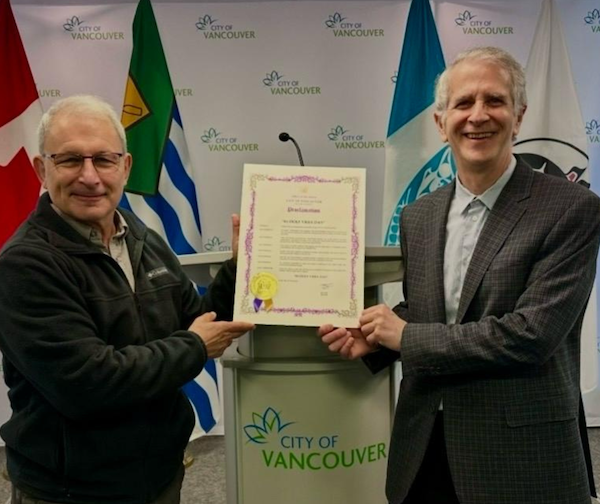
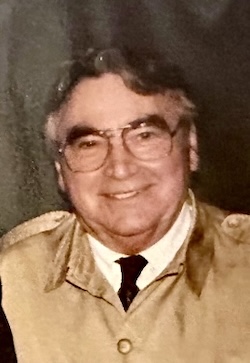
Rudolf Vrba, left, and author Alan Twigg at the University of British Columbia in 2001. Twigg’s new book on Vrba, Holocaust Hero: The Life & Times of Rudolf Vrba, breaks much new ground. (photo by Beverly Cramp)
Celebrated German factory owner Oskar Schindler is estimated to have saved the lives of about 1,200 Jews during the Holocaust. Carl Lutz, a Swiss vice-consul in Budapest, is credited with organizing protective documents and “safe houses” that helped between 50,000 and 62,000 Jews survive. Raoul Wallenberg, a Swedish envoy in Budapest issued passports and sheltered people in buildings, saving somewhere between 20,000 and more than 30,000 Jews. Chiune Sugihara, a Japanese consul in Kaunas, Lithuania, wrote thousands of transit visas, enabling about 6,000 Jews to escape via the Soviet Union and Japan, some of whom came to Canada and settled in Vancouver.
But few outside certain circles know of Rudolf Vrba. The late University of British Columbia professor of pharmacology escaped from Auschwitz and alerted the world to what was happening there. Estimates of the number of Jews saved by Vrba’s report vary, but a consensus among historians worldwide suggests he helped halt the mass deportation of more than 200,000 of Hungary’s Jews to Auschwitz. The late eminent historian Sir Martin Gilbert said of Vrba: “No other single act in the Second World War saved so many Jews from the fate that Hitler and the SS had determined for them.”
And yet, Vrba’s name remains largely unknown. This is not a coincidence. After the war, especially in Israel, there was a deliberate effort to downplay Vrba’s perspective of events.
 A new book – the first of a meticulous two-volume assessment of Vrba’s life – has just been released by Vancouver author Alan Twigg. It goes great lengths to broadening awareness of Vrba’s heroism and correcting the many misconceptions around his legacy. In the process, Holocaust Hero: The Life & Times of Rudolf Vrba breaks much new ground.
Coincidental to the release of this publication, a monument to Vrba’s memory is to be unveiled later this month at Schara Tzedeck Cemetery, righting what many locals see as an unjust historic oversight.
While Vrba wrote his own memoirs, somewhat incredibly, Twigg’s book is the first real Vrba biography.
“There’s never been an in-depth biography of Rudolf Vrba,” said Twigg, who deliberately did not replicate the contents of Vrba’s own 1963 book, written with Alan Bestic, titled I Cannot Forgive and re-released in the 1980s as Escape from Auschwitz. “I tried to concentrate on information that was not available anywhere.”
While this first volume is an eye-opener for those who know nothing of Vrba, it contains bombshells and fascinating depth even for those who have read Vrba’s book or who otherwise know something about his story. And Twigg promises more to come in the next volume.
“The really revealing material is going to be in Volume Two,” Twigg told the Independent. “That volume will be almost entirely original material and it will show the evolution of Rudi’s character.”
Those who know of Vrba are aware of his daring escape. But that was, in many ways, the beginning of his historic story. He joined the Partisans and was a decorated war hero. He was an extraordinary intellectual, a difficult personality, had a dark humour many people didn’t understand, and carried anger throughout his life.
“I think it’s so important if you’re writing a biography to get across his character, not just the events of his life,” said Twigg. The participation of Vrba’s widow, Robin, was invaluable and the book includes extended transcriptions of Twigg’s engaging conversations with her.
Rudolf Vrba was originally a false name that came on the forged papers given to Walter Rosenberg soon after he filed his report and then joined the Czechoslovakian resistance after his escape from Auschwitz.
Born in Slovakia, Rosenberg/Vrba was transported to Auschwitz in June 1942. He steadfastly viewed the plunder of Jewish assets – not antisemitism as its own accelerant – as the motive for the Holocaust.
Vrba is said to have had a near-photographic memory, which allowed him to store away data that would change the course of history. It is believed that he greeted almost every train arriving at Auschwitz for 10 months, mentally noting estimated numbers and places of origin.
Eventually, he gained the coveted job of registrar of Birkenau’s quarantine camp, allowing him unusual access to additional information and limited freedom of movement. He learned that plans were afoot to liquidate the last remaining large population of European Jews – the 800,000 in Hungary – whose destruction would be streamlined by the construction of a new rail line to expedite transportation to the crematoria.
Vrba connected with Alfréd Wetzler, another Slovakian Jew who was registrar of the morgue.
On April 7, 1944, Vrba and Wetzler hid in a woodpile, still on the Birkenau site but outside the barbed wire prisoner encampment. Gasoline-soaked tobacco threw search dogs off their scent. They hid there for three days and nights as search parties worked 24/7 to find the escapees. After the intensive search was called off, they made their move.
The pair made an 11-day trek by foot through Poland to the border with Slovakia, where they connected with the Jewish community.
“Their feet were bloodied and misshapen,” Twigg reports. “A doctor was summoned. The malnourished pair recovered and soon cooperated with Jewish Council officials to produce an anonymous report that would be so detailed and emotionless that it could not not be believed.”
The Vrba-Wetzler Report, as it became known, was the first to have any significant reverberations, apparently because of the mathematical tallies and objective, scientific-like writing.
With the report, pressure came down on Admiral Miklós Horthy, the Hungarian leader viewed by most as a Nazi collaborationist, to halt the deportations of Hungarian Jews to Auschwitz. By 1944, the tide had begun to turn against the Nazis and so it was not moral considerations, Twigg suggests, that turned Horthy against the deportations, but the fear of war crimes charges after the war. Regardless of Horthy’s motivations, it was this impact of the Vrba-Wetzler Report that is believed to have saved at least 100,000 and as many as 200,000 lives.
The deportations did not end permanently, though. And here Vrba’s history is inescapably tied up with that of another Rudolf – Rudolf (Rezső) Kasztner, one of the most polarizing figures in Holocaust history.
“A controversy persists to this day as to the extent prominent Jewish and Zionist leaders should be held accountable for a myriad of failures to adequately inform Jews about the lethal dangers of boarding the trains,” Twigg writes. “For the rest of his days, Vrba would chiefly lay the blame for the failure to adequately inform approximately 800,000 Jews in Hungary about the Holocaust on Kasztner, the Zionist leader from northern Transylvania.”
Kasztner was the first non-Slovakian official to see the Vrba-Wetzler Report and a harsh dispute rages still around what happened next.
In meetings among the leadership of Hungarian Jewry, it was apparently Kasztner who pressed for an approach in which, rather than alerting the Jewish population, the leadership would keep the information to themselves and negotiate directly with Adolf Eichmann for favourable terms that made it possible for Kasztner and other senior Jewish figures to save themselves and a number of others.
Kasztner (and those sympathetic to his narrative) would have seen some logic in the fact that the Nazi war effort was foundering and the Germans desperately needed goods and money, something Kasztner and his associates believed they could access through Jewish channels internationally. With the Soviets approaching from the east, they may have thought they could buy time and save more than their limited numbers.
Eventually, Kasztner negotiated with Eichmann that a trainload of about 1,684 Jews, many or most of Kasztner’s own choosing, would set off for Switzerland. It is estimated that the passage for each passenger had been “bought” from Eichmann for about $1,000.
The passengers did not go directly to Switzerland, though, but were rerouted to Bergen-Belsen. Unlike the other Hungarian Jews arriving at the concentration camps, however, these 1,600 or so were kept separate and eventually did make it to Switzerland, in two transports, later in the year.
In the meantime, 400,000 Hungarian Jews were sent to Auschwitz, where almost all of them were murdered.
The title of Vrba’s book, I Cannot Forgive, is assumed to refer to the Nazis. Twigg, among others, believes it is simultaneously a reference to Kasztner and his coterie of Jewish leaders.
Vrba was openly critical of the Jewish leadership, particularly those in Hungary and especially Kasztner, who by this time had risen to a moderately senior post in the Israeli government, along with other Hungarian Jewish leaders who were senior or mid-level figures in the governing party, Mapai. To some extent, put simply, the Hungarian Jews who had negotiated with Eichmann and who Vrba blamed for preventing his report from saving exponentially more Jewish lives, became integrated into the nascent elite of the new Jewish state. It was decidedly not in their interests to have the provocative professor, now halfway around the world in Vancouver, obtain any wider audience for his book.
Ruth Linn, an Israeli scholar of moral psychology and Holocaust memory at the University of Haifa, has Vancouver connections and stumbled onto Vrba’s story a couple of decades ago. She could not understand why his name was almost completely unknown in Israel. She spearheaded the first publication of the Vrba-Wetzler Report in Hebrew, in 1998, and, in 2004, wrote Escaping Auschwitz: A Culture of Forgetting, which examined why Vrba’s account had been marginalized in Israel and how politics and memory shaped Holocaust historiography.
Capturing the dichotomy of the debate around Kasztner’s role in the Hungarian Holocaust, Twigg juxtaposes two quotes. An Israeli judge, Benjamin Halevi, said of Kasztner, “He didn’t sell his soul to the devil; he was the devil.” Canadian author and publisher Anna Porter, who has written about the subject, said, “If you’re in hell, who do you negotiate with but the devil?”
A 1955 libel trial instigated by Kasztner proved his undoing. Ostensibly a case against Malkiel Gruenwald, who publicized the wartime actions of Kasztner, the trial turned into an examination of the facts of the case. Halevi, the judge who deemed Kasztner the devil himself, ruled that, by saving a chosen few, Kasztner had sacrificed the majority of Hungarian Jews. More than two years later, Israel’s Supreme Court overturned the judgment, but Kasztner did not live to see his legal redemption. He was assassinated outside his home in March 1957.
Twigg came to the Vrba story more by happenstance than design. Twigg edited BC Bookworld, a newspaper about books and authors, for more than three decades.
“I used to keep track of all the books of British Columbia and I had categories,” he said. He could cross-reference, for example, all books on Japanese-Canadians or forestry.
Based on this knowledge, in 2022, Twigg wrote Out of Hiding: Holocaust Literature of British Columbia. (See jewishindependent.ca/a-roadmap-to-remembering.) Its largest, though still necessarily brief, section is on Vrba. However, this was inadequate for Twigg, who decided to expand the project – first as a comprehensive website (rudolfvrba.com) – now as this book.
Not directly related to Holocaust Hero but timely, if profoundly overdue, an ad hoc group of friends and admirers of Vrba will erect the world’s only monument to him on Sunday, Oct. 26, beginning with a ceremony in the chapel at Schara Tzedeck Cemetery at 2 p.m. The program will feature reflections on Vrba’s life, legacy and enduring impact from Dr. Robert Krell, Dr. Joseph Ragaz and Prof. Chris Friedrichs, and will conclude with the dedication of the memorial monument.