
Skip to content
  • Home
  • Subscribe / donate
  • Events calendar
  • News
    • Local
    • National
    • Israel
    • World
    • עניין בחדשות
      A roundup of news in Canada and further afield, in Hebrew.
  • Opinion
    • From the JI
    • Op-Ed
  • Arts & Culture
    • Performing Arts
    • Music
    • Books
    • Visual Arts
    • TV & Film
  • Life
    • Celebrating the Holidays
    • Travel
    • The Daily Snooze
      Cartoons by Jacob Samuel
    • Mystery Photo
      Help the JI and JMABC fill in the gaps in our archives.
  • Community Links
    • Organizations, Etc.
    • Other News Sources & Blogs
    • Business Directory
  • FAQ
  • JI Chai Celebration
  • JI@88! video

Recent Posts

  • Hateful messages intensify
  • Creating entrepreneurs
  • Wrong choice to host Piker
  • Attack on Jewish kids
  • Multiple benefits of a break
  • Dialing up the perfect thriller
  • Empowerment & more
  • Songs in war of peace
  • Successful trip to Cuba 
  • Tackling antizionism head on
  • Thinking of leaving Canada?
  • Kindness as a matter of fact
  • Personal stories, vital lessons
  • Connecting generations
  • Vancouver to Vienna
  • Recipes a form of resistance
  • Community milestones … February 2026
  • Generations … It’s all yours!
  • נתניהו לא מתבייש להאשים את ביידן באחריות להרג חיילים ברצועת עזה
  • Last hostage home
  • New bill targets hate crimes
  • Concerning actions
  • Recipes not always required
  • Survivor urges vigilance
  • Seniors profoundly affected
  • Farm transforms lives
  • Musical legacy re-found
  • A range of Jewish literature
  • A concert of premieres
  • Variety telethon on Feb. 22
  • Victoria club’s many benefits
  • Avodah dedicated to helping
  • Artists explore, soar, create
  • Life’s full range of emotions
  • Community needs survey closes March 29
  • Jerusalem marathon soon

Archives

Follow @JewishIndie
image - The CJN - Visit Us Banner - 300x600 - 101625

Tag: Martin Luther

Visit to cradle of Ashkenaz

Visit to cradle of Ashkenaz

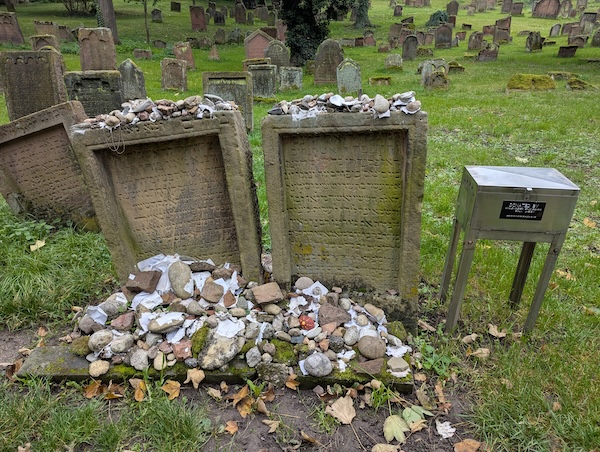
Buried next to Maharam of Rothenburg’s grave is Alexander ben Salomon of Wimpfen (known in some sources as Alexander Süsskind Wimpfen) – the man who paid for the release of the rabbi’s remains. (photo by Pat Johnson)

They say that history repeats itself and, if this is true at all, it is perhaps more true for Jewish history. The recent exchange of almost 2,000 imprisoned Palestinian terrorists for the remaining Jewish hostages held in Gaza was an act of moral compromise that has a long lineage. 

Throughout Israeli history, the centrality in Jewish values of the sanctity of life and the respectful burial of the dead have been exploited by the country’s enemies. Yahya Sinwar, the mastermind of the 10/7 pogrom, was himself freed in a 2011 prisoner release that saw more than 1,000 Palestinian terrorists set free in exchange for the freedom of Gilad Shalit, an Israeli held in Gaza for more than five years.

The ransoming of Jews goes back much, much further, however – at least to the very beginning of Ashkenaz.

In a recent brief visit to the German city of Worms, southwest of Frankfurt, I learned of Rabbi Meir of Rothenburg, who was the leading Ashkenazi halakhic authority of the 13th century. Also known as the Maharam of Rothenburg (an acronym of “Moreinu ha-rav Rabbi Meir,” meaning “Our teacher, the rabbi, Rabbi Meir”), he was imprisoned after attempting to leave the Holy Roman Empire around 1286. Jews were legally considered imperial property and valued for their tax revenue. His attempted departure was due to rising oppression, repressive taxes and broader political instability.

His arrest was intended both to prevent Jewish emigration and to extract a massive ransom by holding the most prominent rabbi of the era hostage. Although the Jewish communities were prepared to pay for his release, the Maharam refused to permit an excessive ransom, invoking the talmudic principle that captives should not be redeemed at exorbitant cost lest it encourage future kidnappings. He remained imprisoned until his death in 1293. After death, his body was held for 14 years, until a private individual paid for the release. He was ultimately buried in the Jewish cemetery at Worms.

The cemetery is known as Heiliger Sand, or Holy Sand, and the Maharam’s grave is adorned in mountains of memorial stones. Buried next to him, and also remembered with countless stones, is Alexander ben Salomon of Wimpfen (known in some sources as Alexander Süsskind Wimpfen) – the man who paid for the release of the rabbi’s remains. The parallel graves symbolize the duality of moral sacrifice and restorative compassion.

The Maharam aside, the cemetery is one of the most significant burial sites in the Jewish world. It is the oldest remaining Jewish cemetery in Europe, the earliest grave estimated to date from 1058.  

Worms was one of the central pillars of medieval Jewish civilization because it stood at the heart of Ashkenazi religious, legal and cultural development during the Middle Ages. Together with Mainz and Speyer, Worms was one of the “ShUM cities,” the most important Jewish centres north of the Alps between roughly the 10th and 13th centuries. The ShUM communities created the foundations of Ashkenazi Judaism as it is still practised today. It was one of the earliest Jewish settlements in Central Europe after Jewish migration from the Mediterranean world. It was a cradle of Ashkenazi civilization and the Maharam its most venerated scholar.

Jewish life in Worms became a template for Ashkenazi Jewish communal life, developing the legal customs (minhagim) around marriage, mourning, tzedakah and education that spread throughout Central and Eastern Europe. Even after the devastation of the Crusades and later expulsions, Worms endured in Jewish consciousness and culture. The last burial in the cemetery was in 1942. Miraculously, unlike many other Jewish cemeteries across Europe, this one survived the Shoah relatively intact. 

The symbiosis – if that is the correct word – of Jewish and Christian life in Worms is embodied in the larger dichotomy of European Jewish life. From the cemetery, the main edifice visible outside the grounds is the imposing Worms Cathedral. Worms may be central in Ashkenazi tradition, but it also holds a profound place in Christian history. 
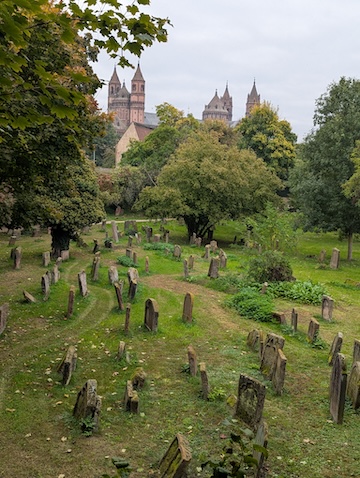
photo - From the cemetery, the main edifice visible outside the grounds is the imposing Worms Cathedral
From the cemetery, the main edifice visible outside the grounds is the imposing Worms Cathedral. (photo by Pat Johnson)

Martin Luther, the 15th-century monk who sparked the Protestant Reformation and drove the most significant schism in Christianity, nailed his 95 theses to the cathedral door in Wittenburg, about 400 kilometres from Worms. Luther’s history intersected with Worms when he was tried at the unappetizingly titled Diet of Worms, in 1521, and found guilty by imperial authorities. Refusing to recant, he became one of history’s most consequential heretics – or spiritual pioneer and reformer, depending on one’s perspective. 

To Jews, Luther is a despotic figure. After effectively inventing Protestant Christianity, Luther was solicitous to the Jews, hoping that the stiff-necked people who had rejected the doctrine of Jesus as purveyed by the Vatican would jump on board the rebranded Lutheran variety. When they overwhelmingly did not, Luther transformed into a ferocious antisemite, putting quill to papyrus in some of history’s most vile racist tirades. 

From the perspective of this history, the cathedral dominating the sightlines of the Holy Sand can be viewed as a place where one of history’s greatest Jew-haters got his comeuppance. Of course, the Catholicism that the building still represents has its own problematic history, to frame it kindly. And, for that matter, Luther landed on his feet, historically speaking.

Visiting the cemetery is a moving experience – with a bizarre and almost laughable twist. 

Unsurprisingly, there were two security personnel seated at a table outside the gate. I attempted to gather some information, but our lack of shared language prevented much conversation. They did motion toward a box of what I thought were face masks, but which turned out to be makeshift kippot. In fact, they were peaked paper caps, the sort that short order cooks at Denny’s might wear. It was an odd experience to be walking around an ancient cemetery looking like I just stepped out of Mel’s Diner. 

We should use caution in making sweeping parallels across history, but it is striking how the enemies of the Jews across the centuries have recognized and exploited the importance of pidyon shvuyim, the redeeming of captives. How many other traditions, I wonder, have prayers in the liturgy for specifically this eventuality? A visit to the Holy Sand reminds us how deep that tradition of exploitation goes. 
Format ImagePosted on December 5, 2025December 3, 2025Author Pat JohnsonCategories TravelTags Alexander Süsskind Wimpfen, antisemitism, cemetery, Germany, history, hostages, Maharam, Martin Luther, Worms
Which path to choose?

Which path to choose?

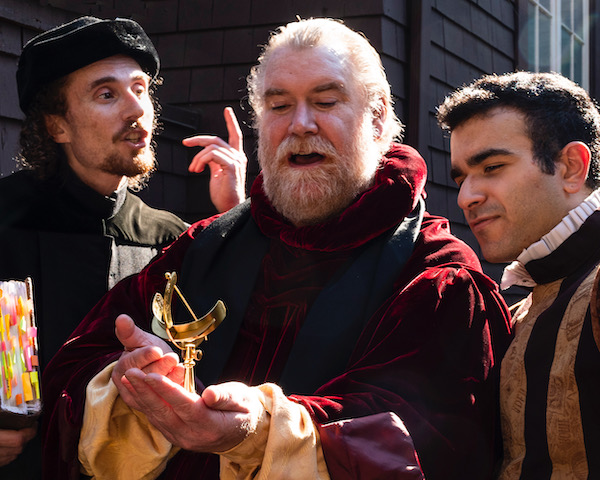
Left to right: Misha Kobiliansky (Luther), Matthew Bissett (Faustus) and Dylan Nouri (Hamlet) in United Players’ production of Wittenberg, which is at Jericho Arts Centre Nov. 11-Dec. 4. (photo by Nancy Caldwell)

The play Wittenberg tackles heady subjects – skepticism or faith? Divine plan or free will? – with fast-paced high- and low-brow humour, mixing the serious and the silly, an actual historical figure with characters from literature.

United Players brings David Davalos’s comedy to Jericho Arts Centre Nov. 11-Dec. 4. Directed by Jewish community member Adam Henderson, it also stars community member Misha Kobiliansky – as Martin Luther.

The play, described as a prequel to both Hamlet and Doctor Faustus, is set in the year 1517. Luther (whose writings would spark the Protestant Reformation but who also would become viciously antisemitic) teaches theology at the University of Wittenberg. His colleague is philosophy professor John Faustus (who has yet to make his deal with the devil for knowledge and pleasure, as he does in Christopher Marlowe’s Doctor Faustus). They debate each other and attempt to sway the views of one of their students, Hamlet (the indecisive Prince of Denmark penned by Shakespeare).

Hamlet has returned to school, in crisis after having studied Copernicus’s radical new theory of the universe, that the earth revolves around the sun. Meanwhile, as the play description explains, Faustus “has decided to make an honest woman of Helen, once ‘of Troy,’ aka ‘the Eternal Feminine,’ but she prefers her freedom” and Luther “is outraged at the abusive practices of the church to which he has sworn obedience.” In a college tennis tournament, Laertes (another character taken from Shakespeare’s Hamlet) competes against Hamlet for the championship title.

Wittenberg is Kobiliansky’s debut with United Players, but he is a veteran actor. When asked how he got into acting, he said, “That’s a nice story I like to tell. Back in the day, my mother worked as a piano player for the Moscow Art Theatre and she used to take me backstage with her when I was little. I remember watching a few plays from behind the scenes and watching actors go on and off stage – the atmosphere there was incredible! I was ‘scarred’ for life.

“A few years after, our family moved to Israel and somehow acting studies never came up, until I was in my early 20s. There were a few of us, theatre enthusiasts with no acting experience, and this very seasoned director who recently came to Israel from Ukraine. He wanted to find a young group of people and do some theatre together. He worked us through a pretty rigorous acting course for about a year and then we actually staged a few plays. Those were great times.”

Prior to winning the role of Luther, Kobiliansky was only minimally familiar with the historical figure on which his character is based.

“All I knew was that he led the Reformation and that the Lutheran Church is named after him,” said Kobiliansky.

While Luther’s antisemitism is a matter of historical record, with catastrophic consequences, of his concepts that a non-Christian might be sympathetic to, the actor said, “Well, Martin Luther’s relationship with God and his struggles with faith can apply pretty much to any religion, I think…. His anti-indulgence protest could be compared to any anti-corruption movement anywhere in the world, where those in power take advantage of their position for personal benefit, by pushing an ideological concept to an extreme.”

Limiting his comments to the character of Luther, as depicted in 1517, Kobiliansky said, “The thing I probably love the most about Martin Luther’s stance in this play – he stands for filling life with purpose as opposed to freedom and progress (represented by Faustus). Progress is a nice concept, but progress for a progress’s sake gets you nowhere.”

Wittenberg also stars Matthew Bissett (Faustus), Dylan Nouri (Hamlet), Deborah Vieyra (the Eternal Feminine) and Jake Anthony (Laertes). Running Nov. 11-Dec. 4, performances take place Thursday through Saturday, 8 p.m., and Sundays, 2 p.m., with talk backs Nov. 17 and 20. Tickets ($30, $26 seniors, $15 students) are available at unitedplayers.com or 604-224-8007, ext. 2.

Format ImagePosted on November 11, 2022November 9, 2022Author Cynthia RamsayCategories Performing ArtsTags faith, free will, Martin Luther, Misha Kobiliansky, theatre, Wittenberg
Proudly powered by WordPress