
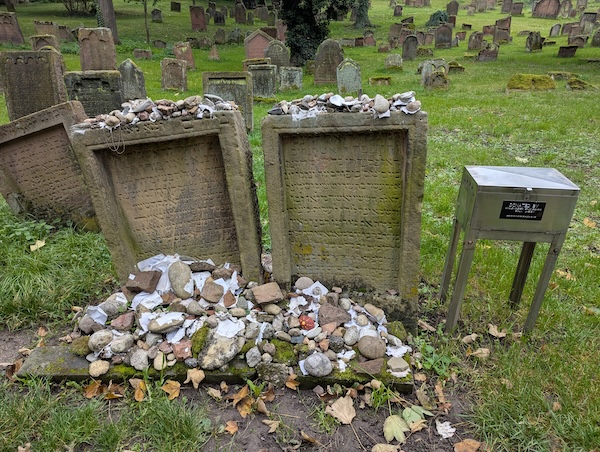
Buried next to Maharam of Rothenburg’s grave is Alexander ben Salomon of Wimpfen (known in some sources as Alexander Süsskind Wimpfen) – the man who paid for the release of the rabbi’s remains. (photo by Pat Johnson)
They say that history repeats itself and, if this is true at all, it is perhaps more true for Jewish history. The recent exchange of almost 2,000 imprisoned Palestinian terrorists for the remaining Jewish hostages held in Gaza was an act of moral compromise that has a long lineage.
Throughout Israeli history, the centrality in Jewish values of the sanctity of life and the respectful burial of the dead have been exploited by the country’s enemies. Yahya Sinwar, the mastermind of the 10/7 pogrom, was himself freed in a 2011 prisoner release that saw more than 1,000 Palestinian terrorists set free in exchange for the freedom of Gilad Shalit, an Israeli held in Gaza for more than five years.
The ransoming of Jews goes back much, much further, however – at least to the very beginning of Ashkenaz.
In a recent brief visit to the German city of Worms, southwest of Frankfurt, I learned of Rabbi Meir of Rothenburg, who was the leading Ashkenazi halakhic authority of the 13th century. Also known as the Maharam of Rothenburg (an acronym of “Moreinu ha-rav Rabbi Meir,” meaning “Our teacher, the rabbi, Rabbi Meir”), he was imprisoned after attempting to leave the Holy Roman Empire around 1286. Jews were legally considered imperial property and valued for their tax revenue. His attempted departure was due to rising oppression, repressive taxes and broader political instability.
His arrest was intended both to prevent Jewish emigration and to extract a massive ransom by holding the most prominent rabbi of the era hostage. Although the Jewish communities were prepared to pay for his release, the Maharam refused to permit an excessive ransom, invoking the talmudic principle that captives should not be redeemed at exorbitant cost lest it encourage future kidnappings. He remained imprisoned until his death in 1293. After death, his body was held for 14 years, until a private individual paid for the release. He was ultimately buried in the Jewish cemetery at Worms.
The cemetery is known as Heiliger Sand, or Holy Sand, and the Maharam’s grave is adorned in mountains of memorial stones. Buried next to him, and also remembered with countless stones, is Alexander ben Salomon of Wimpfen (known in some sources as Alexander Süsskind Wimpfen) – the man who paid for the release of the rabbi’s remains. The parallel graves symbolize the duality of moral sacrifice and restorative compassion.
The Maharam aside, the cemetery is one of the most significant burial sites in the Jewish world. It is the oldest remaining Jewish cemetery in Europe, the earliest grave estimated to date from 1058.
Worms was one of the central pillars of medieval Jewish civilization because it stood at the heart of Ashkenazi religious, legal and cultural development during the Middle Ages. Together with Mainz and Speyer, Worms was one of the “ShUM cities,” the most important Jewish centres north of the Alps between roughly the 10th and 13th centuries. The ShUM communities created the foundations of Ashkenazi Judaism as it is still practised today. It was one of the earliest Jewish settlements in Central Europe after Jewish migration from the Mediterranean world. It was a cradle of Ashkenazi civilization and the Maharam its most venerated scholar.
Jewish life in Worms became a template for Ashkenazi Jewish communal life, developing the legal customs (minhagim) around marriage, mourning, tzedakah and education that spread throughout Central and Eastern Europe. Even after the devastation of the Crusades and later expulsions, Worms endured in Jewish consciousness and culture. The last burial in the cemetery was in 1942. Miraculously, unlike many other Jewish cemeteries across Europe, this one survived the Shoah relatively intact.
The symbiosis – if that is the correct word – of Jewish and Christian life in Worms is embodied in the larger dichotomy of European Jewish life. From the cemetery, the main edifice visible outside the grounds is the imposing Worms Cathedral. Worms may be central in Ashkenazi tradition, but it also holds a profound place in Christian history.
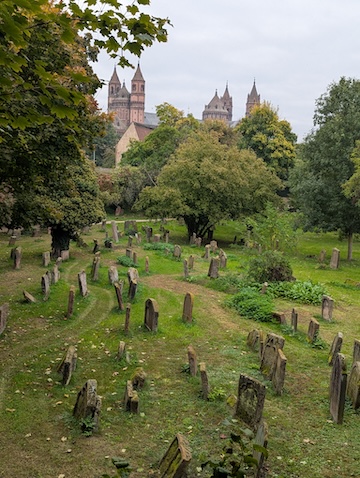
Martin Luther, the 15th-century monk who sparked the Protestant Reformation and drove the most significant schism in Christianity, nailed his 95 theses to the cathedral door in Wittenburg, about 400 kilometres from Worms. Luther’s history intersected with Worms when he was tried at the unappetizingly titled Diet of Worms, in 1521, and found guilty by imperial authorities. Refusing to recant, he became one of history’s most consequential heretics – or spiritual pioneer and reformer, depending on one’s perspective.
To Jews, Luther is a despotic figure. After effectively inventing Protestant Christianity, Luther was solicitous to the Jews, hoping that the stiff-necked people who had rejected the doctrine of Jesus as purveyed by the Vatican would jump on board the rebranded Lutheran variety. When they overwhelmingly did not, Luther transformed into a ferocious antisemite, putting quill to papyrus in some of history’s most vile racist tirades.
From the perspective of this history, the cathedral dominating the sightlines of the Holy Sand can be viewed as a place where one of history’s greatest Jew-haters got his comeuppance. Of course, the Catholicism that the building still represents has its own problematic history, to frame it kindly. And, for that matter, Luther landed on his feet, historically speaking.
Visiting the cemetery is a moving experience – with a bizarre and almost laughable twist.
Unsurprisingly, there were two security personnel seated at a table outside the gate. I attempted to gather some information, but our lack of shared language prevented much conversation. They did motion toward a box of what I thought were face masks, but which turned out to be makeshift kippot. In fact, they were peaked paper caps, the sort that short order cooks at Denny’s might wear. It was an odd experience to be walking around an ancient cemetery looking like I just stepped out of Mel’s Diner.
We should use caution in making sweeping parallels across history, but it is striking how the enemies of the Jews across the centuries have recognized and exploited the importance of pidyon shvuyim, the redeeming of captives. How many other traditions, I wonder, have prayers in the liturgy for specifically this eventuality? A visit to the Holy Sand reminds us how deep that tradition of exploitation goes.