Michael Shamata directs The Lehman Trilogy, which will be at Victoria’s Belfry Theatre from April 23 to May 19. (photo from Belfry Theatre)
From April 23 to May 19, Victoria’s Belfry Theatre will stage The Lehman Trilogy, a three-act play that follows the Lehman family’s story, from three immigrant brothers arriving in the United States in the mid-1800s to the founding of their investment firm, which became a financial giant, then fell.
Michael Shamata, the Belfry’s artistic director, said he knew at once after reading the play that The Lehman Trilogy had to be shown in Victoria.
“I couldn’t put the script down,” he said. “In literary terms – it’s a ‘page-turner.’ In theatrical terms – it is a stunning high-wire act. Three exceptional actors play three brothers and three generations of the Lehman dynasty. It’s a wild ride: from a tiny store in Alabama to a Wall Street juggernaut – from small-town enterprise to full-on moral corruption.”
The Lehman Trilogy was written by Italian novelist and playwright Stefano Massini. It has since been translated into 24 languages and appeared on London’s West End and on Broadway. In 2022, the show picked up five Tony Awards.
Ben Power, associate director at London’s National Theatre, adapted the play from Mirella Cheeseman’s English translation. Massini’s original work started as a nine-hour radio play before being shortened to a five-hour, three-act theatrical work written in free verse. The length was whittled down again when it hit the London stage under the direction of Sam Mendes and the cast, which once numbered 20, was cut to three.
The tale is remarkable. Lehman Brothers started out as a dry goods store in Montgomery, Ala. The firm grew exponentially, moved to Wall Street and rose to become a corporate behemoth before its demise during the 2008 financial crisis. As the Belfry states on its website, “We view The Lehman Trilogy as an exploration of the American Dream, and ultimately a critique of American capitalism.”
The story of Lehman Brothers, once one of the world’s most esteemed financial institutions, offers a worthwhile glimpse into “this journey which is so emblematic of the evolution of consumerism, capitalism and the American way of life,” notes the Belfry. In its heyday, Lehman Brothers employed 25,000 people. At the time it declared bankruptcy, it was in debt more than $600 billion.
One reason the play is compelling theatre, Ben Power told NPR’s The Indicator from Planet Money in 2020, is that it explores the abstract, as the Lehman company grows into a financial powerhouse by being, essentially, a middleman. Whereas, at one time, a trader might have had to bring goods, such as cotton, to a market to be seen (and touched) by a purchaser, trade on a stock exchange involves no such visibility or tangibility, as goods are traded through companies like Lehman Brothers.
“There is a move into the imagination, a move into metaphor. Instead of having a thing, you just have a word,” Power said. “And I think one of the reasons the story works is that at the heart of all these financial systems is the idea that one thing stands for something else. You get the distance from the actual thing that you are selling and the people’s lives you are impacting when you do that. The more you move into the abstract, maybe, the harder it gets to have a moral framework around what you are doing.”
The Victoria production features actors Brian Markinson (Henry Lehman), Celine Stubel (Mayer Lehman) and Nigel Shawn Williams (Emmanuel Lehman). The three take on the roles of dozens of other characters throughout the play.
“Casting across race, religion and gender highlights the universal seductiveness of both the American Dream and capitalism,” says the Belfry on its website. “In addition, given that the production’s three actors are playing multiple characters – crossing genders, cultures and ethnicities – why should the casting not do the same?”
A Broadway staging of The Lehman Brothers encountered some snags due to the pandemic. The March 26, 2020, official opening at the Nederlander Theatre was postponed and did not reopen until September 2021.
Though widely acclaimed by reviewers, The Lehman Trilogy did not receive universal praise. Writing for The Observer, David Rich called the play “profoundly antisemitic.”
“Not in a crude way – a clumsy turn of phrase here, a jarring stereotype there – but in its innermost essence, connecting a modern audience to malevolent beliefs about Jews and money that are buried deep within Western thought. Most striking of all, none of the people responsible for writing, acting, directing or producing this play seem remotely aware, and most reviews have missed it entirely,” Rich wrote.
The play is the first Jewish-related work to be in the Belfry’s lineup since the cancellation of The Runner late last year. The planned scheduling of that play, about an Israeli ZAKA volunteer, made national headlines after anti-Israel protesters demanded that it not be shown.
To order tickets for The Lehman Trilogy, go to belfry.bc.ca.
Sam Margolis has written for the Globe and Mail, the National Post, UPI and MSNBC.

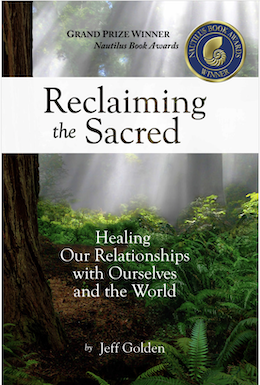 “When we can feel that we are an essential part of the universe, that we are the breath of the divine,” Golden believes that we can transform what he describes as our “morally, spiritually, ecologically, and, soon enough, economically” bankrupt system into “an entirely different way of living and being, rooted in the wonder, reverence, and connection that have long nourished our ancestors, yet unique to our times and needs and opportunities.”