
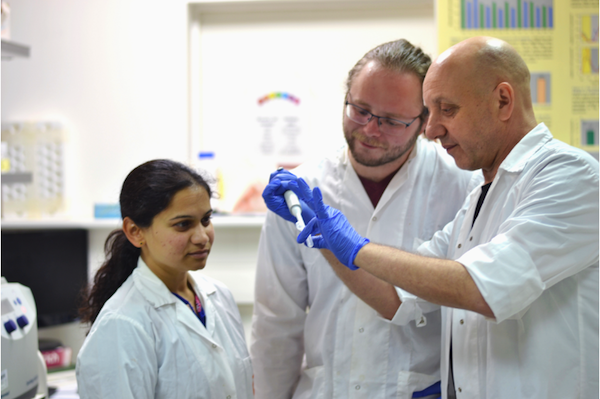
Prof. Simon Barak of the Jacob Blaustein Institutes for Desert Research at Ben-Gurion University of the Negev, right, is coordinating all the plant biologists and imaging specialists. (photo from CABGU)
Can plants grow in a barren landscape such as the surface of the moon? If so, what types of plants? Could enough plants grow to support a future moon colony? These are the types of questions the Lunaria One consortium has set out to answer.
An experiment proposed by Lunaria One, known as Aleph, was selected by SpaceIL, a nonprofit aerospace organization, to be included as one of the payloads on board their Beresheet2 lander. The Beresheet2 mission, scheduled to launch in mid-2025, will consist of two landers, landing on each side of the moon, and an orbiter that will continue to orbit the moon for up to five years. Aleph will consist of a tray of seeds and dehydrated plants, a device that will water them, heaters and cameras to monitor the plants.
Prof. Simon Barak of the Jacob Blaustein Institutes for Desert Research (BIDR) at Ben-Gurion University of the Negev is coordinating all the plant biologists and imaging specialists. They include three Australians, one South African and two of his colleagues from BIDR at Ben-Gurion University: Prof. Aaron Fait and Dr. Tarin Paz-Kagan.
“The chosen experiment has enormous value both for our life here on earth and for humanity’s progress in space exploration,” said Shimon Sarid, SpaceIL chief executive officer. “Examining plant growth under extreme conditions will help us as far as food security is concerned. Plant growth in extreme conditions will help humanity in the long run. We are happy to cooperate with Lunaria One and are very excited.”
“The motivation for this mission comes from humanity’s passion to explore and see life thrive in barren landscapes,” explained Barak. “We see the Aleph payload as an important step towards our eventual goal of providing plants for food, medicine, oxygen production, CO₂-scrubbing and general well-being for future astronauts inhabiting the moon and beyond.”
“The central value guiding this project is that space exploration is for everyone; we don’t want a future where only autonomous and remote-controlled machines inhabit realms beyond earth, but where humans can live and thrive,” said Lunaria One director Lauren Fell. “The key to this is to get humans involved and to give them a say in how we get there. The Aleph project aims to open up the science and engineering behind growing life on the moon so that anyone can be involved.”
Growing plants on the moon means overcoming several challenges, such as massive temperature swings on the way to the moon, a water supply for the plants, and high temperatures when growing the plants. The plant types will need to be those that can germinate and grow to an appropriate size for imaging within 72 hours of deployment.
The research team expects their plant selections to be relevant for vertical farming and resource-challenged landscapes here on earth.
The project also has a strong citizen science component. Parallel science experiments will be carried out by amateurs (for example, high school students) and professionals to compare growth to that on the moon.
Additional universities participating in Lunaria One include Queensland University of Technology, the Royal Melbourne Institute of Technology and the Australian National University, in Australia, and the University of Cape Town, in South Africa.
“The earth is finite,” said Barak. “Its resources are finite. So humanity’s future depends upon reaching the stars.”
– Courtesy Canadian Associates of Ben-Gurion University of the Negev