Skip to content
  • Home
  • Subscribe / donate
  • Events calendar
  • News
    • Local
    • National
    • Israel
    • World
    • עניין בחדשות
      A roundup of news in Canada and further afield, in Hebrew.
  • Opinion
    • From the JI
    • Op-Ed
  • Arts & Culture
    • Performing Arts
    • Music
    • Books
    • Visual Arts
    • TV & Film
  • Life
    • Celebrating the Holidays
    • Travel
    • The Daily Snooze
      Cartoons by Jacob Samuel
    • Mystery Photo
      Help the JI and JMABC fill in the gaps in our archives.
  • Community Links
    • Organizations, Etc.
    • Other News Sources & Blogs
    • Business Directory
  • FAQ
  • JI Chai Celebration
  • JI@88! video

Recent Posts

  • המלחמות של נתניהו וטראמפ
  • Zionism wins big in Vegas
  • Different but connected
  • Survival not passive
  • Musical celebration of Israel
  • Shoppe celebrates 25 years
  • Human “book” event
  • Reclaiming Jewish stories
  • Bema presents Perseverance
  • CSS honours Bellas z”l
  • Sheba Promise here May 7
  • Reflections from Be’eri
  • New law a desecration
  • Resilient joy in tough times
  • Rescue dog brings joy
  • Art chosen for new museum
  • Reminder of hope, resilience
  • The national food of Israel?
  • Story of Israel’s north
  • Sheltering in train stations
  • Teach critical thinking
  • Learning to bridge divides
  • Supporting Iranian community
  • Art dismantles systems
  • Beth Tikvah celebrates 50th
  • What is Jewish music?
  • Celebrate joy of music
  • Women share experiences 
  • Raising funds for Survivors
  • Call for digital literacy
  • The hidden hand of hate
  • Tarot as spiritual ritual
  • Students create fancy meal
  • Encouraging young voices
  • Rose’s Angels delivers
  • Living life to its fullest

Archives

Follow @JewishIndie
image - The CJN - Visit Us Banner - 300x600 - 101625

Tag: memory

Reuniting in Winnipeg

Reuniting in Winnipeg

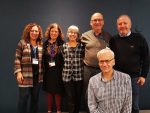
Among those at the reunion were, left to right, Helen Pinsky (Vancouver), Barbara Moser (Montreal), Chana Thau (Winnipeg), Avrum Rosner (Montreal), Cecil Rosner (Winnipeg) and Zev Cohen (Israel). (photo from the reunion)

Anyone who went to a Jewish day school in Winnipeg in the 1950s and 1960s was invited to a reunion recently – and 220 former students attended.

The Oct. 6-9 reunion was organized by Avrum Rosner, who now lives in Montreal, Zev Cohen, who now lives in Israel, and Eileen Margulius Curtis and Bert Schaffer, who both still live in Winnipeg.

Rosner started posting high school photos on Facebook. A closed Facebook group followed and then Rosner created a page inviting people to share photos from Winnipeg Jewish schools.

“So, some genius – Zev Cohen – asked on the Facebook group, ‘How about a reunion?’ And he then started laying the groundwork,” said Rosner. “It went viral after that.”

Rosner and his wife, Marnie Frain, both attended the reunion.

“There were many different Jewish schools in Winnipeg in the 1950s and ’60s, of diverse languages, attitudes to religion, attitudes to Israel, left and right,” said Rosner. “And, what was a thriving community, with unique cultural and social institutions, that reached its numerical peak around 1960, has been drastically diminished by emigration ever since.”

The main venue of the October reunion was Holiday Inn West Airport, where some of the out-of-towners stayed. But, on the Sunday, Gray Academy of Jewish Education (GAJE) hosted the reunion. The academy is the entity into which nearly all the Jewish schools have amalgamated.

The first reunion event was a dinner on Friday evening that included speeches. There was a discussion on Saturday; a brunch and greetings by GAJE staff and students, as well as a bus tour and dance party, on Sunday. On Monday, there was a farewell brunch with live entertainment, performing Hebrew, Yiddish and klezmer songs and 1960s/70s rock ’n’ roll.

Participants included students, and a small number of former teachers, from Winnipeg’s Talmud Torah, Joseph Wolinsky Collegiate, I.L. Peretz School, Rosh Pina, Herzlia, Ramah, and Sholem Aleichem School.

“For me, the highlights are not hard to identify – renewing half-century-old friendships. For me, and for many, it restored my belief in magic,” said Rosner. “Personally, I think I gained the pure pleasure of reconnection with childhood friends. Also, the confirmation of the importance and ongoing vitality of the social, cultural and ethical values … and principles many of us absorbed – not solely through formal education, but by growing up in a unique-in-many-ways Jewish community in an isolated prairie city. It was what I expected and hoped for, though exponentially better.”

Vancouver reunion attendee Helen Pinsky said, “I watched the whole thing happen on Facebook. And, despite the fact that I’d heard very little from other people who I’d gone to school with, the reunion appealed to me a lot. I made arrangements to see all my cousins in Winnipeg, and booked the trip. I attended with my boyfriend, Yossi Amit, who, at that point, knew none of my Winnipeg relatives and had never been to that city.”

Pinsky and Amit stayed at the reunion’s “official” hotel and, though the schedule for the weekend had looked quite bare, that was a plus for them, as it allowed for personal visits. “In the end, most of my cousins attended the reunion, too,” said Pinsky. “Then, we made plans for spending our free time together. The programs were well-received and gave us all a structure from which to build other plans.”

Pinsky enjoyed many aspects of the weekend, including the talk about the history of Winnipeg Jewry, the music and food at Hops, the band Finjan and reminiscences at brunch. “There were lots of photos, laughter, warmth, memories sharing, good feelings and catching up,” she said.

Helen Nadel also attended the reunion. Nadel met Vancouverite Tevy Goodman in Winnipeg in 1975, and the couple were married at what was then Rosh Pina Synagogue.

“My childhood stories of growing up in North End of Winnipeg have always interested my children,” said Nadel. “I heard about the reunion when I was in Winnipeg in April for a reunion of my high school Grade 12 class [of 1952] who all turn 65 this year. I also knew I’d have a 40th-year medical school reunion this year [Sept. 15-17]. So, I decided that this was the year to make it a trifecta.”

When Nadel and her husband decided that he would accompany her, Nadel invited her daughter, Daniella, along, too.

“For me, it was fun to see the older girls who were my cousins’ age, as I was the tag-along with my cousins when I was at Peretz School,” said Nadel. “After pointing out that I was the little pisher who was with Carol and Sandi, recognition was achieved. Reminiscences were exchanged. It was remarkable that, by the end of the weekend, people no longer looked unfamiliar. I remembered them as they were some 50 years ago.

“My daughter loved seeing me with my grade school mates. She loved hearing the stories and began texting her posse about what fun this was, wondering what they might be doing when they are our age. She particularly loved seeing us reminisce when we stopped at the two schools, Peretz and Talmud Torah. I had goose bumps when a few of us spontaneously started singing the Peretz School anthem a cappella in front of the school, although only one in the group – Pam – really remembered all the words.”

Nadel was taken aback by how close Peretz School and Talmud Torah were to one another. She had remembered them as being very far apart – not only ideologically, but in distance.

“All in all,” she said, the reunion was “a chance to re-form and strengthen our bonds and ties to Winnipeg and the wonderful community we all grew up in.”

For Myron Calof, word of the reunion reached him about a year ago, when his wife, Ros-Lynn Sheps, called him at the office to say that she had just checked their voicemail and there was a message from Bert Schafer.

“Although I had not heard that name for over 50 years, I instantly put the name to a face and called Bert,” said Calof. “After confessing that, as a kid, I had routinely stolen crab apples off his parents’ crab apple tree, Bert told me a Winnipeg Jewish schools reunion was in the works and asked if I’d attend. I didn’t hesitate for a second to say that both my wife and I would be there.”

Calof anticipated that the reunion would be a positive experience, but, he said, “It was far better than that. First, although I don’t know when I’ll see them again, I feel reconnected with old friends. Second, the experience made me realize that my classmates and I played a vital role in continuing and strengthening Jewish education – not just in Winnipeg, but in the many North American, Canadian cities where we eventually settled. We carried with us the spirit, value and importance of a Jewish education which, in the raising of our children and through participation in community endeavours, we’ve helped perpetuate.”

Calof noted the similarities between his early Talmud Torah years – less than 10 years after the founding of the state of Israel and the end of the Holocaust – and the threat the world and world Jewry face today with the rise of nationalism, antisemitism, xenophobia and challenges to liberal democracy. “I hope history is not repeating itself, especially where Jews are concerned,” said Calof. “But, if it does, I hope and I truly think, we and the generations of Jewish students who have followed us will be better prepared to oppose and push back our enemies.”

The best part of the weekend for Calof was Monday morning, when so many former students from different years and schools had the opportunity to express their gratitude to teachers, parents and school founders for helping enrich the lives of thousands of students who attended a place of Jewish learning.

Anyone who attended Jewish school in Winnipeg in the 1950s and 1960s can still add their name to the organizers’ contact list by e-mailing [email protected] and can join the 800 others in the closed Facebook group facebook.com/groups/winnipegjewishschools.

Rebeca Kuropatwa is a Winnipeg freelance writer.
Format ImagePosted on November 24, 2017November 23, 2017Author Rebeca KuropatwaCategories NationalTags Helen Nadel, Helen Pinksy, Jewish school, memory, Winnipeg
Grodzka Gate Lublin reunion

Grodzka Gate Lublin reunion

A photo from Lublin: Faces of a Nonexistent City, likely taken by taken by Abram Zylberberg. (photo from Grodzka Gate – NN Theatre Centre)

From July 3-7, the Grodzka Gate – NN Theatre Centre in Lublin (Osrodek Brama Grodzka – Teatr NN), Poland, will host the Lubliner Reunion – the first international meeting of Jewish inhabitants of the city and their descendants in 70 years.

Grodzka Gate – NN Theatre Centre is an organization run by non-Jews dedicated to preserving Jewish memory. It has been actively pursuing this mission for 25 years, and its program includes meetings, discussions, sightseeing tours, commemorations and artistic events. The reunion will constitute an important element of the celebrations, which mark 700 years since the founding of the city of Lublin, and is designed to emphasize the significance of the Jewish community for the history of the city.

The history of Jews has been intertwined with that of Lublin for several hundred years, and has helped shape its identity. The story of Lublin has been enriched with, among other things, the presence of a well-known yeshivah (Yeshivat Chachmei Lublin), the meetings of the Council of Four Lands (Vaad Arba Aratzot), the activities of local rabbis and social organizations and the work of writer and Nobel-laureate Isaac Bashevis Singer.

Just before the Second World War broke out, the 43,000 Jewish citizens of Lublin constituted one-third of the city’s population. The majority of Lublin’s Jewish inhabitants were murdered during the Holocaust and one of the German death camps, Majdanek, was located on the outskirts of Lublin. The story of Lublin cannot be told without the stories of its Jewish inhabitants, which is why, during the festivities organized to celebrate the 700-year-long history of the city in 2017, the presence of their descendants is vital and symbolic.

“The Lubliner Reunion is a way to build a bridge across time,” said Tomasz Pietrasiewicz, founder and director of Grodzka Gate. “It’s meant as a meeting in which both the people and their stories are important. Grodzka Gate is engaged in protecting the ‘memory of the place.’ We want to preserve what is left of Lublin’s Jewish community. The Lubliner Reunion will allow us to share knowledge and fill the blank spaces in the stories about Lublin and its inhabitants.”

photo - Grodzka Gate in Lublin, Poland
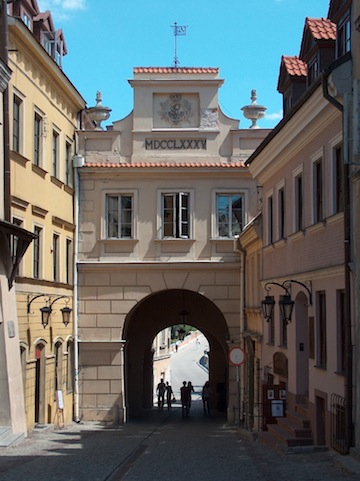
Grodzka Gate in Lublin, Poland. (photo from Grodzka Gate – NN Theatre Centre )

The program of the reunion covers meetings devoted to the history and culture of Jewish Lublin, workshops in genealogy, walks along tourist trails, commemorations and a variety of artistic events. One of the central features of the reunion will be presentations of Lubliner family stories. Guests will have a chance to get to know both historical and contemporary Lublin, visit the former Jewish district and meet non-Jews working to preserve the memory of the Jews of Lublin for generations to come.

Apart from sightseeing within Lublin, Grodzka Gate is also planning tours of the region – Zamosc, Kazimierz Dolny, Belzec and Wlodawa, among other places. Apart from these excursions, all events are free of charge for participants. The inauguration of the reunion will take place on July 3 in the Museum at the Lublin Castle.

“We want to get in touch with and invite all those whose families come from Lublin,” underlined reunion coordinator Monika Tarajko. “We already have participants coming from Israel, the United States, France, Belgium and Great Britain. However, we are still striving to reach as many prospective participants as possible and inform them about the reunion. We are expecting more than 100 people to visit Lublin as part of this special event. Feel welcome to join us!”

For reunion registration and information, visit lubliners2017.teatrnn.pl or contact Tarajko (48-606-687-367, [email protected]) or the American ambassador to Grodzka Gate, Leora Tec (1-781-862-4976, [email protected]).

Grodzka Gate’s other projects include Lublin: Memory of the Holocaust, a trail commemorating the Jewish inhabitants of Lublin who perished in the Holocaust; The Mysteries of Memory, an artistic happening involving a piece of the city with its specific topography, history and technical infrastructure; and Henio Zytomirski: The “Letters to Henio” Project, where, on April 19 (Holocaust Remembrance Day in Poland) every year, citizens of Lublin send letters to Henio Zytomirski, a Jewish boy who was born in 1933 in Lublin and was murdered by the Nazis in a gas chamber, probably in November 1942.

Grodzka Gate’s Lublin: Memory of the Place Exhibition is dedicated to Lublin before the war. A considerable part of the former Jewish district today has been covered with concrete, under which the foundations of Jewish buildings and the memory of those who once lived there are buried. Over the years, Grodzka Gate has become a place where old photographs, documents and testimonies can be preserved for posterity.

As well, there is Lublin: Faces of a Nonexistent City. In May 2012, Grodzka Gate received a collection of 2,700 glass plate negatives found in the attic of the house at Rynek 4 by workmen doing repairs. The photographs were taken between 1914 and 1939 and were, based on Grodzka Gate’s research and recent findings, taken by Abram Zylberberg.

Grodzka Gate’s website is teatrnn.pl/en.

Format ImagePosted on June 9, 2017June 7, 2017Author Grodzka Gate – NN TheatreCategories WorldTags continuity, Grodzka Gate, Holocaust, Lublin, memory, Poland
Forgetting our fright?

Forgetting our fright?

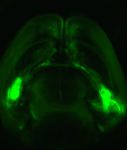
An entire mouse brain viewed from above: neuronal extensions connect the two amygdalas (brightest spots on both sides of the brain) with the prefrontal cortex (top). (photo from wis-wander.weizmann.ac.il)

Erasing unwanted memories is still the stuff of science fiction, but Weizmann Institute scientists have now managed to erase one type of memory in mice. In a study reported in Nature Neuroscience, they succeeded in shutting down a neuronal mechanism by which memories of fear are formed in the mouse brain. After the procedure, the mice resumed their earlier fearless behavior, “forgetting” they had previously been frightened.

This research may one day help extinguish traumatic memories in humans – for example, in people with post-traumatic stress disorder, or PTSD.

“The brain is good at creating new memories when these are associated with strong emotional experiences, such as intense pleasure or fear,” said team leader Dr. Ofer Yizhar. “That’s why it’s easier to remember things you care about, be they good or bad; but it’s also the reason that memories of traumatic experiences are often extremely long-lasting, predisposing people to PTSD.”

In the study, postdoctoral fellows Dr. Oded Klavir (now an investigator at the University of Haifa) and Dr. Matthias Prigge, both from Yizhar’s lab in the neurobiology department, together with departmental colleague Prof. Rony Paz and graduate student Ayelet Sarel, examined the communication between two brain regions: the amygdala and the prefrontal cortex. The amygdala plays a central role in controling emotions, whereas the prefrontal cortex is mostly responsible for cognitive functions and storing long-term memories. Previous studies had suggested that the interactions between these two brain regions contribute to the formation and storage of aversive memories, and that these interactions are compromised in PTSD, but the exact mechanisms behind these processes were unknown.

In the new study, the researchers first used a genetically engineered virus to mark those amygdala neurons that communicate with the prefrontal cortex. Next, using another virus, they inserted a gene encoding a light-sensitive protein into these neurons. When they shone a light on the brain, only the neurons containing the light-sensitive proteins became activated. These manipulations, belonging to optogenetics – a technique extensively studied in Yizhar’s lab – enabled the researchers to activate only those amygdala neurons that interact with the cortex, and then to map out the cortical neurons that receive input from these light-sensitive neurons.

Once they had achieved this precise control over the cellular interactions in the brain, they turned to exploring behaviour: mice that are less fearful are more likely to venture farther than others. They found that when the mice were exposed to fear-inducing stimuli, a powerful line of communication was activated between the amygdala and the cortex. The mice whose brains displayed such communication were more likely to retain a memory of the fear, acting frightened every time they heard the sound that had previously been accompanied by the fear-inducing stimuli.

Finally, to clarify how this line of communication contributes to the formation and stability of memory, the scientists developed an optogenetic technique for weakening the connection between the amygdala and the cortex, using a series of repeated light pulses. Indeed, once the connection was weakened, the mice no longer displayed fear upon hearing the sound. Evidently, “tuning down” the input from the amygdala to the cortex had destabilized or perhaps even destroyed their memory of fear.

“Our research,” said Yizhar, “has focused on a fundamental question in neuroscience: How does the brain integrate emotion into memory? But, one day, our findings may help develop better therapies targeting the connections between the amygdala and the prefrontal cortex, in order to alleviate the symptoms of fear and anxiety disorders.”

For more about the research being done at the Weizmann Institute, visit wis-wander.weizmann.ac.il.

Format ImagePosted on April 7, 2017April 4, 2017Author Weizmann InstituteCategories IsraelTags memory, science
A 22-year-old open wound

A 22-year-old open wound

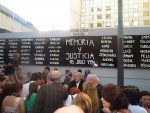
Every year on July 18, thousands of people gather to remember the victims of the AMIA bombing, and demand that justice prevails. (photo by Jaluj via commons.wikimedia.org)

After more than 20 years, an entire nation continues to search for answers and justice.

With an estimated population of 330,000, Argentina’s Jewish community is the largest in South America and, outside Israel, the sixth largest in the world. First arriving in Argentina in early days, Jews have continued to immigrate ever since. During its “golden era” (1900s to 1950s), an estimated 500,000 Jewish people lived there.

The vast majority of Jews in Argentina are Ashkenazi, from central and eastern Europe. From the start, this active, prosperous and engaged community has left its mark in local business, infrastructure, culture and politics. My family was part of this group; Argentina was the place we called home and where four generations of my family were born. AMIA (Asociación Mutual Israelita Argentina or the Argentine Israelite Mutual Association) is the central support organization for all Jews in Argentina, tracing its roots back to 1894.

Everything changed the morning of July 18, 1994, at 9:53 a.m. While I was attending a history class, more than 600 pounds of explosives hidden in a vehicle were detonated in front of AMIA. The explosion was followed by a cloud of smoke and dust seen for miles. In seconds, along with the iconic Jewish organization in Argentina and everything surrounding it, the building housing all of Argentina’s rich Jewish history was, simply, gone. This tragedy was followed by panic, mayhem, sirens, ambulances, calls for help, deaths totaling 85 and hundreds more victims, severely injured and traumatized, transported to hospital.

At my school, phones started to ring. The principal rushed into our classroom to have a private word with our teacher, who then broke the news that AMIA in Buenos Aires was bombed. We were in shock. The same black dusty cloud that could be seen above AMIA descended upon the student body, the teachers and the administrative staff. Frantic activity ensued and, within a few hours, the school was deserted.

My first reaction was concern for my family and friends, many of whom worked at AMIA. I would soon learn that, although one miraculously survived under the rubble and a few others were spared, having not yet arrived at the time of the attack, three died in the explosion. I would learn of the tremendous cultural and historical loss of books, manuscripts, community records, art, pictures and more. I would learn of the disorientation felt by so many who could not comprehend the magnitude of the attack. And I would learn of the rage of those who survived their loved ones. To this day, I will never forget the conversations around the dinner table that revealed the pervasive feeling we were no longer safe.

Some of my friends were immediately withdrawn from the private Jewish school I attended and transferred to the public school system. I would learn of sentiments such as “Jews should be concentrated in one place and live together so innocent Argentines would not suffer.” Yet, in my mind, we were all Argentines.

Over the following years, as I transitioned from my teenage to adult years, I would learn of government cover-ups, of the miscarriage of justice, and of injustice done in the name of greed and corruption. I would also learn of Hezbollah, Iran and other terrorist elements suspected of involvement one way or another. And I would be constantly reminded of the pain of those left behind, and the impunity of the perpetrators, which reinforced the sense of insecurity that took over a proud and vibrant Jewish community.

In spontaneous reaction, hundreds showed up to the site where the AMIA building had stood. Many, my father was among them, were volunteering to assist in the rebuilding process. Those were dark days. The community needed to reorganize. Within a week of the attack at Pasteur 633, a community building a few blocks away began to function. As the temporary head office of AMIA, the Ayacucho 632 site became the place where families sought information about the victims of the attack and where AMIA resumed essential operations, especially those pertaining to social services and community relations.

The Ayacucho building also became the place in which I started my journey as a Jewish community volunteer and where I later decided to pursue a professional career serving the Jewish community.

Five years after the attack, on the original site, a new building was opened that symbolized the creative drive of a community willing to preserve the heritage of a cultural tradition that honors life and collective memory.

This July 18, as every year, the bombing was commemorated with a ceremony in front of the new, now heavily fortified, AMIA: This year’s ceremony marked 22 years since the attack, Argentina’s deadliest bombing ever.

The AMIA bombing was an assault on all society and one that has left deep political scars, not just upon Argentina’s Jewish community. It is a symbol of the entire Argentine state and a society still searching for the truth. And the truth – about a sophisticated terrorist act of mass murder that sent a brutal message of destruction and death – must come to light. The attack is a wound that remains open to this day.

I vow to neither remain silent nor rest until those guilty of these attacks are apprehended, and I hope that the Argentine government will make every effort to ensure that the terrorists responsible for this horrendous act are brought to justice.

Viviana, Cristian and Guillermo, I will never forget. Porque tenemos memoria, exigimos justicia. Because we have memory, we demand justice.

Nico Slobinsky is director, Centre for Israel and Jewish Affairs, Pacific Region. He was born and raised in Argentina before immigrating to Israel and, later, to Canada.

Format ImagePosted on July 22, 2016July 19, 2016Author Nico SlobinskyCategories Op-EdTags AMIA, Asociación Mutual Israelita Argentina, bombing, CIJA, justice, memory, terrorism

Posts pagination

Previous page Page 1 Page 2
Proudly powered by WordPress