Positivity is vital to life

The 15th annual Chutzpah! Festival of the Jewish Performing Arts concluded on Sunday with the group Diwan Saz. Their main message: music has no borders. And, “Don’t believe the news,” i.e. Israel is more than a conflict zone.

Yet, our brains are hardwired to find the negative in life. As one neuropsychologist writes, “the brain is like Velcro for negative experiences but Teflon for positive ones.” It is no coincidence that the news the media mainly reports is bad. It not only titillates, but it sticks with us. However, there are good news stories, and they should not be dismissed as “fluff,” or as less significant than the “serious” news. On the contrary.

The arts are vital to our lives, as are sports and other cultural endeavors. They are not merely for entertainment or to escape from reality. Among other things, these pursuits encourage creativity and propel innovation, they nurture our souls and provide ways in which we can connect to each other. They can be catalysts for all types of change in the world, making people aware of issues they might not otherwise consider, bringing people together to speak out against injustice or in favor of peace, for example.

The multicultural Bedouin, Israeli Arab, Turkish, Jewish Israeli (Ashkenazi and Sephardi) group Diwan Saz, comprised of nine musicians, is a prime example of how people of different places, beliefs and backgrounds can live, play and travel together – by choice, and happily, enriched by one another’s friendship and musicianship.

Since its beginnings, Chutzpah! has shown how arts and culture can bring diverse people together. In recent years, Israeli performers have graced the cover of the Georgia Straight in its Chutzpah! coverage. What better ambassadors of Israeli and Jewish culture, and the cross-cultural possibilities of the Middle East?

This week’s JI cover stories provide another couple of examples.

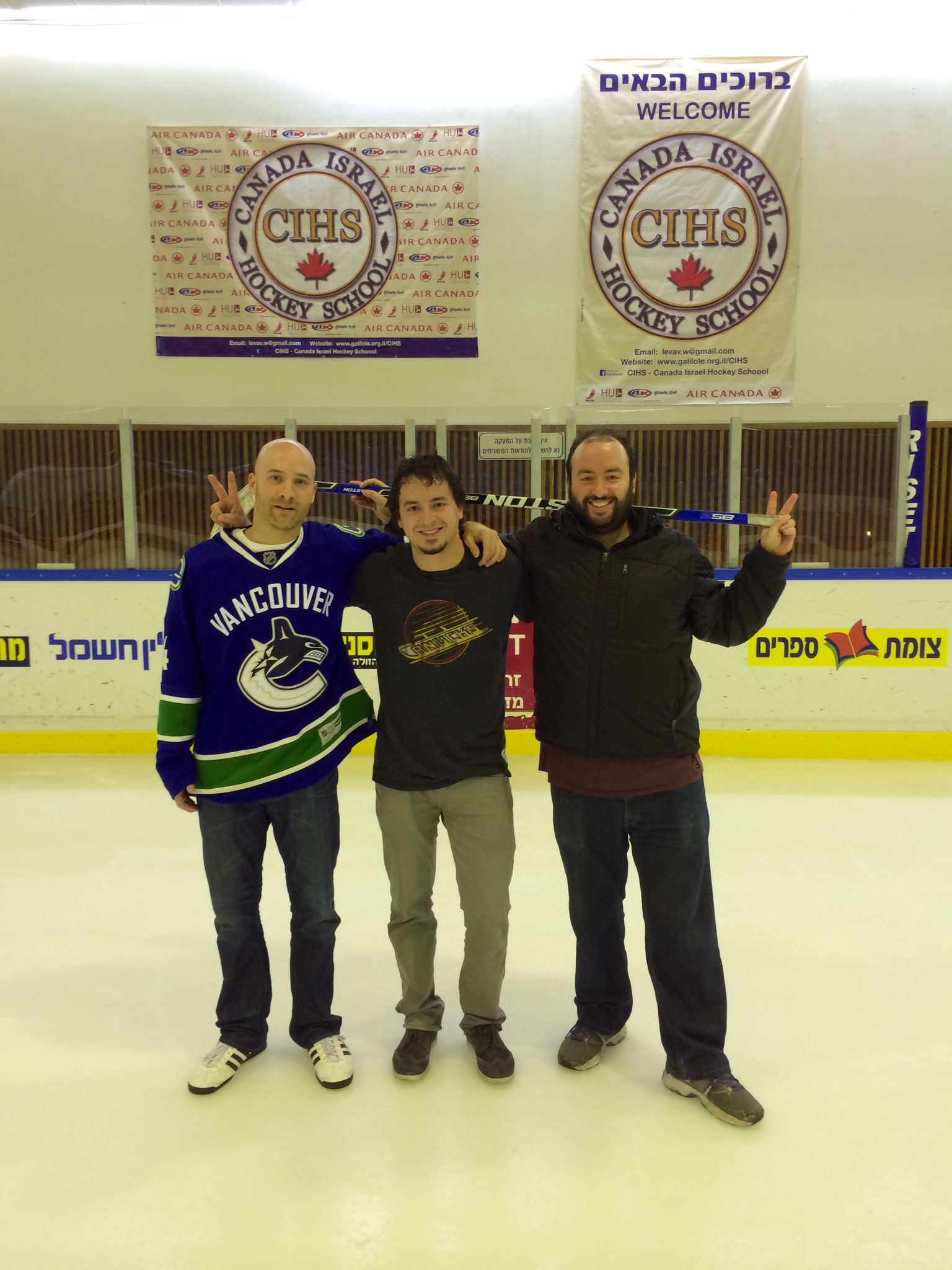
Twenty kids from the Canada Israel Hockey School, a joint venture of the Jewish Community Centre of Greater Vancouver and the Jewish Federation of Greater Vancouver, visited last week – Jewish Israeli, Arab Israeli, girls and boys, the hockey players see each other as teammates, playing for the love of the game. Not only are positive bonds and memories being formed among the players, but also between them and their coaches in Israel and in Vancouver, the local hockey players they met, both from the Jewish league and from the Canucks. Interviewed by CBC’s Shane Foxman, these kids were representing not just themselves, but the sport of hockey and their country of Israel – and they are cause for pride.

Sholom Scouts are also not “just” scouts. Not to put too much pressure on them, but they are Jewish ambassadors to the larger Scouts community as well as the general community. Within the Jewish community, they represent a spectrum of Jewish beliefs, all coming together to become good stewards of the land and good citizens.

It is healthy to see the negative: it helps us to be safe, to become aware of what isn’t quite right, what needs adjustment and what areas of justice still need to be pursued. As Leonard Cohen sings, “there is a crack in everything, that’s how the light gets in.” But, focusing exclusively on the negative – the crack instead of the light – isn’t healthy, not for ourselves personally or for society at large. This does not imply blocking out the reality of the suffering that does exist, but instead recognizing that we ignore the beauty, loving kindness and bright spots of reality to our detriment.

Whether it’s by being more mindful, cultivating more loving kindness, reducing stress and anxiety, re-balancing our middot, being open to new and challenging experiences or learning more about something that interests or concerns us, we can find more good. It takes time and effort to “hardwire happiness” in our brains and in our lives, but it’s possible.

It helps when we consciously draw out the positive, such as the stories mentioned here, and engage in the positive cultural and social behaviors that make us more than mere human animals, and more fully and happily human.

Hockey brings peace in Israel

My new friends! A mixed group of Arab and Jewish kids playing hockey together in Israel.

I have to admit that it has been tough to concentrate on much these days with everything going on in Israel this month.

The country and people that I love – along with every Jew around the world – has been fighting a war of epic proportions. Both in Gaza and in the media.

As I have struggled to come to terms with the reality of how deeply rooted antisemitism currently is around the world and how gleefully willing many people are to remain ignorant and naive, I consider what I can do to contribute.

Sure, there are rallies and gatherings to attend, letters to be written to MPs, Facebook posts to share, all with hopes of spreading intelligent information and support for Israel. But I feel myself needing something more tangible to contribute to.

Those feelings and thoughts almost always take me to a program – or mission – I have already embraced the past few years I have visited Israel.

Myself with Daniel (left) and Ariel Wosk on the Canada Centre ice in Metula.

In the very northern tip of Israel, in Etzpah Hagalil – Vancouver’s P2G Partnership region, there is the lone full-sized (actually, Olympic-sized) hockey rink at Mercaz Canada (Canada Centre) in Metula. I have visited it the past three years to participate in the Israel Recreational Hockey Association Tournament (amazing event!) along with several local friends.

In 2013, while visiting, an Israeli friend told me about a new, growing program at the Canada Centre called the Canada-Israel Hockey School (CIHS). Merely 3 years old, CIHS already featured approximately 400 Israeli kids of all ages, wearing a mish-mosh of donated gear and Jerseys, learning to play Canada’s game.

Just watching these kids had already blown my mind. I was beyond enlightened when Coach Mike Mazeika, a non-Jewish Torontonian who has embraced Israeli culture in more ways than one, informed me that among those skaters was a complete mix of Jewish and Arab children. Hockey had brought Jewish teens who had never once spoken to an Arab teen, and vice-versa, together as teammates. Line mates. Eternal friends. And it was working!

Adding to that, I took a look around the stands and saw the parents of all these children cheering together. Ignoring, at least within this small group, decades of religious and political conflict since Israel had been born.

Hockey, Canada’s game, was doing this!

As I watched in awe I declared, “Someone has to document this!” To which Mazeika replied, “Actually, TSN was here a couple of weeks ago.” (see link below)

I was invited to come back and skate with the school before leaving Israel – an opportunity I called the coolest thing I had done on the ice. I returned home from that trip with a few new friends (Jewish, Christian and Druze) and a new commitment to use my role as the JCCGV’s sports coordinator to develop our community’s connection with the Canada-Israel Hockey School.

Team Vancouver returned this past February to an even larger hockey school as founder Levav Weinberg told me of their plans to reach out to even more communities around Israel.

We are currently working with Weinberg on plans to bring a group from CIHS on a Canadian tour with a key stop in Vancouver in the spring of 2015.

In the mean time, I will be returning in February, with whoever wants to join me, to represent Team Vancouver in the tournament (amazing experience as well!) and continue to develop our relationship with CIHS.

If you are hockey inclined and would like to join us to be part of something truly special in such a desperate time, there are always spots on our team!

Here is the link to the TSN documentary Neutral Zone, http://vimeo.com/70459909.

Kyle Berger is a freelance writer and publisher of the Berger With Fries blog.

Love to win? Or hate to lose?

Pursuing more of my “Love to Win” side at the 2014 Spartan Sprint obstacle race.

Call it ironic, but in my less-than-fit days I was a regular subscriber to Men’s Health magazine.

As I looked upon the cover of each fresh edition I sincerely believed (read: hoped) that this just might be the edition that unveils the ground-breaking discovery that Maple Walnut ice cream contained a fat-burning ingredient that could give me “six-pack abs by summer!”

I eventually decided to take a different route to improved fitness. While I can’t say I would credit Men’s Health for my success, there was one posting that left a long-lasting impression on me.

This specific article effectively split humanity into two simple groups.

Group 1: Those who love to win.

Group 2: Those who hate to lose.

Of course everyone prefers winning and, thus, would rather not lose. But most people, if they really think it through, can probably identify what fuels them more; the rush of victory or resentment toward loss.

It didn’t take me long to realize I was a hate-to-lose kind of dude. If my team, in any sport, was winning life seemed in order and under control. There was balance in the Force. But if we were losing my emotions would take over in an effort to avoid failure. I would walk away from any loss feeling frustrated, unsettled and pondering what I could have done to avoid it. I didn’t need to celebrate the wins as much as I needed to avoid the feeling of loss.

I embraced that discovery and used it to make me better. In hockey I became a defensive, shut-down centre, eventually turning to a pure defenseman where my emotional drive to avoid getting beat could feed my game. It proved to be a good move for my career (boy, do I use the word career lightly).

In the last couple of years, however, I considered if perhaps my friendship with the hate-to-lose side of me had led to complacency and, in some cases, boredom! (we’ll get to that nasty word in a later post)

Generally speaking, of course, hate-to-lose people might play the game of life a little on the safe side. They could miss out on hidden opportunities while choosing to avoid opportunities to test their limits. They are less likely to take risks or seek adventure. Their theory being, “If it ain’t broke, don’t fix it.”

The love-to-win type is ready to take those risks and fly by the seat of their pants for the possible thrill of success. On the flip side, they might take unnecessary risks, act without calculated consideration of consequence, risk losing a lot for the sake of winning a little. Their theory being, “Let’s break it ‘cause maybe we can rebuild it better.”

So which one is better? I could give you all sorts of analogies of how either approach has a proven track record of success.

But the key is to find out who you are and challenge yourself to bring the other element into your life a little more. I’ll use a hockey analogy (get used to it) to show you what I mean. It is commonly preached that “defense wins championships.” But it is also a fact that you can’t win the Stanley Cup without scoring goals. Even the defensemen need to contribute to the offense for a team to be a serious contender. More specifically, the great players who  lead their teams to the big games are the ones who find the right balance of defense and offense. Those players aren’t born playing like that. They all enter the league with one style of play that has gotten them to where they are. Then they develop that balance over seasons of growth, experience and hard work. The most successful players develop their weaknesses to complement their strengths.

This is a concept we should all adopt for the sake of growth, inspiration and diversity. Whether you are more of a hate-to-lose or a love-to-win type, heighten your awareness to that and consider the areas of your life where a lack of balance has possibly challenged your growth or development. Then make the effort to approach the opposite way of thinking from time to time.

It worked for George Costanza!

Kyle Berger is a freelance writer and producer of the Berger With Fries health, fitness and entertainment blog. Follow him on Twitter @kberger16.