
Skip to content
  • Home
  • Subscribe / donate
  • Events calendar
  • News
    • Local
    • National
    • Israel
    • World
    • עניין בחדשות
      A roundup of news in Canada and further afield, in Hebrew.
  • Opinion
    • From the JI
    • Op-Ed
  • Arts & Culture
    • Performing Arts
    • Music
    • Books
    • Visual Arts
    • TV & Film
  • Life
    • Celebrating the Holidays
    • Travel
    • The Daily Snooze
      Cartoons by Jacob Samuel
    • Mystery Photo
      Help the JI and JMABC fill in the gaps in our archives.
  • Community Links
    • Organizations, Etc.
    • Other News Sources & Blogs
    • Business Directory
  • FAQ
  • JI Chai Celebration
  • JI@88! video

Recent Posts

  • Hateful messages intensify
  • Creating entrepreneurs
  • Wrong choice to host Piker
  • Attack on Jewish kids
  • Multiple benefits of a break
  • Dialing up the perfect thriller
  • Empowerment & more
  • Songs in war of peace
  • Successful trip to Cuba 
  • Tackling antizionism head on
  • Thinking of leaving Canada?
  • Kindness as a matter of fact
  • Personal stories, vital lessons
  • Connecting generations
  • Vancouver to Vienna
  • Recipes a form of resistance
  • Community milestones … February 2026
  • Generations … It’s all yours!
  • נתניהו לא מתבייש להאשים את ביידן באחריות להרג חיילים ברצועת עזה
  • Last hostage home
  • New bill targets hate crimes
  • Concerning actions
  • Recipes not always required
  • Survivor urges vigilance
  • Seniors profoundly affected
  • Farm transforms lives
  • Musical legacy re-found
  • A range of Jewish literature
  • A concert of premieres
  • Variety telethon on Feb. 22
  • Victoria club’s many benefits
  • Avodah dedicated to helping
  • Artists explore, soar, create
  • Life’s full range of emotions
  • Community needs survey closes March 29
  • Jerusalem marathon soon

Archives

Follow @JewishIndie
image - The CJN - Visit Us Banner - 300x600 - 101625

Tag: New Year of the Trees

Put color in your chag

Put color in your chag

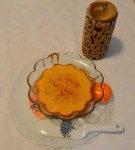
Mix it up this holiday with a colorful orange spice cake. (photo by Barry A. Kaplan)

In honor of Tu b’Shevat on Feb. 3-4, why not try some variety to celebrate the New Year of the Trees? One usually thinks of dates, figs and carob on this holiday, specifically the species of fruits that are listed in the Torah as native to Eretz Yisrael. In Israel today, sometimes we augment that with other in-season fruits, like apples, persimmons, strawberries (though beautiful, they are expensive!) or varieties of delicious citrus. Here are some recipes using oranges.

SYRIAN ORANGE CHICKEN
makes four servings

1 tbsp margarine
1 tbsp oil
1 cut-up chicken
1/2 cup orange juice
1 cup chicken soup
1 1/2 tsp corn starch
1/2 chopped onion
juice of 1/2 lemon
6-9 halved, pitted dates
orange slices

  1. Preheat oven to 350°F. Grease a baking dish.
  2. Heat margarine and oil in a frying pan and brown chicken. Place in a baking dish.
  3. Add orange juice, chicken soup, cornstarch, onion and lemon juice to frying pan and cook, stirring, until sauce thickens. Pour over chicken.
  4. Cover and bake 45 minutes.
  5. Garnish with dates and orange slices, cover and bake at least 15 minutes or until chicken is done. Serve with rice.

ORANGE JUICE SALAD DRESSING
The dressing is good on a salad with lettuce, avocado and grapefruit.

3/4 cup oil
6 tbsp orange juice
1/2 tsp sugar
pinch dry mustard

  1. Combine oil, orange juice, sugar and mustard in a jar.
  2. Shake well.

ORANGE SPICE CAKE

6 seeded, peeled, cut-up small oranges, such as mandarins or tangerines
1/3 cup canola oil
3 eggs
1 cup brown sugar
1/2 tsp ginger
1/4 tsp cinnamon
1 tsp vanilla
1 3/4 cups flour
1 1/2 tsp baking powder
1/2 cup non-dairy creamer

  1. Preheat oven to 350°F. Grease a cake pan, two loaf pans or place mini papers in a mini-muffin pan and spray with vegetable spray.
  2. Place orange pieces, oil, eggs and brown sugar in a mixer or food processor and blend a few seconds.
  3. Add ginger, cinnamon, vanilla, flour, baking powder and non-dairy creamer and blend.
  4. Spoon into baking pans. Bake 25 minutes or until a toothpick inserted in the centre comes out clean.

ORANGE DROP COOKIES
makes three dozen

1 cup sugar
2/3 cup unsalted pareve margarine
2 eggs
1/2 cup orange juice
1 tbsp grated orange peel
2 1/4 cups flour
1/2 tsp baking soda
1/2 cup chopped nuts

  1. Preheat oven to 350°F. Grease cookie sheets.
  2. Cream sugar and margarine with eggs. Stir in orange juice and orange peel.
  3. Add flour, baking soda and nuts and mix well.
  4. Drop by teaspoon onto cookie sheets. Bake 10 minutes or until golden brown.

Sybil Kaplan is a journalist, foreign correspondent, lecturer, food writer and book reviewer who lives in Jerusalem. She also does the restaurant features for janglo.net and leads weekly shuk walks in English in Jerusalem’s Jewish food market.
Format ImagePosted on January 30, 2015January 29, 2015Author Sybil KaplanCategories Celebrating the HolidaysTags New Year of the Trees, seder, Tu b'Shevat
Fruits, nuts, traditions

Fruits, nuts, traditions

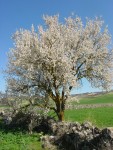
Tu b’Shevat, the New Year of the Trees, coincides with the flowering of the almond tree in Israel. (photo from en.wikipedia.org/wiki/Shevat)

Tu b’Shevat, which falls this year on Feb. 3-4, marks the end of the rainy season in Israel. Buds are beginning to appear on the trees, and the blossoming almond trees, the harbinger of spring, have begun to dot the landscape. So, on the 15th day of the Hebrew month of Shevat, we celebrate the yearly cycle for the growth of trees in Eretz Israel.

According to Jewish mystical tradition, Tu b’Shevat is the day when G-d renews sustenance and the “life-cycle” of the trees, when the sap starts to rise.

There are many customs to remind us of the meaning of this day, including a Tu b’Shevat seder, not unlike the ritual meal we have on Passover.

On Tu b’Shevat, fruit trees were measured for growth in order to calculate the annual tithe to the Temple. Even long after the Temple was destroyed, this seder was a new way to reaffirm the spiritual bond with the land in celebration of the approach of spring and the fruit of the earth.

This ancient tradition was developed in Safed, the seat of kabbalistic studies in the 16th century. Traditionally, we eat nuts and the fruits for which the Torah praises the Land of Israel, including grapes, figs and pomegranates, olives and dates. The table is set with a snowy white tablecloth, candles, fruit and nuts, and the sharing of prayers, readings and songs.

It is traditional to enjoy four cups of wine, like on Passover. Those glasses of wine can be paired with a corresponding fruit and divided into ascending levels of spirituality.

The first cup, therefore, is often white wine, symbolizing winter, accompanied by a fruit that needs a protective covering, such as oranges or almonds.

The second cup is white wine mixed with a small amount of red, signifying spring, the budding of new life. This glass is served with olives, apples, peaches and dates: the outer layer is eaten, yet the heart is protected and has within it the seed of new life.

The third cup is red wine with a small amount of white mixed in. This is the symbol of summer and a perfect world in which nothing is wasted. With this, fruits such as figs, grapes and berries are eaten. These are considered to symbolize the highest level of spiritual openness.

The fourth cup is red wine only, representing fertility and the bounty of the autumnal crops.

What else happens on Tu b’Shevat? Very little religiously, but a lovely ritual has arisen in Israel, one that’s now been adopted all over the Jewish world. It is a popular observance to plant trees, one of the greatest mitzvot we can perform.

Trees have great significance in Judaism. This Tu b’Shevat, however, we are still in a Shmita (jubilee) year in Israel; the land is resting, so no plantings will take place.

Trees hold a special place in Judaism. It is written in Deuteronomy: “When you besiege a city for many days to wage war against it to seize it, don’t destroy its trees….” In the Midrash Shmuel on Pirkei Avot 3:24, it is written that man is like a tree in that his good deeds are his produce, his “fruits,” and his arms and legs the “branches,” which bear these fruits. He is, however, an “upside-down tree,” for his head is rooted in the heavens, nestled in the spiritual soils of the Eternal, and nourished by his connection to his Creator.

At the end of the Hasmonean dynasty, there lived a holy man named Honi, known as the circle drawer, Honi HaMa’agel, and we read his story in Talmud Ta’anit 23a. One day, Honi sees a man planting a carob tree and asks him, “How many years does it take for the carob tree to bear fruit?” The man replies, “Seventy years.” Honi asks, “Do you think you will live another 70 years and reap its fruit?” The man responds, “I am planting the tree not for myself, but for my grandchildren.”

Although the world may not regard Jews as being tied closely to the land, the truth is that Judaism has close ties to agriculture and ecology. The midrash teaches us that man’s life depends on the tree, and we are forbidden to live in a city that has no gardens and trees. They are so important that Rabbi Yohanan Ben-Zakai declared, “If you hold a sapling in your hand and are told, ‘Come look, the Messiah has arrived,’ plant the sapling first and only then go and greet the Messiah.”

Happy Tu b’Shevat!

Dvora Waysman is the author of 13 books, which are available through Amazon, or from the author at [email protected]. Her website is dvorawaysman.com.

Format ImagePosted on January 30, 2015January 17, 2016Author Dvora WaysmanCategories Celebrating the HolidaysTags Israel, Judaism, New Year of the Trees, seder, Tu b'Shevat
Proudly powered by WordPress