Upstanders’ first live event

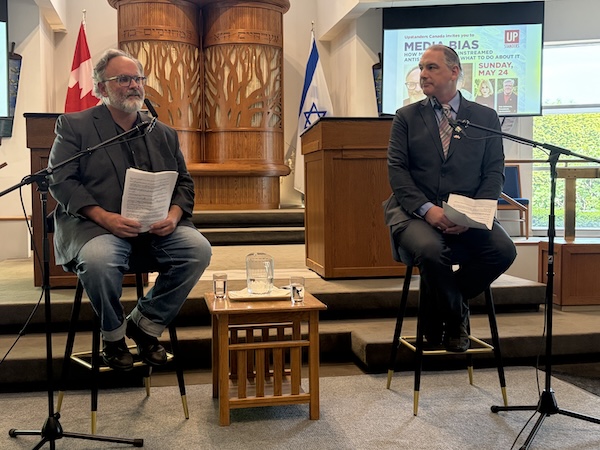
Editor-in-chief of the National Post Rob Roberts, left, in conversation with journalist Dave Gordon at Upstanders Canada’s May 24 Media Bias event at Temple Sholom. (photo by Anna-Mae Wiesenthal)

Media Bias: How Media has Mainstreamed Antisemitism and What to Do About It was the first live event held by Upstanders Canada. It featured a conversation between journalist Dave Gordon and National Post editor-in-chief Rob Roberts, and took place in Vancouver on May 24 and in Ottawa May 26. Roberts was honoured with the inaugural Upstander of the Year Award.

Upstanders Canada, founded by Pat Johnson, encourages Canadians, particularly non-Jewish Canadians, to take a stand against antisemitism and antizionism. He started the event hosted at Temple Sholom by highlighting that Canada, which, until recent years, had been viewed as a nation of decency, fairness and pluralism, is now an international hotspot of antisemitism.

Janet Dirks, a retired CTV National News reporter who worked for a time in Jerusalem, wondered, in her introduction of the featured speakers, why most newsrooms in the country have been reluctant to delve into the barrage of antisemitic incidents in Canada.

“Is there fear of angering those who identify as antizionist, anti-Israel? Is there a dread of covering something that might be too controversial? The fear of getting too many emails criticizing the story treatment from both sides? Is there a narrative I’m not understanding?” asked Dirks, who is a member of the Upstanders board.

Citing a May 9 Toronto Sun editorial, she said, “The problem with appealing to our governments and, indeed, to civil society to combat the unprecedented rise of hatred against Canada’s Jewish citizens is that they were the ones who enabled it. By failing to punish countless examples of Jew-hatred ever since Hamas’s terrorist attack on Israel on Oct. 7, they have normalized antisemitism in Canada.”

The Media Bias event took place on the heels of a May 11 opinion essay by veteran New York Times journalist Nicholas Kristof, which accused Israeli prison guards and others of sexually abusing Palestinians. The Netanyahu government has subsequently sued the newspaper for defamation.

Roberts faulted the Times for not researching the allegations and examining if they withstood scrutiny.

“It’d be my opinion that every human institution is going to have some problems, but you look at that report and you look at the nature of the allegations, and they just don’t hold the ring of truth,” he said. “The other thing I’ll say is this, you don’t have to publish everything that’s submitted to you, even by the marquee columnists.”

Gordon led the discussion towards the National Post and what he called its decidedly pro-Zionist stance, distinguishing it from other papers in Canada, with the possible exception of the Toronto Sun. Roberts said his newspaper has sought to be “fair and balanced” – not inherently pro-Israel.

The editor spoke about the paper’s decision to drop the Associated Press and the Canadian Press. The decision wasn’t made based on the organizations’ reports from the Middle East, said Roberts, but rather the Post’s preference to not run the same material as other papers. Nonetheless, he did not express a high opinion of the AP’s reporting from the region.

“We all know the story about the bomb that Israel dropped in the hospital – except they didn’t. That was AP, and it took them several hours to fix it,” Roberts said. The Post did not post that AP story, he noted, saying, “… we can’t simply trust even this venerable old wire service to do the job properly.”

Roberts maintained that the Post’s policies of fact-checking and fostering open debate have served the paper well at a time when other publications are struggling.

“We try to be very responsible,” he said. “The fact that people are asking whether journalism is dead is really good for us because we’re thriving at the moment,” adding that the Post is currently hiring.
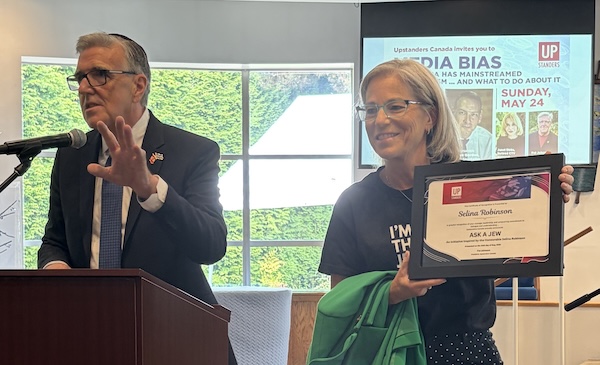
photo - Pat Johnson, founder of Upstanders Canada, announces the launch of Ask a Jew, an initiative inspired by Selina Robinson, who accepted the honour at the Vancouver event
Pat Johnson, founder of Upstanders Canada, announces the launch of Ask a Jew, an initiative inspired by Selina Robinson, who accepted the honour at the Vancouver event. (photo by Anna-Mae Wiesenthal)

Following the conversation, Brandon Lu, an Allied Voices for Israel student ambassador at the University of British Columbia, spoke briefly on the importance of a free press and an informed, discerning public. 

At the end of the program, Johnson announced the creation of a new initiative – inspired by Selina Robinson – called Ask a Jew. Modeled on the Human Library concept, Ask a Jew promotes dialogue between curious, open-minded people and Jewish individuals for one-on-one online conversations. The hope is that such conversations will help build understanding and human connection.

Robinson, the author of Truth Be Told – about her experiences with antisemitism, notably within the BC NDP government, in which she was a senior minister for years – has been donating revenues from book sales to Upstanders Canada and the Parents Circle-Families Forum, a joint Israeli-Palestinian organization that advocates for peace. Robinson joined the Upstanders event in Vancouver, presenting Johnson with another cheque in addition to revenues from the book donated previously.

Iddo Moed, ambassador of the state of Israel to Canada, attended the Ottawa event and addressed the audience, emphasizing the importance of allyship.

For more information about Upstanders Canada, visit upstanderscanada.com. 

Sam Margolis has written for the Globe and Mail, the National Post, UPI and MSNBC.
What to do about media bias

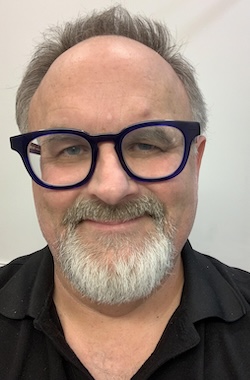
photo - Rob Roberts, editor-in-chief of the National Post
Rob Roberts, editor-in-chief of the National Post. (photo from Upstanders Canada)

Rob Roberts, editor-in-chief of the National Post, will discuss bias and truth in media with writer and journalist Dave Gordon, a regular contributor to the Jewish Independent, at Upstanders Canada’s first-ever live event.

Media Bias and What to do About It will take place in Vancouver on May 24. Janet Dirks, a veteran CTV news reporter, who served six months in Jerusalem among her decades in front of the camera, will contextualize the changed media landscape. Pat Johnson, president of Upstanders Canada and a member of the JI editorial board, will welcome the audience and explain the work of Upstanders, a national organization that is responding to the antisemitism crisis in Canada by developing innovative initiatives and assembling a broad network of non-Jewish allies in every demographic sector.

Presented live in Vancouver at 2:30 p.m. on May 24 (location to be announced), the program will also be livestreamed nationally. More information and tickets, $18, are available through UpstandersCanada.com. 

– Upstanders Canada

CAMERA counters mistruth

Canadian-Israeli Sidney Shapiro addresses the CAMERA conference in Boston last August. (photo from CAMERA)

Sidney Shapiro had finished his Israel Defence Forces service just weeks before he arrived on campus at Laurentian University in Sudbury, Ont.

“I walked into the door of the school and there is a huge poster of a kid, a Palestinian kid, in the shadow of a field box and some Israel apartheid whatever,” he said, referring to a familiar cartoon employed by Canada’s anti-Israel movement. “So I wrote an email to the professor who put up the poster, saying I just served in Gaza for two years, I know a lot about it, I’ve seen from my firsthand experience. I’d like to talk to you about it. Not debate or try to convince you, just tell you what my experiences were. And he [replied], ‘I don’t talk to baby killers.’ That basically set the tone for the rest of my university experience.”

Shapiro, whose family made aliya from Canada when he was 10 years old, joined the Jewish Students Association at Laurentian and now, while working on his PhD, is president of the club. Over the years, he told the Independent, his club has had tremendous support from the Boston-based Committee for Accuracy in Middle East Reporting in America (CAMERA). In August, Shapiro was a guest speaker at the organization’s largest-ever campus advocacy conference.

While primarily an American organization, CAMERA has been a powerful resource whenever the Zionist students at Laurentian have called on them, Shapiro said.

“We started working with them four years ago,” he said. “We went to various U.S.-based organizations, as well as Canadian ones, and the most responsive one was CAMERA.”

CAMERA differs from other advocacy groups in that it focuses attention specifically on promoting more accurate, balanced and complete media coverage of Israel and the Middle East.

“We don’t have a Hillel, we don’t have a Chabad and we’re extremely isolated in terms of responding to Israel advocacy problems on campus,” Shapiro said. “So, while we have some support from the Federation, from CIJA, from other organizations, we don’t have anybody on campus. CAMERA, of all the organizations we ever worked with, is the most responsive, has the most resources and has been a really good partner when we have a frustrating situation on campus, picking up the phone and actually helping us dealing with it.”

The Saudi government sends about 500 students a year to Laurentian, but Shapiro said that is not where most of the trouble comes from. The small band of anti-Israel activists tends to be far removed from the realities of the Middle East. The more common image of a “pro-Palestinian” activist, he said, is “somebody who grew up in the [Canadian] north and has never been exposed to this except that [Israel is] the evil empire and everything that has to do with Israel is merely propaganda. People are incredibly brainwashed,” he said.

Shapiro, who spoke at the conference on the topic of Israeli history, Zionism and Jewish identity, was one of eight Canadian students at the event.

“The most important outcome of the conference is networking,” he said, “meeting many other students. Whether they go to big universities or small universities, we are in exactly the same position.”

A senior CAMERA official countered the idea that the pro-Israel side is losing the battle for minds on campus.

“There’s a misconception that Israel is losing terribly on American campuses,” said Gilad Skolnick, CAMERA’s director of campus programming, in a statement. “In fact, it’s the anti-Israel side that’s losing most of the time.” Of the 44 BDS campaigns [boycott, divestment and sanctions], only 12 have passed BDS resolutions, and over two dozen have failed.… That isn’t to say students don’t face extremely difficult challenges in a lot of places. They do. So, we have to train them as much as possible for whatever comes. Our program provides them with resources and support.”