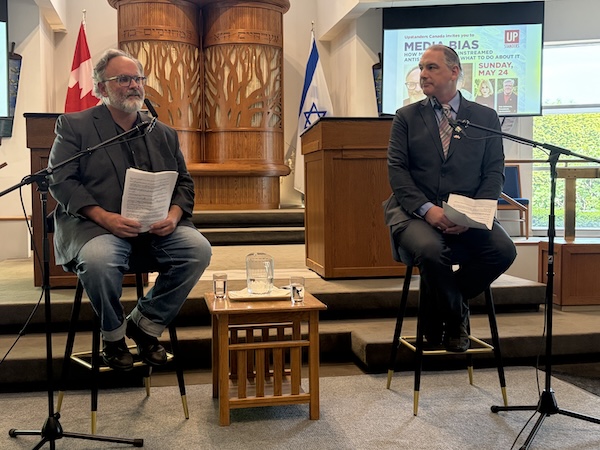
Editor-in-chief of the National Post Rob Roberts, left, in conversation with journalist Dave Gordon at Upstanders Canada’s May 24 Media Bias event at Temple Sholom. (photo by Anna-Mae Wiesenthal)
Media Bias: How Media has Mainstreamed Antisemitism and What to Do About It was the first live event held by Upstanders Canada. It featured a conversation between journalist Dave Gordon and National Post editor-in-chief Rob Roberts, and took place in Vancouver on May 24 and in Ottawa May 26. Roberts was honoured with the inaugural Upstander of the Year Award.
Upstanders Canada, founded by Pat Johnson, encourages Canadians, particularly non-Jewish Canadians, to take a stand against antisemitism and antizionism. He started the event hosted at Temple Sholom by highlighting that Canada, which, until recent years, had been viewed as a nation of decency, fairness and pluralism, is now an international hotspot of antisemitism.
Janet Dirks, a retired CTV National News reporter who worked for a time in Jerusalem, wondered, in her introduction of the featured speakers, why most newsrooms in the country have been reluctant to delve into the barrage of antisemitic incidents in Canada.
“Is there fear of angering those who identify as antizionist, anti-Israel? Is there a dread of covering something that might be too controversial? The fear of getting too many emails criticizing the story treatment from both sides? Is there a narrative I’m not understanding?” asked Dirks, who is a member of the Upstanders board.
Citing a May 9 Toronto Sun editorial, she said, “The problem with appealing to our governments and, indeed, to civil society to combat the unprecedented rise of hatred against Canada’s Jewish citizens is that they were the ones who enabled it. By failing to punish countless examples of Jew-hatred ever since Hamas’s terrorist attack on Israel on Oct. 7, they have normalized antisemitism in Canada.”
The Media Bias event took place on the heels of a May 11 opinion essay by veteran New York Times journalist Nicholas Kristof, which accused Israeli prison guards and others of sexually abusing Palestinians. The Netanyahu government has subsequently sued the newspaper for defamation.
Roberts faulted the Times for not researching the allegations and examining if they withstood scrutiny.
“It’d be my opinion that every human institution is going to have some problems, but you look at that report and you look at the nature of the allegations, and they just don’t hold the ring of truth,” he said. “The other thing I’ll say is this, you don’t have to publish everything that’s submitted to you, even by the marquee columnists.”
Gordon led the discussion towards the National Post and what he called its decidedly pro-Zionist stance, distinguishing it from other papers in Canada, with the possible exception of the Toronto Sun. Roberts said his newspaper has sought to be “fair and balanced” – not inherently pro-Israel.
The editor spoke about the paper’s decision to drop the Associated Press and the Canadian Press. The decision wasn’t made based on the organizations’ reports from the Middle East, said Roberts, but rather the Post’s preference to not run the same material as other papers. Nonetheless, he did not express a high opinion of the AP’s reporting from the region.
“We all know the story about the bomb that Israel dropped in the hospital – except they didn’t. That was AP, and it took them several hours to fix it,” Roberts said. The Post did not post that AP story, he noted, saying, “… we can’t simply trust even this venerable old wire service to do the job properly.”
Roberts maintained that the Post’s policies of fact-checking and fostering open debate have served the paper well at a time when other publications are struggling.
“We try to be very responsible,” he said. “The fact that people are asking whether journalism is dead is really good for us because we’re thriving at the moment,” adding that the Post is currently hiring.
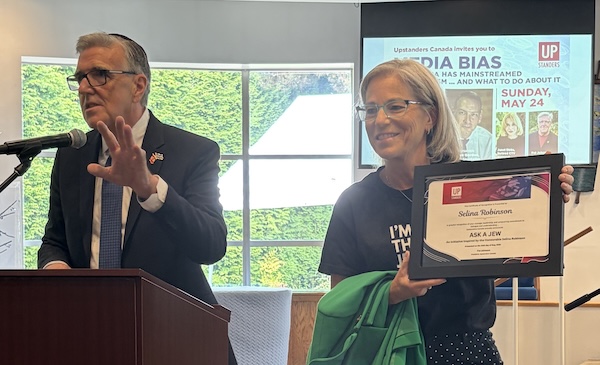
Pat Johnson, founder of Upstanders Canada, announces the launch of Ask a Jew, an initiative inspired by Selina Robinson, who accepted the honour at the Vancouver event. (photo by Anna-Mae Wiesenthal)
Following the conversation, Brandon Lu, an Allied Voices for Israel student ambassador at the University of British Columbia, spoke briefly on the importance of a free press and an informed, discerning public.
At the end of the program, Johnson announced the creation of a new initiative – inspired by Selina Robinson – called Ask a Jew. Modeled on the Human Library concept, Ask a Jew promotes dialogue between curious, open-minded people and Jewish individuals for one-on-one online conversations. The hope is that such conversations will help build understanding and human connection.
Robinson, the author of Truth Be Told – about her experiences with antisemitism, notably within the BC NDP government, in which she was a senior minister for years – has been donating revenues from book sales to Upstanders Canada and the Parents Circle-Families Forum, a joint Israeli-Palestinian organization that advocates for peace. Robinson joined the Upstanders event in Vancouver, presenting Johnson with another cheque in addition to revenues from the book donated previously.
Iddo Moed, ambassador of the state of Israel to Canada, attended the Ottawa event and addressed the audience, emphasizing the importance of allyship.
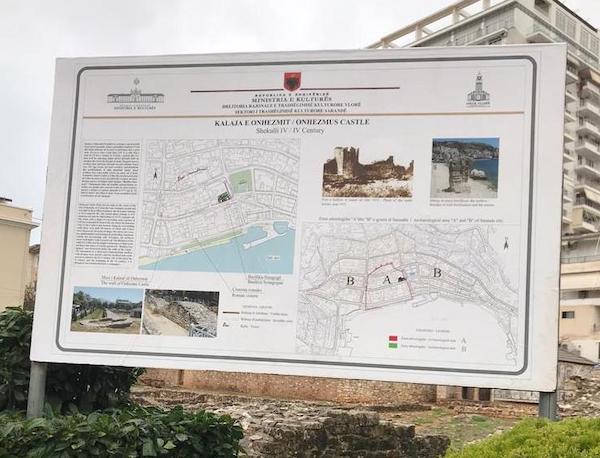
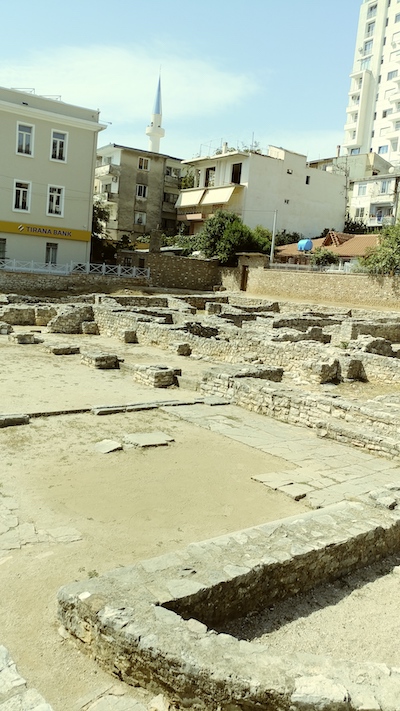
The signage at the site of 1,700-year-old synagogue ruins in Albania was recently replace after a Canadian tourist informed the municipal government of the old signs’ illegibility. (photo from Dave Gordon)
During a trip to Albania in September 2022, Toronto-based Jewish journalist Dave Gordon visited the city of Saranda with a couple of friends. They especially wanted to see the 1,700-year-old synagogue ruins.
As Gordon describes it, the site is roughly the size of two side-by-side tennis courts. What remains are myriad roofless stone walls of just a couple feet tall, which once separated various rooms, including a study and two mikvaot (Jewish ritual baths). A representative of Albania’s culture ministry happened to be at the site when Gordon was there, handing him a leaflet with information about the site’s history and background. It said Israeli archeologists unearthed floor mosaics – now buried with a foot of sand, to protect them from the elements – that displayed a menorah and a deer, regarded in Judaism as a symbol of beauty, majesty and God’s mercy.
Additionally, the literature said the synagogue likely crumbled after either an earthquake or a Slavic invasion, and was abandoned in the last quarter of the sixth century. In the 21st century, there was more deterioration – this time, with the printed panels describing what is on the site.
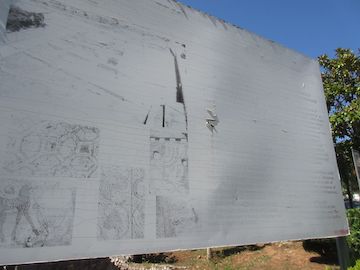
Gordon was “shocked and disappointed” to see that the signage was in disrepair, faded by neglect. Two panels, each measuring some four feet wide by two feet deep, were blanched by the sun, so white that the lettering and imagery were illegible.
“My face turned the same colour as these signs,” Gordon told the Jewish Independent, for which he has written many articles. “This is part of my heritage, my history and people, and it was like it was another Jewish landmark sadly disappearing from memory.”
The signage at the site of the synagogue ruins in Albania when Dave Gordon visited. (photo from Dave Gordon)
On Dec. 12, 2022, Gordon took action. He Googled the Saranda municipality offices’ emails.
“This is shameful for two reasons: your tourists will not be able to obtain much knowledge about the important landmark, and it shows little care from your city’s cultural department to maintain the signage,” he wrote.
“This is highly disrespectful, and I cannot understand why the two signs were permitted to deteriorate,” he continued, adding that he hoped to bring others to Saranda and “would love for them to take photographs of the new signage and publicize this wonderful jewel of archeology.”
A representative from the municipal offices wrote back, two days later: “For the problem in question, we have reported the need for scientific reconceptualization, the preparation and installation of information panels, and we have contacted the Directorate of Cultural Heritage … a copy of your complaint will be sent to the responsible institution and we hope that very soon we will have a better presentation of this monument.”
In the beginning of January, Gordon followed up with an email, asking if the inquiry had landed in the right hands. To his great surprise, on Jan. 20, the Ministry of Culture of Albania sent him this reply: “In response to your email, we inform you that the new information boards have been installed to the Synagogue of Saranada…. Please find attached the photos of the new signage.”
Esmeralda Kodheli, the ministry’s representative, added, “Thank you, too, for promoting our cultural and historical heritage.”
“Quite amazing!” Gordon told the JI. “To print detailed signs and place them, inside of 30 working days – and during the Christmas season, no less. And who was I? Just some guy from Canada writing some emails.”
The site of the synagogue ruins in the city of Saranda. (photo from Dave Gordon)
Gordon said he felt “disbelief, delight and honoured, all at the same time,” and felt like his “little bit of activism” made a tangible difference, reminding him that anyone can enact change.
“I am pleased as anything that this amazing site of Jewish history now has dignity restored,” he said.
Dr. Ruki Kondaj, one of the friends who accompanied Gordon on his trip, is an Albanian-Canadian. He said about Gordon: “He’s done great work through his lobbying to restore the signage, and I’m so happy with his passion and determination. Together we discovered traces of Jewish history that tourists will know more about.”
Albania has various sites of Jewish interest, including the Solomon Museum in Berat, as well as an upcoming Holocaust museum in Tirana and a future Jewish history museum in Vlora, which also is home to “Jewish Street,” marked by a plaque on a home in the city centre, marking the one-time bustling Jewish area. Albania refused to cooperate with the Nazis, deciding as a nation to save its Jews, and even welcoming Jewish refugees from neighbouring countries. For more on Albania’s Jewish history, visit jewishindependent.ca/albanias-many-legends.
Jonathan Wasserlaufis a freelance writer, and a political science major and law student based in Montreal.
Launching within hours of each other in May, the Canadian Jewish Record and TheJ.ca come at journalism from different perspectives.
Like print media as a whole, Jewish newspapers worldwide have been struggling in recent years. The coronavirus, with its economic impacts, was the last straw for Canadian Jewish News, which announced its closure in a message to readers April 13, with the words: “Everything has its season. It is time.”
From the ashes of that flagship media outlet, though, has emerged not one but two new ventures – and rumours of a possible revival of CJN itself.
Launching within hours of each other in May, the Canadian Jewish Record and TheJ.ca come at journalism from different perspectives and the people behind them think there’s room for a range of online voices, even if a national hard-copy print media option isn’t in the picture.
The Record is the brainchild of Bernie Farber, former chief executive officer of the now-defunct Canadian Jewish Congress, and Ron Csillag, a longtime reporter and editor with CJN, whose writing has appeared in the Jewish Independent. TheJ.ca, which has been in the planning stages longer, was started by Winnipeggers Marty Gold and Ron East. The editor is Dave Gordon, a Torontonian whose writing has appeared frequently in the Independent, as well as scores of other Jewish and non-Jewish publications.
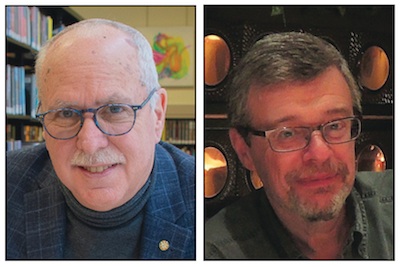
The Canadian Jewish Record’s Bernie Farber, left, and Ron Csillag. (photos from the Record)
Farber and Csillag admit they don’t have a business plan beyond getting writers and editors to work for free – and they see their online venture as a stopgap that would probably cease or merge were CJN to return. The individual rumoured to be considering a rebirth of the paper opted to not comment for this story.
Farber, who was with CJC from 1984 until it was subsumed by the Centre for Israel and Jewish Affairs in 2011 and served as its head from 2006, said they launched CJR on the fly, trying to fill a need in the immediate aftermath of CJN’s demise.
“Our goal is not to become a new Canadian Jewish News,” he said. “When and if they were able to come back up … we would find some way to amalgamate. Nothing is written in stone…. We expect to continue into the fall at this point, hopefully.”
The online news and commentary site operates under the auspices of a nonprofit organization and has no money to speak of, other than enough to cover registration fees and miscellaneous costs, said Farber.
“Everybody who wrote and who is continuing to this day to write for the newspaper is doing it pro bono,” he said. “These are skilled, professional journalists who are, for the most part, people who are used to being paid for their work and have chosen to do this as a donation at this time to the community. It really is a grand mitzvah, Canadian Jewish-style, and it’s working.”
The platform got 22,000 hits in the first week, said Farber, who serves as publisher. “It’s going up from there almost exponentially.”
The model upon which their editorial approach is based is akin to CJN, he said, with a range of opinions represented.
“We’re trying to have a big tent,” he said. “We already got into some hot water because we published a piece by Dr. Mira Sucharov. She’s a wonderful writer, she’s on the edge, people don’t like what she writes, but tough shit. People are allowed to have their opinions.”
JI readers will be familiar with Sucharov’s writing. As for coverage of Israel-related topics, Farber said they will follow a similar open approach.
“It’s not that we don’t support Israel,” he said. “We’re a news source, we’re an information source. We run opinion. We’re not going to [say] you can only write good things about Israel or good things about the Jewish community. We want there to be some spark to it where people can say, no, I disagree with that. We do have an option for feedback and we do get letters to the editor. That’s the Jewish community, right? They are vibrant, they come from all over the place and we want to be able to reflect that.”
Farber and Csillag are well-known figures in the Jewish and larger Canadian scene, which is one of the reasons, they say, that the president of York University reached out to them before releasing a much-awaited report of an investigation around a violent confrontation on campus last November between pro- and anti-Israel groups. The Record got embargoed exclusive access to the report before other media. “It demonstrates how, in a short period of time, we have become a reasonable voice in the community,” Farber said.
Csillag, the editor, said they chose, at the launch on May 21, to “flood” the site with stories to keep readers engaged and coming back. Now, the aim is to post two stories a day plus any breaking news.
“People are talking about it, people are complaining about it,” he said. “I got my first bit of hate mail, which is good. That’s when you know you’re making a difference.”
Finding writers to work for free has not been a challenge. “People have been coming out of the woodwork. I never knew that pretty much everyone on the planet was a writer,” Csillag said, laughing.
Challenges they have not ironed out, they admit, include finding reliable reporters outside Ontario and a steady source of news from Israel, since they don’t have the resources to pay for a news service.
If CJN is not revived, Farber said, “I think we have to get together with serious-minded people within the community and say the CJN is gone and we are here. We don’t have a real business model to be honest. What you see is what you get…. We would have to ramp up to a real business model.”
Farber added that Canada, with the world’s fourth-largest Jewish population at 400,000, should be able to sustain at least two national Jewish media platforms.
That confidence is shared by Gordon, who equates the situation to the old joke about the Jew who, when rescued from a deserted island, was asked why he built two synagogues on the island. One, he told rescuers, was his shul; the other was the one he would never set foot in.
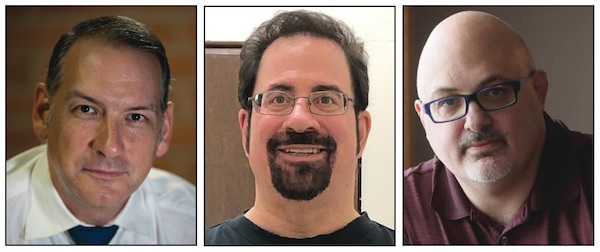
Left to right, TheJ.ca’s Dave Gordon, Marty Gold and Ron East. (photos from TheJ.ca)
TheJ.ca has been in the planning stages for more than a year. Gordon came on a few weeks before launch. Like the Record, TheJ.ca has little overhead, since everyone associated with it works remotely. They have a few investors and some steady advertising agreements. The online nature of the platform also means no printing or distribution expenses.
Gordon touts the diversity of the large stable of writers.
“One of the things that I think is our proudest asset are individuals from the widest array possible, individuals who are liberal to conservative, Jew and Arab, religious to secular,” he said. “We have four gay columnists, we have Jews of colour who are contributing, we have coast-to-coast contributors and, in that respect, I want to say that, not only do we deliver the unexpected, but we represent the previously unrepresented.”
On Israel coverage, though, they aim to determine suitability of opinions based on the “three Ds” formulated by Natan Sharansky to determine if criticism of Israel is antisemitic: delegitimization of Israel, demonization of Israel, and subjecting Israel to double standards.
“In terms of Israel, we’re not going to make it a secret: we’re very pro-Israel, very Zionistic,” said Gordon. “It’s a good read to say that we are centre-right. We will still strive to maintain a kind of balance in terms of Israel reporting … we will tilt from time to time liberal but not left.”
Their aim is to post a batch of new content twice a week.
While Gordon is based in Toronto, TheJ.ca was born in Winnipeg. Marty Gold, a longtime broadcast journalist and publisher, and Ron East, a former pro wrestler and physical education teacher who has also been involved in publishing, are longtime friends who were critical of existing Jewish media.
East is son of the late Israeli military commander, author and counterterrorism expert Yoram Hamizrachi East. When Winnipeg saw an influx of Israeli immigrants a few years ago, the father and son launched a Hebrew-language publication to help the newcomers navigate their city. The 500 copies were routinely snapped up, he said.
The idea for the new media platform came after Gold and East felt that the established Jewish media and communal organizations in the city were not adequately confronting anti-Israel activity.
“There wasn’t really a pro-Israel, Zionistic platform out there,” said East. “We found that our local media here in Winnipeg, as well as when we started looking at Canadian Jewish News and others, were giving more and more room … and more and more credibility to what we would describe as anti-Israel, anti-Zionistic and, in some cases, pro-BDS Jewish movements. Those voices became louder and louder and the Zionistic pro-Israel voices seemed to be drowned out. We felt that it was important to provide a platform that would allow for those voices.”
While TheJ.ca is an online media platform, they are mooting a print digest that might be issued a couple of times a year. They are also working on a way to format content so that it can be easily downloaded and printed for people who prefer to hold their newspaper in their hands. Also in the hopper are plans for region-specific landing pages, so readers in Vancouver or Halifax, say, could access both items of national and international interest, as well as local news relevant to them.
The design of their site, said East, is particularly aimed at reaching younger readers. They credit Gordon’s experience in the field for bringing together a diverse group of writers from across the country.
***
The Jewish media scene has faced unprecedented challenges in recent years. The emergence of the internet more than two decades ago has undermined print media of all types, with publications for small or niche demographics experiencing particular challenges as well as advantages. The pandemic, which led to an unprecedented global economic shutdown in March, had immediate repercussions. Much of the advertising in the Independent, for example, is for upcoming community events, all of which were summarily canceled. Non-essential retailers closed, making advertising extraneous.
The Independent has continued publishing on a reduced schedule.
Winnipeg’s Jewish Post & News announced in April that it was ceasing printing, but started publishing a print edition again at the end of May.
The difficulties nearly led to the dissolution of the world’s oldest English-language Jewish newspaper, Britain’s Jewish Chronicle, which was saved by a conglomerate of philanthropists. The rival Jewish News, which had also announced its liquidation and was set to merge with the Chronicle before the surprise bailout, will, for now, continue publishing independently.
In an article recently about the state of Jewish journalism, the Times of Israel reported that New York’s Jewish Week made a dire plea for support and a leader in the American Jewish Press Association – of which the Independent is a member – acknowledged that COVID has presented a serious challenge to an already struggling sector.
The world’s third-largest Jewish community, in France, is in a different boat. In the 1980s, the French government opened radio airwaves to private groups and Jewish radio stations play a role in that country similar to the role newspapers play in most other Jewish communities.