
Skip to content
  • Home
  • Subscribe / donate
  • Events calendar
  • Business Directory
  • FAQ
  • News
    • Local
    • National
    • Israel
    • World
    • עניין בחדשות
      A roundup of news in Canada and further afield, in Hebrew.
  • Opinion
    • From the JI
    • Op-Ed
  • Arts & Culture
    • Performing Arts
    • Music
    • Books
    • Visual Arts
    • TV & Film
  • Life
    • Celebrating the Holidays
    • Travel
    • The Daily Snooze
      Cartoons by Jacob Samuel
    • Mystery Photo
      Help the JI and JMABC fill in the gaps in our archives.
  • Community Links
    • Organizations, Etc.
    • Other News Sources & Blogs
  • JI Chai Celebration
  • JI@88! video

Recent Posts

  • SFU honours Gloria Gutman
  • Lifting people’s spirits
  • Wedding a ray of light
  • Indigeneity and Zionism
  • Rule of law broken: councilor
  • Football and its roles
  • The burden of defence
  • Fish Café returns after fire
  • All right in what goes wrong
  • Nuns & mermaids at TUTS
  • Camp offers holiday retreat
  • Students and mentors inspire
  • Once-in-a-lifetime trip
  • 100 dancers, one heart
  • Money for the sciences
  • What “Jewish food” means
  • Have a cookie, schnitzel too
  • Federation now across BC
  • Israel fighting for its existence
  • Deal strengthens Iran
  • Patriotic belonging diminishes
  • A campaign to engage
  • Upstanders’ first live event
  • Responding to Carney
  • Having your own home
  • Music a family tradition
  • Musical to warm heart
  • Community milestones … June 2026
  • Sharing her passion for Israel
  • Or Shalom reopens its doors
  • JFS from past to future
  • Need holistic approach
  • Sharing stories, advice
  • Journalist shares fears
  • Skills to live together
  • Road to independence

Archives

Follow @JewishIndie
image - CJN box ad Rockowers 2026

Tag: journalism

Does the truth still matter?

A recently released study from the graduate School of Education at Stanford University engaged 7,800 middle school, high school and college students to evaluate the information they received on the internet. The report said there was a “stunning and dismaying consistency” in the responses from the students, demonstrating an inability to discern information based on whether it originated from activist groups, neutral sources or advertising, and students routinely could not tell the difference between news articles from legitimate sources and unreliable webpages, nor between ostensibly balanced news coverage and opinion pieces.

The aftermath of the recent U.S. presidential election has seen commentators raise alarms over “fake news” – stories planted on social media with the deliberate intent to mislead. Obviously, this is another wrinkle in the whole issue of discerning fact from fiction. Then there is the ability of wholly unchecked assertions to go viral and be taken as fact by hundreds of thousands of people.

The New York Times analyzed one example of how these things can happen. In Austin, Tex., a man with just 40 Twitter followers saw a lineup of buses in downtown Austin on Nov. 9, the day after the election. That evening, crowds gathered in Austin, protesting the election of Donald Trump the night before. The man put two and two together and tweeted that “Anti-Trump protesters in Austin today are not as organic as they seem. Here are the buses they came in. #Fakeprotests #Trump2016 #Austin.”

The due diligence the man performed was a Google search to determine whether there were any major conferences being held in Austin and he found none. It turns out the buses were hired by a software company that was holding a conference for more than 13,000 people. Nevertheless, the tweet, which implies that the anti-Trump protesters were bused into town by some nefarious organizer, was shared 16,000 times on Twitter and 350,000 times on Facebook.

This was an example of a “story” not being adequately researched and proven. It is a slightly different species from the deliberately false “news” stories that popped up during the election with headlines like “Pope Francis shocks world, endorses Donald Trump for president” and “FBI agent suspected in Hillary email leaks found dead in apartment in murder-suicide.” Both of these, and countless more like them, were intentionally false, yet shared by thousands of people who believed – or wished – them to be true.

Comedian Jon Stewart used to refer to his program The Daily Show as “fake news,” but in fact it was parody and satire, taking a grain of truth and riffing humor and social commentary from it. This differs as well from sites like The Onion or Canada’s The Beaverton, which are not intended to be taken seriously, but sometimes are.

Then there is, to bring it full circle, the forms of legitimate journalism – news and analysis – which are generally well-researched, with facts corroborated and sources verified, but are often received by consumers as something else. In other words, people will take falsified news as fact and decry factual reporting as made-up.

On Sunday, Trump himself tweeted, without a shred of evidence, “I won the popular vote if you deduct the millions of people who voted illegally.” With vote counting (inexplicably) still underway, Trump has easily won the electoral college and, therefore, the presidency, but Hillary Clinton is currently 2.2 million votes ahead of Trump in the popular vote.

This sort of assertion from a sore winner is typical of the man, who seems to lie even when there is no advantage, as if to keep in practice. Throughout the campaign,

Trump routinely told untruths, which helps explain why the Oxford dictionary chose “post-truth” as its international word of the year for 2016.

Tens of millions voted for Trump despite, or possibly because of, his awkward relationship with the truth, suggesting that truth doesn’t matter like we once assumed it did. Or that people don’t care what the truth is, so long as what is said, published or posted conforms to or supports their preexisting opinions. People are willing to hear (or read, say or write) falsehoods and accept them as true if they wish them to be, rather than question their own beliefs or situation at all.

The unwillingness or inability to differentiate truth from fiction has long been a concern. Purveyors of lies – in advertising, politics, daily life – have been doing their deeds for centuries. Yet the ability in the internet age for people to select “news” that supports their worldview, or to be duped by people with agendas, has opened whole new universes of falsehood. Scarier, by far, is the apparent insouciance with which many people approach the issue. Some of us are satisfied with fiction if it suits our preferred version of fact. In such a case, we are not facing a problem of media literacy. We are facing a more serious affront to the very idea of reality.
Posted on December 2, 2016December 1, 2016Author The Editorial BoardCategories From the JITags Clinton, fake news, journalism, post-truth, presidential elections, Trump
Making a life in Israel

Making a life in Israel

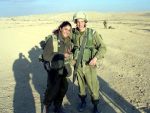
Emily Rose and Aviv Eisenstat in the Israel Defence Forces’ officer’s training school in 2008. (photo from Emily Rose)

When Emily Rose, 28, moved to Israel almost 10 years ago, her plan was to serve in the Israel Defence Forces and then return to Winnipeg. It didn’t happen quite as planned.

Rose was born in Odessa, Tex., and grew up in Winnipeg. Taking a similar road as many Jewish kids in the city, Rose studied at Gray Academy of Jewish Education (GAJE).

“The Winnipeg Jewish community is truly saturated with role models for social justice and it had a major impact on me growing up,” said Rose. “I grew up watching my aunt, Faye Rosenberg, who works for our Jewish community, help bring hundreds of Jews to Winnipeg from Argentina, where they suffered from antisemitism, and watching my best friend’s dad work tirelessly in court to help victims of residential schools receive compensation from the government.

“Winnipeg is an incredibly Zionist and supportive community,” she added. “The longer I am away, the more I appreciate what a wonderful community it really is.”

When Rose was 14, she went to Israel on a Jewish Federation of Winnipeg Partnership 2000 (or Gesher Chai) trip, which sent 10 high school students from GAJE to their sister school, Danziger, in Kiryat Shmona.

She fell in love with the city and the people. “My host family had three sisters and I was thrilled because, up until then, I only had big brothers. And, I remember writing to my mom, ‘Now I have three sisters!’ on the first night. I realized at that point that all my new friends in Israel would be going to the army soon and I remember thinking I had the responsibility to do that as well.”

This is what led Rose to move to Israel at the age of 18, starting with a mechina (a pre-military program) in her first year there.

She lived in Sde Boker in southern Israel and volunteered as an English teacher’s aide in an unrecognized Bedouin village. “Can you think of anything more polar opposite to a very cold Winnipeg, Man., than the middle of the Negev Desert?” she quipped.

“Your first year in Israel is always the most challenging, I think. There were a lot of tears. I was the only foreigner in the program, so I had to learn Hebrew very quickly. But, the program itself was also very intense, because we had classes every day and political tours and hikes every month.”

Something Rose was especially thrilled about in Israel was getting to sleep outside. As a child, she eagerly anticipated going to summer camp for canoe trips and sleeping under the stars.

“When you see the stars in the Negev, you really think it’s got to be the best seat in the house,” said Rose. “And, that first year, my roommate used to wonder why I’d always drag my sleeping bag out of our room to sleep outside.”

The next year, Rose joined the IDF as a lone soldier and served as a combat fitness officer. She recalled that some of her trainees used to call her “M&M,” as she was “hard on the outside, but sweet on the inside (and very small).”

She added, “My first job was training infantry soldiers on a combat training base where I worked with a unique battalion of Druze soldiers. The soldiers I worked with spoke Arabic. This really sparked my interest in the language, which is why I studied Modern Standard Arabic (MSA) in school.”

Today, Rose serves in reserve duty in Jerusalem’s Homefront Command. Her job is to communicate with the civilian population in Jerusalem during times of emergency.

A few years after her IDF service, Rose volunteered at the Michael Levin Centre for Lone Soldiers, which helps soldiers before, during and after their service. At the centre, the first thing she was asked to do was to tell those thinking about joining the IDF “don’t.”

Rose explained, “If we couldn’t convince them not to, then we’d help them as much as we possibly could. Nobody told me not to join the IDF, but also no one would have been able to convince me not to. And, the day I joined, I remember I wasn’t nervous – I just knew it was the right decision.

“I also didn’t plan on staying. I thought I’d serve for two years and then return to Canada. Here I am, almost 10 years later.”

After the army, Rose took Middle Eastern studies (along with MSA) at Hebrew University of Jerusalem. She still lives in Jerusalem, where she recently started writing for the Times of Israel.

Just prior to that, she was an editor at Israel National News, where, she said, she mostly wrote the breaking news but also covered longer form stories. “A few weeks ago,” she said, “I broke a story with exclusive footage of a former Australian minister who got caught in a firefight clash between Kurdish forces and ISIS in Iraq.

“The plight of the Kurdish people is an issue that is very close to my heart. I jumped at the chance to write about it. I’m also so proud to say I come from Winnipeg, [as] our Jewish community sponsors Operation Ezra, bringing Yazidi refugees safely to Canada.”

When on leave from the army a few years back, Rose returned to GAJE to speak to the students. When she visited Winnipeg this past summer, some community women stopped to say hello to her and her mom. “One of them told me that her grandson was going to be a lone solider, an IDF paratrooper, this fall … and she said that I’d spoken to him when he was in high school,” said Rose. “That was very nice, like coming full circle.”

Currently, Rose is working on a short story collection, a novel and three plays.

Her first play was presented at the JCC Berney Theatre in Winnipeg in 2006, the year she graduated high school. Called Radyo, it is about a group of high school kids in Kiryat Shmona who run their local high school radio station during the Second Intifada.

“The second play is a children’s musical I wrote called Don’t Touch the Glutch, which was performed as a part of the Next Wave of Musicals Festival in Montreal and then at the Centaur Theatre children’s series in 2013. It’s about a boy who gets lost in the zoo on a school field trip and discovers that the zoo has a whole host of strange creatures that only come out at night. My brother wrote the music and lyrics and I wrote the book. The show has an anti-bullying theme, because it’s a topic we both feel very strongly about.”

When asked about her feelings about Israel, Rose quoted Rabbi Abraham Isaac Kook: “The truly righteous do not complain about evil, but rather add justice; they do not complain about heresy, but rather add faith; they do not complain about ignorance, but rather add wisdom.”

She added, “Israel is in everything I write, in some form or another, and, though I may not always succeed, I try my best to contribute justice, faith and wisdom with my words.

“For now, I love reporting the news as it happens. Israelis, and those who care about Israel, want to stay informed and I feel privileged to be working with a team that is very committed to keeping our readers updated at all times.”

Rebeca Kuropatwa is a Winnipeg freelance writer.

Format ImagePosted on November 11, 2016November 11, 2016Author Rebeca KuropatwaCategories IsraelTags aliyah, IDF, Israel, journalism, Winnipeg

Posts pagination

Previous page Page 1 … Page 5 Page 6
Proudly powered by WordPress