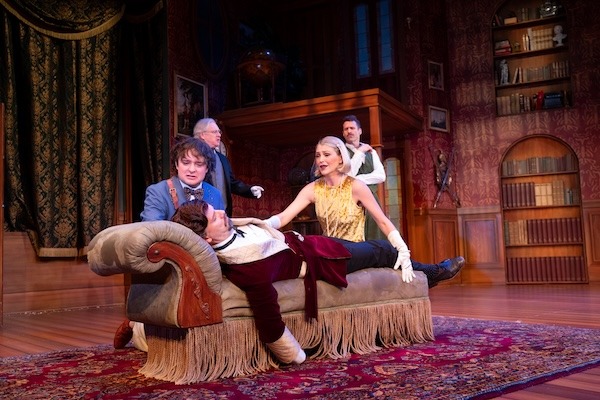
Zander Eke, Ben Elliott, Scott Bellis, Genevieve Fleming and Andrew McNee in The Play That Goes Wrong, playing at Arts Club’s Granville Island Stage until Aug. 16. (photo from Moonrider Productions)
Collapsing sets, misplaced props, missed cues, forgotten lines, unconscious actors, on-stage pyrotechnics, botched entrances and exits, and crew members popping in and out of the wings to deal with technical issues – what else could possibly go wrong? Apparently quite a lot in the British farce The Play That Goes Wrong, now at the Arts Club Granville Island Stage until Aug. 16. This is the Three Stooges meets Monty Python, on steroids. Nonstop laughter is what audiences will receive for the price of their tickets.
Written by Henry Lewis, Henry Shields and Jonathan Sayer, the play had its debut in a London pub in 2012 and quickly moved to the West End, then on to Broadway and elsewhere, winning awards and megafans along the way.
In a nutshell, in this play within a play, an amateur drama group, the Cornley Polytechnic Drama Society, is presenting a production of The Murder at Haversham Manor, a 1920s mystery set in a manor house. In a clichéd opening, as the curtain rises, a body is found in the study lying on the chaise lounge, and Inspector Carter arrives to investigate. The usual suspects are rounded up (the butler, family members, lovers) and, eventually, after two hours of slapstick physical comedy, with everything breaking and/or falling down, the perpetrator is unmasked.
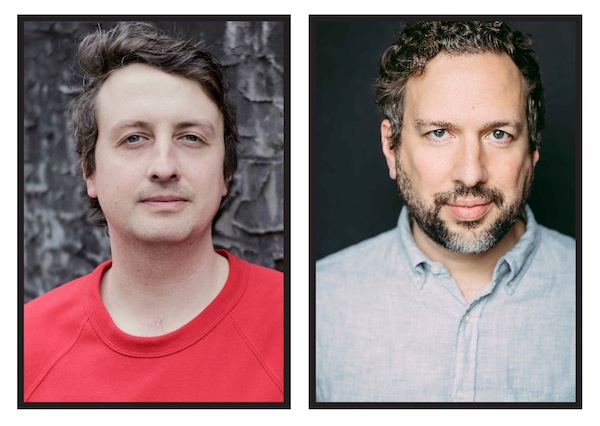
Community member Josh Epstein helms this rollercoaster of a comedy with a wealth of veteran actors in the cast, including Scott Bellis (Perkins, the Butler), Andrew McNee (Thomas) and Ben Elliott (Charles, the corpse). This is a technically demanding production requiring tight timing and choreography in the chaos of the disintegrating set, and kudos must be given to the entire team, both on and behind the stage.
The JI interviewed Epstein after opening night.
JI: How did it come about that you were selected to direct the show?
JE: I think my background across a few different worlds landed me here. Producing for independent film requires a specific kind of precision and technical focus, and mixing that with my experience in big technical theatre and high-speed comedies seemed to be the right recipe. This show is a massive, multi-layered machine, and you need to understand how all those moving parts, the mechanics, the timing and the heart, work together.
JI: What is it like to direct such a physical production?
JE: Directing this much physicality is like choreographing a high-stakes dance where the floor might actually fall out from under you. We protect the actors through “stunt-grade” preparation, everything from secret padding in the costumes to reinforced gussets and custom-built furniture that takes the hit so the actor doesn’t have to. As for the energy, we keep it fresh by reminding ourselves that we aren’t playing a comedy; we are playing a high-stakes murder mystery. The exhaustion is real, but the medicine is the audience. When you hear that level of laughter, it fuels the engine for the next round.
JI: What are the technical requirements needed to ensure safety on the set?
JE: The safety requirements are immense because the set is effectively the antagonist of the play. It has to look like it’s failing dangerously while being under complete, rigorous control behind the scenes. We have built-in redundancies for every major collapse, fail-safes on every moving part, and a crew that is as finely tuned as the cast. It’s all about creating the illusion of a misstep while being mathematically certain of where every foot and hand is going to land.
JI: You are working with some seasoned veterans, all of whom have themselves directed. What is it like to direct directors?
JE: Honestly, it’s a gift. Directing directors means you’re working with people who understand the big picture and the architecture of a scene. They aren’t just thinking about their own lines; they’re thinking about the rhythm of the entire stage. There is a shorthand and a level of trust that allows us to skip the basics and get straight to the nuanced, complicated work. They know exactly how to hold the tension that making this show work requires.
JI: What was your vision for the show?
JE: My vision was to lean into the earnestness of the Cornley drama society. I didn’t want a parody of a bad play; I wanted a production of a high-budget, ambitious, amateur company that has done everything in its power to be professional, only to have the world conspire against them. The set is beautiful, the costumes are classy and the intentions are pure. The comedy isn’t that they are incompetent – it’s that they are desperate to succeed in the face of total disaster.
JI: Some critics think the show is too over the top. Your thoughts on that?
JE: I think over the top is exactly where the joy lives in a piece like this. It is a celebration of the resilience of theatre. There is something deeply human and universal about watching people refuse to give up when everything is going wrong. It’s supposed to be an assault on the senses. If we aren’t pushing the boundaries of the ridiculous, we aren’t doing justice to the spirit of the show.
JI: Why should people come and see the play?
JE: Because it is pure, unadulterated joy. In a world that often feels quite heavy, there is something incredibly healing about sitting in a room with hundreds of strangers and laughing until your ribs ache. You’re seeing world-class performers do something incredibly difficult to make it look effortless and disastrous at the same time. It’s a night where you can just leave it all at the door and watch a group of people try, and hilariously fail, to solve a murder.
For tickets, go to artsclub.com or call the box office at 604-687-1644.
Tova Kornfeld is a Vancouver freelance writer and lawyer.