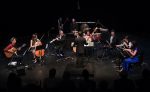
Sound of Dragon Ensemble plays at Orpheum Annex on March 9. (photo from Sound of Dragon Ensemble)
Sound of Dragon Ensemble takes the name of its upcoming concert, Consensus, from a work of the same name by Vancouver composer John Oliver. Oliver’s “Consensus” will be featured in the ensemble’s March 9 performance at Orpheum Annex, along with a number of other works, including one by Israel-born, Vancouver-based Itamar Erez.
In its mission to preserve the traditions of Chinese music, the Sound of Dragon Society “celebrates diversity and creativity in the contemporary applications of this music…. By presenting musicians and ensembles from different ethnicities, nationalities and musical trainings/genres, Sound of Dragon Society redefines Chinese music and reflects Vancouver’s multicultural environment and a highly creative music scene.”
According to the concert’s promotional material, Oliver’s “Consensus” “is a metaphor for inter-cultural music making…. Regardless of where [musicians are] from, there is one thing most can agree on: music was born of about four or five notes in all cultures. This idea inspired Oliver to build his piece on four notes with ever-changing rhythms between different instruments to create great complexity.”
On March 9, the ensemble will also perform pieces by local composers Mark Armanini, Farshid Samandari, Bruce Bai and Lan Tung; Toronto composer Tony Leung; and Italian composer Marco Bindi. The concert includes Vancouver conductor Jin Zhang and dancer/ choreographer Dong Mei.
Erez’s “Rikkud” is described as “a kind of a chaotic, ecstatic dance, with some moments of relief until the very exhausting end.”
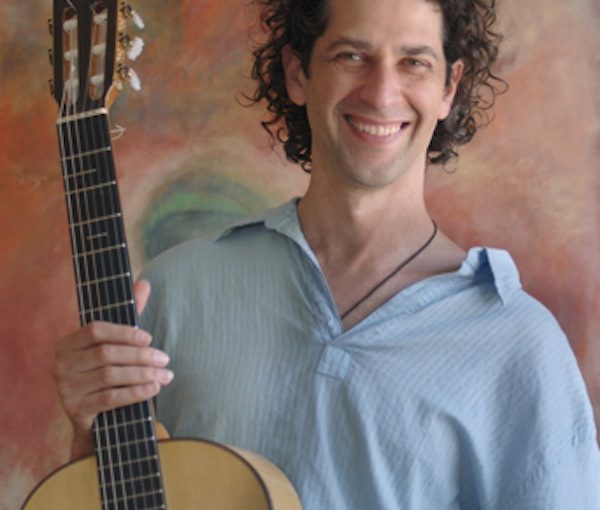
“This piece is based on the last movement of my ‘Piano Trio,’ which was premièred by members of the Standing Wave ensemble back in ’99,” Erez told the Independent. “It is a very rhythmic and playful piece, influenced a lot by East Indian rhythms, and based on a simple pentatonic motive, which is a scale used often in Chinese music. Rikkud simply means dance in Hebrew. I had to rewrite the composition in order for it to work for the unique instrumentation of Sound of Dragon Ensemble.”
Erez, on guitar, is also part of the ensemble’s “plucked strings” section, with Zhimin Yu on the ruan (Chinese lute). The ensemble’s bowed strings are played by Tung and Nicole Li on erhu (Chinese violin) and Marina Hasselberg on cello; winds, by Charlie Lui on the dizi (Chinese flute) and Mark McGregor on the flute; and Jonathan Bernard plays percussion instruments from around the world.
“I played with the ensemble in last year’s festival,” said Erez. “Lan got in touch with me few months before, asking if I would be interested in taking part in this – of course, I was delighted.”
This year’s concert program features two poetry-inspired works: Armanini’s music is set to two poems by China’s Wong Wei (circa 692-761 AD) and Bindi’s “Hymn to Aphrodite” gets its inspiration from Greek poet Sappho (circa 630–570 BCE).
Bai’s “Fall” is locally inspired, by a Vancouver autumn, and Tung’s “Oriole” takes “a 1940s Chinese pop song and pays tribute to Shakti, the highly influential 1970s
Indian fusion band led by John McLaughlin and Zakir Hussain.” The choreography of Mei, one of whose specialties is the Uyghur style, “developed at the crossroad of the ancient Silk Road in northwestern China,” adds her touch, both traditional and modern, to Leung’s “Desert Dew” and Samandari’s “Breath of Life” (which is described as “a metaphor for how Persian and Western music have influenced each other”).
Tickets for Consensus are $15 ($10 for students, seniors and children) and can be purchased at brownpapertickets.com or soundofdragon.com.