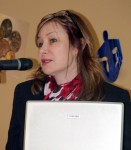
Dr. Victoria Taraska (photo by Rebeca Kuropatwa)
On Dec. 11, the National Council of Jewish Women of Canada, Winnipeg section, held an information session at the Rady Jewish Community Centre about recognizing skin cancer. The talk, part of the section’s Women’s Health Series, was given by Dr. Victoria Taraska, a dermatologist at the Derm Centre.
Taraska received her doctorate in medicine at the University of Manitoba before doing a fellowship in dermatology at the University of Ottawa. She has been practising in Winnipeg since 1998.
In her presentation, Taraska gave many examples, including an array of images, to give the approximately 60 lecture-goers a better idea of how to recognize the three main forms of skin cancer.
“Luckily, women do find most cancers for themselves or someone in their family, because they listen to what we tell them, are concerned about their health, and do get checked,” said the doctor. “Men don’t fare that well. They don’t do as well. We [women] are the nags in the family, right? We definitely save their lives and our lives, too.”
The three main forms of skin cancer Taraska discussed were basal cell carcinoma, squamous cell cancer and melanoma. Although other skin cancers exist, they are rare, she said.
Every year in Canada, 80,000 skin cancers cases are diagnosed. In the United States each year, there are two to three million. “It’s a big burden and a lot of health-care dollars, as well,” said Taraska. “A lot of it could be prevented early by screenings and watching your skin.”
Taraska went on to say that there are about 6,500 cases of reported melanoma a year, which is a cancerous form doctors “most like to avoid,” she said. “Basal cell carcinoma isn’t that aggressive and it’s highly curable if diagnosed early.”
Sun protection is critical in preventing skin cancer, with ultraviolet rays being the most important element to block.
“Even though there are people who are more at risk, anyone can get it,” said Taraska. “Black people can get it, white people who are fair, blond, blue eyed … anyone can get skin cancer. Everyone needs to protect themselves from the sun, or even from tanning beds…. If you have a lot of moles, you might be at higher risk. Anyone who’s on immune suppressant medication has a higher risk for skin cancer. Squamous cell cancer is actually the second highest cause of death in transplant patients, with infection being number one.”
UVA vs. UVB protection
A UVA warning relates to aging, while a UVB warning relates to burning, explained Taraska. “While both are bad and are related to skin cancer, most sun protection products focus on blocking UVB,” she said. “When you’re in your car and you think you’re safe, you’re not. UVA can go through the windows, though the physicality of the window blocks UVB.”
Even when using sunscreen, we are not always protected, as the level of protection noted on sunscreen products refers to UVB. “There’s no number for UVA,” she noted.
Regardless, Taraska is an avid proponent of sunscreen use, applying more of it and more often then you might think is needed. “The way we apply a SPF 15 probably ends up being only an eight or a four, because it’s only a 15 if you can see the sunscreen on your body. But, if you’re putting it on properly, a 15 does block 94-96 percent. We never get up to 100 percent.
“With a 30 or a 50, you have a little play, but if you only buy a 15, you don’t have that. For people who break out from sunscreen, there are sunscreen powders. For those not wanting to use chemical-based sunscreen, they need to understand that the chemical-free products use physical sun blockers – like zinc and titanium – and, as such, these creams are meant to stay on the surface of the skin and will be more visible when applied properly (stay white).
“Regardless, applications need to happen every couple of hours when in the sun for an extended period of time. A bottle of sunscreen shouldn’t last more than a week if you’re on a beach.”
About UV
UV changes some of the nucleic acids in the cell’s DNA. It can change the nucleic acids of tumor suppressors or tumor stimulators.
“If your tumor suppressors are insufficient, you’re not going to be able to clean up the damage,” said Taraska. “If you knock out a couple of the workers, you’ll have a problem healing the skin cancer. We’re always producing skin cancer cells – actually daily – but our body usually has checks and balances to get rid of the cancers, to get rid of the duds.”
There should always be a balance. Some people genetically have deficiency in their suppressors. “When you see families that have many cases of skin cancer, they likely have a deficiency of the P53 enzyme,” said Taraska.
While we can now test for the P53 enzyme, it would be too costly to test everyone. “We should all be checking ourselves regularly, whether we have the family history or not,” she said.
While the UV index is a lot lower in the winter, if you’re a dog walker, skier or jogger, you can still get sunburned, so sunscreen is still important. As for getting your fill of Vitamin D during the winter, Taraska believes that it should be taken in via a supplement, noting, “It’s easy to take 1,000 units of Vitamin D.”
Detection and treatment
While basal cell carcinoma is the most common form of cancer, it is also often easily curable. “It shouldn’t really kill or harm anyone who is reasonable,” said Taraska. “They are slow growing. No one … should die from it.”
Signs to watch for include a pink scaly patch, an open sore that will not heal, or a shiny lump or a scar that is new or changing. Although the nose, for example, is a common place to see such signs, they can appear anywhere.
“For those that have gone aggressive or deeper, there is an oral medication that we can use that does very well for patients with more aggressive basal cell carcinoma,” said Taraska.
Squamous is more common in connection to being sun exposed, but again, it can happen anywhere. “Transplant patients are the highest risk,” noted Taraska, “but, if it’s caught early, it can be treated with cream, scraped off by a doctor or cut out in surgery.”
Melanoma is more serious. “We’re not cavalier with these melanomas,” said Taraska. “We like things to be done quickly. A normal mole is nice, round and even. If you divide a mole into quarters, each quarter should look roughly the same. If it doesn’t, then we worry.
“If it’s shaped like a country with irregular borders, that’s when you want to see a doctor, or if the mole has more than one color…. They are usually really flat. They will grow within the skin first, spread along the surface first. Bigger than the head of a pencil eraser is a sign.
“The risk of getting melanoma is about 0.08 percent, so it’s fairly low in the population and 90 percent are curable (mostly from early detection).”
Rebeca Kuropatwa is a Winnipeg freelance writer.


 Ninety percent of participants reported experiencing a sunburn at some point in their lives, and nearly half have had a sunburn that blistered. Seventy percent of respondents travel to sunnier climates for more than one week each year, primarily to the United States (65%).